
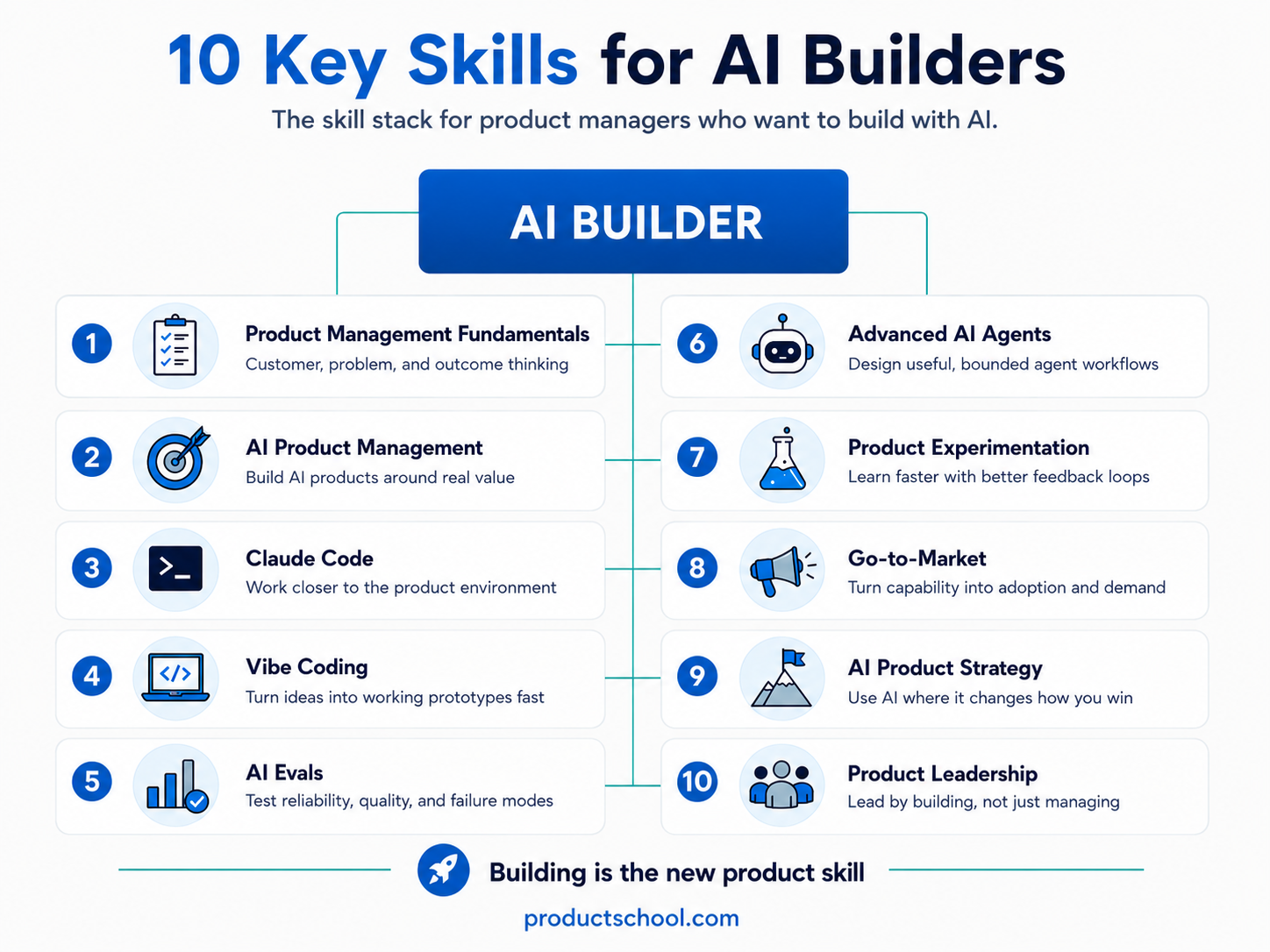
Across my product teams, a new role has emerged that consistently turns fuzzy ideas into validated product artifacts at an unprecedented pace: the AI Builder. This isn’t a rebranded PM or a solo prototyper—it’s a hybrid product professional who treats AI as a core capability for discovery, design, and delivery.
An AI Builder is a product professional who uses AI to prototype, analyze, evaluate, and ship — turning product thinking into artifacts faster than the traditional build cycle allows.
In practice, I rely on AI Builders to collapse the time between a customer insight and a working experience. They transform user problems into testable prototypes, wire up eval-driven development to measure quality, and integrate those learnings back into our product strategy. The result is a tighter discovery-to-delivery loop that complements CI/CD and boosts deployment frequency without sacrificing rigor.
What makes this role so powerful is its full-stack approach to product learning. An effective AI Builder can: rapidly prototype with gen ai, orchestrate AI workflows end-to-end, design retrieval-first pipelines, and set up guardrails for privacy-by-design and AI risk management. They treat prompts, context windows, and data contracts as first-class product surfaces—applying prompt engineering and agentic AI patterns where they add measurable value.
On my teams, AI Builders sit inside the product trio and partner with design and engineering from day one. They turn customer interviews and behavioral analytics into runnable experiments, instrument those experiences for A/B testing, and use evaluation harnesses to benchmark quality before code ever hits production. This approach accelerates continuous discovery while keeping outcomes—not outputs—at the center.
The impact shows up in the metrics that matter. We see faster time-to-insight during product discovery, higher confidence at sprint kickoff, and clearer trade-offs in build vs buy decisions. Because prototypes are evaluated early with real data, we reduce rework, de-risk go-to-market, and preserve optionality in our product roadmapping and sprint planning. It’s execution readiness grounded in evidence.
Tooling-wise, I encourage AI Builders to assemble an AI product toolbox that includes LLMs for product managers, lightweight observability, and feature flags to ship safely behind guardrails. When appropriate, we introduce Model Context Protocol (MCP) integrations to unify data access, and we instrument anomaly detection to catch failure modes quickly. The throughline is the same: move fast, learn faster, and manage risk as a product capability.
If you’re scaling an empowered product team, embedding AI Builders can elevate both velocity and quality. Start with a high-signal use case—like gen ai for product prototyping or in-app guides—establish clear evaluation criteria, and wire your experiments into analytics from day one. With a strong AI Strategy and the right rituals, this role becomes a force multiplier for product-market fit.
The future of product management won’t be defined by how much we ship, but by how precisely we learn. AI Builders make that future practical today—turning product thinking into tangible outcomes with speed, discipline, and empathy for the customer problems that matter most.
Inspired by this post on Product School.




Leave a Reply