Tag: gen ai

  • The Ultimate Knowledge Management Playbook to Supercharge Your AI Service Agent and Scale Support

    The Ultimate Knowledge Management Playbook to Supercharge Your AI Service Agent and Scale Support

    AI in customer service is no longer experimental—it’s the standard. In my work leading product and customer experience teams, I’ve seen the shift firsthand, and the stakes have never been higher for getting the foundations right.

    Fin’s 2026 Customer Service Transformation Report found that 82% of senior leaders say their teams invested in AI for customer service over the last 12 months, with 87% planning to invest in 2026. Those investments pay off with 24/7 availability, multilingual support, major time savings, and faster resolutions. But there’s an unsung hero behind every AI-first support experience: knowledge management.

    A Service Agent is only as good as what we give it to work with. If we’re using an Agent, like Fin, to resolve customer queries end to end, it needs an extensive pool of knowledge to draw from. We have to feed it accurate answers on our product, features, policies, and troubleshooting. Without these, the Agent can’t do its job—and our team ends up handling repetitive queries that should be automated.

    Monochrome headshot beside a prominent Fin quote about customer support, urging time investment in knowledge and processes to create compounding impact and fewer future cases for service teams.
    A Fin-branded quote pairs with a friendly black-and-white portrait to champion smarter support. It reminds readers that time spent building knowledge and processes today compounds into fewer tickets and smoother operations.

    In this guide, I’ll walk you through two phases of the journey. Phase 1 is about building a high-quality knowledge base from scratch or overhauling what you have. Phase 2 is about maintaining, optimizing, and scaling that knowledge so your AI performance keeps compounding over time.

    Definition: Knowledge management is the process of creating, organizing, sharing, and maintaining knowledge in your business.

    Fin-branded quote graphic showing a smiling person in a collared shirt beside large text about feeding an AI knowledge base, supporting a guide on knowledge management for service agents.
    Fin’s quote card blends a friendly headshot with a message to think outside the box and tap new information sources to power an AI knowledge base—ideal inspiration for service teams leveling up knowledge management.

    Your help center is the obvious example, but it’s only the tip of the iceberg. Effective knowledge management also means creating resources like FAQs, troubleshooting guides, onboarding and best-practice docs, internal support guidance, and learning materials that cover everything from everyday how‑tos to complex billing and account questions.

    It means identifying content gaps—missing troubleshooting steps, unclear policy explanations, outdated feature details, or unanswered edge cases—before your customers find them. It means implementing systems so both your Agent and your support reps can access the right information at the right time. And it means developing processes so your content stays in lockstep with product updates, policy changes, and bug fixes.

    Monochrome quote graphic for Fin with a professional headshot on the left and guidance on testing first deployments to mirror the customer experience; for knowledge management and service agents.
    From Fin's guide to knowledge management, this monochrome quote card urges teams to test their first deployment themselves so agents feel the same journey customers do, turning insights into faster, higher-quality support.

    Your knowledge base now fuels your entire support experience, not just self-serve. It’s the key to accurately answering complex questions, reducing handle time, and delighting customers across channels.

    Here’s the blunt truth I share with every team: your Agent is only as strong as what you feed it. A lack of information, messy structure, or stale documentation will tank accuracy and trust. No large language model (LLM) knows your business like you do. It doesn’t understand your customers’ needs, pain points, and use cases. That knowledge is unique to you and your organization, meaning you need to be the one to map it all out and make it available to your Agent.

    Screenshot of a customer service knowledge base page titled 'Procedure: Damaged food order', showing step-by-step guidance with verification steps, an IF rule block, tags, and Test, Save, and Set live controls in a minimalist desktop UI.
    Equip service agents with a clear playbook for damaged delivery reports. This procedure page outlines when to use the guide, how to verify evidence, and the next action to reorder—ready to test, save, and set live.

    Every investment in knowledge also has compounding results. Think of it as a flywheel: when you improve your knowledge base, your Agent solves more cases and generates better data. That data shows you what to add, update, or refine next. The sooner you plant the seeds, the sooner you’ll harvest the returns.

    Consider a simple calculation. If it takes 30 minutes to write a troubleshooting article for a common issue, that half hour often saves hours for your support reps, who no longer need to handle that query. You can estimate impact by multiplying the average time to compose a response by the frequency of the query. For customers, multiply the number of customers who ask this question by their average time to resolution to quantify time saved. Then monitor Agent involvement rate, resolution rate, and automation rate to see the compounding effect.

    Illustration of a sales agent using an AI-powered knowledge management dashboard on a laptop, with chat bubbles, documents, and analytics icons for faster answers and improved customer messaging.
    Give every seller instant, trusted answers with an AI-powered knowledge base that unifies docs, FAQs, and playbooks into a single source of truth—accelerating ramp, boosting call confidence, and improving every customer conversation.

    Phase 1: Building your knowledge base is about getting your content durable and AI-ready. I start by prioritizing what to include, where to source it, and how to audit and triage before go‑live.

    Data-driven tools can surface the right starting points. For example, platforms like Fin can surface knowledge gaps from real customer conversations where help content is missing, unclear, duplicated, or contradictory. A centralized knowledge hub then becomes your single source of truth for both customer-facing and internal content, with audience controls to ensure your Agent only uses the right materials for the right users.

    Black-and-white headshot on the left with a Fin-branded quote on the right about AI learning and improving customer support; clean, minimal graphic for knowledge management content.
    AI elevates service when teams treat deployment as a learning loop. This Fin-branded quote visual introduces our ultimate guide to knowledge management for service agents—iterate from day one to improve customer outcomes and teammate efficiency.

    Here’s how I prioritize content for the first wave. Support FAQs come first—billing changes, account updates, feature usage, troubleshooting, and policy questions. I mine the inbox and historical conversations to find the highest-frequency issues and turn them into crisp help articles the Agent can quote.

    Next, I build onboarding and setup guides so new customers reach value fast. I collaborate with customer success and product to document the fastest path to “first win,” and I ensure the Agent can reference those steps in chat and in‑product guidance.

    Black-and-white portrait of a business professional next to a Fin-branded quote urging regular audits and updates to knowledge so AI and service agents provide accurate, valuable support.
    Keep your help content fresh. A Fin quote urges support leaders to audit and update their knowledge base so AI assistants and service agents surface accurate answers that genuinely add value.

    Then I add troubleshooting and advanced guides for deeper issues and power-user workflows. I pull in product managers, engineering, and success managers to capture deeper diagnostics, known limitations, and recommended workarounds—exactly the details that prevent escalations.

    Finally, I create content for specific use cases and customer segments. Different goals and configurations require contextual guidance, so I reflect language customers actually use and tailor examples to their jobs-to-be-done.

    Monochrome headshot of a person on the left with a bold text panel titled Fin on the right, describing how training AI agents and strong knowledge bases improve customer service performance.
    Smarter support starts with better knowledge. A testimonial highlights how Fin learns from website and help center content, showing that robust knowledge bases train AI agents, raise accuracy, and yield compounding gains.

    When sourcing knowledge, I cast a wide net and consolidate it so the Agent and my team can use it reliably. That includes public help articles and troubleshooting guides; internal runbooks, escalation steps, and policy clarifications; curated snippets for short replies and exceptions; past conversations that expose gaps; relevant website pages; and documents like PDFs and DOCX with selectable text.

    Before anything goes live, I run a structured content audit. The goal is twofold: prevent the Agent from learning from outdated information, and expose gaps that will cause escalations. I divide content by product area, assign clear ownership, and set a time‑boxed review window to update, consolidate, or retire content. Shared ownership turns a daunting clean‑up into a manageable sprint.

    Monochrome headshot on the left with Fin branding and a large quote on the right stressing that strong content underpins accurate Service Agent answers and up-to-date support in knowledge management.
    Why can’t knowledge content be an afterthought? This Fin visual pairs a grayscale portrait with a bold message: great Service Agents rely on a strong, current knowledge base to deliver accurate, evolving support. Explore the guide.

    I also walk the customer journey myself—exactly as a new user would—so I can experience the Agent’s responses firsthand and spot missing topics or keywords. Where my platform supports it, I use preview and batch testing to validate coverage across common questions, then simulate more complex workflows to ensure handoffs and steps are properly defined before launch.

    After 30 days of Agent activity, I dive into the data. I look for topics driving handoffs to humans, articles correlated with low resolution rates or CSAT, and content that customers view but still escalate. Those signals tell me exactly what to write or refine next—and where to tighten conversation design or retrieval.

    Black-and-white headshot of a professional beside a large pull-quote about centralizing conversations, customer data, and knowledge on one platform to improve support, presented with Fin branding.
    Centralize your conversations, customer data, and knowledge in one place to sharpen context and speed resolutions. This Fin graphic pairs a monochrome portrait with a bold pull-quote highlighting unified platforms for better support.

    Prioritization is where impact accelerates. I focus first on the content my team shares most: top help articles, troubleshooting steps, onboarding flows, and policies. I study conversation analytics to identify the most common questions, the longest handle times, and the lowest CX scores, then close those gaps with targeted content. I also review high‑view articles that haven’t been updated recently and refresh anything affected by changes to product, policies, or plans.

    Resourcing matters. Building a high-performing Service Agent shouldn’t be a side gig. I explicitly allocate weekly time for frontline reps, support specialists, and product partners to work on content requests and knowledge improvements. A 5–10 hour per‑person cadence is a practical baseline, and it doubles as a powerful way to upskill the team for emerging AI roles.

    Hero banner with the headline 'Get started with the #1 Agent today' over a dark, colorful gradient with soft light flares, plus a centered button labeled 'Start a free trial' for a service agent platform.
    Jumpstart smarter support with the #1 Agent—organize knowledge, speed answers, and automate routine work. Click Start a free trial to see how AI elevates your service team and delivers faster resolutions.

    Writing for AI is writing for customers. I train the Agent to mirror the terms our customers use by analyzing search queries and real conversation language. I avoid internal jargon, expand acronyms, and clarify key concepts to eliminate ambiguity. When a topic invites yes/no answers, I restate the question and add the necessary context so the Agent doesn’t misinterpret shorthand. I always pair images or videos with clear explanatory text so the guidance is accessible and machine‑readable. And I structure content for scanning with crisp headings and short sections, avoiding hidden information that requires clicks to reveal.

    When I have bite‑size answers—common edge cases, policy clarifications, repetitive high‑volume queries—I collect them into focused internal snippets or compact FAQs so the Agent can retrieve and deliver precise answers quickly.

    Phase 2: Knowledge management is where the compounding value kicks in. Once live, I track the metrics that matter: resolution rate (conversations fully resolved by the Agent when it was involved), automation rate (total conversations handled by the Agent across overall volume), time saved (hours of manual work offloaded), Customer Experience (CX) Score comparisons across AI and human conversations, and CSAT parity.

    Then I put those learnings to work. Inevitably, some problems won’t be solvable on day one. That’s a gift—it shows me where to refine workflows, add clarifying steps, and strengthen knowledge depth. The richest insights often come from where the Agent struggles or escalates; those friction points become my highest‑ROI content tickets.

    Knowledge management is never one‑and‑done. As products, customers, and business goals evolve, so must the knowledge. I formalize an ongoing maintenance cadence with clear ownership, review intervals, and time blocks on the calendar. Wherever possible, I use AI‑assisted drafting to propose updates, summarize gaps, and accelerate review without sacrificing quality.

    To sustain momentum, I create a simple intake for content requests—often a lightweight ticket workflow inside our support tools—so anyone in support, success, sales, marketing, engineering, or product can flag gaps and propose improvements. The teams closest to customers usually spot the patterns first; a good intake system ensures we don’t lose those insights.

    I also bake knowledge work into every launch plan. New features, product updates, plans, and policies require Agent‑ready content at launch, not after. I partner with product, support, and product marketing to produce best practices and anticipated FAQs in advance, then I review early conversations post‑launch to spot recurring confusion and fast‑follow content needs.

    Brand consistency builds trust across every touchpoint. I standardize terminology for products, features, plans, and policies so the Agent, the help center, and human reps all speak the same language. I proof for tone, spelling, and grammar, and I use templates so content feels cohesive. I also include clear contact options for customers who need them—what channel to use, when to use it, and what to expect—so we maintain confidence even when escalation is required.

    Clarity about audience matters, too. If certain content applies only to specific roles, plans, or regions, I label it explicitly and, where my platform supports it, target content so the Agent uses the right guidance for the right segment.

    Finally, I connect the dots. When conversations, customer data, and knowledge live in one place, every interaction becomes an insight loop. A connected Agent turns support into a retrieval-first pipeline, making it far easier to diagnose issues, improve accuracy, and continuously raise the bar on customer experience.

    Behind every high-performing Agent is a rigorous, AI-friendly knowledge management practice. Treating knowledge as a core service function—not a project—creates systems that improve with every conversation. That’s how we transform support from a cost center into a compounding engine for customer satisfaction, operational efficiency, and growth.


    Inspired by this post on The Intercom Blog.


    Book a consult png image
  • Prompt Like a Pro: Three Battle-Tested Tips for Amplitude Global Agent Success

    Prompt Like a Pro: Three Battle-Tested Tips for Amplitude Global Agent Success

    When I guide teams building agentic AI features, I’ve seen a single prompt turn Amplitude Global Agent into either a world-class analyst or a well-meaning rambler. The difference isn’t magic—it’s method. With the right structure and iteration, we consistently get faster, clearer insights that stand up to product and analytics scrutiny.

    AI has gotten really good, but success still depends on the quality of your prompts. Explore three best practices for prompting in Amplitude Global Agent.

    Tip 1 — Define the role, goal, and guardrails. I begin every prompt by stating the agent’s role (for example: “You are a product analyst”), the business objective (“identify activation drop-offs by cohort”), and the boundaries (“use only Amplitude analytics events and properties provided; return JSON with metric, segment, timeframe”). This simple pattern reduces ambiguity, improves context window management, and yields outputs I can compare across runs.

    Tip 2 — Ground the model with concrete context and examples. Agent outputs improve dramatically when I supply the exact data it should reference: event names, properties, segments, filters, and timeframes. I often include a short example—one ideal question and one ideal answer—to anchor tone, structure, and depth. Think retrieval-first pipeline: feed the agent authoritative snippets (definitions, dashboards, prior queries) rather than hoping it guesses. That’s how I cut hallucinations and make results reproducible for LLMs for product managers.

    Tip 3 — Iterate with measurement, not vibes. I version prompts, A/B test variants, and log inputs/outputs so I can score quality with lightweight evals (accuracy against known answers, clarity, and actionability). Over time, a small library of “winning” prompts emerges for common AI workflows—activation analysis, retention cohorts, anomaly detection—so the team can move from tinkering to repeatable performance. This is where Agent Analytics practices pay off: we inspect outcomes, not just outputs.

    A practical starter structure I use: Role and Audience; Objective and Success Criteria; Data Context (events, properties, segments, timeframe); Constraints (sources, methods, privacy); Output Format (tables/JSON, fields, length); Examples (one good Q/A); and Fallbacks (what to do when data is insufficient). Even written as plain language, that scaffold reliably steers Amplitude Global Agent to precise, defensible answers.

    The emotional arc here is familiar: when the agent nails a complex funnel question in one pass, the team gets that “oh wow” moment; when it meanders, morale dips. Clear prompting turns those spikes of delight into a steady cadence of wins—less rework, faster learning loops, and cleaner handoffs from discovery to delivery. In short, invest in prompt engineering once, and you compound gains across every analysis session.

    If you’re just getting started, pick one critical question (for example, activation or retention), apply the three tips above, and commit to two to three prompt iterations with scoring. Within a single sprint, you’ll have a robust template you can reuse and adapt—helping Amplitude Global Agent deliver trustworthy insights at the speed your product strategy demands.


    Inspired by this post on Amplitude – Perspectives.


    Book a consult png image
  • My Always‑On AI Team: How I Get Claude Agents to Tackle Work While I’m Offline

    My Always‑On AI Team: How I Get Claude Agents to Tackle Work While I’m Offline

    Most mornings I wake up to a to-do list that’s already been updated—because my always-on team of agentic AI assistants has been working while I sleep. I rely on Claude to orchestrate these agents so routine prep, follow-ups, and retrospectives never slip through the cracks.

    When a podcast recording hits my calendar, my podcast-manager agent (powered by Claude) automatically creates a podcast-interview-prep task with a concise summary of who I’m interviewing and what they are building. It also creates a transcript review document with the correct share settings. After the recording, it adds a task to my to-do list to share the transcript with the podcast participants.

    For sales, my sales-admin agent (also powered by Claude) prepares a sales-meeting-prep task with notes on who I’m meeting with, where they are in the sales process, and what I need to move the deal forward. After the call, it generates clear next-step tasks so momentum doesn’t stall.

    Every week, my coding-manager agent (still powered by Claude) compiles a report from my prior week’s coding sessions and offers targeted tips. It flags recurring mistakes or dead ends, shows how to avoid them, and suggests ways to work better with Claude. It’s the retrospective I never skip.

    In this walkthrough, I’ll explain how I get Claude to complete tasks for me while I’m away from the computer—and how I designed the system to balance power, safety, and cost control.

    I first explored this approach after seeing the rapid growth of OpenClaw. OpenClaw is an open-source "agent harness" that lets you configure personalized agents to act on your behalf. It’s incredibly promising, but the early wave of enthusiasm also revealed pitfalls: complex safety configuration, overly broad machine access (browser, terminal, files, credentials), third-party skills of varying quality, and surprise usage bills.

    After hearing one too many horror stories about wasted hours and unexpected charges, I set out to design a safer, more predictable way to capture the benefits of OpenClaw while managing risk and spend. That’s what led to my current agent setup.

    For transparency: I’m a long-time practitioner and a genuine fan of Claude Code. I have not received any compensation from Anthropic for writing about my approach. If that ever changes, I will disclose it—both because it’s required by the FTC in the U.S. and because it’s simply the right thing to do.

    An Overview of How My Agent Team Works

    Today, I run three specialized agents: a podcast manager, a sales admin, and a coding manager. As I invest more, I expect this team to grow—because the pattern scales cleanly across use cases.

    This system runs on four core components that keep everything reliable, auditable, and cost-aware.

    First, agent identity. I use a simple but powerful convention: an identity markdown file that tells the agent who it is, where its task folder lives, and provides context for the types of tasks it will do. This keeps scope tight and intent explicit—critical for safety and predictable automation.

    Second, the scheduler. I’m using MacOS’s built-in scheduler (via LaunchAgents). This is like cron, but runs with all your user permissions on Mac. That means I can run all of this under my Claude Code Max subscription or my ChatGPT/Codex subscription. The result is a dependable heartbeat for my AI workflows without relying on fragile cloud glue.

    Third, tasks. Each agent owns a dedicated folder of tasks. A task is a markdown file with frontmatter. That structure makes work items easy to create, parse, review, and version—perfect for repeatable automation with a human-in-the-loop safety net.

    Fourth, scripts. Each agent has its own scripts folder with utilities it can call on demand or that run on a schedule. These scripts are small, composable, and transparent—so I can evolve capabilities without ballooning risk or complexity.

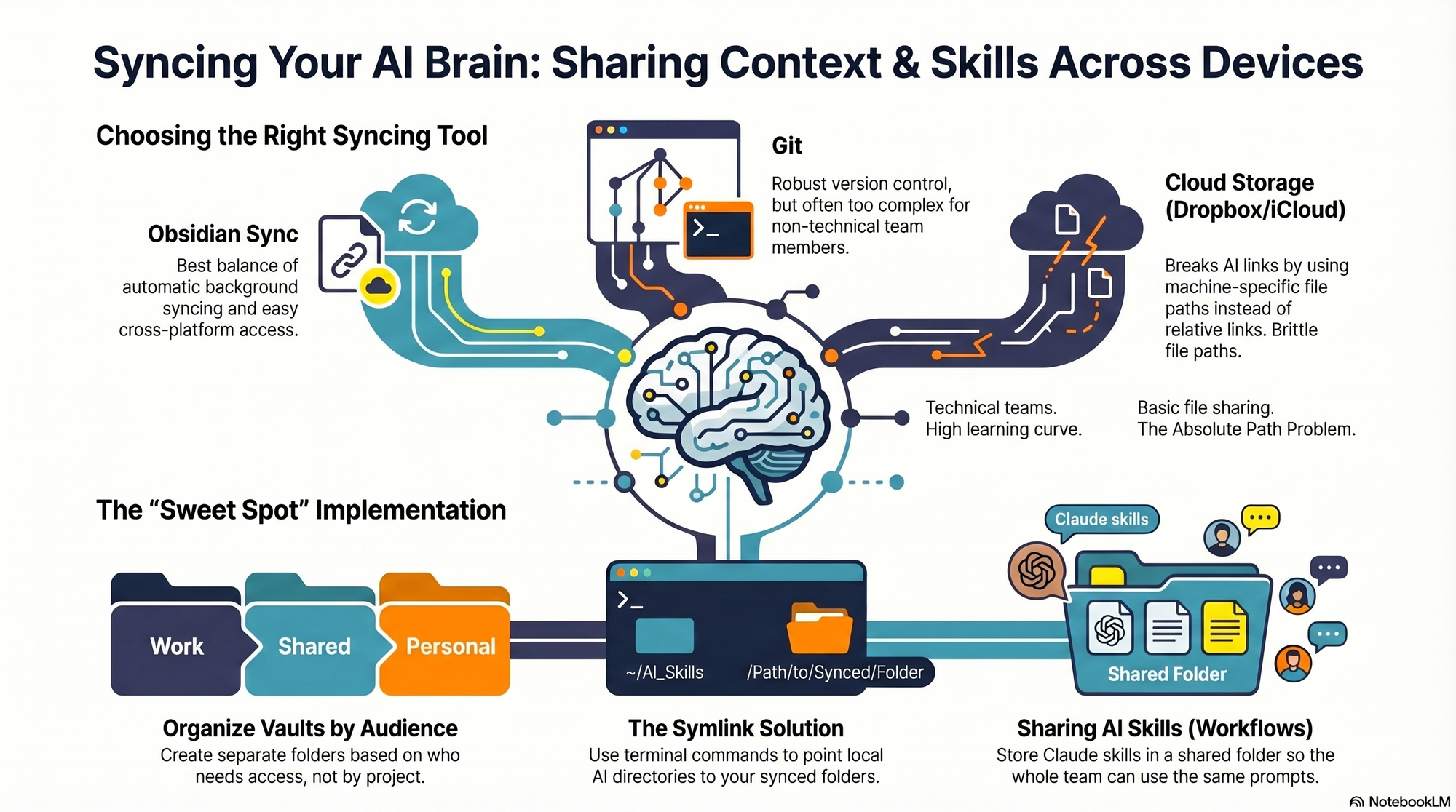
    Agent identity, tasks, and scripts are saved in Obsidian—not Claude Code skills or agents. The scheduler runs on my always-on Mac Mini. The benefit of this is it just works across all of my devices and I can seamlessly switch between Claude Code, Codex—or any other coding CLI—as I need to. All it takes is updating my script that the scheduler uses.

    In practice, this architecture delivers exactly what I want from agentic AI: clarity of responsibility, strong guardrails, and outcomes that compound. My podcast manager keeps interviews buttoned up, my sales admin removes administrative drag, and my coding manager turns lessons learned into steady skill gains—all while I focus on higher-leverage product management work.

    If you’re considering a similar setup, start with a single agent and a narrow task, then expand. Keep identities crisp, scripts small, and schedules explicit. With that foundation, you’ll get the benefits of automation and delegation—without surrendering control.


    Inspired by this post on Product Talk.


    Book a consult png image
  • My Playbook for Safe AI Analytics in Financial Services: Compliance, Trust, and Real Workflows

    My Playbook for Safe AI Analytics in Financial Services: Compliance, Trust, and Real Workflows

    I spend a lot of time helping financial services teams adopt AI analytics without compromising on risk, compliance, or customer trust. The stakes are high: regulations are evolving, data sensitivity is non‑negotiable, and a single misstep can erode confidence. That’s why my approach centers on governed AI, rigorous data governance, and measurable business value—not flashy demos.

    Learn how Amplitude delivers safe, governed AI analytics for financial services—aligned to compliance, built for trust, and ready for real workflows.

    In practice, “safe and governed” means clear lines of accountability and controls that hold up under audit. I look for privacy-by-design principles, role-based access controls, robust audit trails, and granular data permissions that keep sensitive data segregated. Strong AI risk management also requires model oversight—documented policies, human-in-the-loop review where needed, and explainability for high-impact decisions. Above all, the platform must meet regulatory compliance expectations and support the organization’s risk posture without slowing teams down.

    Real workflows are where the value shows up. In financial services, that can mean using behavioral analytics to understand user intent, applying anomaly detection to surface suspicious patterns earlier, and empowering product managers and analysts to iterate safely within a unified analytics platform. When these capabilities are built into the core analytics motion, I see faster detection of issues, clearer attribution of outcomes, and more confident decision-making—all while staying within governance guardrails.

    When I evaluate a solution, my checklist is simple and strict: does it enforce strong data governance by default; does it provide transparent, auditable AI behaviors; can it scale securely to meet enterprise requirements; does it tie insights directly to product and growth outcomes; and will it help risk, compliance, and product teams work together instead of at cross purposes? If the answer is yes across that list, the platform earns a place in the enterprise toolbelt.

    Done right, governed AI analytics give financial services teams the confidence to move faster with less risk. You gain sharper insights from behavioral data, earlier warning from anomalies, and the trust that comes from controls that are aligned to compliance and resilient under scrutiny. That’s the path to durable advantage: responsible AI that accelerates learning, protects customers, and translates directly into better products and performance.


    Inspired by this post on Amplitude – Best Practices.


    Book a consult png image
  • How AI-Designed Enzymes and Agentic AI Could Finally Make Plastic Truly Recyclable

    How AI-Designed Enzymes and Agentic AI Could Finally Make Plastic Truly Recyclable

    Only 10% of the plastic we manufacture gets recycled. For a century, we have relied on mechanical and chemical methods that were never designed to close the loop. As a product leader, I look for step-change technologies that break through entrenched ceilings, and biology—specifically engineered enzymes—has emerged as that missing piece.

    Recently, I dug into the work of Rhea's Factory and spoke with their founders, Arzu Sandıkçı (co-founder and CEO) and Mert Topcu (co-founder). Arzu brings deep expertise in molecular biology and enzyme engineering. Mert brings 20 years in tech, including a decade at Google as a product manager. Their combined perspective—domain science plus product rigor—shows up in every design choice.

    Rhea's Factory has built an AI platform that uses protein language models, multi-step agentic pipelines, and proprietary wet lab data to design novel enzymes that deconstruct plastic polymers into their original monomers—selectively, at low temperatures, and at industrial scale. That stack matters: it layers foundation models with domain-specific constraints and real-world data to systematically explore, evaluate, and scale candidates.

    Here’s the crux: traditional recycling mostly just chops polymer chains into shorter fragments. Enzymatic recycling, by contrast, breaks plastic all the way back to its original monomers. Think of a necklace and pearls analogy—mechanical methods snip the chain; enzymes cleanly return the pearls. The result is true circularity: you can remake high-quality plastic without downcycling.

    Selectivity is the superpower. Enzymes can target specific plastic types even in mixed waste streams, operating at low temperatures in a controlled, low energy reactor process. That combination of precision and energy efficiency is why this approach can be both greener and economically competitive.

    The field accelerated after the discovery of a plastic-eating bacteria in Japan, which opened the door to enzymatic recycling. Advances in protein structure prediction—“AlphaFold” and the Nobel Prize in Chemistry—transformed what’s possible in enzyme engineering, and created space for AI-native design loops to flourish.

    On the AI side, the team evolved from a human-orchestrated pipeline to an agentic AI scientist. Problem statements serve as inputs, multi-step protein generation builds on foundation models, and guardrails at each pipeline step keep the AI pointed in the right direction without limiting exploration. It’s a textbook example of agentic AI applied to a highly constrained, safety-critical domain.

    Crucially, wet lab feedback closes the loop. Why wet lab data—even just hundreds of proprietary data points—can be enough to train a powerful domain-specific prediction model is a reminder that quality and relevance can trump sheer volume when you’re operating in a narrow, high-signal domain. The team measures success in the lab first, then scales what works.

    I appreciated their take on exploration: there are moments when Mert sometimes wants the model to hallucinate. Running high temperature settings helps explore the full enzyme design space, and the guardrails ensure those forays remain productive rather than random. In other words, controlled creativity beats blind search.

    The business constraint is unambiguous: enzymatic recycling must compete economically with cheap, oil-based plastic production. That framing forces disciplined choices around energy use, throughput, and yield—factors that directly determine unit economics and the path to industrial reality and cost parity.

    What’s next is equally compelling: a process agent to optimize end-to-end system performance, a 5,000-ton demo plant in California to validate scale, and enzymes for new plastic types. I’m especially intrigued by enzyme blends for mixed plastics and the practical insight into why clamshells aren’t recyclable—precisely the messy corner cases that decide whether circularity works outside the lab.

    From a product management lens, several patterns stand out: define clear problem statements as inputs to the agentic orchestration; use eval-driven development to enforce stage-by-stage quality; build a proprietary data moat with wet lab results; and tie milestones to industrial metrics (conversion, selectivity, energy per ton) rather than vanity outputs. This is AI Strategy in action—aligning model capability, data leverage, and operational design to deliver outcomes, not just demos.

    Most of all, the ambition to explore an enzyme design space that “makes everything nature has ever evolved look like a tiny dot” captures the promise of this approach. Pairing agentic AI with rigorous lab validation doesn’t just make plastic circularity plausible—it makes it programmable.


    Inspired by this post on Product Talk.


    Book a consult png image
  • From Prototype to Production: How I Built Reliable AI-Generated Opportunity Solution Trees

    From Prototype to Production: How I Built Reliable AI-Generated Opportunity Solution Trees

    I just wrapped an all-out engineering sprint. That still sounds odd coming from me, because while I’ve written code on and off for years, I don’t self-identify as an engineer. I’m a product manager who used to be a designer. It’s been a long time since I wrote code for a living.

    But AI has expanded what’s just now possible—for our products, and for us. It’s pushed me to do more than I imagined. In that spirit, I want to share a recent engineering story. It includes technical details, and a year ago I couldn’t have done any of it. I learned it with the help of AI, and my aim is to show what’s now within reach.

    I’ve been building two services with a partner at Vistaly: AI-generated interview snapshots and AI-generated opportunity solution trees. We put out a call for alpha partners, received over 100 applicants, and selected eight design partners to start.

    Opportunity Solution Tree diagram with a blue Desired Outcome branching to green Opportunity nodes, yellow Solution nodes, and orange Assumption Tests for product discovery and AI workflows.
    A clear, color‑coded map from desired outcome to opportunities, solutions, and assumption tests—showing how to structure discovery work and prompt AI to generate, compare, and validate product ideas.

    Each team uploaded three customer interviews. I identified the key moments and opportunities and then generated an opportunity solution tree from those snapshots. I provide the AI services; Vistaly is building the UI and workflows around them.

    Early feedback was strong. Teams immediately asked to upload more interviews—exactly the kind of demand signal you hope to see—so we got to work making that possible.

    Dark interface screenshot of an opportunity solution tree with colored cards and dotted connectors, showing merged, moved, and evidence-added Opportunity notes about onboarding, support, and bot readiness.
    Go behind the scenes as AI turns raw feedback into a clear Opportunity Solution Tree. Linked cards reveal user needs—onboarding, support offload, and bot-readiness signals—so product teams can spot priorities and next steps at a glance.

    Updating an opportunity solution tree with new interview content is far harder than generating a new tree from scratch. I initially underestimated the complexity. Our goal wasn’t to produce a tree and declare it truth. We wanted teams to engage, correct, and collaborate with the AI—scaffolding cross-interview synthesis instead of doing it for them.

    To support that, we needed a way to communicate precisely how a tree would change after new interviews were added. We took inspiration from git diff and set out to build the equivalent for opportunity solution trees—step-by-step change sets that explain each proposed modification.

    Diagram of an opportunity solution tree with an Outcome node pointing to Opportunity A and Opportunity B; B branches to child opportunities and shows source evidence, labeled “Updates Can't Result in Data Loss.”
    A clear visual of AI‑generated opportunity solution trees: outcomes feed opportunities that branch into sub‑opportunities, while evidence is preserved. The structure ensures updates stay traceable and never cause data loss.

    That decision was right, but the lift was larger than I expected. It wasn’t enough to generate an updated tree; I also had to provide a clear, ordered walkthrough of what changed and why.

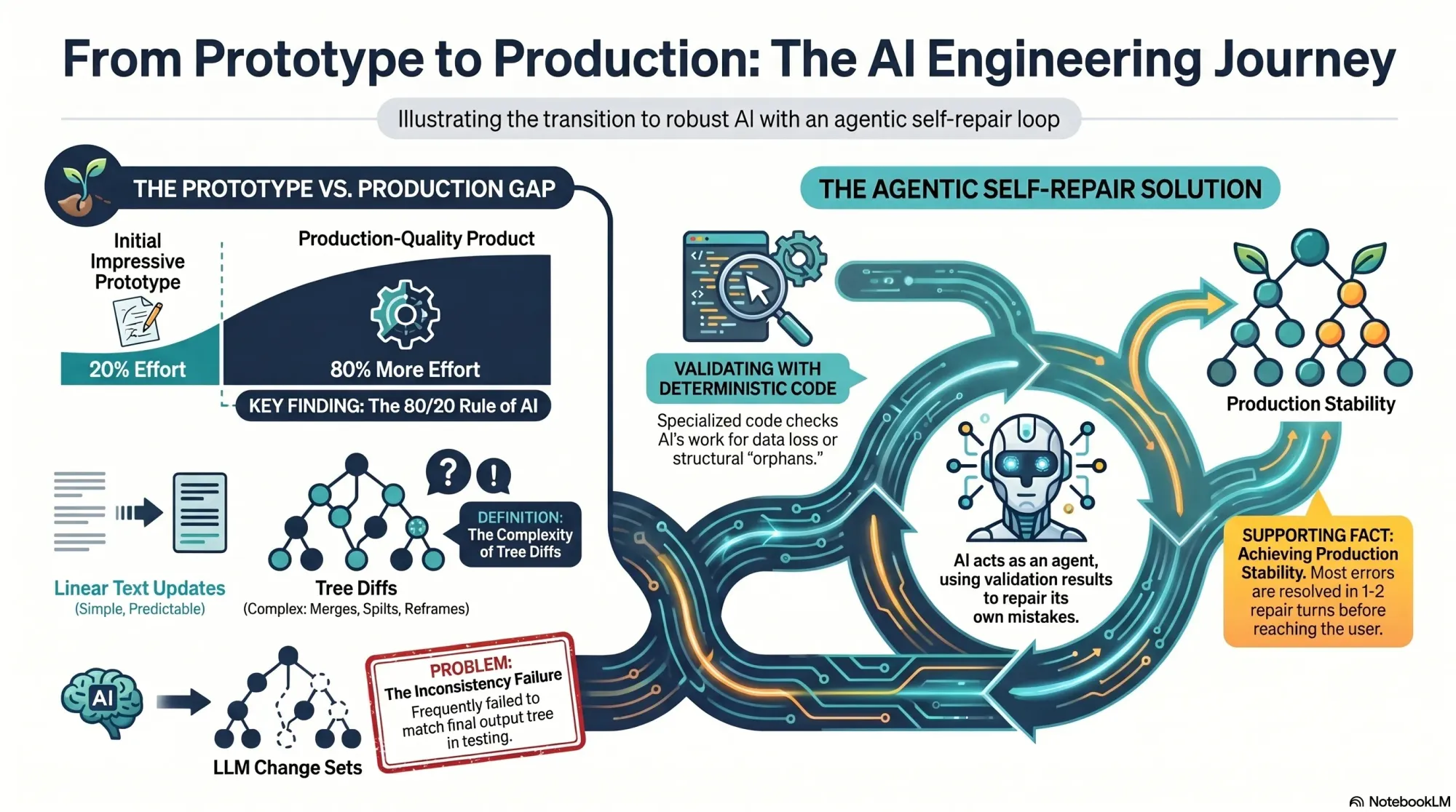
    I often see the same pattern with AI: it’s easy to get to an impressive prototype, but much harder to reach a production-grade product. That was exactly my experience here. My service actually comprised two sub-services: generating a new tree from scratch and updating an existing tree with new interviews. The first worked well in alpha; the second had to be built before anyone could add a fourth interview.

    Opportunity Solution Tree diagram: teal Outcome links to Opportunities A and B; Opportunities C and D branch under B; right panel lists the change set steps for adding nodes.
    Explore how an outcome expands into an Opportunity Solution Tree: Opportunities A and B stem from the goal, with C and D nested under B, while a concise change set tracks every node added along the way.

    On the surface, these services look similar. In reality, updates must preserve existing structure unless new evidence requires a change. You have to account for compound operations—merges, splits, deletes—while guaranteeing no data loss. Every node has source opportunities (supporting evidence from interviews) and children (tree sub-opportunities), and neither can be dropped.

    In classic AI fashion, I got a reasonable version working in a few days and shipped it to our design partners. One team quickly hit our beta limits and asked to convert to a paid subscription so they could keep going. They showed a willingness to pay, converted, and started uploading aggressively.

    Diagram of an Opportunity Solution Tree showing how parent 'Opportunity A' with children x, y, z is split into 'Opportunity A' and 'Opportunity B' to reassign evidence and connections.
    Watch an Opportunity Solution Tree evolve: the original parent A with x, y, z branches is split into A and B, shifting evidence while preserving links—mirroring how AI refines scope and structure in discovery.

    At the 14th, 15th, and 16th uploads, the cracks appeared. We saw odd behavior in some trees. The Vistaly team noticed that the change sets—the step-by-step instructions emitted by my service—didn’t always reconstruct the final tree my service also emitted. We needed those steps to match exactly, so teams could review and accept, modify, or reject each change with confidence.

    They flagged the issue the day I was flying to New Orleans for Jazz Fest. In hindsight, I’m glad I didn’t grasp the scope of what awaited me. I had roughly 80% of the work still to do to make tree updates rock solid. At least I got to enjoy the music first.

    Flowchart merging two opportunity solution trees: Opportunity B with children y and z, and Opportunity C with t, u, v, consolidated into one tree led by Opportunity C connected to five child opportunity nodes.
    From fragments to focus: this diagram shows how Opportunities B and C are merged into a single Opportunity Solution Tree, removing duplicates and unifying context so AI can rank and explore five related opportunities with clarity.

    Back home, I started diagnosing. My service was a pipeline: several LLM-driven steps followed by deterministic code to compare trees and produce change sets. As I dug in, I realized that approach was flawed. Tree diffs, unlike linear document diffs, are ambiguous.

    In a document, if I add a sentence, the diff shows an addition. If I delete a paragraph and rewrite it, the diff shows a removal and an addition. Simple. But trees are different. Suppose I split opportunity A into A and B, and later merge B with C. The split can disappear from the final diff.

    Diagram of an opportunity solution tree labeled 'Input Tree' showing an Outcome node branching to Opportunity A and C, each with child nodes x-z and t-v, with arrows indicating hierarchy.
    Peek inside our process: a simple opportunity solution tree maps an outcome to prioritized opportunities A and C with downstream options x-z and t-v. A clear snapshot of how AI organizes product discovery.

    When the model splits an opportunity, it must distribute A’s source opportunities and children between A and B. For instance, if A has source opportunities 1, 2, 3 and children x, y, z, after the split A might keep 1, 2, and x, while B takes 3, y, and z.

    Now suppose the model merges B into C. If C originally had source opportunities 4 and 5 and children t, u, v, then after the merge C now has source opportunities 3, 4, 5 and children t, u, v, y, z. When you compare the original and final trees, it looks like A somehow donated some evidence and children directly to C. The split and merge that explain why are invisible to a naive diff.

    Opportunity Solution Tree diagram titled Output Tree: a blue Outcome node branches to green Opportunity A and Opportunity C, which expand to nodes x-v with arrows; Product Talk badge.
    See how an AI-generated Opportunity Solution Tree unfolds: one Outcome flows to Opportunities A and C, then into options x–v. Clean colors and arrows reveal the hierarchy from goal to opportunities at a glance.

    That was the core insight: we didn’t just need to show what changed—we needed to show why it changed. I had to reconstruct each move step-by-step. That meant getting the model to show its work, which opened a new can of worms.

    I refactored my prompts so the model produced both the final output and the exact change set it used to get there. The action language was explicit: add, delete, reframe, merge, split, and so on. Crucially, I asked the model to describe its moves in user-meaningful terms—“split A into A and B, then merge B into C”—not as opaque reassignments of sources and children.

    Diagram of an AI-generated Opportunity Solution Tree: blue Outcome node with children Opportunity A and Opportunity B; B branches to Opportunity C and D. A right-hand list shows the change set for each step.
    Watch an opportunity solution tree take shape: start with the outcome, add opportunities A and B, then extend B to C and D. The paired change set makes every edit transparent—ideal for AI-assisted product discovery.

    For each LLM step, the model now emitted its recommendation and the corresponding change set. This helped, but it wasn’t perfect. After extensive testing and error analysis, two classes of errors emerged: (1) the model attempted an invalid move, and (2) the change set didn’t actually generate the recommendation.

    Category 1 felt like designing a game while the model played it creatively. For example, what happens when the model tries to merge a parent with a child? If opportunity A has children B, C, and D and the model merges A with B, the merge is directional. If the instruction is “keep A, delete B,” that works—the parent absorbs the child. But if the instruction is “keep B, delete A,” then C and D become orphans. These puzzles were solvable and even fun.

    Diagram of Opportunity Solution Tree merge rules: merging node B into parent A is allowed, while merging A into B is not because it would orphan opportunities B, C, and D.
    Visual explainer from Product Talk on AI-generated Opportunity Solution Trees. It contrasts an allowed merge (B into A) with a not-allowed merge (A into B) that leaves child opportunities orphaned, guiding safe hierarchy edits.

    Category 2 was harder. Despite prompt iterations, I could only push the discrepancy rate down to about 1 in 40 instances. With 10–20 LLM calls per run, that meant roughly half of all runs still failed. Not acceptable for production. I hit a wall. A paying customer was waiting, and more design partners were queued up.

    Next, I tried to correct the model’s mistakes with deterministic code. I had promised that my change sets would generate the output tree, so I wrote verifiers: detect conflicts (e.g., delete a node, then try to use it later), guard against data loss, prevent orphaned nodes, and more. Detection was straightforward; correction was not. Fixing issues required guessing the model’s intent. If the sequence said “delete A, then merge A with B,” should I remove A entirely or salvage A’s sources and children by merging into B? There were dozens of such cases with no unambiguous answer.

    Workflow diagram titled 'My Simple Repair Loop' showing an iterative validation cycle: Generate the Change Set → Run the validation tool → Check Result, with branches to retry on failure or exit on pass.
    A step-by-step loop shows how changes are validated: generate a change set, run a validation tool, review the result, then repeat on failure and exit on pass—mirroring iterative work behind AI-built Opportunity Solution Trees.

    After 11 straight days of deep work—including weekends—I was exhausted. I dislike hustle culture; this isn’t how I design my life. But I was stuck, and then I had an insight.

    On a walk with my husband (also an engineer), I realized I could have the LLM repair its own mistakes. My data contract with Vistaly requires that the change set must generate the output tree. I had already built robust validation code. I knew exactly when a change set failed—and why. No amount of prompt tuning alone was fixing it. So I turned the validator into a tool for the model and created a simple agentic loop.

    The loop works like this: the model proposes a change set, calls the validation tool, and gets back a pass/fail plus specific feedback. If it fails, the model uses those instructions to repair the change set and calls the tool again. Iterate until success or a max number of turns.

    I prototyped in Node.js with a single model call, a verifier pass, and a repair attempt. At first, the loop didn’t converge—it just accumulated compute. I experimented with how to communicate errors, how much context to include, and how to sequence feedback. Eventually, it clicked: the model began fixing its own mistakes and typically returned a valid change set in one or two repairs. It was, in practice, eval-driven development applied to LLM outputs.

    I had already built an agent loop utility for another AI workflow, so I productionized quickly: model call, optional tool invocation, tool result returned to the model, repeat until the validator signals success or the loop times out. I integrated the new loop into the pipeline and shipped the revamped service to Vistaly on Monday at noon. They’re integrating now, and it will be in the hands of our design partners shortly. I’m relieved—and ready for a day off.

    Reflecting on the last two weeks, a few things stand out. First, I shed limiting beliefs about being an engineer. To make this reliable, I had to solve legitimately hard problems, and that feels good.

    Second, this was genuinely fun. Designing the action set and watching the model push those boundaries was like working through elegant puzzles. Models are incredibly creative, and harnessing that creativity with the right constraints is deeply satisfying.

    Third, I learned when I can and can’t trust Claude to write code for me. Since Opus 4.6 came out, I gave Claude a much longer leash. After the past two weeks, Claude is back on a short leash. I found a lot of gaps in my implementation in areas where I simply trusted that Claude got it right, when in fact it didn’t. If you don’t have the right infrastructure—planning, testing, code review—this can be disastrous. I’ll be investing more here and sharing what I learn.

    Finally, if this work had been spread over two months, it would have been thoroughly enjoyable. I’m discovering how much I like being an AI engineer. It feels like a new chapter where I can combine opportunity solution trees with modern AI engineering—and deliver real value to product teams doing continuous discovery.

    I’m excited to share more of what we’re building with Vistaly and to onboard more design partners soon. If you’re interested, get on the waiting list. And if you’ve been hesitant to stretch beyond your current skill set, I hope this story nudges you to take the first small step toward what’s just now possible.


    Inspired by this post on Product Talk.


    Book a consult png image
  • Intercom Rebrands to Fin: Why Shedding Brand Baggage Powers the Next AI Era

    Intercom Rebrands to Fin: Why Shedding Brand Baggage Powers the Next AI Era

    Sometimes a corporate rename lands with such obvious inevitability—and such lateness—that it feels like a quiet confession. As a product leader, I’ve wrestled with that timing question: move early and risk confusion, or wait and risk stagnation. In this case, the industry finally received the clarity it has been circling for years.

    The announcement was clear: “we’re changing the name of our company to Fin.” Crucially, the name Intercom will continue as the customer service software platform that many of the best brands rely on as their primary help desk. The team also “just launched a complete rebuild, Intercom 2,” and is doubling down investment in that product. In other words, the company brand now matches its leading customer agent platform—Fin—while Intercom remains the flagship product line.

    From a product strategy and brand architecture perspective, this move aligns the corporate identity with the growth engine. I’ve seen too many winners of a prior era cling to yesterday’s positioning while markets shift under their feet. The phrase that keeps echoing in my mind—because it’s true in practice—is that “the only path to success in the future is through destroying your past.” Culture, pricing models, product lineup, investment priorities—those can evolve. But until the company name evolves, the market’s mental model often does not.

    It’s telling that three years ago, when the team effectively created the service agent category, they led with Fin and kept Intercom in the background. That wasn’t indecision—it was smart category design. Humans don’t frequently remap old concepts; we add new ones. We don’t wake up reinterpreting what a chair is, but we do invest energy to understand a new kind of drone or an intelligent software agent. New categories deserve new names, or they’ll be dragged back into old expectations.

    This is where product positioning meets competitive differentiation. Newcomers without legacy baggage enjoy a clean slate; they never have to convince the market they’ve changed because they never had an old position to defend. Even with provably superior technology, an incumbent can find itself explaining rather than advancing. I’ve led naming and repositioning work where the hardest task wasn’t shipping new capabilities—it was unseating the entrenched narrative in customers’ heads.

    So, “baggage be gone.” Fin is clearly positioned as the future of the customer agent category and is poised to become the largest part of the business. Intercom, as a product brand, very much lives on—and with “Intercom 2” now in the world, the product roadmap and investment thesis are unambiguous. The core takeaway for product management leadership: align corporate naming with your category-creating bet, then let go. That’s how you turn momentum into market leadership.

    For leaders working through similar decisions, here’s the lesson I’m taking to my own teams: rebrands aren’t about logos, they’re about narrative clarity and execution velocity. When the corporate name and the breakout product share the same story, go-to-market motions get sharper, customer understanding improves, and AI strategy integrates more naturally into customer support workflows. Naming follows strategy—not the other way around.


    Inspired by this post on The Intercom Blog.


    Book a consult png image
  • How I Orchestrate Growth & AI at Amplitude to Ignite Viral Product Engagement

    How I Orchestrate Growth & AI at Amplitude to Ignite Viral Product Engagement

    I lead Growth & AI at Amplitude, where I focus on viral and core growth strategies, user acquisition, and product engagement. My north star is to architect durable growth loops that compound over time while elevating the customer experience—from the first onboarding moment to deep, habitual use.

    Day to day, I combine Amplitude analytics and behavioral analytics to power product-led growth. By instrumenting the right events, mapping activation journeys, and running disciplined A/B testing, I drive user activation and accelerate time-to-value. That work extends into onboarding, in-app guides, and retention analysis, ensuring we optimize not just for acquisition but also for sustainable engagement and expansion.

    On the AI front, I define and execute the AI Strategy that responsibly applies gen ai and LLMs for product managers to increase experimentation velocity and personalize experiences at scale. This includes deploying intelligent nudges, next-best actions, and adaptive UX while honoring privacy-by-design and strong data governance practices. The outcome is a feedback-rich system that learns from user behavior and continuously improves product-market fit signals.

    My playbook is simple but rigorous: align on a clear North Star, translate it into activation and retention metrics, size lift using minimum detectable effect (MDE), and iterate fast with product trios. I use an opportunity solution tree to prioritize bets, validate with continuous discovery, and then harden winning patterns into repeatable growth loops. This approach keeps teams focused on outcomes, not output, and creates a shared language across product, design, data, and engineering.

    If you’re exploring how to scale product-led growth with AI, this is the path I follow: turn rich product analytics into actionable insights, test with scientific precision, and ship experiences that feel personal, timely, and trustworthy. The result is a growth engine that compounds—driving efficient acquisition, stronger activation, and enduring product engagement.


    Inspired by this post on Amplitude – Best Practices.


    Book a consult png image
  • From Tickets to Topline: How We Turned Support into a Consultative, AI-Powered Growth Engine

    From Tickets to Topline: How We Turned Support into a Consultative, AI-Powered Growth Engine

    By the end of 2024, we were already all-in on Fin, and our customer support organization was deep in its own transformation. Resolution rates were strong, efficiency was improving, and for the first time, something new was emerging: capacity.

    That newfound capacity wasn’t just a relief; it was a strategic opening. As we became less reactive day to day, I saw how support’s unique vantage point—rooted in customer needs and aligned with company goals—could evolve into a consultative function that actively drives value for customers and the business.

    This is the story of how we built consultative support. I’ll walk you through how we got started, the results we achieved, and the lessons I’d carry forward if I were doing it again from scratch.

    We didn’t begin from zero. A few years earlier, we partnered closely with research and data science to drive product adoption. In a project we called “next best step,” we tested offering proactive guidance inside already-established conversations. It worked well, and as Fin accelerated how we worked, we realized we were ready to push into broader, more ambitious opportunities.

    Instead of dictating a solution from the top, I opened the floor. We hosted a support town hall and asked the team to share concrete ways support could directly drive company outcomes. The conversation was electric—practical, creative, and grounded in real customer moments.

    Right there, we spun up campaign concepts. One idea was an always-on in-product banner offering a call with a member of our team to help customers set Fin up to the best of its ability. Another was the “Fin upsell campaign,” where, once a customer had a positive interaction with Fin and clicked the “that helped” button, a tailored message would share details about our own success with Fin and invite the customer to book a call to learn more and ask questions.

    The energy from that session made one thing obvious: the team already knew how to help customers extract more value from the product. They just needed focus, permission, and a clear path to act.

    We started small on purpose. I recruited a group of volunteers who dedicated part of their week to exploring new, proactive ways to support customers. We kept the group tight for two reasons: first, even with Fin freeing up significant capacity, we still had to deliver excellent day-to-day support; second, this was an experiment, and we weren’t going to overhaul a 100+ person organization without proof.

    One of our first campaigns focused on proactive engagement with self-serve customers—those without a dedicated sales or success touchpoint. Our goal was to give this group direct access to teammates with first-hand experience in AI transformation and help them see the value they could get from Fin.

    Early use cases included guiding customers through Fin trials, working with mature customers on optimization to get more out of Fin, and proactively identifying high-potential accounts that looked ready for Fin. None of this required a new team or a big budget—just attention and intention.

    To make consultative support stick, we trained for a mindset shift. I encouraged the team to move beyond solving the immediate issue and instead probe deeper to understand each customer’s unique context. We leaned on our sales and success peers to refine our outreach—learning how to time our messages, frame value succinctly, and meet customers at the right moment rather than waiting for them to come to us.

    To validate our approach, we needed data—not vibes. We built a simple but rigorous comparison: accounts we engaged with versus accounts we reached out to but didn’t hear back from. Over a six month period, we tracked feature adoption, Fin usage, and expansion revenue across both groups.

    The result was clear: engaged accounts grew roughly twice as fast in both usage and expansion.

    To further prove the value of proactive support, we also tracked direct Fin resolutions generated after consultative interactions, resolution and automation rate improvements across engaged accounts, and influenced expansion ARR across everything we worked on over the year.

    Seeing those numbers was a turning point. This wasn’t a side project anymore—it was a repeatable motion with measurable business impact.

    As results became visible, partnerships multiplied. Self-serve engineering teams saw the value of well-timed human touchpoints. Customer lifecycle marketing tapped us to handle responses to their campaigns. Product teams began partnering with us to identify high-impact engagement opportunities. We also deepened our collaboration with digital, scale, and high-touch success teams—stepping in where they lacked capacity and offering deep technical guidance to help customers get the best from the platform.

    What began as simple outreach matured into targeted, strategic initiatives tied directly to company goals.

    Within a year, our volunteer crew grew to ~16 teammates across regions—curious, motivated, and eager to try new things. We continued expanding the consultative support function and took on new projects end to end. Most recently, we assumed ownership of the new “sales assist” team to drive self-serve trial conversions and help new customers get the most from their first experience.

    Here are the practices that mattered most in making consultative support real and durable:

    Start with your team, not a strategy doc. The best ideas came from the people closest to customers. That town hall shaped our initial direction more than any top-down plan could have.

    Don’t scale before you’ve proved it. A small, motivated group moved faster, learned quicker, and produced clearer results than a broad rollout. When you need organizational buy-in, a rigorous proof point beats a promising concept.

    Train for a different mindset. Consultative work requires curiosity, commercial awareness, and the ability to hold broader context—not just product knowledge. Invest deliberately in coaching and frameworks that strengthen these muscles.

    Measure against a control group. Without a control, you have a story. With it, you have a business case—and that’s what unlocks resources, headcount, and prioritization.

    Lean into being different. It’s helpful to take cues from sales and success, but you don’t have to operate exactly like them. There’s real power in support’s distinct perspective and tone.

    Building this consultative support function fundamentally changed how we think about our remit. Support is no longer just there to respond; it now drives adoption, influences retention, generates expansion revenue, and, for many self-serve customers, serves as the primary human touchpoint.

    In an AI-first world, where Fin handles all of the transactional work, this kind of work becomes even more important. Because the question for support leaders is no longer “how do we handle more tickets?” but rather, “how do we use support to grow the business?”


    Inspired by this post on The Intercom Blog.


    Book a consult png image
  • Fin for Ecommerce: The Shopify-native AI Agent transforming product discovery and sales

    Fin for Ecommerce: The Shopify-native AI Agent transforming product discovery and sales

    Today, I’m thrilled to share Fin’s next leap as a Customer Agent: ecommerce. When we launched Fin for Sales, Fin expanded further across the customer journey — and now we’re bringing that same intelligence to product discovery, checkout conversion, and post‑purchase support for Shopify merchants.

    Fin for Ecommerce is a new role purpose-built for Shopify merchants that combines shopping assistance and ecommerce support. Fin is already the best Agent for customer service, resolving over a million queries a week for 8,000+ businesses. Now, it also guides shoppers to the right product, addresses concerns in the moment, and converts browsing into buying — all in one fluid experience.

    Here’s what’s new and why it matters for conversion rate, average order value (AOV), and lifetime value:

    Black-and-white employee portrait beside the Avocado Green Mattress logo and a testimonial explaining that Fin asks about sleep position and firmness preferences to guide shoppers to the right mattress.
    A leading mattress retailer shares how Fin for Ecommerce acts like an expert associate—asking about sleep style and firmness, then recommending the best-fit product to boost confidence and drive conversions.

    Fin helps shoppers find the right product. It asks thoughtful questions, narrows options across large catalogs, and compares products based on what the shopper actually needs — like a great in‑store assistant, at scale.

    Fin helps increase order value. It recommends relevant add‑ons and higher‑value alternatives based on conversation context, keeps carts effortless to update, and guides shoppers smoothly into checkout when they’re ready.

    AI ecommerce UI with a Product Discovery card recommending three ski jackets—blue/green, orange, and yellow/cream—showing item names and prices on a dark green background with lime diagonal bands.
    See Fin for Ecommerce in action: a Product Discovery card curates three high-performance ski jackets with images, names, and prices, revealing how the customer agent guides shoppers and accelerates confident purchases.

    Fin handles support without losing the sale. Returns, refunds, and order changes happen in the same conversation; once resolved, Fin brings shoppers right back to browsing so momentum isn’t lost.

    Fin is integrated with Shopify. Connect your store and Fin syncs your catalog, order data, and APIs in minutes — no manual training or complex setup.

    Monochrome headshot beside a branded quote card for Ninja Transfers, highlighting Fin for Ecommerce performance: 10% of conversations convert to orders and average order value runs 20% above store AOV.
    A customer spotlight from Ninja Transfers shows Fin for Ecommerce boosting sales: 10% of support chats convert, with order values 20% above average—proof that an AI customer agent can drive revenue while improving service.

    In a great retail store, an attentive associate changes everything: they ask what you’re looking for, understand your preferences, answer the questions that matter, and walk you to checkout — and when you return, they remember you. That level of proactive, human‑quality assistance has never truly made it online.

    Most ecommerce still looks like it did a decade ago: filters, FAQs, and self‑serve flows that assume the customer already knows what they want. Ecommerce offers scale and 24/7 convenience, but it’s passive — it can’t understand a shopper’s intent and actively guide them to a product that fits.

    Chat interface titled Fin for Ecommerce helps a shopper change a jacket color, showing three Vertex Hybrid Jacket variants with prices, presented in a clean UI over a green abstract 3D background.
    Fin for Ecommerce acts like a customer agent—checking shipping status, surfacing in‑stock color variants, and updating the order in the same thread—turning a jacket mix‑up into a quick, seamless experience.

    Fin for Ecommerce changes that by bringing high‑quality shopping assistance to Shopify stores.

    "Fin doesn't just recommend products — it asks the right questions about sleep position and firmness preference, understands what the customer actually needs, and guides them to the right decision. It sells the way we sell." Anthony Navarro, Market Sales Manager at Avocado

    Black-and-white headshot next to an Avocado Green Mattress testimonial about Fin for Ecommerce, highlighting smooth support-to-sales handoffs, product and policy guidance, and customer resolutions.
    An Avocado Green Mattress customer experience leader shares how Fin for Ecommerce unifies support and sales—answering policies, selling products, and explaining the mattress break-in period—so shoppers get instant, agent-level help.

    Here’s how it works in practice. When a shopper says "I need a gift for my partner" or asks "what running shoes work for trail and road?," Fin doesn’t dump them on a search results page — it starts a conversation. It asks about preferences, incorporates live browsing context, surfaces the most relevant options, and compares them based on what the shopper cares about.

    This is powered by Fin Apex 1.0, the best-performing model for customer service, combined with a retrieval engine purpose-built for ecommerce. It handles vague, exploratory shopping questions and large product catalogs, helping shoppers find the right fit, faster.

    Modal titled Connect to Shopify with Shopify bag logo, showing a checklist to sync product catalog, understand live inventory, and learn store policies, plus a black Connect to Shopify button.
    Seamlessly connect Fin to your Shopify store. With one click, sync your product catalog, pull live inventory, and import store policies so your customer agent can answer questions and resolve orders faster.

    In practical terms, this is agentic AI meeting ecommerce: Fin plans, retrieves, and reasons through complex product questions and next best actions to move the shopper forward confidently.

    Based on the conversation, Fin recommends complementary or higher-value options, keeps carts easy-to-update, and guides shoppers into checkout when they’re ready.

    Black-and-white headshot beside a Groupsumi testimonial about Fin for Ecommerce, praising fast, high-quality support with minimal, non-technical setup and Shopify-based single source of truth.
    Customer testimonial from Groupsumi spotlights Fin for Ecommerce: rapid, high-quality support with minimal setup, powered by Shopify as the single source of truth, helping teams cut complexity and focus on growth.

    "Fin for Ecommerce is already driving meaningful revenue, with 10% of conversations converting to orders averaging 20% above our store AOV." Matt Satell, Director of Ecommerce, Ninja Transfers

    Fin for Ecommerce is built on the same AI platform that powers Fin for Service. Fin understands whether a conversation requires shopping assistance, support, or both, and moves between them seamlessly without the customer noticing.

    Black hero banner with the headline 'Add Fin to your' centered above a lime‑green 3D Fin logo on a dark background, a minimalist brand visual introducing Fin’s AI customer support agent.
    Meet Fin for Ecommerce, your always‑on customer agent. This bold hero invites you to add Fin to your store so shoppers get instant answers, higher confidence at checkout, and fewer support tickets.

    This means the same Agent that helps shoppers buy also handles the hard and complex post‑purchase work including refunds, exchanges, order changes, tracking, and shipping questions. It can make changes in real time, within the same conversation, using the same context and data.

    "The handoff between support and sales is so smooth I can't tell the difference without checking the filters. Fin talks policy, sells products, and references our mattress break-in period all in one conversation. It handles both the way our best agents would — but without the customer waiting to be passed between people." Kurt Dwiggins, Customer Experience Manager at Avocado

    Fin for Ecommerce is purpose-built for Shopify merchants. Connect your Shopify store and Fin establishes a live connection to your entire catalog – products, variants, content, and order data – ensuring every response reflects your latest inventory and shoppers only see what’s actually available.

    You can add the Messenger to your store and set Fin live in minutes without any manual training or technical expertise. When connected to Shopify’s API, Fin can handle even your most complex customer requests like tracking orders, processing returns, and updating subscriptions via Procedures. Fin automatically drafts Procedures for common ecommerce support queries based on your Shopify account and customized to your company policies.

    You review, adjust, and publish, allowing Fin to start handling real queries in minutes.

    "What surprised us most about Fin for Ecommerce is how quickly it delivers high-quality support with minimal, non-technical setup. Using Shopify as the single source of truth reduces operational complexity and allows us to focus on core business execution." Arnau Jiménez, Chief Technology Officer, GroupSumi

    Fin is now a Customer Agent, with multiple roles that work seamlessly across the customer lifecycle. When a single Agent can guide a shopper from "I need a gift for my partner" to checkout, and handle a return weeks later without losing context, that’s a fundamentally better customer experience. It’s one Agent that deeply understands your products and your customers, and supports them throughout their entire journey with your business.

    Leading ecommerce brands, including Avocado, WHOOP, Shutterstock, Flaviar, Carvana, Nuuly, MPB, Pure Electric, and Goodbuy Gear, already trust Fin to create standout experiences for their shoppers. I’m excited to continue expanding Fin’s roles as a Customer Agent and share more soon.

    Ready to see it in action? Visit fin.ai/ecommerce and add Fin to your Shopify store today.


    Inspired by this post on The Intercom Blog.


    Book a consult png image
  • Taste vs. Evidence in the AI Era: What Product Leaders Must Invest In Now

    Taste vs. Evidence in the AI Era: What Product Leaders Must Invest In Now

    I just finished listening to "Taste – All Things Product Podcast with Teresa Torres & Petra Wille," and as a product leader shipping AI-powered capabilities at HighLevel, Inc., I wanted to pressure-test the sudden obsession with "taste."

    If you're curious, you can listen to this episode on Spotify or Apple Podcasts.

    The core question landed perfectly for our moment: Is "taste" the must-have skill of the AI era — or just the latest tech buzzword in a world where AI is eating through design, delivery, and discovery?

    Teresa pushes back hard, highlighting how slippery the term can be. "It's just this month's flavor of founder mode." She points out that "taste" is rarely defined, can't be easily taught, and too often becomes shorthand for "my preference trumps yours." Just as importantly, "It's not about your taste. It's about your customer's taste."

    Petra adds needed nuance from years in the craft: pattern-recognition is real, and some people do develop sharper product sense over time. As she put it, "I am a strong believer that you develop product sense and taste over time. It's never finished."

    Both threads lead back to familiar roots in product: product sense, founder mode, and the enduring myth of the lone visionary. They even grapple with the big question on everyone’s mind—Will AI Eat Taste Too?—and where that leaves product teams navigating GenAI, LLMs for product managers, and evolving product strategy.

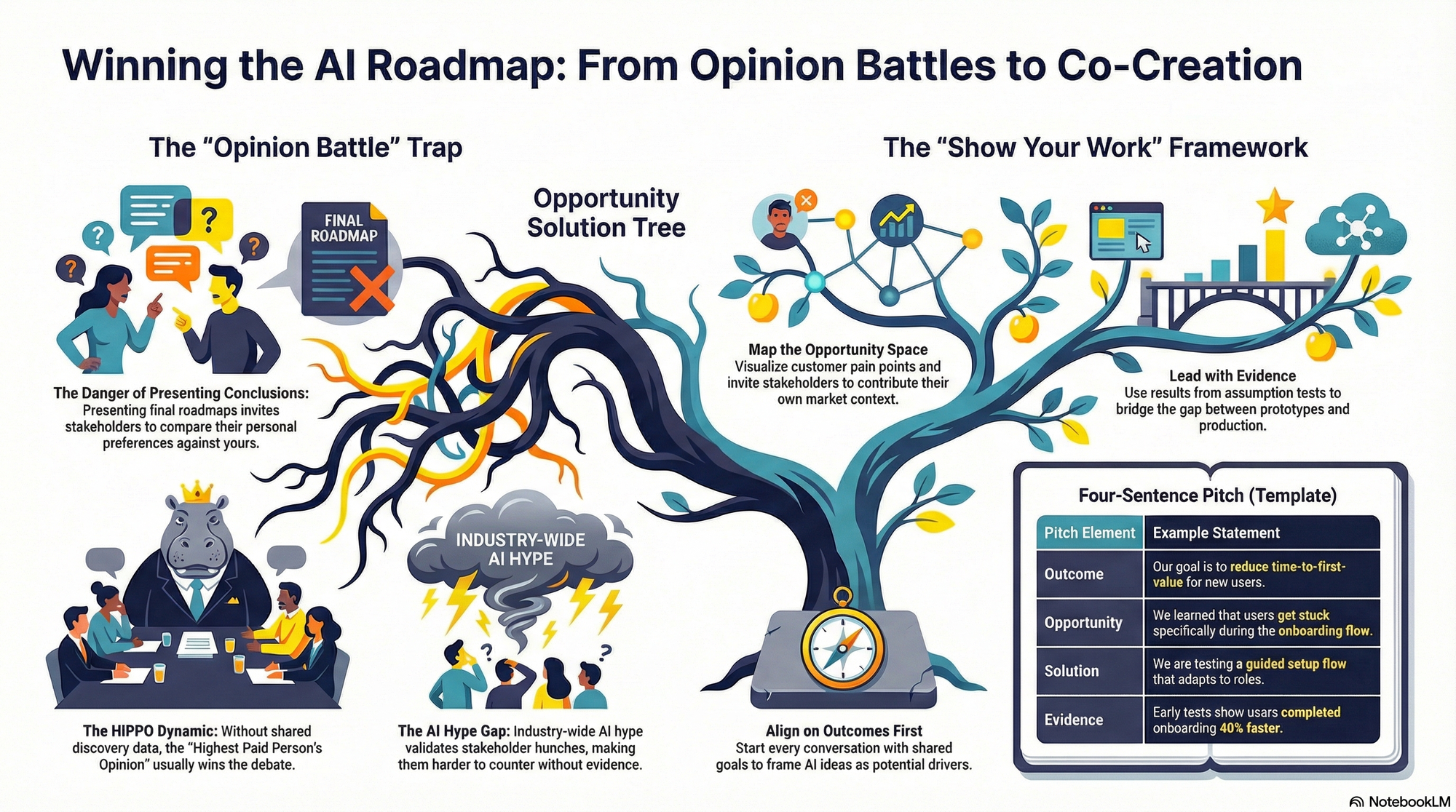
    Here’s my take. "Taste" can be useful as a personal north star, but it is not a decision system. In my teams, we bias toward evidence: continuous discovery, customer interviews, discovery synthesis with opportunity solution trees, and tight collaboration in product trios. Opinion can start the conversation, but evidence should end it.

    Practically, that means investing in the skills that compound: Discovery skills — understanding customers, matching solutions to real needs. Human-to-human interaction skills. Learning to collaborate with AI effectively. Critical thinking and judgment grounded in evidence.

    On AI collaboration specifically, we treat GenAI as a force multiplier, not a decider. We prototype with AI to explore breadth, then narrow with qualitative and quantitative signals, ablation-style experiments, and clear success criteria. The bar I hold myself to is simple: taste without evidence is just opinion.

    Three lines I underlined from the conversation:

    "It's just this month's flavor of founder mode." — Teresa Torres

    "It's not about your taste. It's about your customer's taste." — Teresa Torres

    "I am a strong believer that you develop product sense and taste over time. It's never finished." — Petra Wille

    If you want to go deeper, these references are helpful for sharpening judgment without falling into the "great man" theory trap.

    Follow Teresa Torres: https://ProductTalk.org

    Follow Petra Wille: https://Petra-Wille.com

    Founder mode

    Marty Cagan: Founder-Style Leadership

    Vercel/v0 CEO Guillermo Rauch on building taste: from Lenny Rachitsky’s Linkedin post

    Continuous discovery (Read Teresa’s Everyone Can Do Continuous Discovery—Even You! Here’s How

    The "great man" theory

    Steve Jobs and the myth of the lone product visionary

    Have thoughts on this episode? Leave a comment below and share how your team balances product sense with evidence in the age of AI.


    Inspired by this post on Product Talk.


    Book a consult png image
  • Supercharge Claude and Cursor with Amplitude Plug and Play: Your AI Analytics Expert in One Install

    Supercharge Claude and Cursor with Amplitude Plug and Play: Your AI Analytics Expert in One Install

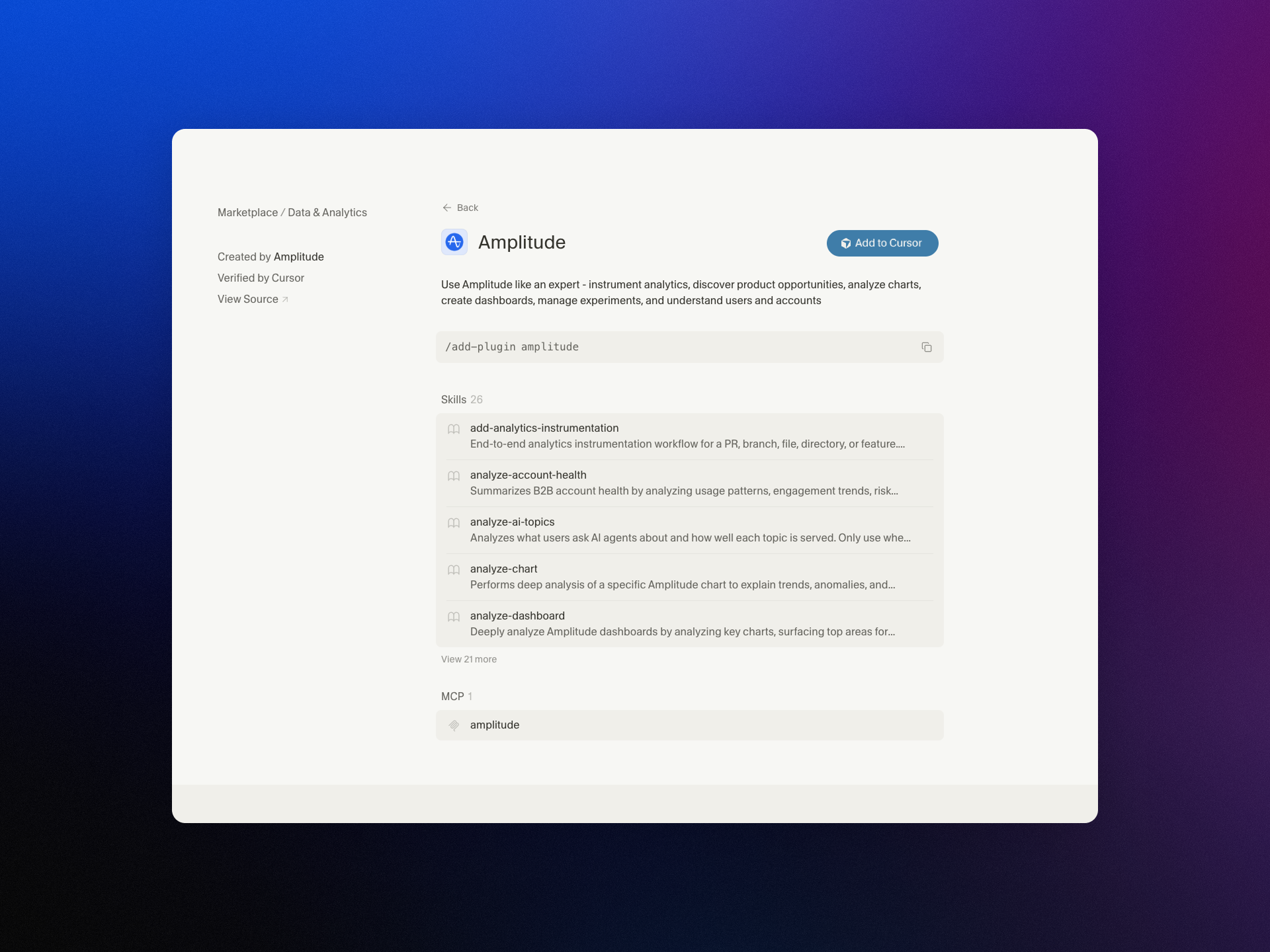
    I’m excited to share that we’ve brought Amplitude Plug and Play to the Claude and Cursor marketplaces—a lightweight way to infuse your everyday prompts with serious product analytics context and speed.

    "Learn more about our new AI plugin, the easiest way to turn your favorite AI client into an analytics expert with a single-install."

    For years, I’ve watched teams lose momentum hopping between dashboards, docs, and spreadsheets just to answer simple questions like “What changed in activation last week?” or “Which cohort is driving retention?” With Amplitude analytics and behavioral analytics at the core, Amplitude Plug and Play collapses that friction by bringing the answers to where you already think and build—inside Claude and Cursor.

    In practice, this means I can ask natural-language questions such as “Show me the funnel from signup to activation by region,” “Compare retention week over week for new users from our latest release,” or “Summarize our last A/B testing results on onboarding” and get structured, context-aware responses. The goal is to keep me in flow while still honoring the rigor of a unified analytics platform.

    What I love most is how this elevates both discovery and delivery. Product managers can accelerate continuous discovery by querying cohorts, drivers, and anomalies mid-conversation. Engineers working in Cursor or with Claude Code can validate event definitions, sanity-check metrics, and spot regressions without leaving their IDE. The result is tighter feedback loops and better decision quality.

    Just as importantly, the experience is designed for clarity and consistency. When I ask about activation, I expect the same canonical definition every time. When I explore a retention analysis, I want clear assumptions and transparent logic. By anchoring responses to well-defined metrics and event taxonomies, the plugin helps reinforce good data governance while keeping the interaction fast and conversational.

    Getting started takes only a few minutes. Open the Claude or Cursor marketplace, search for Amplitude Plug and Play, complete the single-install flow, and connect to your Amplitude analytics workspace. From there, start prompting as you normally would—only now your AI client can reason with product context.

    This launch is part of how I see gen ai reshaping AI workflows for product teams: less context switching, more signal per prompt, and a shared, accessible understanding of what’s really moving the business. If you’re ready to turn your AI assistant into a trusted partner for product insight, Amplitude Plug and Play is a powerful next step.


    Inspired by this post on Amplitude – Best Practices.


    Book a consult png image