If nobody on our team trains the Agent on how to communicate, it will sound like an LLM when it speaks to customers—because it is one. I never want a customer to feel like they’re talking to a machine that doesn’t get them. That’s why I treat conversation design as a core product capability, not an afterthought.
Conversation design is an emerging discipline in AI-first support teams built to solve this exact problem. In practice, I make someone explicitly own how the Agent communicates—tone, structure, level of detail, customer experience, and the handoff and escalation process—because that’s where trust is won or lost.
When there’s no clear owner and no explicit guidance, the Agent starts making its own choices. I’ve seen it over-explain when a short answer would do, reply in a flat tone when a customer is frustrated, or trigger a handoff too late. None of those are model problems; they’re design problems.
The cost is measurable. Customers who get awkwardly structured responses won’t trust the answer—even when it’s accurate—so they escalate to a human to hear the same thing phrased differently. Others will skip the Agent entirely. And when the Agent does hand off, a poor transition means the support rep inherits a frustrated customer. Every one of these outcomes is avoidable; conversation design exists to prevent them.
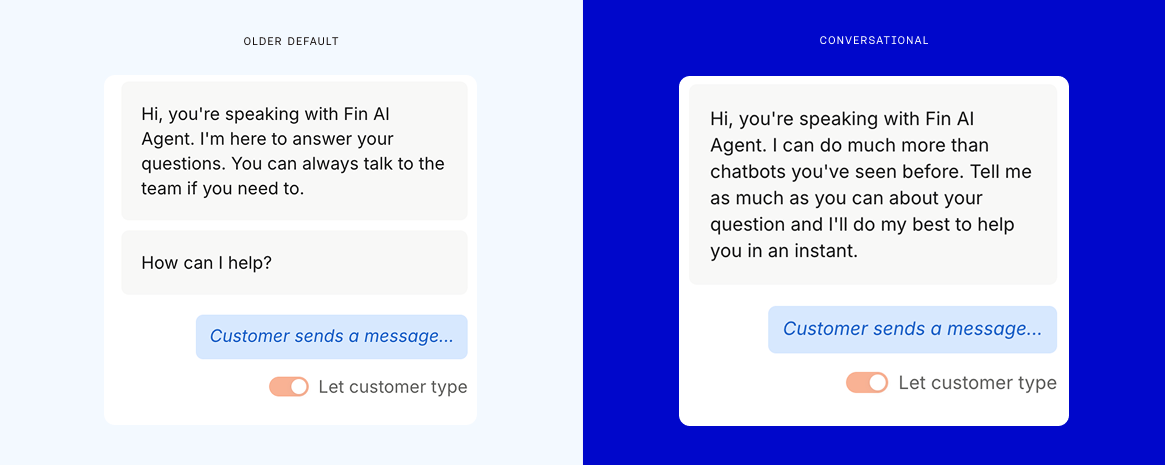
I’ve seen A/B tests where a warmer, more conversational opening message meaningfully lifted customer satisfaction—CSAT moved from 72.8% to 78.4%. A single design change, applied to the very first message, drove a measurable difference. That’s the kind of leverage I look for as a product leader.
Here’s the scope I use when I talk about conversation design—five areas that shape the customer experience end to end:
1) Tone and personality: Define the Agent’s voice, level of detail, and how formal or casual it should sound—and specify where that register adapts to the situation (for example, urgent access issues versus exploratory product questions).
2) Response structure: Ensure the Agent matches the level of detail to the customer’s request, keeping answers tight when the ask is simple and expanding only when complexity demands it.
3) Handoff logic: Decide when to escalate, how to communicate the transition, and what context to carry over so the human teammate can help immediately without rework.
4) Interaction flow: Map how a conversation progresses—clarifying questions, answers, resolution, or handoff—and design for smooth pivots when customers change direction.
5) Response quality: Go beyond technical correctness to ensure answers feel clear, helpful, and on-brand. Accuracy without clarity erodes trust.
To put this into practice, I start with the feel of the conversation. Before tuning individual responses, I write down one tight paragraph describing the Agent’s voice. I don’t need a full brand bible—just a north star I can use to make consistent decisions about tone. The voice stays consistent, while the register adapts to the context: a locked-out customer needs directness and speed; a feature explorer might value more context and examples.
I design the handoff with extreme care because it’s one of the highest-friction moments. Customers shouldn’t have to re-explain anything. The support rep should receive the full conversation history, the underlying context, what the Agent already tried, and why the escalation happened. Even the phrasing matters—“Let me connect you with a teammate who can help with this” feels very different from a silent handover.

I also build a failsafe. If the Agent can’t resolve the issue cleanly, a graceful fallback still gives the customer a smooth experience. A customer might be frustrated with AI at that point, but a well-handled transition can turn that around.
Follow-ups deserve the same rigor as handoffs. If someone drops mid-conversation—with the Agent or a human—how do we reach back out to confirm they got what they needed? Most teams miss this moment; customers don’t.
Another common pitfall is over-explaining. The Agent has access to a lot of information, and left unguided, it will overshare. The fix is simple: match the answer’s depth to the question. A password reset shouldn’t take three paragraphs; a complex integration might. When there’s more to offer, the Agent should ask before expanding.
I also design for the conversation the customer is actually having—not the script I wish they’d follow. Customers change direction, stack questions, or bring up unrelated follow-ups. The Agent should pivot with them, not force them back into a rigid flow. I also consider whether flows vary by channel and whether different segments merit distinct experiences.
On the instruction side, I keep guidance short. Teams often react to edge cases by adding more rules until the LLM is parsing paragraphs before it can reply. I’ve seen it everywhere. My rule: if it’s about content or information, it belongs in the knowledge base. If it’s about tone or handling specific situations, it belongs in the Agent’s instructions. “Be direct about pricing” does more than a paragraph explaining the philosophy behind your pricing communication strategy.
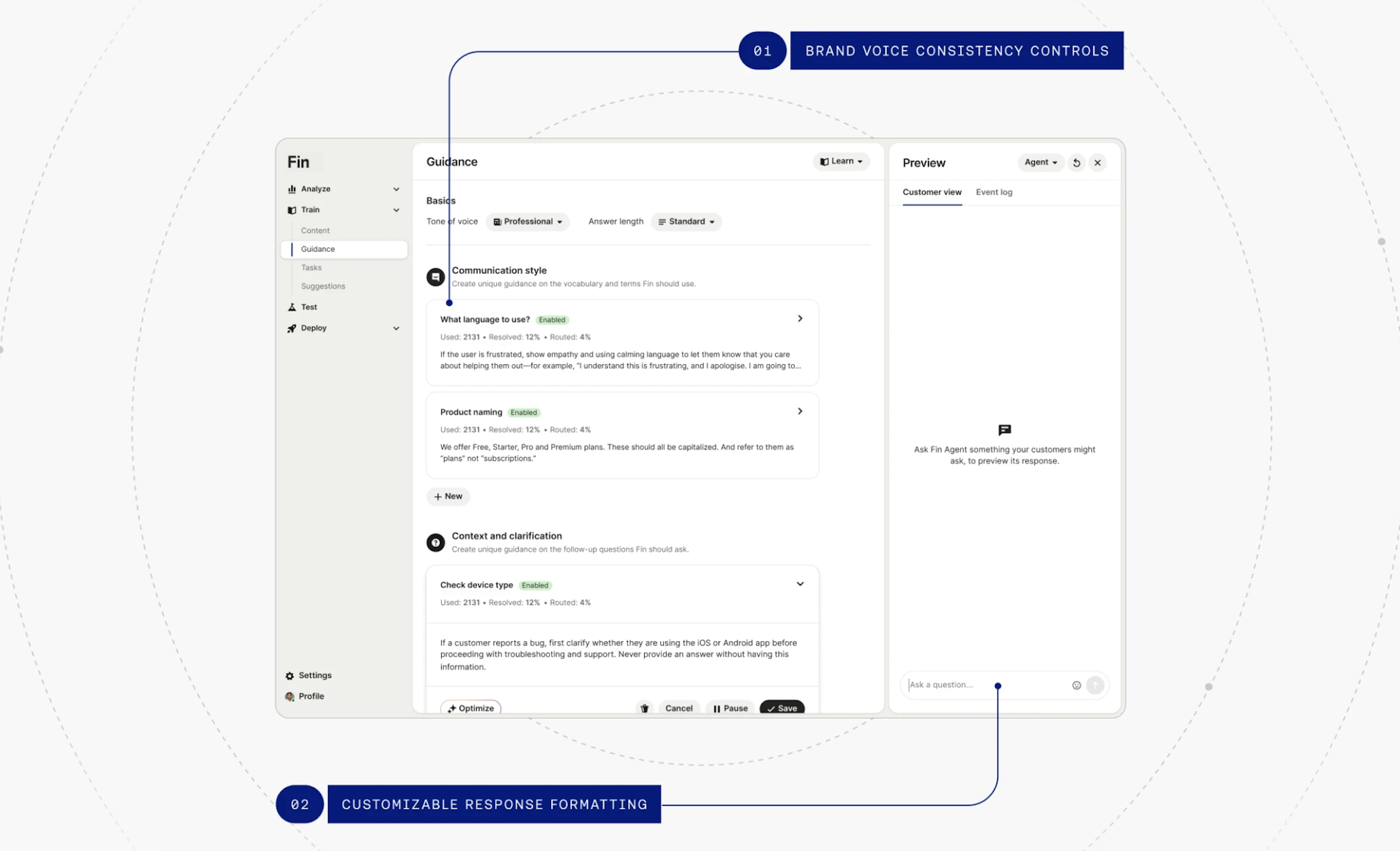
If you’re using Fin, much of this work happens in Guidance. It’s where conversation design takes shape, helping you define how the Agent should sound, how much it should say, and how it should respond in different situations.
Most teams won’t hire a dedicated conversation designer on day one—that’s fine. But someone still needs to own the Agent’s communication, even if it’s part of an existing role. I’ve often seen this start within support operations or knowledge management. As the Agent scales to more conversations, the responsibility becomes formal—and eventually becomes a dedicated role.
Here’s how I’d start, step by step:
1) Name an owner. Make accountability explicit; it doesn’t have to be a new hire.
2) Pick one conversation type that isn’t landing well. Look for cases where the Agent answered correctly but the customer still escalated or left negative feedback. If you’re using Fin, CX Score can help you surface these; it shows which topics and conversation types are scoring poorly and why, so you can see whether the issue is answer quality, customer effort, or something else.
3) Audit the Agent’s instructions. If they’ve grown beyond a few focused rules, trim them. Move content into the knowledge base and keep instructions focused on behavior.
4) Fix your worst handoff. Review a handful of conversations that escalated. Did the customer have to repeat themselves? Did the rep have enough context? Redesign that single transition first.
The impact of these small improvements compounds. A warmer opening can lift CSAT, trimming instructions makes responses sharper, and a better handoff prevents reps from inheriting frustrated customers. None of this requires new knowledge—just someone paying close attention to the conversation itself and designing it with intention.
Inspired by this post on The Intercom Blog.