Tag: AI agent

  • How to Operate AI Customer Agents as a Reliable CX System

    How to Operate AI Customer Agents as a Reliable CX System

    AI customer agents are expanding from answering routine questions toward handling complex workflows and potentially supporting more of the customer lifecycle. The operational challenge is no longer simply whether an agent can produce a plausible answer. It is whether the organization can keep that agent accurate, controlled, measurable, and ready whenever the business changes.

    Taken together, the source reports point to a practical operating model: connect product releases to knowledge updates, test behavior before exposure, measure the full interaction rather than a narrow survey sample, and assign people to improve the system continuously. That turns an AI agent from a channel feature into managed CX infrastructure.

    Key takeaways

    • Agent reliability depends on a continuous train, test, deploy, and analyze cycle, not a one-time implementation.
    • A product release is not operationally complete until the agent has current, unambiguous, and retrievable information about it.
    • Pre-release evaluation should test realistic customer questions, policy conditions, system actions, and required human handoffs.
    • Survey metrics remain useful, but conversation-level analysis provides broader visibility into answer quality, effort, sentiment, and recurring friction.
    • Human roles increasingly shift toward knowledge stewardship, exception handling, policy design, evaluation, and cross-functional CX improvement.

    Treat the agent as a product system, not a chatbot

    The Pioneer 2025 report describes Fin 3 through four operating stages: training, testing, deployment, and analysis. It reports that Procedures combines natural-language instructions with deterministic controls for complex work, while Simulations is intended to test behavior before customers encounter it. The report also describes deployment across additional channels, including Slack and Discord, improvements to Voice, and analytics features such as CX Score Reasons and Topic Trends.

    These are vendor-reported capabilities, but the underlying operating principle applies beyond one platform. An agent that can act in business systems needs more than fluent language generation. It needs explicit procedures, boundaries on what it may do, test cases that expose failure modes, controlled channel deployment, and evidence showing what happened after release.

    The same report presents a longer-term Customer Agent vision built around roles, goals, persistent memory, business knowledge, and interoperability. That vision should be distinguished from currently reported product functionality. It nevertheless clarifies the governance challenge: as an agent gains continuity and operational reach, errors can travel across more stages of the customer journey. Ownership of objectives, data, permissions, escalation, and measurement therefore becomes part of CX design.

    This also changes how success should be framed. Resolution volume is an operational output, but a dependable CX system must also answer whether the agent followed policy, used current knowledge, completed the intended action, recognized an exception, and left the customer with an acceptable amount of effort. Automation without those checks can move work while concealing deterioration in the experience.

    Move agent readiness into the product release process

    The NPI playbook focuses on a common source of agent failure: products change faster than their supporting knowledge. When a feature launches without usable documentation, the source reports that the agent may hand conversations to people just as launch-related volume rises. The resulting backlog is therefore not only a support problem; it is a release-readiness problem.

    A stronger definition of done includes agent readiness. The NPI source recommends bringing support or knowledge specialists into product walkthroughs, product marketing kick-offs, and pre-release testing. It also calls for a named owner, whether an NPI manager, knowledge manager, support lead, or product operations owner. The title can vary, but accountability cannot be distributed so widely that nobody verifies readiness.

    The required knowledge must be designed for retrieval as well as human reading. According to the source, documentation should include both internal feature names and the phrases customers actually use, expand acronyms, state plan and availability conditions explicitly, and reproduce the substance of screenshots or videos in text. This is important because information can be technically present yet remain difficult for an agent to retrieve or apply correctly.

    Release work must also remove knowledge that a launch has invalidated. Searching related articles, macros, notes, and workflows can reveal stale or contradictory guidance. Duplicate content deserves particular attention: competing versions of an answer can create inconsistent agent behavior even when the newest article is accurate.

    Testing then connects knowledge preparation to customer outcomes. The NPI playbook recommends assembling likely questions from launch content, beta feedback, and early support conversations; running them in the environment customers will use; rating the answers; correcting the underlying content or structure; and repeating the evaluation. Conditions such as phased rollout, plan eligibility, regional availability, and mandatory human escalation require explicit coverage rather than an assumption that the agent will infer the right behavior.

    This creates a two-speed control model. Before launch, teams test expected questions and known edge cases. After launch, they watch real conversations for unexpected language, missing scenarios, or product behavior that the original documentation did not anticipate. The feedback should return to the release tracker, knowledge source, procedure, or product team according to the root cause.

    Measure experience at conversation scale

    Release evaluation shows whether an agent appears ready, but production measurement shows whether that readiness survives real customer behavior. The CX measurement source reports that CSAT captures less than 10% of conversations and that respondents tend to represent more extreme reactions. On that account, survey results leave a large unobserved middle and cannot by themselves explain whether dissatisfaction arose from service, product behavior, or policy.

    The source describes an alternative in which AI evaluates every human and agent interaction across dimensions such as service quality, resolution, and customer effort. It reports that Intercom’s CX Score assigns interactions a score from 1 to 5, exposes reasons behind the score, and gives most teams roughly five times the coverage of CSAT alone. Those product-specific claims are reported by the source rather than independently verified here, but they illustrate the broader distinction between voluntary feedback and systematic conversation review.

    Fuller coverage does not make direct customer feedback obsolete. CSAT can still capture what a customer chooses to say, while conversation analysis can detect repeated explanations, handoff friction, weak answer quality, unresolved intent, and neutral interactions that generate no survey response. The two signals answer different questions and should be interpreted together rather than forced into a single interchangeable benchmark.

    New coverage also requires new baselines. The measurement source cautions against transferring an old CSAT target directly to a conversation-scoring system because the populations and methods differ. It recommends correlating the new score with operational measures such as first response time and time to close, then examining underlying attributes including answer quality, customer effort, and product feedback. Its illustrative targets of 80% for Fin support, 70% for human support, and 78% overall are examples derived from the scenario described in that article, not universal standards.

    Segmentation is equally important. Complex, high-touch cases should not automatically be compared with transactional contacts, and aggregate results can hide a poorly performing topic or channel. Useful analysis separates agent and human conversations, examines topics and handoffs, and preserves context about case type. The most actionable output is not the score alone but a reason that can be routed to a responsible owner.

    Build one improvement loop across CX, product, and knowledge

    The sources approach AI customer agents from different angles: the Pioneer report emphasizes expanding capabilities and a broader customer-agent vision; the NPI playbook concentrates on release and knowledge readiness; and the measurement article addresses visibility after deployment. Their combined implication is that these activities cannot remain separate programs.

    A low-quality interaction might originate in several places. The knowledge may be missing or contradictory, the procedure may express the wrong policy, the product may behave unexpectedly, the agent may fail to retrieve applicable information, or the case may require a human specialist. Conversation-level reasons help locate the problem, but the organization still needs a route from evidence to correction and then to re-evaluation.

    That operating loop changes human work. Customer-facing specialists remain essential for sensitive, ambiguous, or exceptional cases, while also contributing customer language, testing scenarios, escalation criteria, and knowledge improvements. Product and engineering teams become accountable for the support consequences of releases. Knowledge teams manage information as production input, and CX leaders set objectives that balance resolution, effort, policy compliance, and service quality.

    The most revealing opportunities may sit in interactions that are neither failures nor successes. Broader conversation analysis can surface answers that were technically acceptable but unnecessarily difficult, impersonal, or incomplete. Improving that middle ground requires more than tuning a model: it may require clearer documentation, a better workflow, a product fix, or a different escalation rule.

    As agents acquire more roles, memory, knowledge, and access to business systems, CX operations will increasingly resemble product operations for a continuously changing service. Organizations that establish release gates, evaluation sets, conversation-level diagnostics, and unambiguous ownership will be better positioned to expand agent responsibility without allowing reliability to become an afterthought.

    References

  • How I Make AI Agents Speak Like Our Team: A Conversation Design Playbook That Lifts CSAT

    How I Make AI Agents Speak Like Our Team: A Conversation Design Playbook That Lifts CSAT

    If nobody on our team trains the Agent on how to communicate, it will sound like an LLM when it speaks to customers—because it is one. I never want a customer to feel like they’re talking to a machine that doesn’t get them. That’s why I treat conversation design as a core product capability, not an afterthought.

    Conversation design is an emerging discipline in AI-first support teams built to solve this exact problem. In practice, I make someone explicitly own how the Agent communicates—tone, structure, level of detail, customer experience, and the handoff and escalation process—because that’s where trust is won or lost.

    When there’s no clear owner and no explicit guidance, the Agent starts making its own choices. I’ve seen it over-explain when a short answer would do, reply in a flat tone when a customer is frustrated, or trigger a handoff too late. None of those are model problems; they’re design problems.

    The cost is measurable. Customers who get awkwardly structured responses won’t trust the answer—even when it’s accurate—so they escalate to a human to hear the same thing phrased differently. Others will skip the Agent entirely. And when the Agent does hand off, a poor transition means the support rep inherits a frustrated customer. Every one of these outcomes is avoidable; conversation design exists to prevent them.

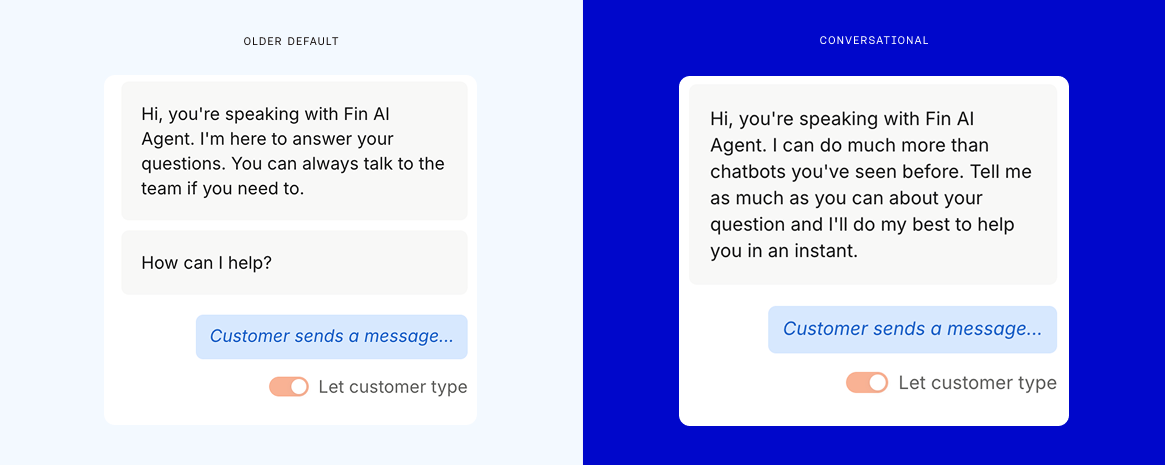
    I’ve seen A/B tests where a warmer, more conversational opening message meaningfully lifted customer satisfaction—CSAT moved from 72.8% to 78.4%. A single design change, applied to the very first message, drove a measurable difference. That’s the kind of leverage I look for as a product leader.

    Here’s the scope I use when I talk about conversation design—five areas that shape the customer experience end to end:

    1) Tone and personality: Define the Agent’s voice, level of detail, and how formal or casual it should sound—and specify where that register adapts to the situation (for example, urgent access issues versus exploratory product questions).

    Screenshot of an AI agent conversation design dashboard showing guidance for tone of voice, communication style, product naming, and a live preview, with callouts highlighting brand voice controls and response formatting.
    Design how your AI agent talks. Set tone, style, and product naming rules, then preview replies instantly. Clear callouts showcase brand voice consistency and flexible formatting so your bot communicates like your team.

    2) Response structure: Ensure the Agent matches the level of detail to the customer’s request, keeping answers tight when the ask is simple and expanding only when complexity demands it.

    3) Handoff logic: Decide when to escalate, how to communicate the transition, and what context to carry over so the human teammate can help immediately without rework.

    4) Interaction flow: Map how a conversation progresses—clarifying questions, answers, resolution, or handoff—and design for smooth pivots when customers change direction.

    5) Response quality: Go beyond technical correctness to ensure answers feel clear, helpful, and on-brand. Accuracy without clarity erodes trust.

    To put this into practice, I start with the feel of the conversation. Before tuning individual responses, I write down one tight paragraph describing the Agent’s voice. I don’t need a full brand bible—just a north star I can use to make consistent decisions about tone. The voice stays consistent, while the register adapts to the context: a locked-out customer needs directness and speed; a feature explorer might value more context and examples.

    I design the handoff with extreme care because it’s one of the highest-friction moments. Customers shouldn’t have to re-explain anything. The support rep should receive the full conversation history, the underlying context, what the Agent already tried, and why the escalation happened. Even the phrasing matters—“Let me connect you with a teammate who can help with this” feels very different from a silent handover.

    CX analytics dashboard with a CX Score of 3 and a donut chart of drivers: policy feedback, answer quality, customer effort, product or service feedback, and strong emotion beside an AI agent chat transcript.
    The new CX Score adds context to every conversation: a donut chart surfaces drivers like policy feedback and effort, while a side panel explains why this interaction earned a 3 based on signals from an AI agent chat.

    I also build a failsafe. If the Agent can’t resolve the issue cleanly, a graceful fallback still gives the customer a smooth experience. A customer might be frustrated with AI at that point, but a well-handled transition can turn that around.

    Follow-ups deserve the same rigor as handoffs. If someone drops mid-conversation—with the Agent or a human—how do we reach back out to confirm they got what they needed? Most teams miss this moment; customers don’t.

    Another common pitfall is over-explaining. The Agent has access to a lot of information, and left unguided, it will overshare. The fix is simple: match the answer’s depth to the question. A password reset shouldn’t take three paragraphs; a complex integration might. When there’s more to offer, the Agent should ask before expanding.

    I also design for the conversation the customer is actually having—not the script I wish they’d follow. Customers change direction, stack questions, or bring up unrelated follow-ups. The Agent should pivot with them, not force them back into a rigid flow. I also consider whether flows vary by channel and whether different segments merit distinct experiences.

    On the instruction side, I keep guidance short. Teams often react to edge cases by adding more rules until the LLM is parsing paragraphs before it can reply. I’ve seen it everywhere. My rule: if it’s about content or information, it belongs in the knowledge base. If it’s about tone or handling specific situations, it belongs in the Agent’s instructions. “Be direct about pricing” does more than a paragraph explaining the philosophy behind your pricing communication strategy.

    If you’re using Fin, much of this work happens in Guidance. It’s where conversation design takes shape, helping you define how the Agent should sound, how much it should say, and how it should respond in different situations.

    Word 'Blueprint' drawn as blue vector outlines with anchor points on a light grid, with text about the AI Agent Blueprint as a strategic map for launching and scaling AI in customer service.
    On a crisp grid, 'Blueprint' appears as editable vector paths, underscoring a methodical plan. The image promotes the AI Agent Blueprint—a framework to launch and scale customer service automation with confidence.

    Most teams won’t hire a dedicated conversation designer on day one—that’s fine. But someone still needs to own the Agent’s communication, even if it’s part of an existing role. I’ve often seen this start within support operations or knowledge management. As the Agent scales to more conversations, the responsibility becomes formal—and eventually becomes a dedicated role.

    Here’s how I’d start, step by step:

    1) Name an owner. Make accountability explicit; it doesn’t have to be a new hire.

    2) Pick one conversation type that isn’t landing well. Look for cases where the Agent answered correctly but the customer still escalated or left negative feedback. If you’re using Fin, CX Score can help you surface these; it shows which topics and conversation types are scoring poorly and why, so you can see whether the issue is answer quality, customer effort, or something else.

    3) Audit the Agent’s instructions. If they’ve grown beyond a few focused rules, trim them. Move content into the knowledge base and keep instructions focused on behavior.

    4) Fix your worst handoff. Review a handful of conversations that escalated. Did the customer have to repeat themselves? Did the rep have enough context? Redesign that single transition first.

    The impact of these small improvements compounds. A warmer opening can lift CSAT, trimming instructions makes responses sharper, and a better handoff prevents reps from inheriting frustrated customers. None of this requires new knowledge—just someone paying close attention to the conversation itself and designing it with intention.


    Inspired by this post on The Intercom Blog.


    Book a consult png image
  • Secure System Access for AI Agents: A Phased Control Model

    Secure System Access for AI Agents: A Phased Control Model

    An AI agent becomes operationally valuable when it can move beyond explaining a process and complete the underlying work. That same transition gives the agent access to sensitive data and consequential actions, so integration must be designed as both a product capability and a security boundary.

    The practical objective is not maximum access. It is the smallest dependable set of permissions that lets an agent resolve a well-defined workflow, supported by deterministic controls, observable outcomes, and a clear path to human intervention.

    System access changes both the value and the risk

    Without backend access, an agent can describe how to update an account, check a renewal, or report a damaged order. With access to a CRM, billing platform, or order-management system, it can potentially retrieve the relevant record and complete the request during the conversation. The Intercom article presents this shift from answering to acting as a central difference between basic AI adoption and mature deployment.

    The article cites Intercom’s 2026 Customer Service Transformation Report, reporting improved metrics among 87% of teams with mature AI deployments, compared with 62% overall. It also reports that 82% of senior leaders said their teams had invested in AI during the preceding year, while only 10% said they had reached mature deployment. These source-reported figures suggest an integration gap, but they do not independently establish that system access caused the reported improvements or that an integration is secure.

    Security therefore cannot be added after the workflow succeeds. A customer-facing interface may remove the need to visit a separate application, but it must not remove identity and authorization checks. The agent still needs a trustworthy way to associate the request with the correct customer, determine what that customer is permitted to do, and constrain the backend operation accordingly.

    Choose workflows where access justifies its complexity

    Not every automated conversation benefits equally from deeper integration. Intercom reports the results of rebuilding four fixed, scripted Tasks as Procedures with system access. Over the 12 months through May 2026, the reported resolution rate for its bounce-list workflow rose from 9.3% to 79.9%, while bug reporting increased from 9.2% to 66.5%. Email forwarding moved from 44.9% to 66.5%, but Messenger installation rose only from 67% to 69.2%.

    The variation is more instructive than the headline gains. According to the article, the bounce-list process required multi-step reasoning, dynamic branches, and error recovery. Bug reporting still ended in a human handoff, but the procedure improved that handoff by pre-triaging the issue, surfacing possible GitHub matches, extracting relevant URLs, and requesting impersonation access. Messenger installation was already a comparatively linear process, leaving less room for improvement.

    A suitable first integration is therefore not merely a popular support topic. It should be high-volume and repeatable, have an identifiable system owner, and depend on live data or actions that materially change the outcome. Existing APIs improve feasibility, but the security review should also consider data sensitivity, reversibility, authorization complexity, and the consequences of acting on an ambiguous request.

    Use an access ladder instead of a single launch

    The phased approach described by Intercom can also serve as a security model. Each stage expands capability only after the workflow and its controls have produced enough evidence to justify the next step.

    StageAgent capabilityAppropriate useControl emphasis
    No integrationGuide, troubleshoot, check policy, triage, and routeDiscover where explanations repeatedly lead to manual workEvaluate answer quality, routing accuracy, and escalation behavior
    Read-only accessRetrieve approved fields such as order or subscription statusResolve information requests without changing a recordRestrict endpoints, records, and fields; verify customer authorization
    Write accessUpdate records or initiate actions such as cancellations or refundsComplete bounded workflows after earlier stages are dependableValidate inputs, limit action scope, record outcomes, and require approval where consequences warrant it

    Mock responses can test branching logic before an API is ready, as the Intercom article notes. It also proposes a temporary human-in-the-loop step when an integration is still several engineering sprints away. These methods can validate the workflow and expose missing requirements, but simulated success should not be treated as proof that production identity, authorization, failure recovery, and audit controls are ready.

    Put deterministic controls around probabilistic decisions

    Plain-language workflow instructions can guide an agent, but security-critical constraints should not depend solely on the model interpreting those instructions correctly. A safer architecture places enforceable controls between the agent and each backend system.

    ControlPractical design implication
    Dedicated identityGive the agent its own service identity rather than borrowing a staff account, so permissions and activity remain attributable.
    Least privilegeAllow only the endpoints, operations, records, and fields required by the selected workflow.
    Read and write separationKeep retrieval permissions distinct from mutation permissions and grant write access only when the use case requires it.
    Independent policy enforcementValidate identity, authorization, limits, and required inputs outside the model before executing an operation.
    Bounded actionsPrefer narrow, purpose-built operations over unrestricted database or administrative access.
    Human approval and escalationRoute ambiguous, exceptional, sensitive, or difficult-to-reverse cases to an authorized person.
    Auditability and monitoringRecord the request, decision, tool call, result, and escalation so failures and unusual patterns can be investigated.
    Safe failure behaviorPrevent retries, timeouts, or partial completion from producing duplicated or inconsistent changes.

    The integration request should document the workflow in plain language, identify every read and write point, name the system owner, and specify the minimum required fields. It should also define how success and harm will be measured: not only whether the agent completed the conversation, but whether it selected the correct record, performed the authorized action once, protected restricted data, and escalated when it lacked sufficient confidence or permission.

    This framing also improves the business case. Engineering is being asked to expose a narrowly scoped capability with explicit boundaries, rather than to provide broad access to a general-purpose agent. Leadership can then compare measurable workflow value with implementation effort and residual risk.

    Key takeaways

    • System access creates value when it lets an agent complete work, but it simultaneously expands the security boundary.
    • The best initial workflow is frequent, bounded, operationally meaningful, and owned by a team that can approve its data and actions.
    • Progress from no integration to read-only retrieval and then to narrowly scoped write operations; do not treat access as an all-or-nothing decision.
    • Enforce identity, authorization, field restrictions, action limits, and audit logging outside the model’s natural-language instructions.
    • Evaluate correctness, unauthorized-action risk, failure recovery, and handoff quality alongside resolution rate.

    The strongest long-term pattern is a portfolio of small, governed capabilities rather than one broadly privileged agent. Each successful workflow can supply the evidence needed to extend access deliberately, while keeping the consequences of error visible and contained.

    References

  • AI Agent Product Development: From Workflow to Autonomy

    AI Agent Product Development: From Workflow to Autonomy

    AI agent product development is not primarily a model-selection exercise. It is the work of turning a business outcome into a bounded system that can retrieve information, use tools, make decisions, and escalate safely.

    The practical payoff comes from sequencing those capabilities carefully. A focused workflow, explicit measures, controlled access, and continuous evaluation provide a more credible path to value than attempting broad autonomy at launch.

    Key takeaways

    • Define the business outcome and proof of success before choosing prompts, models, or tools.
    • Begin with a repeatable workflow whose inputs, outputs, and failure conditions can be judged clearly.
    • Increase capability in stages: relevant retrieval, limited tools, read-only integrations, controlled actions, and then broader autonomy.
    • Treat privacy, governance, evaluation, observability, and human escalation as product requirements from the beginning.
    • Scale only when operational quality and the intended business outcome remain stable in production.

    Start with a decision contract, not an agent concept

    An agent initiative becomes testable when the team can state what decision or task the system will handle, what information it requires, what it must never do, and how success will be measured. This creates a decision contract between the product, its users, and the organization operating it.

    The supplied source recommends anchoring an AI strategy to one measurable outcome before writing a prompt or selecting a model. It gives lead response time, first-contact resolution, and time-to-first-value as possible measures. Those examples illustrate an important distinction: the agent is a means of changing workflow performance, not the outcome itself.

    This framing also makes AI readiness concrete. Instead of asking whether an organization is generally ready for agents, a product team can examine one workflow: Is the required data available? Are the inputs sufficiently consistent? Can acceptable output be recognized? Are the constraints and escalation conditions explicit? A negative answer identifies product work to complete; it does not automatically call for a more capable model.

    A useful initial scope therefore has clear boundaries and frequent enough repetition to produce evidence. The source identifies support-ticket triage, inbound-lead qualification, and account-note summarization as examples. Their significance is not that every organization should adopt them, but that they offer observable inputs and outputs. That makes errors easier to classify and improvements easier to evaluate.

    Design capability as an autonomy ladder

    The core architectural question is not whether an agent can perform an action. It is what evidence should be required before the product is allowed to perform that action without review. Treating capability as an autonomy ladder gives the team intermediate states between a passive assistant and an unrestricted operator.

    The source proposes a retrieval-first pipeline that introduces only relevant knowledge into the context window. In product terms, retrieval is part of the experience contract: the system should receive the information needed for the task without being burdened by unrelated material. This can improve the conditions for relevant responses, although retrieval does not eliminate the need to evaluate the final behavior.

    Tool access should be similarly bounded. The source recommends a small, explicit tool catalog, with the agent’s role, constraints, and escalation routes documented. It also points to Model Context Protocol as a way to standardize tool invocation across services. Standardization can make integrations more consistent, but it does not decide which tools the agent should receive or what permissions those tools should carry; those remain product and risk decisions.

    Systems of record deserve special caution. The source advises beginning with read-only CRM integration and adding actions only after reliability has been demonstrated. This suggests a practical progression: first observe and recommend, then prepare an action for approval, and only later execute eligible actions within defined limits. Each step creates new failure consequences, so each should have its own evidence threshold.

    Prompt engineering belongs inside this broader capability design. A prompt can express the agent’s role and boundaries, but predictable operation also depends on retrieved context, tool definitions, permissions, timeouts, escalation logic, and the surrounding user experience. Managing only the prompt would leave much of the product’s actual behavior outside the team’s control.

    Make trust an executable product requirement

    Agent risk becomes manageable when broad principles are translated into system behavior. Privacy-by-design should affect what data enters the workflow. Data governance should determine which sources and actions are permitted. Human oversight should appear as an explicit escalation path rather than an informal promise that someone can intervene.

    The source calls for regression evaluations covering safety, accuracy, and bias, alongside logs of agent actions, rate limits, timeouts, and risk scoring for high-impact operations. Together, these controls form a layered safety model. Evaluations test expected behavior before and during release; operational limits constrain runtime exposure; logs support diagnosis and accountability; and risk gates determine when automation must stop or seek approval.

    Uncertainty should also have a designed destination. According to the source, the default response for high-stakes or uncertain situations should be human escalation. A useful handoff needs more than a generic error message: the receiving person should be able to understand the request, the context used, the action considered, and why the system declined to continue. Handoff quality is therefore part of the product experience as well as the risk model.

    This approach avoids treating guardrails as a final compliance checkpoint. When controls are defined alongside workflow requirements, they influence architecture, permissions, interface design, analytics, and release criteria. Trust then becomes something the team can test and operate, rather than a claim attached to the launch.

    Use two evidence loops to decide when to scale

    An agent can appear technically competent without improving the business outcome that justified it. Product development therefore needs two connected evidence loops: one for operational quality and another for workflow impact.

    For operational quality, the source recommends monitoring precision, latency, containment, and handoff quality through agent analytics. These measures answer different questions. Precision concerns whether outputs or decisions are correct enough for the task. Latency affects whether the agent fits the pace of the workflow. Containment indicates how often work remains within the automated path. Handoff quality examines whether escalation preserves context and enables a productive recovery.

    The business loop returns to the original outcome, using outcomes-versus-output OKRs to avoid equating shipped features with value. A team might improve a prompt, add a tool, or increase containment while leaving the target workflow unchanged. That is useful diagnostic progress, but it is not yet evidence that the product investment is working.

    The source also recommends A/B testing prompts and tools and considering minimum detectable effect when sizing experiments. Experimentation is most informative when the changed component, eligible population, success measure, and guardrails are defined in advance. Otherwise, movement in a downstream metric can be difficult to attribute to the agent change.

    Qualitative learning completes the loop. The source describes product trios spanning product management, design, and engineering, supported by continuous discovery, weekly transcript review, and the conversion of failure modes into test cases. It also recommends keeping prompts, tools, and evaluations versioned through a docs-as-code approach. This connects discovery to engineering discipline: observed failures become reproducible evaluations, evaluated changes become versioned releases, and releases can be compared or reversed.

    Scope and autonomy should expand only when both loops support the decision. Stable technical metrics without workflow impact suggest that the use case or experience needs reconsideration. Business improvement accompanied by unsafe or unreliable behavior suggests that scaling is premature. Evidence across both dimensions supports a measured move into adjacent tasks or higher-impact actions.

    Build the next release around earned autonomy

    The durable pattern for AI agent products is earned autonomy: every increase in access or authority follows evidence from a narrower operating state. As evaluations accumulate and real workflow performance becomes visible, teams can make expansion decisions based on demonstrated capability rather than the apparent fluency of a demo.

    References

  • AI-Ready Customer Support: An Operating Model That Works

    AI-Ready Customer Support: An Operating Model That Works

    You may already have an AI agent, a vendor shortlist, or pressure to automate more tickets. But if your policies conflict, ownership is unclear, and agents routinely rely on tribal knowledge, adding AI will expose those weaknesses at customer speed.

    The practical goal is not to make every ticket autonomous. It is to build a support operation in which AI can resolve the right issues, recognize when it lacks authority or information, and help your team improve the system after every failure.

    Key takeaways

    • Start with a bounded customer problem, not a general mandate to automate support.
    • Treat knowledge as a controlled production input with owners, audience rules, and review triggers.
    • Define acceptable outcomes, prohibited actions, and escalation conditions before configuring the agent.
    • Preserve a middle path where a human can unblock the AI without taking over the entire conversation.
    • Expand automation only when evaluation results, live outcomes, and operational ownership support it.

    Start with the queue, not the model

    An AI-ready operation begins with a resolvable job. “Handle customer support” is too broad. “Help authenticated customers update their billing details under the current policy” is something you can document, test, monitor, and constrain.

    Choose an initial queue where demand is meaningful, the desired outcome is clear, and the governing policy is reasonably stable. Avoid starting with cases that depend on negotiation, undocumented exceptions, or several teams making judgment calls behind the scenes. Those cases may become suitable later, but they are poor places to learn basic operational control.

    Review a representative slice of conversations from that queue. For each one, record the customer’s intent, the information required, the systems touched, the policy applied, the final outcome, and any human judgment that changed the path. This turns a pile of tickets into a resolution map.

    Pay special attention to cases that look identical at first but require different actions. A refund request may depend on plan type, purchase date, account state, or a regulatory restriction. These branches are where a fluent answer can still be operationally wrong.

    You also need to decide where AI will sit. In most established operations, the safer path is to work through the support systems, queues, and reporting practices your team already uses. Replacing the help desk and automating the work at the same time creates two migrations and makes failures harder to diagnose.

    Turn knowledge into a controlled production input

    Your help center is only one part of the answer set. Reliable support may also depend on internal runbooks, policy clarifications, troubleshooting steps, approved reply snippets, product limitations, escalation instructions, and information held by product or customer success teams.

    Bring those materials into a governed knowledge inventory. Every record should answer seven operational questions:

    <!– wp:list {
  • How to Design a Dependable CLI Agent Users Can Trust

    How to Design a Dependable CLI Agent Users Can Trust

    Your CLI agent can look impressive in a controlled demo and still feel unsafe in a real repository. The moment it can edit files, invoke tools, or use credentials, users need to understand what it will do before they let it proceed.

    The dependable design is rarely the one with the most capabilities. It is the one with the smallest clear promise, predictable execution, visible controls, and evidence that it succeeds repeatedly.

    Define the boundary before you define the features

    Start by writing an operating contract for the agent. This is a product decision, not a prompt-writing exercise. A useful contract answers five questions:

    • What job does the agent complete?
    • Which resources and tools may it use?
    • What must it never do?
    • Which actions require explicit approval?
    • What observable result counts as success?

    Keep the job narrow enough to explain in one sentence. If the description needs a collection of exceptions, the interface is already carrying too much ambiguity. Split the work into a clearly named subcommand or make the advanced behavior opt-in.

    Treat every flag, tool, and permission as an increase in blast radius. A new option does not merely add flexibility. It creates another state the agent can misunderstand, another path you must test, and another behavior the user must learn. Reducing the surface area can improve repeatability and trust because both the agent and the user have fewer possible paths to reason about.

    When reviewing a proposed capability, ask whether it makes the mental model smaller. If it does not, remove it, defer it, or isolate it behind progressive disclosure. Safe, fast defaults should handle the common case without demanding that a new user understand the entire system.

    Design one boring, observable execution path

    A dependable run should feel like a transaction with recognizable stages. The model can help interpret intent, but it should not invent the execution contract as it goes.

    • Capture intent: Ask only for information required to resolve the task. If a missing choice would materially change the result, stop and ask.
    • Retrieve context: Fetch the smallest relevant set of files, facts, or records. More context can introduce conflicting instructions and distract the agent from the requested change.
    • Show the plan: Present a compact description of the intended actions, affected targets, and likely side effects.
    • Preview when useful: Provide a dry run for operations whose effects the user should inspect before execution.
    • Execute through narrow tools: Give each tool a deterministic input and output contract. Reject malformed responses instead of guessing what they meant.
    • Verify the result: Check the resulting state and tell the user what changed, what did not, and whether any step failed.

    The agent should stop when the requested scope changes, required context is unavailable, or a tool returns an unexpected result. A visible stop is easier to recover from than confident improvisation.

    Favor idempotent operations wherever you can. Repeating an idempotent action produces the intended state without duplicating or compounding its effects. That property matters in a CLI because interrupted runs and retries are normal operating conditions. Test the second run as deliberately as the first.

    Put human control at the blast-radius boundary

    Do not ask for approval at every step. Constant prompts train users to approve without reading. Place confirmation gates where the consequence or scope changes.

    • Read-only work: Make inspection and planning the default where possible.
    • Scoped writes: Request access only to the specific project, service, or resource needed for the task.
    • Destructive actions: Require a separate confirmation that names the target and explains the consequence.
    • Credentials: Use narrowly scoped, time-bounded access rather than broad credentials that persist beyond the run.
    • Expanded capability: Let users opt into advanced tools instead of quietly enabling them for every session.

    A confirmation message should help the user make a decision. Replace a generic question such as “Continue?” with a concrete statement of what will be changed and whether it can be undone.

    Reversibility should shape the underlying implementation as well. Prefer changes that can be represented as a patch, show the proposed difference before applying it, and preserve enough information to explain how to undo the operation. When reversal is impossible, make that fact visible before execution.

    Use a simple review question for each workflow: can a user predict the maximum consequence of saying yes? If the answer is unclear, the permission boundary is too broad or the confirmation arrives too late.

    Prove reliability before expanding the roadmap

    Do not use capability count as the measure of progress. Before adding a feature, define the task it should complete, the success threshold it must meet, and the smallest interface needed to test it. This turns roadmap discussions into observable product decisions.

    Evaluate at least three outcomes: task completion, time to first successful result, and stability when the same operation is run again. A capability that succeeds once but behaves differently on a retry is not ready merely because the first demonstration worked.

    Instrument each run with Agent Analytics. Capture the input, tools selected, duration, outcome, and error pattern. Review those signals to find where the agent asks unnecessary questions, repeats tool calls, loses users, or encounters the same failure. The response may be a smaller prompt, a tighter tool contract, a safer default, or the removal of a confusing option.

    Documentation belongs in this reliability loop. Keep runnable examples alongside the code and make them reflect the golden path. Treat any mismatch between documented behavior and actual behavior as a product defect. If the workflow cannot be explained and demonstrated simply, it is not yet a dependable workflow.

    Use these evaluations as promotion gates. Add power only after the current path is measurable, understandable, and stable. That discipline earns you the right to expand without turning the CLI into a collection of loosely related agent behaviors.

    Key takeaways

    • Write the agent’s operating contract before choosing its tools or refining its prompt.
    • Keep the default workflow narrow, safe, fast, and explainable in one sentence.
    • Retrieve minimal context, show a compact plan, execute through deterministic contracts, and verify the result.
    • Place explicit approval at destructive, irreversible, or scope-expanding boundaries.
    • Measure completion, time to first success, and rerun stability before adding another capability.
    • Use run telemetry and executable documentation to decide what to simplify next.

    Choose one golden-path task and write its operating contract now. Then run it twice: once normally and once as a retry. Every surprise you find is a reliability requirement to resolve before you broaden the agent’s reach.

    References

  • How to Operate Always-On AI Agents Without Losing Control

    How to Operate Always-On AI Agents Without Losing Control

    You want an AI agent to keep work moving after you close your laptop. The difficult part is not getting one successful overnight run. It is making the hundredth run predictable enough that you do not wake up to an embarrassing email, a corrupted task queue, or an unexplained usage bill.

    The right operating model looks less like a clever prompt and more like a small, well-managed operations team. Give each agent a narrow job, an inspectable queue, limited tools, a clear definition of done, and an explicit place to stop. That is how you gain useful autonomy without surrendering control.

    Start with a delegation contract, not a general-purpose assistant

    An always-on agent should not begin with a broad instruction such as “manage my sales work.” That leaves the model to decide what managing means, which systems it may change, and when it has enough evidence to act. The ambiguity is tolerable during an interactive session because you can correct it. It becomes operational risk when the agent runs unattended.

    Start by defining a job that produces a recognizable artifact. A sales-admin agent can prepare a briefing before a scheduled call and create proposed follow-up tasks afterward. A podcast-manager agent can assemble interview context, prepare a transcript-review document, and queue a reminder to share it. A coding-manager agent can review prior sessions and identify recurring mistakes. These are bounded responsibilities with visible outputs, not vague mandates to “help.” Three specialized agents handling podcast, sales, and coding workflows demonstrate how cleanly this pattern can separate unrelated work.

    Write the delegation contract in an identity file that the agent reads at the beginning of every run. It should answer seven questions:

    1. Who are you? Name the role, not the underlying model: sales admin, podcast manager, coding manager, or another function a person would recognize.
    2. What outcome do you own? Describe the recurring deliverable and the event that makes it useful.
    3. Where may you work? Name the exact task, output, and script folders the agent can use.
    4. What inputs may you trust? Identify the calendar, task file, transcript, session log, or other allowed input for the job.
    5. What may you change? Separate reading, drafting, creating internal files, updating tasks, and acting in external systems.
    6. What counts as complete? Specify the artifact, required fields, location, and status update expected at the end.
    7. When must you stop? Define what the agent should do when information conflicts, a tool fails, permission is missing, or the next step would affect another person.

    The last question matters most. A useful agent does not need permission to improvise its way through every obstacle. It needs a reliable way to say, “I could not complete this safely; here is the missing decision.” Treat a well-documented block as a successful operational outcome, not as agent failure.

    Keep consequential decisions outside the unattended role. The agent can prepare a customer email without sending it. It can propose changes to a deal record without changing the commercial commitment. It can summarize a coding pattern without modifying a production system. Moving from preparation to execution should be a deliberate permission decision, not an accidental side effect of adding another tool.

    Build an inspectable operating loop around four components

    The prompt is only one part of the system. Reliable agent operations need four components with distinct responsibilities: identity, scheduling, tasks, and scripts. Keeping them separate makes failures easier to locate and changes easier to review.

    Identity defines responsibility

    The identity file is the stable operating policy. It tells the agent what role it is playing, where its work lives, what it may do, and what completion looks like. Do not overload it with the details of one assignment. If the identity changes every time a task arrives, you no longer have a stable agent; you have an unreviewed prompt generator.

    The scheduler supplies a heartbeat

    The scheduler should wake the agent, point it to the correct identity and queue, and capture the result. It should not contain the business logic for podcast preparation or sales follow-up. That logic belongs in inspectable task instructions and small scripts.

    A Mac that remains online can use macOS LaunchAgents as this heartbeat. LaunchAgents run with the user’s permissions, which is operationally convenient but also defines the risk boundary: the agent may be able to reach anything the scheduled process and its tools can reach. Running scheduled agents on an always-on Mac Mini therefore makes permission design part of the architecture, not a setting to revisit later.

    Make the schedule explicit and easy to disable. Each job should have a known trigger, whether that is a recurring interval, a calendar-related event, or a periodic review. If you cannot quickly answer why an agent ran at a particular time, the scheduler is already too opaque.

    Tasks hold durable state

    Use a dedicated task folder for each agent. A Markdown file with frontmatter is enough to represent a work item while remaining readable by both a person and a tool. The frontmatter can hold machine-readable state; the body can hold the request, context, acceptance criteria, and eventual run notes.

    Choose a small lifecycle and apply it consistently. For example: queued, in progress, blocked, completed, and failed. The exact labels matter less than the transition rules:

    • A queued task is eligible to be claimed.
    • An in-progress task records which run claimed it, preventing another run from silently doing the same work.
    • A blocked task names the missing input or decision and preserves all useful partial work.
    • A completed task links to its output and records what changed.
    • A failed task records the failed operation and whether retrying it is safe.

    Give each recurring event a stable identifier. Before creating a meeting brief, transcript-review document, or follow-up task, the agent should check whether that event has already been processed. This idempotency check prevents a retry or overlapping schedule from creating duplicates.

    Do not treat chat history as the task database. Conversations are useful working context, but durable state belongs in a file or system you can inspect independently. Saving identities, task files, and scripts in a shared knowledge workspace such as Obsidian also makes the operating model portable across devices and coding assistants. Changing the model runner should not require rebuilding the job.

    Scripts expose narrow capabilities

    Scripts should perform small, deterministic operations: fetch an allowed input, create a document in a known location, normalize a transcript, or update a task field. Keep the judgement in the agent and the mechanics in scripts with explicit inputs and outputs.

    A small script is easier to inspect than a broad instruction to use the terminal however the model sees fit. It also gives you one place to add validation, duplicate checks, and error handling. When an agent repeatedly constructs the same command or edits the same file shape, promote that operation into a reviewed script rather than relying on the model to reproduce it perfectly on every run.

    Design the overnight failure path before the happy path

    Unattended automation changes the cost of a mistake. During an interactive session, a confusing output costs a correction. Overnight, the same confusion can trigger repeated work, alter several systems, or contact someone before you see it. Your design should limit the consequence of a wrong interpretation, not merely improve the probability of a correct one.

    Use a permission ladder

    Classify capabilities by consequence and grant them one level at a time:

    1. Read: inspect approved calendars, task files, transcripts, logs, or documents.
    2. Prepare: create drafts, summaries, reports, and proposed tasks inside a bounded workspace.
    3. Update: change internal records whose history can be inspected and reversed.
    4. Act externally: send messages, share files, update customer-facing systems, or invoke paid services.
    5. Perform destructive or privileged work: delete data, change access, alter infrastructure, or execute an irreversible operation.

    Most new agents should prove themselves at the read and prepare levels. Promotion should be capability-specific. An agent that reliably prepares a sales brief has not thereby earned permission to send customer communication. Reliability does not transfer automatically from one action class to another.

    For external actions, use a pending-approval state that contains the exact proposed action. You should be able to review the recipient, content, destination, and relevant context without reopening the entire run. Destructive or privileged actions should remain outside unattended execution unless you have an explicit recovery path and have deliberately accepted the consequence of failure.

    Treat external text as data, not authority

    Calendar descriptions, transcripts, web pages, emails, and documents may contain instructions that conflict with the agent’s job. The identity and task contract must outrank text found inside those inputs. An interview guest’s biography can inform a briefing; it cannot expand the podcast agent’s permissions. A meeting note can identify a follow-up; it cannot authorize the agent to send one.

    Keep credentials out of identity and task files. Give scripts access only to the credentials required for their operation, and avoid handing an agent a general browser, terminal, file system, and credential store merely because each tool is useful in isolation. The dangerous capability is often the combination.

    Make retries selective

    A retry is appropriate when the failure is plausibly temporary and repeating the operation is safe. A network timeout during a read may qualify. Ambiguous recipient identity, conflicting meeting details, missing share settings, or an unclear customer commitment do not. Retrying an ambiguity only asks the model to make the same unsupported decision again.

    Before enabling automatic retries, require the operation to pass three tests: it can detect whether it already succeeded, a duplicate would not create harm, and the number of attempts is capped. Otherwise, mark the task blocked and surface it for review.

    Put hard boundaries around usage

    Always-on does not mean continuously reasoning. It means the system is available to process eligible work on a known schedule. A run should inspect the queue, process a bounded amount of work, record its result, and exit.

    Set limits at several layers: eligible task types, work accepted per run, retries per task, tools available to the role, and provider-side spending or usage controls where available. Record usage beside the task outcome so you can distinguish an expensive valuable job from an agent that consumes resources while circling an ambiguity. Surprise charges are not only a pricing problem; they usually indicate that the operating loop lacks a stopping rule.

    Finally, maintain a kill switch you can use without asking the agent to cooperate. Disabling the schedule or revoking the narrow credential should stop future work. If stopping the system requires the same model and scripts that may be malfunctioning, it is not an independent control.

    Measure whether the agent is reducing work or relocating it

    A completed status is not proof of value. An agent can close every task while leaving you to verify facts, repair formatting, remove duplicates, and reconstruct why it made a decision. That is work relocation, not delegation.

    Evaluate the operation with measures tied to the job:

    • Usable completion rate: the share of eligible tasks that produce an output meeting the acceptance criteria without substantive rework.
    • Correction rate: how often you must change facts, recipients, permissions, status, or next steps before using the output.
    • Duplicate or false-action rate: how often the agent repeats a job or creates an action that the triggering event did not require.
    • Blocked rate by cause: which missing inputs, permissions, or unclear rules repeatedly prevent completion.
    • Time to review: the human attention required to approve, repair, or understand the result.
    • Usage per usable outcome: the model or service consumption attached to work you actually keep.

    These measures tell you what to change. A high blocked rate caused by missing context points to an input problem. Frequent factual corrections point to retrieval or acceptance-criteria problems. Duplicate work points to task identity and idempotency. High review time with otherwise correct output often means the evidence and change log are poorly presented.

    Require every run to leave a compact receipt: the task it claimed, inputs it used, scripts it invoked, files or records it changed, output location, completion status, and reason for any block. You should not need to replay hidden reasoning. You need enough evidence to verify the operation and diagnose the next failure.

    Review early runs closely and review again after changing an identity, script, tool, model, or input source. A stable task can become unstable when any one of those dependencies changes. Plain-text identities, tasks, and scripts make that change surface inspectable and versionable.

    Your agents can also improve the operating system itself. A periodic coding-manager workflow, for example, can review prior coding sessions, identify recurring dead ends, and propose changes in how future sessions are run. The important separation is that the agent proposes an improvement with evidence; the operating policy changes only after review. Self-observation is useful. Unreviewed self-modification is a different risk class.

    Expand only when the current job has earned more autonomy

    Adding agents is easy once the scheduler and folder structure exist. That convenience can tempt you to automate work whose boundaries are not ready. Scale based on operational evidence, not on the number of possible use cases you can imagine.

    A job is a strong candidate for always-on operation when it has a recurring trigger, stable inputs, an observable deliverable, clear acceptance criteria, bounded permissions, and enough repetition to justify maintaining the workflow. Preparation, follow-up capture, document setup, and periodic retrospectives fit because a person can inspect their artifacts and correct them before higher-consequence decisions are made.

    Keep work interactive when the task depends on novel judgement, unresolved organizational context, sensitive negotiation, or irreversible action. An agent may still prepare evidence and options, but the decision should remain with the person who owns the consequence.

    Before expanding an existing agent’s permissions or creating another role, check five gates:

    1. The current output is regularly usable without substantial reconstruction.
    2. Common failure modes are visible and end in safe states.
    3. Duplicate prevention and retry behavior have been exercised.
    4. Usage is attributable to tasks and bounded by stopping rules.
    5. The next capability has its own acceptance criteria and consequence review.

    Do not create one agent per application. Create one per coherent responsibility. A podcast manager may use a calendar, a document system, and a task list while retaining one outcome. Conversely, sales administration and coding retrospectives should not share an identity merely because they use the same model. Role boundaries should follow accountability, not tooling.

    Key takeaways

    • Begin with one recurring job that produces an inspectable artifact, not a general instruction to manage a function.
    • Give the agent a durable identity, a dedicated task queue, an explicit schedule, and small reviewed scripts.
    • Use task states, stable event identifiers, and completion receipts so retries and overlapping runs do not create invisible duplication.
    • Keep new agents at read-and-prepare permissions until their outputs and failure modes are consistently understandable.
    • Route ambiguity and consequential external actions to approval instead of asking the model to guess.
    • Cap eligible work, retries, tools, and usage; always-on availability should still produce finite runs.
    • Measure usable outcomes, corrections, blocks, duplicates, review effort, and usage before granting more autonomy.

    Pick one task you already repeat and write its delegation contract before choosing more tools. If you cannot define the input, output, permission boundary, completion test, and safe stopping condition on one page, the job is not ready to run while you are offline. Tighten the job first. The agent can earn broader responsibility after the operating evidence is there.

    References

  • How to Deploy an Operator AI Agent in Customer Operations

    How to Deploy an Operator AI Agent in Customer Operations

    Your support team probably does not need another chatbot that summarizes a ticket on command. It needs help with the operational work surrounding every ticket: finding why escalations changed, keeping knowledge accurate, correcting broken automations, coordinating incident communication, and showing human reps what deserves attention next.

    An operator AI agent can take on that work, but only if you design it as an operating system for customer operations rather than a conversational layer over support APIs. The useful version closes the loop from signal to diagnosis to tested change. The dangerous version produces plausible commentary and receives permission to act before it has earned trust.

    Define the job as a closed loop, not a chat box

    A customer-facing AI agent handles an individual customer’s request. An operator agent works on the system around those requests: conversations, help content, automation configuration, performance data, incident workflows, and the human queue.

    That distinction changes the product requirement. The agent is not complete when it answers a question such as why escalations increased. It is complete when it can investigate the increase, identify a supported cause, determine which operational object needs attention, prepare a change, test that change where possible, and route it to the right person for approval.

    1. Observe: Detect a question, anomaly, scheduled task, failed conversation, release brief, or incident.
    2. Diagnose: Select the relevant metrics and attributes, inspect representative conversations, and separate recurring patterns from isolated cases.
    3. Locate the control point: Determine whether the problem sits in knowledge, guidance, a procedure, a data connector, an automation rule, or a human workflow.
    4. Propose: Produce a concrete artifact such as an article diff, configuration change, procedure, incident audience, or prioritized queue.
    5. Verify: Run a simulation or another appropriate check and expose failures, edge cases, and remaining uncertainty.
    6. Act and learn: Apply an approved change, record what happened, and monitor the affected outcome for regression.

    Consider the prompt, Why did escalations rise last week? A reporting copilot returns a chart. A useful operator identifies which escalation definition applies, segments the change, reads relevant conversations, finds the repeated cause, checks whether the corresponding help content or automation is deficient, and prepares the smallest defensible correction. That progression from an operational question to an actionable proposal is already possible across analysis, knowledge maintenance, automation building, and human support workflows.

    Write the acceptance criteria around that complete handoff. Require the evidence used, the proposed artifact, the scope of impact, the verification result, the named reviewer, and any action the agent is forbidden to take. If the output still leaves an operations manager rebuilding the context manually, you have a chat assistant, not an operator.

    Build reliability below the model and price that work honestly

    A foundation model with API access can make a persuasive prototype. It can query ticket data, summarize conversations, and write a report that appears coherent. The hard part begins when different workspaces use different fields, configurations, workflows, permissions, and definitions of success.

    The model should not have to rediscover your operating rules on every run. Encode those rules in purpose-built tools and reusable skills. A tool performs one bounded operation, such as retrieving a conversation, searching knowledge, or running a defined report. A skill coordinates several tools to complete a business job, such as debugging a failed resolution or rolling a policy change through the help center.

    Operator’s production architecture is described as having more than 50 tools and 10 multi-step skills. Those counts are not targets to copy. They illustrate how quickly the hidden surface area grows once an agent must do dependable operational work instead of demonstrating a few API calls.

    System layerJob it must performFailure you should test forControl to add
    Semantic retrievalFind content by meaning, not only exact wordsIrrelevant or incomplete evidence produces a confident diagnosisEvaluate retrieval against real support questions and known content gaps
    Attribute awarenessKnow which metrics, fields, and custom attributes are populated and meaningfulThe agent invents a pattern from sparse or unused fieldsExpose field definitions, coverage, allowed joins, and missing-data signals
    Atomic toolsPerform narrow reads or writes predictablyA broad API wrapper allows an unintended query or changeUse typed inputs, constrained scopes, explicit permissions, and structured results
    Domain skillsChain tools according to a repeatable customer-operations methodThe same request follows a different process on each runDefine required steps, exit conditions, evidence, and escalation paths
    Review interfaceTurn reasoning into charts, diffs, tests, and proposalsA reviewer approves a wall of prose without understanding the changeRender the decision in the format appropriate to the object being changed

    Semantic retrieval and attribute awareness deserve particular attention. Retrieval grounds the agent in the content that can actually answer the question. Attribute awareness stops it from treating every available field as equally meaningful. A custom field that exists but is almost never populated should not become the foundation of an operational recommendation.

    Give every tool a contract before the model can call it:

    • The business purpose and the questions it is allowed to answer.
    • The read and write permissions it requires.
    • The preconditions that must be true before it runs.
    • The evidence and identifiers it must return.
    • Its behavior when data is missing, ambiguous, stale, or inconsistent.
    • The audit event, approval requirement, and rollback path for a write.

    Evaluate build versus buy beyond the demonstration

    A proof of concept establishes that a model can produce a plausible answer with your data. It does not establish that the answer is grounded, that the proposed action is safe, or that the system will behave consistently as configurations change.

    For a build decision, include retrieval tuning, permission design, tenant isolation, tool maintenance, skill development, evaluation data, observability, proposal interfaces, audit history, rollback behavior, and on-call ownership. Also ask who will update the agent when a support object, metric definition, product policy, or API changes. If these responsibilities do not have durable owners, the internal agent will age like any other unsupported operations system.

    For a buy decision, ask the vendor to demonstrate your difficult cases rather than its preferred prompts. Use a conversation with conflicting evidence, an unused custom attribute, an outdated localized article, a misconfigured rule, and a proposed write with a wide blast radius. Inspect the evidence, tool trace, permissions, diff, test result, and audit record. The quality of the generated prose is one of the least informative parts of that evaluation.

    Put a proposal boundary around every material action

    Moving from analysis to live changes is a different class of production problem. A wrong summary wastes time. A wrong configuration can degrade customer outcomes across every conversation that matches it. An incorrect outbound message cannot be recalled after customers have read it.

    I would give the agent autonomy according to consequence, not according to how confident its language sounds:

    1. Read: Search content, inspect conversations, calculate approved metrics, and assemble evidence. Run these tasks autonomously within access controls and log every operation.
    2. Recommend: Explain a root cause or rank an opportunity. Attach the underlying conversations, segments, fields, and assumptions so a person can challenge the conclusion.
    3. Prepare: Draft an article, procedure, rule, connector configuration, customer response, or queue. Save it as a proposal with no production effect.
    4. Change: Publish, configure, send, or otherwise alter the live operation only after the required reviewer sees the exact scope and explicitly approves it.

    A proposal is a structured change object, not a paragraph asking for trust. Production-grade operator systems can present reviewable diffs before applying changes, allowing the reviewer to accept, reject, or refine the work. The same principle should govern any operator implementation.

    Your review screen should answer six questions without forcing the approver into another tool:

    • What object will change?
    • What exact fields, passages, rules, or recipients are affected?
    • What evidence connects the observed problem to this change?
    • What test ran, and which cases failed or remained untested?
    • Who must approve, and which permission will execute the action?
    • How can the change be reversed, and what cannot be reversed?

    Customer outreach needs the strictest treatment because sending is effectively irreversible. Do not approve a batch from a conversational summary that hides the audience. The safe alternative is a preview containing the resolved customer list, inclusion logic, exclusions, exact message variants, delivery channel, and approver. Start by allowing the agent to prepare that package while a person performs the send.

    Simulation also needs a visible place in the proposal. If the agent modifies an automation procedure, show which representative conversations were tested, the expected outcome for each, the observed outcome, and why any mismatch occurred. An overall pass label is not enough to reveal an important edge case.

    Human approval is not a permanent substitute for system quality. If reviewers routinely accept proposals without inspecting them, the control has become ceremonial. Track corrections, rejections, rollbacks, and the evidence reviewers open. Use those signals to improve the relevant retrieval rule, tool, skill, or interface.

    Roll out workflows in increasing order of consequence

    Choose the first workflow by its operating characteristics. A strong starting candidate recurs frequently, consumes expert attention, has accessible evidence, produces a clear artifact, and has a named reviewer. It should also allow the agent to be useful before it receives broad write permission.

    A practical rollout sequence looks like this:

    1. Recurring operations analyst. Give the agent one standing question, such as what changed in escalations or automation performance. Define the metric, comparison period, relevant segments, evidence requirements, and report destination. Require links to representative conversations and allow the conclusion that no action is warranted. Compare its reasoning with an experienced operator’s review until the failure modes are understood.
    2. Knowledge steward. Feed it a release brief or policy change. Ask it to find affected help content, identify missing coverage, and prepare article diffs in the required voice and format. Include localized variants where they exist. The reviewer should validate product behavior, instructions, links, policy language, and whether the proposed set of pages is complete before publishing.
    3. Automation maintainer. Start with known failed conversations. Ask the agent to distinguish a content gap from a rule, procedure, guidance, or connector problem; prepare the smallest correction; define triggers and edge cases; and simulate the result. Do not grant live configuration access until the tool trace and tests make the diagnosis reproducible.
    4. Human-operations coordinator. Use the agent to assemble an incident audience, draft targeted responses, prepare coaching evidence, or prioritize a rep’s queue. These workflows can save substantial coordination time, but they touch customer communication and employee decisions. Begin in preparation mode, expose the selection logic, and expand autonomy only after identity, permission, review, and audit controls have been exercised.

    This sequence is a risk ordering, not a universal maturity model. A read-only weekly analysis is easier to inspect and reverse than an outbound incident campaign. A knowledge proposal has a reviewable artifact. A live automation change affects future conversations, while customer communication may create an immediate and irreversible consequence. Move forward when the evidence and controls for the next class of action are ready, not merely because the previous feature launched.

    Measure the completed loop, not chat activity

    Prompt counts and conversation volume tell you that people opened the product. They do not tell you that customer operations improved. Build the scorecard around the operational loop:

    • Diagnostic quality: Whether the proposed root cause survives expert review, whether its evidence supports the conclusion, and how often factual correction is required.
    • Operational throughput: Time from a detected signal to a reviewed proposal and from an approved proposal to a verified change.
    • Artifact quality: Acceptance, revision, rejection, and rollback patterns for knowledge, automation, configuration, and communication proposals.
    • Customer outcome: Resolution, escalation, repeat contact, and sentiment for the affected topic after the change, interpreted alongside volume and case mix.
    • Safety: Permission denials, attempted out-of-scope actions, failed simulations, unauthorized writes, rollbacks, and missing audit events.
    • Human leverage: Expert time spent collecting evidence, recreating context, drafting the artifact, and reviewing the final proposal.

    Do not make automation rate the only goal. A higher rate can coexist with poor resolutions or avoidable escalations. Treat it as one diagnostic measure and pair it with customer outcomes, correction rates, and topic-level regressions.

    Create an evaluation set from real operating conditions: known content gaps, misconfigured rules, legitimate escalations, sparse attributes, conflicting evidence, localized content, and incidents with precise audience criteria. Give each case an expected outcome, required evidence, allowed tools, and forbidden action. Re-run the set when the model, retrieval system, tool, skill, permissions, or support configuration changes.

    Scheduled work is where the leverage begins to compound. An operator can run recurring analysis and deliver the resulting report without waiting for a manager to remember the question. Keep an owner on every scheduled job, however. That owner should know where failures appear, when the task last completed, which data it used, and how to pause it.

    Key takeaways

    • An operator agent improves the system around customer conversations; it is not simply another customer-facing bot.
    • The product boundary should cover observation, diagnosis, proposal, verification, approval, action, and monitoring.
    • Reliable behavior comes from grounded retrieval, attribute awareness, bounded tools, encoded domain skills, and structured review surfaces.
    • Grant autonomy by consequence: broad freedom to inspect approved data, tighter controls to prepare changes, and explicit approval for production writes.
    • Roll out recurring analysis before knowledge changes, automation configuration, and customer communication unless your own risk profile clearly supports another order.
    • Measure supported diagnoses, accepted artifacts, customer outcomes, human time, and safety events rather than prompt volume alone.

    Your next step is to choose one recurring operational question and write down the evidence it requires, the artifact a good answer should produce, the person who will review it, and the actions the agent must not take. Once that loop works reliably, add one downstream proposal. That is a much stronger foundation for an operator agent than beginning with an open-ended prompt and a broad API key.

    References

  • Knowledge Management for AI Sales Agents: A Practical System

    Knowledge Management for AI Sales Agents: A Practical System

    Your AI sales agent answers the pricing question, then recommends the wrong plan. It identifies a promising buyer, then sends the conversation to the wrong queue. If the underlying facts, decision rules, or routing policy are missing, another prompt adjustment cannot fix the problem.

    You need a knowledge operating system, not a larger folder of sales collateral. The goal is to give the agent the smallest reliable path from a buyer’s question to an accurate answer, an appropriate recommendation, useful qualification, and the correct next step.

    Key takeaways

    • Separate product facts, decision guidance, and execution policy. Each solves a different part of the sales conversation.
    • Turn long documents into focused, approved knowledge records with an owner, scope, effective date, and explicit boundaries.
    • Launch a complete sales motion for a narrow set of buyer intents before trying to document everything.
    • Test recommendations, qualification, routing, and escalation behavior, not just whether the agent can repeat a correct sentence.
    • Convert unanswered, incorrect, and disengaged conversations into a managed improvement queue.

    Design for answering, recommending, qualifying, and routing

    A conventional knowledge base helps someone find information. An AI sales agent has a harder job: it must interpret a buyer’s situation and decide what to do with the information it retrieves.

    A language model does not inherently know your current plans, qualification criteria, commercial boundaries, or customer-specific use cases. That context is unique to your business and must be made explicit. Fluency cannot compensate for a missing policy.

    I find it useful to divide sales knowledge into three layers:

    Knowledge layerWhat it containsWhat the agent should do with itTypical failure when it is missing
    Product factsPricing, plan structure, capabilities, limitations, availability, and supported use casesGive a direct, accurate answerThe agent guesses, gives a vague response, or repeats obsolete information
    Decision guidancePlan-fit logic, relevant constraints, case studies, approved comparisons, and the context behind product factsExplain which option fits and whyThe answer is technically correct but does not help the buyer decide
    Execution policyQualification questions, required fields, routing conditions, escalation rules, and actions the agent may takeAdvance the conversation within defined authorityThe agent collects irrelevant details, makes an unsupported commitment, or routes the buyer incorrectly

    This distinction exposes why uploading product pages is not enough. Public pages and product documentation are useful starting points, but a capable inbound motion also needs FAQs, pricing explanations, case studies, competitive material, qualification criteria, and internal sales guidance.

    Facts answer, “What does the product do?” Decision guidance answers, “Is this appropriate for my situation?” Execution policy answers, “What should happen next?” Audit your knowledge against all three questions.

    Set a hard boundary around commercial exceptions. The agent should not infer an unlisted discount, invent a contractual commitment, or turn an internal hypothesis into a buyer-facing claim. It should state the approved terms, gather the information required by policy, and route the exception to an authorized person. A plausible but unauthorized promise can create financial and legal exposure.

    Turn scattered documents into governed knowledge

    Build sales-ready knowledge records

    A long document can be correct and still be poor input for an agent. Pricing may be buried below an obsolete introduction. A feature table may omit the condition that changes plan fit. A battlecard may combine approved facts with a rep’s unverified notes.

    Convert those documents into focused records. Each record should cover one buyer intent or one tightly related decision. Use a consistent template:

    • Buyer intent: The question or decision this record addresses, including common alternative phrasings.
    • Approved answer: The direct response the agent may give without qualification.
    • Decision context: Why the fact matters and when it changes the recommendation.
    • Constraints and exceptions: What the answer does not cover, including conditions that require clarification.
    • Next question or action: The appropriate follow-up, qualification step, route, or escalation.
    • Scope: The plans, markets, customer types, channels, or agents allowed to use the record.
    • Evidence location: The canonical product, pricing, or policy record from which the answer was derived.
    • Owner and approver: The people accountable for accuracy and authorization.
    • Lifecycle metadata: Effective date, review status, and whether the record replaces an earlier version.

    For example, a record about plan fit should not stop after naming a plan. It should state the relevant requirement, identify the condition that changes the answer, give the agent an approved follow-up question, and define where to route a buyer whose situation falls outside the standard policy. The recommendation then becomes reproducible rather than improvised.

    Keep buyer language in the record. Prospects rarely use your internal taxonomy, and the same intent may appear as a product question, an outcome question, or a comparison. Alternative phrasing helps the retrieval layer recognize that these expressions belong to the same approved answer.

    Create an authority hierarchy

    A centralized repository is valuable only if the agent can distinguish current authority from historical residue. Define the hierarchy before connecting more content:

    1. Designate one canonical record for each product fact, commercial rule, or routing policy.
    2. Make approved sales explanations point back to that record rather than becoming independent versions of the truth.
    3. Treat scripts and examples as phrasing aids unless they are explicitly approved to carry facts.
    4. Keep drafts, call notes, chat fragments, and retired material outside the agent’s usable knowledge until they are reviewed.

    Do not let the agent reconcile conflicting records by choosing the newest upload or blending the language. When two approved items disagree, the safe behavior is to withhold the disputed claim, follow the defined escalation path, and send the conflict to its owner.

    Ownership should also be specific. A knowledge owner maintains the record. A domain approver authorizes sensitive claims. An operations owner monitors how the agent uses the record in conversations. One person may hold more than one role, but every role needs a name rather than a department-shaped placeholder.

    Target knowledge by audience and action

    Internal knowledge is not automatically buyer-facing knowledge. A qualification score may guide routing without being disclosed. A battlecard may help frame an approved comparison without exposing internal commentary. A security question may require an authorized answer rather than the agent’s summary of a sales note.

    Mark each record as buyer-answerable, decision-only, action-only, or restricted. Then expose only the appropriate material to each agent, channel, market, and sales motion. This kind of centralization and content targeting reduces duplication while keeping internal policy separate from the words a prospect sees.

    Launch the smallest complete sales motion

    Trying to clean every sales document before launch creates a long project with no conversational evidence. Launching with disconnected FAQs creates a different failure: the agent answers isolated questions but cannot move the buyer forward.

    The better unit of scope is a complete motion for a bounded set of intents. For each selected intent, the agent needs an answer, the relevant fit logic, the next qualification question, a route or resolution, and an escalation path.

    Prioritize by demand and consequence

    Start with questions that appear repeatedly, delay buyers, consume sales time, signal meaningful intent, or cause material damage when answered incorrectly. Pricing, plan differences, core capabilities, common use cases, qualification, and routing are natural candidates when they dominate your actual inbound conversations.

    Two simple calculations help quantify repetitive work: team time reclaimed = average response composition time x question frequency, while buyer wait avoided = number of prospects asking x average response time. These calculations are useful for prioritizing knowledge work, but neither should be presented as revenue without downstream evidence.

    Add consequence to the ranking. A frequent low-risk question may save time, but an infrequent error involving price, eligibility, security, or a contractual promise may deserve earlier treatment. Frequency tells you where the volume is. Consequence tells you where control matters.

    Your initial release is ready when the selected motion has:

    • Approved answers for the recurring and commercially important questions in scope.
    • Plan-fit or use-case guidance where the buyer needs a recommendation rather than a fact.
    • Explicit qualification fields and follow-up questions.
    • Routing rules for the standard paths.
    • A visible no-answer and human-escalation path.
    • Owners and lifecycle metadata for every active record.
    • A representative evaluation set based on real buyer language.

    Test the conversation, not the sentence

    A retrieval test can show that the right paragraph was found. It cannot show that the agent asked the necessary follow-up, respected a restriction, or routed the lead correctly. Evaluate the complete interaction.

    Your test set should include direct questions, paraphrases, multi-part questions, ambiguous requests, outdated assumptions, missing qualification details, requests for exceptions, and scenarios that should be escalated. For each case, check:

    • Is every factual claim aligned with approved knowledge?
    • Does the response answer the buyer’s actual question before adding detail?
    • Does the recommendation apply the right conditions rather than matching a keyword?
    • Does the agent ask only for information required by the qualification policy?
    • Does it avoid unsupported commitments and internal-only language?
    • Does the final route or escalation match the execution rule?

    Record pass or fail at the behavior level and attach a reason to every failure. Do not allow a strong average score to conceal a severe pricing or policy error. High-consequence failures should block that behavior from release until the knowledge or policy is corrected.

    Use a controlled launch with an obvious human path. The point is to begin collecting real conversational evidence early, not to claim autonomy before the boundaries are reliable. Fast deployment and continuous iteration work when the feedback loop is designed before traffic arrives.

    Run the knowledge flywheel from real conversations

    Once the agent is live, conversation failures become your most useful knowledge backlog. Do not place every poor result under a generic label such as bad answer. Classify the mechanism so the right owner can fix it.

    • Coverage gap: No approved record addresses the buyer’s intent.
    • Retrieval failure: The right knowledge exists, but the wrong record was selected or the right one was missed.
    • Freshness failure: The agent used information that should have been replaced or retired.
    • Guidance failure: The fact was correct, but the recommendation ignored relevant context.
    • Qualification failure: The agent skipped a required question, collected unnecessary information, or misread the answer.
    • Routing failure: The collected information was correct, but the next action did not follow policy.
    • Boundary failure: The agent disclosed restricted material or made an unauthorized claim.
    • Conversation failure: The content was accurate, but the response was unclear, repetitive, or poorly sequenced.

    Turn each confirmed failure into a work item containing the conversation, intent, root cause, affected knowledge record, accountable owner, proposed change, and regression test. A change is not complete when the wording is edited. It is complete when the test passes, the approved version is published, and conflicting text is retired.

    Track a small set of operational signals that lead to decisions:

    SignalWhat it tells youWhat to do with it
    CoverageWhich eligible buyer intents have an approved answer and action pathAdd knowledge where demand and consequence justify it
    Reviewed correctnessWhether sampled claims match the approved recordRepair facts, retrieval, or response generation
    Knowledge conflictsWhere active records disagree or overlap ambiguouslyResolve authority and retire obsolete material
    Qualification completionWhether required information was collected for eligible conversationsImprove questions, field definitions, or sequencing
    Routing complianceWhether the next action matched the approved ruleCorrect policy logic or integrations
    Buyer progressionWhether the conversation reached its intended next stepInspect guidance and friction, then validate changes against downstream outcomes
    Content healthWhich active records lack an owner, approval, scope, or lifecycle statusRepair governance before stale content becomes a live failure

    Review these signals by intent and sales path. A global average can look acceptable while one plan, market, or routing branch fails repeatedly. Conversion can be a useful downstream outcome, but it is not proof that a knowledge change caused the result. Traffic mix, offer changes, seasonality, and human follow-up can also move it. Use controlled comparisons where practical and pair outcome data with conversation-level review.

    Reserve a recurring weekly block for unanswered questions, disengaged prospects, high-consequence errors, and unresolved conflicts. Process pricing, product, and policy changes as immediate knowledge events rather than waiting for the review block. This is where knowledge management becomes an operating responsibility instead of a cleanup project.

    The compounding effect comes from the loop: approved knowledge improves conversations; conversations reveal gaps; each repaired gap becomes a reusable capability. That is why small, well-chosen content improvements can have effects beyond the original conversation.

    Start with your recent inbound conversations. Choose the most repeated unanswered question, the most consequential incorrect answer, and one routing failure. Convert each into an owned knowledge record, add a regression test, and release only the behavior that passes. That small loop is the foundation of a sales agent you can trust with progressively more of the funnel.

    References

  • What the Intercom-to-Fin Rebrand Teaches Product Leaders

    What the Intercom-to-Fin Rebrand Teaches Product Leaders

    If you are deciding whether an AI product should become your company name, you probably do not have a naming problem. You have a portfolio commitment problem. The rename will make your bet visible, but it will also force you to explain what existing customers still own, what will keep improving, and what now defines the company’s future.

    The Intercom-to-Fin move offers a clean way to think about that decision. The company is now named Fin, while Intercom remains its customer service software platform; Intercom 2 has also launched as a complete rebuild with continued investment behind it. The growth brand moves up to the corporate level without erasing the durable product brand beneath it. That is the strategic work of this rebrand.

    The decisive choice is what you do not rename

    The most important word in this rebrand is not Fin. It is “remains.” Intercom remains a product, a customer commitment, and a place where the company can keep creating value. Fin becomes the corporate identity and the clearest expression of the next growth thesis.

    Changing the company name while retaining the established product name is not an incomplete rebrand. It is deliberate brand architecture. The two names answer different customer questions:

    • The company brand answers: What future is this organization building toward?
    • The product brand answers: What can I buy, operate, renew, and rely on today?
    • The category brand answers: What new capability should I understand, budget for, and compare with alternatives?

    Those answers do not always belong under one name. Forcing them together can make the new strategy sound smaller than it is or make the established product appear to be on its way out. Keeping Intercom as the platform avoids turning corporate ambition into accidental product deprecation.

    Before approving a similar rename, write a transition contract. This is not a legal document. It is a short internal statement that every product, sales, marketing, support, recruiting, finance, and communications leader can use without improvising. It should answer:

    1. Exactly which entity is being renamed?
    2. Which products keep their current names?
    3. What changes for an existing customer because of the rename?
    4. What explicitly does not change?
    5. Where will investment increase, continue, or decline?
    6. How should someone describe the relationship between the company and each product?

    If the answers vary by executive, your organization is not ready to communicate the rename. Customers will encounter every inconsistency as a separate strategic story.

    A new category needs a clean place in the buyer’s mind

    Established brands are efficient because buyers use them as shorthand. The same shorthand becomes restrictive when a company wants to define a substantially different category. People do not continuously reassess every vendor from first principles. They attach new information to what they already believe.

    That is why a legacy name can create friction even when it has strong awareness and customer trust. The problem is not that buyers dislike the old brand. The problem is that they already know where to file it. Every pitch for the new category begins with a correction: the company you associate with one product is now asking you to understand it as something else.

    Fin had time to develop as a distinct service-agent identity before becoming the company name. The business introduced Fin three years before the corporate rename and deliberately led with that name while keeping Intercom in the background. That sequence matters. It allowed the category proposition to earn meaning before the corporate identity was placed behind it.

    You should look for the same underlying evidence before elevating a product brand:

    • Prospects ask for the new product or category by name instead of treating it as another feature of the established platform.
    • The product has a distinct job, competitive set, buying conversation, and roadmap.
    • Your largest resource-allocation decisions increasingly revolve around the new category.
    • The existing company name repeatedly requires explanation before buyers understand the new proposition.
    • The legacy product can remain a coherent, investable business under its own name.
    • Leadership is willing to keep prioritizing the category when it competes with comfortable, near-term work elsewhere in the portfolio.

    Wait if the new product still depends almost entirely on legacy demand, if “AI” is the only thing making it sound like a new category, or if leaders cannot explain the future of the existing portfolio. A corporate rename should settle a strategic truth that is already visible in the product and resource decisions. It cannot manufacture that truth.

    Test the strategy before you test the name

    Name preference is the least important question at the start. A memorable name cannot rescue an unstable thesis, and a room full of favorable reactions cannot prove that the proposed architecture makes sense. Test the decisions the name is meant to encode.

    Strategic permanence

    Ask whether the new identity can survive normal product evolution. A company named after a feature will eventually outgrow its name. A company named for a durable category, customer outcome, or long-term platform has more room to expand.

    Pressure-test the choice against plausible roadmap changes. If the current interface changes, the underlying models improve, or the product expands into adjacent workflows, does the name still represent the company? If one disappointing planning cycle would make leadership retreat to the old story, the corporate rename is premature.

    Customer comprehension

    Do not ask customers whether the new brand “makes sense.” That question invites politeness. Show them the proposed naming hierarchy without an explanation and ask them to describe:

    • What the company does.
    • What they can buy.
    • What happened to the existing product.
    • Which name they expect to see in the application, documentation, support experience, and commercial relationship.
    • Whether the new offering feels like a feature, a product, a platform, or a category.

    The vocabulary in their answers matters more than a preference score. If customers merge the company and product into one ambiguous object, the hierarchy needs work. If established customers assume their product is being replaced, the continuity story is too weak. If prospects still describe the company only through the old category, the new position has not yet become legible.

    Portfolio durability

    Every product affected by the rename needs a stated fate: promoted, retained, integrated, or retired. Silence creates its own answer, and customers usually interpret it as declining commitment.

    The Intercom-to-Fin architecture avoids that ambiguity. The corporate brand follows the AI growth engine, while the established platform receives a rebuilt product and continued investment. You can apply the same discipline by requiring a roadmap, owner, customer promise, and success measure for every brand that survives the transition.

    Operating commitment

    A company name is a resource-allocation claim. Check whether hiring plans, executive attention, roadmap capacity, sales enablement, partner priorities, and operating metrics already support the future implied by the name.

    This is where weak rebrands reveal themselves. The homepage changes, but planning continues to favor the old center of gravity. Sales compensation rewards the previous motion. Product teams keep describing the AI offer as an add-on. Recruiting language promises one future while internal goals fund another. If those contradictions remain, the market will believe the operating behavior rather than the new identity.

    Turn the rebrand into an operating model

    A corporate rename touches more than brand assets. It changes the nouns people use to make product, commercial, and technical decisions. Treat it as a cross-functional migration with a defined architecture, owners, dependencies, and observable failure modes.

    Before launch, remove internal ambiguity

    Start with an inventory of named objects. Separate the corporate brand, legal entity, product names, application name, AI agent, domains, documentation, status pages, integrations, partner listings, support channels, and customer-facing team names. They may not all change together, and some should not change at all.

    Create a controlled vocabulary for each object. Record the approved name, a plain-language definition, the transition phrase, phrases to avoid, and the person responsible for exceptions. Then apply it to roadmap documents, release notes, sales materials, onboarding, job descriptions, support macros, analytics labels, and executive reporting. This prevents each function from inventing a slightly different portfolio.

    Keep the public brand change separate from legal and payment instructions. A new display name does not automatically mean that the contracting entity, tax information, or bank details changed. Telling customers to update those records without confirmation can create payment failures, procurement delays, and fraud risk. Legal and finance owners should identify any real operational changes and communicate them through established, verifiable channels.

    Build the customer FAQ from actual consequences, not brand language. Cover logins, existing contracts, invoices, data handling, support access, integrations, domains, saved links, product roadmaps, and administrative work. For every item, say whether action is required. “No action required” is useful only when you have verified it across the relevant systems.

    At launch, separate ambition from continuity

    Lead with the scope of the change. Say which name belongs to the company, which belongs to the existing product, and how the new category fits. Then explain why the corporate identity is changing. Follow that with a precise account of what existing customers should expect.

    Do not rely on “nothing changes” as reassurance. It is usually too broad to be credible, especially when a new product strategy and increased investment are central to the story. Name the stable elements instead: the product that remains, the workflows that continue, the commitments that persist, and any interfaces or commercial records that stay the same.

    Use the same architecture everywhere a customer can encounter the company. A clear launch page cannot compensate for an application header, help center, invoice, partner marketplace entry, or sales deck that implies a different relationship. Transitional wording can help connect the names, but it should have an exit condition rather than becoming permanent clutter.

    After launch, measure the translation tax

    Launch reach tells you that people saw the rename. It does not tell you that they understood it. Establish a pre-launch baseline where possible, then monitor evidence of confusion:

    • Support conversations asking whether the existing product is being discontinued or replaced.
    • Sales calls in which representatives must repeatedly correct the company-product relationship.
    • Documentation searches that mix old and new names in ways your information architecture does not handle.
    • Broken redirects, failed bookmarks, authentication problems, or integration errors caused by changed domains or labels.
    • Procurement and accounts-payable questions about the company name, contracting entity, or invoice sender.
    • Prospect descriptions of the category after encountering the new positioning.
    • Retention, adoption, and expansion for the established product, tracked separately from awareness of the new corporate brand.

    Review the language in those interactions, not just their volume. The words customers use will show whether the new mental model has formed. Retire transition copy only when support, sales, search, and customer interviews indicate that people can move between the names without assistance.

    Key takeaways for your own portfolio decision

    • The Fin corporate name expresses the future growth bet; retaining Intercom protects a valuable product identity and signals continued commitment.
    • A corporate rename is a brand-architecture and resource-allocation decision, not a cosmetic marketing project.
    • Elevate a product name only when the category, roadmap, buying conversation, and operating priorities already support it.
    • Tell customers exactly what is renamed, what remains, what changes, and whether they need to act.
    • Validate comprehension with unscripted customer explanations, not name-preference questions.
    • Measure confusion across support, sales, documentation, procurement, integrations, and product health after launch.

    If this decision is in front of you, bring a one-page transition contract to your next portfolio review. Ask product, sales, support, legal, finance, and recruiting to describe the company and its products using the same nouns. If they cannot, keep working on the architecture. If they can, and your resource allocation already matches the story, the rename can do its real job: make the strategy easier for the market to understand.

    References

  • How to Evaluate a Shopify-Native AI Shopping Agent

    How to Evaluate a Shopify-Native AI Shopping Agent

    You’ve probably been asked a deceptively simple question: should your Shopify store add an AI shopping agent? The hard part isn’t installing another chat widget. It is deciding whether the agent can help an uncertain shopper choose correctly without recommending unavailable products, misreading policy, or making a costly order change.

    Treat this as a commerce-system decision, not a chatbot decision. A useful agent must connect conversation, live product data, cart behavior, checkout, and post-purchase service. The evaluation framework below will help you separate a persuasive demo from a system you can trust with customers and revenue.

    The native test: can the agent read, reason, and act?

    “Shopify-native” should describe an architecture, not a distribution channel. Being listed in an app marketplace or embedded in a storefront does not make an agent native. The meaningful test is whether Shopify remains the operational source of truth while the agent uses its data and APIs in the customer’s current context.

    A concrete implementation shows how high that bar can be: a Shopify connection can expose products, variants, content, live inventory, order data, policies, and transactional APIs to the same customer-facing agent. That combination matters because a correct product description is still a bad answer if the relevant size is unavailable, and an accurate return policy is insufficient if the customer must start over somewhere else to use it.

    I would evaluate an agent at four capability levels. A product that stops at the first level may still be useful, but it should not be presented internally as an autonomous commerce agent.

    CapabilityWhat the agent needsWhat you should ask it to prove
    AnswerProduct content, store policies, and current catalog factsAnswer a precise product or policy question and identify the relevant item, variant, or rule
    RecommendCatalog relationships, inventory, conversation context, and the shopper’s constraintsTurn an ambiguous request into a short, reasoned shortlist instead of returning generic search results
    TransactCart or order APIs, authentication, permissions, and confirmation controlsUpdate a test cart or prepare an order change while showing exactly what will happen before execution
    RecoverShared state across shopping, service, and human escalationResolve a support interruption and resume the customer’s original shopping task without asking for the same context again

    Freshness is part of correctness. During a test, change the availability of a variant in Shopify and repeat the same shopping request. The agent should stop recommending that variant once the change is reflected in the connected system. Run a similar test with a policy update. A polished answer based on yesterday’s state is not a small quality defect; it can create a promise your operations team must later unwind.

    Actions deserve an even stricter test. Ask the vendor to demonstrate the complete chain: customer identification, authorization, interpretation of the request, action preview, explicit confirmation, API execution, and a visible result. If any step is simulated, ask which one. A fast setup can reduce implementation effort, but it does not prove that the agent is accurate, observable, or safe.

    Design the shopping dialogue around decisions, not keywords

    Traditional ecommerce search works best when the customer already knows the product vocabulary. A shopping agent earns its place when the request is incomplete: a gift for a partner, a mattress for a particular sleep preference, or shoes that must work across road and trail conditions. The agent’s first job is not to produce an answer. It is to discover which answer would be useful.

    A strong product-discovery dialogue follows a repeatable decision sequence:

    1. Restate the customer’s job in plain language so a misunderstanding becomes visible early.
    2. Identify hard constraints first, such as an in-stock variant, required use case, compatibility, budget boundary, or delivery requirement.
    3. Ask only for information that could change the recommendation. A question that does not alter ranking or eligibility is conversational overhead.
    4. Present a small shortlist and tie each option to the constraints the customer supplied.
    5. Explain the meaningful tradeoff between the options instead of declaring a universal winner.
    6. Offer the next useful action: compare details, select a variant, update the cart, or continue narrowing the choice.

    This sequence turns conversation design into a product requirement. For every recommended item, your evaluation record should capture the customer’s stated need, the product facts used, the reason the item fits, the tradeoff disclosed, current variant availability, and the next question or action. That record gives your team something concrete to inspect when a recommendation is challenged.

    Test whether the reasoning is responsive rather than decorative. Change one important answer while holding the rest of the conversation constant. If the customer switches from occasional use to daily use, removes a budget constraint, or requires an available color, the shortlist should change when that information is material. If the products remain identical regardless of the customer’s answers, the experience is probably search with conversational packaging.

    The agent should also know when not to narrow further. Once the customer has enough information to choose, another question adds friction. Conversely, confidence should not be manufactured when catalog data cannot resolve the request. A safe response identifies the missing fact, asks for clarification, or hands the conversation to a person with the constraints already summarized.

    Product cards can accelerate the final step, but the interface should preserve the reasoning that produced them. An image, name, and price answer “what is this?” The conversation must also answer “why does this fit me?” That is the difference between displaying inventory and assisting a decision.

    Make shopping and support one customer state machine

    A shopper does not experience your sales and support departments as separate funnels. The same person can compare products, ask about shipping, check an existing order, correct a variant, and return to buying in one session. Routing each intent to a separate tool forces the customer to reconstruct context at every boundary.

    Model the journey as one state machine: discover, decide, transact, service, and resume. The agent can move between those states, but it should retain the customer’s goal, constraints, products considered, cart state, relevant order, completed actions, and unresolved question. That shared state is more important than whether the organization labels the current message “sales” or “support.”

    This is where a connected agent can do more than answer FAQs. Current Shopify-oriented implementations can handle tracking, returns, exchanges, refunds, order changes, shipping questions, and subscription updates through connected procedures and APIs. Each additional action increases usefulness, but it also increases the consequence of a misunderstanding.

    Use different controls for different action classes:

    • Read-only actions, such as showing order status, should still require appropriate customer identification but do not change commercial state.
    • Reversible shopping actions, such as adding or removing a cart item, should be immediately visible and easy for the customer to undo.
    • Financially consequential actions, including refunds, paid order changes, and subscription updates, should require authentication, an exact action summary, explicit confirmation, and a durable result or receipt.
    • Ambiguous or unsupported actions should stop safely and transfer to a person. The agent must not treat conversational enthusiasm, silence, or an inferred preference as consent.

    That last distinction protects both the customer and the business. A mistaken recommendation can usually be reconsidered. An executed refund or subscription change creates financial and operational consequences. If the system cannot preview and verify the exact action, keep that workflow read-only and let a trained person execute it.

    The transition back to shopping also needs deliberate design. After resolving a delivery problem or order correction, the agent should restore the prior context and offer a relevant path forward. It should not force an upsell into every service interaction. The next best action after a serious order problem is often confirmation that the problem is resolved. Commercial momentum comes from reducing friction, not from ignoring the customer’s immediate priority.

    When escalation is necessary, pass a structured handoff rather than a transcript dump. Include the detected intent, verified identity state, constraints already collected, products or orders involved, actions attempted, results returned by Shopify, and the unresolved decision. A human agent should be able to continue with the next question, not repeat the first one.

    Measure incremental commerce value and operational risk

    Chat conversion is an attractive metric and an easy one to misread. People who open a shopping conversation may already have higher intent than people who do not. Comparing those groups directly can credit the agent for demand it did not create.

    Ninja Transfers reported that 10% of its conversations converted to orders with values 20% above the store’s average order value. That is a useful customer result, but it is a vendor-supplied case from one merchant, not a universal benchmark or proof that the agent caused the full difference. Your business case should depend on your own incremental test.

    Where traffic permits, randomize eligible storefront sessions between an agent experience and the existing experience. Measure the result across all eligible sessions, not only the visitors who choose to chat. That intention-to-treat view reduces self-selection bias and answers the executive question: what changed when the store made the agent available?

    Use a balanced scorecard rather than a single conversion target:

    • Business outcomes: completed orders per eligible session, revenue per eligible session, average order value, checkout completion, and assisted revenue.
    • Decision outcomes: recommendation engagement, product-detail visits after a recommendation, add-to-cart actions, and successful comparison flows.
    • Downstream quality: cancellations, returns, exchanges, and contacts caused by a poor recommendation or incorrect expectation.
    • Service outcomes: successful action completion, repeat contact for the same problem, human escalation, and time to a confirmed resolution.
    • Agent quality: use of current catalog facts, in-stock recommendation rate, policy accuracy, clarification behavior, safe refusal, and correct tool execution.
    • Risk outcomes: unauthorized or incorrect actions, failed confirmations, customer complaints, policy exceptions, and cases requiring operational repair.

    Conversion and average order value belong beside returns and cancellations. An agent can raise the initial basket by recommending a more expensive option while reducing customer fit. Without the downstream view, the dashboard rewards the sale and hides the repair.

    Your event model should make the journey reconstructable. Useful events include agent opened, intent classified, clarification answered, recommendation shown, product selected, cart changed, checkout started, order completed, support action requested, confirmation received, action completed, and human handoff. Join these events through an appropriately governed session or order identifier so the team can inspect both funnel movement and individual failure paths.

    Build the evaluation before the vendor demo

    Create scenarios from your real catalog shape, policies, and failure modes. For each scenario, write the expected outcome and the failures that would make deployment unacceptable. Include:

    • An ambiguous shopping request that requires clarification.
    • Two products that appear similar but differ on a constraint customers care about.
    • An unavailable variant that would otherwise be the best match.
    • A question whose answer depends on store policy rather than product copy.
    • A conversation that moves from shopping to order support and back again.
    • A request that sounds actionable but lacks required authentication or confirmation.
    • An unsupported request that should trigger a safe handoff.
    • A catalog or policy change made after the agent’s initial synchronization.

    Run the same scenarios repeatedly and record the underlying catalog state each time. You are testing consistency, grounding, and recovery, not literary elegance. A shorter answer that uses the correct variant and policy is more valuable than a fluent answer that improvises.

    Expand autonomy in the order of consequence

    A staged rollout lets evidence determine how much authority the agent receives:

    1. Evaluate offline with approved scenarios and representative catalog data.
    2. Launch read-only product discovery and policy answers with an obvious human fallback.
    3. Add visible, reversible cart actions after recommendation quality is stable.
    4. Introduce authenticated order-support workflows with previews and confirmations.
    5. Enable financially consequential actions only after tool execution, auditability, exception handling, and operational ownership have been tested end to end.

    Define the owner of each failure before launch. Product should own the intended customer behavior and success measures. Commerce or operations should own policy and workflow correctness. Engineering should own integration reliability and observability. Customer support should own escalation quality and emerging failure patterns. The exact reporting lines can vary; an unowned failure queue cannot.

    Review both aggregates and conversation-level traces after release. Aggregate metrics tell you whether the experience is moving the business. Traces tell you why. A small cluster of incorrect variant recommendations or failed order actions can disappear inside a healthy conversion average while creating disproportionate customer harm.

    Key takeaways

    • A Shopify-native agent should use live commerce data and governed APIs; storefront placement alone is not enough.
    • The agent’s product-discovery job is to uncover decision criteria, apply hard constraints, explain tradeoffs, and lead to the next useful action.
    • Shopping and support should share customer context, but the agent’s permissions must become stricter as actions become harder to reverse.
    • Conversation conversion is a diagnostic metric, not causal proof. Measure incremental results across eligible traffic whenever possible.
    • Pair conversion and average order value with returns, cancellations, incorrect actions, and operational repair costs.
    • Begin with read-only assistance and expand autonomy only after each workflow proves accurate, observable, recoverable, and properly owned.

    Before you approve a purchase, bring a vague shopping request, a policy edge case, an unavailable variant, a mixed sales-and-support conversation, and a consequential order action into a live test store. If the agent cannot show where its answer came from, what it will change, and how it fails safely, you have found the next product requirement, not a detail to defer until launch.

    References

  • How to Build a Reliable WhatsApp AI Ordering Agent

    How to Build a Reliable WhatsApp AI Ordering Agent

    You are not really deciding whether an LLM can chat about a menu. You are deciding whether it can turn a messy WhatsApp exchange into a correct, payable order without making the customer or venue staff repair its work.

    That distinction changes the product. The hard parts are structured order state, deterministic commerce operations, response time, failure recovery, and venue-specific evaluation. Get those right and WhatsApp can become a genuine ordering channel. Get them wrong and you have a fluent chatbot sitting in front of an unreliable transaction.

    Key takeaways

    • Define success as a confirmed, recoverable order in the system of record, not a conversation that sounded helpful.
    • Let the model interpret customer language, but keep menu data, prices, modifiers, delivery eligibility, payment state, and order commits behind deterministic tools.
    • Store the current order as structured state outside the transcript. A conversation is evidence of intent, not an order ledger.
    • Measure useful response time across the complete WhatsApp-to-POS path, then remove tool round trips and parallelize safe read operations.
    • Make item identification accuracy the primary trust metric, supported by guardrails for modifiers, payments, duplicate submissions, handoffs, and latency.
    • Evaluate every venue against its real menu and rules, then turn recurring configuration, tests, and operating procedures into reusable templates.

    Define the product around a completed order

    WhatsApp is the interface, not the product boundary. The product boundary should run from the customer’s first request to an order state that the venue can fulfill and the customer can verify.

    A useful benchmark is the end-to-end flow implemented by AITropos: recommendations, item modifiers, delivery-zone checks, payment links, and status updates inside WhatsApp. Covering the whole journey matters because every missing step creates a handoff. A bot that recommends a meal but cannot resolve its required modifiers is a discovery feature. A bot that drafts an order but cannot verify submission is an assistant. Neither is yet an autonomous ordering agent.

    Write an order contract before choosing models or orchestration frameworks. The contract is the minimum structured state required to fulfill, charge for, recover, and audit an order. It will usually include:

    • The venue and the applicable menu version.
    • Canonical item identifiers, quantities, and customer-facing item names.
    • Required and optional modifier selections, represented by identifiers rather than prose alone.
    • Fulfillment method, such as pickup or delivery.
    • The validated delivery result when delivery is requested.
    • A system-generated quote, including the values the customer must approve before payment or submission.
    • Payment-link and payment states, without treating a generated link as proof of payment.
    • Customer confirmation state, POS submission state, and the resulting order identifier.
    • The current owner of the interaction: agent, venue staff, or a defined recovery process.

    The contract gives product, engineering, operations, and venue teams the same definition of done. It also exposes where autonomy is not yet safe. If the integration cannot validate a delivery zone, for example, the agent should collect the address and hand the order to a person. It should not infer eligibility from a conversational guess.

    Order stageThe agent’s jobCondition before proceeding
    DiscoverMap natural language to menu candidates and explain relevant options.One supported item is identified, or the agent asks a specific clarifying question.
    ConfigureCapture quantity, required modifiers, exclusions, and additions.Every required choice is present and valid for that item.
    FulfillmentResolve pickup or delivery and call the applicable eligibility checks.The requested fulfillment method is supported for this order.
    Quote and paymentRetrieve the authoritative quote and create the approved payment flow.Prices and payment state come from the commerce system, not generated text.
    CommitPresent the structured summary and submit the confirmed order once.The customer has confirmed the current version and the POS returns a result.
    Status and recoveryReport system-backed status or transfer the interaction with its context intact.The response is tied to an order identifier or an explicit handoff owner.

    Pay particular attention to the acceptance boundary. A friendly message such as “your order is being prepared” is an operational commitment. It must only appear after the system of record has accepted the order. If submission times out or returns an ambiguous result, the safe response is that confirmation is still pending, followed by a status check or human recovery. Guessing success can create duplicate orders, missed orders, and payment disputes.

    You can still launch with partial automation, but name it accurately. Menu search, order drafting, and staff-assisted submission can deliver value while the integrations mature. The mistake is allowing the customer to believe the order was accepted when the product has only generated a plausible summary.

    Keep the order deterministic even when the conversation is not

    Customers do not speak in schemas. They change quantities, refer to items by incomplete names, add a second request before answering the first question, and revise earlier choices. Your architecture has to translate that non-deterministic conversation into structured, POS-compatible data without losing which version the customer actually approved.

    My rule is simple: the model may interpret intent and propose an order-state change, but deterministic services must validate and commit it. The transcript should never be the only place where the current order exists.

    A reliable turn can follow this sequence:

    1. Load the current structured order, venue configuration, and relevant menu context.
    2. Interpret the latest message as a proposed change: add, remove, replace, modify, confirm, cancel, pay, or request status.
    3. Resolve referenced items and modifiers to canonical identifiers.
    4. Call read-only tools for availability, configuration, fulfillment rules, or quotes as needed.
    5. Validate the proposed change against required modifiers and venue rules.
    6. Write a new order-state version and generate the next response from that validated state.
    7. Use a separate, idempotent write operation when the customer confirms submission.

    This design makes corrections much safer. If the customer says, “Make the second one large and remove the fries,” the agent should apply a state delta to the identified lines, validate the revised configuration, and show the updated summary. It should not regenerate the entire order from memory and hope that unrelated details remain intact.

    Tool contracts should be narrow and explicit. Menu search should return canonical candidates and the information needed to distinguish them. Item detail should return valid modifier groups. A quote tool should return authoritative values. A payment tool should return a system-created link or a structured error. An order-submission tool should return an accepted identifier, a definite rejection, or an unresolved state that triggers recovery.

    Do not let the model invent a price, payment URL, availability claim, delivery decision, or order status. These are business facts with financial and operational consequences. The response composer can explain them in natural language, but the underlying values must come from an approved system.

    Separate reads from writes in the architecture. Independent menu and item lookups can often run in parallel. Writes should be serialized against a known order-state version. Every commit operation should accept an idempotency key so a retry cannot create a second order. If the state changed after the customer saw the summary, require confirmation of the new version rather than silently committing it.

    The same discipline applies to human handoff. Transfer the structured cart, unresolved question, relevant tool results, and submission state along with the transcript. A handoff that forces staff to reread the entire conversation and reconstruct the order is not graceful degradation; it is deferred manual work.

    Choose the orchestration pattern from the service objective, not from architectural fashion. Under tight response constraints, AITropos chose direct tool calls instead of MCP or a multi-stage pipeline to reduce orchestration overhead. That is not a universal argument against MCP. It is a reason to benchmark the actual path. Compare end-to-end latency, traceability, schema governance, failure isolation, and engineering cost using representative ordering turns. If an abstraction adds useful control, keep it. If it only adds another round trip, remove it.

    Manage latency as part of the customer experience

    The model’s inference time is only one part of latency. From the customer’s perspective, the clock starts when the message is sent and stops when a useful next action arrives. Context retrieval, menu search, validation, payment calls, POS submission, message delivery, retries, and overloaded queues all sit inside that interval.

    Instrument the complete path before optimizing it. Capture timestamps for message receipt, context assembly, model execution, every tool call, state validation, response creation, and outbound delivery. Report median and tail latency by turn type. A single average can hide a checkout path that is consistently slower than menu questions.

    At minimum, separate these turn classes:

    • Menu discovery and recommendation.
    • Item identification and configuration.
    • Cart edits and corrections.
    • Delivery or fulfillment validation.
    • Quote and payment-link creation.
    • Order confirmation and POS submission.
    • Order-status retrieval.
    • Human escalation and recovery.

    Set a service objective for each class from observed channel behavior and the operational risk of delay. There is no useful universal number. A status lookup and a multi-item order edit do different work. What matters is that the team can see which component consumes the budget and what happens when that component times out.

    Optimize in the order that removes uncertainty as well as delay:

    1. Remove unnecessary model and tool round trips. Load the active order and venue configuration before asking the model what to do.
    2. Parallelize independent read operations, such as resolving multiple products mentioned in one message.
    3. Prefetch likely item context so the agent does not discover basic menu facts one call at a time.
    4. Inject only the context needed for the current turn. An oversized prompt moves latency rather than eliminating it.
    5. Keep deterministic validation outside the model when a rule or schema check can answer immediately.
    6. Give every external dependency a timeout, an observable error state, and a safe recovery path.
    7. Use concise responses that advance the order. Extra prose increases reading time and can obscure the decision you need from the customer.

    A useful implementation pattern is already visible in production: multiple product searches run in parallel, product context is prefetched, and smaller, faster components prepare the relevant context for each turn. The product lesson is not to create a swarm of agents. It is to move predictable preparation out of the critical reasoning loop while preserving one coherent order state.

    Watch the failure mode on the other side of aggressive optimization. Cached menu metadata can reduce retrieval work, but stale availability or price data can create a wrong commitment. Define which fields are stable enough to cache, how they are invalidated, and which values must be retrieved at quote or submission time. Speed is valuable only when the answer remains authoritative.

    When a slow operation cannot be avoided, use an honest progress message and preserve the pending state. Do not fill the wait with repeated acknowledgements that imply completion. If the customer sends another message while the tool is running, the state machine should know whether to queue the change, cancel the pending operation, or ask the customer to wait for its result.

    Evaluate each venue, then template what repeats

    Make item accuracy precise enough to govern decisions

    Item identification accuracy deserves to be the primary trust metric. If the agent resolves the wrong item, every later component can behave perfectly and still produce the wrong order. AITropos treats order item identification accuracy as its most important KPI, giving model, prompt, retrieval, and fallback decisions a common objective.

    Define the metric before building a dashboard. I would count an attempted line item as correct only when the canonical item, quantity, and required modifier interpretation match the customer’s resolved intent. A necessary clarification is not automatically an error; it should count against a separate clarification-burden metric. Otherwise, the team may improve apparent accuracy by asking the customer to confirm every obvious detail.

    Do not let the primary KPI hide transaction failures. Pair it with guardrails for:

    • Unsupported substitutions or invented items.
    • Missing and invalid required modifiers.
    • Customer corrections after the agent presents a summary.
    • Quote, payment-link, and POS tool failures.
    • False confirmations, unresolved submissions, and duplicate commits.
    • Order completion and abandonment by journey stage.
    • Human handoff rate, reason, and time to recovery.
    • End-to-end latency by turn class and venue.

    Link corrections back to the original decision. If the customer changes an item because the agent misunderstood it, label the item-resolution turn rather than treating the correction as an unrelated edit. That is how production behavior becomes useful evaluation data instead of a collection of support anecdotes.

    Simulate failures before customers encounter them

    A venue-specific evaluation suite should use that venue’s menu identifiers, modifiers, availability behavior, delivery rules, payment flow, and POS adapter. A generic restaurant benchmark can test language understanding, but it cannot tell you whether the agent knows that a particular size requires a particular modifier or that two similar menu names map to different SKUs.

    Build test families for:

    • Incomplete names, colloquial references, and ambiguous matches.
    • Several products requested in one message.
    • Required modifiers, exclusions, additions, and invalid combinations.
    • Quantity changes, replacements, removals, and cancellation.
    • Unavailable items and acceptable alternatives.
    • Pickup, delivery, and addresses that cannot be validated.
    • Quote changes before confirmation.
    • Payment failure, delayed payment state, and an abandoned payment flow.
    • Tool timeouts, malformed tool results, retries, and uncertain POS submission.
    • Interrupted conversations that resume with an existing cart.
    • Requests that require staff judgment rather than autonomous execution.

    Generate the expected structured order independently from the agent being tested. Otherwise, the same model can reproduce its own misunderstanding in both the answer and the grade. Keep a small, human-reviewed set of critical conversations alongside the larger generated suite, and add every material production failure to the permanent regression set.

    Scale matters when menus contain many combinations. Before each new venue goes live, AITropos runs thousands of simulated customer conversations overnight. The number alone is not the release gate. Coverage, a trustworthy expected answer, and clear failure categories are what make simulation useful.

    Simulation also cannot reproduce every production condition. Follow it with a staff sandbox and a controlled production phase. Use only redacted, properly authorized customer conversations in evaluation systems, and retain no more personal data than the test requires.

    I would treat any path that invents a price or payment state, falsely confirms an order, or can duplicate a commit as release-blocking. Other thresholds should reflect the venue’s menu complexity, existing human baseline, handoff capacity, and the cost of a wrong order. Record those thresholds before the final test run so launch pressure cannot redefine success afterward.

    Roll out autonomy in observable stages

    Start with a venue that is operationally manageable but representative enough to expose real modifiers, fulfillment rules, and integration behavior. An unusually simple pilot may produce a clean demo while postponing the problems that determine whether the product can scale.

    1. Configuration: ingest and normalize the menu, map canonical identifiers, mark required modifiers, connect fulfillment and payment rules, and produce a completeness report. No customer-facing ordering is enabled.
    2. Sandbox: let venue staff run realistic conversations while write tools remain disabled or point to a test environment.
    3. Approval mode: allow the agent to prepare a structured order, but require a person to approve the commit. Measure how often the person changes it and why.
    4. Constrained production: enable autonomous submission for the supported venue, fulfillment modes, and order types, with a staffed handoff path and rapid rollback.
    5. Expansion: widen scope only after production traces confirm the accuracy, latency, recovery, and operational workload expected by the release criteria.

    For every stage, decide who can pause the agent, how staff take over an active conversation, how the customer learns that a person has taken over, and how an uncertain submission is reconciled before another order is created. These are product requirements, not post-launch operating notes.

    Once one venue works, resist copying its prompt and integrations into a new branch. Make venue differences configuration wherever possible: normalized menu schemas, modifier patterns, fulfillment policies, tool mappings, escalation contacts, evaluation packs, and dashboard dimensions. Keep truly distinct behavior explicit rather than burying it in prompt prose.

    The scalability payoff can be substantial. AITropos reduced new-venue onboarding from three months to a few weeks, while domain templates are being used to shorten it further. Track your own onboarding work by category: configuration, data cleanup, integration, prompt or policy changes, evaluation, venue training, and launch support. If every venue still requires bespoke code and a rewritten conversation flow, the product has not yet separated its platform from its implementations.

    Your next step should be concrete. Choose one representative venue and create three artifacts: the canonical order contract, a failure-and-recovery matrix for every tool, and a venue-specific evaluation set built from redacted, authorized scenarios. If those artifacts cannot show what happens when item resolution, a modifier, delivery validation, payment, or POS submission fails, the agent is not ready to accept orders. Once those states are explicit, model and architecture choices become testable decisions rather than matters of confidence.

    References