Tag: gen ai for product prototyping

  • Master Build-to-Learn: The Essential FAQ to Supercharge Product Discovery in the AI Era

    Master Build-to-Learn: The Essential FAQ to Supercharge Product Discovery in the AI Era

    In the age of AI, I’ve come to believe we’re all builders—yet not all building is the same. There is a very meaningful difference between building to learn (known as product discovery) versus building to earn (known as product delivery). When we confuse the two, we waste precious time, budget, and team energy on output over outcomes. My goal in this FAQ-style reflection is to clarify when and how to choose each mode so we can make smarter, faster, more confident product decisions.

    Why does this distinction matter so much right now? Because as the cost of product delivery continues to drop, the scarce resource shifts from shipping capacity to clarity of problem, solution, and value. Cloud infrastructure, CI/CD, feature flags, and even gen AI code assistance have made it cheaper to launch. That’s great—but if we don’t learn the right things before we scale, we’ll efficiently deliver the wrong product. Discovery is how we de-risk that.

    What do I mean by build to learn? I use discovery to quickly validate problems, test value, and shape solutions before committing delivery teams to scale. In practice, that means continuous discovery with customer interviews, rapid prototyping, and lightweight experiments that put us in front of real users fast. I rely on product trios and empowered product teams to co-own outcomes, not just output, and I anchor decisions with outcomes vs output OKRs so we stay focused on measurable impact.

    How do I structure discovery sprints? I start with an opportunity solution tree to map customer pain points and candidate solutions, then select the smallest test that can invalidate a risky assumption. When signals are ambiguous, I refine the questions and instrument better learning loops rather than pushing harder on delivery. For experiments, I keep a bias to speed: clickable prototypes, concierge tests, or gen ai for product prototyping often reveal more in days than a coded MVP does in weeks. When experiments go live, I use a clear minimum detectable effect (MDE) and resist reading noise as signal.

    Where does AI change the calculus? LLMs for product managers are turbocharging discovery by accelerating research synthesis, persona drafts, and early concept validation. I pair that with eval-driven development to set crisp acceptance criteria for AI behaviors before any production integration. Prompt engineering and conversation design are part of the toolkit, but the same rule applies: prototype to learn, not to impress. AI can make bad ideas cheaper to build—so disciplined discovery matters more than ever.

    So when do I switch to build to earn? Once I have evidence of value and feasibility, I shift into product delivery to scale with quality, security, and reliability. This is where I bring in product roadmapping and sprint planning, DORA metrics to monitor deployment frequency and lead time, and strong SRE and observability practices to safeguard the user experience. The handoff isn’t a wall; discovery continues inside delivery to refine scope, reduce risk, and maintain momentum.

    What pitfalls do I watch for? The biggest is treating delivery as discovery—shipping features to “see what happens” without a clear learning thesis. Another is tech-first decisions driven by technology FOMO instead of product strategy and customer value. I also see teams set output-based commitments that crowd out learning; outcomes vs output OKRs keep us honest. And when considering build vs buy, I evaluate whether the capability differentiates us; if not, I’ll buy to preserve discovery capacity on what truly matters.

    My operating conviction is simple: invest early and deliberately in build to learn so build to earn becomes high-confidence, high-velocity, and high-impact. In practical terms, that means smaller bets, faster feedback, clearer outcomes, and tighter collaboration across product, design, and engineering. If we get discovery right, delivery feels inevitable—and customers feel understood.


    Inspired by this post on SVPG.


    Book a consult png image
  • Pretotyping vs. Prototyping: How I Validate Ideas Fast and Build Products Customers Love

    Pretotyping vs. Prototyping: How I Validate Ideas Fast and Build Products Customers Love

    I learned early in my career that beautiful prototypes don’t save you when you’re solving the wrong problem. What does save you is separating market risk from solution risk and choosing the fastest, lowest-cost way to get evidence. That’s why I rely on pretotyping to test demand in days and prototyping to refine usability and feasibility once I see a strong signal. The result: faster cycles, fewer wasted sprints, and products customers genuinely want.

    Pretotyping vs. prototyping explained: differences, benefits, examples, and when to use each approach to validate ideas before you build.

    Here’s how I define the two in practice. Pretotyping answers, “Should we build this at all?” Its goal is to validate real user intent and behavior with the lightest-weight artifact possible—often before any code. Think painted-door (fake door) experiments, Wizard-of-Oz flows powered by humans behind the scenes, concierge tests, landing-page smoke tests with waitlists or preorders, and simple A/B testing to gauge click-through intent. It optimizes for time-to-signal and cost-to-learn.

    Prototyping answers, “Can we build this well?” and “How should it work?” Once demand is evidenced, I prototype to de-risk solution details: usability, architecture, performance, and integration. This might include interactive UI models, high-fidelity flows, technical spikes, or service stubs. Here, I optimize for learning about user experience and technical feasibility without fully committing to production.

    When should you use each? If your biggest unknown is market risk—whether customers care at all—start with pretotyping. If your biggest unknown is solution risk—how to deliver an experience that’s usable, reliable, and scalable—move to prototyping. In other words, validate the “right thing” before you perfect the “thing right.”

    My decision rule is simple: identify the dominant risk, then pick the smallest experiment that can credibly invalidate it. For market risk, I look for evidence of behavior, not opinions: clicks on a painted door, signups on a landing page, willingness to pay (deposits, preorders), or sustained repeat usage in a Wizard-of-Oz flow. For solution risk, I look for task completion, time-on-task, error rates, and qualitative friction from usability sessions with a realistic prototype.

    Concrete examples from recent work help illustrate the difference. When exploring a new analytics insight, I shipped a fake door inside our product nav; a simple tooltip explained the concept and captured interest. Click-through rate, conversion to a short explainer, and waitlist signups told me whether the value proposition resonated before building anything. For a complex AI-assisted workflow, I ran a Wizard-of-Oz experiment: users experienced the end-to-end flow while our team manually handled the “AI” behind the curtain. That gave us real engagement data and edge cases to inform the prototype and later the MVP.

    Metrics matter. I set a clear hypothesis with a guardrail on sample size and a minimum detectable effect I’d consider actionable. For pretotyping, I focus on time-to-first-signal, intent conversion (CTR to interest, interest to signup), cost-per-qualified-lead, and evidence of willingness to pay. For prototyping, I prioritize task success rates, usability severity findings, and qualitative insights that materially change the design or technical approach. Above all, I avoid vanity metrics and anchor decisions to outcomes, not output.

    My repeatable playbook looks like this: (1) Frame the problem and value proposition in one crisp sentence. (2) Choose the leanest pretotyping method that can reveal real behavior. (3) Define success metrics and a decision rule before you run the test. (4) Launch quickly, instrument well, and let the data run long enough to be credible. (5) If demand is strong, promote to a prototype to refine UX and de-risk technicals; if not, iterate the proposition or stop. This keeps product discovery continuous and ensures roadmapping and sprint planning are guided by evidence.

    There are ethical guardrails I never skip. Painted doors must set correct expectations once clicked; waitlists or learn-more pages are honest and respectful. For Wizard-of-Oz and concierge tests, I’m explicit about data handling and provide timely follow-up. Trust compounds when experiments are transparent and user time is valued.

    Tooling can accelerate the cycle without diluting rigor. I often use lightweight design systems and no-code automations to stitch together realistic flows, and I’ll leverage gen AI for product prototyping to generate copy, microinteractions, or data scaffolding. But the principle remains: don’t over-invest until evidence earns the investment. Empowered product teams thrive when they optimize for learning velocity, not feature velocity.

    If you’ve ever felt the tension between shipping fast and shipping right, this approach resolves it. Pretotype to prove the market; prototype to perfect the solution. Do that consistently and you’ll spend more time delivering outcomes customers value—and far less time debating outputs.


    Inspired by this post on Product School.


    Book a consult png image
  • The AI PM One-Pager: Radical prototyping requirements for speed, clarity, and truth

    The AI PM One-Pager: Radical prototyping requirements for speed, clarity, and truth

    I move fastest in Generative AI when I strip work down to its essential signals. At HighLevel, I rely on a single-page format—”Prototyping Requirements: The One-Pager for AI PMs”—to turn ideas into testable artifacts within hours, not weeks. This approach reinforces AI Strategy, minimizes coordination overhead, and keeps Product Management focused on learning over ceremony.

    “Prototyping requirements go rogue: one page, zero bureaucracy, built for AI. Shape concepts fast, prompt tools directly, and get to the truth sooner.”

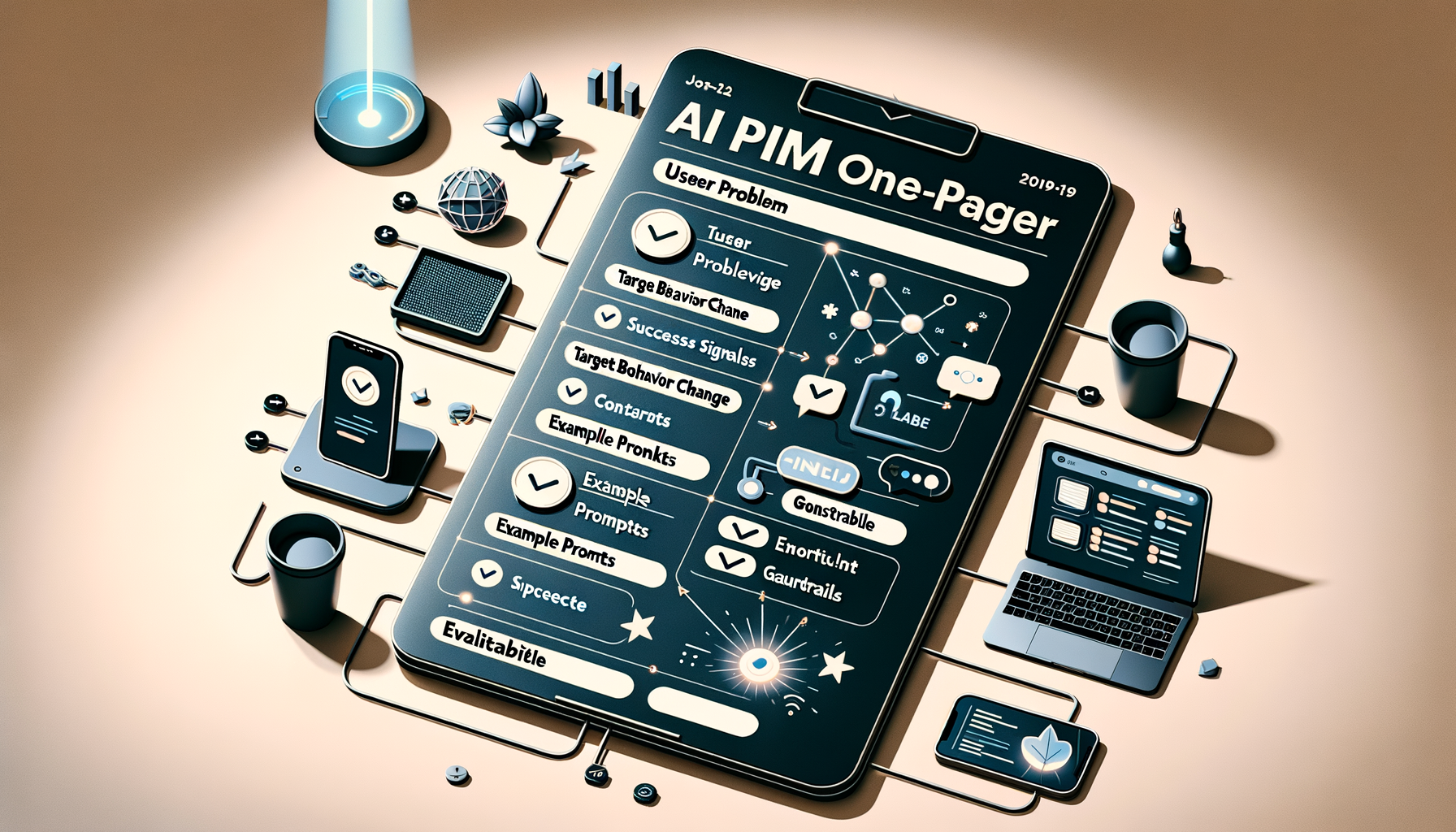
    In practice, my one-pager captures only what’s required to run an immediate experiment: the user problem, the target behavior change, success signals, core constraints, intended AI workflows, and the smallest realistic path to an evaluable demo. I also include example prompts, guardrails, and evaluation criteria so the team can apply prompt engineering and LLMs for product managers without guessing.

    This is eval-driven development in action. I document a minimal hypothesis, concrete inputs/outputs, and a quick plan for metrics, including qualitative signals from product discovery and continuous discovery. By prompting tools directly, we expose assumptions early, shorten feedback loops, and build an AI product toolbox that compounds learning sprint after sprint.

    I run this with a product trio to ensure we balance feasibility, usability, and value. We align on risks, dependencies, and what “good” looks like, then we integrate the learnings into product roadmapping and sprint planning. The result: fewer meetings, tighter collaboration, and empowered product teams delivering sharper outcomes with less friction.

    If you want speed and clarity without sacrificing rigor, adopt the one-pager. It centers the conversation on evidence, accelerates AI workflows from prompt to prototype, and makes it obvious what to try next—and what to stop doing. Most importantly, it keeps the team focused on truth over theater, which is how great AI products actually ship.


    Inspired by this post on Product School.


    Book a consult png image
  • Inside Banani: How a Canvas-First AI Designer Elevates UX and Accelerates Product Teams

    Inside Banani: How a Canvas-First AI Designer Elevates UX and Accelerates Product Teams

    I believe the future of product design isn’t about replacing designers—it’s about giving every team access to one. That’s why Banani grabbed my attention. It’s an AI product designer that doesn’t just generate code—it generates design. For solo founders, stretched design teams, and early-stage startups, that shift matters: it raises the design floor without lowering the creative ceiling.

    I spent time with Vlad Solomakha (CEO & Co-founder), Vova Kovalchuk (CTO & Co-founder), and Vlad Ostapovats (Founding Growth) to unpack how they took Banani from a Figma plugin proof-of-concept to a canvas-first AI design tool generating hundreds of thousands of designs per week. Vlad brings a decade of design experience and a precise north star: AI should produce beautiful, tasteful design rather than average, undifferentiated UI.

    The architectural choices stood out. They engineered their agent to handle parallel screen edits, manage per-screen context across canvases with hundreds of frames, and make surgical edits without regenerating entire screens. This is the kind of agentic AI work that product leaders have been waiting for: concrete advances in context window management, tool orchestration, and prompt engineering that translate into higher throughput without sacrificing quality.

    Equally important is how they addressed the "gulf of specification"—the mismatch between how designers think visually and how agents understand text. Banani’s canvas-first approach acknowledges that design is spatial, hierarchical, and iterative. Rather than forcing a chat-first UX, they center the canvas and let the agent do production work while keeping the designer firmly in control. In practice, this narrows intent ambiguity, speeds up iteration, and preserves taste.

    The team made another pivotal bet: Why Banani doesn’t compile running applications — just HTML/CSS mockups — and how that shapes everything. By decoupling the design artifact from runnable code, they optimize for velocity, taste, and exploration. In my experience, this separation is the right product strategy for early discovery and gen ai for product prototyping—move fast on aesthetics and flows, then converge on implementation once you’ve validated the direction.

    I also appreciated their pragmatic evaluation approach. Instead of traditional evals, they spin up 10 screens from one prompt to compare models. It’s hands-on, outcome-based, and aligned with eval-driven development in real product environments. They’re relentlessly discerning about when to work around model limitations versus when to wait for the models to improve—an essential discipline when building at the edge of what’s possible.

    Under the hood, context engineering and specialized agent tools do the heavy lifting. Per-screen history with shared project context enables precise, reversible changes across large canvases. The result: fewer destructive regenerations, more reliable design intent preservation, and a workflow that feels like collaborating with a strong mid-level designer who’s exceptionally fast and consistent.

    If you want a quick tour, I recommend jumping to a few highlights: 20:13 Product Tour Canvas First AI, 33:40 Gulf of Specification, 42:54 Agent Architecture Under Hood, 48:48 State History Context Tricks, and 56:04 Navigating Busy Canvases. Each segment reveals a different layer of the system design and product thinking behind Banani’s canvas-first UX.

    For product leaders, this is a compelling blueprint for raising the design floor while protecting the last mile of craft. It aligns with empowered product teams, continuous discovery, and LLMs for product managers who need leverage without losing judgment. If you’re exploring agentic AI in design, this is a thoughtful, execution-focused model worth studying and trialing on your next product tour or redesign.

    Resources worth exploring: Banani and TL Draw. To hear the full conversation, you can listen on Spotify or Apple Podcasts. Then, pressure-test the approach inside your own product development lifecycle and see how a canvas-first AI designer reshapes your team’s velocity and quality bar.


    Inspired by this post on Product Talk.


    Book a consult png image
  • Ship MVPs in Days, Not Months: My Proven Prompt Prototyping Playbook for Product Teams

    Ship MVPs in Days, Not Months: My Proven Prompt Prototyping Playbook for Product Teams

    Most MVPs take too long, cost too much, and still miss the mark. Over the past year, I’ve shifted my team to a prototyping prompts approach that lets us validate problem-solution fit in days, not months. The result is faster learning loops, clearer tradeoffs, and a dramatically higher hit rate on features that actually move the needle.

    When I say prototyping prompts, I mean structured, layered instructions that guide gen ai systems to produce the right artifacts at the right fidelity. Instead of jumping straight to code, we generate concise problem briefs, user stories, interaction flows, low-fidelity UI descriptions, and test plans. Each pass is constrained by acceptance criteria and business outcomes, which keeps the work grounded in value rather than output.

    Here’s the playbook my product trios use to go from idea to a testable MVP in 48–72 hours. First, we anchor on outcomes vs output OKRs and clarify the customer job-to-be-done using evidence from customer interviews and support data. This is classic continuous discovery, but we compress it by focusing on the single riskiest assumption to de-risk this week.

    Second, we build a prompt scaffold. We specify the role, constraints, target users, success metrics, and the exact output format we expect. We also define evaluation upfront, borrowing from eval-driven development. For example, before any generation, we list the acceptance tests that a good solution must pass, including edge cases and compliance considerations. This discipline keeps hallucinations in check and improves repeatability.

    Third, we spin up multiple prototypes in parallel. One prompt generates a lean product brief; another outlines user flows; a third proposes UI states and error handling. If we’re exploring voice, we add prompt engineering for voice to script dialogs and repair strategies. For data-heavy features, we call out retrieval-first pipeline patterns so the model references source-of-truth data rather than guessing.

    Fourth, we validate with real users using the lightest-weight experiment possible. Fake-door tests, concierge workflows, and guided click-throughs let us measure intent before we invest. Where we can, we run quick A/B testing and size the effort using minimum detectable effect (MDE) so we don’t over- or under-sample. The point isn’t perfection; it’s fast, directional signal to inform the next iteration.

    Fifth, we instrument and ship behind feature flags. We track activation, task completion, and time-to-value from day one. On the delivery side, we watch DORA metrics and deployment frequency to ensure we’re learning continuously rather than batching big bets. This bridges discovery and delivery so roadmaps reflect real-world feedback, not assumptions.

    One recent example: we needed to evaluate a voice AI agent for appointment scheduling. In 72 hours, prompts produced the problem brief, dialog flows, error recovery strategies, and a sandbox to simulate inbound requests across three user personas. We exposed a thin slice to a pilot cohort, captured call outcomes, and iterated the repair prompts twice before writing any production code. The pilot converted at a higher rate than our control flow and gave us the confidence to invest in full integration.

    This approach only works if we treat governance as a first-class concern. We bake in privacy-by-design, clear data governance boundaries, and AI risk management from the start. Prompts include guardrails on personally identifiable information, explicit constraints on data use, and links to approved sources. We also maintain a prompt repository with versioning and automated evaluations so changes are observable and reversible.

    Practically, strong prompt scaffolds share three traits. They’re specific about context and constraints, they define success in measurable terms, and they separate concerns by artifact type. I’ll often ask for three variants with different tradeoffs, then run a quick synthesis prompt that highlights points of parity and differentiation. This gives the team structured options rather than a single, brittle path.

    If you’re starting from zero, begin with one high-leverage workflow. Write a crisp outcome statement, draft your acceptance tests, and create a prompt that outputs a one-page brief, three user flows, and the top five risks with mitigations. Validate with five users in 48 hours, then decide: double down, pivot, or park. Rinse and repeat, and your product roadmapping and sprint planning will shift from speculation to evidence.

    The bottom line is simple. Prototyping prompts won’t replace product judgment, but they will accelerate it. By turning ideas into testable artifacts in hours, you minimize waste, maximize learning, and ship better MVPs—fast.


    Inspired by this post on Product School.


    Book a consult png image
  • Design Smarter with Amplitude + Figma Make: AI-Powered Prototyping, Testing, and Learning

    Design Smarter with Amplitude + Figma Make: AI-Powered Prototyping, Testing, and Learning

    I rely on Amplitude analytics and Figma Make to turn real user insights into high-fidelity prototypes in hours, not weeks. This pairing compresses our continuous discovery loop and helps my team prioritize what truly moves the needle for customers and the business.

    Design smarter with Amplitude and Figma Make. Use AI and product analytics together to prototype, test, and learn faster.

    Here’s how I put that into practice: I start with product analytics to isolate a measurable opportunity—often around user activation, conversion drop‑offs, or retention analysis. Amplitude cohorts and funnels surface where friction hides; I translate those signals into design prompts and flows in Figma Make, so we can visualize and validate potential solutions before a single line of production code is written.

    Once a promising direction emerges, I convene the product trio—design, engineering, and product—around a clear outcome metric, not output. We build a lightweight driver tree, align on a hypothesis, and define the minimum detectable effect (MDE) so our A/B testing has enough statistical power to be decision‑worthy. From there, we create a small set of Figma Make variations that reflect distinct value hypotheses, not cosmetic tweaks.

    On the experimentation front, I gate risky changes behind feature flags and ship via our CI/CD pipeline to limit blast radius and accelerate feedback. I monitor the experiment with a unified analytics platform mindset: the same definitions and segments in Amplitude power both pre‑launch discovery and post‑launch evaluation. That continuity lets us compare prototype expectations against production reality with far fewer translation errors.

    A few principles keep this workflow sharp and responsible: I use privacy-by-design patterns, apply data governance guardrails to keep datasets consent‑aligned, and set AI risk management standards so generated designs respect accessibility and brand constraints. Critically, I avoid vanity metrics—I measure learning speed, decision quality, and downstream impact on activation or retention, which are what sustain product-led growth.

    If you’re looking for a playbook, try this cadence: 1) define the customer outcome and success metric; 2) map a simple driver tree to narrow the solution space; 3) explore multiple flows in Figma Make; 4) validate quickly with concept tests and usability checks; 5) run A/B testing with a clearly defined MDE; 6) ship iteratively behind feature flags; 7) close the loop in Amplitude with cohort‑level retention analysis; 8) refine copy and UX writing to reinforce the core value proposition. Repeat until the signal is undeniable.

    Blending Amplitude analytics with Figma Make has become my fastest path from insight to impact. It keeps my team focused on learning that compounds, features that matter, and outcomes customers can feel—so we truly make what matters.


    Inspired by this post on Amplitude – Best Practices.


    Book a consult png image
  • Build vs. Buy in an AI-First World: My Framework to De-Risk Decisions and Own Your Data

    Build vs. Buy in an AI-First World: My Framework to De-Risk Decisions and Own Your Data

    Build vs. buy is a decision that never truly goes away, and with AI reshaping the economics of software, I’m revisiting this question more frequently—and with more nuance—than ever. The temptation to “just build it” is real when prototypes are cheaper, shipping feels faster, and small tools can rival big platforms. But the real decision has never been about code; it’s about value, data, and long-term responsibility.

    Across product orgs at every stage, I see the same pattern: AI makes building feel easier—but it doesn’t eliminate the tradeoffs. The hard part is separating what differentiates your product from what simply supports it. That’s why I start by asking whether the capability is truly core to my value stream, and then I force myself to reason about ownership and maintenance, not just velocity.

    My rule of thumb remains simple: If something isn’t core to your value stream, don’t build it. And even when it is core, vendors may still be better positioned—especially for payments, invoicing, and infrastructure. Those domains carry deep operational complexity, continuous compliance, and reliability requirements that are easy to underestimate and painful to own.

    Here’s how this plays out for me. I would never build my own blogging platform. I moved from WordPress to Ghost, because publishing isn’t where I differentiate, and the long tail of upgrades, security, and performance is a drag on focus. The platform does the job, my audience gets a better experience, and my team avoids owning commodity maintenance work.

    On the other hand, I did build my own task management system—despite the abundance of excellent tools like Trello, Evernote, and OmniFocus. For me, tasks, notes, and workflows are deeply personal and idiosyncratic. I wanted my system to reflect how I think, plan, and communicate, with tight integration to my daily product rituals. In this case, the underlying data became the real product—and owning and controlling that data changed the equation.

    That’s the heart of the decision: When the underlying data becomes the real product, ownership matters. Task management, notes, and workflows evolve into a personalized operating system. The moment your data model represents your unique value—and your future differentiation—build vs. buy is no longer a tooling choice; it’s a strategy choice.

    AI is pushing this even further. Cheaper prototyping and “vibe coding” lower the cost of building. Tools like Claude Code and platforms from OpenAI make it viable to ship smaller, targeted tools that would have been uneconomical a few years ago. That expands the frontier of what teams can build without committing to a monolithic platform—and it puts pressure on vendors to improve data portability.

    Which brings me to vendor lock-in. Exports aren’t always enough. When I evaluate CRMs or course platforms, I look for more than CSV dumps. I want robust, well-documented APIs, webhook coverage, import/export parity, schema transparency, and a clear migration path. I’ve seen teams drown in brittle integrations with Salesforce or HubSpot, struggle to unwind course data from Teachable, or get stuck in signature workflows around DocuSign without a clean escape hatch. Portability is table stakes now.

    I treat build vs. buy as a discovery problem. Options are assumptions to test. On the build side, I run feasibility spikes: proof-of-concept integrations, latency checks, cost-to-serve models, and a sober read on maintenance. On the buy side, I trial vendors, not their marketing. I replicate a real workflow, test the edges, validate data portability, and simulate failure modes like vendor downtime or schema changes.

    A word of caution on complexity: “we can build anything” is not the same as “we should build this.” Long-lived products accumulate hidden complexity over time—security, privacy, performance, observability, SRE runbooks, QA automation, documentation, and compliance. Be honest about engineering capabilities and maintenance costs, especially when uptime and regulatory exposure are in play.

    My practical checklist looks like this: Is this core to our differentiation? Do we need to own the data model? How strong is data portability (APIs, webhooks, mapping, re-import)? What’s the true total cost of ownership over three years (people, ops, security, compliance)? Are there regulatory or reliability constraints better handled by a vendor? What’s the opportunity cost of not building something more strategic? And if we buy, what’s our exit plan?

    Ultimately, build vs. buy isn’t just about speed or cost—it’s about core value, data ownership, and long-term responsibility. AI lowers the barrier to building, but it doesn’t erase complexity. Treat build vs. buy decisions like any other discovery effort: test assumptions, prototype, and validate before committing. Ask not just can we build it, but should we own it?

    If you’re wrestling with vendor lock-in, fielding pressure to “just build it,” or rethinking your stack in an AI-first world, this lens will help you ask better questions before you commit. And if you’re exploring targeted builds alongside platforms like Stripe, Dropbox, Obsidian, or Ghost, I’d love to hear what’s working for you and where portability remains a hurdle.


    Inspired by this post on Product Talk.


    Book a consult png image
  • Building Physician‑Grade AI When Trust Is Everything: Inside Healio’s Proven Playbook

    Building Physician‑Grade AI When Trust Is Everything: Inside Healio’s Proven Playbook

    Trust is the currency of any high-stakes AI product, and nowhere is that more true than in healthcare. I recently dug into how Healio built an AI assistant for physicians—an audience that can’t afford to be wrong—and it’s a masterclass in balancing accuracy, transparency, and speed without compromising credibility.

    Healio, a 125-year-old medical publishing company, set out to create Healio AI to help clinicians prepare for patient care. From the outset, their guiding principle was simple: physicians won’t trust you until you prove it. That lens shaped every decision—from discovery and prototyping to architecture, evaluation, and ongoing validation.

    Discovery started with a survey of 300 healthcare professionals to understand real-world needs at the point of care. The headline insight: physicians primarily want AI for preparation, not bedside use. Even more surprising, the top ask wasn’t purely diagnostic support; it was help with patient communication and empathy—translating complex information into clear, accessible conversation.

    Momentum mattered. After beginning with Figma mockups to validate workflows, the team built a working prototype in a single weekend using Cursor. That velocity wasn’t about cutting corners; it was about proving value quickly, reducing ambiguity, and iterating with concrete feedback from physicians.

    Under the hood, the system employs RAG and hybrid search—combining lexical search, vector search, and semantic search across multiple trusted sources like PubMed. As any PM who has integrated biomedical literature knows, "just use PubMed" isn’t simple—there are five different ways to access the same data, each with trade-offs. The team made pragmatic choices to balance freshness, coverage, latency, and cost while preserving trust in source quality.

    Designing for trust extended all the way to the citation UX. The team leaned into citations that physicians actually trust: subscripts, hover states, and progressive disclosure. This gave clinicians verifiable threads back to source material without overwhelming the core interaction, aligning with how experts want to audit evidence under time pressure.

    Evaluation wasn’t left to chance. They stood up eight LLM judges for evals: safety, medical accuracy, faithfulness, relevancy, completeness, reasoning, clarity, and overall quality. Just as importantly, they treated those signals as directional, not definitive. In a high-stakes domain, physician feedback trumps LLM-as-judge feedback—so they complemented automated evals with direct reviews from practicing clinicians to calibrate quality and reduce hallucinations.

    On the safety front, the team implemented HIPAA compliance and input guardrails for masking personal health information. That choice reflects strong data governance and privacy-by-design thinking: protect PHI by default, constrain prompts to safe boundaries, and make compliance a first-class citizen in the product architecture.

    They also addressed monetization without compromising experience. Serving contextual ads while the LLM processes queries is a practical approach that preserves physician workflow efficiency and creates a clear, non-intrusive revenue model.

    Critically, the work didn’t stop at launch. The Healio Innovation Partners provide ongoing discovery and validation, ensuring the system evolves with physician needs and the medical evidence base. This is the operating cadence you want for any AI product that sits at the intersection of safety, accuracy, and fast-changing knowledge.

    My takeaways for building AI in high-stakes domains: prioritize retrieval-first pipelines over model cleverness; couple RAG with hybrid search across vetted sources; design citations that earn trust at a glance; use eval-driven development, but let domain-expert feedback be the ultimate judge; and embed regulatory compliance into your product strategy from day one. If trust is your North Star, this is a playbook worth emulating.


    Inspired by this post on Product Talk.


    Book a consult png image
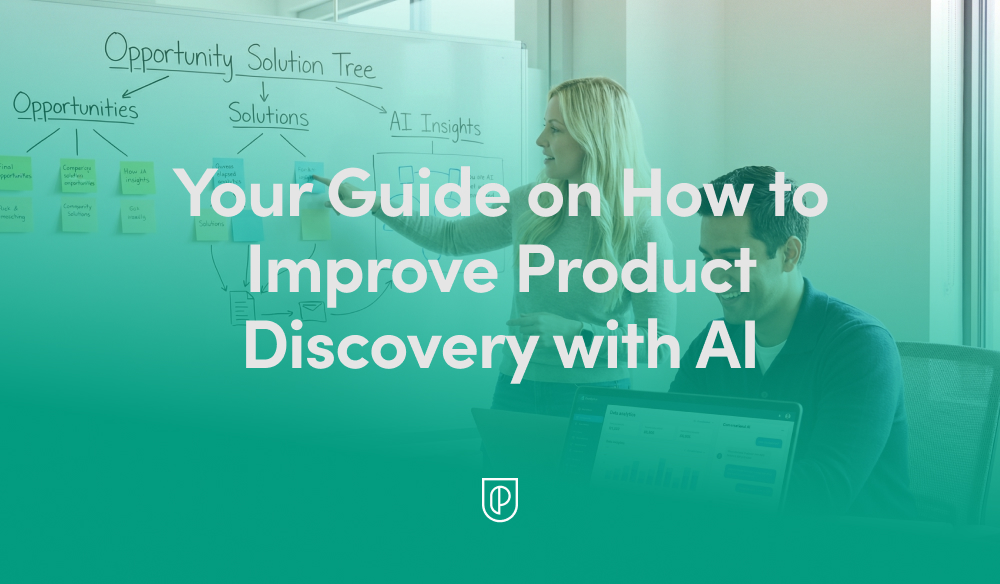
  • How I Harness AI to Supercharge Product Discovery for Faster Research, Prototyping, and Validation

    How I Harness AI to Supercharge Product Discovery for Faster Research, Prototyping, and Validation

    I’ve led product teams through countless discovery cycles, and nothing has accelerated our learning loops like AI. By weaving AI into our continuous discovery practice at HighLevel, I cut time-to-insight, reduce risk earlier, and keep our product strategy relentlessly focused on customer outcomes.

    AI streamlines product discovery by accelerating research, prototyping, and validation, enabling teams to make faster, smarter, and user-driven decisions.

    In the research phase, I use gen ai and LLMs for product managers to synthesize interviews, cluster themes, and surface unmet needs in minutes instead of days. Pairing those qualitative insights with behavioral signals in Amplitude analytics helps me spot high-intent cohorts and friction points at scale, so our problem framing is both human-centered and data-backed.

    From there, I translate insights into crisp hypotheses and prioritize with the Kano Model and outcomes vs output OKRs. To keep experiments honest, I define a minimum detectable effect (MDE) up front and design A/B testing plans that reflect realistic traffic and seasonality, ensuring our decisions are statistically grounded rather than anecdotal.

    Prototyping is where gen ai for product prototyping really shines. I spin up multiple UX flows, UI copy variants, and edge-case scenarios using prompt engineering, then iterate with rapid feedback from product trios. When needed, I mock in-app guides and product tours to validate onboarding concepts before we commit to code, preserving velocity without sacrificing quality.

    For validation, I lean on a mix of lightweight experiments—fake-door tests, concierge pilots, and targeted A/B testing—augmented by in-product surveys via Pendo or Intercom. For AI-powered features, I apply eval-driven development to measure relevance, latency, and safety, so we can ship responsibly while maintaining the pace of learning.

    This approach only works when the team is structured to move fast. Empowered product teams and product trios own discovery end-to-end, with clear guardrails around data governance, privacy-by-design, and AI risk management. That alignment lets us shift from opinions to evidence, and from output to outcomes, without friction.

    If you’re getting started, pick one discovery loop to transform: automate research synthesis, prototype two to three variants with AI, and validate with a tightly scoped experiment. Instrument your analytics, track time-to-insight and time-to-prototype, and iterate your product roadmapping and sprint planning with what you learn. The payoff is immediate: faster cycles, stronger conviction, and a more user-driven path to product-led growth.


    Inspired by this post on Product School.


    Book a consult png image
  • From Idea to Impact: How AI Supercharges Product Design, Testing, and Time-to-Value

    From Idea to Impact: How AI Supercharges Product Design, Testing, and Time-to-Value

    AI is changing how I build products, not by replacing designers or researchers, but by amplifying the quality and speed of what our product trios can deliver. The real breakthrough isn’t a single tool; it’s the way genAI and traditional methods combine into a tighter discovery–design–delivery loop that shortens time-to-value without sacrificing rigor.

    Learn how Pendo’s product design team is using genAI and traditional tools to speed up design and development.

    In practice, that’s exactly the pattern I see working across my teams: we treat genAI as part of the AI product toolbox—great for rapid exploration, structured synthesis, and test preparation—while we rely on our proven techniques to validate outcomes. For early-stage concepting, I use prompt engineering to generate multiple storyboard options and interaction flows in minutes, then refine those outputs with our design system for alignment and accessibility. It’s a pragmatic “gen ai for product prototyping” approach that lets us compare more alternatives, faster, with better signal.

    On the testing front, AI accelerates everything around A/B testing without diluting statistical discipline. We draft hypotheses, define success metrics, and estimate minimum detectable effect (MDE) with guardrails, then deploy variants via feature flags in CI/CD. That pairing—LLMs for product managers plus eval-driven development—keeps experiments reproducible while boosting deployment frequency. The outcome is fewer opinions, more evidence, and a tighter feedback loop from build to learn.

    Research goes from weeks to days when we combine a retrieval-first pipeline for qualitative data with strong data governance. I’ll ingest interview notes, support tickets, and session transcripts to cluster themes, then pressure-test the clusters with live customer calls. Privacy-by-design and AI risk management remain non-negotiable: we redact sensitive fields, constrain context windows, and keep a human-in-the-loop for decisions that affect user experience or compliance.

    Where analytics meets adoption, tools like in-app guides and product tours help us translate insights into behavior change. I’ll prototype a flow, auto-generate guidance variants, and run controlled rollouts to target segments, measuring activation and retention analysis in parallel. This is product-led growth in action: discover the friction, design the intervention, instrument the journey, and validate outcomes with unified analytics.

    Organizationally, empowered product teams and continuous discovery make the difference. Our product trios work from outcomes vs output OKRs, pairing competitive differentiation with product strategy to keep bets focused. We meet weekly to review experiment readouts, model trade-offs with the Kano Model, and update product roadmapping and sprint planning based on verified learning—never vibes alone.

    If you’re getting started, begin with one workflow—say, prototype generation plus structured experiment design—and measure impact across cycle time, experiment throughput, and decision quality. Layer in communities of practice to share prompt patterns, establish eval baselines, and codify what “good” looks like. The companies winning with AI aren’t chasing shiny objects; they’re building a repeatable system that turns curiosity into customer value.


    Inspired by this post on Pendo – Best Practices.


    Book a consult png image
  • AI in Product Design: My Proven Playbook, Real Use Cases, and the Tools That Win Faster

    AI in Product Design: My Proven Playbook, Real Use Cases, and the Tools That Win Faster

    In product design, AI has shifted from novelty to non-negotiable. I’ve watched teams accelerate discovery, compress prototyping cycles, and turn ambiguous ideas into validated experiences faster than ever—without sacrificing quality or customer trust.

    AI in product design has quickly moved from new to necessary. Here are the AI product design tools and approaches you need to stay relevant in this decade.

    From my vantage point leading product teams, “necessary” means AI is woven throughout the product lifecycle—discovery, prioritization, prototyping, validation, and iteration—not bolted on. The goal isn’t to chase hype; it’s to build durable advantage with clear AI Strategy, disciplined execution, and measurable outcomes.

    First, anchor the work in strategy. Tie every AI initiative to a specific customer problem and value proposition, then express that linkage with outcomes vs output OKRs. This keeps teams focused on real impact and avoids feature-chasing. It also sharpens product positioning and clarifies where AI can deliver competitive differentiation versus simple points of parity.

    Second, upgrade discovery. I rely on AI workflows to synthesize interviews, cluster themes, and surface insights at scale. A retrieval-first pipeline—grounding models in our own data—improves factuality and reduces hallucinations. Combine this with strong data governance and privacy-by-design so insights are trustworthy and compliant from day one.

    Third, make quality measurable. Adopt eval-driven development: define evaluation sets and acceptance thresholds that reflect real user tasks before you ship. Pair that with A/B testing and minimum detectable effect (MDE) discipline, so you learn quickly and confidently. Add safety guardrails (red-teaming prompts, content filters, and bias checks) to manage AI risk without slowing the pace.

    Fourth, enable empowered product teams. Product trios (PM, design, engineering) should co-create prompts, prototypes, and evaluation criteria. Give designers and PMs practical tools—LLMs for product managers, structured prompt templates, and reusable components—so AI-augmented work becomes the default, not a special project.

    Where does AI shine in product design today? Concept exploration and market scans, turning fuzzy opportunity spaces into crisp problem statements. Rapid wireframes and interaction ideas, using gen ai for product prototyping to explore multiple design directions in minutes. UX writing that adapts tone and reduces friction across onboarding, tooltip design, and microcopy.

    It also excels at guided experiences. I’ve seen strong lifts in user activation when we pair in-app guides and product tours with context-aware suggestions. For support and education use cases, a retrieval-grounded assistant can deflect tickets, shorten time-to-value, and reinforce the product’s value proposition at the exact moment a user needs help.

    Voice is another frontier. A well-scoped voice AI agent can accelerate complex workflows (think data entry or multi-step configurations) when hands-free is faster or more intuitive. Just be intentional about when agentic AI adds net value versus when a simple UI tweak would do.

    On the tooling side, my AI product toolbox is pragmatic and modular. For analytics and learning loops, Amplitude analytics and Pendo help quantify behavior changes and retention analysis. For in-product engagement and feedback routing, Intercom and HubSpot integrate cleanly with LLM-driven tagging and summarization. For ideation and automation, I use a ChatGPT connector and Claude Code for quick scripts, data wrangling, and prompt experiments. The constant: a retrieval-first pipeline that grounds models in approved knowledge and maintains context window management at scale.

    Risk management is built in, not bolted on. Set clear AI risk management policies, catalog model and data dependencies, and document decisions. Align with regulatory compliance requirements early, and keep an audit trail of prompts, datasets, and eval results. That’s how you move fast without breaking trust.

    If you’re getting started, begin small: pick one high-friction workflow, add a retrieval-grounded copilot, and measure the lift. Use the results to inform product roadmapping and sprint planning, then scale to adjacent use cases. With disciplined discovery, sharp evaluation, and the right tooling, AI becomes a force multiplier for product teams and a clear win for customers.


    Inspired by this post on Product School.


    Book a consult png image
  • From No-Code Hack to 10,000 Weekly Calls: Inside Perk’s Voice AI That Actually Works

    From No-Code Hack to 10,000 Weekly Calls: Inside Perk’s Voice AI That Actually Works

    I love real-world AI that ships, scales, and actually solves painful customer problems. This story checks every box. As a product leader who has brought agentic AI to production environments, I was captivated by how a small, focused team at Perk took a no-code voice AI prototype and turned it into a system that reliably makes 10,000+ calls per week to prevent failed hotel payments.

    What happens when you combine a real customer problem, a no-code prototype, and a team willing to listen to every single call?

    Steven Payne (Product Manager), Gabriel Stock (Senior Engineering Manager), and Philipe Steiff (Senior Software Engineer) from Perk share how they built a voice AI agent that calls hotels to verify virtual credit card payments, preventing travelers from arriving to find their rooms unpaid. This is a textbook example of linking operational pain to a high-leverage AI solution.

    What started as a hackathon experiment in Make.com became a production system handling over 10,000 calls per week across multiple languages. Along the way, the team learned hard lessons about prompt engineering for voice (numbers, pronunciation, and a very "Karen-like" first version), how to break a single monolithic prompt into structured conversation stages, and why listening to actual calls beats any amount of theorizing.

    From a product management perspective, this approach aligns perfectly with eval-driven development and continuous discovery. Structure the problem, instrument aggressively, ship safely, then listen—deeply—to real interactions. In my own teams, I’ve seen that nothing accelerates iteration on agentic AI like closing the loop between qualitative call reviews and quantitative evals.

    They built a working prototype without writing a single line of backend code.

    They structured the call into discrete stages (IVR, booking confirmation, payment) to improve reliability.

    They created two eval systems: one for call success classification, another for conversational behavior.

    They scaled from five calls a day to tens of thousands per week while maintaining quality.

    This is a detailed look at building AI for real-time human interaction—where the stakes are high and the feedback is immediate.

    Guests: Steven Payne, Product Manager, Perk; Gabriel Stock, Senior Engineering Manager, Perk; Philipe Steiff, Senior Software Engineer, Perk.

    What stood out to me was how Perk's team identified an AI use case by connecting prior experimentation with a real operational problem. Why they chose Make.com for prototyping—and shipped to production without touching backend code—underscores how far no-code can take you when paired with crisp problem framing. The evolution from a single prompt to structured conversation stages (IVR handling, booking confirmation, payment request) is exactly how you harden agent behavior for production.

    Breaking up the agent's task dramatically improved reliability. They also built two eval systems: classification for success rates and LLM-as-judge for conversational behavior. Even with automation, the team still listens to calls manually—a practice I strongly endorse for uncovering edge cases, trust issues, and UX nuances that dashboards can’t show.

    The challenge of prompt engineering for voice—numbers, booking references, and text-to-speech markup—was non-trivial. Expanding to German revealed that prompts in native language improve results. And, as often happens with operations-heavy rollouts, this project uncovered other operational problems they didn't know existed—valuable signal for the roadmap.

    Resources & Links: Perk. Make.com — No-code automation platform used for the prototype. Twilio — Voice/telephony provider. Eleven Labs — Text-to-speech provider (used in early experiments).

    Chapters: 00:00 Introduction to the Team; 01:54 Understanding PERK's Mission; 02:59 Challenges in Travel Booking; 07:27 AI Solutions for Customer Care; 09:52 Prototyping with AI and Voice; 17:00 Implementing AI in Production; 25:51 Learning Through Trial and Error; 26:40 Prompting Challenges and Solutions; 27:58 Iterating on Prompts and Evaluations; 30:08 Scaling and Production Challenges; 32:43 Advanced Evaluation Techniques; 35:32 Real-World Applications and Success; 49:07 Future Directions and Expansion; 53:53 Conclusion and Team Reflections.

    My product takeaways: Start with clear operational pain and measurable outcomes (e.g., payment verification). Use no-code to validate quickly, then progressively harden. Treat voice AI like any production system: break it into deterministic stages, add guardrails, and measure both outcome and behavior. Pair automated evals with hands-on reviews. And when going multilingual, write prompts in the native language—your accuracy will thank you.

    If you’re exploring agentic AI for operations, this is the blueprint: tight scoping, Make.com for speed, Twilio for reliability, structured prompts for control, and an eval-driven loop to scale quality with confidence.


    Inspired by this post on Product Talk.


    Book a consult png image