The AI PM One-Pager: Radical prototyping requirements for speed, clarity, and truth

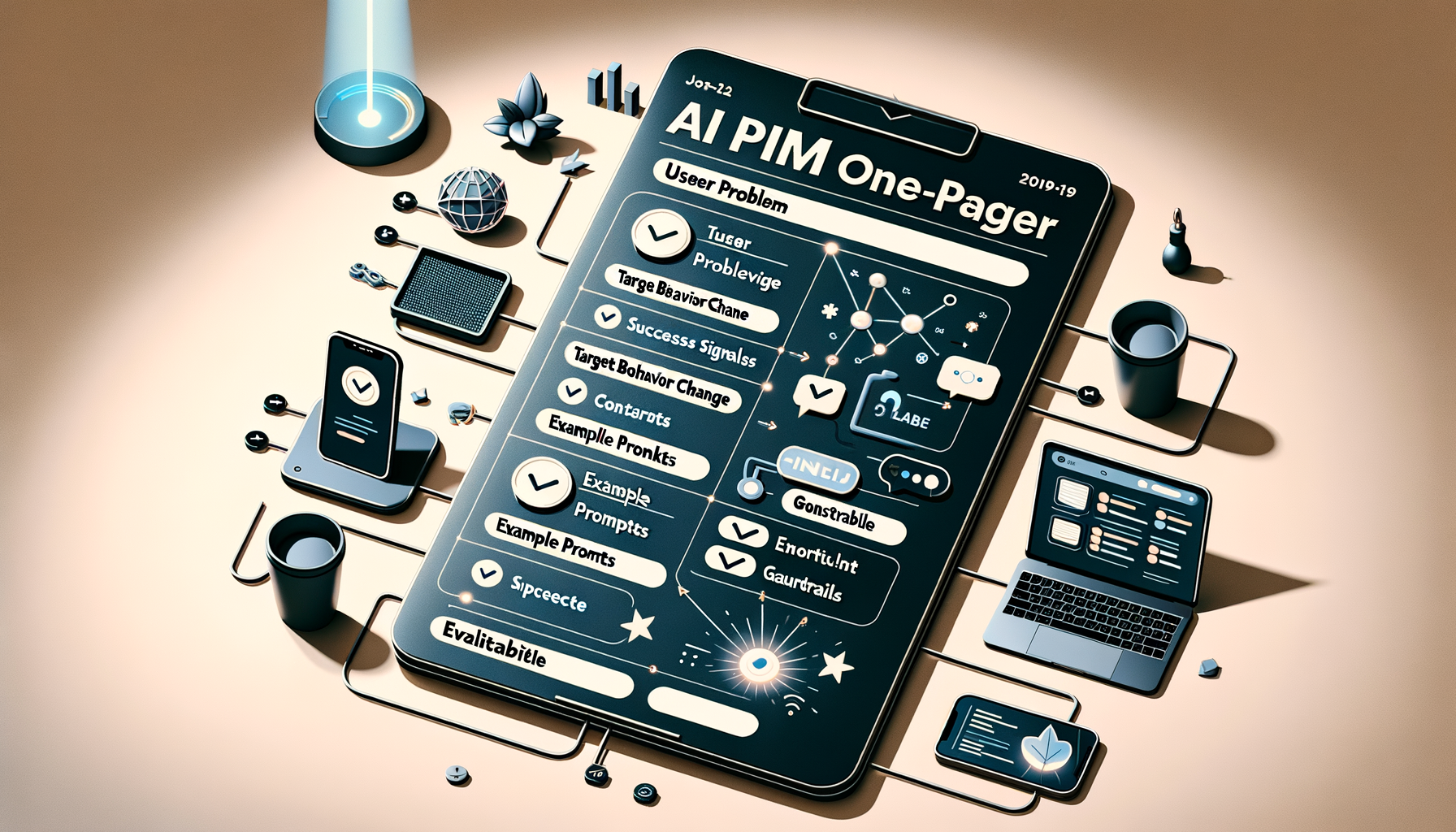
Isometric 3D illustration of a large smartphone UI titled AI PIM One-Pager, showing checklists, nodes, and diagrams, wired to a laptop, phone, and desk items by circuit-like traces.

I move fastest in Generative AI when I strip work down to its essential signals. At HighLevel, I rely on a single-page format—”Prototyping Requirements: The One-Pager for AI PMs”—to turn ideas into testable artifacts within hours, not weeks. This approach reinforces AI Strategy, minimizes coordination overhead, and keeps Product Management focused on learning over ceremony.

“Prototyping requirements go rogue: one page, zero bureaucracy, built for AI. Shape concepts fast, prompt tools directly, and get to the truth sooner.”

In practice, my one-pager captures only what’s required to run an immediate experiment: the user problem, the target behavior change, success signals, core constraints, intended AI workflows, and the smallest realistic path to an evaluable demo. I also include example prompts, guardrails, and evaluation criteria so the team can apply prompt engineering and LLMs for product managers without guessing.

This is eval-driven development in action. I document a minimal hypothesis, concrete inputs/outputs, and a quick plan for metrics, including qualitative signals from product discovery and continuous discovery. By prompting tools directly, we expose assumptions early, shorten feedback loops, and build an AI product toolbox that compounds learning sprint after sprint.

I run this with a product trio to ensure we balance feasibility, usability, and value. We align on risks, dependencies, and what “good” looks like, then we integrate the learnings into product roadmapping and sprint planning. The result: fewer meetings, tighter collaboration, and empowered product teams delivering sharper outcomes with less friction.

If you want speed and clarity without sacrificing rigor, adopt the one-pager. It centers the conversation on evidence, accelerates AI workflows from prompt to prototype, and makes it obvious what to try next—and what to stop doing. Most importantly, it keeps the team focused on truth over theater, which is how great AI products actually ship.


Inspired by this post on Product School.


Book a consult png image

What is the AI PM One-Pager?

The AI PM One-Pager is a single-page format designed to turn ideas into testable artifacts within hours, not weeks. It centers the user problem, the target behavior, success signals, and constraints to guide fast, evaluable experiments.

What elements does the one-pager capture?

It captures what’s needed to run an immediate experiment: the user problem, the target behavior change, success signals, core constraints, intended AI workflows, and the smallest realistic path to an evaluable demo. It also includes example prompts, guardrails, and evaluation criteria to guide prompt engineering.

How does it reduce meetings and improve speed?

It is run with a product trio to balance feasibility, usability, and value, aligning on risks and dependencies and integrating learnings into roadmapping and sprint planning. The result is fewer meetings, tighter collaboration, and empowered product teams delivering sharper outcomes.

What is eval-driven development?

Eval-driven development documents a minimal hypothesis, concrete inputs and outputs, and a quick plan for metrics, including qualitative signals from product discovery and continuous discovery. Prompting tools directly helps expose assumptions early and shorten feedback loops.

How does the approach affect shipping AI products?

It centers the conversation on evidence and accelerates AI workflows from prompt to prototype. It helps teams decide what to try next and what to stop doing, enabling faster, more rigorous shipping of AI products.

What inspired the approach?

It was inspired by a Product School post about prototyping requirements—the One-Pager for AI PMs. The post provided the framework for focusing on speed, clarity, and truth in AI product prototyping.

Comments

Leave a Reply

Your email address will not be published. Required fields are marked *

Signup for Weekly Digest Emails

Categories

Archieve