Tag: eval-driven development

  • AI Evals for Product Managers: How I Measure Agent Quality—A Beginner’s Playbook

    AI Evals for Product Managers: How I Measure Agent Quality—A Beginner’s Playbook

    I’ve led multiple AI agent launches, and the single most reliable way I’ve found to ship with confidence is to treat evaluations as a product capability, not a side project. When we make AI quality measurable, predictable, and comparable over time, we move faster, reduce risk, and build trust with customers and stakeholders.

    Learn how product managers use AI evaluations to measure agent quality. Covers traces, LLM judges, offline evals, online evals, and how to connect evals to product outcomes.

    Why does this matter so much in product management? Because agent quality is only meaningful when it drives adoption, satisfaction, and revenue. I use eval-driven development to align the day-to-day iteration of prompts, policies, and workflows with business outcomes like activation, retention, and Net Recurring Revenue (NRR). That alignment turns AI quality from an abstract notion into a roadmap lever.

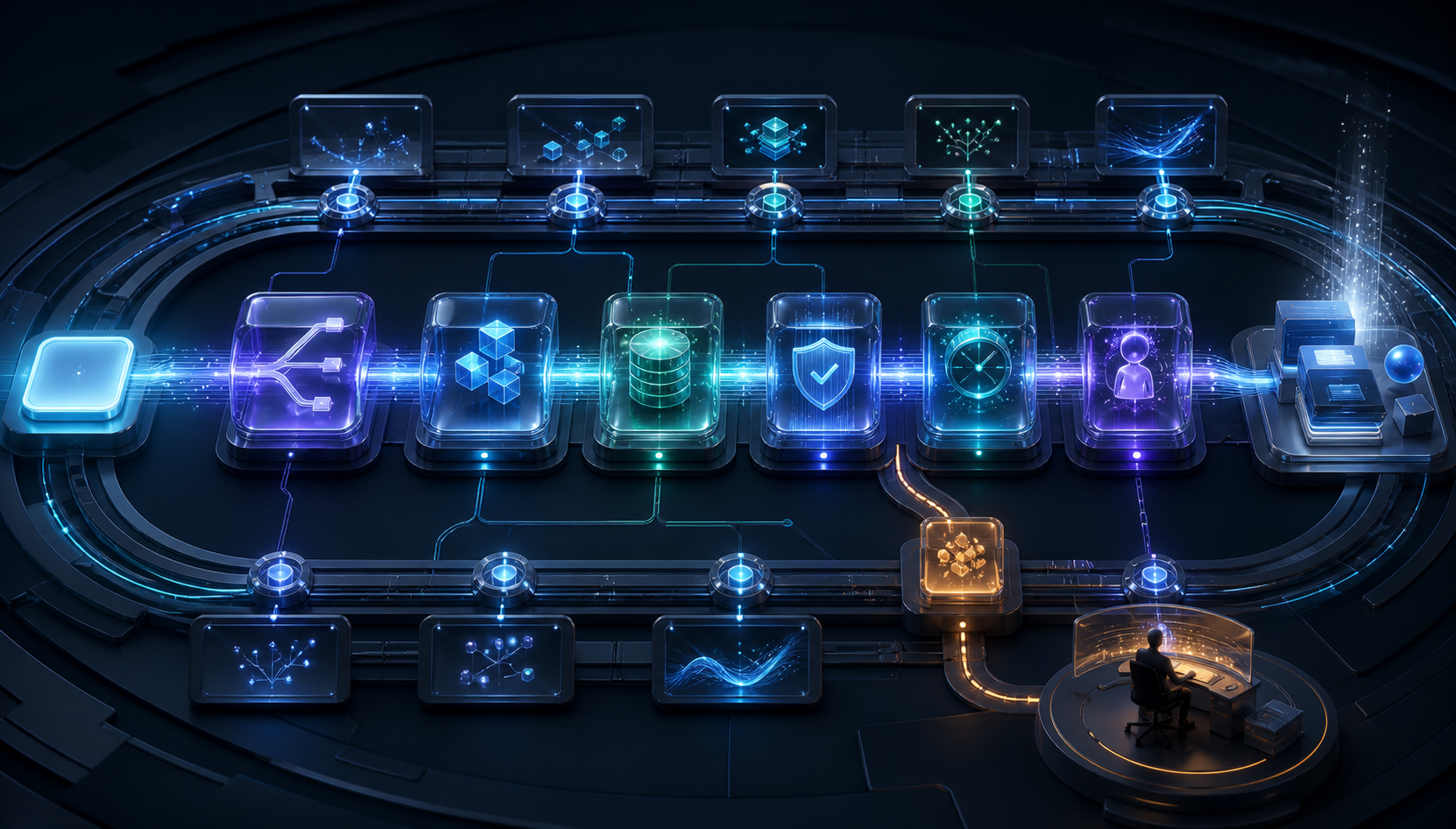
    First, traces. Traces are the spine of evaluation for agentic AI: they capture inputs, intermediate steps, tools invoked, and final responses. I instrument traces to make reasoning visible—what the agent tried, where it hesitated, and why it chose a path. With that visibility, I can compare prompts, policies, and tools, and I can teach the team to fix the root cause instead of patching symptoms. This is also where Agent Analytics becomes real: we move from anecdotes to observable behavior trends across cohorts and use cases.

    Next, LLM judges. I use model-as-judge to score qualities like helpfulness, coherence, or adherence to brand and policy. The trick is calibration. I pair LLM judges with a small, high-quality human-labeled set to ground the scale, then monitor drift as models, prompts, or data shift. LLM judges help me evaluate at speed, but I still spot-check edge cases and highly regulated flows to balance efficiency with risk controls.

    Offline evals come first. Before I expose users to changes, I run fixed test suites representing core scenarios, failure modes, and edge cases. I include golden examples, adversarial prompts, and domain-specific queries. Metrics cover task success, factuality, safety, latency, and cost. This is where prompt engineering and retrieval quality are tuned; if I’m using a retrieval-first pipeline, I evaluate evidence quality separately from generation so improvements are attributable and reproducible.

    Online evals follow to validate real-world performance. I roll changes out behind feature flags and use A/B testing to compare variants under production conditions. I track conversation outcomes, tool success rates, fallbacks to human support, and user satisfaction. These online signals close the loop on whether an offline improvement actually compounds value in the product—critical for product-led growth.

    Connecting evals to product outcomes is non-negotiable. I map quality signals to a driver tree: from per-turn scores (helpfulness, safety, latency) up to session-level outcomes (task completion, deflection, revenue intent), and finally to product KPIs (activation, retention, NRR). With this structure, I can set thresholds for launch gates, prioritize roadmap items that move the biggest levers, and build dashboards that leadership understands at a glance.

    A few lessons learned. Start with a minimal but durable test set and grow it as you discover new failure modes. Version everything—prompts, tools, and datasets—so you can reproduce wins. Beware metric drift when you swap models or update prompts. Blend human review where the cost of error is high. Above all, make evaluations part of your AI workflows and sprint rituals so quality improves continuously, not sporadically.

    If you’re just getting started, begin with traces and a small offline suite, add LLM judges for scale, then prove impact with a focused online experiment. Within a few cycles, you’ll have a living evaluation system that guides decisions, accelerates delivery, and gives your team—and your customers—confidence in every AI release.


    Inspired by this post on Amplitude – Perspectives.


    Book a consult png image
  • We Open-Sourced Our AI Skills Library: Reusable Skills to Supercharge Product Velocity

    We Open-Sourced Our AI Skills Library: Reusable Skills to Supercharge Product Velocity

    We open-sourced our AI Skills library. Here's what we built, why we built it, and how to use it. I’m sharing the approach we’ve used to move faster with more confidence across product discovery, prototyping, and production—while keeping governance, safety, and measurement front and center.

    What we built is a modular, open-source library of “skills” for agentic AI and LLM-powered workflows—things like retrieval and grounding, summarization, classification, tool-use, data enrichment, safety guardrails, and evaluation harnesses. Each skill follows consistent interfaces and conventions so teams can compose them like building blocks, swap implementations without breaking flows, and standardize best practices across products.

    Why we built it is simple: we kept rebuilding the same core capabilities across experiments and teams. Standardizing these skills accelerates time-to-value, reduces integration risk, and helps product trios collaborate with a common language. It also lets us scale what works—prompt patterns, eval datasets, telemetry—so every new initiative starts on third base instead of at bat.

    How to use it in practice: start by running a quick-start example to see a baseline skill chain in action. Then compose your own flow by selecting skills (for example, retrieval + summarization + tool call), configure them with environment variables and guardrails, and wire in evaluation datasets. From there, instrument the pipeline with metrics so you can compare variants and promote the best-performing chain to your main app or API.

    In a typical stack, the library dovetails with analytics and experimentation: ship skill variants behind feature flags, measure impact with A/B testing, and observe runtime behavior with logs and traces. CI/CD hooks let you run evals pre-merge, and production dashboards keep an eye on latency, cost, and outcome quality. This creates a virtuous loop where ideas move from prototype to production with clear evidence.

    Common use cases include customer support summarization and triage, lead scoring and enrichment, anomaly detection in product telemetry, and automated content workflows. Because the skills are composable, you can try multiple retrieval-first strategies, swap prompt templates, or add tools (search, RAG, calculators, connectors) without rewriting everything from scratch.

    Governance and safety are built in. Guardrails handle PII redaction, content policy checks, and rate limiting; configs make it easy to enforce privacy-by-design; and evaluation harnesses encourage an eval-driven development culture. The result is faster iteration without sacrificing data governance or reliability.

    If you want to contribute, add a new skill, improve prompts, share eval datasets, or open an issue with a scenario you want supported. The roadmap focuses on richer retrieval adapters, better test fixtures, and deeper observability so teams can debug and optimize complex chains with confidence.

    I’m excited to see how you’ll use the library to accelerate your roadmap. Clone it, run a quick start, and compose your first workflow today—then measure, iterate, and scale what works. I’ll keep sharing patterns, learnings, and updates as we grow the skills catalog and sharpen the tooling.


    Inspired by this post on Amplitude – Perspectives.


    Book a consult png image
  • Decode How Amplitude AI Thinks: Proven Workflows to Get Actionable, High-Accuracy Results

    Decode How Amplitude AI Thinks: Proven Workflows to Get Actionable, High-Accuracy Results

    I’ve learned that the fastest way to unlock better AI outcomes is to understand how the system reasons, then partner with it deliberately. In product organizations, that means treating AI like a capable collaborator with a transparent process, clear inputs, rigorous checks, and measurable success criteria. When I work this way, my teams ship insights and experiments faster—and with far fewer surprises.

    Discover how Amplitude AI thinks and best practices for working with it. Partner with AI at each step of its process for more accurate, actionable outputs.

    Here’s the mental model I use. AI moves through a series of steps: clarify the goal, ingest context, retrieve and rank relevant information, reason through candidate solutions, draft an answer, self-critique, and refine. My job is to actively guide each step. I define the objective precisely, supply high-signal context, specify constraints, ask for structured reasoning, and require a quality bar before anything ships to stakeholders.

    Start by setting intent and success criteria. I write a one-sentence objective (“what problem are we solving now”), then define the evaluation rubric (“what good looks like”) up front. This small habit powers eval-driven development: it keeps AI outputs aligned with product goals, not just plausible-sounding text. I’ll often include target metrics and guardrails, such as confidence thresholds or required evidence from “Amplitude analytics.”

    Next, I curate the context. For analytics use cases, I provide event taxonomies, metric definitions, segments, and recent behavioral analytics trends to ground the model. A retrieval-first pipeline helps here: I scope the corpus, trim noise, and apply context window management so the model sees only what’s essential. The result is sharper, faster answers that map to our real data model and “unified analytics platform.”

    Then I shape the prompt. I use concise role framing, 1–3 high-quality exemplars, and explicit constraints (format, length, tone, citation requirements). I also ask the model to show its reasoning with a short, labeled scratchpad and to state uncertainties. This is practical prompt engineering—not magic—designed to make reasoning inspectable and reproducible across “AI workflows.”

    When tools are available, I encourage agentic AI patterns: let the system plan, call functions, and iterate. With “Amplitude AI,” I ask it to propose the next best analysis (e.g., segment drill-down, funnel step attribution, or anomaly detection), run it, summarize findings, then reflect on whether the next step changes. If you’re using “Amplitude MCP,” formalize these actions as callable tools so the model can chain them reliably.

    Quality is never an afterthought. I build lightweight evaluations into every loop: compare the model’s output against the rubric, check factual grounding, and A/B test alternative prompts for clarity and conversion where appropriate. Over time, these evaluations become our regression suite, giving us confidence as data, prompts, or model versions evolve. This discipline keeps LLMs for product managers aligned with shifting business priorities.

    Finally, I turn insights into action. I ask “Amplitude AI” for decision-ready artifacts—clear hypotheses, prioritized opportunities, and concrete next steps owners can execute. I require the model to cite the specific supporting events or segments and to flag assumptions. That last step is crucial: it invites human judgment where it matters and prevents automation from outpacing accountability.

    This approach doesn’t slow teams down; it speeds them up with focus. By guiding each step—intent, context, reasoning, tools, and evaluation—you transform AI from a black box into a reliable copilot. The payoff is tangible: clearer insights, faster cycles, and outputs stakeholders trust the first time they see them.


    Inspired by this post on Amplitude – Perspectives.


    Book a consult png image
  • AI Broke Your A/B Tests: 3 Proven Shifts to Rebuild a Resilient Experimentation Program

    AI Broke Your A/B Tests: 3 Proven Shifts to Rebuild a Resilient Experimentation Program

    I’ve watched a once-reliable A/B testing playbook buckle under the weight of generative AI. Traffic patterns aren’t stable, LLMs update behind the scenes, prompts evolve weekly, and personalization reshapes cohorts mid-flight. The result is non-stationary data, diluted statistical power, and “wins” that don’t replicate in production. If your experimentation program feels slower, noisier, and less trustworthy, you’re not imagining it—and you’re not alone.

    Learn why running more tests isn’t the answer to AI, and the three ways mature teams are shifting their experimentation programs.

    First, I’ve shifted from test volume to an evaluation stack—what I call eval-driven development. Instead of defaulting to production A/B tests, we front-load learning with offline evaluations (golden sets, synthetic scenarios), automated regressions on prompts and policies, and pre-production canaries. We size experiments with a clear minimum detectable effect (MDE), use sequential or Bayesian methods to handle drift, and reserve full A/B runs for hypotheses with sufficient power and operational readiness. This layered approach accelerates decisions, reduces traffic waste, and restores trust in effect sizes.

    Second, I’ve re-anchored our metrics and governance for AI-era reliability. We define a driver tree that links value creation to guardrail metrics such as latency, hallucination rate, cost per request, safety incidents, and user trust proxies. Persistent holdouts and long-lived control cohorts protect against platform-wide regressions, while anomaly detection highlights model or data shifts before they corrupt reads. Strong instrumentation—behavioral analytics, consistent event semantics, and product telemetry wired into Amplitude analytics—keeps our feedback loop tight and auditable.

    Third, we rebuilt rollout mechanics to make delivery experimentation-native. Feature flags, progressive delivery, and targeted canaries let us test safely in production while gating exposure by segment, risk, or policy. Shadow mode and offline replay provide signal before real users see risk. Multi-armed bandits help with exploration when goals are clear and guardrails are enforced, but we resist over-rotating to bandits when measurement is fragile. Tightly integrating experiments into CI/CD and observability shortens the cycle from hypothesis to validated outcome.

    In practice, here’s how I operationalize this shift. In 30 days, I audit the backlog, kill or consolidate tests that can’t meet MDE, and establish a minimal evaluation harness for prompts, policies, and safety checks. By 60 days, guardrail metrics are live with persistent holdouts and feature flags across AI surfaces. By 90 days, the team runs a balanced portfolio: offline evals for fast iteration, canaries for risk, and selective A/B testing for strategic bets—supported by continuous discovery to keep hypotheses grounded in real customer needs.

    AI didn’t eliminate the need for experimentation; it raised the bar for rigor. By moving from volume to validity, from vanity lifts to guardrailed outcomes, and from monolithic launches to progressive delivery, I’ve seen experimentation regain its edge—fewer false positives, faster cycles, and clearer signal on what truly drives impact. That’s how we turn a brittle testing culture into a resilient, learning system built for LLMs and beyond.


    Inspired by this post on Amplitude – Perspectives.


    Book a consult png image
  • AI Operating Model Playbook: Why 80% Stall—and How the Top 1% Accelerate with Discipline

    AI Operating Model Playbook: Why 80% Stall—and How the Top 1% Accelerate with Discipline

    I keep meeting talented product teams who can demo impressive proof-of-concepts but can’t get durable business impact into production. The difference isn’t raw ingenuity—it’s the operating model. As I’ve scaled AI initiatives in my own organization, one sentence has proven painfully accurate: "What the top 1% of AI-native product teams are doing differently – and why most won't catch up without rebuilding the operating model."

    When I say “AI operating model,” I mean the end-to-end way we set strategy, discover value, build, ship, govern, and learn—specifically adapted for AI systems. If we try to bolt AI onto a classic software cadence, we stall. If we rebuild our operating model around AI’s unique constraints and compounding advantages, we accelerate.

    It starts with strategy. I anchor our portfolio to explicit outcomes, not features—tying every initiative to measurable customer and commercial impact. Driver trees and an opportunity solution tree make tradeoffs transparent, while outcomes vs output OKRs prevent us from celebrating activity over results. This is how empowered product teams earn autonomy without losing alignment on the AI Strategy.

    Next is discovery. Continuous discovery reframes “can we ship a model?” into “can we change a behavior or decision with acceptable risk?” I pair customer interviews with in-product telemetry and journey mapping to qualify moments of high value and high frequency. The litmus test: can we describe the target workflow in plain language and simulate success before training models? If not, we’re not ready.

    Data foundations come third. A retrieval-first pipeline is now my default, not an afterthought. We invest in data governance, privacy-by-design, and observability so we can explain where answers come from, prove consent, and debug drift. Without trustworthy data and clear lineage, every downstream AI promise is fragile—and your AI readiness is mostly theater.

    Then I insist on eval-driven development. Before we optimize prompts or tune models, we define offline and online evals that represent the real task, including safety and “gotcha” cases. We treat prompt engineering, context window management, and agentic AI patterns as hypotheses that must beat a baseline under repeatable tests. This moves debate from opinions to evidence.

    Shipping is where most teams quietly stall. We integrate AI into our CI/CD with feature flags, shadow modes, and progressive rollouts, building MLOps into the same platform that runs our services. I watch DORA metrics to keep delivery velocity healthy, but I also watch AI-specific signals—input distribution shifts, response variance, and time-to-mitigation—so we catch regressions before customers do. Platform scalability matters more when inference costs and latency can spike overnight.

    Governance isn’t a gate at the end; it’s a runway from the start. We operationalize AI risk management with tiered reviews, model and data cards, and clear escalation paths. The goal is not to slow down, but to reduce surprise—so product managers, engineers, and legal share the same playbook for safety, fairness, and regulatory compliance.

    Value capture closes the loop. We connect product metrics to commercial levers like Net Recurring Revenue (NRR) and retention analysis, then shape packaging so customers pay for outcomes, not raw compute. This is where product-led growth meets sales-led growth: we demonstrate value in-product, then arm go-to-market teams with unambiguous proof.

    So why are 80% of teams stuck? Three patterns recur: technology FOMO masquerading as strategy, fragmented data that can’t support high-quality retrieval, and a lack of evals that forces decisions by vibes. Add ad hoc governance and you get pilots that impress in slides but wither under real-world variance.

    How do the top 1% think differently? They rebuild the operating model first. They position discovery around workflows, not models. They invest in retrieval-first architectures early. They standardize evals. They ship with guardrails. And they treat “learning per week” as a sacred metric—because compounding insight beats sporadic heroics.

    If you need a 90-day plan, here’s the sequence I use. Week 1–2: run a content audit of data sources and map the top five repeatable workflows ripe for AI leverage. Week 3–4: define success metrics and offline evals for one beachhead use case. Week 5–8: build the retrieval pipeline, implement prompt baselines, and instrument observability. Week 9–12: ship behind feature flags, run A/B testing with safety thresholds, and iterate on failure cases. By the end, you’ll have a reusable blueprint—not just a demo.

    Team design matters. I staff product trios (PM, design, tech lead) with forward deployed engineers or solutions engineering partners who sit with customers. That proximity reduces spec ambiguity and accelerates learning. It also sharpens our product roadmapping and sprint planning because we plan against outcomes, not outputs.

    The hardest part is emotional, not technical: letting go of familiar software rituals that don’t serve AI. Once we accept that AI demands a different operating rhythm, progress feels lighter. The top 1% don’t have secret models; they have disciplined systems. Rebuild yours, and the compounding benefits will outpace any single model upgrade.


    Inspired by this post on Product School.


    Book a consult png image
  • Inside Lorikeet’s Dual-Agent Support: AI Humility, Faster Resolutions, and Safer Guardrails

    Inside Lorikeet’s Dual-Agent Support: AI Humility, Faster Resolutions, and Safer Guardrails

    I keep asking myself a simple, high-stakes question: what does it take to build an AI customer support agent that actually knows when it can't help — and says so?

    Recently, I dug into how Jamie Hall (Co-founder & CTO), Xharmagne Carandang, and Rona Wang at Lorikeet are answering that question for enterprises in regulated industries. Their target outcome is refreshingly concrete: an agent that responds like the best customer support you’ve ever had — one that knows you, gets things fixed, and hands off gracefully when it’s out of its depth.

    What resonated first was the honesty about early missteps. The team explored reflection tools and information dashboards before a healthcare startup reframed the job-to-be-done with a blunt directive: just help us clear the inbox. The earliest prototype wasn’t flashy — a command-line script spitting out a CSV — yet it paved the way for a scalable, measurable foundation.

    Today, the system runs on a dual-agent architecture: a Concierge that handles customer tickets end-to-end, and a Coach that helps customers configure, test, and continuously improve it. That split is more than a technical choice; it’s a product strategy that separates operational resolution from the meta-work of quality, guardrails, and evaluation.

    The backbone principle is "AI humility" — defaulting to a human handoff when uncertain. In practice, this isn’t about avoiding responsibility; it’s about preserving trust. When an agent signals uncertainty, it protects brand equity and customer experience while still accelerating the path to resolution.

    Lorikeet integrates with Zendesk and Intercom instead of replacing them. That decision respects the entrenched workflows and analytics ecosystems support leaders already rely on, and it reduces adoption friction while enhancing existing queues, macros, and reporting.

    The UX has evolved from a workflow builder to a conversational interface — and yet the blank chat box is still hard. Guardrails, prompts, and example-led onboarding help teams get started without forcing them to be prompt engineers. When you’re aiming for low cognitive load, a hybrid of guided steps and conversational nudges works better than a pure canvas.

    One of the most nuanced patterns is "resolution in the loop": how human agents unblock the AI without taking over a ticket. Instead of a full manual escalation, humans can provide a targeted nudge — a missing piece of data, a policy citation, a link to a system of record — and let the Concierge finish the job. That collaboration preserves productivity while keeping humans in the quality loop.

    Guardrails turned out to be deeply domain-specific — a cannabis company’s support tickets famously broke the team’s first approach. That’s a crucial lesson for regulated industries: policy nuance often lives in the edge cases. Lorikeet responded by making customer-configurable guardrails a first-class capability through the Coach interface.

    Even more interesting, they’re flipping the configuration workflow so customers define "what good looks like" before they ever write a standard operating procedure. By anchoring configuration in outcomes and test cases rather than prose SOPs, teams move faster, reduce ambiguity, and get to measurable quality earlier.

    The platform leans into eval-driven development: using AI to diagnose failure modes in traces and automatically suggest fixes. A "Trace Diagnosis Agent" surfaces root causes and remediation paths, shrinking the feedback loop from discovery to improvement.

    Culturally, the product engineering cadence is customer-obsessed: every engineer asks weekly what they learned from a customer. That lightweight ritual is a forcing function for continuous discovery and keeps prioritization tethered to real-world tickets, not just internal hypotheses.

    Here’s how I translate these lessons for any customer support AI strategy in regulated environments. First, ship with opinionated "AI humility" and measure handoffs as a quality feature, not a failure. Second, separate resolution from configuration via a dual-agent architecture so each can evolve independently. Third, integrate where your customers already work (Zendesk, Intercom) to accelerate time-to-value. Fourth, make guardrails domain-native and customer-configurable, and start with evals that define "what good looks like". Finally, invest in trace analysis and automatic fix suggestions to shorten the learning cycle.

    If you’re scaling support in healthcare, financial services, or any high-stakes domain, these patterns are practical, defensible, and ready to operationalize. Build the Concierge to resolve, empower the Coach to continuously improve, and let "resolution in the loop" bind humans and agents into one reliable system of service.


    Inspired by this post on Product Talk.


    Book a consult png image
  • The Counterintuitive Playbook for CLI Agents: Why Ruthless Subtraction Beats Feature Creep

    The Counterintuitive Playbook for CLI Agents: Why Ruthless Subtraction Beats Feature Creep

    I’ve learned the hard way that the fastest path to a reliable command-line agent is radical subtraction. "In the last month of developing Amplitude Wizard CLI, we cut more than we added. Learn less is more when it comes to building CLI agents." That decision was less about minimalism and more about product strategy: constraints sharpen behavior, clarify intent, and raise trust.

    When I evaluate agentic AI systems, especially those that act on developer environments, I start by asking what the agent must never do. By establishing hard guardrails first, the design naturally converges on an opinionated, safe, and teachable interface. Every additional flag, tool, or permission expands the blast radius; every removal shortens the path to first success.

    For CLI agents, the most valuable product choice is a narrow toolset with sane defaults. Opinionated workflows reduce cognitive load and failure modes, while clear human override points keep users in control. I prefer a bias toward idempotent actions, reversible changes, and explicit confirmation gates for anything destructive. If a feature can’t explain itself in a single, crisp sentence in the help text, it likely doesn’t belong.

    Security and reliability flow from limits. Progressive permissioning, scoped credentials, and time-bounded tokens prevent the agent from wandering. Dry-run modes build confidence without side effects. When a user can reason about what the agent will and won’t do, adoption accelerates—and support tickets plummet.

    Observability is the other half of trust. I instrument "Agent Analytics" across every run: inputs, tool choices, durations, outcomes, and error patterns. Those signals reveal where the agent gets confused, which steps users abandon, and which prompts need pruning. With that loop in place, "less is more" stops being a philosophy and becomes an evidence-backed operating model.

    I anchor the roadmap in eval-driven development. Before adding a capability, I define a measurable task, a success threshold, and the smallest viable interface to reach it. If the capability can’t lift completion rate, time-to-first-success, or re-run stability, it waits. That simple discipline protects the experience from feature creep and preserves velocity in CI/CD.

    Under the hood, I design for a retrieval-first pipeline and careful context window management. The agent should fetch only the minimally relevant facts, present a compact plan, and execute predictably. Thoughtful prompt engineering helps—but prompts are not a substitute for clear boundaries, deterministic tool contracts, and robust error handling.

    Documentation is product. I maintain docs-as-code with runnable examples that mirror the golden paths. When the docs and the CLI disagree, the CLI changes—never the docs. This creates an internal forcing function: if we can’t document it simply, we probably shouldn’t ship it.

    My litmus test for any proposed addition is simple: does this make the mental model smaller? If not, cut it, make it progressive, or hide it behind a clearly named subcommand. Defaults should be boring, safe, and fast. Advanced power should be opt-in and discoverable without overwhelming new users.

    The paradox of agentic AI is that capability grows as surface area shrinks. By removing distractions, we amplify signal, increase repeatability, and earn the right to add the next carefully chosen step. The result is a CLI agent that feels sharp, dependable, and—most importantly—useful on day one.


    Inspired by this post on Amplitude – Perspectives.


    Book a consult png image
  • Beyond Accuracy: How I Evaluate AI Customer Service Agents That Delight and Scale

    When teams evaluate AI Agent options for customer service, I often see the rigor aimed at the wrong subset of criteria. After leading and observing dozens of proof of concept (POC) efforts with our customers and prospects, I understand why performance—accuracy scores, resolution rates, and benchmark tests on curated datasets—soaks up most of the attention. But those indicators alone won’t guarantee success once you leave the sandbox and face real customers.

    If your POC only proves that the AI “works,” you’re missing the bigger picture. Here’s what else I look for to make the best long-term decision.

    How does it handle your real-world setup?

    Performance is table stakes, but it has to reflect the messiness of an actual support environment. The best-performing Agents don’t just get answers right—they exhibit resilient, human-like behavior under pressure. I watch how the Agent behaves when it doesn’t know an answer: does it recover or spiral? Does it stay on track through multi-step requests, and how gracefully does it hand off to human agents? If your knowledge base depends on a retrieval-first pipeline, test cross-source retrieval and grounding—not just single-document lookups.

    When I build evaluation scenarios, I put the Agent through its paces with a broad, realistic mix:

    • Multi-turn queries that require the Agent to carry context across a conversation, not just answer isolated questions.
    • Vague or fragmented inputs, like typos, grammatical errors, and incomplete questions, because that’s how customers actually write.
    • Edge cases and sensitive scenarios, like billing disputes, frustrated customers, and questions that sit at the boundary of what the Agent is trained on.
    • Different phrasings of the same question. An Agent that handles one version well but fails on a rephrasing has a knowledge problem, not a performance problem.
    • Queries that require pulling from multiple knowledge sources. Real issues are rarely answered by a single help article, and an Agent that can only handle single-source questions will hit a ceiling fast.
    • Multilingual conversations, if your customer base requires it. Performance can vary significantly across languages and it’s better to discover that in testing than in production.

    This preparation is worth the effort. Any Agent can look impressive in a demo; what matters is how it holds up as part of your team, serving your customers in production.

    What does it feel like to interact with the Agent?

    Two AI Agents can post the same quantitative scores—resolution rates, containment rate, and more—and still deliver very different customer experiences. Resolution rate tells me whether the Agent finishes conversations; it says nothing about how customers felt during them. I deliberately assess the experience, not just the outcome, because conversation design shapes trust and brand perception.

    Here’s what I look for to ensure the AI Agent is enjoyable to interact with:

    • Is the tone natural and on-brand, or does it feel robotic and generic?
    • Does it build trust early in the conversation, or does it create friction that makes customers want to immediately request a human?
    • When it doesn’t know the answer, does it handle that gracefully?
    • When it hands off to a human, is that transition seamless, or does the customer feel abandoned?

    As George Dilthey at Clay put it when evaluating their AI setup: “Keep what’s important to your business up front and center. For us, that was transparency and control over the customer experience.”

    That framing is exactly right. The Agent represents your brand in every conversation. Customers don’t experience “accuracy,” they experience conversations. An Agent that’s technically accurate but tonally off-brand will erode customer trust over time.

    I make the experience dimension explicit in my POCs. I have people on my team—and when possible, a small cohort of real customers—interact with the Agent under realistic conditions. Then I ask how it felt, not just whether it worked.

    Can you keep improving it after launch?

    This is the dimension most teams don’t evaluate at all, and it’s possibly the most important one. Choosing an Agent that works today and ensures you can continuously improve the customer experience over time requires more than a functional demo. You’re buying a system that must get better every week, not just during the first sprint.

    The feedback loop

    Can your team easily review conversations and identify where the Agent is underperforming? Can you pinpoint specific gaps (missing knowledge, incorrect tone, poor handoff decisions) and act on them quickly? The faster the loop between “something isn’t working” and “we’ve fixed it,” the more value compounds over time. In practice, that means instrumenting conversations, leveraging Agent Analytics, tagging misroutes and tone slips, and running targeted evals on known failure modes.

    The speed of iteration

    When you identify a gap, how quickly can you address it? This is partly a question of tooling (how easy is it to update knowledge, refine guidance, adjust behavior?) and partly a question of team capability. The teams getting the most out of AI are the ones that have changed how they operate and made continuous improvement a part of their everyday work. They’ve committed to going all-in for the long term, not just the first few weeks when launching their AI Agent. We treat this as eval-driven development: automate evaluations that mirror real tickets, tighten prompt engineering and retrieval settings, and ship small fixes daily.

    The vendor partnership

    The vendor behind the Agent matters just as much as the solution itself. You’re choosing a partner for transformation that will help you evolve how your business delivers customer experience. Ask:

    • How does customer feedback influence the product roadmap, and can they show you examples?
    • If you have feedback on limitations or weaknesses, do they engage transparently or get defensive?
    • What kind of support will you get post-launch?
    • Are they shaping where AI customer experience is going, or reacting to what others are building?

    How a vendor responds to those questions tells you more about the long-term relationship than any benchmark result.

    What a good POC proves

    If your POC only proves “the AI works,” you haven’t done enough. A strong proof of concept tests performance in realistic conditions, evaluates the experience from the customer’s perspective, and validates the system that will support continuous improvement after launch. Done well, it sets you up for long-term operational success and builds organizational AI readiness—not just a flashy demo.


    Inspired by this post on The Intercom Blog.


    Book a consult png image
  • From PM to AI Engineer: RAG, Evals, and Discovery—The Surprising Playbook I’m Applying

    From PM to AI Engineer: RAG, Evals, and Discovery—The Surprising Playbook I’m Applying

    I just finished a standout conversation on AI engineering and product discovery that hit squarely at the questions I hear from product leaders every week: What does practical AI engineering actually look like for product managers, and how do we ramp without a traditional software background?

    Listen to this episode on: Spotify | Apple Podcasts

    Here’s the arc that resonated with me: a product leader goes from occasional tinkerer to spending 60% of her time on real engineering work—building AI-powered tools for continuous discovery, forming a licensing partnership with Vistaly, and quietly constructing "Teresa Bot," an AI discovery coach trained on everything she’s ever written. The journey is less about mastering every framework up front and more about structuring learning, tightening feedback loops, and shipping useful outcomes.

    The most energizing throughline is the myth-busting: you don’t need a deep engineering pedigree to operate in this space. Curiosity, rigorous discovery habits, and eval-driven development will take you further than brute-force coding. As one moment put beautifully, "I know anything that I don't know how to do, Claude will teach me how to do. And Claude is infinitely patient." That captures the posture I expect modern PMs to adopt with LLMs and tools like Claude Code.

    On the nuts and bolts, the discussion gets concrete about AI engineering in practice: context engineering, prompt writing, RAG, observability, and evals. This is the real stack—think retrieval-first pipeline design, prompt engineering guardrails, instrumentation for model drift, and continuous, automated evals to protect behavior as you iterate. If you’ve been dabbling with context window management but haven’t formalized your test harnesses or dashboards, this is your cue.

    What I appreciated most is how directly discovery skills transfer. Framing assumptions, running tight customer interviews, mapping opportunity solution trees, and aligning stakeholders—these are precisely the muscles you need to shape problem spaces before you “vibe code” solutions. As one reflection nails it, "The moment I learned more about data science, all of my discovery work became so different." That’s the bridge from qualitative sense-making to measurable, model-centered learning.

    The partnership with Vistaly is also a smart build vs buy case study. Rather than reinvent infrastructure, the choice to license purpose-built opportunity solution tree software keeps focus on the differentiated layer—learning systems and product outcomes. As it’s put plainly: "I don't want to build all that stuff. I don't really want to be a software company. I'm almost set up like an AI researcher." Product leaders should internalize this lens for platform choices across their AI roadmaps.

    On "Teresa Bot," the implementation breadcrumbs are familiar and pragmatic: pair a solid retrieval-first pipeline (RAG) with clean content sources, keep prompts modular, enforce code review even for vibe coding, and stand up observability and evals early. I’ve had similar success using Claude Code for rapid iteration while treating every prompt and context change as a versioned artifact. That discipline pays dividends when you need to trace regressions or prove improvements.

    If you’re a PM ready to lean in, start small and systematic. Pick one high-signal discovery workflow, model the knowledge you already have, and wire up basic evals before you scale. Keep a lab notebook, use programmatic tests to gate deployments, and measure outcome movement—not just model cleverness. This is where LLMs for product managers move from novelty to execution readiness.

    Resources mentioned: Watch the episode on YouTube, Claude Code, Vistaly (opportunity solution tree software), Opportunity Solution Trees: Visualize Your Discovery to Stay Aligned and Drive Outcomes, Product Talk Academy, Just Now Possible Podcast, Vibe Coding Best Practices: Avoid the Doom Loop with Planning and Code Reviews, and the AI Evals for Engineers and PMs course on Maven.

    What stood out to you—RAG design choices, eval frameworks, or the discovery-to-engineering mindset shift? Drop your thoughts below; I’d love to learn how you’re applying these patterns in your own product roadmaps.


    Inspired by this post on Product Talk.


    Book a consult png image
  • Proven 3-Step Playbook to Quantify AI Agent ROI: Boost Revenue, Cut Costs, Reduce Risk

    AI agents are only as valuable as the measurable outcomes they deliver. In my role leading product strategy at HighLevel, I’ve learned that the fastest way to earn executive trust is to translate agent performance into clear revenue impact, cost savings, and risk reduction. The challenge isn’t enthusiasm for AI; it’s creating a disciplined, repeatable way to prove business value.

    Here’s the three-step playbook my teams and I use to quantify the value of agentic AI, align stakeholders, and scale what works.

    Step 1 — Define value outcomes and success criteria. Start with a driver tree that ties agent outcomes to company-level goals. For revenue, target conversion lift, average order value, and expansion (e.g., trial-to-paid, self-serve upsell). For cost, focus on containment/deflection rate, reduced handle time, and lower cost to serve. For risk, measure error rates, hallucinations, security/policy violations, and customer complaint rate. Convert these into outcomes vs output OKRs, set baselines, and pre-commit to thresholds for launch, scale, or rollback. This ensures the team is accountable to business KPIs, not vanity metrics.

    Step 2 — Instrument comprehensively and establish baselines. Instrument the full journey: prompts, responses, human-in-the-loop events, escalations, feedback, and downstream conversions. Capture both leading indicators (time-to-first-value, containment rate, self-serve completion) and lagging outcomes (NRR, churn, LTV/CAC). Use behavioral analytics, session replay, product tours, and in-app guides to contextualize what users do before and after agent interactions. Baselines matter—freeze a control period so improvements are truly incremental.

    Increase revenue, cut costs, and reduce risk with Pendo’s Software Experience Management platform. Optimize the entire software experience to drive adoption and improve engagement.

    Step 3 — Experiment, attribute, and risk-adjust. Treat every agent capability like a hypothesis. Run A/B tests or holdouts with a precomputed minimum detectable effect so you can ship confidently. Attribute outcomes to the agent by linking events to conversions and support deflection, and calculate ROI as (incremental revenue + cost avoided – total operating cost, including model/API, labeling, and oversight). Apply AI risk management by tracking false positives/negatives, escalation rate, and policy breaches; adjust ROI with a risk score so the “cheapest” agent isn’t inadvertently the riskiest. This is eval-driven development in practice: define success, measure, iterate.

    Operationalizing the playbook requires crisp reporting. Stand up Agent Analytics dashboards in your unified analytics platform that roll up per-agent KPIs, funnel performance, cohort trends, and experiment results. Review them in QBRs and with frontline teams to connect numbers to lived customer experience. When metrics improve, amplify with product-led growth motions—targeted in-app guides and lifecycle nudges to get more users into high-value agent flows.

    What does this look like in the real world? Early on, we celebrated “tickets deflected” and missed that some conversations quietly increased churn risk. After we adopted this three-step approach, we saw the full picture: a modest dip in deflection quality was offset by a larger lift in expansion revenue and a meaningful drop in time-to-resolution. The risk-adjusted ROI was unambiguous, and the CFO greenlit broader rollout.

    If you’re building or scaling AI agents, anchor on outcomes, instrument ruthlessly, and insist on experimentation. With the right measurement discipline, you’ll know exactly which agents deserve more investment, which need redesign, and which should be retired. The result is a portfolio of agents that reliably drive adoption, engagement, and durable business value.


    Inspired by this post on Pendo – Best Practices.


    Book a consult png image
  • Escape the “It’s Just an LLM” Trap: Inside Operator, a Reliable, Actionable AI Agent

    Escape the “It’s Just an LLM” Trap: Inside Operator, a Reliable, Actionable AI Agent

    We just launched Operator, an Agent for your customer operations that helps you understand, manage, and improve your entire customer experience. I’ve spent years shipping AI-driven products at production scale, and this one reflects the lessons I’ve learned the hard way about what it really takes to go from a flashy demo to a dependable system your team trusts.

    To give you a clear view of just how powerful this Agent is, I want to share the technical infrastructure and engineering choices that make Operator work reliably at production scale across thousands of customer workspaces. My goal is to demystify the gap between a well-prompted LLM and a true, production-grade Agent—so you can make an informed build vs. buy decision.

    If you’re a technical leader evaluating whether to build something like this yourself, or trying to understand the difference between a well-prompted LLM and a production Agent system, this is for you.

    Escaping the “it’s just an LLM” trap

    Most engineering teams in this space start the same way: a prototype. You take a foundation model, give it API access to your support data, add a system prompt with some domain context, and you’ve got something that queries your database, summarizes tickets, and generates reports that look right. It demos convincingly—and I’ve been there, impressed in the moment, only to watch it buckle under real-world complexity.

    The problem with that prototype is that it obscures the scope of what’s actually required. It demonstrates the 10% of the system that’s straightforward to build, and it’s easy to assume the rest is just as straightforward. It isn’t. The gap between a working demo and a production system your team depends on daily is where most of the engineering investment lives. That’s precisely the gap we focused on closing.

    With Operator, we’ve invested deeply in every layer: tooling, reasoning, how the Agent takes action, and the infrastructure that makes it reliable at scale. Here’s a closer look at the architecture and why it matters for agentic AI, platform scalability, and observability.

    The tooling layer

    The first thing we had to confront was that the obvious approach (giving a model access to your APIs and letting it figure things out) doesn’t hold up in production. The model makes reasonable decisions for simple queries, but operating across thousands of customer workspaces with different configurations, data models, and usage patterns, a “figure it out” approach isn’t nearly precise enough.

    What you need is purpose-built tooling: tools that encode decisions about what data to fetch, how to structure it, what context to include, and what to leave out. Operator has over 50 of these tools and 10 skills.

    A tool is a single action that Operator takes (search content, run a query, look up a conversation). A skill chains multiple tools together to complete a whole job, like debugging a conversation end-to-end, rolling out a content update across an entire help center, and identifying the next automation opportunity. This is where AI workflows move from abstract prompts to dependable, repeatable outcomes.

    The difference between using thin wrappers around API endpoints and purpose-built tooling shows up in something as seemingly simple as a performance question. When you ask “how did Fin perform last week?”, a naive implementation runs a query and hands back a table. Operator runs a reporting tool that determines which metrics are relevant for your specific workspace, which are meaningful for your particular question, and what the numbers actually mean in context, giving you a much richer answer that you can do something tangible with.

    Developing that behavior took months of engineering. Not because any individual piece is conceptually hard, but because getting it right across the full range of customer workspaces, configurations, and edge cases is an iterative process. You build it, you test it against real conversations, you find the cases where it breaks, you fix those, and you repeat. There’s no shortcut—and in practice, this is where most DIY efforts stall.

    The intelligence layer

    The tooling layer solves what to do, but beneath it is a harder problem: understanding what’s worth doing, and why. This is the layer that makes Operator understand your business rather than just query it. Three components go into it, and in my experience they’re non-negotiable for a reliable Agent.

    1. Semantic search

    Unlike solutions that rely on keyword matching, Operator uses a system that understands what content is about, not just what words it contains. When it searches your help center, it’s using the same semantic search engine we’ve spent years optimizing for Fin itself. This is a retrieval system that’s been tuned against millions of real support conversations, with precision and recall characteristics we’ve measured and improved continuously. This retrieval-first pipeline is the backbone of grounding and dramatically reduces hallucinations.

    2. Attribute awareness

    Operator has access to your data and knows what is meaningful for different questions. It knows which metrics are actually in use in your workspace, which custom attributes carry signals, and which fields are populated versus effectively empty. We’ve built specific skills that give Operator this meta-knowledge, so when it’s investigating a performance question, it’s looking at the right things, not hallucinating insights from sparse data.

    3. Intelligent reasoning

    A well-built Agent can answer your question and anticipate what you should ask next. If you ask Operator about escalations spiking, it doesn’t just say, “escalations increased 23% week-over-week.” It’ll continue on to tell you why this happened by examining the escalated conversations and identifying that a disproportionate number involved a specific product area, before moving on to check whether the relevant help content is up to date, and, if it isn’t, proposing an update. That chain of reasoning isn’t prompt engineering. It’s encoded in the skills we’ve built, refined against the patterns we see across our entire customer base.

    The action layer

    This is where the engineering complexity increases by an order of magnitude because instead of just analyzing problems and recommending solutions, Operator takes action to solve them itself. It can update Guidance rules, draft and publish help articles, create Procedures, configure data connectors, and modify your Fin configuration. Moving from read-only insights to write-capable actions is a fundamentally different class of product and infrastructure problem—one that demands rigorous SRE practices and rock-solid safeguards.

    Every one of these actions has to be safe, reversible, and auditable. An analytics tool that occasionally returns a wrong number is frustrating. but an Agent that occasionally applies a wrong configuration change to a live support system is a different category of problem. To prevent this, we built a robust proposal system, whereby every change Operator suggests is presented as a reviewable diff. You see exactly what will change before anything is applied, with the option to accept, reject, or refine. Nothing goes live without your explicit approval.

    What else sets Operator apart

    A UI that’s both conversational and graphical, not one or the other. Operator blends conversational interaction with purpose-built graphical components. Proposal diffs show exactly what will change in an article. Inline charts visualize performance trends. Dashboards render directly inside the conversation thread. In practice, that means a knowledge manager reviews a structured diff—not a wall of LLM-generated text—and a team lead asking about weekly performance gets an accurate chart with context, not a paragraph approximating data.

    Building this hybrid experience is extremely difficult outside of a native platform integration. In a chat interface or CLI, you’re limited to text output; in a standalone dashboard, you lose conversational context. Operator does both in the same thread, so every interaction is detailed and context-rich—and importantly, actionable in the flow of work.

    It lives where your team already works. Operator is built into the same platform your team uses every day. It’s not a separate tool with a separate login, nor is it a Slack bot your engineer set up that only three people know about. It operates exactly where you are, alongside the conversations, help center articles, workflows, and data you’re working with. That tight integration closes the gap between finding a problem and fixing it: spot an outdated article while reviewing a Fin conversation, and Operator can surface the fix in the same session. Notice an escalation spike in the morning, and you can ask Operator to investigate without switching tools, waiting for a data pull, or filing a ticket.

    The compounding advantage

    Every customer using Operator teaches us something. We see which debugging approaches work across different types of support operations, learn which content structures perform better, and identify automation strategies that consistently land. Those patterns get encoded back into Operator’s skills and tools. When we discover that a particular sequence of investigation steps reliably identifies the root cause of a spike in escalations, we build that into Operator’s diagnostic skill. When we find that a specific way of structuring help articles leads to higher Fin resolution rates, we encode that into the content creation skill. Our engineering team is continuously shipping improvements based on what we observe across the entire customer base.

    A custom-built solution gives you exactly what you built, meaning it doesn’t get smarter unless you invest engineering resources into making it smarter. And that usually means taking time and talent away from your core product. I’ve watched teams underestimate the ongoing cost of eval-driven development, model upgrades, and API churn—costs that only grow as your footprint expands.

    We’re not locking the door

    Some teams want to build their own Agents. Some of our most technical customers do this. But when you do, you’re working with raw APIs and building your own tooling on top of them. When you use Operator, you’re working with a system that already knows what questions to ask, understands your data, and encodes the best practices we’ve learned from thousands of support teams. We recently launched the Fin CLI, which means you can use third-party agents like Claude Code or Cursor to interact with your Fin data and configuration. That door is open. What I hope this post has clarified is everything that goes into the build of Operator: Over 50 tools and 10 skills, purpose-built for support operations. Years of investment in semantic search. Deep integration with every layer of Fin’s stack. The proposal system. The intelligence layer. The reliability infrastructure.

    If you’d still like to move ahead with building a custom solution, here’s an honest assessment. You can build a useful read-only tool in weeks. It’ll query your data, summarize tickets, and generate reports, but turning it into a production system will take quarters. Reliability, security, edge case handling, multi-tenant data isolation, and graceful degradation are all important architectural decisions that you’ll need to get right from the start. The action layer is also where you might risk stalling out. Going from “here’s what’s wrong” to safely making changes in a production system is a fundamentally different engineering problem than analysis. Most DIY projects never get there. Finally, you’ll be maintaining it forever. Every model upgrade, API change, and new capability in your support platform means updating your custom tooling. We have a team dedicated to this. You’ll need one too.

    The economics still favor buying when a vendor has invested more in the problem than you can justify internally. What I hope this post adds is a clearer picture of what that investment actually looks like from an engineering perspective—and why it compounds into a durable advantage for your support organization.

    The investment is ongoing. The problems we’re solving at the infrastructure level today are harder than the ones we solved a year ago, and that trajectory isn’t slowing down. If you’re ready to see the difference a production-grade Agent can make, explore Operator.


    Inspired by this post on The Intercom Blog.


    Book a consult png image
  • How AI-Designed Enzymes and Agentic AI Could Finally Make Plastic Truly Recyclable

    How AI-Designed Enzymes and Agentic AI Could Finally Make Plastic Truly Recyclable

    Only 10% of the plastic we manufacture gets recycled. For a century, we have relied on mechanical and chemical methods that were never designed to close the loop. As a product leader, I look for step-change technologies that break through entrenched ceilings, and biology—specifically engineered enzymes—has emerged as that missing piece.

    Recently, I dug into the work of Rhea's Factory and spoke with their founders, Arzu Sandıkçı (co-founder and CEO) and Mert Topcu (co-founder). Arzu brings deep expertise in molecular biology and enzyme engineering. Mert brings 20 years in tech, including a decade at Google as a product manager. Their combined perspective—domain science plus product rigor—shows up in every design choice.

    Rhea's Factory has built an AI platform that uses protein language models, multi-step agentic pipelines, and proprietary wet lab data to design novel enzymes that deconstruct plastic polymers into their original monomers—selectively, at low temperatures, and at industrial scale. That stack matters: it layers foundation models with domain-specific constraints and real-world data to systematically explore, evaluate, and scale candidates.

    Here’s the crux: traditional recycling mostly just chops polymer chains into shorter fragments. Enzymatic recycling, by contrast, breaks plastic all the way back to its original monomers. Think of a necklace and pearls analogy—mechanical methods snip the chain; enzymes cleanly return the pearls. The result is true circularity: you can remake high-quality plastic without downcycling.

    Selectivity is the superpower. Enzymes can target specific plastic types even in mixed waste streams, operating at low temperatures in a controlled, low energy reactor process. That combination of precision and energy efficiency is why this approach can be both greener and economically competitive.

    The field accelerated after the discovery of a plastic-eating bacteria in Japan, which opened the door to enzymatic recycling. Advances in protein structure prediction—“AlphaFold” and the Nobel Prize in Chemistry—transformed what’s possible in enzyme engineering, and created space for AI-native design loops to flourish.

    On the AI side, the team evolved from a human-orchestrated pipeline to an agentic AI scientist. Problem statements serve as inputs, multi-step protein generation builds on foundation models, and guardrails at each pipeline step keep the AI pointed in the right direction without limiting exploration. It’s a textbook example of agentic AI applied to a highly constrained, safety-critical domain.

    Crucially, wet lab feedback closes the loop. Why wet lab data—even just hundreds of proprietary data points—can be enough to train a powerful domain-specific prediction model is a reminder that quality and relevance can trump sheer volume when you’re operating in a narrow, high-signal domain. The team measures success in the lab first, then scales what works.

    I appreciated their take on exploration: there are moments when Mert sometimes wants the model to hallucinate. Running high temperature settings helps explore the full enzyme design space, and the guardrails ensure those forays remain productive rather than random. In other words, controlled creativity beats blind search.

    The business constraint is unambiguous: enzymatic recycling must compete economically with cheap, oil-based plastic production. That framing forces disciplined choices around energy use, throughput, and yield—factors that directly determine unit economics and the path to industrial reality and cost parity.

    What’s next is equally compelling: a process agent to optimize end-to-end system performance, a 5,000-ton demo plant in California to validate scale, and enzymes for new plastic types. I’m especially intrigued by enzyme blends for mixed plastics and the practical insight into why clamshells aren’t recyclable—precisely the messy corner cases that decide whether circularity works outside the lab.

    From a product management lens, several patterns stand out: define clear problem statements as inputs to the agentic orchestration; use eval-driven development to enforce stage-by-stage quality; build a proprietary data moat with wet lab results; and tie milestones to industrial metrics (conversion, selectivity, energy per ton) rather than vanity outputs. This is AI Strategy in action—aligning model capability, data leverage, and operational design to deliver outcomes, not just demos.

    Most of all, the ambition to explore an enzyme design space that “makes everything nature has ever evolved look like a tiny dot” captures the promise of this approach. Pairing agentic AI with rigorous lab validation doesn’t just make plastic circularity plausible—it makes it programmable.


    Inspired by this post on Product Talk.


    Book a consult png image