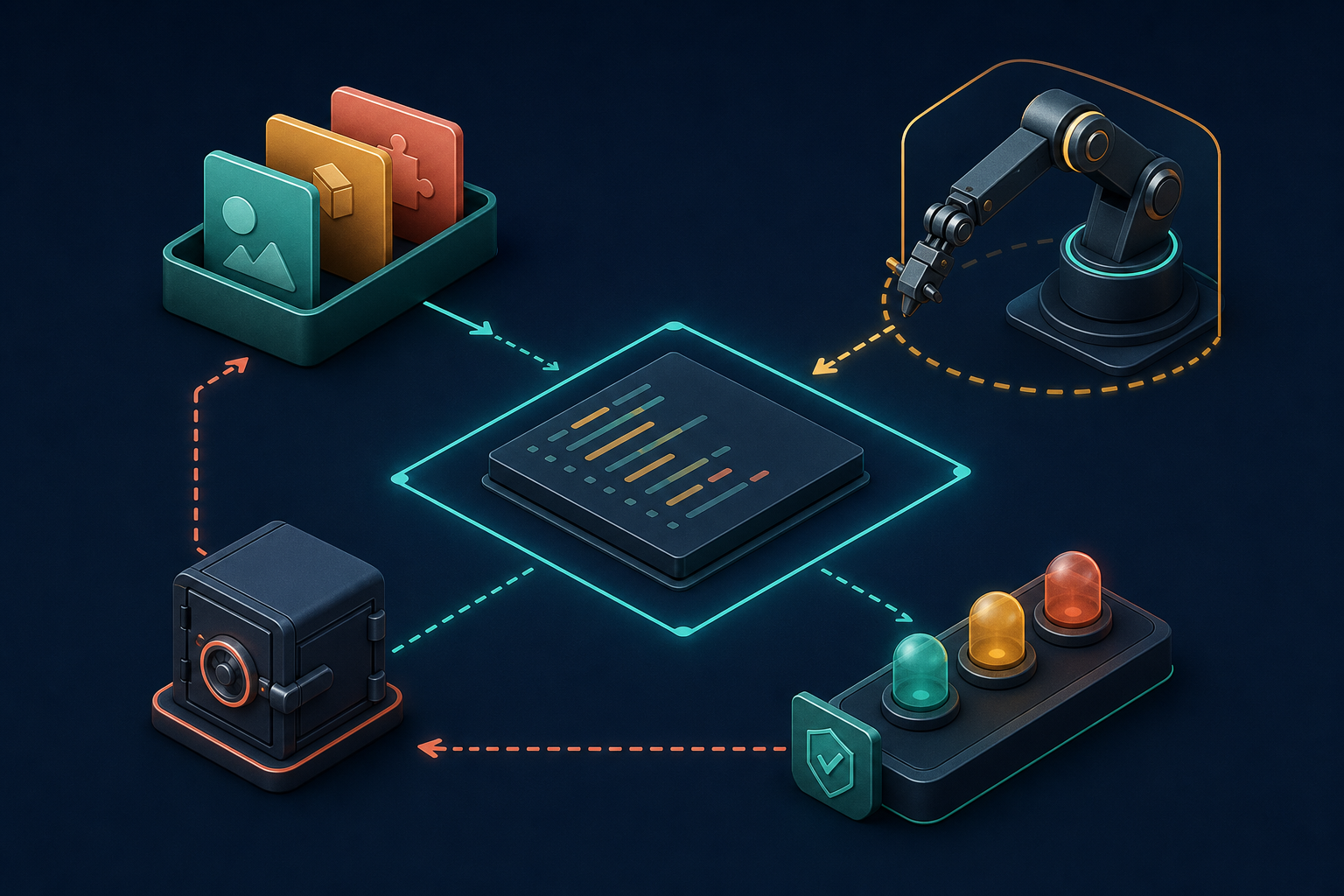
Reliable AI coding is not primarily a matter of finding a better prompt or a more capable model. It is a workflow-design problem: teams must control what the product should do, what the repository currently does, what the model can see, and what the agent is allowed to change.
Managing those four kinds of state turns an AI coding session from an open-ended conversation into a bounded engineering process. The payoff is faster iteration without treating plausible output, confident status messages, or large context windows as substitutes for evidence.
Reliability depends on the surrounding system
A large language model generates an answer token by token from the input available to it. That input can include more than the visible request: an application may add system instructions, conversation history, project files, enabled tools, skills, and other supporting context. As Shivam.Consulting Blog’s guide to how ChatGPT works explains, the surrounding application therefore helps shape the result even when two products use the same underlying model.
This mechanism has an important operational consequence. An agent can produce code that looks convincing without possessing a stable model of the intended product, the complete repository, or the runtime environment. Fluency indicates that the output fits learned patterns; it does not establish that the implementation satisfies the requirement.
A dependable workflow consequently controls four connected states. Product state covers requirements, constraints, permissions, edge cases, and acceptance criteria. Repository state covers the actual code, data model, dependencies, tests, and uncommitted changes. Model state covers the instructions and evidence present in the context window. Execution state covers tools, filesystem access, commands, network activity, and other permissions. A failure in any one can appear to be a coding error even when the code is not the original cause.
Tool selection should reflect that distinction. Shivam.Consulting Blog’s vibe-coding playbook recommends managed app builders when the purpose is to explore an interaction or answer an early product question, while positioning developer-oriented coding agents as more appropriate for existing repositories, multi-file changes, tests, and review workflows. The useful dividing line is not whether a tool can generate code. It is whether the environment exposes enough control and evidence for the consequence of the change.
Convert product intent into a bounded change contract
Many unreliable sessions begin before an agent edits a file. If the requested behavior, non-goals, affected users, data rules, and observable success conditions remain ambiguous, the model must fill the gaps. Each follow-up correction can then preserve a different assumption, creating a chain of locally plausible patches without a coherent final design.
A stronger starting point is a compact change contract written outside the chat. It should identify the outcome, relevant current behavior, permitted scope, important invariants, expected edge cases, and the evidence that will demonstrate completion. For a defect, that evidence begins with a reproducible failing case. For a feature, it includes examples of accepted and rejected behavior. The contract should also record explicit non-goals so that an agent does not broaden a narrow request while attempting to be helpful.
Blast radius deserves separate attention. The vibe-coding playbook uses data, controller, and view as a practical three-layer model. A request involving permissions, sorting, filtering, workflow state, or reporting may cross all three even if it appears in the interface as a small change. Reviewing the planned impact across storage, logic, and presentation helps reveal missing migrations, inconsistent validation, stale queries, and user-interface states before implementation begins.
The same source proposes separate plan-review-fix and implement-review-fix loops. Combined with the change contract, these become distinct gates rather than one continuous conversation. The plan gate asks whether the proposed files, layers, and tests match the requirement. The implementation gate asks whether the resulting diff and observed behavior match the approved plan. Separating the gates makes it easier to reject a mistaken approach before it accumulates code.
This structure also clarifies the human role. The agent can explore the repository, propose a plan, implement a bounded change, and help investigate failures. Product and engineering owners remain responsible for deciding what behavior is correct, which tradeoffs are acceptable, and what evidence is sufficient to ship.
Treat context as a limited working set, not permanent memory
A long conversation can feel comprehensive while becoming less dependable. Shivam.Consulting Blog’s context-rot analysis reports research showing that model performance can deteriorate as input length grows and that information at different positions may receive unequal attention. The article’s practical conclusion is more useful than any advertised context-window maximum: available capacity should not be confused with reliable attention.
Context should therefore be curated as a task-specific working set. Durable facts belong in versioned project documents; the active session should receive only the instructions, files, decisions, and evidence needed for the current change. Old tool output, abandoned plans, duplicate explanations, and superseded requirements consume attention without improving the task.
Shivam.Consulting Blog’s guide to Claude Code workflows describes a layered memory pattern: broad preferences in global instructions, project-specific conventions in repository-level files, and reference material loaded when relevant. It also presents stored commands as a way to make recurring procedures explicit, and sub-agents as a way to isolate context or perform independent work. The transferable principle is architectural rather than product-specific: stable policy, project knowledge, task instructions, and transient evidence should not be mixed into one ever-growing transcript.
A clean session boundary can be a reliability control. When a conversation has accumulated contradictory instructions or repeated failed fixes, the next step should not automatically be another patch request. A new session can begin from a short handoff containing the approved change contract, current repository state, attempted approaches, observed failures, and unresolved questions. This preserves useful evidence without carrying the entire history forward.
Sub-agents require the same discipline. Parallelism is valuable when work can be partitioned into independent questions, such as locating relevant code, examining tests, or reviewing a proposed diff. It is less useful when several agents can modify overlapping files or make incompatible architectural assumptions. Each delegated task needs a narrow scope, an expected output, and a rule for whether it may write or only report.
Require evidence, limited authority, and a recovery path
An agent’s statement that a problem is fixed is a claim to verify, not completion evidence. Verification should return to the original reproducer or acceptance criteria, then examine the diff and run the smallest relevant checks. Broader tests can follow when the change crosses modules, alters shared behavior, or affects data. This sequence distinguishes a real correction from a patch that merely changes the visible symptom.
Review should inspect both behavior and change shape. A diff may pass a narrow test while introducing unrelated refactoring, weakening validation, swallowing errors, or duplicating logic. Unexpected file changes, new dependencies, disabled checks, and unusually broad edits are signals to pause. If the evidence is inconclusive, the workflow should return to diagnosis rather than asking the same context-saturated agent to keep editing.
Reliability also depends on limiting what an agent can do. Shivam.Consulting Blog’s Claude Code risk guide describes escalating exposure as an agent moves from reading a project folder to reading elsewhere, fetching external material, writing files, executing generated code, and installing third-party packages or extensions. Although permission models vary by product, the general control is consistent: grant the least authority required for the current step and review the exact path or command before approval.
Folder boundaries should match the task boundary. Credentials, customer information, confidential documents, and unrelated projects should not be placed within an agent’s working scope. One-time approval is preferable when an operation is unusual or its future use would be difficult to predict. Commands that delete, overwrite, upload, install, or execute deserve more scrutiny than read-only inspection because their impact is larger or harder to reverse.
Reversibility completes the control system. The safety guide emphasizes backups and version control because an AI coding interface may not provide a dependable undo operation. A clean checkpoint before implementation, small commits, reviewable diffs, protected secrets, and a tested rollback path reduce the cost of both model errors and human approval mistakes. For higher-risk work, the agent should operate in a disposable branch, isolated environment, or similarly constrained workspace rather than directly against valuable state.
These safeguards are mutually reinforcing. A bounded contract limits scope; curated context reduces instruction drift; verification exposes incorrect claims; least privilege limits blast radius; and version control makes recovery practical. Removing any one of them shifts too much trust onto probabilistic output.
Key takeaways
- Control product state, repository state, model context, and execution authority as separate parts of one workflow.
- Write a change contract with scope, non-goals, invariants, edge cases, and acceptance evidence before implementation.
- Keep context task-specific; store durable knowledge in files and start a clean session when history becomes contradictory or noisy.
- Treat an agent’s completion report as a hypothesis until the original reproducer, relevant tests, observed behavior, and diff support it.
- Match permissions and isolation to the risk of the operation, and create a recovery point before allowing changes.
As coding agents gain more tools and autonomy, reliable teams will distinguish themselves less by how much work they delegate than by how clearly they define authority, evidence, and recovery. The durable advantage will come from workflows in which faster generation is paired with tighter control.
References
- Shivam.Consulting Blog — Vibe Coding Without the Doom Loop: A Practical Playbook for Safer AI-Built Products
- Shivam.Consulting Blog — Context Rot Is Quietly Breaking AI Workflows: How I Manage the Context Window
- Shivam.Consulting Blog — Use Claude Code Safely: A Practical Risk Guide for Non-Technical AI Workflows
- Shivam.Consulting Blog — How ChatGPT Really Works: A Clear, Practical Guide for Product Leaders
- Shivam.Consulting Blog — Claude Code Workflows That Actually Scale: Slash Commands, Agents, Skills, Hooks