Tag: AI product toolbox

  • We Open-Sourced Our AI Skills Library: Reusable Skills to Supercharge Product Velocity

    We Open-Sourced Our AI Skills Library: Reusable Skills to Supercharge Product Velocity

    We open-sourced our AI Skills library. Here's what we built, why we built it, and how to use it. I’m sharing the approach we’ve used to move faster with more confidence across product discovery, prototyping, and production—while keeping governance, safety, and measurement front and center.

    What we built is a modular, open-source library of “skills” for agentic AI and LLM-powered workflows—things like retrieval and grounding, summarization, classification, tool-use, data enrichment, safety guardrails, and evaluation harnesses. Each skill follows consistent interfaces and conventions so teams can compose them like building blocks, swap implementations without breaking flows, and standardize best practices across products.

    Why we built it is simple: we kept rebuilding the same core capabilities across experiments and teams. Standardizing these skills accelerates time-to-value, reduces integration risk, and helps product trios collaborate with a common language. It also lets us scale what works—prompt patterns, eval datasets, telemetry—so every new initiative starts on third base instead of at bat.

    How to use it in practice: start by running a quick-start example to see a baseline skill chain in action. Then compose your own flow by selecting skills (for example, retrieval + summarization + tool call), configure them with environment variables and guardrails, and wire in evaluation datasets. From there, instrument the pipeline with metrics so you can compare variants and promote the best-performing chain to your main app or API.

    In a typical stack, the library dovetails with analytics and experimentation: ship skill variants behind feature flags, measure impact with A/B testing, and observe runtime behavior with logs and traces. CI/CD hooks let you run evals pre-merge, and production dashboards keep an eye on latency, cost, and outcome quality. This creates a virtuous loop where ideas move from prototype to production with clear evidence.

    Common use cases include customer support summarization and triage, lead scoring and enrichment, anomaly detection in product telemetry, and automated content workflows. Because the skills are composable, you can try multiple retrieval-first strategies, swap prompt templates, or add tools (search, RAG, calculators, connectors) without rewriting everything from scratch.

    Governance and safety are built in. Guardrails handle PII redaction, content policy checks, and rate limiting; configs make it easy to enforce privacy-by-design; and evaluation harnesses encourage an eval-driven development culture. The result is faster iteration without sacrificing data governance or reliability.

    If you want to contribute, add a new skill, improve prompts, share eval datasets, or open an issue with a scenario you want supported. The roadmap focuses on richer retrieval adapters, better test fixtures, and deeper observability so teams can debug and optimize complex chains with confidence.

    I’m excited to see how you’ll use the library to accelerate your roadmap. Clone it, run a quick start, and compose your first workflow today—then measure, iterate, and scale what works. I’ll keep sharing patterns, learnings, and updates as we grow the skills catalog and sharpen the tooling.


    Inspired by this post on Amplitude – Perspectives.


    Book a consult png image
  • The Surprising Eval Signal That Tripled Retention: How I Connected AI Evals to Product KPIs

    The Surprising Eval Signal That Tripled Retention: How I Connected AI Evals to Product KPIs

    Our retention curve had flattened even as activation ticked up, and that disconnect told me we were missing a leading indicator buried in our AI agent telemetry. I set out to connect our AI evals directly to product retention, not as an academic exercise, but as the basis for focused roadmap bets and stronger product-led growth.

    "Learn how we used Agent Analytics to discover an eval signal that predicts 3X higher user retention."

    Connecting AI evals to retention analysis is deceptively hard. Evals often live in ad-hoc notebooks while behavioral analytics and cohort retention live elsewhere. IDs drift. Signals are noisy. Teams gravitate to fast output over outcome clarity. I leaned into eval-driven development to close that gap and make our AI workflows accountable to business results.

    We began with crisp hypotheses: for example, that higher semantic accuracy and lower escalation rates would correlate with repeat usage. We enumerated a concise eval taxonomy—accuracy, containment, safety, latency, and UX friction—and used Agent Analytics to compute per-user and per-tenant features on a daily cadence. That gave us a reliable, unified analytics platform for AI-specific signal generation.

    Next, we joined those features to our product telemetry in Amplitude analytics using clean user and account identifiers. With that foundation, we created weekly and monthly cohorts, ran retention analysis, and used driver trees alongside simple logistic models to control for plan type, segment, region, and acquisition channel. The goal wasn’t perfection—it was directional clarity strong enough to inform product strategy.

    One eval metric separated itself from the pack. When users hit a specific threshold early in their journey, the model predicted 3X higher user retention compared to peers who didn’t. I still remember overlaying that signal on our cohort chart—the lift was impossible to unsee, and it immediately reframed our activation and onboarding priorities.

    From there, we operationalized. We built in-app guides that nudged new users toward the eval threshold, added a health score to customer success workflows, and put feature flags on model changes until they improved the eval. We validated the effect size with A/B testing and set up anomaly detection to catch regressions before they touched real users.

    If you want a repeatable playbook: define your north-star retention window, shortlist 3–5 eval candidates tied to real user value, ensure rock-solid identifiers across systems, compute daily features in Agent Analytics, model uplift against retention cohorts in Amplitude analytics, then translate the winning signal into onboarding nudges, product tours, and success playbooks. Track second-order outcomes too—support tickets, NPS, and Net Recurring Revenue (NRR)—so you don’t optimize a proxy at the expense of experience.

    I also learned what to avoid. Watch for sample-size traps and label leakage, and remember that segment mix can masquerade as model improvement. Use minimum detectable effect (MDE) calculations to size experiments, add risk scoring to gate launches, and keep a tight feedback loop between product, data science, and customer success.

    The payoff is far more than a tidy dashboard. By grounding our AI strategy in behavioral analytics and measurable retention lift, we turned an abstract eval into a concrete growth lever—and gave our product teams the confidence to move faster with clarity.


    Inspired by this post on Amplitude – Perspectives.


    Book a consult png image
  • The AI PM One-Pager: Radical prototyping requirements for speed, clarity, and truth

    The AI PM One-Pager: Radical prototyping requirements for speed, clarity, and truth

    I move fastest in Generative AI when I strip work down to its essential signals. At HighLevel, I rely on a single-page format—”Prototyping Requirements: The One-Pager for AI PMs”—to turn ideas into testable artifacts within hours, not weeks. This approach reinforces AI Strategy, minimizes coordination overhead, and keeps Product Management focused on learning over ceremony.

    “Prototyping requirements go rogue: one page, zero bureaucracy, built for AI. Shape concepts fast, prompt tools directly, and get to the truth sooner.”

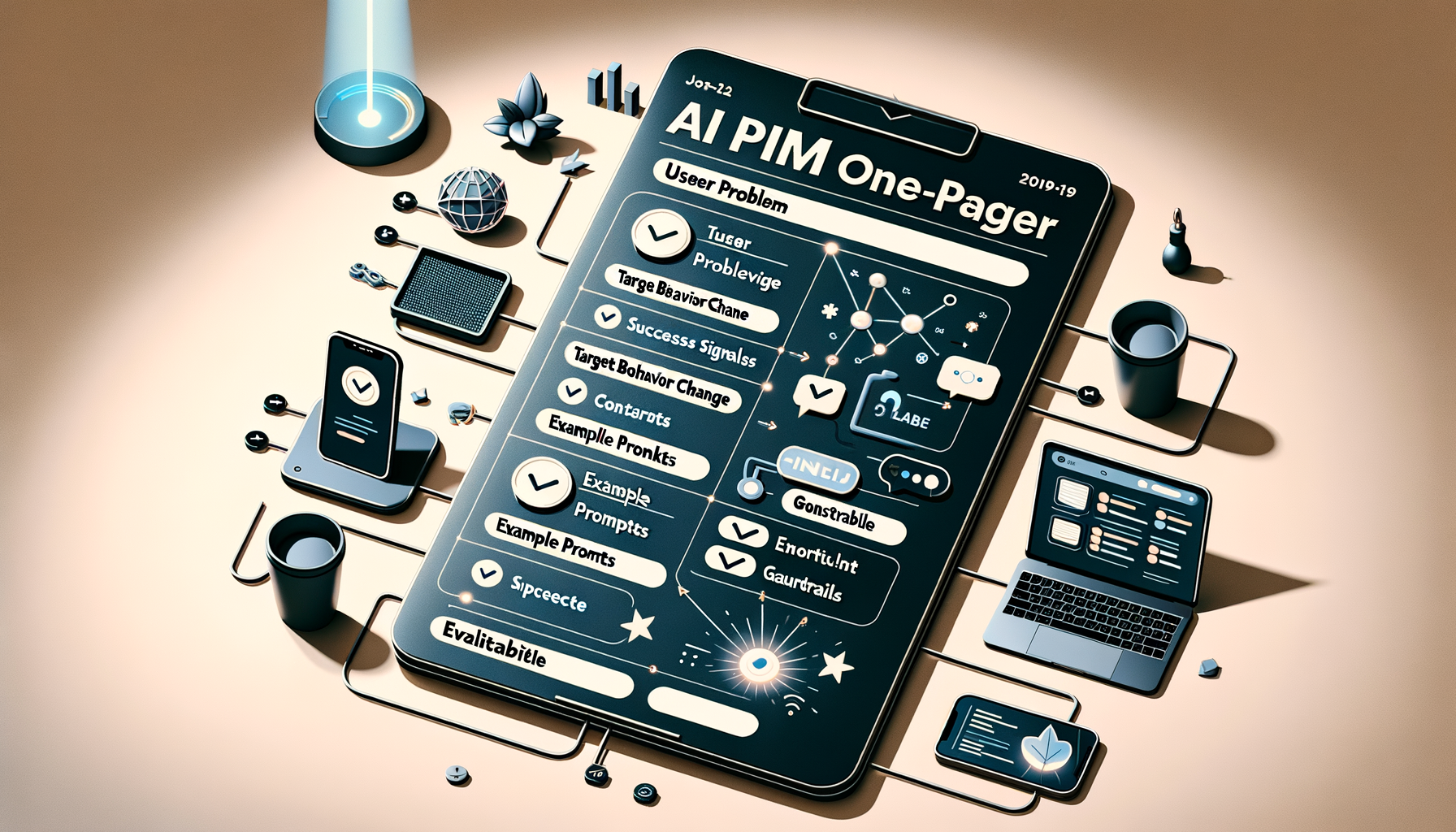
    In practice, my one-pager captures only what’s required to run an immediate experiment: the user problem, the target behavior change, success signals, core constraints, intended AI workflows, and the smallest realistic path to an evaluable demo. I also include example prompts, guardrails, and evaluation criteria so the team can apply prompt engineering and LLMs for product managers without guessing.

    This is eval-driven development in action. I document a minimal hypothesis, concrete inputs/outputs, and a quick plan for metrics, including qualitative signals from product discovery and continuous discovery. By prompting tools directly, we expose assumptions early, shorten feedback loops, and build an AI product toolbox that compounds learning sprint after sprint.

    I run this with a product trio to ensure we balance feasibility, usability, and value. We align on risks, dependencies, and what “good” looks like, then we integrate the learnings into product roadmapping and sprint planning. The result: fewer meetings, tighter collaboration, and empowered product teams delivering sharper outcomes with less friction.

    If you want speed and clarity without sacrificing rigor, adopt the one-pager. It centers the conversation on evidence, accelerates AI workflows from prompt to prototype, and makes it obvious what to try next—and what to stop doing. Most importantly, it keeps the team focused on truth over theater, which is how great AI products actually ship.


    Inspired by this post on Product School.


    Book a consult png image
  • My Essential AI Toolbox for Product Managers: Tested Picks, Prompts, Workflows + Checklists

    My Essential AI Toolbox for Product Managers: Tested Picks, Prompts, Workflows + Checklists

    I created this practical guide to help product managers cut through the hype and apply AI where it genuinely moves the needle—faster discovery, clearer strategy, sharper execution, and measurable outcomes.

    A practical guide to AI tools for product managers: tested picks, what each tool is best for, copy-paste prompts, workflows, and screenshot checklists.

    Leading product management at HighLevel, I’ve pressure-tested dozens of gen AI solutions across product discovery, roadmap planning, delivery, and go-to-market. In this guide, I map an AI product toolbox to core PM jobs-to-be-done so you can move from experimentation to repeatable impact with confidence.

    Expect clear recommendations on where each tool excels—LLMs for product managers, research synthesis for customer interviews, behavioral analytics for opportunity sizing, and lightweight automation for in-app guides and product tours. I connect these tools to proven practices like continuous discovery, outcomes vs output OKRs, and product roadmapping and sprint planning so you can operationalize AI inside your existing workflows.

    I also share the evaluation criteria I use before rollout—AI Strategy alignment, data governance and privacy-by-design, AI risk management, observability, and total cost of ownership. This eval-driven development approach helps teams avoid technology FOMO while creating defensible, trustworthy workflows that scale.

    To accelerate adoption, I’ve included copy-paste prompts (including prompt engineering patterns for both chat and voice), retrieval-first pipeline blueprints to ground your models in product docs and decision logs, and conversation design tips for support and success use cases. You’ll see step-by-step AI workflows that tie directly to journey mapping, opportunity solution trees, and Kano Model trade-offs.

    Every workflow comes with screenshot checklists you can use for onboarding or stakeholder management, making it easy to align ICs and leaders on the same operating picture. Whether you’re optimizing A/B testing, retention analysis, or QBRs vs OKRs, these checklists turn good intentions into repeatable rituals.

    Use this guide as your field companion to ship faster with higher confidence—reducing cycle time, improving signal in discovery, and building momentum for product-led growth. If you’re ready to translate generative AI into reliable PM leverage, start with the workflows, adapt the prompts, and make them your own.


    Inspired by this post on Product School.


    Book a consult png image
  • Beat AI FOMO: A Product Leader’s Playbook to Choose Tools, Stay Focused, and Learn Deeply

    Beat AI FOMO: A Product Leader’s Playbook to Choose Tools, Stay Focused, and Learn Deeply

    Lately, it feels like every morning brings a new AI launch, a dazzling demo, or a must-try tool. I love the pace of innovation, but the constant stream can trigger counterproductive FOMO if I’m not intentional. As a product leader, I’ve learned to turn that anxiety into a disciplined learning system—one that keeps me curious without letting novelty hijack my focus.

    That’s exactly why this conversation with Petra Wille and Teresa Torres resonated with me. They explore how to stay experimental in the AI era without chasing every shiny object. Their perspective aligns closely with my own operating cadence: start with real problems, go deep on a small set of tools, and create explicit boundaries between work, learning, and play.

    Listen to this episode on: Spotify | Apple Podcasts

    Here’s the mindset I apply. I don’t start with tools—I start with problems. When I encounter concrete friction in a workflow or see a credible opportunity to improve an outcome, that’s my trigger to explore a new capability. This mirrors the continuous discovery habit of prioritizing opportunities over solutions, and it’s how I avoid performing “innovation theater.”

    To keep exploration healthy, I time-box my learning. I block recurring windows specifically for experiments, reading, and hands-on trials so they don’t overrun my core product work. During these blocks, I’ll set a clear question, run a tight test, and capture what I learned. No rabbit holes, no endless tinkering.

    I also separate “interesting” from “actionable.” Plenty of inputs are worth awareness, but very few deserve immediate action. I bookmark the rest for later. This simple filter reduces cognitive load and keeps my backlog—from ideas to proofs of concept—well-governed.

    Social media can amplify technology hype cycles, so I establish boundaries. I batch consumption, mute low-signal channels, and prioritize practitioner communities over performative threads. The goal isn’t to be first; it’s to be right for my customers, my team, and our strategy.

    When choosing what to try next, I use a practical rubric. Does the tool target a real friction I’ve seen in discovery or delivery? Can it plug cleanly into our AI workflows without unsustainable glue work? Do we have a safe, compliant way to test it? Is there a plausible path from trial to compounding value? If the answer isn’t a confident yes to most of these, I wait.

    Depth beats breadth. I’d rather take one promising tool into a real use case, instrument it, and measure outcomes than skim ten trending demos. That tighter loop produces sharper intuition, clearer product bets, and better partner decisions. A quick opportunity solution tree helps me connect user pain to outcomes before I let any solution onto the field.

    In the episode, Petra Wille and Teresa Torres talk candidly about managing FOMO, deciding which tools to explore, and designing intentional learning systems. They discuss why starting with a problem is more valuable than starting with a tool, how social media amplifies technology FOMO, and why going deeper with fewer tools can lead to better learning. If you’ve ever felt like you’re falling behind because you haven’t tried the latest AI tool yet, this conversation will help you rethink how you approach learning and experimentation.

    If you’re curious about what came up, here are some of the tools and communities mentioned: Claude Code, OpenClaw (formerly Clawdbot, Moltbot), NotebookLM, Product Talk, ElevenLabs, Lenny’s Newsletter Community, and even a nod to Bridgerton for a touch of levity.

    My takeaway is simple but powerful: curiosity doesn’t require constant experimentation. The best product managers cultivate a balanced system—grounded in product discovery, energized by focused experiments, and protected by clear boundaries—so we can learn faster while staying pointed at outcomes that matter.

    Discussion Question: How do you decide which new tools or technologies are worth exploring—and which ones you can safely ignore?

    Resources & Links: Follow Teresa Torres: https://ProductTalk.org | Follow Petra Wille: https://Petra-Wille.com

    Full transcripts are only available for paid subscribers.

    Have thoughts on this episode? Leave a comment below.


    Inspired by this post on Product Talk.


    Book a consult png image
  • AI Product Manager in 2026: Beyond the Buzzword—Skills to Lead, Ship, and Win

    AI Product Manager in 2026: Beyond the Buzzword—Skills to Lead, Ship, and Win

    Are you an AI product manager or want to become one? This guide cuts through the noise and shows where the PM role is really heading with AI.

    I’ve spent the last few years scaling AI initiatives across complex SaaS products, and I’ve learned that “AI product manager” isn’t a vanity title—it’s a capability set. The role evolves traditional product management with new responsibilities across data, model behavior, risk, and continuous learning systems. My goal here is to demystify what matters, so you can lead with clarity, build with confidence, and deliver measurable outcomes.

    First, let’s separate hype from reality. An effective AI Strategy starts with the customer problem, not the model. I anchor roadmaps around clear use cases, then evaluate whether we need a retrieval-first pipeline, agentic AI, or conventional automation. “Build vs buy” is no longer a procurement question; it’s a lifecycle question about iteration speed, quality control, data governance, and long-term unit economics.

    Discovery also looks different. I still run continuous discovery and customer interviews, but I augment them with behavioral analytics and targeted experiments to validate feasibility, risk, and value. I practice privacy-by-design and AI risk management from day one, and I define guardrails for acceptable model behavior alongside success metrics. When high stakes are involved, I document data provenance and align with regulatory compliance standards to protect customers and the business.

    Execution shifts from shipping static features to operating learning systems. In product roadmapping and sprint planning, I account for context window management, prompt engineering, and the realities of LLMs for product managers: latency, cost, drift, and failure modes. I use feature flags, A/B testing, and eval-driven development to move from offline model evals to online impact with a minimum detectable effect (MDE) worth the release risk. Observability, anomaly detection, and incident management aren’t optional—they’re how we earn trust.

    Collaboration expands beyond engineering and design. I work closely with data science on evaluation frameworks, with solutions engineering to de-risk complex enterprise deployments, and with customer success to close the loop on model performance in the wild. Our outcomes vs output OKRs emphasize activation, time-to-value, and sustained retention over vanity accuracy metrics.

    Tooling is now strategic advantage. My AI product toolbox includes prompt libraries with versioning, synthetic data generation where appropriate, and a disciplined approach to model and prompt regression tests. I standardize AI workflows—intake, evaluation, deployment, and monitoring—so teams can ship faster without cutting corners. This is how empowered product teams scale safely.

    Career-wise, I look for—and coach—PMs who can frame trade-offs crisply: explain when to fine-tune vs use retrieval, when to embed agents, and when not to use AI at all. Show me driver trees that connect model metrics to business outcomes, a clear risk register, and a plan for continuous discovery. If you can tell a compelling story backed by transparent evaluation and customer value, you’re already ahead.

    Here’s the bottom line: the “AI product manager” that matters in 2026 is a product leader who can turn uncertainty into systematized learning. If you focus on real customer problems, rigorous evaluation, responsible design, and iterative delivery, you won’t just carry the title—you’ll create durable competitive differentiation.


    Inspired by this post on Product School.


    Book a consult png image
  • Go From 3 Customer Interviews to a High-Quality Opportunity Solution Tree—In Minutes

    Go From 3 Customer Interviews to a High-Quality Opportunity Solution Tree—In Minutes

    Most product teams—and especially well-run product trios—know they should be interviewing customers. More teams than ever are actually doing it. That’s the good news.

    The bad news? Many teams still struggle with what comes next. Turning raw recordings into a structured opportunity space that truly guides product discovery can feel overwhelming.

    In my experience, interview synthesis is cognitively demanding work. You have to extract the key moments from each conversation, translate those moments into clear opportunities, and then organize those opportunities into a coherent view of your opportunity space. It’s no surprise I hear teams say, "We need to stop interviewing so we can catch up on what we’ve already learned." Too often, they pause—and never start again.

    Recordings pile up. Maybe there are scattered notes. But nothing gets turned into an opportunity solution tree. The team hasn’t synthesized what they’ve learned, so the research isn’t actionable. That’s the gap I want to help close.

    What if you could go from 3 interviews to a draft OST in minutes?

    My AI goals are straightforward: 1) build tools that help you learn discovery and 2) build tools that help you do discovery. The learning tools are coming through on-demand courses. Today, I’m excited to share the first big step on the "do" side.

    I’m excited to see an expanded partnership with Vistaly—the opportunity solution tree tool many of you already use—to bring AI-powered discovery tools directly into their platform.

    Great synthesis happens in two steps: first, you synthesize each interview separately; then you synthesize across interviews. Most AI tools skip the first step and jump straight to cross-interview analysis—exactly how teams lose the nuance and context that make research actionable.

    This approach does both. You upload three interviews for the same product outcome. The AI extracts the key moments and opportunities from each one separately. Then it synthesizes across those interviews and generates a first draft of your opportunity solution tree for you. Three interviews in. A draft OST out.

    Here’s what this is—and what it isn’t. You’ve probably heard criticism of tools that promise "one-click opportunity solution trees." Those tools ask you to describe your market, click a button, and get a tree. The point of an opportunity solution tree is not to have one—it’s to synthesize what you’re learning from real customers so your team can align on the best path forward. A one-click tree built from made-up data is useless.

    Vistaly 2.0 landing page featuring 'Build what matters,' a blue Enroll in Beta button, and a dark-grid opportunity solution tree connecting an Outcome to Opportunity and Solution nodes.
    Turn interviews into insights in minutes with Vistaly. This hero screen invites you to enroll in beta and showcases an opportunity solution tree that maps outcomes to opportunities and actionable solutions.

    This approach is fundamentally different. It starts with your real customer interviews. The AI does the heavy lifting of extracting key moments and opportunities from those conversations and organizing them into a draft opportunity solution tree. But it’s a draft—you review it, refine it, and reorganize it. You bring your judgment and context to the work.

    My vision for AI-aided cross-interview synthesis is simple: AI identifies common opportunities across interviews, suggests a tree structure, and facilitates the team’s review. Historically, it’s been hard to give AI access to an opportunity solution tree in a way that preserves structure and context. The integration with Vistaly solves that problem by building this capability directly into the tool where your tree already lives.

    In my own experiments using Claude, the AI surfaced opportunities I missed—and I caught things it missed. The highest-quality synthesis came from combining both perspectives. Research (see here and here) backs this up: Experts working with AI outperform both experts working alone and AI working alone. That’s the model we’re building toward—AI generates the draft, you bring the expertise.

    I have mixed feelings about AI doing discovery work for us because there is real value in doing the synthesis yourself. But I also know that a draft OST you actually refine is better than a perfect process you never get to. This is about raising the floor—helping more teams get to a structured opportunity space, even if they aren’t doing every step manually.

    We’re looking for a small group of alpha partners to help shape this product. To apply, sign up for a free Vistaly account and upload three customer interviews for the same outcome or product space.

    We’ll select alpha partners from the applicants. We want a range of interview styles, experience levels, and product spaces. Selected partners will get access to the AI-powered synthesis tools and will work closely with the team to shape the product. Even if you aren’t selected for the alpha, your application puts you at the front of the line when we enter beta.

    A few things to know as you apply: Your three interviews should be for the same outcome, goal, or product space, so the tool can generate a meaningful OST. You don’t need to be a Vistaly user today—the account is free. You don’t need to be an expert interviewer either; we’re looking for a range of experience levels, though we’re particularly interested in story-based customer interviews.

    This is just the beginning. The vision is a full AI-powered discovery suite inside Vistaly—from interview analysis to complete interview snapshots to opportunity solution trees and beyond. We’ll learn alongside our alpha partners and share what we discover as we go.

    If you’ve been looking to bridge the gap between your customer interviews and your opportunity space, this is your chance to help shape how that works. Apply for the alpha today.


    Inspired by this post on Product Talk.


    Book a consult png image
  • Two People, Zero Waste: How Earmark’s Agentic AI Turns Meetings into Finished Work

    Two People, Zero Waste: How Earmark’s Agentic AI Turns Meetings into Finished Work

    I care about meetings only insofar as they create momentum and outcomes. What if your meetings could actually produce the artifacts you need—specs, tickets, slides—before the call even ends?

    I recently listened to an episode of Just Now Possible where Teresa Torres talks with Mark Barbir (CEO) and Sanden Gocka (Co-Founder), the co-founders of Earmark, about building a productivity suite that turns unstructured conversations into finished work in real time. As a product leader, this premise hits the sweet spot of agentic AI, real-time AI workflows, and ruthless focus on outcomes over output.

    Listen to this episode on: Spotify | Apple Podcasts

    Unlike generic AI notetakers that produce summaries nobody reads, Earmark runs multiple agents in parallel during your meetings—translating engineering jargon, drafting product specs, even spinning up prototypes in Cursor or V0 while you're still talking. That’s the bar I want from AI in the room: finished work, not notes.

    What impressed me most was the clarity of their pivot. They moved from an Apple Vision Pro presentation coaching tool to a web-based meeting assistant. I’ve made similar calls: when the distribution path and daily workflow are obvious, you follow the user’s gravity. This shift unlocked a broader surface area—PMs, engineers, design partners—and made agentic workflows useful where work actually happens.

    They also turned a technical constraint into a commercial advantage. Their ephemeral (no-storage) architecture became a feature for enterprise sales. I’ve seen this repeatedly in AI risk management: privacy-by-design and clear data governance reduce friction with security reviewers and accelerate procurement. For many enterprises, “we don’t store your data” is the win condition.

    Cost discipline was another standout. They tackled the hard problem of making real-time AI affordable—from $70 per meeting down to under a dollar through prompt caching. That’s not just optimization; it’s product strategy. Choices like model selection, context window management, and retrieval-first pipeline design determine whether a feature can scale to every meeting or remains a demo.

    On capability design, the team leaned into templates and simulated stakeholders to ship value fast. Template-based agents: Engineering Translator, Make Me Look Smart, Acronym Explainer. Personas that simulate absent team members (security architect, legal, accessibility). This is exactly how I frame early AI workflows: remove friction for the product trio, anticipate blockers, and let the agent do the tedious, error-prone first pass.

    They were refreshingly pragmatic about models. Why GPT 4.1 still beats newer models for prose quality in their use case is a reminder that “best” is contextual. When the job-to-be-done is precise prose and production-grade artifacts, consistent quality trumps leaderboard buzz. Of course, they also invest in guardrails to ensure quality and manage hallucinations—another non-negotiable for enterprise adoption.

    Search and analysis across time is where many AI products stumble. They explained the limits of vector search for analysis questions across meetings and how they’re building agentic search with multiple retrieval tools (RAG, BM25, metadata queries, bespoke summaries). I couldn’t agree more: analysis requires reasoning over structure, time, and purpose—not just semantic proximity. Layered retrieval with stateful agents beats a single embedding call.

    They also articulated a crisp user thesis: design for product managers as the extreme user to solve for everyone. In my experience, if you satisfy the PM’s bar for clarity, traceability, and actionability, engineers, designers, and go-to-market teams benefit immediately. That’s how you earn daily active use, not once-a-week novelty.

    For builders curious about the stack and comparables, they discuss services and tools like Assembly AI for speech-to-text, OpenAI API with prompt caching support, and build integrations with Cursor and V0 by Vercel. They also reference Granola as a comparison point and nod to ProductPlan, where both founders previously worked. If you want to try the product, here’s Earmark—a productivity suite where the work completes itself.

    If you're a PM drowning in follow-up work or a builder curious about real-time AI architectures, this conversation offers a detailed look at what it takes to ship an AI product that people can't imagine working without. Personally, I see this as a credible path toward an AI chief of staff—their vision goes beyond automating deliverables to orchestrating judgment, compliance signals, and cross-functional readiness.

    The episode covers the founder backstory, what Earmark does, comparisons to competitors, unique features, templates and personas, technical decisions, early versions and challenges, optimizing transcript summarization, managing multiple tools and costs, challenges with context and reasoning models, innovative search and retrieval techniques, creating actionable artifacts from meetings, ensuring quality and managing hallucinations, and the future vision for an AI chief of staff. It’s a full-spectrum look at building with agentic AI, not just talking about it.

    Podcast transcripts are only available to paid subscribers.


    Inspired by this post on Product Talk.


    Book a consult png image
  • The Customer Feedback Playbook: AI-Powered Tactics I Use to Make Better Product Decisions

    The Customer Feedback Playbook: AI-Powered Tactics I Use to Make Better Product Decisions

    Customer feedback is the most reliable compass I have for product strategy and execution. Over the years leading product at HighLevel, I’ve built and refined a system that turns raw signals from users into clear, prioritized decisions our teams can confidently ship.

    A practical guide to collecting and using product feedback in product management (from AI tools to early-stage tactics) for better product decisions.

    My playbook starts with continuous discovery. I keep a steady flow of insights from sales calls, customer support threads, community forums, and in-product behavior so I can triangulate patterns rather than chase loud anecdotes. This mix of quantitative and qualitative data helps me separate urgent noise from strategically meaningful trends.

    On the quantitative side, I rely on product analytics to ground the conversation. Amplitude analytics gives me activation, retention cohorts, and feature engagement, while controlled experiments and A/B testing validate whether an idea actually moves a target metric. Tying these signals to specific customer segments helps me see where product-led growth is working—and where it’s stalling.

    For qualitative insight, I combine in-app guides and lightweight surveys (via tools like Pendo) with structured interviews and support escalations (often surfaced through platforms like Intercom). I map problems using the Kano Model to understand which requests are basic expectations, which are performance drivers, and which are potential delights. This keeps our roadmap focused on outcomes, not just outputs.

    AI now accelerates the synthesis step. With LLMs for product managers in my AI product toolbox, I summarize interview transcripts, cluster themes across thousands of notes, and quantify sentiment without losing nuance. I still review raw artifacts to avoid hallucinations and preserve context, but AI reduces the time from signal to insight dramatically—freeing me to spend more energy on judgment and storytelling.

    In early-stage contexts, I bias toward speed and proximity to users. I schedule founder- or PM-led discovery calls weekly, instrument product tours early, and launch scrappy in-product prompts to validate demand before over-investing. When data is sparse, I focus on high-signal channels (power users, churned customers with qualified use cases) and document crisp problem statements that connect directly to activation, retention analysis, and revenue outcomes.

    Prioritization ties everything together. I translate insights into hypotheses aligned to outcomes vs output OKRs, then pressure-test them with feasibility and strategic fit. We run small, measurable experiments, track deltas in activation and retention, and adjust the product roadmapping and sprint planning cadence based on what the data and customers teach us.

    This approach builds trust with stakeholders and creates empowered product teams. By grounding decisions in a transparent trail of feedback, analytics, and experiments, we reduce thrash, move faster, and—most importantly—ship product moments that customers value.

    If you’re refining your own feedback engine, start by instrumenting the basics, set a weekly discovery rhythm, and let AI handle the heavy lifting on aggregation and synthesis. The compounding effect is real: better insights lead to better bets, which lead to better outcomes for your users and your business.


    Inspired by this post on Product School.


    Book a consult png image
  • PMs and Developers Need Different AI Metrics—Here’s How That Builds Faster, Better Products

    PMs and Developers Need Different AI Metrics—Here’s How That Builds Faster, Better Products

    I’ve sat in countless AI measurement debates and noticed a recurring gap. One major voice has been noticeably underrepresented in the AI measurement conversation: the product manager (PM) that’s leading development. From experience, PMs and developers do need different measurement tools—and making those differences explicit is exactly what speeds up decisions and improves outcomes.

    Developers optimize the model and system layer. Their toolkit centers on eval-driven development: offline evals, regression suites, red-teaming, latency and throughput monitoring, token cost tracking, and hallucination rate reduction. On the delivery side, engineering teams watch DORA metrics alongside CI/CD performance to keep iteration fast and safe. When building LLM-backed experiences, they also care deeply about retrieval-first pipeline quality and context window management because those mechanics determine grounding, relevance, and consistency.

    PMs, by contrast, own outcomes. We instrument user journeys end to end and define a clear north-star tied to value: activation, time-to-value, task success rate, retention analysis, support deflection, and revenue contribution. We rely on A/B testing frameworks and minimum detectable effect (MDE) planning to separate real impact from noise, and we consolidate behavioral signals in a unified analytics platform like Amplitude analytics and Pendo to understand adoption, friction, and cohort differences. This is the heart of product-led growth and continuous discovery: evidence, not anecdotes.

    The fact that these toolboxes differ is a strength, not a weakness. Specialized metrics keep responsibilities crisp: developers guarantee model quality and reliability; PMs guarantee that quality translates into customer and business outcomes. What we need is an explicit metrics ladder that connects layers—model-level quality floors and SLOs, feature-level KPIs, and company-level results—so trade-offs are transparent and prioritization is principled.

    In practice, I create a shared measurement contract for every AI initiative. It links eval sets to user-facing success criteria, defines acceptance thresholds, and spells out observability across the stack. We include governance from day one—AI risk management, privacy-by-design, and data governance—so we can scale responsibly without slowing teams down.

    Here’s the AI product toolbox I give my teams: start with a concise value hypothesis; define a success rubric the customer would recognize; instrument the happy path and the failure path; plan experiments with MDE up front; segment results by persona and job-to-be-done; and close the loop with qualitative feedback inside the product via in-app guides, product tours, and lightweight surveys. For AI features specifically, add Agent Analytics for agentic AI, capture grounding sources for explainability, and log model/context inputs to make debugging and iteration repeatable. That way, LLMs for product managers stop being magic and start being manageable.

    When we roll out a new assistant—whether a retrieval-augmented copilot or a voice AI agent—we set two dashboards: one for developers (eval pass rates, latency, context integrity, error budgets) and one for PMs (activation, task completion, deflection, satisfaction). The dashboards read differently by design, yet they are joined at the hip by shared definitions and experiment IDs. This lets us move quickly with confidence: engineering can tighten quality loops while product steers toward the outcome that matters most.

    If you’re feeling the tension between model metrics and product metrics, don’t collapse them—connect them. Start with a thin slice, agree on 3–5 measurable outcomes, and let your evals and A/B tests work together. With a clear metrics ladder and a unified analytics platform, PMs and developers can each excel at their craft and still ship AI that customers love.


    Inspired by this post on Pendo – Perspectives.


    Book a consult png image
  • AI Context Pulling Playbook: How I Get LLMs and Teams to Collaborate for Better Product Outcomes

    AI Context Pulling Playbook: How I Get LLMs and Teams to Collaborate for Better Product Outcomes

    In my role leading product, I’ve learned that the fastest path to higher-quality deliverables from large language models (LLMs) is not a clever prompt—it’s rigorous context. I call the practice AI context pulling: a repeatable way to assemble, compress, and structure the most relevant knowledge before the model ever starts generating. Done well, it turns generative AI into a dependable partner for discovery, prioritization, and execution.

    AI context pulling means I proactively gather the right artifacts (customer insights, analytics, strategy, constraints), manage context windows intentionally, and shape the model’s task with clear objectives and guardrails. This reduces hallucinations, improves alignment, and creates traceability back to sources—critical for product management leadership and stakeholder trust.

    Learn a new way in which product professionals can collaborate with AI to get even better results on their projects.

    Here’s the simple flow I use: first, I define the intent (e.g., “synthesize discovery interviews for a positioning brief”). Next, I inventory relevant context: top customer pains from product discovery, usage patterns from Amplitude analytics, recent support trends from Intercom, and any constraints from our product strategy. Then I run a retrieval-first pipeline to select only the most pertinent slices—favoring recency, representativeness, and canonical sources.

    Because context window management matters, I compress long documents into short, source-cited summaries and keep raw excerpts handy when nuance is important. My prompts follow a consistent structure: role and objective, constraints and audience, curated context, the explicit ask, preferred output format, and a brief self-check (e.g., “cite sources and flag uncertainty”). This is prompt engineering for reliability, not theatrics.

    A quick example: when drafting a one-page feature brief, I attach three items—the product strategy paragraph that sets the frame, a usage cohort analysis that highlights who’s affected, and five verbatim customer quotes. I ask the LLM to propose a problem statement, success criteria, and a shortlist of solution hypotheses, each tied to a cited piece of evidence. The result is a grounded, decision-ready artifact I can share with product trios and stakeholders.

    Tooling-wise, I keep it pragmatic. A lightweight retrieval-first pipeline (embeddings, metadata filters, and recency rules) ensures the LLM pulls what matters. I version prompts and contexts together so I can run quick A/B testing on output quality. And I log decisions and sources to support eval-driven development and continuous discovery.

    Common pitfalls are avoidable. Too little context yields generic answers; too much overwhelms the model. Stale docs can mislead; curate aggressively. Vague asks invite fluffy prose; specify outcomes, audiences, and formats. If the task is high risk, I bias toward smaller, well-cited outputs and expand iteratively with human review in the loop.

    To measure impact, I track rework rate, review time, and stakeholder alignment on first pass. Over time, teams adopting AI context pulling report clearer artifacts, faster synthesis cycles, and more confident decisions—because every recommendation traces back to evidence. That’s how humans and LLMs truly collaborate better: we provide the right context, and the model amplifies our judgment.

    If you’re ready to operationalize this, start by templatizing your most common product workflows—discovery synthesis, roadmap rationale, and release notes—and attach small, high-signal context packs. With a retrieval-first mindset and disciplined prompting, AI becomes an extension of your product craft, not a gamble.


    Inspired by this post on Pendo – Perspectives.


    Book a consult png image
  • From Idea to Impact: How AI Supercharges Product Design, Testing, and Time-to-Value

    From Idea to Impact: How AI Supercharges Product Design, Testing, and Time-to-Value

    AI is changing how I build products, not by replacing designers or researchers, but by amplifying the quality and speed of what our product trios can deliver. The real breakthrough isn’t a single tool; it’s the way genAI and traditional methods combine into a tighter discovery–design–delivery loop that shortens time-to-value without sacrificing rigor.

    Learn how Pendo’s product design team is using genAI and traditional tools to speed up design and development.

    In practice, that’s exactly the pattern I see working across my teams: we treat genAI as part of the AI product toolbox—great for rapid exploration, structured synthesis, and test preparation—while we rely on our proven techniques to validate outcomes. For early-stage concepting, I use prompt engineering to generate multiple storyboard options and interaction flows in minutes, then refine those outputs with our design system for alignment and accessibility. It’s a pragmatic “gen ai for product prototyping” approach that lets us compare more alternatives, faster, with better signal.

    On the testing front, AI accelerates everything around A/B testing without diluting statistical discipline. We draft hypotheses, define success metrics, and estimate minimum detectable effect (MDE) with guardrails, then deploy variants via feature flags in CI/CD. That pairing—LLMs for product managers plus eval-driven development—keeps experiments reproducible while boosting deployment frequency. The outcome is fewer opinions, more evidence, and a tighter feedback loop from build to learn.

    Research goes from weeks to days when we combine a retrieval-first pipeline for qualitative data with strong data governance. I’ll ingest interview notes, support tickets, and session transcripts to cluster themes, then pressure-test the clusters with live customer calls. Privacy-by-design and AI risk management remain non-negotiable: we redact sensitive fields, constrain context windows, and keep a human-in-the-loop for decisions that affect user experience or compliance.

    Where analytics meets adoption, tools like in-app guides and product tours help us translate insights into behavior change. I’ll prototype a flow, auto-generate guidance variants, and run controlled rollouts to target segments, measuring activation and retention analysis in parallel. This is product-led growth in action: discover the friction, design the intervention, instrument the journey, and validate outcomes with unified analytics.

    Organizationally, empowered product teams and continuous discovery make the difference. Our product trios work from outcomes vs output OKRs, pairing competitive differentiation with product strategy to keep bets focused. We meet weekly to review experiment readouts, model trade-offs with the Kano Model, and update product roadmapping and sprint planning based on verified learning—never vibes alone.

    If you’re getting started, begin with one workflow—say, prototype generation plus structured experiment design—and measure impact across cycle time, experiment throughput, and decision quality. Layer in communities of practice to share prompt patterns, establish eval baselines, and codify what “good” looks like. The companies winning with AI aren’t chasing shiny objects; they’re building a repeatable system that turns curiosity into customer value.


    Inspired by this post on Pendo – Best Practices.


    Book a consult png image