Tag: product discovery

  • Join Me in June: Master Opportunity-First Product Strategy with Continuous Discovery Habits

    Join Me in June: Master Opportunity-First Product Strategy with Continuous Discovery Habits

    I’m celebrating the five-year anniversary of Continuous Discovery Habits by inviting you to read it with me this June. As someone who leads product management and coaches product trios, I’ve seen how a shared discovery practice tightens alignment, speeds up learning, and drives outcomes. This month, we’ll go deep on prioritizing opportunities—not solutions—and I’ll guide you step by step so you can apply the ideas on your own team.

    Each month, I’m releasing an in-depth reading guide that includes:

    We’ll discuss each month’s reading in the comments, and we’ll gather quarterly on a live call to unpack real-world applications, trade wins and missteps, and keep the momentum going.

    Joining late? No problem. I monitor the comments on each reading guide throughout the year. Start with the current month or go back to January—whatever works for you. Ask for help, share what’s working, and connect with other readers at any point.

    If you want to participate, grab a copy of the book (or dust off your old copy), share the “Spread the Love” videos with your team, block time for the exercises, and register for the community sessions. Let’s do this.

    This Month’s Reading

    Chapter:

    Estimated reading time: ~16 minutes

    This month's chapter will introduce you to:

    Need a copy? Grab the book

    Share the Love with Friends and Colleagues

    We learn best in community. Use these short videos to spread the key ideas across your product trios, engineering partners, and stakeholders. Invite them to read along with you so your discovery cadence—and your product strategy—advance together.

    Reflect & Discuss What You Read

    When we reflect and discuss what we read, we absorb more and apply it faster. This chapter challenges a deeply ingrained habit: prioritizing solutions. I’ve been in those meetings—spreadsheets full of features, heated roadmap debates, and a creeping sense that we’re optimizing outputs rather than outcomes. The shift to opportunity-first thinking changed how my teams frame bets, sequence discovery, and communicate product strategy.

    Individual Reflection

    Team Discussion

    Put It Into Practice

    This month is all about shifting from solution-first to opportunity-first thinking. These short, focused exercises will help your product trio practice opportunity prioritization and improve decision speed without sacrificing product discovery rigor.

    Exercise: Map Your Roadmap to Opportunities

    Time: 45 minutesDo this: With your product trio

    Take your current roadmap or backlog and work backwards. For each planned feature or solution:

    This exercise often reveals that you're either:

    Use these insights to inform your next prioritization conversation.

    Exercise: Practice Two-Way Door Thinking

    Time: 30 minutesDo this: With your product trio

    Choose 3-5 recent or upcoming product decisions. For each one, discuss:

    The goal is to calibrate your team's decision-making speed. Two-way door decisions should be made quickly with "just enough" evidence. One-way door decisions deserve more deliberation and data.

    Go Deeper: Additional Reading

    If you prefer an audio summary of this month’s reading, including the book chapters and the following resources, I’ve included an audio version for members at the bottom of this post.

    Related In-Depth Guides

    Supplementary Reading

    Related Courses

    Our Live Discussion Schedule

    Our live discussion sessions are for registered members. Sessions are not recorded. Invitations will go out two weeks before the scheduled event—reserve time now.

    Audio Summary

    Prefer to listen? Stream the audio overview here: June — Prioritizing Opportunities (audio).

    Ready to put continuous discovery into action? Grab the book, share the videos with your team, schedule the exercises, and join the community sessions. Opportunity-first product strategy is a muscle we can build together.

    The chapters we will be readingA preview of the most important concepts we'll be learning aboutShort videos you can share with friends and colleagues to help spread the ideasIndividual and team discussion questions to help you absorb and engage with the readingTeam exercises to help you put the ideas into practiceAdditional reading to help you go deeper on the core ideasChapter 7: Prioritizing Opportunities, Not SolutionsWhy product strategy happens in the opportunity space, not the solution spaceHow to focus on one target opportunity at a time to deliver value iterativelyUsing the tree structure to simplify prioritization decisionsThe four criteria for assessing opportunities: sizing, market factors, company factors, and customer factorsWhy treating prioritization as a messy, subjective decision leads to better outcomes than scoring formulasThe concept of two-way door decisions and how they apply to opportunity prioritizationWork on one small opportunity at a time – Reduce your batch sizeGetting started with compare and contrast decisions – Choose the right target opportunityTurn big intractable problems into smaller, more solvable problems – The power of decompositionThink about your team's current roadmap or backlog. How much of your time is spent prioritizing features versus understanding and prioritizing customer opportunities? What would change if you flipped that ratio?Reflect on the last time you made a product decision. Did you treat it as a one-way door (irreversible) or a two-way door (reversible)? How did that framing affect your decision-making process and timeline?Consider the four assessment criteria (opportunity sizing, market factors, company factors, customer factors). Which of these does your team currently emphasize most? Which do you tend to overlook or underweight?As a team, list the top 5-10 items on your current roadmap or backlog. For each one, try to identify the underlying customer opportunity it addresses. If you can't clearly articulate the opportunity, what does that tell you about how you're making decisions?The chapter argues against scoring formulas (like RICE or ICE) for prioritization, calling them "made-up math." If your team uses a scoring system, discuss: What is it really measuring? Does it help you make better decisions, or does it just make subjective decisions feel more objective?Walk through a recent prioritization decision. Did you assess options in isolation ("should we build this?") or compare and contrast them? How might your decision have been different with a compare-and-contrast approach?Identify the customer opportunity it's meant to addressWrite it as something a customer might say (e.g., "I can't find anything to watch" not "We need better search")Look for patterns: Are multiple solutions addressing the same opportunity? Are some solutions disconnected from any clear customer need?Spreading yourself thin across too many opportunitiesOver-investing in a single opportunity with multiple solutionsBuilding solutions with no clear opportunity attachedIs this a one-way door decision (hard to reverse) or a two-way door decision (easy to reverse)?If it's a two-way door, what's the smallest step we could take to learn whether we're on the right track?What would we need to see to know we made the wrong choice?If we realize we're wrong, how quickly could we course-correct?Opportunity Solution Trees: Visualize Your Discovery to Stay Aligned and Drive OutcomesCustomer Interviews: Uncover Hidden Insights from Every ConversationPrioritize Opportunities, Not Solutions7 Key Benefits of Using Opportunity Solution TreesProduct in Practice: How 2-Way Door Decisions Helped Simply Business Learn FastProduct in Practice: Getting Started with Opportunity Solution Trees at SuperAwesomeProduct Discovery Fundamentals: Learn a structured and sustainable approach to continuous discovery.Tuesday, June 16, 2026: 9am-10am PDTThursday, September 17, 2026: 9am-10am PDTWednesday, December 16, 2026: 9am-10am PST


    Inspired by this post on Product Talk.


    Book a consult png image
  • From PM to AI Engineer: RAG, Evals, and Discovery—The Surprising Playbook I’m Applying

    From PM to AI Engineer: RAG, Evals, and Discovery—The Surprising Playbook I’m Applying

    I just finished a standout conversation on AI engineering and product discovery that hit squarely at the questions I hear from product leaders every week: What does practical AI engineering actually look like for product managers, and how do we ramp without a traditional software background?

    Listen to this episode on: Spotify | Apple Podcasts

    Here’s the arc that resonated with me: a product leader goes from occasional tinkerer to spending 60% of her time on real engineering work—building AI-powered tools for continuous discovery, forming a licensing partnership with Vistaly, and quietly constructing "Teresa Bot," an AI discovery coach trained on everything she’s ever written. The journey is less about mastering every framework up front and more about structuring learning, tightening feedback loops, and shipping useful outcomes.

    The most energizing throughline is the myth-busting: you don’t need a deep engineering pedigree to operate in this space. Curiosity, rigorous discovery habits, and eval-driven development will take you further than brute-force coding. As one moment put beautifully, "I know anything that I don't know how to do, Claude will teach me how to do. And Claude is infinitely patient." That captures the posture I expect modern PMs to adopt with LLMs and tools like Claude Code.

    On the nuts and bolts, the discussion gets concrete about AI engineering in practice: context engineering, prompt writing, RAG, observability, and evals. This is the real stack—think retrieval-first pipeline design, prompt engineering guardrails, instrumentation for model drift, and continuous, automated evals to protect behavior as you iterate. If you’ve been dabbling with context window management but haven’t formalized your test harnesses or dashboards, this is your cue.

    What I appreciated most is how directly discovery skills transfer. Framing assumptions, running tight customer interviews, mapping opportunity solution trees, and aligning stakeholders—these are precisely the muscles you need to shape problem spaces before you “vibe code” solutions. As one reflection nails it, "The moment I learned more about data science, all of my discovery work became so different." That’s the bridge from qualitative sense-making to measurable, model-centered learning.

    The partnership with Vistaly is also a smart build vs buy case study. Rather than reinvent infrastructure, the choice to license purpose-built opportunity solution tree software keeps focus on the differentiated layer—learning systems and product outcomes. As it’s put plainly: "I don't want to build all that stuff. I don't really want to be a software company. I'm almost set up like an AI researcher." Product leaders should internalize this lens for platform choices across their AI roadmaps.

    On "Teresa Bot," the implementation breadcrumbs are familiar and pragmatic: pair a solid retrieval-first pipeline (RAG) with clean content sources, keep prompts modular, enforce code review even for vibe coding, and stand up observability and evals early. I’ve had similar success using Claude Code for rapid iteration while treating every prompt and context change as a versioned artifact. That discipline pays dividends when you need to trace regressions or prove improvements.

    If you’re a PM ready to lean in, start small and systematic. Pick one high-signal discovery workflow, model the knowledge you already have, and wire up basic evals before you scale. Keep a lab notebook, use programmatic tests to gate deployments, and measure outcome movement—not just model cleverness. This is where LLMs for product managers move from novelty to execution readiness.

    Resources mentioned: Watch the episode on YouTube, Claude Code, Vistaly (opportunity solution tree software), Opportunity Solution Trees: Visualize Your Discovery to Stay Aligned and Drive Outcomes, Product Talk Academy, Just Now Possible Podcast, Vibe Coding Best Practices: Avoid the Doom Loop with Planning and Code Reviews, and the AI Evals for Engineers and PMs course on Maven.

    What stood out to you—RAG design choices, eval frameworks, or the discovery-to-engineering mindset shift? Drop your thoughts below; I’d love to learn how you’re applying these patterns in your own product roadmaps.


    Inspired by this post on Product Talk.


    Book a consult png image
  • Level Up: May 26 Claude Code Show & Tell + Final Product Discovery Fundamentals Cohort

    I’m excited to share two opportunities this season to uplevel your craft, connect with peers, and leave with practical, repeatable techniques you can apply immediately to your product work.

    We will be doing another round of Claude Code: Show and Tell on May 26th at 9am PDT. These community-driven sessions are hands-on and fast-paced—we swap proven workflows, compare prompts, and pressure-test approaches together. You’ll see how product teams are operationalizing AI workflows in real contexts and walk away with ideas you can adapt for your own roadmap and experimentation pipeline. Invites will go out to Supporting Members and CDH Members tomorrow. If you'd like to join us, keep an eye on your inbox for the invite.

    I love these Show & Tell sessions because they translate tacit knowledge into clear, reusable playbooks. Whether you’re refining evaluation loops for LLMs, streamlining discovery synthesis, or standardizing prompts for consistency, the shared rigor and camaraderie make it a high-signal hour for any product leader invested in AI workflows.

    I also want to share that I'll be teaching our June 4th – July 9th cohort of Product Discovery Fundamentals. This is the last time I'll be teaching this cohort in its current format. If you've been thinking of enrolling in this program, and want to take it with me, this is your last chance. Register here.

    Across this cohort, we’ll practice continuous discovery habits—framing opportunities, tightening assumptions, running lean experiments, and aligning product trios on evidence-backed decisions. If you want a rigorous, repeatable system for turning customer insight into confident prioritization and compelling product strategy, I’d be thrilled to have you in the room.


    Inspired by this post on Product Talk.


    Book a consult png image
  • Amplitude Heatmaps Rebuilt: Rock-Solid Screenshots, Precise Placement, Smarter Scrollmaps

    Amplitude Heatmaps Rebuilt: Rock-Solid Screenshots, Precise Placement, Smarter Scrollmaps

    When a platform as foundational as Amplitude refreshes a core feature, I pay close attention. Heatmaps are where qualitative intuition meets quantitative scale, and reliability and precision determine whether teams trust what they see. The latest update meaningfully raises the bar for product analytics teams who depend on crisp visual evidence to guide experiments, diagnose friction, and accelerate product-led growth.

    Here’s the essence of the change, in Amplitude’s own terms: “more reliable screenshot capture, selector-based placement, automatic device detection, and a redesigned scrollmap.” That combination tackles the two biggest historical pain points with heatmaps—stability in dynamic interfaces and confidence that clicks are attributed to the right UI elements across devices and layouts.

    First, more reliable screenshot capture improves the fidelity of what I’m analyzing. When screenshots consistently mirror the live UI state, I can compare sessions across releases without worrying about rendering quirks or timing artifacts. That boosts trust in behavioral analytics, shortens feedback loops with engineering, and makes heatmaps a dependable companion to A/B testing and session replay.

    Second, selector-based placement is a pragmatic step toward precision. In modern, componentized front ends where elements shift with personalization, localization, or responsive design, stable selectors dramatically reduce misattributed interactions. In practice, this means cleaner insights for funnel drop-off analysis, clearer readouts for micro-conversions (e.g., CTA vs. secondary actions), and more confident iteration on UX copy and layout—without constant re-instrumentation.

    Third, automatic device detection aligns insights with the actual context of use. Patterns on mobile often diverge from desktop, and blending them can mask critical signals. Accurate device-specific readouts help me tailor experiments, refine activation paths, and decide when to prioritize mobile-first optimizations versus desktop refinements.

    Finally, the redesigned scrollmap matters because attention is a finite resource. Knowing how far users scroll—and where they pause—helps me position value propositions, trust elements, and calls to action where they’ll be seen. Combining scroll insights with session replay and event data gives me a sharper picture of what’s above the fold, what’s ignored, and where copy or layout needs a rethink.

    How I’d operationalize this update: validate key selectors with engineering and design for critical templates; compare pre- and post-update heatmaps to establish new baselines; segment by device to isolate diverging behaviors; map scroll depth to conversion micro-moments; and feed prioritized findings into backlog grooming and product roadmapping. This keeps heatmaps directly connected to outcomes rather than just interesting visuals.

    Bottom line: these improvements make heatmaps a more trustworthy lens for discovery and optimization. With sturdier screenshot capture, precise selector-based placement, automatic device detection, and a redesigned scrollmap, I can move faster from observation to decision—reducing analysis ambiguity, tightening experiment cycles, and turning behavioral analytics into measurable product strategy.


    Inspired by this post on Amplitude – Best Practices.


    Book a consult png image
  • How AI-Designed Enzymes and Agentic AI Could Finally Make Plastic Truly Recyclable

    How AI-Designed Enzymes and Agentic AI Could Finally Make Plastic Truly Recyclable

    Only 10% of the plastic we manufacture gets recycled. For a century, we have relied on mechanical and chemical methods that were never designed to close the loop. As a product leader, I look for step-change technologies that break through entrenched ceilings, and biology—specifically engineered enzymes—has emerged as that missing piece.

    Recently, I dug into the work of Rhea's Factory and spoke with their founders, Arzu Sandıkçı (co-founder and CEO) and Mert Topcu (co-founder). Arzu brings deep expertise in molecular biology and enzyme engineering. Mert brings 20 years in tech, including a decade at Google as a product manager. Their combined perspective—domain science plus product rigor—shows up in every design choice.

    Rhea's Factory has built an AI platform that uses protein language models, multi-step agentic pipelines, and proprietary wet lab data to design novel enzymes that deconstruct plastic polymers into their original monomers—selectively, at low temperatures, and at industrial scale. That stack matters: it layers foundation models with domain-specific constraints and real-world data to systematically explore, evaluate, and scale candidates.

    Here’s the crux: traditional recycling mostly just chops polymer chains into shorter fragments. Enzymatic recycling, by contrast, breaks plastic all the way back to its original monomers. Think of a necklace and pearls analogy—mechanical methods snip the chain; enzymes cleanly return the pearls. The result is true circularity: you can remake high-quality plastic without downcycling.

    Selectivity is the superpower. Enzymes can target specific plastic types even in mixed waste streams, operating at low temperatures in a controlled, low energy reactor process. That combination of precision and energy efficiency is why this approach can be both greener and economically competitive.

    The field accelerated after the discovery of a plastic-eating bacteria in Japan, which opened the door to enzymatic recycling. Advances in protein structure prediction—“AlphaFold” and the Nobel Prize in Chemistry—transformed what’s possible in enzyme engineering, and created space for AI-native design loops to flourish.

    On the AI side, the team evolved from a human-orchestrated pipeline to an agentic AI scientist. Problem statements serve as inputs, multi-step protein generation builds on foundation models, and guardrails at each pipeline step keep the AI pointed in the right direction without limiting exploration. It’s a textbook example of agentic AI applied to a highly constrained, safety-critical domain.

    Crucially, wet lab feedback closes the loop. Why wet lab data—even just hundreds of proprietary data points—can be enough to train a powerful domain-specific prediction model is a reminder that quality and relevance can trump sheer volume when you’re operating in a narrow, high-signal domain. The team measures success in the lab first, then scales what works.

    I appreciated their take on exploration: there are moments when Mert sometimes wants the model to hallucinate. Running high temperature settings helps explore the full enzyme design space, and the guardrails ensure those forays remain productive rather than random. In other words, controlled creativity beats blind search.

    The business constraint is unambiguous: enzymatic recycling must compete economically with cheap, oil-based plastic production. That framing forces disciplined choices around energy use, throughput, and yield—factors that directly determine unit economics and the path to industrial reality and cost parity.

    What’s next is equally compelling: a process agent to optimize end-to-end system performance, a 5,000-ton demo plant in California to validate scale, and enzymes for new plastic types. I’m especially intrigued by enzyme blends for mixed plastics and the practical insight into why clamshells aren’t recyclable—precisely the messy corner cases that decide whether circularity works outside the lab.

    From a product management lens, several patterns stand out: define clear problem statements as inputs to the agentic orchestration; use eval-driven development to enforce stage-by-stage quality; build a proprietary data moat with wet lab results; and tie milestones to industrial metrics (conversion, selectivity, energy per ton) rather than vanity outputs. This is AI Strategy in action—aligning model capability, data leverage, and operational design to deliver outcomes, not just demos.

    Most of all, the ambition to explore an enzyme design space that “makes everything nature has ever evolved look like a tiny dot” captures the promise of this approach. Pairing agentic AI with rigorous lab validation doesn’t just make plastic circularity plausible—it makes it programmable.


    Inspired by this post on Product Talk.


    Book a consult png image
  • From Vision to Execution: Building Agentic, Data‑Driven Products with Real‑World Rigor

    From Vision to Execution: Building Agentic, Data‑Driven Products with Real‑World Rigor

    When I consider where product development is headed, one statement captures the mandate perfectly: "Eric Carlson is a Principal AI Engineer helping to shape and build Amplitude's next generation vision of of agentic and data driven product development." That vision resonates deeply with how I lead teams—anchoring strategy in behavioral analytics while enabling agentic AI to act on insights with speed, safety, and measurable impact.

    Translating that vision into execution starts with clarity of outcomes. I frame driver trees that connect customer value to leading indicators—activation, engagement depth, and retention—then instrument product telemetry with Amplitude analytics and behavioral analytics to surface the moments that matter. From there, we operationalize learning with A/B testing and feature flags, ensuring each hypothesis gets a fair, observable run and that we can safely ramp what works.

    Agentic AI changes the operating model. Instead of static dashboards, we design autonomous workflows that observe signals, reason over context, and take action—grounded in a retrieval-first pipeline and governed by eval-driven development. For product managers, this demands fluency with LLMs for product managers and practical prompt engineering, plus rigorous AI Strategy around data governance, privacy-by-design, and risk scoring so agents remain trustworthy under real-world conditions.

    Cross-functional cadence is everything. I partner closely with Principal AI Engineers and product trios to blend continuous discovery with execution: rapid user interviews to reveal intent, opportunity solution trees to prioritize, and outcomes vs output OKRs to align incentives. The result is a system where insights are unified, decisions are explainable, and agents improve through tight feedback loops across analytics, experimentation, and production telemetry.

    If you’re building toward an agentic, data-driven future, invest in a unified analytics platform, shorten the path from signal to action, and measure learning velocity as carefully as feature delivery. With the right foundations, agentic AI becomes more than a feature—it becomes a force multiplier for product strategy, customer value, and sustainable growth.


    Inspired by this post on Amplitude – Perspectives.


    Book a consult png image
  • From Prototype to Production: How I Built Reliable AI-Generated Opportunity Solution Trees

    From Prototype to Production: How I Built Reliable AI-Generated Opportunity Solution Trees

    I just wrapped an all-out engineering sprint. That still sounds odd coming from me, because while I’ve written code on and off for years, I don’t self-identify as an engineer. I’m a product manager who used to be a designer. It’s been a long time since I wrote code for a living.

    But AI has expanded what’s just now possible—for our products, and for us. It’s pushed me to do more than I imagined. In that spirit, I want to share a recent engineering story. It includes technical details, and a year ago I couldn’t have done any of it. I learned it with the help of AI, and my aim is to show what’s now within reach.

    I’ve been building two services with a partner at Vistaly: AI-generated interview snapshots and AI-generated opportunity solution trees. We put out a call for alpha partners, received over 100 applicants, and selected eight design partners to start.

    Opportunity Solution Tree diagram with a blue Desired Outcome branching to green Opportunity nodes, yellow Solution nodes, and orange Assumption Tests for product discovery and AI workflows.
    A clear, color‑coded map from desired outcome to opportunities, solutions, and assumption tests—showing how to structure discovery work and prompt AI to generate, compare, and validate product ideas.

    Each team uploaded three customer interviews. I identified the key moments and opportunities and then generated an opportunity solution tree from those snapshots. I provide the AI services; Vistaly is building the UI and workflows around them.

    Early feedback was strong. Teams immediately asked to upload more interviews—exactly the kind of demand signal you hope to see—so we got to work making that possible.

    Dark interface screenshot of an opportunity solution tree with colored cards and dotted connectors, showing merged, moved, and evidence-added Opportunity notes about onboarding, support, and bot readiness.
    Go behind the scenes as AI turns raw feedback into a clear Opportunity Solution Tree. Linked cards reveal user needs—onboarding, support offload, and bot-readiness signals—so product teams can spot priorities and next steps at a glance.

    Updating an opportunity solution tree with new interview content is far harder than generating a new tree from scratch. I initially underestimated the complexity. Our goal wasn’t to produce a tree and declare it truth. We wanted teams to engage, correct, and collaborate with the AI—scaffolding cross-interview synthesis instead of doing it for them.

    To support that, we needed a way to communicate precisely how a tree would change after new interviews were added. We took inspiration from git diff and set out to build the equivalent for opportunity solution trees—step-by-step change sets that explain each proposed modification.

    Diagram of an opportunity solution tree with an Outcome node pointing to Opportunity A and Opportunity B; B branches to child opportunities and shows source evidence, labeled “Updates Can't Result in Data Loss.”
    A clear visual of AI‑generated opportunity solution trees: outcomes feed opportunities that branch into sub‑opportunities, while evidence is preserved. The structure ensures updates stay traceable and never cause data loss.

    That decision was right, but the lift was larger than I expected. It wasn’t enough to generate an updated tree; I also had to provide a clear, ordered walkthrough of what changed and why.

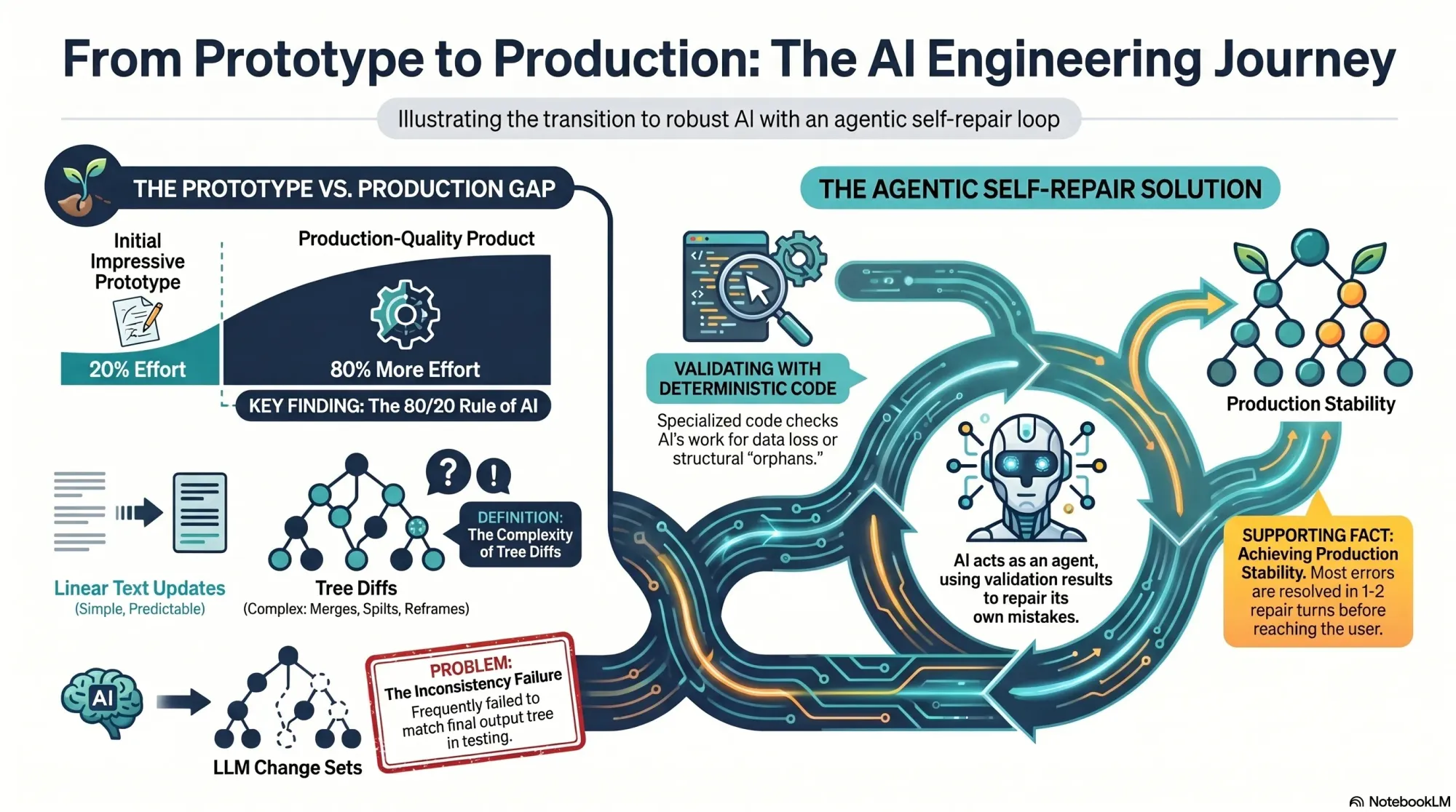
    I often see the same pattern with AI: it’s easy to get to an impressive prototype, but much harder to reach a production-grade product. That was exactly my experience here. My service actually comprised two sub-services: generating a new tree from scratch and updating an existing tree with new interviews. The first worked well in alpha; the second had to be built before anyone could add a fourth interview.

    Opportunity Solution Tree diagram: teal Outcome links to Opportunities A and B; Opportunities C and D branch under B; right panel lists the change set steps for adding nodes.
    Explore how an outcome expands into an Opportunity Solution Tree: Opportunities A and B stem from the goal, with C and D nested under B, while a concise change set tracks every node added along the way.

    On the surface, these services look similar. In reality, updates must preserve existing structure unless new evidence requires a change. You have to account for compound operations—merges, splits, deletes—while guaranteeing no data loss. Every node has source opportunities (supporting evidence from interviews) and children (tree sub-opportunities), and neither can be dropped.

    In classic AI fashion, I got a reasonable version working in a few days and shipped it to our design partners. One team quickly hit our beta limits and asked to convert to a paid subscription so they could keep going. They showed a willingness to pay, converted, and started uploading aggressively.

    Diagram of an Opportunity Solution Tree showing how parent 'Opportunity A' with children x, y, z is split into 'Opportunity A' and 'Opportunity B' to reassign evidence and connections.
    Watch an Opportunity Solution Tree evolve: the original parent A with x, y, z branches is split into A and B, shifting evidence while preserving links—mirroring how AI refines scope and structure in discovery.

    At the 14th, 15th, and 16th uploads, the cracks appeared. We saw odd behavior in some trees. The Vistaly team noticed that the change sets—the step-by-step instructions emitted by my service—didn’t always reconstruct the final tree my service also emitted. We needed those steps to match exactly, so teams could review and accept, modify, or reject each change with confidence.

    They flagged the issue the day I was flying to New Orleans for Jazz Fest. In hindsight, I’m glad I didn’t grasp the scope of what awaited me. I had roughly 80% of the work still to do to make tree updates rock solid. At least I got to enjoy the music first.

    Flowchart merging two opportunity solution trees: Opportunity B with children y and z, and Opportunity C with t, u, v, consolidated into one tree led by Opportunity C connected to five child opportunity nodes.
    From fragments to focus: this diagram shows how Opportunities B and C are merged into a single Opportunity Solution Tree, removing duplicates and unifying context so AI can rank and explore five related opportunities with clarity.

    Back home, I started diagnosing. My service was a pipeline: several LLM-driven steps followed by deterministic code to compare trees and produce change sets. As I dug in, I realized that approach was flawed. Tree diffs, unlike linear document diffs, are ambiguous.

    In a document, if I add a sentence, the diff shows an addition. If I delete a paragraph and rewrite it, the diff shows a removal and an addition. Simple. But trees are different. Suppose I split opportunity A into A and B, and later merge B with C. The split can disappear from the final diff.

    Diagram of an opportunity solution tree labeled 'Input Tree' showing an Outcome node branching to Opportunity A and C, each with child nodes x-z and t-v, with arrows indicating hierarchy.
    Peek inside our process: a simple opportunity solution tree maps an outcome to prioritized opportunities A and C with downstream options x-z and t-v. A clear snapshot of how AI organizes product discovery.

    When the model splits an opportunity, it must distribute A’s source opportunities and children between A and B. For instance, if A has source opportunities 1, 2, 3 and children x, y, z, after the split A might keep 1, 2, and x, while B takes 3, y, and z.

    Now suppose the model merges B into C. If C originally had source opportunities 4 and 5 and children t, u, v, then after the merge C now has source opportunities 3, 4, 5 and children t, u, v, y, z. When you compare the original and final trees, it looks like A somehow donated some evidence and children directly to C. The split and merge that explain why are invisible to a naive diff.

    Opportunity Solution Tree diagram titled Output Tree: a blue Outcome node branches to green Opportunity A and Opportunity C, which expand to nodes x-v with arrows; Product Talk badge.
    See how an AI-generated Opportunity Solution Tree unfolds: one Outcome flows to Opportunities A and C, then into options x–v. Clean colors and arrows reveal the hierarchy from goal to opportunities at a glance.

    That was the core insight: we didn’t just need to show what changed—we needed to show why it changed. I had to reconstruct each move step-by-step. That meant getting the model to show its work, which opened a new can of worms.

    I refactored my prompts so the model produced both the final output and the exact change set it used to get there. The action language was explicit: add, delete, reframe, merge, split, and so on. Crucially, I asked the model to describe its moves in user-meaningful terms—“split A into A and B, then merge B into C”—not as opaque reassignments of sources and children.

    Diagram of an AI-generated Opportunity Solution Tree: blue Outcome node with children Opportunity A and Opportunity B; B branches to Opportunity C and D. A right-hand list shows the change set for each step.
    Watch an opportunity solution tree take shape: start with the outcome, add opportunities A and B, then extend B to C and D. The paired change set makes every edit transparent—ideal for AI-assisted product discovery.

    For each LLM step, the model now emitted its recommendation and the corresponding change set. This helped, but it wasn’t perfect. After extensive testing and error analysis, two classes of errors emerged: (1) the model attempted an invalid move, and (2) the change set didn’t actually generate the recommendation.

    Category 1 felt like designing a game while the model played it creatively. For example, what happens when the model tries to merge a parent with a child? If opportunity A has children B, C, and D and the model merges A with B, the merge is directional. If the instruction is “keep A, delete B,” that works—the parent absorbs the child. But if the instruction is “keep B, delete A,” then C and D become orphans. These puzzles were solvable and even fun.

    Diagram of Opportunity Solution Tree merge rules: merging node B into parent A is allowed, while merging A into B is not because it would orphan opportunities B, C, and D.
    Visual explainer from Product Talk on AI-generated Opportunity Solution Trees. It contrasts an allowed merge (B into A) with a not-allowed merge (A into B) that leaves child opportunities orphaned, guiding safe hierarchy edits.

    Category 2 was harder. Despite prompt iterations, I could only push the discrepancy rate down to about 1 in 40 instances. With 10–20 LLM calls per run, that meant roughly half of all runs still failed. Not acceptable for production. I hit a wall. A paying customer was waiting, and more design partners were queued up.

    Next, I tried to correct the model’s mistakes with deterministic code. I had promised that my change sets would generate the output tree, so I wrote verifiers: detect conflicts (e.g., delete a node, then try to use it later), guard against data loss, prevent orphaned nodes, and more. Detection was straightforward; correction was not. Fixing issues required guessing the model’s intent. If the sequence said “delete A, then merge A with B,” should I remove A entirely or salvage A’s sources and children by merging into B? There were dozens of such cases with no unambiguous answer.

    Workflow diagram titled 'My Simple Repair Loop' showing an iterative validation cycle: Generate the Change Set → Run the validation tool → Check Result, with branches to retry on failure or exit on pass.
    A step-by-step loop shows how changes are validated: generate a change set, run a validation tool, review the result, then repeat on failure and exit on pass—mirroring iterative work behind AI-built Opportunity Solution Trees.

    After 11 straight days of deep work—including weekends—I was exhausted. I dislike hustle culture; this isn’t how I design my life. But I was stuck, and then I had an insight.

    On a walk with my husband (also an engineer), I realized I could have the LLM repair its own mistakes. My data contract with Vistaly requires that the change set must generate the output tree. I had already built robust validation code. I knew exactly when a change set failed—and why. No amount of prompt tuning alone was fixing it. So I turned the validator into a tool for the model and created a simple agentic loop.

    The loop works like this: the model proposes a change set, calls the validation tool, and gets back a pass/fail plus specific feedback. If it fails, the model uses those instructions to repair the change set and calls the tool again. Iterate until success or a max number of turns.

    I prototyped in Node.js with a single model call, a verifier pass, and a repair attempt. At first, the loop didn’t converge—it just accumulated compute. I experimented with how to communicate errors, how much context to include, and how to sequence feedback. Eventually, it clicked: the model began fixing its own mistakes and typically returned a valid change set in one or two repairs. It was, in practice, eval-driven development applied to LLM outputs.

    I had already built an agent loop utility for another AI workflow, so I productionized quickly: model call, optional tool invocation, tool result returned to the model, repeat until the validator signals success or the loop times out. I integrated the new loop into the pipeline and shipped the revamped service to Vistaly on Monday at noon. They’re integrating now, and it will be in the hands of our design partners shortly. I’m relieved—and ready for a day off.

    Reflecting on the last two weeks, a few things stand out. First, I shed limiting beliefs about being an engineer. To make this reliable, I had to solve legitimately hard problems, and that feels good.

    Second, this was genuinely fun. Designing the action set and watching the model push those boundaries was like working through elegant puzzles. Models are incredibly creative, and harnessing that creativity with the right constraints is deeply satisfying.

    Third, I learned when I can and can’t trust Claude to write code for me. Since Opus 4.6 came out, I gave Claude a much longer leash. After the past two weeks, Claude is back on a short leash. I found a lot of gaps in my implementation in areas where I simply trusted that Claude got it right, when in fact it didn’t. If you don’t have the right infrastructure—planning, testing, code review—this can be disastrous. I’ll be investing more here and sharing what I learn.

    Finally, if this work had been spread over two months, it would have been thoroughly enjoyable. I’m discovering how much I like being an AI engineer. It feels like a new chapter where I can combine opportunity solution trees with modern AI engineering—and deliver real value to product teams doing continuous discovery.

    I’m excited to share more of what we’re building with Vistaly and to onboard more design partners soon. If you’re interested, get on the waiting list. And if you’ve been hesitant to stretch beyond your current skill set, I hope this story nudges you to take the first small step toward what’s just now possible.


    Inspired by this post on Product Talk.


    Book a consult png image
  • Taste vs. Evidence in the AI Era: What Product Leaders Must Invest In Now

    Taste vs. Evidence in the AI Era: What Product Leaders Must Invest In Now

    I just finished listening to "Taste – All Things Product Podcast with Teresa Torres & Petra Wille," and as a product leader shipping AI-powered capabilities at HighLevel, Inc., I wanted to pressure-test the sudden obsession with "taste."

    If you're curious, you can listen to this episode on Spotify or Apple Podcasts.

    The core question landed perfectly for our moment: Is "taste" the must-have skill of the AI era — or just the latest tech buzzword in a world where AI is eating through design, delivery, and discovery?

    Teresa pushes back hard, highlighting how slippery the term can be. "It's just this month's flavor of founder mode." She points out that "taste" is rarely defined, can't be easily taught, and too often becomes shorthand for "my preference trumps yours." Just as importantly, "It's not about your taste. It's about your customer's taste."

    Petra adds needed nuance from years in the craft: pattern-recognition is real, and some people do develop sharper product sense over time. As she put it, "I am a strong believer that you develop product sense and taste over time. It's never finished."

    Both threads lead back to familiar roots in product: product sense, founder mode, and the enduring myth of the lone visionary. They even grapple with the big question on everyone’s mind—Will AI Eat Taste Too?—and where that leaves product teams navigating GenAI, LLMs for product managers, and evolving product strategy.

    Here’s my take. "Taste" can be useful as a personal north star, but it is not a decision system. In my teams, we bias toward evidence: continuous discovery, customer interviews, discovery synthesis with opportunity solution trees, and tight collaboration in product trios. Opinion can start the conversation, but evidence should end it.

    Practically, that means investing in the skills that compound: Discovery skills — understanding customers, matching solutions to real needs. Human-to-human interaction skills. Learning to collaborate with AI effectively. Critical thinking and judgment grounded in evidence.

    On AI collaboration specifically, we treat GenAI as a force multiplier, not a decider. We prototype with AI to explore breadth, then narrow with qualitative and quantitative signals, ablation-style experiments, and clear success criteria. The bar I hold myself to is simple: taste without evidence is just opinion.

    Three lines I underlined from the conversation:

    "It's just this month's flavor of founder mode." — Teresa Torres

    "It's not about your taste. It's about your customer's taste." — Teresa Torres

    "I am a strong believer that you develop product sense and taste over time. It's never finished." — Petra Wille

    If you want to go deeper, these references are helpful for sharpening judgment without falling into the "great man" theory trap.

    Follow Teresa Torres: https://ProductTalk.org

    Follow Petra Wille: https://Petra-Wille.com

    Founder mode

    Marty Cagan: Founder-Style Leadership

    Vercel/v0 CEO Guillermo Rauch on building taste: from Lenny Rachitsky’s Linkedin post

    Continuous discovery (Read Teresa’s Everyone Can Do Continuous Discovery—Even You! Here’s How

    The "great man" theory

    Steve Jobs and the myth of the lone product visionary

    Have thoughts on this episode? Leave a comment below and share how your team balances product sense with evidence in the age of AI.


    Inspired by this post on Product Talk.


    Book a consult png image
  • Mastering Product Marketing with Amplitude Analytics: Proven Playbooks for Sustainable Growth

    Mastering Product Marketing with Amplitude Analytics: Proven Playbooks for Sustainable Growth

    I’m continually refining how we use analytics to elevate product marketing, and this collection brings together my most effective playbooks for driving measurable growth with Amplitude Analytics. If you’re focused on product-led growth, you’ll find pragmatic guidance on translating behavioral analytics into sharper positioning, stronger activation, and durable retention.

    In my day-to-day work, I connect product strategy with go-to-market strategy by grounding every narrative in real user behavior. That means using event data to validate our value proposition, mapping journeys to uncover friction, and aligning product positioning with the moments that actually matter in-app. The outcome is a marketing engine that mirrors how customers discover, adopt, and expand within the product.

    Activation and retention are where outcomes are won or lost. I detail how to set leading indicators for user activation, instrument key behaviors, and run retention analysis that distinguishes healthy engagement from noisy usage. You’ll see how I turn cohort insights into precise messaging, targeted onboarding, and experiments that compound over time.

    Cross-functional execution is essential, so I share ways to operationalize a unified analytics platform across product, marketing, and customer success. With shared metrics, product trios can move faster from product discovery to launch, and marketing can scale campaigns that reflect what’s truly driving adoption. This tight loop reduces guesswork and increases our hit rate on both features and narratives.

    If you’re building a modern product marketing function, these essays and guides will help you move from intuition-led storytelling to evidence-backed strategy. Dive in to learn how I connect behavioral analytics to positioning, packaging, and roadmap choices—so every campaign and release ladders up to meaningful customer outcomes and sustainable growth.


    Inspired by this post on Amplitude – Perspectives.


    Book a consult png image
  • Master Opportunity Mapping with Continuous Discovery Habits — Join the May 2026 Book Club

    Master Opportunity Mapping with Continuous Discovery Habits — Join the May 2026 Book Club

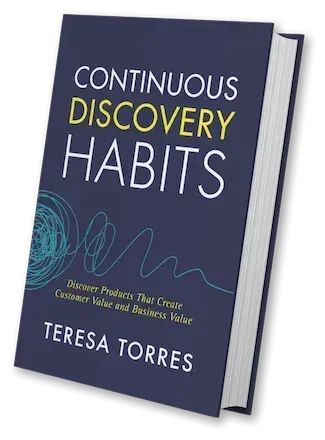
    Five years in, Continuous Discovery Habits continues to be one of the most practical frameworks I use to align empowered product teams, sharpen product strategy, and convert customer interviews into outcomes. To celebrate its impact, I’m hosting a community read-along and inviting you to dig in with me this May.

    Each month, I’m releasing an in-depth reading guide to make learning stick. You’ll find the chapters we’ll be reading, a preview of the essential concepts, short videos to help you spread the ideas across your organization, individual and team discussion prompts, team exercises to put the concepts into practice, and additional reading if you want to go deeper. My goal is simple: help you turn product discovery into a steady habit, not a once-a-quarter activity.

    We’ll discuss each month’s reading in the comments, and we’ll gather quarterly on a live call to compare notes and share what’s working. Joining late is absolutely fine—I monitor the conversation throughout the year. Start with the current month or rewind to January; you can ask for help, share wins and roadblocks, and connect with other readers anytime.

    If you want to participate, grab a copy of the book (or dust off your old one), share the "Spread the Love" videos with your team, block focused time for the exercises, and register for the community sessions. Let’s do this together.

    This Month’s Reading

    Chapter: Chapter 6: Mapping the Opportunity Space

    Estimated reading time: ~23 minutes

    This month’s chapter will introduce you to why opportunity mapping is critical for structuring the ill-structured problem of reaching your desired outcome; how to move from overwhelming opportunity backlogs to well-structured opportunity spaces; the power of tree structures for depicting parent-child and sibling relationships between opportunities; how to identify distinct branches in your opportunity space using key moments in time; common anti-patterns to avoid when building your first opportunity solution tree; and why structure "gets done, undone, and redone" as you continue to learn.

    Need a copy? Grab the book.

    Share the Love with Friends and Colleagues

    We learn best in community. Use these short videos to spread the core concepts from this chapter—then invite your team to join the book club with you.

    The need for opportunity mapping – You will never fully satisfy your customers' desires

    Understanding the structure of an opportunity solution tree – Depicting two types of relationships

    Turn big intractable problems into smaller, more solvable problems – The power of decomposition

    How to map an opportunity space – Getting started with opportunity solution trees

    A well-structured opportunity space has distinct branches – Identify key moments in time

    Reflect & Discuss What You Read

    Reflection turns reading into capability. This chapter asks us to shift from reacting to every request to deliberately structuring the opportunity space. If you’ve ever felt overwhelmed by a never-ending backlog or pressure to ship output over outcomes, this is where the fog starts to lift. As you read, focus on how your team currently organizes (or doesn’t organize) what you hear from customers.

    Individual Reflection

    1) Think about your current product backlog or opportunity list. Is it a flat list, or do you have some structure to it? If you were to group similar opportunities together, what patterns would emerge?

    2) When was the last time you heard a customer need and immediately jumped to a solution without exploring whether there were related opportunities? What would change if you took the time to map how that opportunity connects to others?

    3) Review the anti-patterns from the chapter (opportunities framed from your company's perspective, vertical opportunities, opportunities with multiple parents, etc.). Which of these do you recognize in how your team currently talks about opportunities?

    Team Discussion

    1) As a team, pick a top-level opportunity you're currently working on. Try breaking it down into sub-opportunities together. Where do you struggle? Where do you disagree about how to frame or group opportunities? What does that tell you about gaps in your shared understanding?

    2) Look at your experience map (from Chapter 4) and identify 3-5 distinct moments in time during your customer's experience. Could these become the top-level branches of your opportunity solution tree? Where do you see overlap, and where are there clear distinctions?

    3) Discuss the quote from Barbara Tversky: "Structure gets done, undone, and redone." How does your team currently respond when you discover new information that changes how you understand the opportunity space? Do you treat your opportunity map as fixed or as something that evolves?

    Put It Into Practice

    Reading is step one; building your first opportunity solution tree is where the real learning happens. The exercises below are exactly how I coach product trios to transform ambiguous problems into aligned action.

    Exercise: Build Your First Opportunity Solution Tree

    Time: 60 minutes. Do this: With your product trio.

    Start by reviewing your interview snapshots from the past few weeks. For each opportunity you captured, ask the three questions from the chapter:

    Is this opportunity framed as a customer need, pain point, or desire (not a solution)?

    Is this opportunity unique to one customer, or have we seen it in more than one interview?

    If we address this opportunity, will it drive our desired outcome?

    Then, using your experience map, identify 3-5 distinct moments in time to serve as your top-level opportunities. Group the opportunities from your interviews under these top-level branches.

    Look for opportunities to add structure to each branch. Group similar opportunities together and identify a parent opportunity. Look for vertical stacks (one parent, one child) and fill in missing siblings. Reframe opportunities that are too broad or that could live in multiple branches.

    Don’t aim for perfection. Get something on paper (or a digital canvas) and iterate the tree with every new interview.

    Exercise: Practice Framing Opportunities from Your Customer’s Perspective

    Time: 30-45 minutes. Do this: With your product trio.

    Take 10-15 opportunities from your current backlog or list. For each one, ask: "Can I imagine a customer saying this?" If the answer is no, reframe it from your customer’s perspective. For example:

    "Increase subscription conversions" becomes "I want to know if this product is worth paying for"

    "Reduce support tickets" becomes "I can't figure out how to do X"

    "Improve onboarding completion" becomes "I'm not sure what to do next"

    This exercise helps you spot business-centric opportunities disguised as customer opportunities. It also trains your team to listen for opportunities in interviews that are framed from the customer’s point of view.

    Go Deeper: Additional Reading

    If you prefer an audio summary of this month’s reading, including the book chapters and the following resources, I’ve included an audio version for paid subscribers at the bottom of this post.

    Related In-Depth Guides

    Opportunity Solution Trees: Visualize Your Discovery to Stay Aligned and Drive Outcomes

    Customer Interviews: Uncover Hidden Insights from Every Conversation

    Supplementary Reading

    Prioritize Opportunities, Not Solutions

    Product in Practice: Opportunity Mapping at Grailed

    Product in Practice: Opportunity Mapping at trivago

    7 Key Benefits of Using Opportunity Solution Trees

    Getting Started with Opportunity Solution Trees at SuperAwesome

    Bringing Order to Chaos: Using Opportunity Solution Trees in Everyday Life

    Other Voices

    Why Groups Struggle to Solve Problems Together by Al Pittampalli

    More PM Problem Areas by Marty Cagan

    Five Superpowers of Diagrams by Abby Covert

    Critical Thinking is Product Management by This Is Product Management

    Our Live Discussion Schedule

    Our live discussion sessions are for paid subscribers. Sessions are not recorded. Invitations will go out to Supporting Members and CDH Members two weeks before the scheduled event. But reserve the time on your calendar now.

    Tuesday, June 16, 2026: 9am-10am PDT

    Thursday, September 17, 2026: 9am-10am PDT

    Wednesday, December 16, 2026: 9am-10am PST

    Audio Summary

    This summary was produced by NotebookLM. The sources supplied were the book chapters as well as all of the additional reading.


    Inspired by this post on Product Talk.


    Book a consult png image
  • Inside AI Product Management at Amplitude: How Leaders Turn Data into Better Products

    Inside AI Product Management at Amplitude: How Leaders Turn Data into Better Products

    When I think about the impact of AI on product management, one line sums it up for me: "Spencer Whittaker is a senior AI product manager at Amplitude. He focuses on using AI to advance Amplitude's mission of helping companies build better products." That focus on outcomes reflects how I frame AI Strategy—grounding every model and workflow in customer value and product-led growth.

    In practice, that means pairing Amplitude analytics and behavioral analytics with A/B testing and continuous discovery. I lean on eval-driven development to keep models honest, and I coach LLMs for product managers techniques so teams can prototype safely while we protect signal. Using a unified analytics platform clarifies what to build next and how to iterate faster.

    On teams I lead, product discovery stays tightly coupled to AI workflows: we map hypotheses to metrics, design experiments, and close the loop with instrumentation before we ship. That discipline turns AI from a demo into durable value, accelerating activation, retention, and feature adoption without sacrificing quality. A pragmatic AI product toolbox keeps us focused on measurable outcomes, not just novel capabilities.

    If you’re building with AI today, take a page from leaders pushing the craft forward: start with clear outcomes, connect your data in a unified analytics platform, and let A/B testing and continuous discovery guide your roadmap. With the right foundations—Amplitude analytics, behavioral analytics, and a sharp AI Strategy—you’ll transform insight into impact and build better products, faster.


    Inspired by this post on Amplitude – Perspectives.


    Book a consult png image
  • Beyond Command and Control: How I Build Trust, Speed, and Autonomy in Product Teams

    Beyond Command and Control: How I Build Trust, Speed, and Autonomy in Product Teams

    When uncertainty spikes, I notice many organizations snap back to "Command and control." It feels fast, safe, and decisive—especially when the stakes are high. But in product management leadership, speed without shared context is often an illusion, and control without trust rarely scales. I’ve learned that what looks like strength from the top can quietly create bottlenecks, missed signals, and disengaged teams.

    Why do smart companies revert in tough times? Familiarity. Centralizing decisions can reduce short-term cognitive load and signal clarity. Yet the cost shows up quickly: leaders become single-threaded on context they cannot possibly hold, and teams spend cycles asking for permission rather than creating value. The result is slower learning and weaker product strategy just when continuous discovery and iteration matter most.

    Here’s the hard truth: no single leader can hold all the context required to make every decision in a modern, cross-functional environment. The hidden complexity of customer segments, technical debt, data signals, and go-to-market constraints outstrips any one person’s bandwidth. That’s why empowered product teams, staffed with domain experts, outperform command centers—provided they’re aligned on outcomes and guardrails.

    I like the burning house analogy: in a true emergency, crisp direction helps—"take the stairs, not the elevator"—because the problem is clear, the time horizon is short, and the action is obvious. But most product work is not a single burning house; it’s a city with evolving fire codes, shifting weather, and neighborhoods that look different block to block. In that environment, distributed action scales better than centralized control.

    Strong leadership is not the same as command-and-control. In practice, it means setting a compelling direction, defining guardrails, and running tight feedback loops. I aim for what I call the "Flotilla of kayaks": we’re all headed to the same lighthouse, but each kayak navigates its own currents based on local information. That’s aligned autonomy—fast, resilient, and deeply accountable.

    People often ask why some command-and-control companies still succeed. My view: beneath the surface, there’s usually more trust and unofficial autonomy than their org charts suggest. Teams earn freedom by shipping reliably, sharing decision rationales, and showing outcomes. Leaders tolerate—and even quietly endorse—those pockets of autonomy because they see the results.

    It’s a spectrum, not a binary. I flex my style based on risk, reversibility, and time horizon—what I’d call spectrum thinking. Early in a bet, or when risks are existential, I raise the altitude and tighten the cadence. As confidence builds, I widen autonomy and shift the team to outcomes over outputs. Beware "Founder mode" when it drifts from vision-setting into day-to-day decision vetoes; it’s intoxicating early and suffocating at scale.

    On decision-making, I prefer a simple principle: let the person with the most relevant expertise decide, while incorporating the right input. That’s "Consultative decision-making" in practice. In some regions, you’ll hear it called "Konsultativer Einzelentscheid." The point is to seek counsel without defaulting to consensus that bogs down speed. One person owns the call, and everyone commits to the decision once it’s made.

    Practically, here’s what works for my teams: we clarify decision rights up front, draft pre-reads with clear options and risks, involve the smallest set of stakeholders required, and document the decision and expected signals ahead of time. Product trios keep discovery tight with design and engineering, while stakeholder management focuses on context, not sign-offs. We track outcomes vs output OKRs and hold regular decision reviews so we can reverse or double down fast.

    My key takeaways are consistent: "Command and control" can feel efficient, but it doesn’t scale in complex environments. No leader can hold all the context. Strong leadership is about direction, guardrails, and feedback loops—not control. High-performing teams balance autonomy with alignment. Decision-making should sit with the person closest to the problem, supported by the right input and transparent reasoning. Trust is built and earned over time—and it changes how teams operate.

    Reflection prompts I use with my leads: Where does your team sit on the command-and-control ↔ autonomy spectrum? Are the highest-context people truly making the decisions? What would it take to increase trust and autonomy—better instrumentation, clearer guardrails, or tighter cadences? Which calls require consensus, and which deserve a decisive, single-threaded owner?

    If you’re wrestling with speed, alignment, and autonomy in your organization, start small: pilot "Consultative decision-making" on one consequential decision, set explicit guardrails, and measure the outcome. You may be surprised how quickly aligned autonomy compounds into better product discovery, sharper product strategy, and stronger execution.


    Inspired by this post on Product Talk.


    Book a consult png image