Month: February 2026

  • From Tickets to Strategy: How AI Is Rewriting Support Careers—and Why Now Is the Moment

    From Tickets to Strategy: How AI Is Rewriting Support Careers—and Why Now Is the Moment

    To truly transform with AI, I’ve learned it’s never just about the technology—it’s about redesigning how we work. The teams that win don’t bolt AI on; they re-architect around it. That means rethinking roles, workflows, and governance to build a system that sustains and improves AI performance over time.

    In The 2026 Customer Service Transformation Report, teams at every stage of maturity describe human agents taking on more proactive work—training AI systems, handling the hardest queries, and owning tasks that demand judgment. Job descriptions are shifting, too, with many organizations explicitly adding AI-related responsibilities.

    I’m also seeing a clear rise in dedicated AI specialists. Conversation analysts, knowledge managers, and AI operations leads are fast becoming standard. For support professionals, this opens new, higher-leverage career paths—and creates a talent pipeline that blends service excellence, data fluency, and product thinking.

    Support once centered on queue-level activity—ticket triage, routing, translations, and answering FAQs. Now, as AI handles more frontline interactions, our human roles are moving up the stack toward optimization, oversight, and continuous improvement.

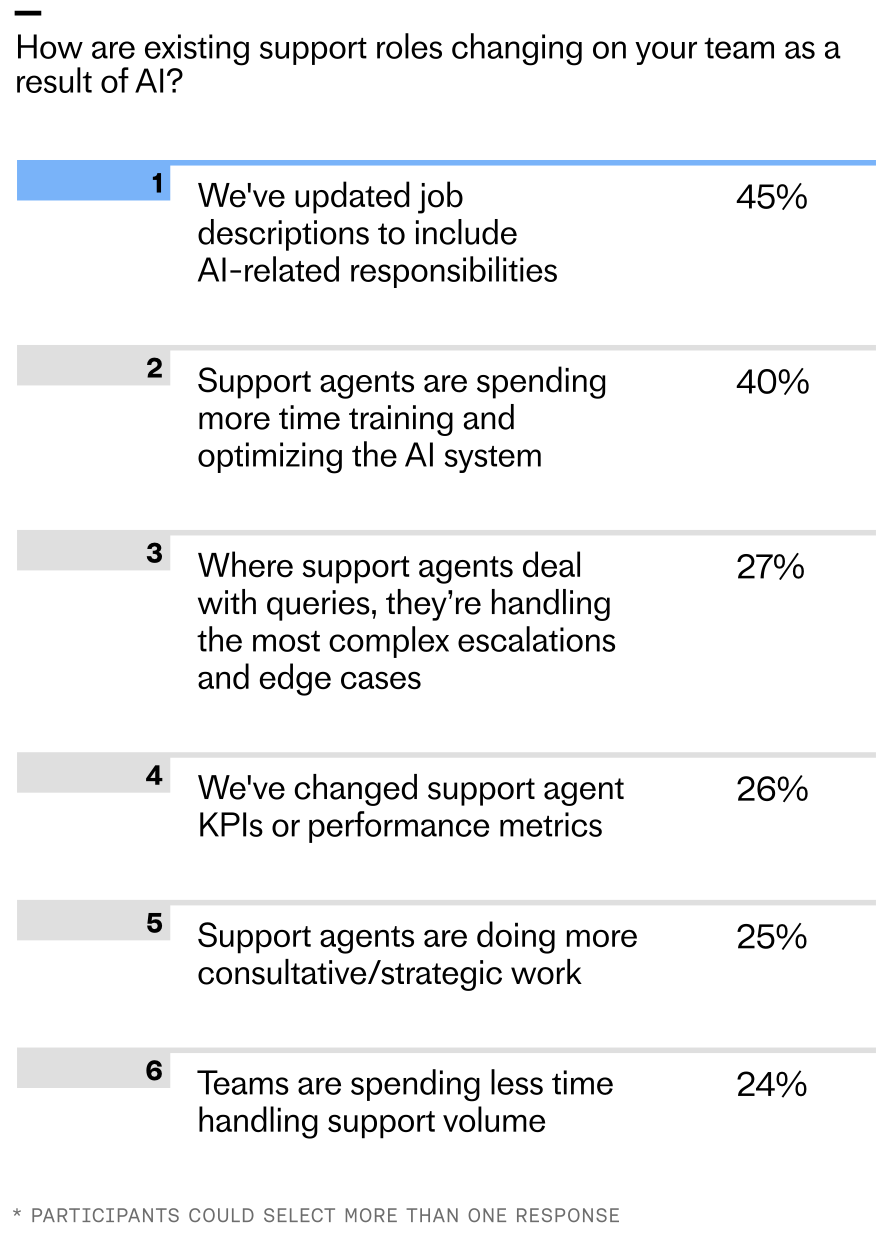
    According to the latest research, 45% of teams report updating job descriptions to include AI-related responsibilities, with 40% saying their human agents are now more focused on training AI systems. Another 27% report that human agents primarily handle the most complex escalations and edge cases, while a quarter say agents are doing more consultative and strategic work.

    Even at the initial deployment stage, 16% of teams report spending less time handling support volume since implementing AI – and among teams who’ve reached maturity, that figure rises to 28%.

    When Intercom’s Research, Analytics & Data Science (RAD) team interviewed 166 of our customers, similar themes emerged. Nearly all participants (≈95%) reported meaningful workflow changes, with manual processes being handled by AI, and humans focusing more on monitoring or fine-tuning AI outputs. Eighty-three percent of participants also reported seeing their team’s roles and responsibilities change to become more strategic and supervisory in nature.

    Infographic of AI-driven customer support roles and adoption rates: conversation analyst 32%, knowledge manager 30%, AI operations lead 28%, support automation specialist 24%; 8% say no new roles added.
    AI is reshaping support teams: organizations are adding conversation analysts (32%), knowledge managers (30%), AI operations leads (28%), and support automation specialists (24%). Just 8% report no new AI roles.

    It’s not just the work that’s evolving; organizational structures are, too. Some teams are reallocating existing talent into AI-focused roles; others are hiring entirely new skill sets. Many of the most common job titles in this space didn’t exist two years ago.

    Consider a Senior AI Knowledge Manager, Beth-Ann Sher, who transitioned from a help center manager role. Like many careers transformed by AI, her work evolved from administrative to strategic. Instead of focusing solely on customer-facing, self-serve content, her mandate expanded to designing and optimizing knowledge inputs that directly improve AI Agent Fin’s performance—work that materially lifts resolution rates.

    Or look at a Senior Conversation Designer, Fred Walton, hired specifically for an AI-first function. He focuses on frictionless customer journeys with Fin, smoothing handoffs between automation and human support while keeping customer satisfaction front and center—hallmarks of mature AI workflows and conversation design.

    In high-performing organizations, roles like these typically sit within a dedicated AI support team under senior CS leadership. Clear ownership and accountability for AI performance is critical; without it, optimization stalls and trust erodes.

    These shifts aren’t isolated. Take Robb Clarke from RB2B. He went from Head of Technical Operations to Head of AI. With Fin, his focus moved from repetitive support questions to managing knowledge and improving the system behind it—freeing him to be proactive about product improvements and fix issues before they hit customers.

    Or consider Eric Broulette from Bloomerang, a support leader who leaned into AI and became the VP of Support and Education. By deploying Fin, his team found breathing room to invest in what’s next. Agents stepped into new roles, contributed to meaningful projects, and built skills that had previously felt out of reach. As Eric puts it: “Do not wait to embrace AI. It will unlock more career growth for your teams than you can imagine.”

    Neon green hero graphic reading 'The 2026 Customer Service Transformation Report', with subhead 'The AI deployment gap is widening' and a black 'Get the report' button over a bar-chart pattern.
    Leaders are racing ahead with real AI in support. Explore the 2026 Customer Service Transformation Report to see where deployment is stalling, benchmark your team, and get practical steps to scale automation that delights.

    Bringing AI into support will eventually change every agent’s day-to-day work. For leaders at the start of the journey, that can feel daunting. My perspective: the most successful teams treat this as an operating model shift, not a tooling rollout—anchored in AI Strategy, governance, and continuous improvement.

    Be transparent about what’s changing, why it matters, and how success will be measured. Define how AI performance will be evaluated (resolution rate, containment, CSAT impact), empower agents to train and improve the system, and communicate how responsibilities will evolve. When teams help build the AI, they’re invested in making it great.

    Here’s the playbook I rely on with support leaders: First, reset expectations about time allocation—less time in the queue, more time improving the AI system that serves the queue. Second, elevate knowledge management as a core capability. Prioritize content quality and coverage for your AI Agent, and carve out dedicated “out of the inbox” time so every agent contributes. Third, keep outcome metrics—especially resolution rate—front and center. It gives the team a north star for experimentation and iteration.

    Scaling AI is as much a people challenge as it is a technology challenge. As automation takes on more work, support roles become more proactive, strategic, and cross-functional—even early in the journey. Responsibilities expand, new roles emerge, and team structures adapt to concentrate on and amplify AI performance. In the process, support careers are transformed.

    If you’re leading this shift, now’s the moment to reimagine your operating model: clarify ownership, invest in knowledge and conversation design, adopt eval-driven development, and build the muscle for continuous improvement. That’s how you move from tickets to strategy—and unlock compounding value for your customers, your business, and your teams.


    Inspired by this post on The Intercom Blog.


    Book a consult png image
  • Scaling Enterprise Sales from $0 to $3.5B: CRO Lessons, MEDDIC Mastery, and GTM Truths

    Scaling Enterprise Sales from $0 to $3.5B: CRO Lessons, MEDDIC Mastery, and GTM Truths

    I’ve led product organizations through multiple growth chapters, and the pattern is always the same: the tighter the alignment between product, sales, and marketing, the faster you scale. Reflecting on the journey of Chris Degnan — the first sales hire at Snowflake who spent 11 years helping scale the company from zero to $3.5 billion in revenue as its CRO while partnering with four different CEOs — I’m struck by how consistently the fundamentals win. The playbook isn’t mysterious; it’s disciplined execution, ruthless clarity, and a go-to-market strategy that matures with each revenue stage.

    At $10M ARR, the CRO role is hands-on and founder-adjacent. You’re close to the product, running point on key deals, pressure-testing messaging, and building credibility with early customers. By $1B+, the job is organization design: segmentation, international expansion, forecast accuracy, enablement, recruiting, and cross-functional orchestration. The shift is from deal quarterback to system architect — standing up repeatable, auditable processes that produce reliable outcomes across regions, segments, and industries.

    Sales leaders who can’t sell the product themselves don’t last. Whether you sit in product management leadership or run the field, you need to master discovery, speak the customer’s language, and translate use cases into value. That also means getting fluent in solutions engineering — understanding integrations, data paths, security, and the operational realities buyers live with. I’ve found this hands-on competence to be the fastest way to earn trust internally and externally, and to keep product strategy grounded in market truth.

    The MEDDIC methodology is the foundation for every durable sales org — and, frankly, a founder’s best insurance policy. MEDDIC forces alignment on qualification criteria, from Metrics to Economic Buyer to Decision Process and Identifying Pain. When product and sales both operate to this standard, roadmap bets improve, marketing targets sharpen, and win rates climb. It’s not paperwork; it’s pattern recognition at scale.

    High-output CROs obsess over the right numbers. Pipeline coverage by segment and stage; conversion rates through each gate; sales cycle length by use case; average selling price and discount discipline; consumption predictability when you have consumption SaaS pricing; and post-sale expansion velocity. The art is deciding which two or three metrics are the organization’s true north at a given stage — then designing enablement, compensation, and operating cadence around them.

    On operating cadence, the week in the life at scale is predictable for a reason. Forecast reviews that surface risk early. Deal reviews that coach to MEDDIC depth, not activity theater. Enablement blocks to uplevel managers and ICs. Recruiting time — always. Customer roadshows to refine value proposition and product positioning. And standing meetings with product, marketing, and finance to keep the GTM motion, roadmap, and unit economics in sync.

    Compensation is a force multiplier or a silent saboteur. Keep it simple, consistent, and aligned to the current motion. Early on, weight new logo acquisition and land quality; as you mature, balance new business with expansion, multi-product adoption, and healthy consumption. Guardrails matter — cap over-discounting, reward multi-threading, and avoid plans that create end-of-quarter cliff behavior. The best plans reinforce the behaviors you want your culture to scale.

    Technical CEOs often underestimate how much narrative, segmentation, and process discipline great GTM requires. The handoff from founder-led GTM to sales-led growth is where many teams stall. My rule: prove one repeatable motion in one segment before you add complexity. Codify the buyer’s journey, instrument the funnel, and make sure product strategy and enablement move in lockstep.

    Culture sets the ceiling. You have to find the fakers, manage-uppers, and passengers quickly — people who look busy but don’t move pipeline, who talk big but avoid accountability, or who ride the momentum of others. The mantra that has saved me endless time: “When there’s doubt, there’s no doubt”. Move fast, but with humanity; be clear on expectations, coach hard, and when it’s not a fit, make the change before the team does it for you.

    Feedback is the operating system of a high-performing org. Leaders at every level need to be coachable — on message discipline, on forecast rigor, on how they develop people. I’ve benefited from straight talkers who hold a high bar, and I try to pay that forward. The fastest way to raise organizational IQ is to institutionalize feedback loops across sales, product, and marketing — from post-mortems to win-loss analysis to field-sourced roadmap reviews.

    What separates exceptional ICs from the rest? Hunger, intellectual honesty, and a builder’s mindset. They qualify hard, align to customer metrics early, multi-thread to power and value, and partner tightly with solutions engineering. They don’t hide from gaps; they surface them, and they know exactly what they need from product, marketing, and leadership to win.

    Executive teams that scale share a few traits: crisp segmentation decisions, single-threaded ownership for outcomes, and healthy conflict that resolves into commitment. Dysfunction, by contrast, looks like metrics roulette, opaque decision-making, and a tolerance for exceptions that become precedent. Make the rules explicit and the exceptions rare.

    Leaders like Frank Slootman have popularized intensity, speed, and focus — and there’s real power there when paired with clarity and data. The lesson I carry forward: move fast on people decisions, keep the message simple, and measure what matters. Equally important is knowing where that approach can backfire — when speed outruns learning, or when pressure erodes cross-functional trust. The best operators balance urgency with systems thinking.

    Most AI companies will face a go-to-market reckoning. Model quality won’t save a weak motion. The winners will articulate a hard-nosed ROI, solve specific workflow pain, address data governance and security head-on, and show measurable lift — not demo dazzle. In other words, the same fundamentals apply; the stakes and scrutiny are just higher.

    If you’re building or rebuilding your revenue engine, start here: define your ideal customer profile and segmentation with ruthless clarity; adopt MEDDIC and teach it across product and sales; align compensation to today’s motion; instrument the funnel and inspect it weekly; and cultivate a culture where feedback is fuel. Do that, and the path from $0 to $3.5B stops feeling like mythology — and starts looking like math.


    Book a consult png image
  • 12 Game-Changing Updates to Fin Procedures & Simulations for Complex Queries

    12 Game-Changing Updates to Fin Procedures & Simulations for Complex Queries

    Today, I’m excited to share 12 major updates to Fin’s Procedures and Simulations—the foundation that lets Fin handle complex work while keeping teams fully in control of the customer experience.

    In my work building AI workflows with product and support leaders, I’ve seen how the right blend of natural language instructions, deterministic controls, and fully agentic behavior turns Fin into a reliable problem solver. Procedures make this blend possible by enabling Fin to act like a human—yet with the repeatability and governance of software. Simulations then let us test those complex Procedures at scale before they reach customers, so we can deploy with confidence.

    Together, these capabilities make Fin self-manageable, transparent, and ready for genuinely complex work.

    Here’s what’s new at a glance: we’ve made Procedures easier to build and maintain; enhanced deterministic controls for precision and policy compliance; expanded agentic behavior so Fin can adapt in real time; and delivered more powerful Simulations to validate end-to-end workflows before go-live.

    Why did we build this? Many teams see early AI gains in speed, coverage, and cost to serve—but then hit a ceiling. They keep AI confined to simple automation and information retrieval, rather than setting it up to handle the nuanced, multi-step workflows they still trust to humans. We designed Procedures and Simulations to remove that ceiling, so teams can confidently set up, govern, and iterate on complex AI workflows without bottlenecks.

    Dark UI diagram of a continuous AI/ML lifecycle loop on a grid, labeled ANALYZE, TRAIN, TEST, and DEPLOY, with TRAIN highlighted in orange to signal iterative model development and evaluation.
    Follow the AI lifecycle as it cycles from Analyze to Train to Test to Deploy. This streamlined loop spotlights the TRAIN phase, underscoring faster iteration and feedback that power more capable procedures and realistic simulations.

    We also heard that teams needed an easy way to connect data so Fin could reliably check customer status or eligibility and then take action. And they didn’t want to route through engineering every time they needed to create or amend logic for mid-conversation decisions. Procedures combines natural language instructions and intuitive data connector setups. You tell Fin in your own words how you want it to behave, and you’ll be guided through creating conditional steps so Fin will react consistently, with the option to add in any code snippets for circumstances where absolute precision is required. Once you build one Procedure, we believe you’ll want to build several, so Fin will constantly read the conversation it’s in to ensure it’s following the most relevant Procedure, and jump to a more relevant one if the user intent changes.

    I know that taking something like this live the first time can feel like a leap of faith. That’s exactly why we built Simulations—to test Procedures comprehensively, uncover edge cases, and launch with confidence.

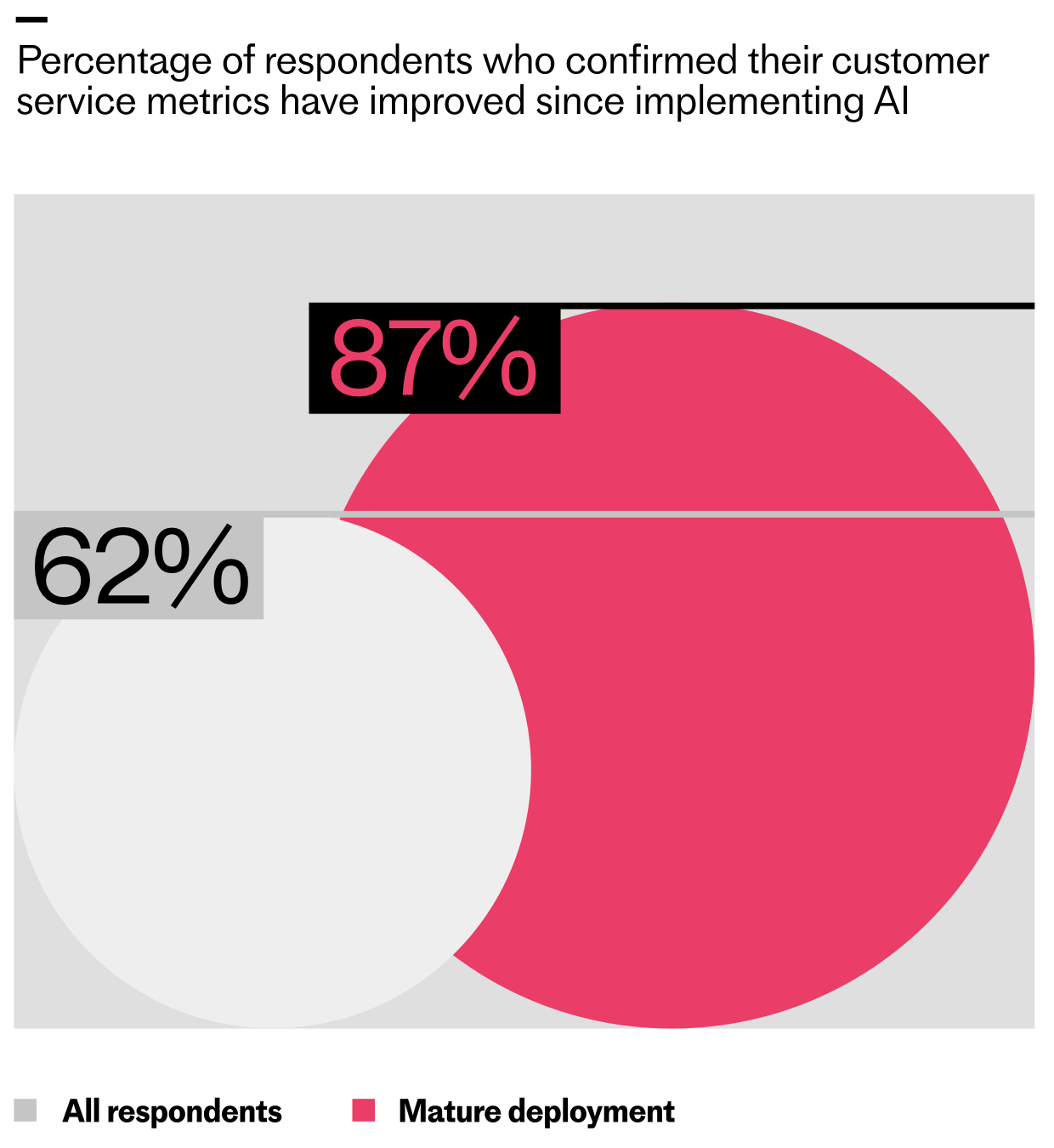
    Reaching mature deployment takes a deliberate, ongoing commitment to training workflows, validating them before deployment, measuring performance in production, and refining them over time. At Intercom, we call this the Fin Flywheel: train, test, deploy, analyze. Procedures form the foundation of the train stage, and Simulations make the test stage reliable at scale. Together, they enable Fin to handle complex work, and teams to stay in control of it.

    Procedures: Define exactly how Fin handles complex work. With Procedures, I can set Fin up to resolve complex, time-consuming queries that require multiple steps or business logic. Fin follows standard operating procedures and applies sound judgment—just like a seasoned teammate—so even complicated queries are resolved in controllable, predictable ways.

    Interface screenshot of a customer service Procedures editor titled 'Procedure: Damaged food order,' showing when-to-use guidance, Train Fin on examples, and Test, Save, Set live actions.
    A snapshot of the Procedures builder in action, mapping a clear path for handling damaged food orders while letting teams train Fin on examples, target channels, quickly test updates, and publish with Set live.

    Procedures combine three powerful elements. First, natural language instructions. You write a Procedure in plain language, just like documenting a process for a new teammate. You can paste in your existing SOPs, write from scratch, or let AI draft them for you, then iterate yourself.

    What’s new: Draft Procedures with AI. Share an outline of your process and Fin drafts a complete Procedure using your conversation history, knowledge hub content, and relevant data. If additional context is needed, it prompts you with clarifying questions to make sure the Procedure is thorough and tailored to your use case, significantly reducing setup time. For example: if you’re creating a refund workflow, the system can draft conditional paths for eligibility, approval thresholds, and verification steps based on your historical cases and policies.

    What’s new: Break complex workflows into Sub-procedures. Write a process once and reference it across multiple Procedures by breaking it down into reusable steps, called Sub-procedures. This makes workflows easier to read, faster to build, and simpler to maintain as things change.

    Second, deterministic controls. Natural language is flexible, but some steps need to be exact. You can layer in deterministic controls where precision matters, starting with a fully natural language Procedure and introducing structure gradually where it adds value: conditional steps (branching logic) to handle decision points so Fin’s behavior is consistent and predictable; data connectors so Fin can pull information from your tools or take actions automatically; code snippets for when absolute accuracy is essential; and checkpoints to pause for approval or hand off to a teammate.

    Screenshot of a Transaction dispute procedure showing IF/ELSE logic, a code step for check_dispute_eligibility, and a Data Connector menu with Freeze credit card and Get upcoming invoice.
    Fin demonstrates structured troubleshooting: a transaction dispute flow with eligibility checks, clear IF/ELSE steps, and quick Data Connector actions like freezing a card or pulling invoices, streamlining complex support tasks.

    What’s new: Instruct Fin to read specific content from your knowledge hub. You can set clear rules for Fin to reference a specific policy or article from your knowledge hub in defined situations so Fin always surfaces the right context in a conversation.

    What’s new: Explicit Procedure switching under defined conditions. You can set rules that deterministically trigger a switch to a different Procedure, for example, escalating to a complaints Procedure if specific risk signals are detected mid-conversation.

    What’s new: Internal notes for human handoffs. When Fin hands off to a teammate, it can now include internal notes with relevant context so the person picking up the conversation knows exactly what happened and what needs to happen next.

    Third, fully agentic behavior. Because real conversations rarely follow the happy path, Procedures let Fin reason through what’s happening and adapt—jumping to the right step or switching Procedures entirely if a customer changes their mind or the issue shifts.

    Product UI showing a Simulations panel where a 'Food order damage clear' test is running, with a simulated user and Fin AI Agent exchanging messages and green checks marking triggered steps.
    Procedures and Simulations in action: Fin rehearses a food order damage scenario, confirming details and progressing through each trigger. Teams validate complex flows end to end as steps turn green and outcomes are tracked.

    What’s new: Automatic Procedure switching. If a customer starts in a billing workflow but then asks about cancelling their subscription, Fin transitions to the relevant Procedure without forcing the customer to restart.

    What’s new: Structured data extraction from uploaded files. Fin can now extract structured data directly from PDFs and images uploaded by customers—like invoices, forms, or receipts—and use that data within the conversation. Customers don’t have to copy and paste or repeat themselves.

    As MONY Group put it:

    “ If a customer starts down one path but their issue turns out to be something else entirely, Fin adapts seamlessly – no more getting stuck in loops or forcing customers into the wrong workflow. ”

    Screenshot of a Simulations panel for AI support workflows, listing scenarios: Damage confirmed (Pass), Refund subscription (Fail), No subscriptions (Not run yet), with Run all, New, and suggested tests.
    Simulations help teams rehearse procedures and verify outcomes before going live. Run all tests or launch a new one to ensure Fin handles tricky customer scenarios—from damage confirmation to refunds and missing subscriptions.

    The result is a conversation that feels fluid, but always follows your intended rules.

    Making complexity easier to manage is just as important as unlocking new capabilities. Beyond the core updates, we’ve focused on creation, governance, and scale—while keeping ownership with your team.

    What’s new: Improved instruction authoring. We’ve made it easier to write, edit, and structure Procedures, so building and updating them takes less time and requires less effort.

    What’s new: Reporting on when Procedures trigger, resolve, or hand off. You can now track how Procedures are performing directly within the Procedures UI, seeing exactly when they trigger, when they resolve, and when they hand off to a teammate. This visibility helps you spot issues early and improve over time.

    Two-column graphic with customer testimonials on Fin’s Procedures and Simulations update, citing payment query handling, ~94% CSAT for Payment Information, and real-time claims via API-driven decisions.
    Customer stories from Raylo and Mony Group show how Fin now resolves payment issues and complex claims in-chat, checks account data via APIs, and lifts CSAT to about 94%, highlighting the impact of Procedures and Simulations.

    Simulations: Test complex workflows at scale before they reach customers. Simulations let you validate how Procedures will perform before anything goes live, and continuously revalidate as things change. Deploying complex AI can feel uncertain; Simulations remove that uncertainty so you can launch with confidence and iterate safely.

    You can simulate full conversations. For any Procedure, choose a user or customer segment and run a complete, multi-turn simulated conversation. You see every step Fin takes, how it applies your rules, reasons through decisions, and where it passes or fails—giving you the observability to debug and fix issues before they ever reach customers.

    What’s new: Upload images for richer testing. Simulations now support image uploads, so you can test workflows that involve receipts, invoices, or forms—the same inputs your customers actually send.

    What’s new: Clearer visibility into Fin’s reasoning. You can now see exactly how Fin is thinking through each step of a Simulation, making it easier to understand behavior, catch unexpected decisions, and refine Procedures with confidence.

    You can also use AI to create, store, and rerun tests. Writing test coverage manually doesn’t scale. Fin’s AI Assistant generates Simulations directly from your Procedures, suggesting realistic edge cases like partial refund disputes, missing invoice uploads, or no subscription found, so you can expand coverage without expanding overhead. All the Simulations you create are stored in a central library. When a product changes, a policy updates, or a Procedure is edited, hit “run all” to instantly check whether anything has regressed. This applies the same rigor to AI automation that engineering teams bring to software testing.

    What’s new: AI-suggested Simulations. You can now use AI to generate a full set of Simulations from any Procedure. The AI Assistant suggests realistic variations based on your workflow, so you can build comprehensive test coverage fast.

    Customers are already seeing this in production. “Fin can now handle payment-related queries that were never possible before… The impact on CSAT and overall CX has been pretty shocking – the Payment Information procedure CSAT is sitting at ~94%, and CX score is significantly higher than our average.” – Raylo

    “Procedures have fundamentally changed what we can achieve with Fin. Previously, complex processes like cashback claim investigations could only be handled through a static form on our website… Now, Fin can handle these sophisticated scenarios in real-time within the conversation itself. It checks account information via API calls, makes complex decisions, and guides customers through the entire claims process dynamically.” – MONY Group

    Procedures and Simulations are available now. I’m eager to see how teams use these updates to scale agentic AI, deliver faster resolutions, and raise the bar for customer experience—without sacrificing control, compliance, or quality.


    Inspired by this post on The Intercom Blog.


    Book a consult png image
  • Stop Blurring the Lines: Clear Product–Engineering Boundaries to Boost Quality and Prevent Burnout

    Stop Blurring the Lines: Clear Product–Engineering Boundaries to Boost Quality and Prevent Burnout

    Where is the true boundary between product and engineering—and what happens when it gets blurry? I’ve led and coached teams through this question many times, and I’ve learned that clarity here isn’t just a nice-to-have; it’s foundational to quality, velocity, and team health.

    I’ve seen well-intentioned product managers step in to “help” by taking ownership of bug triage, tech debt prioritization, or even system architecture. At first, it feels productive. Over time, it creates role confusion, slows decision-making, and burns out PMs—while paradoxically lowering engineering quality. The “CEO of the product” myth and legacy IT, project-based mindsets are usually at the root. Treating engineers as “order takers” breaks down in evergreen product environments.

    The healthiest collaboration model is simple and disciplined: The product trio owns the “what”; engineering owns the “how”. Product managers are not people managers for engineers—and shouldn’t be accountable for engineering quality. Our job is to frame the problem, align on outcomes, and continuously discover value with customers—not to supervise technical execution.

    If quality is a problem, the solution is escalating and fixing the system, not managing individual bugs. In practice, that means surfacing patterns and elevating them to engineering leadership, who can address root causes—staffing, skills, code health, CI/CD gaps, observability, or process design—rather than asking PMs to paper over issues with status updates. This keeps accountability where it belongs and reinforces outcomes vs output OKRs.

    One high-leverage move is to remove unnecessary intermediaries. Removing the PM as a middleman creates better flow and clearer ownership. Create direct paths for stakeholders to get bug status without routing everything through product. Use dashboards, shared tools, or Slack channels instead of one-off updates. In my teams, shared Jira views, Slack incident channels, and status pages eliminated handoffs, improved stakeholder management, and gave engineers the space to solve problems end-to-end.

    Strong engineering leadership is non-negotiable. What strong engineering leadership should own (and why that matters) is the technical system, quality guardrails, sustainable pace, and the practices that uphold them—incident management, code review rigor, test coverage, and SLOs with SRE. Skilled engineering teams naturally push back when boundaries are crossed—and that’s a good thing. It signals ownership, craft pride, and a pathway to durable execution.

    When do I step in as product? Primarily to clarify desired outcomes, sequencing, and trade-offs—bringing customer and business context to the table. I structure product roadmapping and sprint planning around value slices and risks, not task lists. I align on decision rights early: architecture and tech debt strategies live with engineering; product strategy, positioning, and success metrics live with product; discovery and prioritization live with the product trio.

    Here are the system-level moves I’ve found most effective: Escalate systemic quality issues to engineering leadership, not individual contributors. Advocate for real engineering leadership if your org expects product teams—not IT teams. Then reinforce a culture of continuous discovery so product, design, and engineering make better upstream decisions together. This is how empowered product teams ship higher-quality outcomes—without burning anyone out.

    If you’ve ever found yourself acting as the middleman for bug status or being asked to “own” engineering decisions outside your expertise, you’re not alone. Reset the boundaries, make work visible, and double down on shared outcomes. In my experience, the moment we clarify roles and remove status theater, quality rises, cycle time improves, and everyone does the job they were hired to do—better.


    Inspired by this post on Product Talk.


    Book a consult png image
  • Human-in-the-Loop Mastery: Proven Oversight Tactics That Elevate AI Quality and Trust

    Human-in-the-Loop Mastery: Proven Oversight Tactics That Elevate AI Quality and Trust

    Human-in-the-loop oversight is the fastest and most reliable way I know to elevate AI quality, build user trust, and reduce risk. At HighLevel, my teams treat oversight as a product feature—not an afterthought—because dependable AI experiences come from deliberate design choices across data, models, and people.

    When I say “human-in-the-loop,” I mean a system that blends automation with targeted human judgment at key moments: during data curation, prompt engineering, evaluation, deployment, and post-launch learning. This approach turns “AI workflows” into measurable, repeatable processes and keeps me honest about what’s working, what’s drifting, and where a human safety net must step in.

    Architecturally, I start with a retrieval-first pipeline to ground outputs in trusted knowledge, then wrap it in guardrails. Deterministic preprocessing, careful prompt engineering, and post-processing validators catch obvious failure modes. Confidence thresholds and policy checks route ambiguous or sensitive cases to a human reviewer, while clear, auditable traces show why the system chose automation versus escalation. This balance supports reliability at scale while preserving agility for “agentic AI” patterns when they add value.

    Quality is only real if I can measure it, so I build with eval-driven development from day one. I maintain golden datasets, rubric-based scoring guidelines, and an automated evaluation harness that runs on every change to prompts, models, or data. Pre-production gates protect against regressions, while production telemetry surfaces drift by segment and use case. When it’s time to run experiments, I use A/B tests sized with a minimum detectable effect (MDE) to avoid overfitting to noise.

    Operationally, I optimize for outcomes, not output. I track task success rate, time-to-resolution, safety violation rate, hallucination rate, and cost-to-serve, then connect these to outcomes vs output OKRs. The signal I want is simple: are we reliably solving the user’s job-to-be-done with lower effort and higher confidence? If not, I tighten prompts, refine retrieval, or expand human review where it pays off most.

    Risk governance is non-negotiable. I design with privacy-by-design and data governance from the start—role-based access, audit trails, PII redaction, and red-team tests for safety. Clear reviewer playbooks and calibration sessions reduce bias and ensure consistent decisions. These practices aren’t bureaucracy; they’re how I operationalize AI risk management while maintaining velocity.

    Teams make or break this model. I empower product trios to own the full lifecycle—discovery, build, and learning—so feedback loops close quickly. In-product feedback widgets, reviewer queues, and incident management playbooks help us respond in hours, not weeks. Over time, human review becomes a targeted scalpel rather than a blanket requirement as the system learns and improves.

    Economics guide the level of oversight. I treat each workflow like a portfolio: where the value of accuracy is high and ambiguity is common, I route more to humans; where tasks are simple, frequent, and well-bounded, I automate aggressively. The goal isn’t zero humans—it’s optimal humans, deployed precisely where their judgment compounds ROI.

    If you’re getting started, begin with one high-impact workflow, establish your golden set and evaluation rubric, and wire in a simple review queue. Prove the lift, then scale. In the short video above, I walk through the patterns I use to design these loops, measure quality with rigor, and ship AI that teams—and customers—can trust.


    Inspired by this post on Product School.


    Book a consult png image
  • Inside Partner Product Marketing: Lessons that Elevate Go-to-Market and Product-Led Growth

    Inside Partner Product Marketing: Lessons that Elevate Go-to-Market and Product-Led Growth

    I’ve learned that the most effective partner product marketing is less about decks and more about decisions. When I collaborate with partner product marketing managers, we translate complex capabilities from a unified analytics platform into crisp, outcome-led narratives that customers can act on. This is where product positioning and go-to-market strategy intersect to create momentum for product-led growth.

    In my experience, the strongest partner product marketing managers operate like solution orchestrators. They align value propositions across partners, clarify the problem-solution fit, and articulate competitive differentiation without drowning teams in feature lists. By anchoring messaging in clear customer pains and measurable gains, they help everyone—from solutions engineering to sales—tell the same story with confidence.

    My playbook starts with outcomes. We define the “why” in terms customers care about, then quantify it with retention analysis, user activation, and time-to-value. That evidence shapes positioning, enables tighter points of parity and differentiation, and ensures our value proposition resonates in market. The result is faster alignment and fewer cycles spent debating messaging without data.

    Cross-functional execution makes or breaks the strategy. I partner closely with solutions engineering to validate solution patterns, and with sales to balance sales-led motions alongside product-led growth. Strong stakeholder management keeps discovery loops tight: we capture objections early, refine narratives quickly, and reduce friction across the funnel.

    On the tactics side, I rely on A/B testing to de-risk bold messaging changes and to optimize in-app guides and product tours. We set a minimum detectable effect upfront, instrument journeys with Amplitude analytics, and iterate quickly. This gives the team statistical confidence while keeping speed high—especially when refining narratives for complex partner solutions.

    Ultimately, great partner product marketing illuminates the shortest path from capability to customer value. When we pair disciplined positioning with data-driven learning, we strengthen our go-to-market strategy and build durable competitive advantage. That’s how we turn strong solutions into market-leading stories that win—and keep—customers.


    Inspired by this post on Amplitude – Best Practices.


    Book a consult png image
  • Make Your Analytics AI-Ready: De-Risk, Measure, and Scale AI-First Products Fast

    Make Your Analytics AI-Ready: De-Risk, Measure, and Scale AI-First Products Fast

    I ask one question before I green‑light any new AI feature: is our analytics truly AI‑ready? If the answer is no, we slow down, because nothing derails an AI roadmap faster than shipping features we can’t measure, iterate, or trust. Over time, I’ve learned that the right analytics foundation is the difference between a flashy demo and a durable, compounding product advantage.

    "Product and engineering teams face new challenges when building AI-first products. A modern digital analytics platform offers solutions." I agree—and I’d add that the real win comes when model metrics and product outcomes live in one coherent system, so we can connect every improvement to customer value.

    Here’s what “AI‑ready” analytics means in practice for me: a unified event taxonomy tied to clear user and account identities; consistent product analytics (activation, funnels, retention analysis, cohorts); ground‑truth labels and feedback signals for model evaluation; and a single source of truth that blends model telemetry with user behavior. When those pieces click, our AI Strategy turns from guessing to “eval‑driven development.”

    Start with data governance and privacy‑by‑design. Define event names, properties, and versioning rules up front. Capture the context that AI needs—inputs, outputs, confidence scores, content types—without storing unnecessary PII. This discipline reduces rework, improves observability, and keeps auditors and customers confident in how we handle data.

    Next, operationalize eval‑driven development. I run offline evaluations with representative datasets, then shadow mode in production, and finally controlled rollouts with A/B testing and feature flags. We set a minimum detectable effect so experiments are conclusive, and we include AI risk management metrics—like safety violations, fallback rates, and moderation triggers—alongside core product KPIs such as activation, task success, and time‑to‑value.

    On the product analytics side, I rely on a unified analytics platform (e.g., Amplitude analytics or similar) to track adoption of AI features: who sees the feature, who tries it, who repeats it, and who retains because of it. Cohort analyses help me isolate lift among target segments; CRM integration connects usage to revenue; and pathing highlights where users need guidance. This is the engine of product‑led growth for AI capabilities.

    Quality and observability complete the loop. I monitor latency, error rates, and cost per successful outcome, but I also watch human‑grounded proxies: thumbs up/down, edits after AI suggestions, and deflection and CSAT for support workflows. These signals feed back into prompt engineering, retrieval quality, and model selection—closing the gap between LLM behavior and customer value.

    None of this works without strong cross‑functional rituals. Product trios align on success metrics before we write a line of code; continuous discovery validates user problems; and QBRs versus OKRs are reconciled so we invest in durable capabilities, not just quarterly spikes. When analytics and discovery move in lockstep, we ship fewer speculative features and more compounding improvements.

    Finally, choose build versus buy intentionally. I buy a robust, scalable analytics substrate and only build the custom AI evals I need for proprietary use cases. With feature flags in CI/CD and automated schema checks, instrumentation becomes part of deployment frequency—not an afterthought. The result is a reliable runway to scale AI‑first products without losing speed, safety, or clarity.

    If you want a quick readiness check: do you have a clean event schema, identity resolution, and governed properties; a measurable definition of activation for each AI feature; offline and online evals connected to business KPIs; guardrails and human feedback in the loop; and dashboards that team leaders actually use? If not, start there. The payoff is faster iteration, lower risk, and a clearer line from AI investment to customer outcomes.


    Inspired by this post on Amplitude – Perspectives.


    Book a consult png image
  • Unlock Data-Driven Growth: My Take on Analytics, Experimentation, and Personalization Mastery

    Unlock Data-Driven Growth: My Take on Analytics, Experimentation, and Personalization Mastery

    I’m sharing a focused set of insights on analytics, experimentation, and personalization designed to help teams ship smarter, reduce risk, and accelerate outcomes. Drawing on years of leading product teams, I translate complex data practices into practical playbooks you can apply immediately to improve user activation, conversion, and retention.

    My approach starts with a strong measurement foundation. I lean on a unified analytics platform—often powered by tools like Amplitude analytics—to centralize product, marketing, and customer success signals. With clear event taxonomies, consistent governance, and trustworthy dashboards, teams gain a single source of truth to prioritize the right problems and sequence roadmap bets with confidence.

    Experimentation turns insight into evidence. I emphasize A/B testing discipline, including minimum detectable effect (MDE), guardrail metrics, and pre-registered hypotheses. This repeatable system lifts decision quality, shortens feedback loops, and aligns cross-functional partners around what actually moves the needle, not what merely sounds promising.

    Personalization compounds the value of experimentation by delivering the right value to the right segment at the right moment. Thoughtful in-app guides and product tours—rooted in behavioral signals—nudge users through friction points and increase the likelihood of early wins. The result is a more intuitive path to first value, stronger user activation, and healthier long-term engagement.

    Retention is the ultimate scoreboard. I rely on retention analysis, cohorting, and leading-indicator metrics to connect feature usage to durable outcomes. When paired with product-led growth motions, teams can identify activation thresholds, build habit loops, and scale what works without overextending sales or support capacity.

    If you’re getting started, begin with a crisp instrumentation plan, shared definitions, and a lightweight review ritual. Use continuous discovery practices, opportunity solution tree mapping, and driver trees to tie data signals to real user problems. From there, iterate: test small, learn fast, and scale what is proven. Over time, this system becomes a flywheel for product strategy—fewer debates, more evidence, better products.

    In this series, I distill the frameworks, templates, and real-world lessons that have consistently improved outcomes for product teams: how to structure experiment backlogs, how to read funnel breakpoints, how to detect false positives quickly, and how to operationalize analytics for day-to-day decisions. Expect practical guidance you can copy, adapt, and run with immediately.


    Inspired by this post on Amplitude – Perspectives.


    Book a consult png image
  • How Deep AI Transforms Support Into Proactive, Omnichannel CX—No Extra Headcount Needed

    How Deep AI Transforms Support Into Proactive, Omnichannel CX—No Extra Headcount Needed

    For years, I chased the elusive goal of delivering a perfect customer experience. Today, with AI embedded in our support operations, that standard is finally within reach—and it’s reshaping how we prioritize, design, and scale service.

    In “The 2026 Customer Service Transformation Report,” teams report early, tangible wins from AI: faster responses, higher efficiency, and consistent coverage across languages and time zones. Those gains create the capacity we’ve always needed. The more we push the technology, the more quality improvements we unlock.

    This marks a fundamental shift. As AI takes on more, our focus can finally move from firefighting to crafting the customer experience. When the AI is working, the measure of success becomes how well it’s working—across accuracy, tone, resolution, and end-to-end journey quality.

    I’ve seen this transformation firsthand. Mature AI deployment gives my team “breathing room,” so we can design for consistently excellent outcomes rather than obsess over deflection. That means widening access to support, removing friction on the path to resolution, and anticipating customer needs before they escalate.

    In our own support organization, we opened support to trial customers, accelerated first response times, and added consultative sessions during onboarding. We absorbed a 300% increase in total demand without adding headcount—made possible by deep integration of an AI Agent and a disciplined AI strategy.

    Infographic comparing ability to meet rising customer expectations: 27% of organizations with mature deployments say support always meets expectations, versus 9% at initial deployment, shown as orange and gray bubbles.
    Teams with mature customer service deployments are nearly three times likelier to say they always meet increasing expectations—27% vs 9% at initial rollout—highlighted by bold orange and gray comparison bubbles.

    Across the industry, the pattern is similar. When teams initially deploy AI, only 9% say they can always meet customer expectations. That number triples as teams reach a mature level of deployment. Even as expectations rise, the organizations that deeply integrate AI—complete with clear ownership, robust instrumentation, and continuous improvement loops—are the ones most likely to meet (and exceed) the bar.

    Looking ahead to 2026, I expect omnichannel consistency to become a key differentiator. The data shows planned investment is distributed nearly equally across chat, email, and social messaging (36% each), closely followed by phone/voice (31%). The question is no longer “Which channel should we optimize?” but “How do we deliver a consistent, AI-powered experience everywhere our customers are?”

    Teams that solve for omnichannel consistency will bridge the long-standing gap between what customers expect and what support can deliver. Every touchpoint becomes an opportunity to exceed expectations and build durable trust.

    Consider Clay, a team that scaled support without sacrificing quality. Support is one of their main growth drivers, and as their customer base expanded, ticket volume surged. Early on, they concentrated much of their effort in Slack, cultivating close, transparent community relationships. But relying on a single channel created friction as they grew; customers wanted the flexibility of email and in-app chat, and Clay needed to deliver the same high standard everywhere.

    Infographic showing channels where teams plan to expand AI usage in 2026: chat 36%, social 36%, email 36%, and phone/voice 31%, displayed as four bold orange blocks with labels.
    Where AI investment is headed for customer service in 2026: chat, social, and email lead at 36%, with phone/voice close behind at 31%. A bold visual snapshot of shifting channel priorities in CX.

    By unifying their support experience with an AI Agent, Clay brought consistency across channels. Today, AI is involved in 90% of all queries and handles half of Clay’s total volume, upwards of 7,000 queries a month. First response rates improved significantly, freeing the team to focus on proactive, high-impact work.

    That work includes identifying content gaps for education and content marketing, reaching customers before they need to ask for help, and surfacing feature requests and recurring challenges to product teams. Clay proves that when support is truly great, it becomes a competitive edge.

    So how do you build a superior customer experience with an AI Agent? Here are five principles I use when scaling toward mature deployment.

    1) Treat customer experience like a product. Treating support as a product means designing, building, and managing the support experience with the same rigor as your core product. You define goals (faster onboarding, higher CSAT or CX Score, lower churn). You map flows (AI starts the conversation, human handovers, proactive nudges). You instrument the journey (track handoffs, drop-offs, success states). You run tests and ship improvements (tone tweaks, fallback paths, training updates). You own the outcomes (gather feedback, measure performance, use insights to continuously improve the system).

    Neon green hero graphic reading 'The 2026 Customer Service Transformation Report', with subhead 'The AI deployment gap is widening' and a black 'Get the report' button over a bar-chart pattern.
    Leaders are racing ahead with real AI in support. Explore the 2026 Customer Service Transformation Report to see where deployment is stalling, benchmark your team, and get practical steps to scale automation that delights.

    2) Lead with AI, back with humans. AI isn’t replacing the human touch. It’s redefining when, where, and how it’s most valuable. In a scaled model, AI is the first responder and the end point for most conversations. Humans step in where they add the most value—particularly during high-stakes issues—and those handoffs should feel seamless. Meanwhile, your team focuses on improving AI performance and optimizing the end-to-end journey.

    3) Be proactive. Use AI to anticipate needs, guide customers before problems arise, and nudge them toward successful outcomes. This is where customer support AI strategy shines—moving from reactive triage to journey orchestration that protects momentum and builds trust.

    4) Build for trust. Many customers still carry the legacy of clunky chatbots that delivered vague answers and dead ends. You earn trust by showing that your system works. Don’t hide your AI Agent behind layers of “choose an option.” Get customers to the AI quickly, demonstrate real problem-solving, and ensure that when a human is needed, they join with full context to resolve complex issues efficiently.

    5) Make it feel personal. Your AI Agent represents your brand. The way it speaks, follows policies, and responds matters. Use tone control, fallback logic, and language preferences to align the experience to your standards. Consistency builds trust; personality builds connection and loyalty.

    Perfect really is possible. With deep AI implementation, you can scale comprehensive, fast, and personal support across channels—so customers feel supported not just when they reach out, but throughout their journey. That’s the promise of modern AI workflows in support, and it’s what will separate leaders from laggards in the years ahead.


    Inspired by this post on The Intercom Blog.


    Book a consult png image
  • Eliminating the Last Bottleneck: Agentic AI in Amplitude That Builds What Matters Faster

    Eliminating the Last Bottleneck: Agentic AI in Amplitude That Builds What Matters Faster

    For years, I’ve watched high-performing product teams run into the same wall: the gap between insight and action. Dashboards multiply, yet decisions stall. That final mile—where we interpret trends, prioritize tradeoffs, and ship changes—remains the last bottleneck. It’s not a data problem; it’s a bandwidth and focus problem.

    Amplitude's AI Analytics Platform takes the next step: agents that investigate, monitor, and act so your team can build what actually matters.

    From my seat leading product at HighLevel, I see “agentic AI” as a structural upgrade to the product operating system. Instead of waiting on human cycles to discover anomalies, craft hypotheses, and trigger the next experiment, Agent Analytics can continuously investigate user behavior, monitor mission-critical metrics, and initiate actions—closing the loop from observation to outcome. That shift transforms analytics from a passive reference layer into an active, decision-making teammate.

    Practically, this matters because empowered product teams win on speed and focus, not on the volume of reports. When agents surface the most material opportunities—say, a sudden drop in activation for a high-value cohort or a retention dip tied to a recent release—we compress time-to-insight and, more importantly, time-to-action. The result is fewer context switches, fewer meetings, and more cycles invested in building meaningful value.

    The most compelling use cases are those that compound: continuous discovery that highlights friction in onboarding flows, proactive retention analysis on at-risk segments, automated experiment prioritization aligned to outcomes vs output OKRs, and closed-loop alerts that trigger workflows in your CRM or in-app guides to accelerate product-led growth. With a unified analytics platform feeding these agents, we can move from reactive analytics to anticipatory product strategy.

    Of course, leverage requires guardrails. I anchor adoption in three pillars: clear decision rights for agents (what they can autonomously act on vs. recommend), transparency in reasoning (so PMs can audit how conclusions were reached), and explicit alignment to key outcomes (activation, retention, expansion). Done right, this is not a replacement for product judgment—it’s an amplifier for it.

    If I were rolling this out today, I’d set a success dashboard that tracks: time-to-insight, time-to-action, percentage of initiatives initiated by agents, impact on North Star metrics, and the reduction in manual analysis hours. I’d also implement lightweight prompts and playbooks—LLMs for product managers—that standardize how we ask better questions and interpret agent outputs.

    The promise here is simple but profound: eliminate the last bottleneck by giving your teams a partner that never sleeps, never tires, and never loses the plot. When agents investigate, monitor, and act, we spend less time arguing about the data and more time building the right things, faster.


    Inspired by this post on Amplitude – Best Practices.


    Book a consult png image
  • Design Smarter with Amplitude + Figma Make: AI-Powered Prototyping, Testing, and Learning

    Design Smarter with Amplitude + Figma Make: AI-Powered Prototyping, Testing, and Learning

    I rely on Amplitude analytics and Figma Make to turn real user insights into high-fidelity prototypes in hours, not weeks. This pairing compresses our continuous discovery loop and helps my team prioritize what truly moves the needle for customers and the business.

    Design smarter with Amplitude and Figma Make. Use AI and product analytics together to prototype, test, and learn faster.

    Here’s how I put that into practice: I start with product analytics to isolate a measurable opportunity—often around user activation, conversion drop‑offs, or retention analysis. Amplitude cohorts and funnels surface where friction hides; I translate those signals into design prompts and flows in Figma Make, so we can visualize and validate potential solutions before a single line of production code is written.

    Once a promising direction emerges, I convene the product trio—design, engineering, and product—around a clear outcome metric, not output. We build a lightweight driver tree, align on a hypothesis, and define the minimum detectable effect (MDE) so our A/B testing has enough statistical power to be decision‑worthy. From there, we create a small set of Figma Make variations that reflect distinct value hypotheses, not cosmetic tweaks.

    On the experimentation front, I gate risky changes behind feature flags and ship via our CI/CD pipeline to limit blast radius and accelerate feedback. I monitor the experiment with a unified analytics platform mindset: the same definitions and segments in Amplitude power both pre‑launch discovery and post‑launch evaluation. That continuity lets us compare prototype expectations against production reality with far fewer translation errors.

    A few principles keep this workflow sharp and responsible: I use privacy-by-design patterns, apply data governance guardrails to keep datasets consent‑aligned, and set AI risk management standards so generated designs respect accessibility and brand constraints. Critically, I avoid vanity metrics—I measure learning speed, decision quality, and downstream impact on activation or retention, which are what sustain product-led growth.

    If you’re looking for a playbook, try this cadence: 1) define the customer outcome and success metric; 2) map a simple driver tree to narrow the solution space; 3) explore multiple flows in Figma Make; 4) validate quickly with concept tests and usability checks; 5) run A/B testing with a clearly defined MDE; 6) ship iteratively behind feature flags; 7) close the loop in Amplitude with cohort‑level retention analysis; 8) refine copy and UX writing to reinforce the core value proposition. Repeat until the signal is undeniable.

    Blending Amplitude analytics with Figma Make has become my fastest path from insight to impact. It keeps my team focused on learning that compounds, features that matter, and outcomes customers can feel—so we truly make what matters.


    Inspired by this post on Amplitude – Best Practices.


    Book a consult png image
  • Inside ShowMe’s Playbook: Orchestrating Voice, Video & Multi‑Agent AI Sales Reps that Close

    Inside ShowMe’s Playbook: Orchestrating Voice, Video & Multi‑Agent AI Sales Reps that Close

    What happens when you treat an AI agent not as a chatbot, but as a full teammate on your sales team – one that can jump on video calls, demo your product, make phone calls, and follow up over days?

    I recently dug into this question with the team behind ShowMe, an AI-native startup building digital sales reps for inbound teams. Founded in April 2025, ShowMe has engineered a multi‑agent system that combines conversation agents for live voice and video interactions, evaluator agents that score every call for quality and sentiment, and creator agents that ingest customer documentation to build tailored playbooks. A workflow layer orchestrates the entire lead‑to‑close journey across days, not minutes—exactly the kind of agentic AI approach I expect to see become standard in revenue workflows.

    What stood out to me first was the origin story: a glaring conversion gap on a previous website, and the realization that a purpose‑built AI could fill it. The initial MVP was refreshingly pragmatic—start with a voice agent, pair it with product videos, and back it with a simple RAG knowledge base. That retrieval‑first pipeline let the team ship quickly, validate real user behavior, and then scale sophistication where it mattered.

    Then came a pivotal affordance shift: adding a realistic avatar via HeyGen. It wasn’t just eye candy; it changed how prospects engaged. The video-call UX established trust and made the AI’s capabilities legible at a glance. Prospects behaved as if they were with a human rep—interrupting, probing, and asking for demos—because the surface area invited that behavior.

    On the architecture side, the team decomposed a single sales conversation into multiple specialized sub‑agents—greeting, qualifying, pitching—to manage latency, memory constraints, and model limitations. Deterministic workflows handle the happy paths reliably, while a smart orchestrator is emerging to break out of rigid paths when context demands it. Confidence scoring and frustration detection kick in for real‑time human handoff decisions, a must for revenue‑critical moments where a missed nuance can cost pipeline.

    Training the system to sell like your team is where it gets powerful. ShowMe ingests sales transcripts and training materials to teach company‑specific sales skills, then uses creator agents to assemble tailored playbooks. Conversation agents stay focused on live interactions, while evaluator agents continuously score calls for quality and sentiment. The result: repeatable, compliant, and brand‑consistent selling—without flattening personalization.

    Quality isn’t an afterthought—it’s operationalized. Early deployments run with customer-driven evaluation loops where 100% of conversations are reviewed, tapering to about 5% over time as confidence increases. Feedback becomes automated tests to prevent prompt regression, and production quality is proven with POCs, A/B rollouts, dashboards, and CRM logging. This is eval-driven development applied to go‑to‑market: measurable, auditable, and continuously improving.

    I also appreciate how they treat the agent as a coworker, not a widget. Onboarding happens via Slack, weekly reporting aligns with sales leadership rhythms, and tight CRM integration keeps data flowing both ways. That mindset unlocks adoption because it fits how sales teams actually operate—and it creates real Agent Analytics you can manage.

    From a product perspective, several pragmatic details matter. Real‑time voice and avatar demos rely on latency tricks and a library of video clips to keep interactions snappy. The conversation agent evolved from a basic Q&A bot into guided sales discovery, balancing personalization with the ever-present risks of hallucination. Guardrails, human‑in‑the‑loop, and clearly defined handoff rules are non‑negotiables in high‑stakes sales workflows.

    Looking ahead, the roadmap makes sense: move toward self‑serve PLG setup, add smarter orchestration that adapts beyond deterministic flows, and expand into adjacent roles like customer success. For product leaders building in gen ai, the pattern here is instructive: start with inbound value, design AI workflows that align to proven sales motions, and use rigorous evals to earn the right to automate more.

    If you want to go deeper into the build, the live demos, and the full multi‑agent orchestration, listen to this episode on: Spotify | Apple Podcasts. For more on the stack, explore ShowMe and the avatar platform HeyGen.


    Inspired by this post on Product Talk.


    Book a consult png image