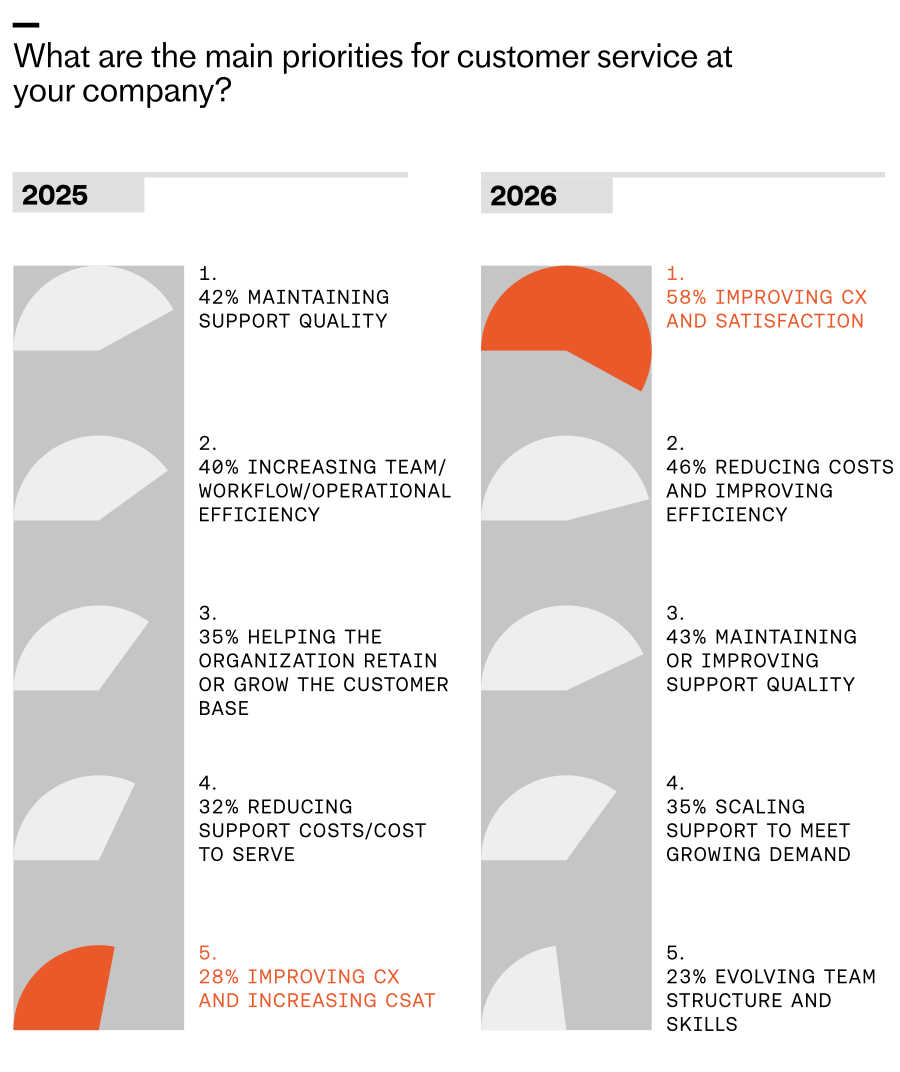
For years, I chased the elusive goal of delivering a perfect customer experience. Today, with AI embedded in our support operations, that standard is finally within reach—and it’s reshaping how we prioritize, design, and scale service.
In “The 2026 Customer Service Transformation Report,” teams report early, tangible wins from AI: faster responses, higher efficiency, and consistent coverage across languages and time zones. Those gains create the capacity we’ve always needed. The more we push the technology, the more quality improvements we unlock.
This marks a fundamental shift. As AI takes on more, our focus can finally move from firefighting to crafting the customer experience. When the AI is working, the measure of success becomes how well it’s working—across accuracy, tone, resolution, and end-to-end journey quality.
I’ve seen this transformation firsthand. Mature AI deployment gives my team “breathing room,” so we can design for consistently excellent outcomes rather than obsess over deflection. That means widening access to support, removing friction on the path to resolution, and anticipating customer needs before they escalate.
In our own support organization, we opened support to trial customers, accelerated first response times, and added consultative sessions during onboarding. We absorbed a 300% increase in total demand without adding headcount—made possible by deep integration of an AI Agent and a disciplined AI strategy.
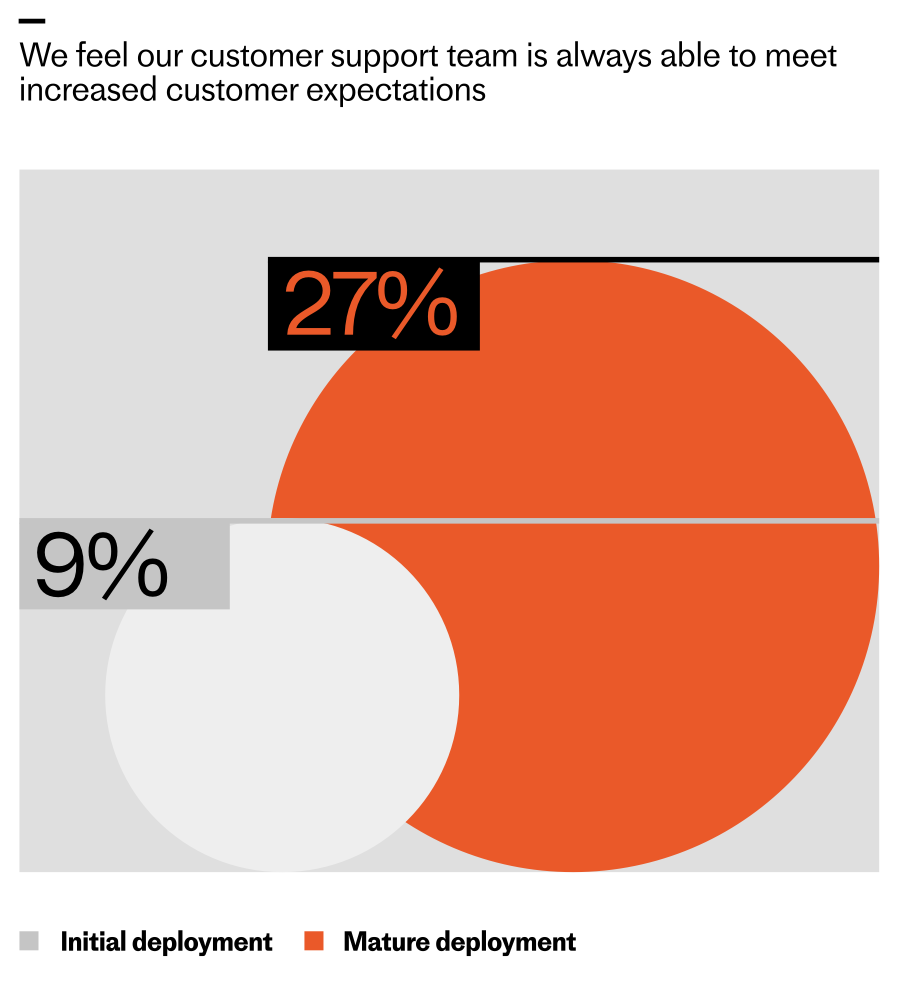
Across the industry, the pattern is similar. When teams initially deploy AI, only 9% say they can always meet customer expectations. That number triples as teams reach a mature level of deployment. Even as expectations rise, the organizations that deeply integrate AI—complete with clear ownership, robust instrumentation, and continuous improvement loops—are the ones most likely to meet (and exceed) the bar.
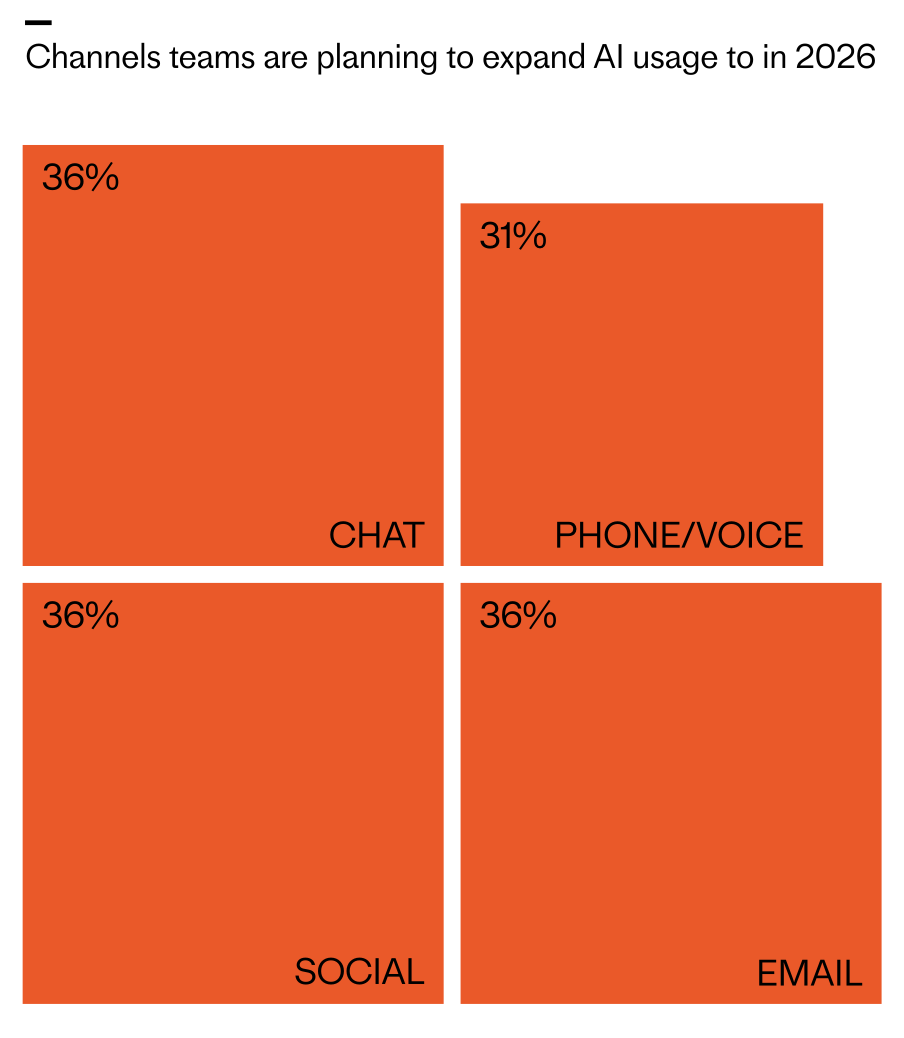
Looking ahead to 2026, I expect omnichannel consistency to become a key differentiator. The data shows planned investment is distributed nearly equally across chat, email, and social messaging (36% each), closely followed by phone/voice (31%). The question is no longer “Which channel should we optimize?” but “How do we deliver a consistent, AI-powered experience everywhere our customers are?”
Teams that solve for omnichannel consistency will bridge the long-standing gap between what customers expect and what support can deliver. Every touchpoint becomes an opportunity to exceed expectations and build durable trust.
Consider Clay, a team that scaled support without sacrificing quality. Support is one of their main growth drivers, and as their customer base expanded, ticket volume surged. Early on, they concentrated much of their effort in Slack, cultivating close, transparent community relationships. But relying on a single channel created friction as they grew; customers wanted the flexibility of email and in-app chat, and Clay needed to deliver the same high standard everywhere.
By unifying their support experience with an AI Agent, Clay brought consistency across channels. Today, AI is involved in 90% of all queries and handles half of Clay’s total volume, upwards of 7,000 queries a month. First response rates improved significantly, freeing the team to focus on proactive, high-impact work.
That work includes identifying content gaps for education and content marketing, reaching customers before they need to ask for help, and surfacing feature requests and recurring challenges to product teams. Clay proves that when support is truly great, it becomes a competitive edge.
So how do you build a superior customer experience with an AI Agent? Here are five principles I use when scaling toward mature deployment.
1) Treat customer experience like a product. Treating support as a product means designing, building, and managing the support experience with the same rigor as your core product. You define goals (faster onboarding, higher CSAT or CX Score, lower churn). You map flows (AI starts the conversation, human handovers, proactive nudges). You instrument the journey (track handoffs, drop-offs, success states). You run tests and ship improvements (tone tweaks, fallback paths, training updates). You own the outcomes (gather feedback, measure performance, use insights to continuously improve the system).

2) Lead with AI, back with humans. AI isn’t replacing the human touch. It’s redefining when, where, and how it’s most valuable. In a scaled model, AI is the first responder and the end point for most conversations. Humans step in where they add the most value—particularly during high-stakes issues—and those handoffs should feel seamless. Meanwhile, your team focuses on improving AI performance and optimizing the end-to-end journey.
3) Be proactive. Use AI to anticipate needs, guide customers before problems arise, and nudge them toward successful outcomes. This is where customer support AI strategy shines—moving from reactive triage to journey orchestration that protects momentum and builds trust.
4) Build for trust. Many customers still carry the legacy of clunky chatbots that delivered vague answers and dead ends. You earn trust by showing that your system works. Don’t hide your AI Agent behind layers of “choose an option.” Get customers to the AI quickly, demonstrate real problem-solving, and ensure that when a human is needed, they join with full context to resolve complex issues efficiently.
5) Make it feel personal. Your AI Agent represents your brand. The way it speaks, follows policies, and responds matters. Use tone control, fallback logic, and language preferences to align the experience to your standards. Consistency builds trust; personality builds connection and loyalty.
Perfect really is possible. With deep AI implementation, you can scale comprehensive, fast, and personal support across channels—so customers feel supported not just when they reach out, but throughout their journey. That’s the promise of modern AI workflows in support, and it’s what will separate leaders from laggards in the years ahead.
Inspired by this post on The Intercom Blog.