
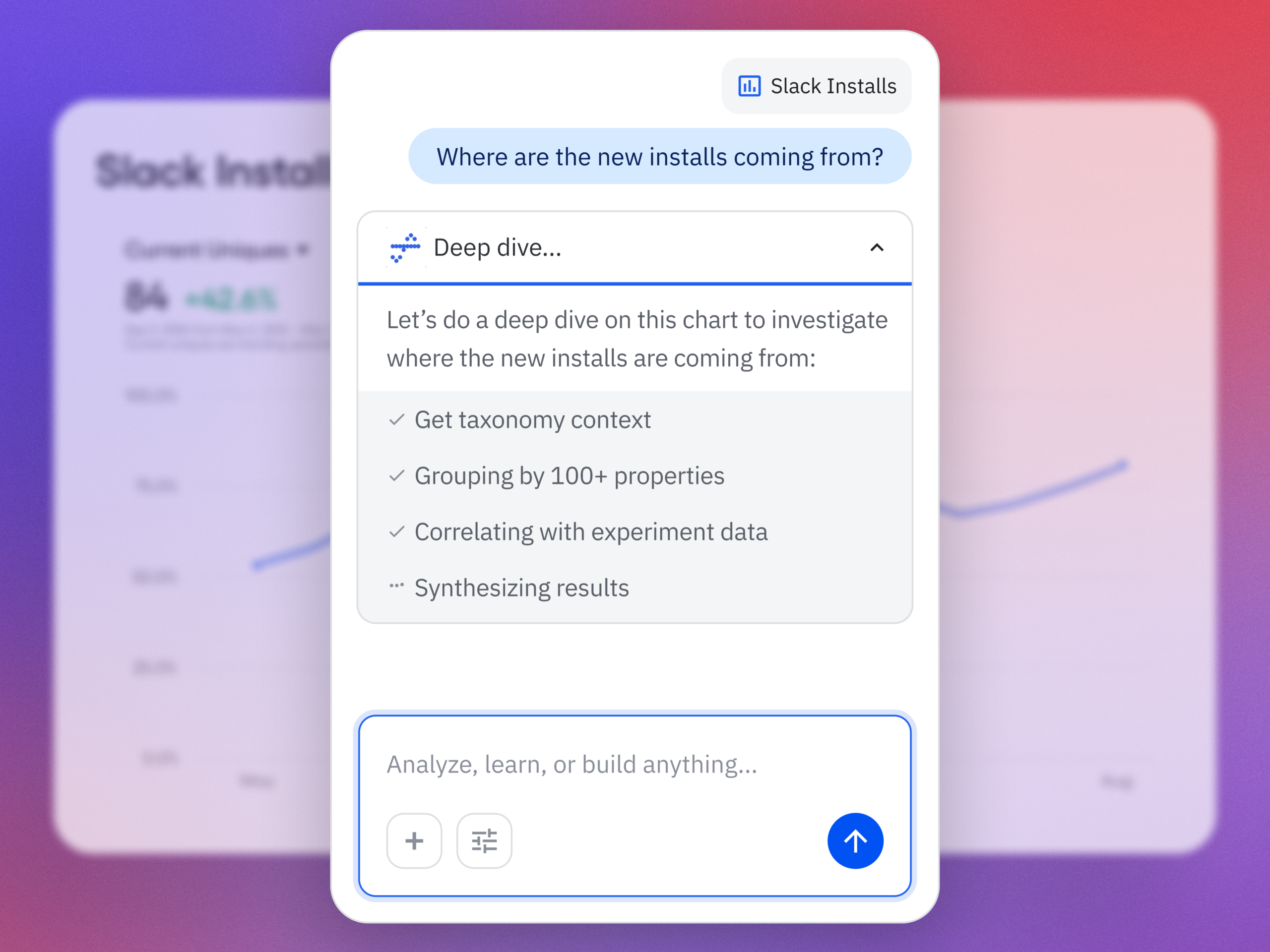
For years, I’ve watched high-performing product teams run into the same wall: the gap between insight and action. Dashboards multiply, yet decisions stall. That final mile—where we interpret trends, prioritize tradeoffs, and ship changes—remains the last bottleneck. It’s not a data problem; it’s a bandwidth and focus problem.
Amplitude's AI Analytics Platform takes the next step: agents that investigate, monitor, and act so your team can build what actually matters.
From my seat leading product at HighLevel, I see “agentic AI” as a structural upgrade to the product operating system. Instead of waiting on human cycles to discover anomalies, craft hypotheses, and trigger the next experiment, Agent Analytics can continuously investigate user behavior, monitor mission-critical metrics, and initiate actions—closing the loop from observation to outcome. That shift transforms analytics from a passive reference layer into an active, decision-making teammate.
Practically, this matters because empowered product teams win on speed and focus, not on the volume of reports. When agents surface the most material opportunities—say, a sudden drop in activation for a high-value cohort or a retention dip tied to a recent release—we compress time-to-insight and, more importantly, time-to-action. The result is fewer context switches, fewer meetings, and more cycles invested in building meaningful value.
The most compelling use cases are those that compound: continuous discovery that highlights friction in onboarding flows, proactive retention analysis on at-risk segments, automated experiment prioritization aligned to outcomes vs output OKRs, and closed-loop alerts that trigger workflows in your CRM or in-app guides to accelerate product-led growth. With a unified analytics platform feeding these agents, we can move from reactive analytics to anticipatory product strategy.
Of course, leverage requires guardrails. I anchor adoption in three pillars: clear decision rights for agents (what they can autonomously act on vs. recommend), transparency in reasoning (so PMs can audit how conclusions were reached), and explicit alignment to key outcomes (activation, retention, expansion). Done right, this is not a replacement for product judgment—it’s an amplifier for it.
If I were rolling this out today, I’d set a success dashboard that tracks: time-to-insight, time-to-action, percentage of initiatives initiated by agents, impact on North Star metrics, and the reduction in manual analysis hours. I’d also implement lightweight prompts and playbooks—LLMs for product managers—that standardize how we ask better questions and interpret agent outputs.
The promise here is simple but profound: eliminate the last bottleneck by giving your teams a partner that never sleeps, never tires, and never loses the plot. When agents investigate, monitor, and act, we spend less time arguing about the data and more time building the right things, faster.
Inspired by this post on Amplitude – Best Practices.






Leave a Reply