
I've been getting a lot of questions about why I'm diving so deep into Claude Code, so I want to take a step back and provide some context.
Last March, when I started building my first AI product—the Interview Coach—I felt like I had to figure it all out on my own. I had never built an AI product before, and I didn't have a team I could lean on. It was equal parts energizing and intimidating.
I had a blast digging in, experimenting, and learning what I needed to learn to ship that first AI product. But I also started to wonder, "How are product teams going to learn this stuff?"
As an industry, we are being asked to leverage a new technology that is foreign to us. We are all experimenting and learning what's just now possible. It's moving so fast, it's exhausting just following the news, let alone trying to learn and develop new skills.
My mission has always been to help teams make better product decisions. That still drives me today.
After releasing the Interview Coach, I asked myself two questions: "How am I going to rapidly develop my skill set?" and "How can I help others do the same?" I landed on a three-part plan: First, I'm going to collect and share stories about how other teams are learning and building AI products—that's why I launched Just Now Possible. Second, I'm going to push the boundaries on how I can use AI in my day-to-day life, and I'm going to write about it. Third, I'm going to keep building AI products—and I'm going to write about that, too.
The Claude Code series was born out of number two. It’s had an interesting side effect: it’s also helping me build better AI products.
The more I push the boundaries of what's possible with Claude Code, the more I understand how to build more robust AI products. That’s reinforced my belief that product teams need to get hands-on with this stuff in their day-to-day lives. It’s how we’re going to develop the skillsets we need to build tomorrow’s products.
In my context rot article—where we learned how to manage the context window in Claude Code—I showed just how much day-to-day practice compounds. Today, I want to show how learning about context window management in our day-to-day lives directly maps to managing the context window in the AI products we might build. My hope is to make it crystal clear how experience in one area develops expertise in the other. Let’s dive in.
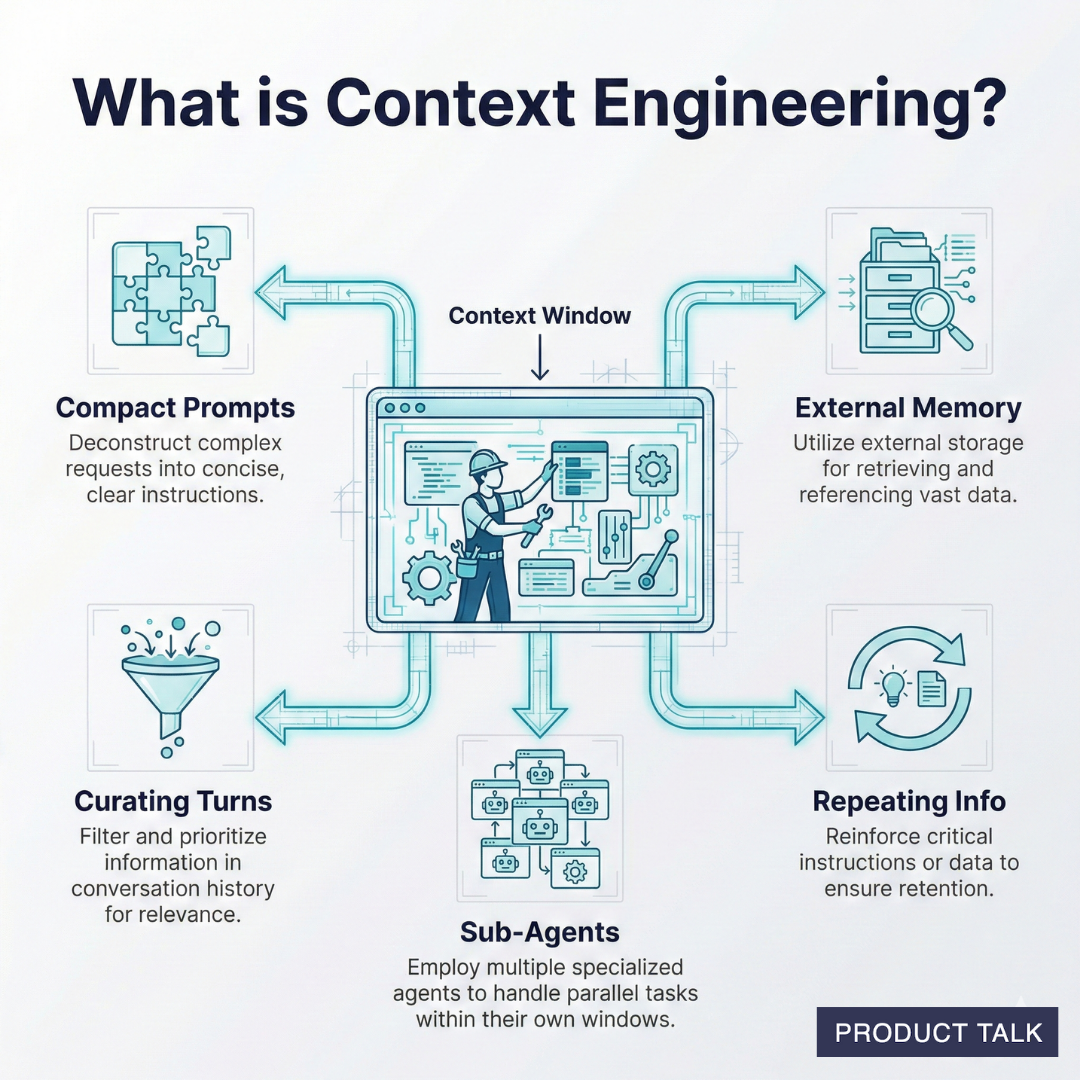
A quick refresher on context window management. In the context rot article, we learned: "what the context window is and what goes into it"; "how to offload conversational context to the file system"; "about the /compact and /clear tools"; "to repeat critical information as the context window fills up to overcome tokens "lost in the middle" or at the beginning of the input"; and "how to use agents to get access to more context windows."
It turns out these exact same skills are being used by developers to manage the context window in production products. If you haven't read the context rot article, start there: "Context Rot: Why AI Gets Worse the Longer You Talk (And How to Fix It)."
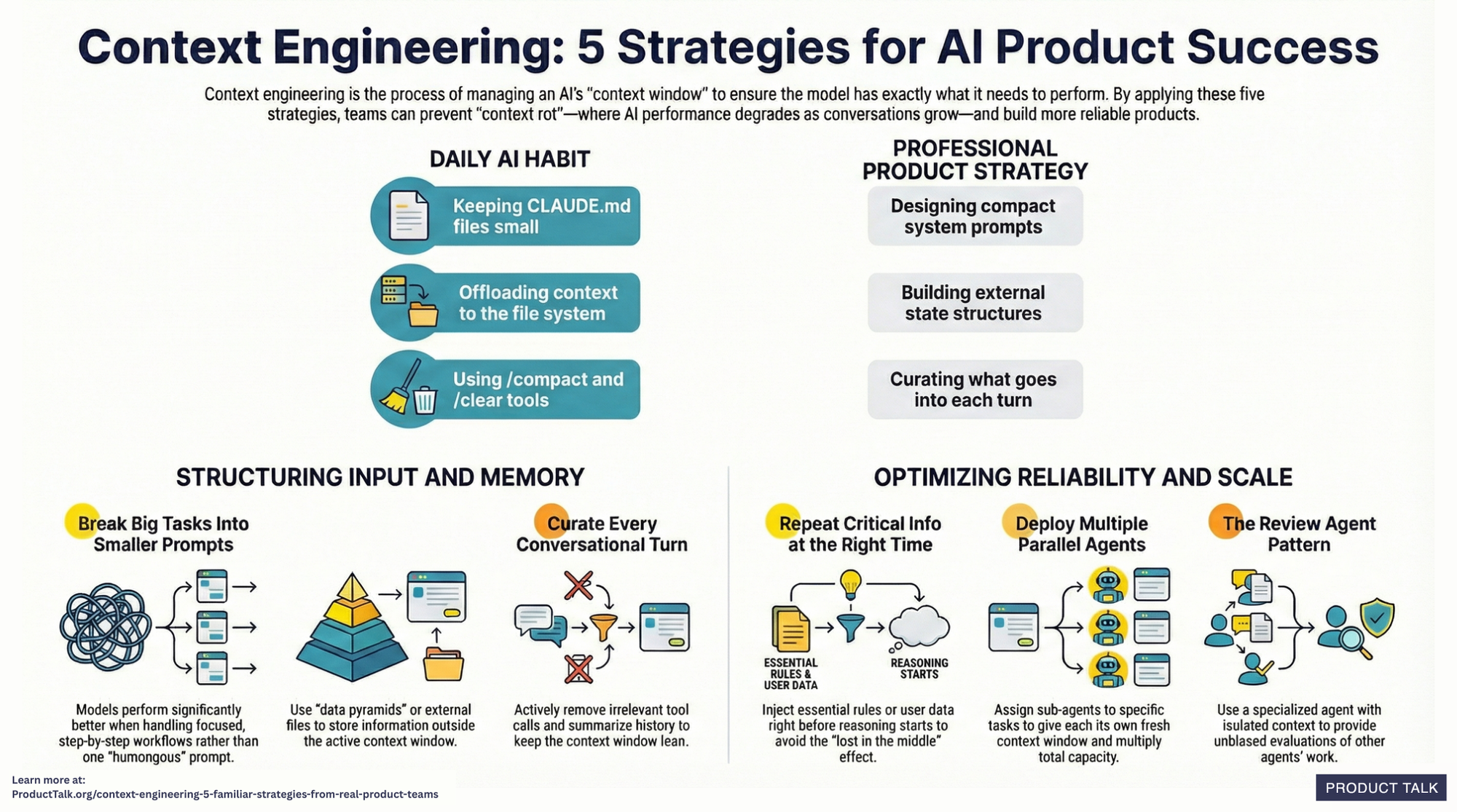
What is Context Engineering? Context engineering is the work that we do to manage the context window in the AI products and services that we build. It's how we give the large language model the context it needs to do the job well. It's also how we manage and mitigate context rot in our product and services, so that we can get the highest performance from the underlying model.
Today, we are going to look at five different strategies that product teams are currently using in their context engineering efforts. You are going to see that each of these strategies ties back to a strategy you might already be using in your day-to-day AI usage (especially if you followed the advice in the context rot article).
Here's how product teams are putting this into practice right now: designing compact system prompts by breaking big tasks into smaller tasks; building external memory/state structures to keep the context window clean; curating what goes into each turn; repeating critical information as context grows; and using sub-agents to grow the context window.
I'll connect each tactic back to patterns you're likely already using in your daily AI workflows, especially if you followed the advice in the context rot article. Along the way, I’ll share practical guardrails and instrumentation ideas so you can track quality with eval-driven development, reduce context rot, and scale performance predictably.
Why this matters for product trios: these strategies clarify the handoffs between prompt engineering, external memory design, and orchestration, which strengthens collaboration across PM, design, and engineering. Whether you’re exploring gen ai prototypes, hardening a retrieval-first pipeline, or evolving toward agentic AI, context engineering is the backbone of reliable, high-performing experiences.
If you build or lead LLMs for product managers initiatives, consider this your field guide. In upcoming posts, I’ll break down each strategy with concrete examples and templates you can adapt to your stack, so your team can move from experiments to durable, scalable AI workflows with confidence.
Inspired by this post on Product Talk.






Leave a Reply