I see the Director of Product, Growth & AI at Amplitude as a mandate to operationalize "viral and core growth strategies, user acquisition, and product engagement" with precision. From my vantage point, that means building a rigorous, metrics-first operating system grounded in Amplitude analytics and product-led growth principles, then layering in an AI Strategy that personalizes experiences without sacrificing control or safety.
I start by defining a clear North Star Metric and mapping a driver tree to expose causal levers across acquisition, activation, engagement, retention, and monetization. With behavioral analytics and cohort analysis, I quantify which user behaviors correlate with long-term value. I operationalize rapid experimentation through A/B testing with sensible minimum detectable effect (MDE) thresholds, guardrail metrics, and sequential testing to ensure we move fast while preserving measurement integrity.
For "viral and core growth strategies," I lean on durable growth loops more than one-off hacks. Viral loops might include collaboration invites, user-generated content, and shareable artifacts that make the product more valuable as it spreads. Core growth centers on frictionless activation: guided onboarding, in-app guides, product tours, progressive disclosure, and judicious tooltip design that connects users to the ‘aha’ moment quickly. Session replay and funnel instrumentation help isolate friction and systematically remove it.
On user acquisition, I connect performance channels and go-to-market strategy tightly to in-product activation. Rather than optimizing for clicks, I optimize for post-signup behaviors that predict retention. This includes improving landing page-message-product congruence, refining qualification (so top-of-funnel aligns with downstream value), and orchestrating lifecycle messaging that nudges users toward key activation milestones.
To deepen product engagement, I focus on leading indicators of retention and feature adoption. I segment by jobs-to-be-done and intent, then personalize in-app prompts to surface the right capability at the right moment. Retention analysis, pathing, and funnel breakouts inform which nudges to deploy and where—whether that’s smarter checklists, contextual education, or lightweight in-product interventions that turn sporadic usage into reliable habits.
AI raises the ceiling on what’s possible here. With a thoughtful AI Strategy, I use gen ai to personalize onboarding flows, recommend next-best actions based on behavioral signals, and summarize complex activity patterns into actionable insights for the team. I maintain strict measurement: every AI intervention ships behind feature flags, is evaluated through controlled experiments, and adheres to privacy-by-design principles. The outcome is a system that learns continuously while staying aligned to business and user outcomes.
Execution is where strategy becomes real. I rely on empowered product trios, continuous discovery with customers, and outcome-focused roadmaps that tie directly to the driver tree. This keeps the organization moving in sync: engineering prioritizes the highest-signal experiments, design accelerates comprehension and task success, and product ensures each release strengthens the core loop rather than adding ornamental features.
Ultimately, the blueprint is simple and disciplined: anchor on "viral and core growth strategies, user acquisition, and product engagement," quantify what matters with behavioral analytics, and iterate through well-instrumented experiments. Combine that with targeted AI augmentation, and you create a compounding growth engine that is both measurable and resilient.
Inspired by this post on Amplitude – Perspectives.
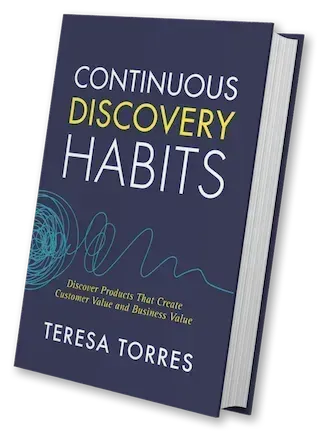
I’m celebrating the five-year anniversary of Continuous Discovery Habits by inviting you to read it with me this June. As someone who leads product management and coaches product trios, I’ve seen how a shared discovery practice tightens alignment, speeds up learning, and drives outcomes. This month, we’ll go deep on prioritizing opportunities—not solutions—and I’ll guide you step by step so you can apply the ideas on your own team.
Each month, I’m releasing an in-depth reading guide that includes:
We’ll discuss each month’s reading in the comments, and we’ll gather quarterly on a live call to unpack real-world applications, trade wins and missteps, and keep the momentum going.
Joining late? No problem. I monitor the comments on each reading guide throughout the year. Start with the current month or go back to January—whatever works for you. Ask for help, share what’s working, and connect with other readers at any point.
If you want to participate, grab a copy of the book (or dust off your old copy), share the “Spread the Love” videos with your team, block time for the exercises, and register for the community sessions. Let’s do this.
This Month’s Reading
Chapter:
Estimated reading time: ~16 minutes
This month's chapter will introduce you to:
Need a copy? Grab the book
Share the Love with Friends and Colleagues
We learn best in community. Use these short videos to spread the key ideas across your product trios, engineering partners, and stakeholders. Invite them to read along with you so your discovery cadence—and your product strategy—advance together.
Reflect & Discuss What You Read
When we reflect and discuss what we read, we absorb more and apply it faster. This chapter challenges a deeply ingrained habit: prioritizing solutions. I’ve been in those meetings—spreadsheets full of features, heated roadmap debates, and a creeping sense that we’re optimizing outputs rather than outcomes. The shift to opportunity-first thinking changed how my teams frame bets, sequence discovery, and communicate product strategy.
Individual Reflection
Team Discussion
Put It Into Practice
This month is all about shifting from solution-first to opportunity-first thinking. These short, focused exercises will help your product trio practice opportunity prioritization and improve decision speed without sacrificing product discovery rigor.
Exercise: Map Your Roadmap to Opportunities
Time: 45 minutesDo this: With your product trio
Take your current roadmap or backlog and work backwards. For each planned feature or solution:
This exercise often reveals that you're either:
Use these insights to inform your next prioritization conversation.
Exercise: Practice Two-Way Door Thinking
Time: 30 minutesDo this: With your product trio
Choose 3-5 recent or upcoming product decisions. For each one, discuss:
The goal is to calibrate your team's decision-making speed. Two-way door decisions should be made quickly with "just enough" evidence. One-way door decisions deserve more deliberation and data.
Go Deeper: Additional Reading
If you prefer an audio summary of this month’s reading, including the book chapters and the following resources, I’ve included an audio version for members at the bottom of this post.
Related In-Depth Guides
Supplementary Reading
Related Courses
Our Live Discussion Schedule
Our live discussion sessions are for registered members. Sessions are not recorded. Invitations will go out two weeks before the scheduled event—reserve time now.
Audio Summary
Prefer to listen? Stream the audio overview here: June — Prioritizing Opportunities (audio).
Ready to put continuous discovery into action? Grab the book, share the videos with your team, schedule the exercises, and join the community sessions. Opportunity-first product strategy is a muscle we can build together.
The chapters we will be readingA preview of the most important concepts we'll be learning aboutShort videos you can share with friends and colleagues to help spread the ideasIndividual and team discussion questions to help you absorb and engage with the readingTeam exercises to help you put the ideas into practiceAdditional reading to help you go deeper on the core ideasChapter 7: Prioritizing Opportunities, Not SolutionsWhy product strategy happens in the opportunity space, not the solution spaceHow to focus on one target opportunity at a time to deliver value iterativelyUsing the tree structure to simplify prioritization decisionsThe four criteria for assessing opportunities: sizing, market factors, company factors, and customer factorsWhy treating prioritization as a messy, subjective decision leads to better outcomes than scoring formulasThe concept of two-way door decisions and how they apply to opportunity prioritizationWork on one small opportunity at a time – Reduce your batch sizeGetting started with compare and contrast decisions – Choose the right target opportunityTurn big intractable problems into smaller, more solvable problems – The power of decompositionThink about your team's current roadmap or backlog. How much of your time is spent prioritizing features versus understanding and prioritizing customer opportunities? What would change if you flipped that ratio?Reflect on the last time you made a product decision. Did you treat it as a one-way door (irreversible) or a two-way door (reversible)? How did that framing affect your decision-making process and timeline?Consider the four assessment criteria (opportunity sizing, market factors, company factors, customer factors). Which of these does your team currently emphasize most? Which do you tend to overlook or underweight?As a team, list the top 5-10 items on your current roadmap or backlog. For each one, try to identify the underlying customer opportunity it addresses. If you can't clearly articulate the opportunity, what does that tell you about how you're making decisions?The chapter argues against scoring formulas (like RICE or ICE) for prioritization, calling them "made-up math." If your team uses a scoring system, discuss: What is it really measuring? Does it help you make better decisions, or does it just make subjective decisions feel more objective?Walk through a recent prioritization decision. Did you assess options in isolation ("should we build this?") or compare and contrast them? How might your decision have been different with a compare-and-contrast approach?Identify the customer opportunity it's meant to addressWrite it as something a customer might say (e.g., "I can't find anything to watch" not "We need better search")Look for patterns: Are multiple solutions addressing the same opportunity? Are some solutions disconnected from any clear customer need?Spreading yourself thin across too many opportunitiesOver-investing in a single opportunity with multiple solutionsBuilding solutions with no clear opportunity attachedIs this a one-way door decision (hard to reverse) or a two-way door decision (easy to reverse)?If it's a two-way door, what's the smallest step we could take to learn whether we're on the right track?What would we need to see to know we made the wrong choice?If we realize we're wrong, how quickly could we course-correct?Opportunity Solution Trees: Visualize Your Discovery to Stay Aligned and Drive OutcomesCustomer Interviews: Uncover Hidden Insights from Every ConversationPrioritize Opportunities, Not Solutions7 Key Benefits of Using Opportunity Solution TreesProduct in Practice: How 2-Way Door Decisions Helped Simply Business Learn FastProduct in Practice: Getting Started with Opportunity Solution Trees at SuperAwesomeProduct Discovery Fundamentals: Learn a structured and sustainable approach to continuous discovery.Tuesday, June 16, 2026: 9am-10am PDTThursday, September 17, 2026: 9am-10am PDTWednesday, December 16, 2026: 9am-10am PST
I’m often asked how leading growth teams turn insights into compounding business results. Few organizations illustrate this better than the Growth Engineering team at Amplitude. Drawing from their example and my own experience, I’ve distilled a practical playbook that any product organization can use to move faster, learn smarter, and scale impact.
At the core is a disciplined blend of behavioral analytics and rapid experimentation. Amplitude analytics, as part of a unified analytics platform, enables precise event instrumentation, cohorting, and funnel analysis that surface where activation and retention truly break down. When I combine those signals with qualitative insights, I can prioritize fewer, higher-leverage bets that directly improve user activation and long-term retention.
My growth loop always starts with clearly stated hypotheses, success metrics, and A/B testing power considerations, including a defined minimum detectable effect (MDE). I pair feature flags with staged rollouts to de-risk changes and accelerate iteration without compromising stability. This cadence turns every release into a learning opportunity, compounding knowledge across teams and time.
Cross-functional execution is non-negotiable. I rely on tight “product trios” collaboration—product, engineering, and design—so we can ship small, measurable changes quickly, observe outcomes, and then widen scope with confidence. The Growth Engineering mindset keeps us grounded in real user behavior, not assumptions, and ensures our roadmap is fueled by evidence rather than opinion.
Consider onboarding. Instead of a single redesign, I prefer a series of targeted experiments—tweaking progressive disclosure, refining tooltip design, and adding in-app guides where users predictably stall. Each test is instrumented end to end, from first action to activation event, and validated via retention analysis to confirm that short-term lifts turn into durable habit formation.
When prioritizing, I map ideas to driver trees tied to our North Star metric. Behavioral analytics tell me which levers—time-to-value, depth-of-use, or frequency—will yield the biggest gain. That clarity focuses engineering effort on interventions that actually shift outcomes, not just outputs.
If you’re building your own Growth Engineering capability, start with three moves: instrument ruthlessly so you can trust your signals, adopt feature flags to speed safe experimentation, and hold teams accountable to measurable, user-centric outcomes. Do this consistently and you’ll feel the compounding effect—faster learning cycles, stronger product-market fit signals, and a durable engine for product-led growth.
Inspired by this post on Amplitude – Perspectives.
I’m excited to share two opportunities this season to uplevel your craft, connect with peers, and leave with practical, repeatable techniques you can apply immediately to your product work.
We will be doing another round of Claude Code: Show and Tell on May 26th at 9am PDT. These community-driven sessions are hands-on and fast-paced—we swap proven workflows, compare prompts, and pressure-test approaches together. You’ll see how product teams are operationalizing AI workflows in real contexts and walk away with ideas you can adapt for your own roadmap and experimentation pipeline. Invites will go out to Supporting Members and CDH Members tomorrow. If you'd like to join us, keep an eye on your inbox for the invite.
I love these Show & Tell sessions because they translate tacit knowledge into clear, reusable playbooks. Whether you’re refining evaluation loops for LLMs, streamlining discovery synthesis, or standardizing prompts for consistency, the shared rigor and camaraderie make it a high-signal hour for any product leader invested in AI workflows.
I also want to share that I'll be teaching our June 4th – July 9th cohort of Product Discovery Fundamentals. This is the last time I'll be teaching this cohort in its current format. If you've been thinking of enrolling in this program, and want to take it with me, this is your last chance. Register here.
Across this cohort, we’ll practice continuous discovery habits—framing opportunities, tightening assumptions, running lean experiments, and aligning product trios on evidence-backed decisions. If you want a rigorous, repeatable system for turning customer insight into confident prioritization and compelling product strategy, I’d be thrilled to have you in the room.
I’ve learned that customers don’t just buy features—they buy the way we discover, decide, build, ship, and support. In other words, the operating model is the product. That realization has shaped how my team and I at HighLevel translate product strategy into tangible, repeatable outcomes that show up in quality, reliability, onboarding, and consultative support every single day.
We created Product Partners to codify that operating model and scale it with discipline. It’s a blueprint and operating rhythm that unifies product strategy with go-to-market strategy, customer success, and solutions engineering—so empowered product teams can move faster without sacrificing clarity, governance, or customer trust.
First, we anchored on continuous discovery. Product trios work shoulder-to-shoulder with customer-facing teams to run customer interviews, journey mapping, and A/B testing, then validate insights with session replay and behavioral analytics. We use driver trees and opportunity solution trees to connect problems to outcomes, ensuring prioritization is evidence-based and aligned to product-market fit—not just output.
Second, we elevated delivery excellence. Our practices emphasize CI/CD, feature flags, observability, SRE-informed incident management, and DORA metrics to shorten feedback loops while raising the bar on stability. Privacy-by-design, data governance, and regulatory compliance are built into our workflows, and we make deliberate build vs buy decisions to protect platform scalability and long-term velocity.
Third, we integrated go-to-market alignment from day one. Solutions engineering and customer success shape requirements early, so launches include in-app guides, product tours, onboarding paths, and consultative support that accelerate user activation. We tie outcomes vs output OKRs to stakeholder management rituals, ensuring sales-led and product-led growth motions reinforce each other instead of competing for focus.
Finally, we closed the loop with a unified analytics platform. Activation, retention analysis, and Net Recurring Revenue (NRR) sit alongside qualitative signals from customer interviews and support. This single source of truth helps us refine product positioning, sharpen value propositions, and improve roadmapping and sprint planning with clear, testable hypotheses.
What does this mean for our partners and customers? Faster time-to-value, fewer handoffs, clearer expectations, and a shared lens on the metrics that matter. Product Partners isn’t a side program; it’s how we operationalize trust—through transparency, consistent rituals, and a bias toward learning that compounds.
If this resonates, you’ll feel it in how we discover, build, and support together. I’ll continue to share our playbooks—covering continuous discovery, onboarding, and outcome-based planning—so we can keep raising the standard for product management leadership and product-led growth, one operating rhythm at a time.
Five years in, Continuous Discovery Habits continues to be one of the most practical frameworks I use to align empowered product teams, sharpen product strategy, and convert customer interviews into outcomes. To celebrate its impact, I’m hosting a community read-along and inviting you to dig in with me this May.
Each month, I’m releasing an in-depth reading guide to make learning stick. You’ll find the chapters we’ll be reading, a preview of the essential concepts, short videos to help you spread the ideas across your organization, individual and team discussion prompts, team exercises to put the concepts into practice, and additional reading if you want to go deeper. My goal is simple: help you turn product discovery into a steady habit, not a once-a-quarter activity.
We’ll discuss each month’s reading in the comments, and we’ll gather quarterly on a live call to compare notes and share what’s working. Joining late is absolutely fine—I monitor the conversation throughout the year. Start with the current month or rewind to January; you can ask for help, share wins and roadblocks, and connect with other readers anytime.
If you want to participate, grab a copy of the book (or dust off your old one), share the "Spread the Love" videos with your team, block focused time for the exercises, and register for the community sessions. Let’s do this together.
This Month’s Reading
Chapter: Chapter 6: Mapping the Opportunity Space
Estimated reading time: ~23 minutes
This month’s chapter will introduce you to why opportunity mapping is critical for structuring the ill-structured problem of reaching your desired outcome; how to move from overwhelming opportunity backlogs to well-structured opportunity spaces; the power of tree structures for depicting parent-child and sibling relationships between opportunities; how to identify distinct branches in your opportunity space using key moments in time; common anti-patterns to avoid when building your first opportunity solution tree; and why structure "gets done, undone, and redone" as you continue to learn.
Need a copy? Grab the book.
Share the Love with Friends and Colleagues
We learn best in community. Use these short videos to spread the core concepts from this chapter—then invite your team to join the book club with you.
The need for opportunity mapping – You will never fully satisfy your customers' desires
Understanding the structure of an opportunity solution tree – Depicting two types of relationships
Turn big intractable problems into smaller, more solvable problems – The power of decomposition
How to map an opportunity space – Getting started with opportunity solution trees
A well-structured opportunity space has distinct branches – Identify key moments in time
Reflect & Discuss What You Read
Reflection turns reading into capability. This chapter asks us to shift from reacting to every request to deliberately structuring the opportunity space. If you’ve ever felt overwhelmed by a never-ending backlog or pressure to ship output over outcomes, this is where the fog starts to lift. As you read, focus on how your team currently organizes (or doesn’t organize) what you hear from customers.
Individual Reflection
1) Think about your current product backlog or opportunity list. Is it a flat list, or do you have some structure to it? If you were to group similar opportunities together, what patterns would emerge?
2) When was the last time you heard a customer need and immediately jumped to a solution without exploring whether there were related opportunities? What would change if you took the time to map how that opportunity connects to others?
3) Review the anti-patterns from the chapter (opportunities framed from your company's perspective, vertical opportunities, opportunities with multiple parents, etc.). Which of these do you recognize in how your team currently talks about opportunities?
Team Discussion
1) As a team, pick a top-level opportunity you're currently working on. Try breaking it down into sub-opportunities together. Where do you struggle? Where do you disagree about how to frame or group opportunities? What does that tell you about gaps in your shared understanding?
2) Look at your experience map (from Chapter 4) and identify 3-5 distinct moments in time during your customer's experience. Could these become the top-level branches of your opportunity solution tree? Where do you see overlap, and where are there clear distinctions?
3) Discuss the quote from Barbara Tversky: "Structure gets done, undone, and redone." How does your team currently respond when you discover new information that changes how you understand the opportunity space? Do you treat your opportunity map as fixed or as something that evolves?
Put It Into Practice
Reading is step one; building your first opportunity solution tree is where the real learning happens. The exercises below are exactly how I coach product trios to transform ambiguous problems into aligned action.
Exercise: Build Your First Opportunity Solution Tree
Time: 60 minutes. Do this: With your product trio.
Start by reviewing your interview snapshots from the past few weeks. For each opportunity you captured, ask the three questions from the chapter:
Is this opportunity framed as a customer need, pain point, or desire (not a solution)?
Is this opportunity unique to one customer, or have we seen it in more than one interview?
If we address this opportunity, will it drive our desired outcome?
Then, using your experience map, identify 3-5 distinct moments in time to serve as your top-level opportunities. Group the opportunities from your interviews under these top-level branches.
Look for opportunities to add structure to each branch. Group similar opportunities together and identify a parent opportunity. Look for vertical stacks (one parent, one child) and fill in missing siblings. Reframe opportunities that are too broad or that could live in multiple branches.
Don’t aim for perfection. Get something on paper (or a digital canvas) and iterate the tree with every new interview.
Exercise: Practice Framing Opportunities from Your Customer’s Perspective
Time: 30-45 minutes. Do this: With your product trio.
Take 10-15 opportunities from your current backlog or list. For each one, ask: "Can I imagine a customer saying this?" If the answer is no, reframe it from your customer’s perspective. For example:
"Increase subscription conversions" becomes "I want to know if this product is worth paying for"
"Reduce support tickets" becomes "I can't figure out how to do X"
"Improve onboarding completion" becomes "I'm not sure what to do next"
This exercise helps you spot business-centric opportunities disguised as customer opportunities. It also trains your team to listen for opportunities in interviews that are framed from the customer’s point of view.
Go Deeper: Additional Reading
If you prefer an audio summary of this month’s reading, including the book chapters and the following resources, I’ve included an audio version for paid subscribers at the bottom of this post.
Related In-Depth Guides
Opportunity Solution Trees: Visualize Your Discovery to Stay Aligned and Drive Outcomes
Customer Interviews: Uncover Hidden Insights from Every Conversation
Supplementary Reading
Prioritize Opportunities, Not Solutions
Product in Practice: Opportunity Mapping at Grailed
Product in Practice: Opportunity Mapping at trivago
7 Key Benefits of Using Opportunity Solution Trees
Getting Started with Opportunity Solution Trees at SuperAwesome
Bringing Order to Chaos: Using Opportunity Solution Trees in Everyday Life
Other Voices
Why Groups Struggle to Solve Problems Together by Al Pittampalli
More PM Problem Areas by Marty Cagan
Five Superpowers of Diagrams by Abby Covert
Critical Thinking is Product Management by This Is Product Management
Our Live Discussion Schedule
Our live discussion sessions are for paid subscribers. Sessions are not recorded. Invitations will go out to Supporting Members and CDH Members two weeks before the scheduled event. But reserve the time on your calendar now.
Tuesday, June 16, 2026: 9am-10am PDT
Thursday, September 17, 2026: 9am-10am PDT
Wednesday, December 16, 2026: 9am-10am PST
Audio Summary
This summary was produced by NotebookLM. The sources supplied were the book chapters as well as all of the additional reading.
In the age of AI, I’ve come to believe we’re all builders—yet not all building is the same. There is a very meaningful difference between building to learn (known as product discovery) versus building to earn (known as product delivery). When we confuse the two, we waste precious time, budget, and team energy on output over outcomes. My goal in this FAQ-style reflection is to clarify when and how to choose each mode so we can make smarter, faster, more confident product decisions.
Why does this distinction matter so much right now? Because as the cost of product delivery continues to drop, the scarce resource shifts from shipping capacity to clarity of problem, solution, and value. Cloud infrastructure, CI/CD, feature flags, and even gen AI code assistance have made it cheaper to launch. That’s great—but if we don’t learn the right things before we scale, we’ll efficiently deliver the wrong product. Discovery is how we de-risk that.
What do I mean by build to learn? I use discovery to quickly validate problems, test value, and shape solutions before committing delivery teams to scale. In practice, that means continuous discovery with customer interviews, rapid prototyping, and lightweight experiments that put us in front of real users fast. I rely on product trios and empowered product teams to co-own outcomes, not just output, and I anchor decisions with outcomes vs output OKRs so we stay focused on measurable impact.
How do I structure discovery sprints? I start with an opportunity solution tree to map customer pain points and candidate solutions, then select the smallest test that can invalidate a risky assumption. When signals are ambiguous, I refine the questions and instrument better learning loops rather than pushing harder on delivery. For experiments, I keep a bias to speed: clickable prototypes, concierge tests, or gen ai for product prototyping often reveal more in days than a coded MVP does in weeks. When experiments go live, I use a clear minimum detectable effect (MDE) and resist reading noise as signal.
Where does AI change the calculus? LLMs for product managers are turbocharging discovery by accelerating research synthesis, persona drafts, and early concept validation. I pair that with eval-driven development to set crisp acceptance criteria for AI behaviors before any production integration. Prompt engineering and conversation design are part of the toolkit, but the same rule applies: prototype to learn, not to impress. AI can make bad ideas cheaper to build—so disciplined discovery matters more than ever.
So when do I switch to build to earn? Once I have evidence of value and feasibility, I shift into product delivery to scale with quality, security, and reliability. This is where I bring in product roadmapping and sprint planning, DORA metrics to monitor deployment frequency and lead time, and strong SRE and observability practices to safeguard the user experience. The handoff isn’t a wall; discovery continues inside delivery to refine scope, reduce risk, and maintain momentum.
What pitfalls do I watch for? The biggest is treating delivery as discovery—shipping features to “see what happens” without a clear learning thesis. Another is tech-first decisions driven by technology FOMO instead of product strategy and customer value. I also see teams set output-based commitments that crowd out learning; outcomes vs output OKRs keep us honest. And when considering build vs buy, I evaluate whether the capability differentiates us; if not, I’ll buy to preserve discovery capacity on what truly matters.
My operating conviction is simple: invest early and deliberately in build to learn so build to earn becomes high-confidence, high-velocity, and high-impact. In practical terms, that means smaller bets, faster feedback, clearer outcomes, and tighter collaboration across product, design, and engineering. If we get discovery right, delivery feels inevitable—and customers feel understood.
Product teams rarely fail because they don’t ship enough features; they fail because they don’t learn fast enough. That’s the core tension I manage every day: when to build to learn and when to build to earn. Navigating that balance is how we protect focus, accelerate time-to-value, and ultimately deliver durable business impact.
Over the years, I’ve seen at least two major ways to develop product: build to learn and build to earn. The first is discovery-led and evidence-seeking; the second is delivery-led and value-capturing. Both are essential. The real craft is knowing which mode to be in, when to switch, and how to keep stakeholders aligned around outcomes instead of output.
The project model remains the default in many organizations—even in the age of AI—and it’s all about output. Stakeholders or executives assemble a prioritized roadmap of features and projects, and teams ship against it. This can create momentum, but without clear outcome metrics and customer validation, it’s easy to drift into a feature factory that looks productive while missing the mark on user value and business results.
When I build to learn, I emphasize continuous discovery. That means using customer interviews to surface unmet needs, running lightweight prototypes to test desirability and usability, and deploying A/B testing to quantify impact. I map assumptions, risks, and opportunities with an opportunity solution tree, and I timebox experiments so we learn fast and cheap. The standard is evidence, not opinions—especially my own. The goal is simple: reduce uncertainty before we scale.
When I build to earn, the objective shifts to capturing value with confidence. Here I align teams to outcomes vs output OKRs, commit to clear acceptance criteria, and ensure product roadmapping and sprint planning reflect the highest-leverage bets we validated in discovery. Delivery excellence matters: crisp definition, reliable release trains, observability, and a strong feedback loop to confirm we’re moving activation, conversion, or retention in the intended direction.
Deciding when to transition from learning to earning is all about thresholds of evidence. I look for leading indicators that our solution reliably solves the target problem, shows a measurable lift in key behaviors, and can be delivered with acceptable risk. If we can’t articulate the expected outcome and how we’ll measure it, we’re not ready to scale. If we can, we invest, monitor impact, and keep guardrails in place to avoid scope drift.
The operating model that makes this sustainable is simple and disciplined. I rely on empowered product teams organized as product trios (product, design, engineering) to run dual tracks of discovery and delivery. We socialize learning with stakeholders early and often to strengthen trust and stakeholder management. We elevate strategy by linking every roadmap item to a problem statement, a testable hypothesis, and a quantified outcome—no orphan features, no vanity launches.
In the AI era, speed can tempt us back into shipping-by-idea. I use gen AI for product prototyping and insight synthesis, and I lean on LLMs for product managers to accelerate discovery work—without treating AI as a shortcut to validation. Our AI Strategy clarifies where AI augments discovery, where it powers the product, and how we evaluate risk, so we move faster without compromising rigor or ethics.
My rule of thumb: spend just enough time building to learn to achieve conviction, then shift decisively to building to earn—while preserving a small discovery cadence to keep learning alive. This rhythm protects focus, compounds insight, and makes growth more predictable. It’s how we avoid the output trap, deliver meaningful outcomes, and create products that customers love and the business celebrates.
Lately, I keep hearing a familiar question: with AI making it so easy to generate ideas and build products, do we still need product managers? My answer is unequivocal—yes. Tools accelerate delivery, but they don’t build trust, reconcile competing incentives, or create the shared understanding teams need to ship outcomes. Product work is relationship work.
I recently listened to “Product Work Is Relationship Work – All Things Product with Teresa & Petra,” and it echoed what I see every day in high-performing product organizations. If you prefer to watch, here’s the episode on YouTube: https://www.youtube.com/embed/d-0f8uAfc8w?feature=oembed
Listen to this episode on: Spotify | Apple Podcasts
While AI can help build things faster, it can’t replace the relationship work required to align stakeholders, navigate competing priorities, and create shared understanding across teams. That’s the hard, human part of product management—and it’s not going away.
In my experience, product teams stall when collaboration becomes transactional. We jump to negotiation (“What can you commit by Friday?”) before establishing context (“What problem are we solving and why now?”). When I slow down to get curious—about constraints, incentives, and assumptions—momentum actually increases because we’re rowing in the same direction.
Stakeholder alignment often breaks down when we conflate advocacy with exploration. We argue our viewpoint as if it were the only lens that matters, rather than making space to surface how others see the system. I’ve found the distinction between “dialogue vs. discussion,” rooted in work by Chris Argyris and elaborated in The Fifth Discipline by Peter Senge, to be a powerful reset. Dialogue builds shared understanding; discussion decides. You need both, in the right order.
Language matters in the room. The improv principle “Yes, and” is deceptively simple but transformative. When a designer, engineer, or executive feels heard (“Yes”) and we build on their idea (“and”), we create psychological safety without sacrificing critical thinking. I use “Yes, and” to explore perspectives before we converge on decisions—especially with product trios and senior stakeholders.
Here are the moves I rely on to keep collaboration relational and outcomes-focused. First, we align on outcomes before solutions. I explicitly separate outcomes vs output OKRs so we’re clear on what success looks like, independent of the features we ship. That clarity reduces rework and speeds up decision-making later.
Second, we operationalize curiosity with continuous discovery. I schedule recurring, lightweight touchpoints with customers and internal stakeholders so insights compound. When learning is continuous, debates quiet down—evidence does the heavy lifting.
Third, we invest in relationship rituals. Regular 1:1s with key partners, stakeholder maps that capture motivations, and pre-reads that frame trade-offs all prevent misalignment from surfacing in the last mile. These small habits pay huge dividends in trust and speed.
Fourth, I’m explicit about mode-switching in meetings: are we advocating a position or exploring perspectives? Calling the mode out loud prevents people from mistaking questions for opposition and keeps the conversation productive.
Fifth, we use “Yes, and” to move from possibility to practicality. We explore generously, then converge rigorously—ranking options by impact, effort, and risk so decisions are transparent and fair.
If stakeholder alignment, team dynamics, or product “politics” slow your team down, this conversation offers a practical reframe. You’ll move faster when you build the relational tissue first—because alignment is an accelerant, not a tax.
Resources & Links:
Follow Teresa Torres: https://ProductTalk.org
Follow Petra Wille: https://Petra-Wille.com
Mentioned in this episode:
Petra’s Coaching Packages
Work by Chris Argyris on organizational learning and dialogue vs. discussion
The Fifth Discipline: The Art and Practice of the Learning Organization by Peter Senge
Improv principle “Yes, and”: Saying “Yes, and” — A principle for improv, business & life and Yes, and …
Have thoughts on this episode or examples from your team? Leave a comment below—I’d love to learn what’s working (and what’s not) in your stakeholder landscape.
“Continuous Discovery Habits” turns five this year, and I’m celebrating by reading it with our community—together, in practice, not just in theory. Each month, I’m publishing an in-depth reading guide with the chapters we’ll cover, a preview of the most important concepts, short videos you can share with your teams, individual and team discussion questions, practical exercises to apply what you read, and additional resources to go deeper.
We’ll keep the conversation active in the comments each month and meet live once a quarter to compare notes, share what’s working, and troubleshoot what’s not. If you’re joining late, no problem—start with the current month or go back to January. You can also find all of the book club articles here.
If you want to participate, grab a copy of the book (or dust off your old one), share the “Spread the Love” videos with colleagues, block time for the team exercises, and register for the community sessions. Let’s dive in together.
This chapter grounds us in why interviewing on a regular cadence is critical to the success of any product trio; how cognitive biases affect what we learn from direct questions; the difference between research questions and interview questions; how to use story-based interviewing to uncover actual customer behavior (not ideal behavior); the interview snapshot, a one-page tool for synthesizing what you learned from a single interview; how to automate the recruiting process so interviewing becomes easier than not interviewing; and why product trios should interview customers together.
Need a copy? Grab the book.
Share the Love with Friends and Colleagues
We learn best in community. To help your team rally around these practices, share these concise primers and invite them to join the book club discussion with you.
What are customer interviews? – Build a competitive advantage that compounds over time.
What should we ask in customer interviews? – Mitigating cognitive biases.
Research questions vs. interview questions – And why the difference matters.
Getting reliable feedback from customer interviews – Ask the right questions.
Who should conduct customer interviews? – My answer might surprise you.
How do you find customers to interview? – Automate the recruiting process.
The Interview Snapshot – How to synthesize a single customer interview.
Reflect and Discuss What You Read
Reflection cements learning. This month, I’m challenging you—as I challenge my own teams—to build a weekly habit of interviewing customers and to shift from direct questions (which trigger bias) to collecting specific stories about past behavior. For many teams, this is a big mindset change: from infrequent “big research projects” to lightweight, continuous conversations that fuel daily decision-making.
Individual Reflection: Think about your last customer interview or conversation. Did you rely on direct questions, or did you excavate a specific story about what happened? How might the answers have changed if you had used the other approach?
Consider your own behavior—buying jeans, going to the gym, choosing what to watch on Netflix. Where do your ideal intentions differ from what you actually do? How might that same gap show up in your customers’ answers to direct questions?
Scan your calendar from the past month. How many customer interviews did you conduct? If it’s fewer than four, what got in the way? What needs to change to make weekly interviewing sustainable?
Team Discussion: As a team, discuss your current interview cadence. If you’re not interviewing at least weekly, name the biggest obstacle—recruiting, time, or synthesis—and commit to reducing one barrier this month.
Try this together: Ask a teammate, “How does a product idea go from concept to launch at our company?” Have them write it down. Then ask for the last specific feature or improvement that launched and capture the story. Compare the two. What’s different? What does this reveal about the gap between ideal process and actual process?
If you already interview regularly, ask: Who participates? Is it just one person (like the designer or product manager), or does the whole trio join? What value might you be missing by not having all three perspectives in the room?
Put It Into Practice
Understanding the “why” is easy; building the habit is the work. The following exercises are how my teams operationalize continuous interviewing week over week.
Exercise: Conduct a Story-Based Interview (Time: 20–30 minutes. Do this with your product trio.) Schedule a conversation with a current customer. Instead of drafting a long script, identify a handful of research questions (what you need to learn) and translate them into one story-based interview question (what you’ll ask).
For example, research questions might include: What challenges do customers face when onboarding? Where do they get stuck? What are we asking them to do that they don’t understand? How can we make it easier for them to get to the activation moment? The corresponding interview question could be: Tell me about the first time you used our product.
During the interview, excavate the story with temporal prompts like “What happened first?”, “What happened next?”, and “What happened before that?” If the participant drifts into generalities (“I usually…” or “In general…”), gently bring them back to the specific instance.
After the interview, debrief as a trio. What did each of you hear? Which opportunities surfaced? What surprised you? If you want personalized, detailed feedback on your technique, consider the Interview Coach available through the Story-Based Customer Interviews course.
Exercise: Create Your First Interview Snapshot (Time: 30 minutes. Do this with your product trio immediately after the interview.) Using the interview snapshot template, capture a photo of the participant (or a visual that represents their story), quick facts about their context, a memorable quote you’ll still recall months from now, the opportunities (needs, pain points, desires) you heard, notable insights that aren’t yet opportunities, and an experience map that illustrates the story. Over time, aim to complete each snapshot in 15–20 minutes.
Go Deeper: Additional Reading
If you prefer audio, I’ve included an audio summary for paid subscribers that covers this month’s chapter plus the resources below.
Related In-Depth Guides: Customer Interviews: How to Recruit, What to Ask, and How to Synthesize What You Learn.
The Value of Continuous Interviewing: Why Product Trios Should Interview Customers Together – How interviewing together ensures research is timely, actionable, and believable.
How to Find Customers to Talk To: Customer Recruiting: Get Easy Access to Customers Week Over Week – Practical strategies for automating your recruiting process. Ask Teresa: How Do You Select Customers for Customer Interviews? – Who to interview and how to recruit them. Tools of the Trade: Finding People to Interview Before You Have Customers – Recruiting strategies for early-stage products.
What to Ask in Your Interviews: Why You Are Asking the Wrong Customer Interview Questions – Understanding the gap between ideal behavior and actual behavior. Story-Based Customer Interviews Uncover Much-Needed Context – Why collecting specific stories is more reliable than asking direct questions. Ask Teresa: What Are the Best Customer Interview Questions? – Common questions and how to improve them. Ask About the Past Rather than the Future – Why memories about recent instances are more reliable than speculation.
How to Take Notes and Synthesize What You Are Learning: How to Take Notes During Customer Research Interviews – Practical tips for capturing what you hear. The Interview Snapshot: How to Synthesize and Share What You Learned from a Single Customer Interview – A comprehensive guide to creating and using interview snapshots. Customer Interview Analysis: How AI Helps and Hurts – Learn how to use AI effectively.
Videos: All Things Product Podcast: Customer Interview Analysis – Petra and I discuss using AI to analyze customer interviews, the risks and benefits, and why your interviewing skills matter more than any AI tool.
Other Resources from Around the Web: The Top 5 Mistakes Product Teams Make With Customer Interviews by Pragmatic Live. Continuous interviewing with Kristian Collin Berge (CEO & Co-founder at UX Signals) by Afonso Franco. How to Make Time for Customer Interviews & Validation by Rich Mironov. Brave UX: An interview with Teresa Torres by Brendan Jarvis.
Related Courses: Customer Recruiting for Continuous Discovery – Get easy access to customers week over week. Story-Based Customer Interviews – Collect reliable feedback from every customer conversation.
Our Live Discussion Schedule
Our live discussion sessions are for paid subscribers. Sessions are not recorded. Invitations will go out to members two weeks before each event—add these to your calendar now: Tuesday, June 16, 2026: 9am–10am PDT. Thursday, September 17, 2026: 9am–10am PDT. Wednesday, December 16, 2026: 9am–10am PST.
Audio Summary
This summary was produced by NotebookLM. The sources supplied were the book chapters as well as all of the additional reading.
This article is part of the CDH Book Club celebrating the five-year anniversary of Continuous Discovery Habits.
“Is product management dead?” I hear this question at almost every conference hallway chat. After listening to the latest Product Builders – All Things Product Podcast with Teresa Torres & Petra Wille, I’m more convinced than ever: product management isn’t dead—it’s evolving fast, and the leaders will be those who embrace the shift.
Listen to this episode on: Spotify | Apple Podcasts
The core take resonated deeply with my day-to-day at HighLevel: product management isn’t dying—“the traditional product trio (PM, design, engineering) is collapsing into something new.” The center of gravity is shifting from swim lanes to outcomes, from rigid handoffs to fluid collaboration, and from role definitions to capabilities that actually ship value.
AI is raising the baseline across the board. That “80/20 shift: AI handles patterns, humans handle hard problems” is real on my teams. With LLMs like “GPT 5.2” and “Opus 4.5,” coding agents such as “Claude Code” and “Codex,” and tools like “Replit” and “Lovable,” we’re compressing cycle time on the repeatable 80%. The bottleneck is no longer typing code or drafting copy—it’s selecting the right problems, crafting sharp product strategy, and making confident trade-offs.
This is why the future belongs to “product builders” — people with a shared foundation across disciplines and deep expertise in one area. I look for teams that can shape, prototype, validate, and iterate in tight loops, blending continuous discovery with empowered product teams. The baseline expands, the craft deepens.
Functional expertise still matters—more than ever—because the hard parts are getting harder. We need leaders who can weigh platform scalability against time-to-value, protect privacy-by-design, apply AI risk management, and navigate data governance while sustaining product-market fit. When AI accelerates execution, judgment becomes the differentiator.
For leaders, this creates a clear mandate: “What product leaders must do to create safe AI infrastructure.” In practice, that means building guardrails early—security reviews tailored to AI workflows, QA harnesses that include eval-driven development, model performance observability, and human-in-the-loop review systems. You can’t bolt this on later without paying a tax in velocity and trust.
Hiring signals are already shifting. “How job descriptions and hiring expectations are already shifting” shows up in my reqs: we emphasize cross-functional range, fluency with AI workflows, prompt engineering literacy, and the ability to frame measurable outcomes. We still want craft depth—design systems, systems thinking in engineering, rigorous discovery—but we prize people who move seamlessly from discovery to delivery.
In the episode, I appreciated the crisp framing of why product management isn’t dying—but changing. The rise of the “product builder” foundation reframes team topology and unlocks smaller, more cross-functional squads. AI changes the baseline skill set across product teams, and ignoring it is a career risk. If you’re not learning AI tools, you’re falling behind.
My key takeaways were straightforward and actionable. Smaller, more cross-functional teams are likely. Deep expertise still matters—especially for complex trade-offs. Leaders need guardrails: security, QA, and review systems built for an AI-driven workflow. And if you work in product, design, or engineering, this episode is your signal to start upskilling now.
“The risk of ignoring AI in your craft” is not hypothetical. I encourage PMs to carve out weekly lab time for hands-on experiments with LLMs for product managers, build lightweight prototypes with Replit or Lovable, and pressure-test opportunity solution trees with data-informed discovery. Pair with your engineers on agentic AI use cases, and integrate model evals into your CI/CD pipelines.
“Mentioned in the episode” were several resources worth exploring: “Product at Heart” (June, Hamburg), “Replit,” “Lovable,” “Every,” “Petra’s Coaching Packages,” and “coding agents (Claude Code, Codex) and LLMs (GPT 5.2, Opus 4.5).” These are great jumping-off points for your own product builder toolkit.
My recommendation: queue up the episode on your commute, then pick one workflow to augment with AI before the week ends. Replace a handoff with a shared canvas. Automate a repetitive analysis. Ship a scrappy prototype. Momentum compounds.
Have thoughts on this episode? Leave a comment below. I’d love to hear how your teams are evolving your product trios, what AI workflows are sticking, and where governance has been most challenging.
“Outcomes over outputs” is the right mantra—and one I’ve championed across product teams—but turning it into daily practice is where most teams stumble.
It’s simple in theory: focus on the impact of what we build, not just shipping features. In reality, it’s rarely black and white because most teams are asked to do both—hit outcomes and deliver specific outputs—at the same time.
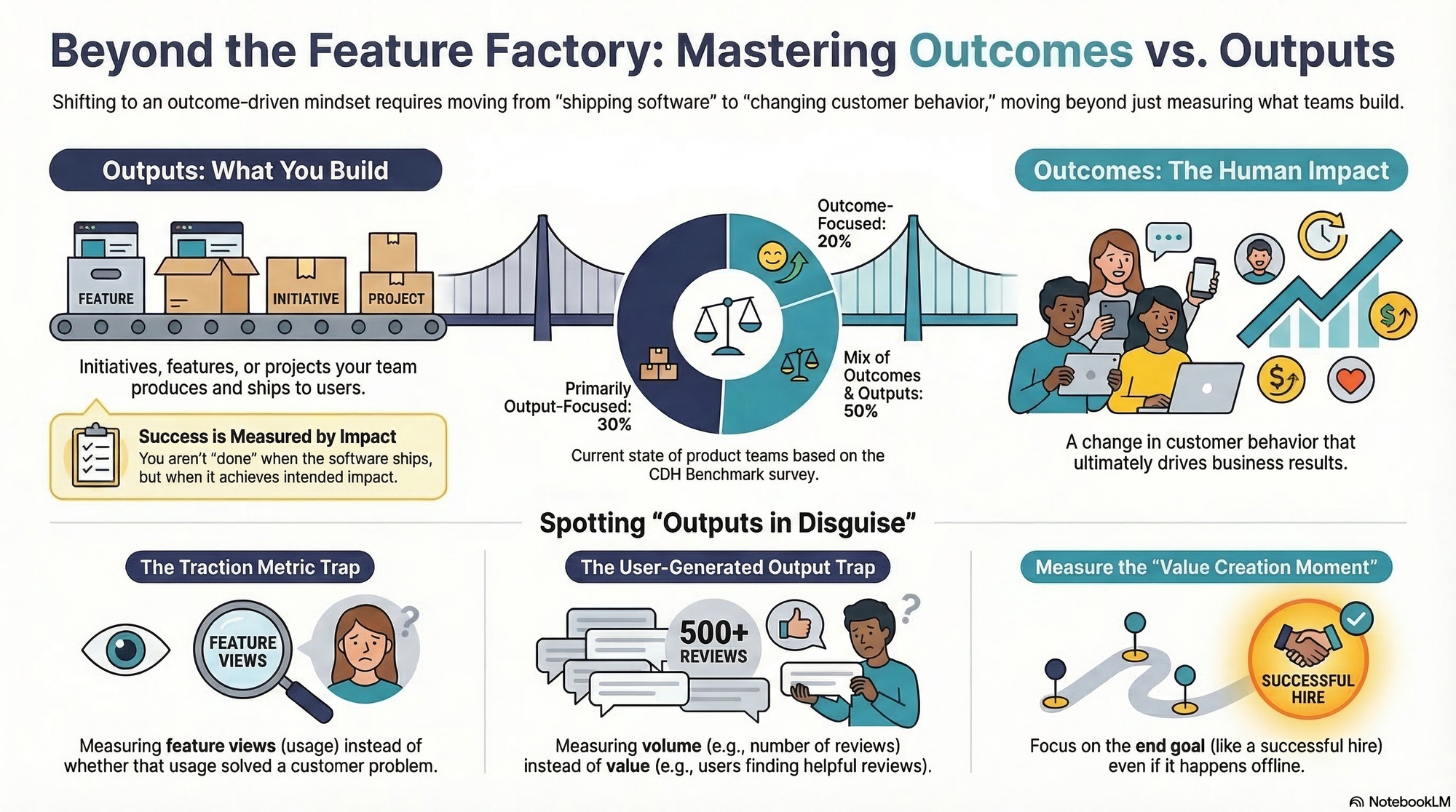
In a benchmark survey, 20% of product teams claim to be outcome-focused, nearly half describe themselves as working in a mix of outcomes and outputs, and about 30% are still primarily working with outputs. I’ve seen versions of this in my own org: we aspire to outcomes, but our rituals, roadmaps, and reporting still reward shipping.
Here’s how I draw the line clearly, coach my teams to avoid common traps, and negotiate better, more actionable outcomes that unlock genuine product discovery and business results.
Simple definitions we live by
An output is something you build or produce—a feature, a project, an initiative. It’s something your team ships.
An outcome is the impact of that output—a change in customer behavior or a business result.
Josh Seiden puts it well in his book Outcomes Over Output: “An outcome is a change in human behavior that drives business results.”
Shift from shipping to shaping results. This graphic clarifies outputs vs outcomes, revealing that value emerges between deliverables and impact—when features change customer behavior and move business results.
I distinguish business outcomes from product outcomes. Business outcomes are typically financial metrics that measure the health of the business (e.g. increase revenue or reduce costs) while product outcomes measure a customer behavior in the product or a sentiment about the product.
Here’s a simple example I’ve used with platform teams. Many B2B companies support a number of integrations. Integrations are outputs. Having integrations alone doesn’t create value. Customers using and finding value in those integrations—that’s an outcome. If those customers retain their subscriptions longer because of the integrations—that’s also an outcome.
Building something isn’t the same as creating value. That’s the core of this distinction, and it’s what separates empowered product teams from feature factories.
Why this distinction matters for empowered product teams
When we task teams with delivering outputs, they’re done when the software ships. When we task teams with delivering outcomes, they aren’t done until the software ships and has the expected impact.
That small shift changes almost everything about how a team works: what we measure (impact, not just delivery), how we know we’re done (measurable behavior change, not release notes), the autonomy we grant (told what to achieve, not what to build), and the planning artifacts we use (an opportunity solution tree beats a feature roadmap when we’re exploring the best path to an outcome).
When I assign outcomes, I’m giving the team latitude—and responsibility—to figure out the best path to success. That’s what opens the door for real product discovery and continuous discovery habits.
Shift your lens from shipping features to achieving impact. This side-by-side visual explains how outcome-driven teams measure success, grant more autonomy, define 'done' by results, and plan with an opportunity solution tree.
Examples: spotting outputs disguised as outcomes
Clear-cut example: “Our outcome is to deliver an Android app.” An Android app is something we build and ship. It’s clearly an output.
To get to an outcome, I ask, “What’s the value of having an Android app?” or “How will we know the Android app is successful?”
We might answer: “Having an Android app will allow us to engage more users. We’ll know it’s successful when people engage with the app on a regular basis.”
This answer uncovers the hidden outcome: engage more people. Now we can set the right scope: increase the percentage of engaged users across any platform; increase the percentage of engaged mobile users; or increase the percentage of engaged Android users.
Any of these outcomes gives us more room to explore than a fixed output. Maybe we don’t need a native app at all. We could deliver the same engagement through a mobile web experience, notifications, or email. And we’re not done when we ship—we’re done when the right people are actually engaged.
Tricky example 1: measure the value creation moment (hires, not applicants)
Move beyond shipping features to the impact that matters. This visual maps the path from build an Android app to the real goal, increase engaged users, by asking why, defining value, and owning results.
When setting outcomes, it’s tempting to choose the easiest-to-measure metric. But a good outcome measures the customer’s value creation moment.
I worked at a company that helped new college grads find their first job. When I started working there, the primary outcome was “increase job applications.” This technically is an outcome—it measures a specific behavior in the product.
But it doesn’t measure the value creation moment. A job seeker doesn’t get value when they apply for a job. They only get value when they get the job. Similarly, employers don’t get value from any job applicant, they get value when the right job applicant applies.
Many job boards try to measure qualified applicants—instead of counting any applicant, they compare the credentials of the applicant to the job description and only count qualified applicants. This is better. But it still doesn’t measure the value creation moment. Both the job seeker and the employer get value when an open job is successfully filled. The right metric is hires.
Yes, “hires” can be hard to instrument because it happens off-platform and incentives misalign. Measure it anyway, even with proxies. The easy metric isn’t always the right outcome.
Tricky example 2: measure impact, not user-generated output (the course reviews trap)
I worked with a team that helped students choose university courses. They set their outcome as: “Increase the number of course reviews on our platform.”
Confusing activity with impact? This visual breaks down four common outcome traps—measuring at the wrong moment, mistaking outputs, chasing adoption, and relying on sentiment—so teams focus on real value.
Sounds like an outcome, right? It’s a metric. You can measure it. It’s an action users take on the site—writing a review. But it’s actually an output in disguise.
Reviews are valuable when they help a student evaluate a course. They don’t create any value if a student never sees them. More reviews aren’t always better, especially if they’re clustered where nobody looks.
A better outcome is “Increase the number of course views that include reviews.” Now we’re measuring impact on the decision moment, not just the production of content.
If you can hit your metric without helping customers, you’re tracking an output, not an outcome.
Tricky example 3: measure success, not just adoption (the traction metric trap)
“Increase the percentage of users who viewed the performance report.”
This looks like a good outcome. It measures a specific behavior in the product. It’s within the team’s control. But it’s what I call a traction metric—it measures adoption of a single feature, not value to the customer.
Why teams get trapped in shipping features: a vicious trust cycle fuels micromanagement, while performance-linked outcomes push safe targets. Break the loop and refocus on customer outcomes that truly move the needle.
Two problems arise. First, people can view the report and still not find what they need. Second, we might have perfectly happy customers who don’t need the report at all. Driving usage of an unneeded feature wastes time and erodes trust.
Measure the value creation moment, not just feature adoption.
Tricky example 4: pair sentiment with behavior
I define a product outcome as a metric that measures either 1. a specific behavior in the product or 2. a sentiment about the product. But sentiment metrics—like CSAT or NPS—can be tricky on their own.
Sentiment metrics are outcomes, but they aren’t directional. They don’t tell us where to explore or set guardrails for what to avoid. So I pair a behavior with a sentiment, for example: “Increase engagement without negatively impacting satisfaction.” I use sentiment as a counterweight.
Facebook and Instagram illustrate why this matters. Meta is exceptional at driving engagement—but to a fault. Many of us don’t like these addictive products. Pairing engagement with a satisfaction guardrail prevents “engagement at all costs.”
Why getting this right is hard (and how I counter it)
Ready to move from shipping features to creating impact? This visual playbook shares five practical moves—translate metrics, partner with teams, iterate, avoid traps, and dig deeper—to turn outputs into measurable outcomes.
The trust cycle. Managers don’t trust that teams can reach outcomes on their own. So managers micromanage the outputs. Teams, in turn, don’t communicate their progress toward outcomes—they communicate their progress on features. This reinforces the manager’s belief that they need to stay involved in the details. It’s a vicious cycle.
I break it by asking teams to show their work—share assumptions, research, opportunity solution trees, and evidence behind choices—and by giving feedback on the thinking, not just the solutions.
The accountability trap. When performance reviews are tied to hitting outcomes, teams play it safe. They sandbag their targets. They disguise outputs as outcomes to guarantee “success.”
I treat outcomes as learning opportunities first. When we start on a new outcome, I set a learning goal—“learn what moves the needle on this metric”—before a performance goal—“increase X by Y%.” This creates space to explore without fear.
How I get teams started with better outcomes
Translate business outcomes to product outcomes. Business outcomes like revenue, retention, and market share are lagging indicators—by the time you see them, it’s too late to act. Product outcomes measure behavior changes within the product that lead to those business results. They’re leading indicators within the team’s control.
Negotiate outcomes with your team. Outcome-setting should be a two-way conversation. Leadership brings the cross-company context. The team brings customer insight and technical realities. Neither side dictates; we co-own the target and the constraints.
Stop celebrating shipped features and start celebrating change. This visual contrasts a feature factory mindset with a true product team, urging teams to track impact, not output, and define success by outcomes.
Expect to iterate on your metrics. Your first outcome metric probably won’t be right. That’s normal. Sonja at tails.com went through four iterations—from 90-day retention to 30-day to 5-day to behavior-based metrics—before landing on something actionable. Thomas at Bluestone Analytics iterated three or four times before finding the right metric. Iteration is the work.
Watch for common mistakes. Outputs disguised as outcomes. Traction metrics masquerading as product outcomes. Sentiment metrics without direction. Business outcomes assigned directly to product teams without translating to behavior change.
Use the right artifacts. Replace feature roadmaps with an opportunity solution tree to explore multiple paths, test assumptions, and sequence bets explicitly against a clear outcome.
Align OKRs with outcomes. If your company uses OKRs, make sure the “KR”s are true product outcomes (behavior change and value creation), not a list of features to ship.
The bottom line
When we shift from an output-first mindset to an outcome-first mindset, it doesn’t mean that outputs stop mattering. Product teams will always ship features, and the ability to do so quickly and with quality still matters. This shift simply ensures those features achieve the intended impact. We aren’t done when we ship—we’re done when what we shipped has the intended impact.
Measure success by the impact of what you ship and you’ll build a product team that learns, adapts, and creates real value. Measure success by what you ship and you’ll get a feature factory.
Quick self-check: is your “outcome” really an outcome?
Ask yourself: 1) Does it measure a behavior change or a sentiment tied to value creation? 2) Could we hit it without helping customers? 3) Is it adoption of a single feature (a traction metric) or a result that customers and the business care about? 4) Do we have a counter-metric to prevent unintended harm? If you stumble on any of these, refine it before you commit.