
My writing process used to be messy. Even in my role leading product strategy, I’d start strong and then stall because I hadn’t clarified what I truly wanted to say.
I’d begin with a brain dump—everything swirling in my head. I’d try to shape it into an outline, lose patience, and just start writing. A few paragraphs later, I’d realize I didn’t know where I was going, stop, and return to the outline. It was a tortured loop between writing and structuring.
Now I do it differently. When I get stuck, I don’t start writing. I ask Claude for help.
Claude reviews my outline and helps me fill in gaps. It often suggests things that I don’t like. This is good. It helps me figure out the core of what I want to say. Instead of writing my way to what I think, I discuss my way to what I think.
Claude isn’t just a sounding board. I also use it to help me brainstorm headlines, explore outline alternatives, critique each section as I write, conduct supporting research, act as my thesaurus and dictionary, make SEO recommendations, and so much more. As a result, I am writing way more.
I didn’t design this workflow in one sitting. I built it iteratively, the same way I build products: by asking, "How can Claude help with this?" and evolving from there.
If you haven’t been following along, I’m deep in a series about Claude Code and how it helps me work better. Here’s what we’ve covered so far: Claude Code: What It Is, How It’s Different, and Why Non-Technical People Should Use It, Stop Repeating Yourself: Give Claude Code a Memory, How to Use Claude Code Safely: A Non-Technical Guide to Managing Risk, and How to Choose Which Tasks to Automate with AI (+50 Real Examples).
This week, I’m diving into how to design personal AI workflows. I’ll use my writing workflow to illustrate each step, and I encourage you to follow along with your own process so you end with something tangible.

Designing AI workflows looks a lot like designing product solutions. I lean on "discovery" habits—clarifying outcomes, mapping the journey, and testing assumptions—to make the work both reliable and repeatable.
This series is inspired by my personal usage of Claude Code. I have not received any compensation from Anthropic for writing this series. And you can trust that if that ever changes, I will disclose it. This is not only required by the FTC here in the US, but I strongly believe it is the right thing to do. You can count on me to do so.
First, I map out what I do to complete the task. Once you’ve identified the AI workflow you want to create, start by mapping exactly what you do when you do it yourself. If this feels hard, do the task a few more times and jot down each step as you go.
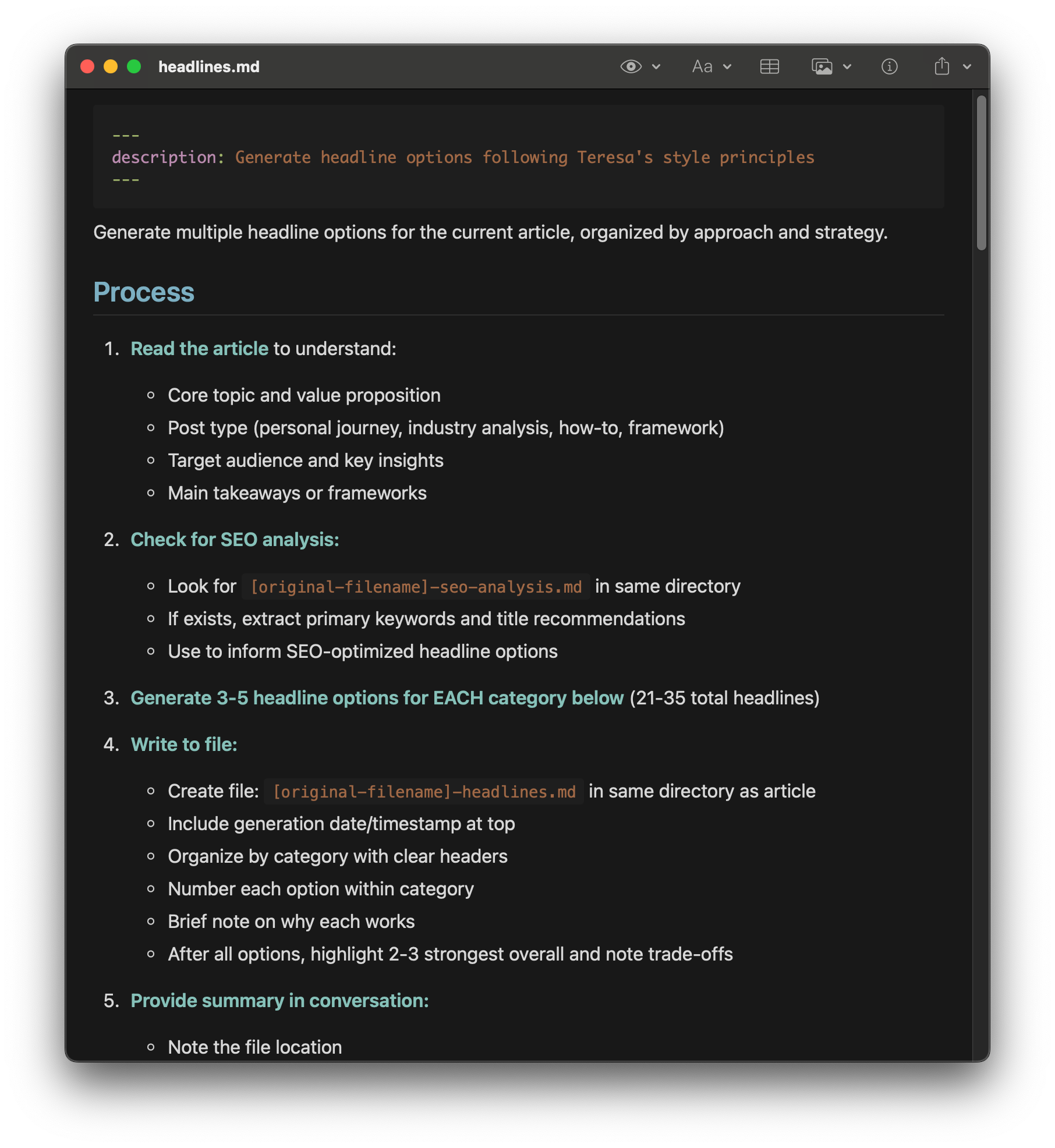
Here’s what I do when I write a blog post: I choose a topic; I write down everything I can think of related to that topic; I structure it into an outline; I do some research to fill in gaps; I write each section; I edit each section; I think about SEO tactics; I brainstorm headlines; I decide what images to add; and I send it to my editor.
If this looks a lot like story mapping, that’s because it is. Instead of mapping what a customer has to do to get value from a solution, I’m mapping what I do to complete a task. The benefit is the same: I can see what must happen and ask, "Where can AI help?"
From here, I focus on four moves: choose one step to automate or augment with AI; decide on the right automation (or augmentation) strategy—code vs. LLMs; prototype the first workflow with detailed instructions; and test and iterate until it meets my bar for quality and speed.
My goal is to give you enough guidance that you can follow along and end with a draft of your first AI workflow. If you apply continuous discovery to your own process, you’ll not only accelerate output—you’ll improve the clarity and quality of your thinking along the way.
Inspired by this post on Product Talk.




Leave a Reply