
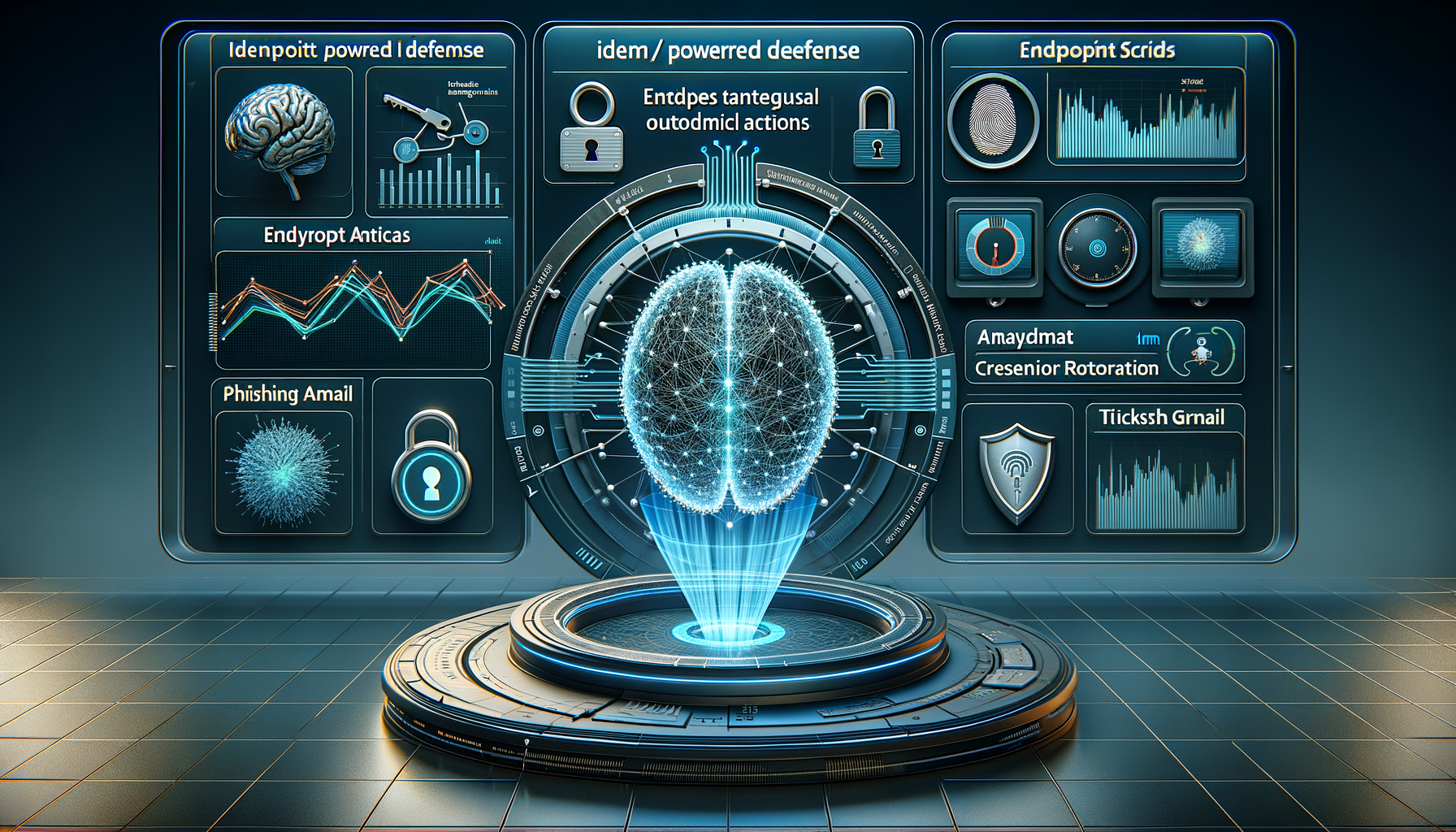
Every week, I watch the cybersecurity landscape shift under our feet. As a VP of Product Management, I’m responsible for building secure, resilient products—and that means understanding how artificial intelligence is transforming the way IT teams defend, respond, and even anticipate attacks.
Learn the ways in which AI is transforming both cybersecurity offense and defense for IT teams.
First, AI supercharges threat detection and prevention. Pattern-recognition models now sift through endpoint telemetry, identity signals, and network flows to surface anomalies in near real time. In practice, that means fewer false positives, faster prioritization, and earlier containment. We’re pairing behavioral analytics with enrichment from our SIEM/EDR stack so analysts get a ranked, explainable view of risk instead of a noisy alert queue—directly improving mean time to detect and laying the groundwork for scalable threat detection and response.
Second, AI accelerates incident response. We’ve embedded LLM-powered copilots into our SOC workflows to summarize alerts, propose next-best actions, and auto-generate draft remediation steps from playbooks. Orchestration then executes routine tasks—isolating endpoints, rotating credentials, updating tickets—while keeping a human-in-the-loop for approvals. To keep this safe, we use privacy-by-design principles, a retrieval-first pipeline for authoritative playbook content, and eval-driven development to measure precision/recall on suggested actions. The result is meaningful reduction in mean time to recover and more consistent incident management.
Third, the offense is getting smarter—and we need to be honest about it. Adversaries use gen AI to craft targeted spear-phishing, deepfake executive voice notes, and polymorphic malware that evades signature-based tools. We counter by red-teaming with AI, deploying deception tech to waste attacker cycles, and hardening identity as the new perimeter (MFA, conditional access, continuous risk scoring). Education matters, too: when employees see how convincing AI-generated lures have become, phishing reports spike and successful compromise rates drop.
None of this works without strong governance. We treat AI like any high-impact capability: rigorous data governance, model access controls, and AI risk management across the lifecycle. We log model prompts and outputs, restrict sensitive data via contextual policies, and continuously test for drift and bias. This is as much an IT leadership challenge as it is a technical one—clear ownership, well-defined runbooks, and regular tabletop exercises make the difference between resilience and chaos.
If you’re getting started, I recommend a focused 90-day plan: identify one high-signal detection use case, one response playbook ripe for automation, and one employee risk area (usually phishing) for immediate uplift. Instrument everything—latency, precision/recall, MTTR—and iterate with a cross-functional group spanning security engineering, SRE, and product management leadership. With disciplined AI strategy and guardrails in place, you can move faster, reduce noise, and stay ahead of adversaries without compromising data or trust.
Inspired by this post on Pendo – Perspectives.







Leave a Reply