
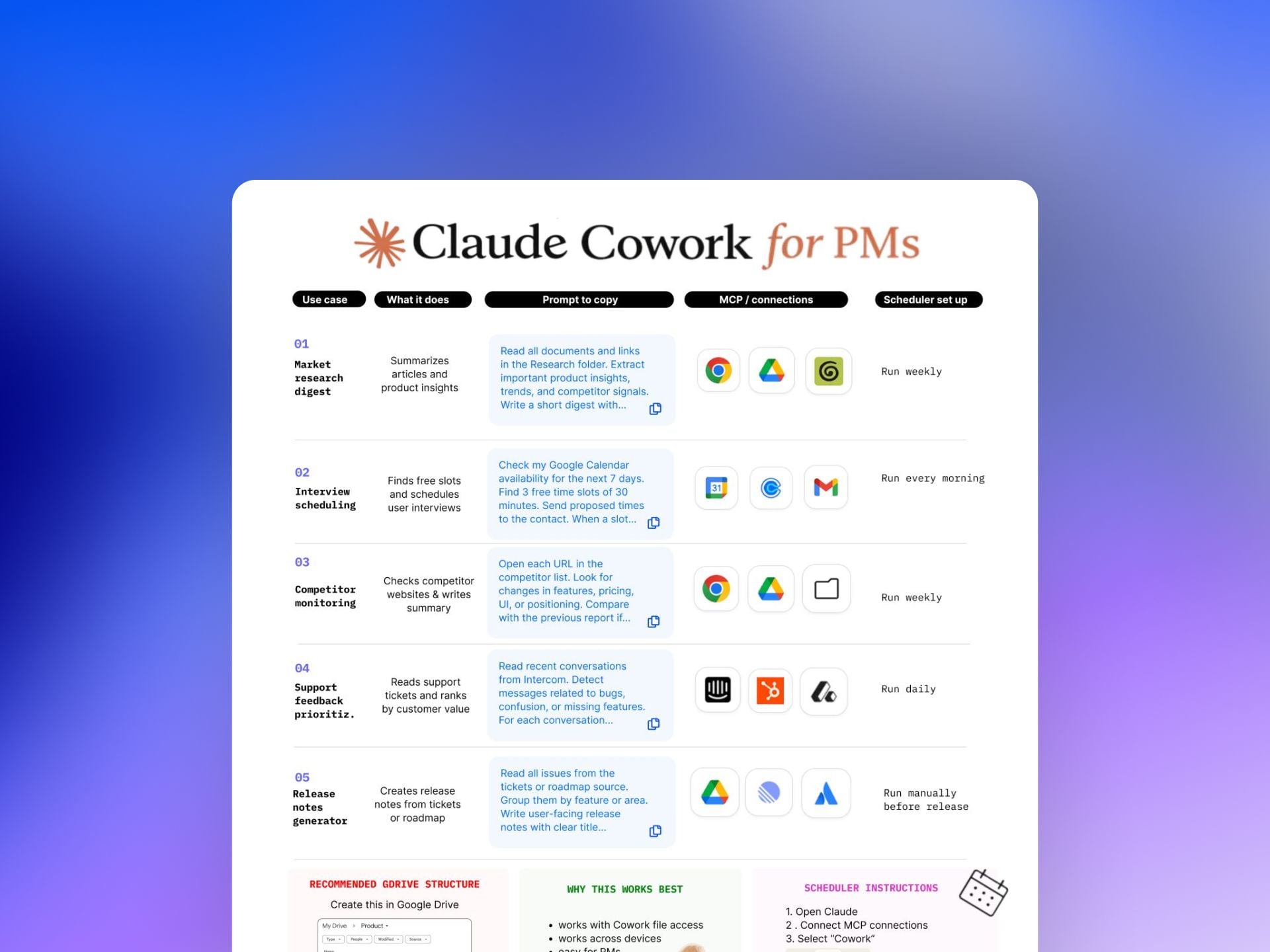
In my role leading product teams, I’m relentless about freeing time for high-leverage work—clarifying strategy, sharpening positioning, and unblocking execution. Claude Cowork has become a reliable AI partner in that mission, helping me automate repeatable tasks while preserving judgment for the decisions that matter most.
Get 5 playbooks to automate common product management tasks with Claude Cowork and free yourself for higher-leverage PM work.
When I say “playbooks,” I mean structured, repeatable workflows that turn messy inputs into crisp outputs—without sacrificing rigor. With agentic AI, LLMs for product managers, and thoughtful prompt engineering, these playbooks plug directly into my product roadmapping and sprint planning process, accelerating discovery, analysis, and stakeholder alignment.
Playbook 1: Continuous discovery synthesis. I route raw customer interviews, support threads, and behavioral analytics into Claude Cowork to cluster themes, extract Jobs-to-Be-Done, and propose opportunity areas. It drafts an initial opportunity solution tree with clear problem statements, target outcomes, and candidate solutions, which I then refine with the team. This shortens the loop between customer interviews and actionable insights while preserving the nuance that continuous discovery requires.
Playbook 2: Strategy-to-roadmap alignment. Starting from our product strategy and target outcomes, I ask Claude Cowork to translate goals into a prioritized roadmap, calling out outcomes vs output OKRs and showing driver trees that connect initiatives to measurable impact. It flags dependencies and suggests stakeholder management touchpoints, making the narrative behind prioritization transparent and easier to socialize across product trios and leadership.
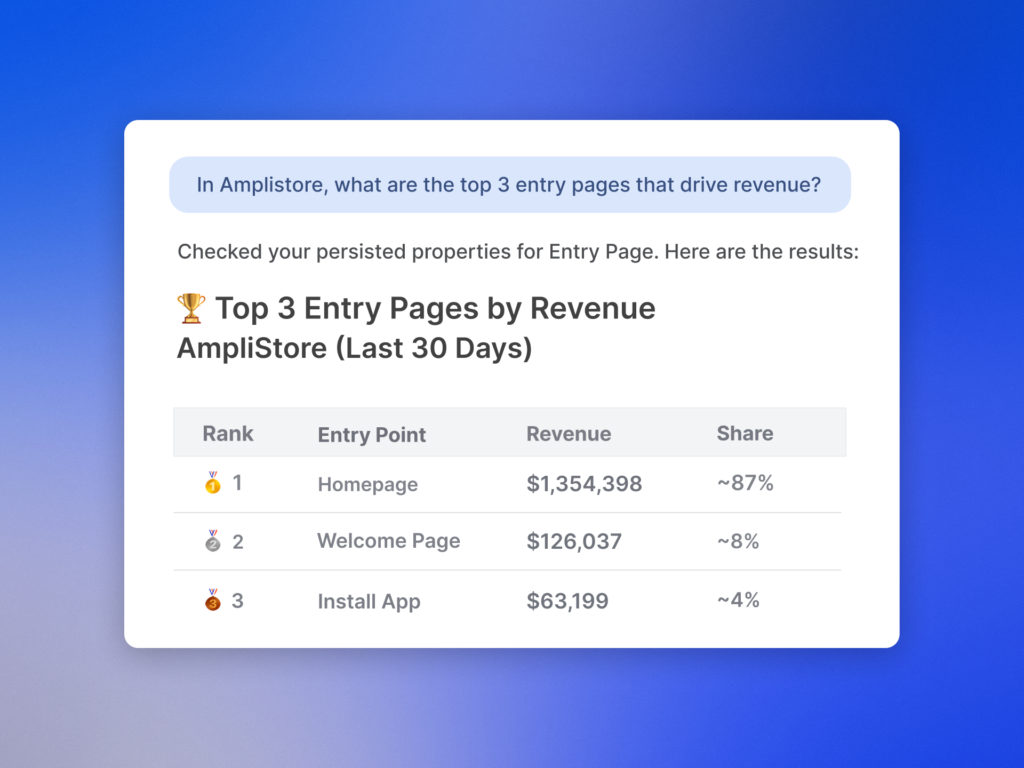
Playbook 3: Experiment design and A/B testing. To move from ideas to evidence, I have Claude Cowork generate testable hypotheses, success metrics, and guardrails for A/B testing. It produces experiment briefs, checks statistical assumptions like minimum detectable effect (MDE), and suggests instrumentation plans for tools such as Amplitude analytics. I use these drafts to speed up reviews without compromising on methodological rigor.
Playbook 4: Launch communications and in-product guidance. After we ship, I leverage Claude Cowork to assemble UX writing, release notes, and in-app guides tailored to user segments. It proposes short product tours, contextual tooltips, and support macros that keep messaging consistent across Pendo or Intercom while reinforcing our value proposition. The result is faster, more cohesive go-to-market execution with fewer round-trips.
Playbook 5: AI risk, governance, and quality checks. Before anything goes live, I use Claude Cowork to run structured reviews for data governance, privacy-by-design, and AI risk management. It helps draft acceptance criteria, red-team prompts for edge cases, and an eval-driven development checklist so the team can track model behavior and mitigate regressions over time. These safeguards maintain trust as we scale AI workflows across the product surface.
To make these playbooks sing, I seed Claude Cowork with a retrieval-first pipeline of canonical docs—vision, strategy, OKRs, analytics dashboards, and definition-of-done checklists—plus prompt templates tuned for our voice and review standards. Tight context window management, explicit role instructions, and lightweight evaluations keep outputs accurate, auditable, and on-brand.
The impact has been compounding: faster discovery-to-decision cycles, clearer roadmaps tied to outcomes, stronger experiments, and launch content that lands. Most importantly, the team spends more time on creative problem solving and stakeholder partnership, not manual synthesis or formatting. If you’re ready to reclaim your calendar and elevate your product strategy, start with these five Claude Cowork playbooks and iterate from there.
Inspired by this post on Amplitude – Perspectives.


Leave a Reply