Tag: stakeholder management

  • From Solutions Engineering to PMM Leadership: Darshil Gandhi’s Playbook for Amplitude’s Edge

    From Solutions Engineering to PMM Leadership: Darshil Gandhi’s Playbook for Amplitude’s Edge

    I look for product marketing leaders who translate market noise into clear decisions that move roadmap, revenue, and relationships. In that context, Darshil Gandhi exemplifies how competitive rigor and technical depth can sharpen product strategy and accelerate go-to-market strategy across empowered product teams.

    Darshil leads competitive intelligence, partner product marketing and technical marketing at Amplitude. He is a former solutions engineering team principal.

    That blend matters: a solutions engineering mindset grounds messaging in real implementation details, while competitive intelligence and partner product marketing align product positioning, points of parity, and competitive differentiation with what buyers actually evaluate. At a company centered on Amplitude analytics, that cross-functional view helps transform behavioral data into a crisp value proposition customers can feel in evaluations and expansions.

    In practice, I prioritize a few patterns when partnering with leaders who span these domains: align on a single competitive narrative using driver trees that connect capabilities to outcomes; use Amplitude analytics to validate claims and win themes; co-create partner playbooks that make integrations repeatable; and ensure technical marketing closes the loop by pressure-testing demos, docs-as-code, and reference architectures with field feedback. This strengthens stakeholder management across sales, solutions engineering, and product trios, reducing ambiguity and speeding decisions.

    The net effect is clarity: sharper differentiation in the field, cleaner handoffs between teams, and faster feedback cycles that de-risk launches. It’s a model I trust when stakes are high—use the truth of implementation to tell a compelling story, then let the market confirm it.


    Inspired by this post on Amplitude – Perspectives.


    Book a consult png image
  • Broken Procurement Is Costing You Talent: A Product Leader’s Playbook for Speed and Sanity

    Broken Procurement Is Costing You Talent: A Product Leader’s Playbook for Speed and Sanity

    Procurement should accelerate value, not suffocate it. Listening to this episode, I found myself nodding (and wincing) through a painfully familiar story about how well-intended controls morph into barriers that keep great expertise out. As a product leader responsible for speed, outcomes, and brand experience, I see procurement as a direct mirror of culture—and an often overlooked part of the product operating system.

    In the conversation, Teresa is cranky—and honestly, she has every right to be. She’s simultaneously juggling seven speaking engagement contracts, and six of them have become a part-time job in themselves—think 80-page ethics policies, 800-question security forms, and Multi-Factor Authentication (MFA) questions asked 17 different times. Meanwhile, the one company that just put her fee on a credit card? Scheduled, confirmed, and done in two weeks. That contrast is the whole story: friction repels talent; clarity and simplicity attract it.

    Petra adds her own horror story—filling out 12 identical Word document forms—and together they surface a deeper truth I’ve seen across organizations: broken vendor processes don’t just frustrate consultants; they stop companies from getting the expertise they actually need. And despite what many assume, company size isn’t the deciding factor—leadership intent and process ownership are.

    If you’ve ever wondered why a training got canceled, why a speaker backed out, or why your team can’t seem to bring in outside experts, this is likely the culprit: procurement theater. Repetitive forms, unbounded scope creep, and sprawling security reviews create drag that outlasts any short-term legal or compliance gain. The opportunity cost—lost learning, slower progress, and talent that simply says no—is enormous.

    One detail that stood out: with CEO-level buy-in, a legal review timeline collapsed from four months to 10 days. I’ve seen the same thing. Executive sponsorship is the fastest procurement tool there is, and it reveals what the organization truly values. If you can compress the path when a leader cares, you can redesign the path so it’s always faster—without compromising real risk management.

    I also loved the clarity of a simple policy from the episode: Teresa’s new policy is straightforward—her paperwork, credit card payment, no vendor setup—or no speaking engagement. That’s not obstinance; it’s a bright-line test for whether an organization respects expert time and understands total cost. The best experts have options, and friction filters them out first.

    Here’s how I operationalize this in product-led organizations. Tier risk by engagement type (e.g., one-hour talk vs. long-term software vendor) and match the process to the risk. Offer a credit-card fast lane with standard, plain-English terms for low-risk work. Eliminate duplicate data entry and kill redundant questionnaires. Use a single, secure intake that auto-fills known fields. Track cycle time end to end, and publish SLAs for legal, InfoSec, and finance. Most importantly, make vendor experience a first-class metric—because it is a brand experience.

    Security and compliance matter, but they must be right-sized. If you’re buying a keynote, you’re not buying data processing—so why the 800-question security review? Calibrate controls to actual data access and system interaction. The episode even references AWS DynamoDB and GuardDuty, plus Claude Code—helpful reminders that your stack context matters, but not every purchase touches it. Don’t conflate deep technical diligence for a SaaS integration with a simple, no-data engagement.

    There’s a reason the classic film Office Space gets a nod—it’s the perfect metaphor for what happens when well-meaning governance calcifies. Bureaucracy compounds over time, usually after adverse events, until startups—or any team that still moves fast—run circles around you. Procurement that treats experts like adversaries won’t win the race that actually matters: learning faster than the market.

    If you want the full story, listen to the episode here: Spotify (https://open.spotify.com/episode/2JHnTvnZX2WcFczml7ozKY?ref=producttalk.org) | Apple Podcasts (https://podcasts.apple.com/kh/podcast/procurement/id1794203808?i=1000770701690&ref=producttalk.org). It’s cathartic, but more importantly, it’s a blueprint for fixing what’s broken.

    Mentioned in the episode: Hire Teresa to Speak (https://www.producttalk.org/hire-teresa-to-speak/), AWS DynamoDB (https://aws.amazon.com/dynamodb/?ref=producttalk.org), GuardDuty (https://aws.amazon.com/guardduty/?ref=producttalk.org), Claude Code (https://www.claude.com/product/claude-code?ref=producttalk.org), and Office Space (https://en.wikipedia.org/wiki/Office_Space?ref=producttalk.org).

    I’d love to hear your experiences and fixes. Where does your procurement flow break, how do you measure cycle time today, and what would it take to create a vendor experience you’d be proud to put your brand on? Drop your thoughts below and let’s trade playbooks.


    Inspired by this post on Product Talk.


    Book a consult png image
  • Inside My Pricing Playbook: Building Value-Based Packaging That Balances Growth and Profit

    Inside My Pricing Playbook: Building Value-Based Packaging That Balances Growth and Profit

    Pricing looks deceptively simple from the outside; inside, it’s anything but. Over the years, I’ve learned that every price tag is really a strategic statement about value, priorities, and the future we’re building toward.

    At Fin, pricing and packaging (P&P) is more than a finishing touch. It’s a research problem, a forecasting challenge, a commercial decision, and ultimately, a strategic statement, requiring deep cross-functional work. We must balance the needs and wants of our customers, the value delivered by our product, and the broader vision we are building towards.

    Our approach keeps evolving as our product and market mature. I treat it as a living system—continuously informed by research, GTM learning, and customer behavior, never "set and forget."

    Here’s how I run the process in practice, especially when we launch something new that needs to be monetized, like Fin, our AI Agent. The work moves from qualitative discovery to quantitative validation to commercial modeling, with tight partnership across product, research, data science, finance, GTM, and engineering.

    Step 1: Foundational research

    I start by talking to buyers to understand their mental models of value. How do they define ROI? What pricing models do they expect in this category? What feels intuitive, and what feels off? This early discovery shapes two crucial choices: the pricing model and the pricing metric.

    The pricing model is the overall structure; value-based, usage-based, access-based, fixed fee, and so on. With Fin, we chose a value-based model: you only pay when Fin delivers value. Our research clearly showed that buyers don’t want to pay for usage, they want to pay for results.

    The pricing metric is the unit of value within that model, the unit we anchor pricing to. For Fin, the pricing metric is “outcomes.” An outcome is defined by Fin successfully handling a customer service query.

    Small definitional changes can dramatically alter how customers perceive value, so I obsess over details. Buyers rarely hand us the “right” model; they reveal how they evaluate value, and I translate that into a model and metric that align with their goals and expectations.

    Throughout, I loop in execs, finance, GTM, and engineering to ensure alignment before proceeding. Pricing choices cut across the business; they can’t be made in isolation.

    Step 2: Willingness to pay

    Once we have a model and metric, I quantify what the market will bear. This is where rigorous willingness-to-pay (WTP) research comes in, grounded in the language we validated through the qualitative work.

    Here’s the kind of framing I use in surveys to keep things concrete and consistent with our model and metric:

    You would only pay when Fin delivers an outcome (→ the model). An outcome is counted when the AI Agent resolves a customer query with no further help needed (→ the metric). Would you be willing to pay $X per outcome for Fin?

    The foundational qual is so important as a first step. It helps us decide what we should be asking about before we start asking how much people will pay. Without the qual ground work, you risk building a very convincing answer to the wrong question.

    The goal isn’t to find a perfect price. That doesn’t exist. The goal is to ground our discussions in the reality of the market.

    I use methods like Gabor-Granger and Van Westendorp to understand WTP and to shape a demand curve that informs strategy, not just a single number.

    This chart shows us what percentage of the market is willing to buy the product at various price points. The demand curve shows that 69% of buyers were willing to pay for the product at $0.86 per outcome, whereas only 39% were willing to pay at $1.42.

    The dashed line shows the price point at which revenue for the business would be maximized (by multiplying adoption by the dollar amount).

    This allows us to debate knotty questions like: What’s the right balance between growth and revenue? How sensitive is demand to price changes? At what price do we start losing the market? If we wanted to increase adoption, would lowering our prices by $X make a meaningful difference?

    Those conversations help me weigh customer value and business outcomes side by side. At this stage, decisions feel more tangible, but I don’t finalize a price until I’ve modeled the operational realities.

    Step 3: Modeling

    By now I have a validated model, a clear metric, and a strong WTP signal. Next I translate theory into a commercially workable plan—this is where data science and finance are indispensable.

    I start with a list price aligned to our strategy and commercial goals. Then I adjust for likely discounting to estimate realized price. Next, I analyze beta usage to project outcomes per customer by segment and derive average ARR. I combine usage projections with WTP to model attach rates across conservative-to-optimistic scenarios. Finally, I connect the dots in our long-range plan—logos, ARR, margins—iterating until the numbers and narrative cohere.

    The modeling step is important because willingness-to-pay data is somewhat theoretical. It reflects intent, not behavior. Modeling helps us bridge that gap.

    The goal of this step is to land on a price point recommendation, alongside forecasts for ARR and adoption. It allows us to understand the real business impact of the decisions we’re making.

    Alongside all of this, we need to ensure any decision we make falls in line with our pricing principles and broader business objectives.

    Step 4: Sign-off and execution

    With the analysis complete, I consolidate everything into a clear P&P recommendation for executive approval. Once approved, the real work begins: enabling sales, communicating changes to customers, instrumenting ROI proof points, and monitoring performance so we can learn and iterate.

    Do we run the full process every time?

    Not always. This is the ideal process, and I apply it end-to-end for the most material decisions. In reality, time and resource constraints require judgment; rigor should mirror impact. When uncertainty crops up midstream, I run scrappier, targeted research rather than forcing a linear path.

    The ongoing challenge

    As Fin’s breadth has expanded, our pricing system has had to evolve, too. For a while, modular pricing worked well—each product had its own logic tied to a crisp outcome. As we add more products, more Agent capabilities, and more outcomes, the question shifts from “what is the right P&P for this one product?” to “how does everything fit together into a coherent pricing system?”

    We must recognize that pricing isn’t something you set once and leave alone. As products evolve, especially in a world where AI is rapidly changing how value is created and delivered, it’s important to regularly step back and review the bigger picture, not just the component parts.

    For example, outcome-based pricing has served us well, particularly when our products were tightly tied to clear, measurable outcomes. But as our products become more varied, and as we continue building toward a broader platform, it becomes less straightforward to apply a single model cleanly everywhere.

    The challenge becomes less about replacing one model with another, and more about continually looking up and asking: what pricing philosophy best reflects the value we’re delivering today? And how do we deliver that philosophy in a way that still feels right for customers?

    In short, there is no finish line, pricing is never “done” – and that’s exactly how it should be.

    Why this work matters

    Pricing and packaging is often noticeable only when it goes wrong. A confusing model, a bad metric, or a price that feels disconnected from value. And we hear about those quickly.

    When pricing is done well, it becomes nearly invisible—but it still does a lot of work. It shapes how people perceive value, clarifies what they’re paying for, and makes the product easier to sell, easier to buy, and easier to scale. Most importantly, it forces us to be honest about what the product is really worth. That’s why I take it so seriously—and why I treat pricing as a product in its own right.


    Inspired by this post on The Intercom Blog.


    Book a consult png image
  • Our Operating Model Is the Product—Why We Built Product Partners to Accelerate Outcomes

    Our Operating Model Is the Product—Why We Built Product Partners to Accelerate Outcomes

    I’ve learned that customers don’t just buy features—they buy the way we discover, decide, build, ship, and support. In other words, the operating model is the product. That realization has shaped how my team and I at HighLevel translate product strategy into tangible, repeatable outcomes that show up in quality, reliability, onboarding, and consultative support every single day.

    We created Product Partners to codify that operating model and scale it with discipline. It’s a blueprint and operating rhythm that unifies product strategy with go-to-market strategy, customer success, and solutions engineering—so empowered product teams can move faster without sacrificing clarity, governance, or customer trust.

    First, we anchored on continuous discovery. Product trios work shoulder-to-shoulder with customer-facing teams to run customer interviews, journey mapping, and A/B testing, then validate insights with session replay and behavioral analytics. We use driver trees and opportunity solution trees to connect problems to outcomes, ensuring prioritization is evidence-based and aligned to product-market fit—not just output.

    Second, we elevated delivery excellence. Our practices emphasize CI/CD, feature flags, observability, SRE-informed incident management, and DORA metrics to shorten feedback loops while raising the bar on stability. Privacy-by-design, data governance, and regulatory compliance are built into our workflows, and we make deliberate build vs buy decisions to protect platform scalability and long-term velocity.

    Third, we integrated go-to-market alignment from day one. Solutions engineering and customer success shape requirements early, so launches include in-app guides, product tours, onboarding paths, and consultative support that accelerate user activation. We tie outcomes vs output OKRs to stakeholder management rituals, ensuring sales-led and product-led growth motions reinforce each other instead of competing for focus.

    Finally, we closed the loop with a unified analytics platform. Activation, retention analysis, and Net Recurring Revenue (NRR) sit alongside qualitative signals from customer interviews and support. This single source of truth helps us refine product positioning, sharpen value propositions, and improve roadmapping and sprint planning with clear, testable hypotheses.

    What does this mean for our partners and customers? Faster time-to-value, fewer handoffs, clearer expectations, and a shared lens on the metrics that matter. Product Partners isn’t a side program; it’s how we operationalize trust—through transparency, consistent rituals, and a bias toward learning that compounds.

    If this resonates, you’ll feel it in how we discover, build, and support together. I’ll continue to share our playbooks—covering continuous discovery, onboarding, and outcome-based planning—so we can keep raising the standard for product management leadership and product-led growth, one operating rhythm at a time.


    Inspired by this post on Product School.


    Book a consult png image
  • Unlock High-Leverage PM Work: 5 Claude Cowork Playbooks to Turbocharge Your Strategy

    Unlock High-Leverage PM Work: 5 Claude Cowork Playbooks to Turbocharge Your Strategy

    In my role leading product teams, I’m relentless about freeing time for high-leverage work—clarifying strategy, sharpening positioning, and unblocking execution. Claude Cowork has become a reliable AI partner in that mission, helping me automate repeatable tasks while preserving judgment for the decisions that matter most.

    Get 5 playbooks to automate common product management tasks with Claude Cowork and free yourself for higher-leverage PM work.

    When I say “playbooks,” I mean structured, repeatable workflows that turn messy inputs into crisp outputs—without sacrificing rigor. With agentic AI, LLMs for product managers, and thoughtful prompt engineering, these playbooks plug directly into my product roadmapping and sprint planning process, accelerating discovery, analysis, and stakeholder alignment.

    Playbook 1: Continuous discovery synthesis. I route raw customer interviews, support threads, and behavioral analytics into Claude Cowork to cluster themes, extract Jobs-to-Be-Done, and propose opportunity areas. It drafts an initial opportunity solution tree with clear problem statements, target outcomes, and candidate solutions, which I then refine with the team. This shortens the loop between customer interviews and actionable insights while preserving the nuance that continuous discovery requires.

    Playbook 2: Strategy-to-roadmap alignment. Starting from our product strategy and target outcomes, I ask Claude Cowork to translate goals into a prioritized roadmap, calling out outcomes vs output OKRs and showing driver trees that connect initiatives to measurable impact. It flags dependencies and suggests stakeholder management touchpoints, making the narrative behind prioritization transparent and easier to socialize across product trios and leadership.

    Playbook 3: Experiment design and A/B testing. To move from ideas to evidence, I have Claude Cowork generate testable hypotheses, success metrics, and guardrails for A/B testing. It produces experiment briefs, checks statistical assumptions like minimum detectable effect (MDE), and suggests instrumentation plans for tools such as Amplitude analytics. I use these drafts to speed up reviews without compromising on methodological rigor.

    Playbook 4: Launch communications and in-product guidance. After we ship, I leverage Claude Cowork to assemble UX writing, release notes, and in-app guides tailored to user segments. It proposes short product tours, contextual tooltips, and support macros that keep messaging consistent across Pendo or Intercom while reinforcing our value proposition. The result is faster, more cohesive go-to-market execution with fewer round-trips.

    Playbook 5: AI risk, governance, and quality checks. Before anything goes live, I use Claude Cowork to run structured reviews for data governance, privacy-by-design, and AI risk management. It helps draft acceptance criteria, red-team prompts for edge cases, and an eval-driven development checklist so the team can track model behavior and mitigate regressions over time. These safeguards maintain trust as we scale AI workflows across the product surface.

    To make these playbooks sing, I seed Claude Cowork with a retrieval-first pipeline of canonical docs—vision, strategy, OKRs, analytics dashboards, and definition-of-done checklists—plus prompt templates tuned for our voice and review standards. Tight context window management, explicit role instructions, and lightweight evaluations keep outputs accurate, auditable, and on-brand.

    The impact has been compounding: faster discovery-to-decision cycles, clearer roadmaps tied to outcomes, stronger experiments, and launch content that lands. Most importantly, the team spends more time on creative problem solving and stakeholder partnership, not manual synthesis or formatting. If you’re ready to reclaim your calendar and elevate your product strategy, start with these five Claude Cowork playbooks and iterate from there.


    Inspired by this post on Amplitude – Perspectives.


    Book a consult png image
  • My Playbook for a Smarter Feature Launch Slack Channel with Agents, Feature Flags, and Readouts

    My Playbook for a Smarter Feature Launch Slack Channel with Agents, Feature Flags, and Readouts

    Feature launches move fast, and the Slack channel is our command center. Recently, I leveled it up with agentic AI so every data question, feature flag decision, and post-launch readout lives in one trusted place—faster, clearer, and with less operational drag on the team.

    Learn how to set up your launch Slack channel so agents handle your data questions, feature flags, and post-launch readouts in one place.

    Here’s the strategy I use. I treat the launch Slack channel like a real-time control room: agentic AI handles the repetitive asks, experts handle the judgment calls, and stakeholders stay aligned through crisp, automated summaries. The result is tighter stakeholder management, quicker go/no-go calls, and fewer meetings—without sacrificing data quality or governance.

    First, I set clear channel rituals. I name the space #launch-[feature], declare scope and SLAs, and pin the success metrics, dashboards, and rollout plan. Product, engineering, data, support, and GTM all join. I keep threads focused: one for metrics, one for incidents, one for enablement, one for feedback. This small bit of structure makes agent responses and human follow-ups easy to find.

    Next, I add a data questions agent. The agent connects to approved sources and answers the most common queries—activation by cohort, conversion by segment, latency by region—directly in-thread with citations and timestamps. When the question requires nuance, the agent routes to an owner and posts a handoff note, preserving context. This keeps our AI workflows safe and reliable while giving the team quick visibility.

    Then I wire in a feature flags agent. It exposes read-only status by environment, shows rollout percentages, and links to change history. When a toggle is requested, the agent enforces approvals and logs who asked, who approved, and why. We can pause, ramp, or roll back in seconds—with auditability intact. Feature flags become an operational muscle instead of a bottleneck.

    Finally, I schedule post-launch readouts. The readout agent publishes T+1 hour, T+24 hours, and T+7 days summaries: adoption, performance, anomalies, and key learnings. It highlights A/B testing results, flags outliers, and threads follow-up actions to owners. The team gets a single source of truth for post-launch readouts without scrambling across tools.

    Governance matters. I apply role-based access, protect PII, and make the agent cite sources so we can trust what we see. I use Agent Analytics to monitor response accuracy, deflection, and time-to-answer, then refine prompts and permissions. This is practical AI risk management: clear boundaries, human-in-the-loop for consequential decisions, and transparent logs.

    The impact has been real: faster decisions during go-to-market, fewer pings to data and engineering, and higher confidence in our product management rituals. Centralizing “questions, flags, and readouts” in Slack doesn’t replace expertise—it frees it to focus on the hard problems.

    If you’re rolling this out, start small: define the channel, pin your metrics, launch the data agent with a handful of approved queries, add the feature flags agent with strict approvals, and automate a simple daily readout. Iterate weekly. Within one or two launches, you’ll feel the compounding benefits.


    Inspired by this post on Amplitude – Best Practices.


    Book a consult png image
  • Stop Obsessing Over the Roadmap: The High-Impact CPO Playbook for Ambition, AI, and Focus

    Stop Obsessing Over the Roadmap: The High-Impact CPO Playbook for Ambition, AI, and Focus

    I used to treat the roadmap like a sacred artifact. Over time, I learned the uncomfortable truth: the best product leaders stop obsessing over the roadmap and start obsessing over ambition. My number one job isn’t shipping features—it’s raising the bar for what the team believes is possible and carving out the time to think deeply. When I spend half my time thinking (not doing), the business moves faster, customers feel the lift, and outcomes finally outpace output. The impact of a great product leader starts with context-setting. Under a founder, the role often skews toward influence without deference—pressure-testing ideas, bringing data and customer insight, and helping translate founder vision into a portfolio and product strategy. Under a hired CEO, it’s about aligning capital allocation, setting clear investment theses, and ensuring product roadmapping and sprint planning connect directly to financial and go-to-market realities. Ambition beats activity. I push teams beyond “what we can fit this quarter” and anchor on value creation: how does this create net-new customer advantage? We measure with outcomes vs output OKRs, tie initiatives to activation, retention, and Net Recurring Revenue (NRR), and celebrate learning velocity as much as shipping velocity. When the narrative moves from features to outcomes, customers notice—and so does the business. I’m demanding without breeding fear. The trick is a high bar plus psychological safety: crisp quality standards, blameless postmortems, and an expectation of intellectual honesty. I separate people from problems, model curiosity over certainty, and use stakeholder management to align early, not late. The result is a culture where empowered product teams volunteer for the hard problems because the path to excellence is transparent. Most “politics” is an incentives problem. When functions optimize for different scorecards, status games fill the vacuum. I fix this with a shared driver tree, clarified decision rights, and compensation aligned to company-wide outcomes. Once incentives match the strategy, alignment stops being a meeting and starts being momentum. I use a three-bucket framework to delegate decisions. Bucket 1: I decide (irreversible, cross-company implications, or existential risk). Bucket 2: Team decides; I’m consulted (reversible or scoped risk with clear guardrails). Bucket 3: Team decides; I’m informed (local optimization and execution details). This creates speed without surrendering strategic coherence, and it’s a practical approach to building empowered product teams. I’m militant with my calendar to protect thinking time. I block two to three mornings per week for deep work, partner with executive assistants to defend those blocks, and aggressively prune low-ROI rituals. “Thinking time” isn’t a luxury; it’s where product strategy is forged, complex bets are sequenced, and product-market signals get synthesized. I also fly at a low altitude—joining customer calls, reviewing designs and PRDs weekly—so judgment stays grounded without micromanaging. The AI era demands more risk in our roadmaps. I place a few venture-like bets, timebox them, and instrument eval-driven development so we can kill or scale quickly. The concept of an app is changing—from static screens to adaptive workflows, assistants, and agentic AI. This shifts product roadmapping and sprint planning toward capabilities, data leverage, and safety systems (privacy-by-design, data governance, and AI risk management) rather than a linear feature list. Innovation teams need shelter from the core. I separate their KPIs from immediate monetization, create technical sandboxes with clear guardrails, and run a parallel discovery track. Forward deployed engineers sit with customers; continuous discovery ensures we converge on problems worth solving; and when something works, we integrate it into the core without smothering it with legacy processes. I use a barbell planning horizon: 12 weeks of executional clarity and 12–24 months of strategic theses. Anything beyond that is scenario planning, not a promise. We revisit the theses quarterly, tie them to product strategy and go-to-market strategy, and ensure each increment is measurable. This balances focus with optionality. Excellence in 2026 looks different. It requires fluency in AI Strategy, strong data governance, and the ability to move from feature leadership to system leadership. Product leaders must be bilingual—equally comfortable discussing LLMs and retrieval-first pipelines as they are speaking in NRR, gross margin, and payback periods. The job is to translate technology shifts into durable customer advantage. Being a great C-suite partner means acting enterprise-first. I co-own capital allocation with finance, sequence hiring with people and engineering, and encode our strategy into operating cadence. I treat sales-led growth and product-led growth as complementary systems, not rival religions, and I bring clarity to trade-offs with driver trees and scenario plans. Chase impact, not titles. The fastest growth I’ve seen comes from optimizing for scope, learning rate, and mentors—not for role labels. If you want comp and career to compound, maximize the value you create: fix activation, improve retention, unlock expansion, or reduce cost-to-serve. Titles follow impact, not the other way around. Four bottlenecks stall careers repeatedly. First, a scope ceiling—holding too much IC work and not scaling through delegation. Second, stakeholder friction—underinvesting in alignment and communication. Third, weak people leadership—not hiring, coaching, and performance-managing decisively. Fourth, fuzzy strategy—if your strategy can’t be drawn as a driver tree, your teams can’t execute it. Remove these bottlenecks and your trajectory changes fast. In the end, the roadmap is an instrument, not the strategy. Raise the team’s ambition, align incentives, protect deep work, and take smarter AI-informed risks. Do that consistently and the roadmap stops being a crutch—it becomes a flywheel.
    Book a consult png image
  • Principal Product Manager Playbook: Strategy, Leadership, and Execution That Scales

    Principal Product Manager Playbook: Strategy, Leadership, and Execution That Scales

    I’ve learned that the Principal Product Manager role is the crucible where strategy, execution, and leadership meet. It’s less about owning a backlog and more about owning an outcome—aligning a portfolio of bets to a clear vision, then guiding empowered product teams to deliver measurable impact at pace.

    Unlike a Senior PM who may anchor a single area or a Group PM who often has direct people management, I operate as a force multiplier. I set product strategy, shape cross-functional operating rhythms, mentor PMs and product trios, and influence executives and partners—without relying on formal authority. The bar is outcomes over output, clarity over activity, and learning over certainty.

    My first move is to define a crisp North Star and the driver tree beneath it. I translate company goals into outcomes using outcomes vs output OKRs, ensuring every roadmap item ties to a measurable lever (conversion, retention, activation, expansion). This structure prevents feature factory drift and creates a shared language for prioritization and trade-offs.

    Discovery is continuous, not a phase. I run weekly customer interviews, synthesize insights with journey mapping, and map opportunities with an opportunity solution tree so teams solve the right problems before building the right solutions. I use the Kano Model to calibrate expectations on “delighters” versus “must-haves,” and I document assumptions so we can invalidate them early instead of discovering them late.

    Data sharpens judgment. I rely on Amplitude analytics for behavioral analytics, retention analysis, and funnel diagnostics, pairing this with A/B testing to validate causal impact. I size experiments with minimum detectable effect (MDE) to reduce false negatives, and I instrument leading indicators to shorten feedback loops—so we can pivot weeks earlier, not quarters later.

    Execution is where strategy earns its keep. I plan in outcomes-based quarters and deliver in two-week sprints, keeping a living roadmap that reflects new learning. Product trios (PM, design, engineering) co-own problem framing and solution shaping, while I maintain stakeholder management with transparent trade-offs and crisp decision records. This balance preserves autonomy while ensuring alignment.

    High standards spread through coaching. I mentor PMs on writing testable bets, crafting compelling problem statements, and telling a metrics-first narrative. I champion empowered product teams because autonomy plus accountability consistently outperforms mandate-driven delivery—and because it attracts and retains top talent.

    As scope scales, so does storytelling. I align leaders through a brief, repeatable operating cadence: monthly business reviews tied to driver trees, quarterly OKRs grounded in outcomes, and QBRs vs OKRs alignment to keep customer-facing teams in lockstep. I choose first principles decision making for high-ambiguity calls, and I make risks explicit early.

    Go-to-market is part of product, not an afterthought. I partner with marketing and customer success to craft value propositions, then validate them in-product with in-app guides and product tours. We define user activation precisely, instrument it, and iterate messaging and onboarding until time-to-value collapses. This is how product-led growth compounds.

    Technical excellence reduces product risk. I advocate for feature flags to decouple release from launch, CI/CD to increase deployment frequency, and observability to catch regressions fast. These practices make experimentation cheaper and safer, which in turn makes bold bets possible.

    My 30-60-90 framework is simple. In 30 days, clarify outcomes, baselines, and constraints; in 60, run discovery sprints and ship the first experiments; in 90, land two to three measurable wins, prune low-signal bets, and scale the operating cadence. The goal is momentum with meaning—evidence, not theater.

    At HighLevel, I’ve seen that the Principal Product Manager unlocks leverage by combining strategic clarity with disciplined learning and empathetic leadership. When we align on outcomes, instrument for truth, and empower teams, we don’t just ship features—we shift the trajectory of the business.


    Inspired by this post on Amplitude – Best Practices.


    Book a consult png image
  • Beyond Command and Control: How I Build Trust, Speed, and Autonomy in Product Teams

    Beyond Command and Control: How I Build Trust, Speed, and Autonomy in Product Teams

    When uncertainty spikes, I notice many organizations snap back to "Command and control." It feels fast, safe, and decisive—especially when the stakes are high. But in product management leadership, speed without shared context is often an illusion, and control without trust rarely scales. I’ve learned that what looks like strength from the top can quietly create bottlenecks, missed signals, and disengaged teams.

    Why do smart companies revert in tough times? Familiarity. Centralizing decisions can reduce short-term cognitive load and signal clarity. Yet the cost shows up quickly: leaders become single-threaded on context they cannot possibly hold, and teams spend cycles asking for permission rather than creating value. The result is slower learning and weaker product strategy just when continuous discovery and iteration matter most.

    Here’s the hard truth: no single leader can hold all the context required to make every decision in a modern, cross-functional environment. The hidden complexity of customer segments, technical debt, data signals, and go-to-market constraints outstrips any one person’s bandwidth. That’s why empowered product teams, staffed with domain experts, outperform command centers—provided they’re aligned on outcomes and guardrails.

    I like the burning house analogy: in a true emergency, crisp direction helps—"take the stairs, not the elevator"—because the problem is clear, the time horizon is short, and the action is obvious. But most product work is not a single burning house; it’s a city with evolving fire codes, shifting weather, and neighborhoods that look different block to block. In that environment, distributed action scales better than centralized control.

    Strong leadership is not the same as command-and-control. In practice, it means setting a compelling direction, defining guardrails, and running tight feedback loops. I aim for what I call the "Flotilla of kayaks": we’re all headed to the same lighthouse, but each kayak navigates its own currents based on local information. That’s aligned autonomy—fast, resilient, and deeply accountable.

    People often ask why some command-and-control companies still succeed. My view: beneath the surface, there’s usually more trust and unofficial autonomy than their org charts suggest. Teams earn freedom by shipping reliably, sharing decision rationales, and showing outcomes. Leaders tolerate—and even quietly endorse—those pockets of autonomy because they see the results.

    It’s a spectrum, not a binary. I flex my style based on risk, reversibility, and time horizon—what I’d call spectrum thinking. Early in a bet, or when risks are existential, I raise the altitude and tighten the cadence. As confidence builds, I widen autonomy and shift the team to outcomes over outputs. Beware "Founder mode" when it drifts from vision-setting into day-to-day decision vetoes; it’s intoxicating early and suffocating at scale.

    On decision-making, I prefer a simple principle: let the person with the most relevant expertise decide, while incorporating the right input. That’s "Consultative decision-making" in practice. In some regions, you’ll hear it called "Konsultativer Einzelentscheid." The point is to seek counsel without defaulting to consensus that bogs down speed. One person owns the call, and everyone commits to the decision once it’s made.

    Practically, here’s what works for my teams: we clarify decision rights up front, draft pre-reads with clear options and risks, involve the smallest set of stakeholders required, and document the decision and expected signals ahead of time. Product trios keep discovery tight with design and engineering, while stakeholder management focuses on context, not sign-offs. We track outcomes vs output OKRs and hold regular decision reviews so we can reverse or double down fast.

    My key takeaways are consistent: "Command and control" can feel efficient, but it doesn’t scale in complex environments. No leader can hold all the context. Strong leadership is about direction, guardrails, and feedback loops—not control. High-performing teams balance autonomy with alignment. Decision-making should sit with the person closest to the problem, supported by the right input and transparent reasoning. Trust is built and earned over time—and it changes how teams operate.

    Reflection prompts I use with my leads: Where does your team sit on the command-and-control ↔ autonomy spectrum? Are the highest-context people truly making the decisions? What would it take to increase trust and autonomy—better instrumentation, clearer guardrails, or tighter cadences? Which calls require consensus, and which deserve a decisive, single-threaded owner?

    If you’re wrestling with speed, alignment, and autonomy in your organization, start small: pilot "Consultative decision-making" on one consequential decision, set explicit guardrails, and measure the outcome. You may be surprised how quickly aligned autonomy compounds into better product discovery, sharper product strategy, and stronger execution.


    Inspired by this post on Product Talk.


    Book a consult png image
  • From 70 Employees to Dominance: My Playbook for Hypergrowth, Focus, and Top-Down Goals

    From 70 Employees to Dominance: My Playbook for Hypergrowth, Focus, and Top-Down Goals

    Scaling a real-world marketplace from scrappy to dominant takes a different kind of product leadership. Reflecting on Christopher Payne’s decade leading DoorDash as President and COO — growing from roughly 70 employees to the dominant food delivery platform in the US — I’m struck by how much of that success hinged on mastering an atoms-based business while still operating with software-level rigor. As a VP of Product Management, I see the same patterns in my own work: relentless clarity on inputs, a bias for builder-executives, and a cadence that keeps leaders close to product details without becoming bottlenecks.

    Running an atoms-based business versus a pure software company forces you to obsess over operational physics: unit economics, quality control, on-time reliability, and dense local liquidity. It’s precisely where traditional “bits” executives can stumble. What’s worked for me is a simple “plate spinning” framework for executive attention: identify the five or six plates that must never stop — customer experience, marketplace health, quality and safety, product velocity, platform reliability, and P&L — then schedule recurring deep dives to keep those plates spinning. If a plate wobbles, I drop in, fix the root cause, re-instrument the inputs, and zoom back out.

    Hiring at hypergrowth speed only works when you bias toward a “builder mentality.” I look for executives who run toward fuzzy problems, write clearly, and can prove they’ve shipped value with incomplete information. Prior industry experience can be a liability when you’re reinventing the market; first-principles thinkers outlearn domain experts who try to port yesterday’s playbooks. In executive hiring, I’ve found structured work samples and narrative memos far more predictive than marathon interview loops — companies routinely spend too much time on job interviews and too little time evaluating how candidates think and execute.

    Great executives never outgrow the details. Staying close doesn’t mean micromanaging — it means sampling the customer journey and instrumenting the system so you can feel where it hurts. In my own practice, I rotate through frontline touchpoints weekly: support transcripts, NPS verbatims, failed checkout sessions, and reliability dashboards. Small signals often reveal systemic issues. A single ciabatta bread moment — the kind of edge-case substitution that seems trivial — can expose broken handoffs, unclear policies, and misaligned incentives across the marketplace.

    Top-down goal setting beats bottom-up when you’re aiming for category leadership. Bottom-up targets tend to regress to comfort; they calibrate to today’s constraints, not tomorrow’s possibilities. I set ambitious, top-down outcomes (not output), frame the non-negotiables, and map driver trees to clarify the input metrics that matter. Then I ask empowered product teams to pressure-test the plan, propose approaches, and own the how. This preserves ambition while unlocking creativity — a practical balance of clarity and autonomy that outcomes vs output OKRs were designed to achieve.

    One-size-fits-all management is a myth. Early-stage teams need hands-on coaching and fast decisions; later-stage teams need mechanisms that scale: crisp PRDs, pre-mortems, and operating cadences that separate strategy, planning, and execution. The mark of a high-functioning executive team is not uniform style — it’s high candor, fast escalation paths, and visible commitment after debate. In tough moments, a little charisma goes a long way; in practice, that’s not theatrics, it’s steady optimism, simple language, and consistent follow-through that keeps people moving forward.

    The hypergrowth skill stack for executives is surprisingly learnable: ruthless prioritization under uncertainty, narrative writing that aligns cross-functionally, structured delegation with clear “inspection points,” and a weekly rhythm that protects maker time. I leverage a cadence of business reviews (inputs > outputs), customer-scent checks, and decision logs so we can move fast without losing the thread. CEO and executive time management is the ultimate forcing function — if we can’t show where our attention maps to goals, the team won’t either.

    Some of my enduring lessons echo the best of Amazon and eBay: customer obsession beats competitor obsession, input metrics beat lagging vanity metrics, and simple mechanisms beat heroics. From Jeff Bezos’s playbook I borrow the insistence on written narratives, single-threaded ownership, and clarity on what will not change. Those principles remain the backbone of platform scalability and resilient product strategy, especially when markets get noisy.

    AI is about to flatten organizations. With agentic AI, retrieval-first pipelines, and AI workflows embedded into product development, managers can widen their span without losing fidelity. I see LLMs for product managers accelerating discovery, PRD drafting, and experiment analysis — while raising the bar on decision quality. The implication for leadership: fewer layers, more transparency, and even greater pressure to define sharp, top-down outcomes that teams can autonomously pursue.

    If I had to compress this into a playbook, it’s this: set audacious, top-down goals; keep your “plate spinning” calendar sacred; write more than you talk; hire builders, not resume archetypes; sample the customer journey every week; and build mechanisms that make the right thing easier than the heroic thing. That’s how you scale product management leadership from dozens to thousands — in atoms, in bits, and in the messy, exhilarating space where they meet.


    Book a consult png image
  • Build to Learn vs. Build to Earn: My Proven Playbook for Outcomes Over Output in the AI Era

    Build to Learn vs. Build to Earn: My Proven Playbook for Outcomes Over Output in the AI Era

    Product teams rarely fail because they don’t ship enough features; they fail because they don’t learn fast enough. That’s the core tension I manage every day: when to build to learn and when to build to earn. Navigating that balance is how we protect focus, accelerate time-to-value, and ultimately deliver durable business impact.

    Over the years, I’ve seen at least two major ways to develop product: build to learn and build to earn. The first is discovery-led and evidence-seeking; the second is delivery-led and value-capturing. Both are essential. The real craft is knowing which mode to be in, when to switch, and how to keep stakeholders aligned around outcomes instead of output.

    The project model remains the default in many organizations—even in the age of AI—and it’s all about output. Stakeholders or executives assemble a prioritized roadmap of features and projects, and teams ship against it. This can create momentum, but without clear outcome metrics and customer validation, it’s easy to drift into a feature factory that looks productive while missing the mark on user value and business results.

    When I build to learn, I emphasize continuous discovery. That means using customer interviews to surface unmet needs, running lightweight prototypes to test desirability and usability, and deploying A/B testing to quantify impact. I map assumptions, risks, and opportunities with an opportunity solution tree, and I timebox experiments so we learn fast and cheap. The standard is evidence, not opinions—especially my own. The goal is simple: reduce uncertainty before we scale.

    When I build to earn, the objective shifts to capturing value with confidence. Here I align teams to outcomes vs output OKRs, commit to clear acceptance criteria, and ensure product roadmapping and sprint planning reflect the highest-leverage bets we validated in discovery. Delivery excellence matters: crisp definition, reliable release trains, observability, and a strong feedback loop to confirm we’re moving activation, conversion, or retention in the intended direction.

    Deciding when to transition from learning to earning is all about thresholds of evidence. I look for leading indicators that our solution reliably solves the target problem, shows a measurable lift in key behaviors, and can be delivered with acceptable risk. If we can’t articulate the expected outcome and how we’ll measure it, we’re not ready to scale. If we can, we invest, monitor impact, and keep guardrails in place to avoid scope drift.

    The operating model that makes this sustainable is simple and disciplined. I rely on empowered product teams organized as product trios (product, design, engineering) to run dual tracks of discovery and delivery. We socialize learning with stakeholders early and often to strengthen trust and stakeholder management. We elevate strategy by linking every roadmap item to a problem statement, a testable hypothesis, and a quantified outcome—no orphan features, no vanity launches.

    In the AI era, speed can tempt us back into shipping-by-idea. I use gen AI for product prototyping and insight synthesis, and I lean on LLMs for product managers to accelerate discovery work—without treating AI as a shortcut to validation. Our AI Strategy clarifies where AI augments discovery, where it powers the product, and how we evaluate risk, so we move faster without compromising rigor or ethics.

    My rule of thumb: spend just enough time building to learn to achieve conviction, then shift decisively to building to earn—while preserving a small discovery cadence to keep learning alive. This rhythm protects focus, compounds insight, and makes growth more predictable. It’s how we avoid the output trap, deliver meaningful outcomes, and create products that customers love and the business celebrates.


    Inspired by this post on SVPG.


    Book a consult png image
  • Product Work Is Relationship Work: How I Align Stakeholders Faster and Cut Team Politics

    Product Work Is Relationship Work: How I Align Stakeholders Faster and Cut Team Politics

    Lately, I keep hearing a familiar question: with AI making it so easy to generate ideas and build products, do we still need product managers? My answer is unequivocal—yes. Tools accelerate delivery, but they don’t build trust, reconcile competing incentives, or create the shared understanding teams need to ship outcomes. Product work is relationship work.

    I recently listened to “Product Work Is Relationship Work – All Things Product with Teresa & Petra,” and it echoed what I see every day in high-performing product organizations. If you prefer to watch, here’s the episode on YouTube: https://www.youtube.com/embed/d-0f8uAfc8w?feature=oembed

    Listen to this episode on: Spotify | Apple Podcasts

    While AI can help build things faster, it can’t replace the relationship work required to align stakeholders, navigate competing priorities, and create shared understanding across teams. That’s the hard, human part of product management—and it’s not going away.

    In my experience, product teams stall when collaboration becomes transactional. We jump to negotiation (“What can you commit by Friday?”) before establishing context (“What problem are we solving and why now?”). When I slow down to get curious—about constraints, incentives, and assumptions—momentum actually increases because we’re rowing in the same direction.

    Stakeholder alignment often breaks down when we conflate advocacy with exploration. We argue our viewpoint as if it were the only lens that matters, rather than making space to surface how others see the system. I’ve found the distinction between “dialogue vs. discussion,” rooted in work by Chris Argyris and elaborated in The Fifth Discipline by Peter Senge, to be a powerful reset. Dialogue builds shared understanding; discussion decides. You need both, in the right order.

    Language matters in the room. The improv principle “Yes, and” is deceptively simple but transformative. When a designer, engineer, or executive feels heard (“Yes”) and we build on their idea (“and”), we create psychological safety without sacrificing critical thinking. I use “Yes, and” to explore perspectives before we converge on decisions—especially with product trios and senior stakeholders.

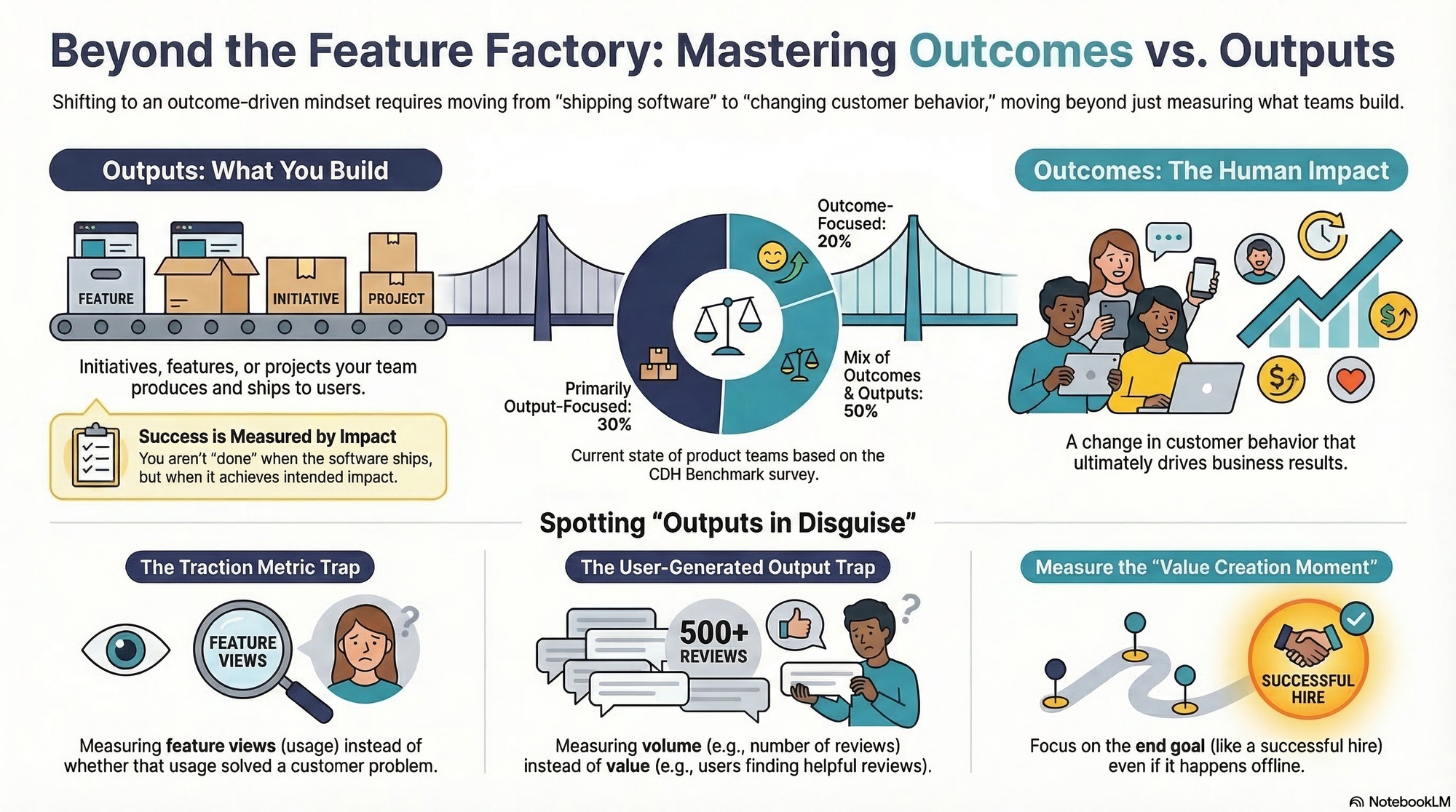
    Here are the moves I rely on to keep collaboration relational and outcomes-focused. First, we align on outcomes before solutions. I explicitly separate outcomes vs output OKRs so we’re clear on what success looks like, independent of the features we ship. That clarity reduces rework and speeds up decision-making later.

    Second, we operationalize curiosity with continuous discovery. I schedule recurring, lightweight touchpoints with customers and internal stakeholders so insights compound. When learning is continuous, debates quiet down—evidence does the heavy lifting.

    Third, we invest in relationship rituals. Regular 1:1s with key partners, stakeholder maps that capture motivations, and pre-reads that frame trade-offs all prevent misalignment from surfacing in the last mile. These small habits pay huge dividends in trust and speed.

    Fourth, I’m explicit about mode-switching in meetings: are we advocating a position or exploring perspectives? Calling the mode out loud prevents people from mistaking questions for opposition and keeps the conversation productive.

    Fifth, we use “Yes, and” to move from possibility to practicality. We explore generously, then converge rigorously—ranking options by impact, effort, and risk so decisions are transparent and fair.

    If stakeholder alignment, team dynamics, or product “politics” slow your team down, this conversation offers a practical reframe. You’ll move faster when you build the relational tissue first—because alignment is an accelerant, not a tax.

    Resources & Links:

    Follow Teresa Torres: https://ProductTalk.org

    Follow Petra Wille: https://Petra-Wille.com

    Mentioned in this episode:

    Petra’s Coaching Packages

    Work by Chris Argyris on organizational learning and dialogue vs. discussion

    The Fifth Discipline: The Art and Practice of the Learning Organization by Peter Senge

    Improv principle “Yes, and”: Saying “Yes, and” — A principle for improv, business & life and Yes, and …

    Have thoughts on this episode or examples from your team? Leave a comment below—I’d love to learn what’s working (and what’s not) in your stakeholder landscape.


    Inspired by this post on Product Talk.


    Book a consult png image