Tag: stakeholder management

  • Inside the Most Politically Dangerous C‑Suite Role: Hard Truths on Culture, Layoffs, and Leadership

    Inside the Most Politically Dangerous C‑Suite Role: Hard Truths on Culture, Layoffs, and Leadership

    I’ve long believed the people function is a strategic engine, not a support lane. That conviction was only reinforced in a recent deep dive with Katie Burke, now COO at Harvey after joining as Chief People Officer. Before Harvey, she spent 11 years in HR leadership at HubSpot, helping build one of tech’s most distinctive cultures. In this piece, I unpack what resonated most for me as a product leader: a marketing-minded approach to HR, deliberate hiring from hospitality, and the non-negotiable case for culture as a core business strategy.

    The first principle is simple and often overlooked: HR leaders should think like marketers. Employer brand is a product; your candidate and employee journeys are funnels; and your programs deserve the same rigor we bring to product—segmentation, positioning, channels, and continuous A/B testing. When we treat onboarding, performance, and manager enablement like iterative product launches—complete with activation metrics, retention curves, and NPS—we stop guessing and start compounding results.

    One line has become a north star for how I approach executive leadership: “Don’t ask for a seat at the table. Build the table.” In practice, that means codifying the operating system—decision rights, principles, cadences, and accountability—so the organization isn’t improvising strategy in every meeting. Product, People, and Finance should co-own this OS; that’s how you scale clarity faster than headcount.

    Transparency is the tax we pay for alignment, and it compounds trust. After an IPO, the impulse can be to close ranks. The better move is radical transparency with context: what changed, why it matters, and how decisions get made now. On my teams, that looks like publishing decision records, sharing tradeoffs explicitly, and using written docs to reduce rumor velocity—core muscles in stakeholder management as complexity grows.

    I also loved the counterintuitive hiring bet: prioritize hospitality backgrounds alongside traditional corporate pedigrees. People who’ve thrived in service environments bring customer empathy, operational resilience, and a bias for proactive care—traits that elevate everything from onboarding to incident response. In product terms, they’re culturally accretive hires with high signal on service quality and consistency.

    The trickiest part of the Chief People Officer role isn’t process—it’s politics. You are the executive team’s own HR business partner, which requires coaching, candor, and conflict mediation at the highest stakes. The goal is to “Be the Michael Jordan of your exec team”—the teammate who elevates standards, makes others better, and chooses the hard right over the easy familiar.

    Layoffs create a culture debt that accrues interest. Expect a “2.5-year cultural hangover after a layoff”—in many companies, an inevitable two-year layoff hangover—unless you actively repay it. That repayment plan includes narrating the why with specificity, rebuilding trust through manager enablement, and re-anchoring on performance and values. Measure leading indicators (manager effectiveness, time-to-decision, psychological safety) alongside lagging ones (regretted attrition) to track the true recovery arc.

    People leaders also need to create “graceful exits.” Doing this well preserves dignity for the person, protects the team’s morale, and safeguards the company’s brand. The bar is straightforward: clear rationale, fair process, useful feedback, generous support, and alumni pathways. A graceful exit signals that even when business realities bite, respect is non-negotiable.

    Expectation-setting matters. Two truths cut through the noise: “The workplace shouldn’t be Disneyland” and “Our job is not to make you happy every day.” The promise is not perpetual happiness; it’s meaningful work, fair standards, growth opportunities, and leaders who tell the truth. When we set that contract clearly, engagement becomes an outcome of purpose and progress—not perks.

    On feedback, I use the protein vs. sugar rule for employee feedback. Sugar feedback is pleasant and perishable; protein feedback is specific, sometimes uncomfortable, and growth-driving. Great cultures build a taste for protein—clear role expectations, crisp examples, and written follow-ups. Mechanically, that looks like structured 1:1s, decision retros, skip-levels, and manager training that demystifies “what good looks like.”

    Being a Chief People Officer isn’t for the faint of heart. The role must be demanding by design—on executive hiring quality, performance management courage, and values enforcement. Moments like “Berry-Gate” are reminders that small symbolic issues can balloon when feedback loops are unclear. Close the loop fast, publish the rationale, and ensure there’s a predictable path for concerns to be heard and resolved.

    When hiring, beware patterns that predict friction. That’s why “frequent flyers” are a new-hire red flag. Movement can signal adaptability—but weather-vein pivots and blame-shifting often repeat. Probe for ownership, learning moments, and sustained impact; you want people who compound value, not just sample it.

    Clarity on scope prevents leadership whiplash. Which company decisions fall to the Chief People Officer? Think leveling frameworks, compensation philosophy and bands, performance calibration, manager standards, ER policies, and org design guardrails—always in lockstep with Finance and the CEO. Escalate when there are values collisions or systemic risks; otherwise, push decisions to the right altitude and owner.

    Scaling exposes the same few failure modes on repeat: fuzzy decision rights, a thin manager bench, brittle processes that don’t flex, and inconsistent leveling that erodes trust. The antidote is an operating model that pairs clear principles with lightweight mechanisms—documented roles, regular calibration, and reviews that audit for both outcomes and operating behaviors.

    Comparing a scaled SaaS like HubSpot with an AI-native company like Harvey surfaces important differences. The former optimizes for durable systems, predictable cadences, and governance; the latter optimizes for rapid learning loops, emergent org design, and a higher tolerance for ambiguity. The art is porting the right controls at the right time without crushing velocity.

    AI is already changing the people function. GenAI can draft job descriptions, summarize performance notes, classify themes from engagement surveys, and power AI workflows that resolve common HR tickets. The human-in-the-loop remains essential for judgment, context, and ethics—especially around data governance and privacy-by-design. A pragmatic AI Strategy here frees HRBPs for higher-order coaching and organizational development work.

    One practice I recommend widely: share your own performance reviews. Modeling openness normalizes growth and turns feedback into a shared craft, not a secret ritual. It also builds trust when you later ask the organization to lean into sharper, protein-rich feedback.

    Finally, disagreements with the CEO are inevitable—and healthy. Handle them with pre-briefs, crisp written proposals, explicit tradeoffs, and a shared decision record. Argue like scientists, not politicians; once a call is made, disagree and commit. That combination of candor and alignment is what keeps executive teams high-trust and high-velocity.

    The people leader’s chair may be the most politically dangerous role in the C-suite—but it’s also one of the most leveraged. Build the table, tell the truth, design for standards and dignity, and treat culture like the product that powers everything else.


    Book a consult png image
  • Commercial vs. Internal Products: Hard Truths, High Leverage, and How I Make the Call

    Commercial vs. Internal Products: Hard Truths, High Leverage, and How I Make the Call

    Internal Products Are Hard; Commercial Products Are Harder. That line captures years of hard-won lessons from leading both internal platforms and market-facing SaaS at HighLevel. I’ve seen how the two demand different muscles—even when the tech stack, talent, and timelines look the same on paper.

    When I talk about internal products, I mean services and solutions that our own employees use to take care of customers—customer-enabling tools and services, agent consoles, fulfillment and billing workflows, operations dashboards, and the underlying platforms that keep them fast, compliant, and resilient. These tools don’t generate revenue directly, but they quietly determine customer experience, gross margin, and how quickly we can ship, resolve issues, and scale.

    Commercial products, by contrast, add a second challenge layer. Beyond discovery, usability, and reliability, we must conquer positioning, pricing and packaging, competitive differentiation, sales enablement, procurement hurdles, and ongoing customer success motion. The surface area for failure is bigger, and the time-to-signal on product-market fit is slower and noisier.

    Here’s how I decide where to invest. First, I anchor on outcomes, not output. If the business priority is net revenue retention, faster onboarding, or reduced cost-to-serve, internal products often provide the highest-leverage path. If the priority is new revenue, new market entry, or a must-have differentiator, we lean commercial. I make the trade explicit in outcomes vs output OKRs so we can defend the decision when pressure mounts.

    Second, I run a clear build vs buy calculus. For internal needs, the default is buy if a mature, configurable solution exists that meets our security, data governance, and integration requirements. I only build when the workflow is core to our differentiation, the TCO of customization is lower than vendor sprawl, or we can capture unique proprietary advantage. For commercial products, I avoid embedding third-party IP in a way that caps differentiation or compresses margins as we scale.

    Third, I insist on continuous discovery. Internal audiences are not a captive market—they’re discerning experts with real jobs to do. I treat them like customers, with structured customer interviews, journey mapping, and opportunity solution trees. I rely on empowered product teams and product trios to validate problems and reduce solution risk before we commit engineering time.

    Fourth, I frame commercial vs internal work with capacity guardrails. In most planning cycles, I reserve explicit allocation for platform scalability and internal tooling, separate from feature bets. Without this, internal products become backlog filler, which guarantees we’ll pay the interest later in churn, SLA breaches, and slower delivery.

    Execution differs too. For internal products, change management is the make-or-break. I plan enablement as a first-class deliverable: clear rollouts, in-app guides, training, and feedback loops with frontline champions. I track adoption, time-to-resolution, error rate, and satisfaction for internal users with the same rigor we apply to external users.

    For commercial products, I design the discovery-to-GTM handshake early. Pricing and packaging must reflect value drivers discovered in research, not what’s easiest to meter. Sales and solutions engineering need crisp narratives, objection handling, and proof points. Customer success needs activation plans and health signals tied directly to leading indicators of retention.

    Across both, I instrument the product and process. I lean on feature flags and progressive delivery to manage risk, and I protect SLOs with error budgets so teams balance reliability with iteration speed. CI/CD isn’t a badge—it’s how we earn the right to ship continuously without eroding trust.

    Common pitfalls recur. Teams skip UX for employee tools because “they have to use it”—which backfires as shadow workflows and rework. Leaders underfund internal platforms, then wonder why velocity stalls. On the commercial side, teams over-index on features and under-invest in positioning and onboarding, leading to poor activation and elongated sales cycles.

    What’s the payoff? When we treat internal products as products, we unlock scale: shorter handling times, fewer escalations, clearer accountability, and higher customer satisfaction. When we approach commercial products with the same discovery rigor plus smart GTM, we compress time-to-value and amplify differentiation. The craft is knowing which lever to pull when—and having the discipline to measure what matters.

    My rule of thumb is simple. If the goal is operational excellence that compounds across the entire customer journey, invest in internal products with the same intensity you reserve for revenue-generating features. If the goal is market expansion or category leadership, invest in commercial products with a tight discovery-to-GTM loop. In either case, clarity of outcomes, disciplined discovery, and empowered teams win the day.


    Inspired by this post on SVPG.


    Book a consult png image
  • How Top Product Teams Roadmap Through Uncertainty: Align Faster, Adapt Smarter, Deliver

    How Top Product Teams Roadmap Through Uncertainty: Align Faster, Adapt Smarter, Deliver

    Product roadmaps should not be promises etched in stone; they are portfolios of bets made under uncertainty. When I build a roadmap, I’m not predicting the future—I’m designing a system that helps the team learn faster than the market changes, allocate capital wisely, and create alignment across engineering, design, go-to-market, and leadership.

    The best roadmaps I’ve seen and shipped anchor on outcomes rather than features. “Outcomes vs output OKRs” is more than a slogan; it’s how we translate strategy into measurable impact. I start by defining a small set of outcome metrics that matter—such as activation rate, time-to-first-value, or expansion revenue—and attach clear key results and guardrails to each theme. This reframes prioritization from “what can we build?” to “what must change in customer behavior?” and gives empowered product teams real autonomy.

    I organize the roadmap into time horizons—Now, Next, Later—with explicit confidence levels. Near-term items have higher confidence and more specificity; mid- and long-term bets are thematic with wider time windows. This approach reduces false precision and builds trust because stakeholders can see both the intent and the uncertainty. When dates matter, I use windows and service level expectations rather than single deadlines, and I pair each initiative with a lightweight risk scoring so we can discuss uncertainty explicitly rather than implicitly.

    Continuous discovery keeps the roadmap honest. I partner in tight “product trios” across product, design, and engineering to run rapid customer interviews, opportunity sizing, and assumption tests before we commit significant delivery capacity. The opportunity solution tree is my favorite artifact here; it visualizes the path from outcomes to opportunities to experiments and solutions, making trade-offs and sequencing transparent. By the time something moves into sprint planning, we’ve already reduced key uncertainties and clarified the narrowest viable slice we can ship.

    Uncertainty demands options. I plan initiatives as options with stage gates and explicit kill criteria rather than as single monolithic projects. For every significant theme, I outline base, best, and worst-case scenarios with pre-decided triggers for when we escalate, pivot, or stop. This practice prevents sunk-cost fallacy and keeps the team focused on evidence. We treat scope as a knob, not a switch, and we bias toward small, sequential bets that compound learning.

    Capacity is strategy. I routinely reserve a discovery buffer—typically 10–20%—and a contingency buffer for integration, security, and performance risks that always show up late. I ruthlessly control work-in-progress to limit thrash and protect the team’s ability to respond when new information arrives. When we must navigate dependencies, I use thin vertical slices and decouple via contracts or feature flags so discovery momentum doesn’t stall while platforms evolve underneath.

    Prioritization under uncertainty benefits from explicit models. I combine value, effort, and confidence with risk scoring to surface where the unknowns are hiding. Driver trees help us connect top-level outcomes to leading indicators, so we can place bets where they have the highest causal leverage. I also lean on the Kano Model and qualitative signals to avoid over-investing in performance attributes while neglecting excitement features that unlock differentiation and word-of-mouth.

    The most effective stakeholder management is narrative-first. For executives, I present a one-page outcomes roadmap that shows themes, expected shifts in key results, and the learning plan. For teams, I provide a more detailed plan that links discovery insights, assumptions-to-test, and decision points. I make room for a “what we’re not doing” section to reduce noise and prevent shadow backlogs from reappearing in every meeting. Most importantly, I socialize change before it happens, explaining the evidence and the trade-offs so adjustments feel like progress, not whiplash.

    Measurement closes the loop. We instrument experiments and releases with leading indicators tied to the driver tree and review them on a predictable cadence. If movement stalls, we diagnose whether we have a targeting problem (wrong audience), a value problem (weak proposition), or a friction problem (broken journey). That discipline lets us iterate with purpose instead of chasing vanity metrics or isolated anecdotes.

    Here’s a concrete example of roadmapping through uncertainty. Suppose our Q3 objective is to “Increase user activation” with key results to raise the Week-1 activation rate from 32% to 45% and cut time-to-first-value by 30%. In discovery, customer interviews reveal confusion in the first-run setup and a missing integration that advanced users expect. We map an opportunity solution tree and identify two high-leverage opportunities: simplifying the first 10 minutes and offering a guided setup for the integration. We then shape two minimal bets: an in-app guide to streamline the first three tasks and an integration wizard behind a feature flag. Each bet has an explicit decision rule and a two-sprint runway. We ship the guide first, confirm a statistically significant lift via A/B testing, then expand scope. The integration wizard underperforms initial expectations, so we pause, revisit the assumptions, and re-allocate buffer to the stronger path. The roadmap updates in real time, and everyone understands why.

    When uncertainty spikes—new competitor, pricing shock, platform deprecation—I shift the roadmap cadence to rolling-wave planning. We shorten planning horizons, increase the frequency of readouts, and elevate discovery allocations temporarily. We also create thematic “containment zones” where we explore multiple options in parallel with small budgets until one path justifies scale. This allows us to stay responsive without abandoning strategy.

    Good governance accelerates, it doesn’t slow. A lightweight product council that reviews outcomes, risks, and cross-functional dependencies prevents surprise escalations and ensures we keep shipping what matters. We avoid death-by-approval by agreeing in advance on decision rights and thresholds—for example, a product trio can pivot a bet within a theme up to a certain budget or timeline impact without additional approval, as long as it improves the outcome likelihood.

    If you’re evolving your roadmap practice, start with three moves. First, reframe your plan in outcomes and publish a driver tree that connects those outcomes to the few leading indicators you believe move them. Second, stand up a continuous discovery cadence with a visible opportunity solution tree and an assumptions-to-test backlog. Third, implement time windows and confidence levels for all mid- and long-term items, and pair each major initiative with explicit kill criteria. You’ll feel the difference in a single quarter: clearer trade-offs, faster learning, and more predictable delivery—despite uncertainty.

    In the end, a roadmap that thrives in uncertainty is an agreement about how we learn and decide together. It aligns the organization on outcomes, it funds options—not fantasies—and it gives empowered product teams room to maneuver. That’s how top product teams plan for uncertainty and still deliver with confidence.


    Inspired by this post on Product Talk.


    Book a consult png image
  • The CPO Playbook I Wish I’d Had: Ditch Bad Wisdom, Ship Faster, and Lead with Clarity

    The CPO Playbook I Wish I’d Had: Ditch Bad Wisdom, Ship Faster, and Lead with Clarity

    I keep a running list of product wisdom that sounds great on a slide but quietly sabotages execution. Recently, I revisited that list after a deep conversation with a seasoned CPO from a leading security and compliance platform and reflected on how these lessons show up in my own operating rhythm. What follows is my practical playbook for scaling product organizations without losing speed, quality, or the soul of the product.

    Most big-tech veterans struggle when they leap into startups because the safety net of process disappears. At a startup, the buck truly stops with you—there’s no committee to shield a decision and no process to rescue a weak plan. The mindset shift is simple to say and hard to do: own outcomes end to end, reduce your reliance on institutional scaffolding, and make decisions with incomplete information while keeping standards high.

    “Great product leaders stay in the details.” I sample artifacts every week—PRDs, design flows, user research notes, postmortems—and I read customer threads to calibrate my intuition. To maintain shipping velocity as headcount grows, I instrument a few critical indicators (deployment frequency, change failure rate) and favor outcomes over output. Data guides my attention; it never replaces judgment.

    As teams scale, I use a blunt rule to keep speed high: small autonomous teams, small batch sizes, short feedback loops. One clear owner, one prioritized backlog, and weekly demos to customers. We ship thin slices, not big bangs. And “Great CPOs should avoid comfort metrics”—the easy dashboards that rise when nothing meaningful is moving. I push for outcome-centric OKRs tied to customer value, not vanity charts.

    Rigid hierarchies derail quality decision-making. They slow signal, encourage escalation theater, and suppress the truth from the edges. I shorten paths between PMs, engineers, designers, research, and go-to-market leads, and I strip out stage gates that don’t add learning. Above all, I refuse to “Stop making your team fetch rocks”—randomized executive requests without context. Instead, I frame clear problem statements, explicit constraints, and observable success criteria.

    Revenue and product can feel at odds, but they don’t have to be. The key to a quality CPO and CRO relationship is a shared operating model: one customer narrative, a joint pipeline of problems worth solving, and a common scorecard. We meet weekly, review the same signals, and align on sequencing: what we solve now for impact, what we stage for scale, and what we sunset to reduce complexity. When trade-offs get tough, we anchor on customer value and long-term defensibility.

    Who ultimately oversees the quality bar? I do—and I do it through clarity, exemplars, and consistent feedback loops, not micromanagement. When I leave feedback, I make it actionable and specific: name the user scenario, note the friction, propose a sharper decision frame, and suggest a smaller, testable slice. I expect narrative memos and crisp acceptance criteria; I offer rapid, detailed responses so momentum never stalls.

    Open office hours are my forcing function for transparency and speed. Anyone can bring a thorny escalation, a design in progress, or a customer insight. Pair that with weekly 1:1s—non-negotiable for developing leaders and unblocking work—and the organization learns to surface issues early, make faster decisions, and self-correct without drama.

    Here’s a glimpse into my working week: Mondays set priorities and confirm the few decisions that matter; midweek is for deep reviews across roadmap, research, and engineering readiness; Thursdays I’m with customers and partners; Fridays I write and synthesize. I leave space for unscripted time with individual contributors—because ICs are the unsung heroes of a company—and I celebrate excellent craft out loud.

    The hardest leadership skill is knowing when to push and when to give space. I push on clarity, sequencing, and quality; I give space on solutions and implementation paths. I reject comfort metrics, reinforce outcomes vs. output, and keep the organization close to customers and details. If you’re stepping from big tech into a startup or scaling your product org through rapid growth, these practices will help you ship faster, decide better, and raise the quality bar without burning out your team.


    Book a consult png image
  • Outcomes vs Outputs: How I Stopped the Feature Factory and Drove Real Product Impact

    Outcomes vs Outputs: How I Stopped the Feature Factory and Drove Real Product Impact

    “Outcomes over outputs” is the right mantra—and one I’ve championed across product teams—but turning it into daily practice is where most teams stumble.

    It’s simple in theory: focus on the impact of what we build, not just shipping features. In reality, it’s rarely black and white because most teams are asked to do both—hit outcomes and deliver specific outputs—at the same time.

    In a benchmark survey, 20% of product teams claim to be outcome-focused, nearly half describe themselves as working in a mix of outcomes and outputs, and about 30% are still primarily working with outputs. I’ve seen versions of this in my own org: we aspire to outcomes, but our rituals, roadmaps, and reporting still reward shipping.

    Here’s how I draw the line clearly, coach my teams to avoid common traps, and negotiate better, more actionable outcomes that unlock genuine product discovery and business results.

    Simple definitions we live by

    An output is something you build or produce—a feature, a project, an initiative. It’s something your team ships.

    An outcome is the impact of that output—a change in customer behavior or a business result.

    Josh Seiden puts it well in his book Outcomes Over Output: “An outcome is a change in human behavior that drives business results.”

    Infographic comparing outputs vs outcomes in product management: outputs are what you ship—feature, project, integration; outcomes are what changes—customer behavior and business results; arrow notes where value happens.
    Shift from shipping to shaping results. This graphic clarifies outputs vs outcomes, revealing that value emerges between deliverables and impact—when features change customer behavior and move business results.

    I distinguish business outcomes from product outcomes. Business outcomes are typically financial metrics that measure the health of the business (e.g. increase revenue or reduce costs) while product outcomes measure a customer behavior in the product or a sentiment about the product.

    Here’s a simple example I’ve used with platform teams. Many B2B companies support a number of integrations. Integrations are outputs. Having integrations alone doesn’t create value. Customers using and finding value in those integrations—that’s an outcome. If those customers retain their subscriptions longer because of the integrations—that’s also an outcome.

    Building something isn’t the same as creating value. That’s the core of this distinction, and it’s what separates empowered product teams from feature factories.

    Why this distinction matters for empowered product teams

    When we task teams with delivering outputs, they’re done when the software ships. When we task teams with delivering outcomes, they aren’t done until the software ships and has the expected impact.

    That small shift changes almost everything about how a team works: what we measure (impact, not just delivery), how we know we’re done (measurable behavior change, not release notes), the autonomy we grant (told what to achieve, not what to build), and the planning artifacts we use (an opportunity solution tree beats a feature roadmap when we’re exploring the best path to an outcome).

    When I assign outcomes, I’m giving the team latitude—and responsibility—to figure out the best path to success. That’s what opens the door for real product discovery and continuous discovery habits.

    Infographic comparing output-driven vs outcome-driven teams, covering metrics measured, team autonomy, definition of done, and planning artifacts: feature roadmap vs opportunity solution tree.
    Shift your lens from shipping features to achieving impact. This side-by-side visual explains how outcome-driven teams measure success, grant more autonomy, define 'done' by results, and plan with an opportunity solution tree.

    Examples: spotting outputs disguised as outcomes

    Clear-cut example: “Our outcome is to deliver an Android app.” An Android app is something we build and ship. It’s clearly an output.

    To get to an outcome, I ask, “What’s the value of having an Android app?” or “How will we know the Android app is successful?”

    We might answer: “Having an Android app will allow us to engage more users. We’ll know it’s successful when people engage with the app on a regular basis.”

    This answer uncovers the hidden outcome: engage more people. Now we can set the right scope: increase the percentage of engaged users across any platform; increase the percentage of engaged mobile users; or increase the percentage of engaged Android users.

    Any of these outcomes gives us more room to explore than a fixed output. Maybe we don’t need a native app at all. We could deliver the same engagement through a mobile web experience, notifications, or email. And we’re not done when we ship—we’re done when the right people are actually engaged.

    Tricky example 1: measure the value creation moment (hires, not applicants)

    Infographic showing shift from output to outcome: build an Android app -> ask when it is successful -> increase engaged users. Highlights value, goals, and accountability in product management.
    Move beyond shipping features to the impact that matters. This visual maps the path from build an Android app to the real goal, increase engaged users, by asking why, defining value, and owning results.

    When setting outcomes, it’s tempting to choose the easiest-to-measure metric. But a good outcome measures the customer’s value creation moment.

    I worked at a company that helped new college grads find their first job. When I started working there, the primary outcome was “increase job applications.” This technically is an outcome—it measures a specific behavior in the product.

    But it doesn’t measure the value creation moment. A job seeker doesn’t get value when they apply for a job. They only get value when they get the job. Similarly, employers don’t get value from any job applicant, they get value when the right job applicant applies.

    Many job boards try to measure qualified applicants—instead of counting any applicant, they compare the credentials of the applicant to the job description and only count qualified applicants. This is better. But it still doesn’t measure the value creation moment. Both the job seeker and the employer get value when an open job is successfully filled. The right metric is hires.

    Yes, “hires” can be hard to instrument because it happens off-platform and incentives misalign. Measure it anyway, even with proxies. The easy metric isn’t always the right outcome.

    Tricky example 2: measure impact, not user-generated output (the course reviews trap)

    I worked with a team that helped students choose university courses. They set their outcome as: “Increase the number of course reviews on our platform.”

    Infographic titled '4 Outcome Traps to Avoid' for product teams, highlighting wrong moment, output in disguise, traction trap, and sentiment alone with concise guidance.
    Confusing activity with impact? This visual breaks down four common outcome traps—measuring at the wrong moment, mistaking outputs, chasing adoption, and relying on sentiment—so teams focus on real value.

    Sounds like an outcome, right? It’s a metric. You can measure it. It’s an action users take on the site—writing a review. But it’s actually an output in disguise.

    Reviews are valuable when they help a student evaluate a course. They don’t create any value if a student never sees them. More reviews aren’t always better, especially if they’re clustered where nobody looks.

    A better outcome is “Increase the number of course views that include reviews.” Now we’re measuring impact on the decision moment, not just the production of content.

    If you can hit your metric without helping customers, you’re tracking an output, not an outcome.

    Tricky example 3: measure success, not just adoption (the traction metric trap)

    “Increase the percentage of users who viewed the performance report.”

    This looks like a good outcome. It measures a specific behavior in the product. It’s within the team’s control. But it’s what I call a traction metric—it measures adoption of a single feature, not value to the customer.

    Infographic 'Why Teams Stay Stuck on Outputs' with a trust cycle—manager micromanages, team reports features, manager stays in details—and an accountability trap about safe targets and disguised outputs.
    Why teams get trapped in shipping features: a vicious trust cycle fuels micromanagement, while performance-linked outcomes push safe targets. Break the loop and refocus on customer outcomes that truly move the needle.

    Two problems arise. First, people can view the report and still not find what they need. Second, we might have perfectly happy customers who don’t need the report at all. Driving usage of an unneeded feature wastes time and erodes trust.

    Measure the value creation moment, not just feature adoption.

    Tricky example 4: pair sentiment with behavior

    I define a product outcome as a metric that measures either 1. a specific behavior in the product or 2. a sentiment about the product. But sentiment metrics—like CSAT or NPS—can be tricky on their own.

    Sentiment metrics are outcomes, but they aren’t directional. They don’t tell us where to explore or set guardrails for what to avoid. So I pair a behavior with a sentiment, for example: “Increase engagement without negatively impacting satisfaction.” I use sentiment as a counterweight.

    Facebook and Instagram illustrate why this matters. Meta is exceptional at driving engagement—but to a fault. Many of us don’t like these addictive products. Pairing engagement with a satisfaction guardrail prevents “engagement at all costs.”

    Why getting this right is hard (and how I counter it)

    Infographic, 'How to Make the Shift,' shows five steps to move teams from outputs to outcomes: translate metrics, negotiate with teams, expect iteration, watch for traps, and go deeper.
    Ready to move from shipping features to creating impact? This visual playbook shares five practical moves—translate metrics, partner with teams, iterate, avoid traps, and dig deeper—to turn outputs into measurable outcomes.

    The trust cycle. Managers don’t trust that teams can reach outcomes on their own. So managers micromanage the outputs. Teams, in turn, don’t communicate their progress toward outcomes—they communicate their progress on features. This reinforces the manager’s belief that they need to stay involved in the details. It’s a vicious cycle.

    I break it by asking teams to show their work—share assumptions, research, opportunity solution trees, and evidence behind choices—and by giving feedback on the thinking, not just the solutions.

    The accountability trap. When performance reviews are tied to hitting outcomes, teams play it safe. They sandbag their targets. They disguise outputs as outcomes to guarantee “success.”

    I treat outcomes as learning opportunities first. When we start on a new outcome, I set a learning goal—“learn what moves the needle on this metric”—before a performance goal—“increase X by Y%.” This creates space to explore without fear.

    How I get teams started with better outcomes

    Translate business outcomes to product outcomes. Business outcomes like revenue, retention, and market share are lagging indicators—by the time you see them, it’s too late to act. Product outcomes measure behavior changes within the product that lead to those business results. They’re leading indicators within the team’s control.

    Negotiate outcomes with your team. Outcome-setting should be a two-way conversation. Leadership brings the cross-company context. The team brings customer insight and technical realities. Neither side dictates; we co-own the target and the constraints.

    Infographic on outcomes vs outputs in product management: side-by-side panels show Feature Factory (measure what you ship) versus Product Team (measure what it changes), highlighting the shift to impact.
    Stop celebrating shipped features and start celebrating change. This visual contrasts a feature factory mindset with a true product team, urging teams to track impact, not output, and define success by outcomes.

    Expect to iterate on your metrics. Your first outcome metric probably won’t be right. That’s normal. Sonja at tails.com went through four iterations—from 90-day retention to 30-day to 5-day to behavior-based metrics—before landing on something actionable. Thomas at Bluestone Analytics iterated three or four times before finding the right metric. Iteration is the work.

    Watch for common mistakes. Outputs disguised as outcomes. Traction metrics masquerading as product outcomes. Sentiment metrics without direction. Business outcomes assigned directly to product teams without translating to behavior change.

    Use the right artifacts. Replace feature roadmaps with an opportunity solution tree to explore multiple paths, test assumptions, and sequence bets explicitly against a clear outcome.

    Align OKRs with outcomes. If your company uses OKRs, make sure the “KR”s are true product outcomes (behavior change and value creation), not a list of features to ship.

    The bottom line

    When we shift from an output-first mindset to an outcome-first mindset, it doesn’t mean that outputs stop mattering. Product teams will always ship features, and the ability to do so quickly and with quality still matters. This shift simply ensures those features achieve the intended impact. We aren’t done when we ship—we’re done when what we shipped has the intended impact.

    Measure success by the impact of what you ship and you’ll build a product team that learns, adapts, and creates real value. Measure success by what you ship and you’ll get a feature factory.

    Quick self-check: is your “outcome” really an outcome?

    Ask yourself: 1) Does it measure a behavior change or a sentiment tied to value creation? 2) Could we hit it without helping customers? 3) Is it adoption of a single feature (a traction metric) or a result that customers and the business care about? 4) Do we have a counter-metric to prevent unintended harm? If you stumble on any of these, refine it before you commit.


    Inspired by this post on Product Talk.


    Book a consult png image
  • Staying Sane as a Product Leader: Practical Strategies I’m Using from Teresa Torres & Petra Wille

    Staying Sane as a Product Leader: Practical Strategies I’m Using from Teresa Torres & Petra Wille

    The world can feel like it’s spinning, and as a product leader, I feel that pressure acutely—juggling customer needs, stakeholder expectations, and the relentless news cycle. I recently listened to a powerful conversation with Teresa Torres and Petra Wille about staying grounded when everything feels “bonkers,” and it offered a practical, human way to keep showing up without losing yourself.

    What resonated most was the invitation to live my values through small, consistent actions. Rather than waiting for grand gestures or perfect solutions, I’m leaning into the mindset of “Something is better than nothing.” It’s the same spirit we bring to continuous improvement in product: make a change, evaluate impact, iterate.

    “Create the world you want to live in” has become a daily prompt for me. I’m applying it to how I spend my attention, time, and platform—three scarce resources for any product management leader. I’m not going to do everything perfectly, but I can make better trade-offs this week than I did last week, and I can keep improving.

    Practically, that looks like reconsidering which speaking invites I accept, especially when representation is skewed. If a stage is heavily male, I now ask organizers about their plan for balance before committing. I also question travel expectations for short talks when a high-quality virtual experience is possible—good for sustainability, budgets, and energy. These choices compound, just like product roadmapping and sprint planning decisions.

    Petra’s “under-complexity” lens was a wake-up call. In product, oversimplified narratives—whether a single KPI, a vanity metric, or a forced binary—usually increase fear and bad decisions. The same is true in civic discourse. To counter that, I’m seeking more nuance on purpose: reading multiple sources on the same story, listening for who’s not in the room, and noticing how the same facts can carry different meanings depending on who’s telling it.

    One simple habit helps: I’ll read The New York Times and The Wall Street Journal on a headline, then follow up with Tangle by Isaac Saul, which lays out “what the left says / what the right says / editor’s take,” sometimes including perspectives from affected communities. It’s a lightweight form of personal knowledge management that improves my product judgment and my citizenship.

    Another idea that stuck with me is swapping media proxies for human connection. In product, we don’t ship based on secondhand opinions—we run customer interviews, co-create with users, and build empowered product teams. The same principle applies in community: talk to someone directly affected, ask real questions, and stay curious. When conversations get heated, I try to build bridges, reduce proxies, and look people in the eye.

    I’m also reflecting on platform responsibility. Even a “small” platform can snowball through weak ties inside a company or community. I’m asking: When should I speak up? Where should I draw lines? And when is “staying in your lane” actually a way to avoid necessary leadership? These are the same stakeholder management questions we navigate in product strategy—assess impact, clarify intent, and act with integrity.

    Local grounding matters, too. I’ve found energy and clarity in community-level action: voting, attending public protests when it feels right, mentoring, and supporting nonprofits like World Pulse. I love the framing of “don’t mess with my neighbors”—it keeps me focused on tangible care when the internet starts to feel like reality. I’ve also seen leaders use angel investing in agriculture-related efforts as a counterbalance to “internet reality,” channeling resources into durable, real-world outcomes.

    If you want to experiment this week, pick one small lever you control: where you spend money, time, attention, or your platform. Add nuance by reading at least two different perspectives before reacting. Replace proxies with people by talking to someone with lived experience. Reduce polarization by asking, “what shaped that view?” before judging it. And go local—connect with neighbors or a community group and let small actions compound.

    If you’d like to hear the full conversation that inspired these reflections, you can listen on Spotify or Apple Podcasts. Here are the direct links: Spotify: https://open.spotify.com/episode/1sxEFquu73ZB9fL9gGk6Om and Apple Podcasts: https://podcasts.apple.com/kh/podcast/staying-sane/id1794203808?i=1000755696295

    Resources I’m exploring and recommend: World Pulse (https://www.worldpulse.org/), The New York Times (https://www.nytimes.com/), The Wall Street Journal (https://www.wsj.com/), and Tangle by Isaac Saul (https://www.readtangle.com/ and https://www.readtangle.com/author/isaac-saul/). For builders and writers, I also appreciate Ghost (https://ghost.org/) as an open-source publishing platform. If you work in or with the MENA ecosystem, take a look at MENA Product Summit ’26 (https://www.prdkt.plus/summit26). Colleagues like Jeff Merrell (https://jeffdmerrell.com/) and grassroots efforts such as No Kings Protest (https://www.nokings.org/) offer additional perspectives and ways to get involved.

    If this resonates, share it with a teammate who’s been feeling the weight of the world. I’d love to hear one small, values-aligned action you’re taking this month—what “something” will you try next?


    Inspired by this post on Product Talk.


    Book a consult png image
  • Inside Zipline’s Wild Pivot: My Take on Hiring Heat-Seekers and Scaling to 5,000 Hospitals

    Inside Zipline’s Wild Pivot: My Take on Hiring Heat-Seekers and Scaling to 5,000 Hospitals

    I’m consistently drawn to stories where product strategy and operational grit collide to change real lives. Zipline, the world’s largest commercial autonomous delivery system, is one of those rare cases. Serving 5,000 hospitals across multiple countries and saving an estimated 17,000 lives per year, it embodies the kind of mission-driven execution I try to model in product management. The arc—from a near-dead home robot startup to a scrappy bet on drone blood delivery in Rwanda, to 135 million autonomous miles flown—offers some of the clearest lessons I’ve seen on hiring, leadership, and product-market fit under extreme constraints.

    One principle that immediately resonated with me: why Zipline doesn’t hire for experience. The idea behind “Why Zipline hires teenagers over PhDs” isn’t a dismissal of expertise; it’s a commitment to learning velocity, ownership, and unteachable hunger. The best startup employees, as described here, are “heat-seeking missiles for pain”—people who chase the hardest problems, not the shiniest projects. In my org, I look for the same signal: candidates who can move from ambiguity to action, who find the bottleneck without being asked, and who care more about outcomes than optics.

    I also appreciated the unapologetic stance that “blind references are a non-negotiable.” In high-stakes builds—especially in regulated or safety-critical categories—the cost of a mis-hire compounds. I routinely validate for two traits during references: intellectual humility and accountability. “Can candidates admit when they screwed up?” is a powerful filter. If someone can’t name a hard mistake and how they specifically changed as a result, they’re unlikely to scale with the organization.

    Equally important is clarity about who not to hire. The employees Zipline doesn’t want are those who optimize for status, process theater, or low-friction work. In practice, that means pressure-testing for problem-finding, not just problem-solving. I often design interviews around messy, cross-functional constraints (regulatory, operational, and financial) to see who can integrate tradeoffs, not just ideate features. That’s how we build empowered product teams that ship consequential outcomes, not outputs.

    There’s a reference to “Zipline’s secret leadership playbook,” and while the specifics remain private, the spirit is unmistakable: first principles decision making, ruthless focus, and a culture that rewards radical responsibility. Translating that to my product organization, I emphasize five behaviors: orient to the mission under uncertainty, run fast but close the loop with data, communicate constraints early and often, own the long tail of consequences (especially in safety and reliability), and scale judgment by teaching the why, not just the what. That blend of clarity and autonomy is the backbone of product management leadership at any growth stage.

    On the other side of the culture coin is “Why you should always fire quickly” and “The brutal firing advice that shaped Keller’s leadership.” I’ve learned (sometimes the hard way) that slow decisions erode trust and team velocity. Moving quickly doesn’t mean being harsh; it means being fair, explicit, and humane—tight feedback loops, role clarity, and decisive action when the gap persists. If your bar is clear and your coaching is consistent, acting fast protects both the mission and the team’s energy.

    Strategically, the origin story reads like a masterclass in choosing the right problem. The team moved “from toy robots to drone delivery: Zipline’s pivot,” then partnered deeply with Rwanda, where “How Rwanda’s health minister changed everything” is a pivotal moment. It wasn’t a linear climb—”How Zipline almost died – twice” and “Why Zipline’s launch was a ‘complete disaster’” underline a tough truth: breakthrough products rarely arrive fully formed. What matters is the operating cadence that turns early chaos into repeatable reliability—especially when the stakes are measured in minutes and lives.

    Scaling from 1 hospital to 5000 required more than product brilliance; it demanded systems thinking across logistics, compliance, safety, and community trust. That’s stakeholder management at its highest level. The product lessons are durable: anchor on outcomes, not artifacts; build reliability as a feature; and practice founder-led GTM where your credibility is on the line with customers and regulators. This is where first principles decision making beats benchmarking—particularly in novel categories where there are no playbooks to copy.

    There’s also a hard-nosed operational takeaway in “The 10x hardware cost rule every founder should know.” My read: assume total cost of ownership will balloon once you account for manufacturing variability, support, redundancy, maintenance, and compliance. In product strategy, I treat those multipliers as design inputs, not afterthoughts. If the unit economics can’t survive these realities, the idea isn’t ready—no matter how elegant the prototype looks in a lab.

    Across all of this, a few product management patterns stand out for me: build teams around outcomes vs output OKRs; hire for slope, not just intercept; make continuous discovery routine with real users (in this case, clinicians and health systems); and treat operational excellence as a product surface. When a mission is this consequential, culture becomes a safety system—and every leadership decision compounds into either speed with quality or speed with regret.

    For leaders building in complex domains, this journey is a blueprint: pick problems that matter, hire “heat-seeking missiles for pain,” keep blind references non-negotiable, lead with first principles, and scale with responsibility. Do that well and even a “complete disaster” launch can become the inflection point of a category-defining company that flies 135 million autonomous miles and saves 17,000 lives per year.


    Book a consult png image
  • Inside Amplitude’s AI Acquisition: Career Lessons Product Managers Can Use to 10x Impact

    Inside Amplitude’s AI Acquisition: Career Lessons Product Managers Can Use to 10x Impact

    I’m often asked how to translate early-stage experience into outsized product impact at scale. In my own practice, I study real career arcs that crystallize the habits of high-leverage product managers—especially those operating at the intersection of analytics and AI strategy.

    Consider this path: Lucas is a Product Manager at Amplitude. Previously, he was employee #1 at Command AI, acquired by Amplitude in October 2024. Lucas studied computer science at Princeton.

    What stands out to me is the compounding effect of being an early builder. When you are employee #1, you live close to the user problem, own outcomes end-to-end, and develop a bias toward focused, continuous discovery. That foundation creates durable instincts around product strategy, sharp prioritization, and empowered product teams—skills that transfer directly to later-stage environments where clarity and speed become competitive advantages.

    Acquisition integration is where those instincts meet enterprise rigor. Folding Command AI into a unified analytics platform like Amplitude requires disciplined product roadmapping and sprint planning, precise stakeholder management, and a strong POV on where AI augments core “Amplitude analytics” versus where it creates net-new value. The north star remains unchanged: deliver measurable customer outcomes that strengthen product-led growth and reduce time-to-value.

    On the AI front, I’ve seen the most successful PMs treat gen ai and LLMs for product managers as means, not ends. They anchor use cases to concrete analytics workflows—accelerating insight generation, surfacing anomaly detection, improving retention analysis, and driving user activation—while validating each step through continuous discovery and rigorous experiment design. This balance of ambition and evidence protects teams from shiny-object drift and keeps investment tethered to business impact.

    Execution-wise, the playbook is straightforward but unforgiving: clarify the problem through customer interviews; define crisp outcomes vs output OKRs; map the journey end-to-end; ship in thin slices; and iterate with observability baked into every release. Along the way, keep your cross-functional partners close—solutions engineering, customer success, and GTM—so that your learning loops extend beyond the product surface and into real adoption dynamics.

    If you’re building analytics or AI-powered experiences today, borrow these lessons: translate early-stage builder energy into enterprise-scale focus; make AI serve the product, not the other way around; and use Amplitude analytics to close the loop from idea to impact. That is how PMs compound credibility, accelerate careers, and, most importantly, create products customers can’t live without.


    Inspired by this post on Amplitude – Best Practices.


    Book a consult png image
  • How I Used Claude Code to Run a Full Content Audit in Hours—and Uncovered Big SEO Wins

    How I Used Claude Code to Run a Full Content Audit in Hours—and Uncovered Big SEO Wins

    Can an AI agent actually run a credible content audit end to end? I put that to the test. In my role leading product at a high-growth SaaS and as a hands-on content strategist, I’m constantly balancing depth with reach. During a recent office-hours discussion, someone asked me to zoom out and explain when to use Claude Code. That prompt inspired me to launch a running series—Conversations with Claude—showing exactly how I apply it to real product management and SEO problems.

    I’m a heavy user and share what works for me. I receive no compensation from Anthropic for this series; if that ever changes, I’ll disclose it. With that out of the way, let’s dive into how I had Claude conduct a full content audit—and why the results exceeded my expectations.

    For the first installment, I chose a fairly complex use case: a comprehensive content audit of my site. I expected this to be a slog. Instead, it was refreshingly fast and rigorous once I set Claude up with the right scaffolding.

    I kicked off with a simple directive: start by asking clarifying questions, proceed step by step, and capture notes in a shared task file. I also provided deep context—specifically, the CDH Book (15 chapters + intro) and my entire blog archive in markdown—so the model could reason with my actual corpus rather than guessing from sparse prompts.

    Claude began with smart clarifying questions that framed the analysis well. Scope of keywords: Should it focus strictly on concepts unique to or heavily associated with my work like "opportunity solution tree" and "continuous discovery," or also include broader product management terms such as "product outcomes," "assumption testing," and "customer interviewing"? Keyword geography: Start with US-only or include UK/global? Blog coverage assessment: What counts as "well covered"—dedicated deep dives or credible coverage within broader posts? Output format: Add findings to the task file or create a separate deliverable?

    Dark-mode notes workspace titled content-audit showing task properties (type: task, due 03/06/2026, tags product-talk and content) and step-by-step instructions for a content audit.
    Peek inside a Notion-style page that turns content strategy into action: a content-audit task with due date and tags, plus clear steps for keyword research, blog gap analysis, and SEO improvements.

    I replied: 1. both 2. us only is a good place to start 3. evaluate this based on how well we rank for the keyword, if we rank reasonably well, you might suggest content improvements to rank better, if we don't rank at all, then you might suggest a whole new article 4. add to the task file

    From there, Claude read the CDH Book, extracted roughly 100 keywords, ran them through Keywords Everywhere in two batches of 50 to capture search volume, and pulled current domain rankings and traffic metrics. Within minutes, I had a high-signal view of what’s working, where we’re invisible, and how to prioritize fixes.

    The good news came first: we own our branded terms—#1 for "product discovery," "opportunity solution tree," "continuous discovery," and "product trio." That brand equity is doing real work for us.

    The biggest gaps were in broad topics the CDH Book covers but where there’s no targeted content. "Outcomes vs outputs" (1,300/mo) — Arguably THE central thesis of CDH, and no ranking. This is the single biggest gap. "Product roadmap" (4,400/mo) — I have a strong anti-roadmap POV but no content targeting this. "Product strategy" (1,900/mo) — Ch 7 argues strategy = opportunity selection. Strong differentiator, no ranking. "Story mapping" (5,400/mo) — I use story maps uniquely (for surfacing assumptions). Huge volume. "Stakeholder management" (2,900/mo) — Ch 13 is entirely about this. No ranking. "Pre-mortem" (4,400/mo) — I cover this as a product discovery technique. No ranking.

    Dark-mode markdown editor shows a chapter titled 'The What and Why of Continuous Discovery' and a left sidebar of organized folders and notes, indicating a structured, searchable content library.
    Inside a dark-themed writing workspace, a long-form chapter is open while a tidy folder tree catalogs pages and chapters. The scene invites readers to think like auditors—inventory content, track structure, and surface gaps with AI assistance.

    The trojan horse opportunity: High-volume generic terms like story mapping, pre-mortem, and usability testing could bring in readers who don't know about CDH yet. Write about these broadly-searched topics with my specific product-discovery angle.

    In just a few minutes, Claude generated an analysis of what keywords we ranked for and at what position, a ranked set of high-, medium-, and lower-volume (but strategic) keywords where we didn’t rank yet had relevant content, concrete net-new topics to close the gaps, and a list of existing articles to update to lift their SERP positions. It worked far better than I expected.

    Here’s how I set it up so the model could deliver: I didn’t simply ask Claude.ai to "audit my site" and hope for the best. I supplied rich, relevant context (my book and all blog posts as markdown) so it could anchor on my language, frameworks, and mental models. I paired that with live data via APIs like Keywords Everywhere to ground recommendations in actual search volume and competitive rankings. With the right inputs, Claude Code behaved like a capable research analyst and an SEO strategist—able to reason, prioritize, and suggest high-leverage actions.

    Next, I went deeper and used the findings to draft a long-form article that addresses the biggest gap—"Outcomes vs outputs"—and ties it directly to product roadmapping and sprint planning. I wove in continuous discovery practices, opportunity solution tree techniques, and product trios collaboration to make it actionable for empowered product teams. I’ll share the end-to-end workflow—including files, prompts, and the editorial QA checklist—in a follow-up.

    If you’re new to Claude Code and want a practical starting point, replicate the setup above: assemble your canonical sources in markdown, define a clear evaluation rubric, and ground keyword research with reliable volume data. If you want my exact task file, clarifying-question template, and step-by-step audit rubric, tell me which content gap you’d prioritize first and why—I’ll tailor the walkthrough to the highest-interest topic.


    Inspired by this post on Product Talk.


    Book a consult png image
  • Stop Selling Your Roadmap: Win Stakeholder Trust by Showing Your Work, Not Conclusions

    Stop Selling Your Roadmap: Win Stakeholder Trust by Showing Your Work, Not Conclusions

    I’m seeing the same pattern in product orgs everywhere—inside HighLevel and across my network: everyone is racing to add AI to the roadmap, and every stakeholder has a strong opinion about what to build next. Delivery has never been faster, which makes it dangerously easy to confuse speed with progress.

    When we chase features without grounding in continuous discovery, we drift back into a feature factory. We ship more, but we ship the wrong things faster. The antidote is simple and hard at the same time: recommit to product discovery, validate with assumption testing, and let the evidence steer our AI Strategy—not the hype.

    Of course, that only works if we can bring our stakeholders along. In the AI moment, it’s deceptively easy to get to a slick prototype and painfully hard to harden it for production. Early demos make almost any idea look promising. That’s precisely why stakeholder management must evolve from pitching solutions to showing our work.

    In practice, stakeholder management is about alignment with the people who influence our product decisions—executives, sales, marketing, customer success, engineering leadership, and sometimes legal or finance. Some have veto power; others have input. Knowing who can block versus who can shape is crucial for where we spend our time. Even in empowered product trios, the best discovery can derail if we reveal only conclusions at the end.

    I’ve tried every mapping framework—power-interest grids, RACI matrices—and they help. But the real challenge isn’t identifying stakeholders. It’s figuring out how to bring them along so that our product roadmapping and sprint planning decisions stick.

    Infographic for product teams on stakeholder management, showing three groups—veto power, influences, and needs to be informed—with guidance on prioritizing stakeholder influence.
    Identify who shapes your product decisions. This visual groups stakeholders into three tiers—those with veto power, key influencers, and audiences to inform—so teams can align, communicate, and reduce delivery risk.

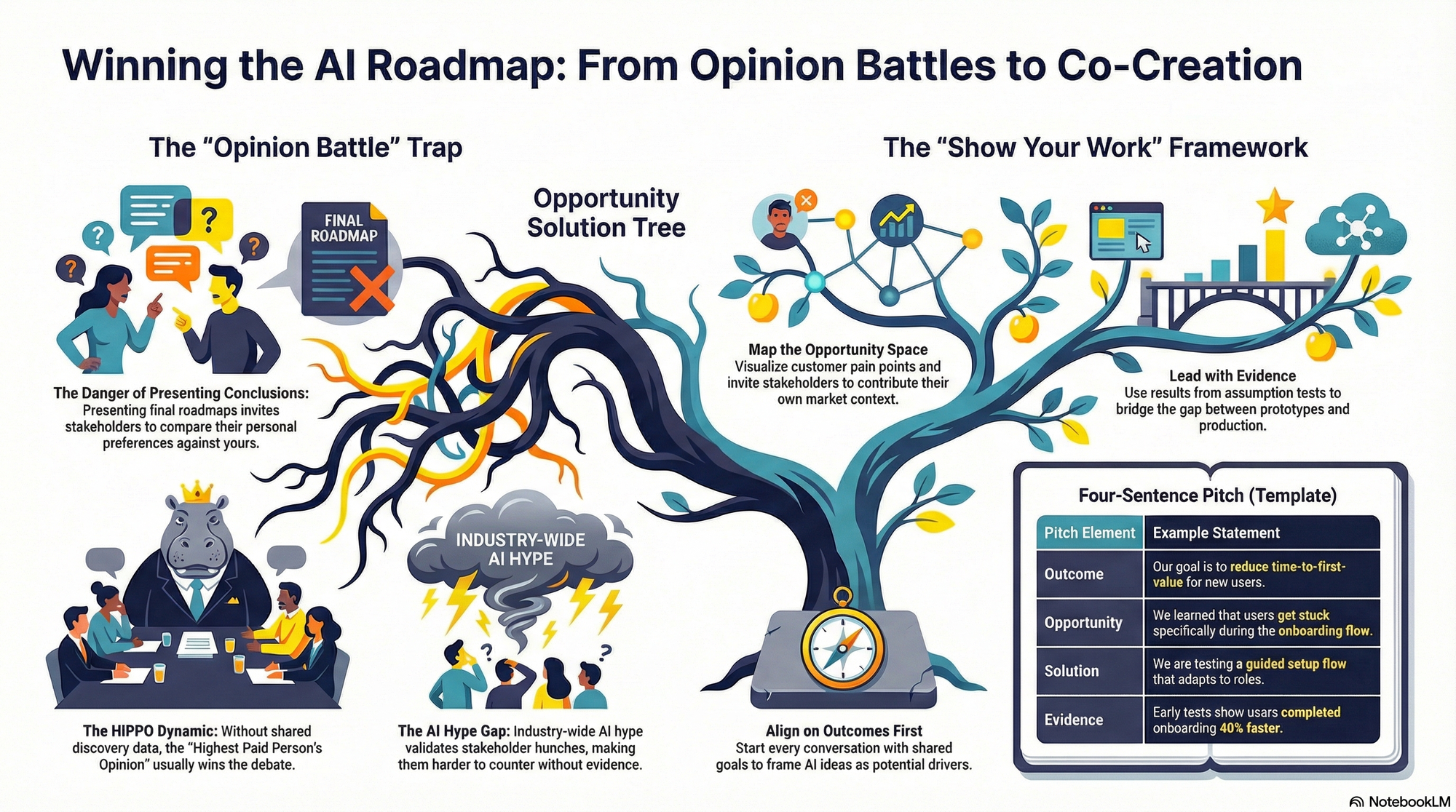
    Here’s the most common trap I see (and have fallen into): focusing stakeholder reviews on the roadmap, release plan, or prioritized backlog. That invites an opinion battle. And stakeholders have their own conclusions—usually shaped by the last customer call, a board meeting, or a market headline.

    This is how the HiPPO dynamic gets created. HiPPO stands for the “Highest Paid Person’s Opinion,” and the saying goes, “The HiPPO always wins.” When we present conclusions without the journey, we set ourselves up to lose. In the gen ai rush, the chorus of “everyone is doing AI” makes that opinion even harder to counter.

    So I don’t try to win opinion battles. I bring new information—fresh customer interviews, clear opportunity mapping, and results from assumption tests. The gap between what the market hypes and what customers actually need is often enormous. Our edge is evidence.

    The strategy that consistently works for me is simple: show your work. If you’re practicing continuous discovery, your opportunity solution tree isn’t just a thinking tool—it’s your strongest stakeholder management asset. It helps you build confidence in your decisions, and it can help your stakeholders build the same confidence.

    Infographic for product teams on stakeholder management, outlining the trap of anchoring in solution space, the HiPPO consequences, and the lever of bringing new discovery insights and data.
    Avoid the stakeholder trap of selling conclusions. This visual shows how anchoring on solutions invites HiPPO battles—and how to shift the conversation by sharing discovery evidence, insights, and data.

    Step 1 — Start with the outcome. I open every conversation by restating the shared goal and asking whether anything has changed. Anchoring on outcomes vs output OKRs reframes hot-button solution debates (like “we need an AI feature”) back to what will move the needle on the outcome we agreed to pursue.

    Step 2 — Share the opportunity space. I show how we mapped customer needs, pain points, and desires. Then I ask, “What did we miss?” Stakeholders often surface opportunities we haven’t seen yet—signals from the field, market shifts, or partner feedback. I capture their input and commit to validating it in upcoming customer interviews.

    Step 3 — Walk through prioritization. Using the tree’s structure, I explain why we prioritized one branch over another. Then I ask where they might have chosen differently. This turns debate into collaboration and lets me leverage their expertise without ceding the discovery framework.

    Step 4 — Go deep on the target opportunity. Before we talk solutions, I make the customer’s problem vivid and real. Interview snapshots help stakeholders empathize and see what matters most. Once the opportunity is crisp, solution discussions become dramatically more objective.

    Infographic titled A Better Stakeholder Management Strategy: Show Your Work, showing seven steps for product teams using the Opportunity Solution Tree to align outcomes, prioritize, test assumptions, and iterate.
    Show your work, not just your conclusions. This infographic guides product teams through seven steps to build stakeholder confidence—align on outcomes, map opportunities, prioritize, test assumptions, and repeat.

    Step 5 — Share solutions and invite theirs. I present our solution set and explicitly ask for additional ideas. If their suggestions diversify our set, we include them. Solution ideas are cheap; the opportunity is what matters. This is where product trios can benefit from leadership’s pattern recognition and industry context.

    Step 6 — Share your assumption tests and results. I walk through our story maps, high-risk assumptions, and what we’ve learned so far. I invite stakeholders to add assumptions—this is where their knowledge shines. If we have data, we share it; if we’re pre-data, we share the plan to get it and ask for feedback.

    Step 7 — Repeat. I don’t batch this into a big reveal. I keep a steady cadence and tailor depth to each audience: weekly for my manager, monthly highlights for marketing, and concise updates for executives. Continuous discovery pairs with continuous stakeholder management.

    Showing your work doesn’t mean drowning people in detail. It means tailoring the signal to the audience. My rule of thumb is outcome, opportunity, solution, evidence—walk the lines of the tree at the right altitude for each stakeholder.

    Infographic for product teams on tailoring stakeholder communication. A smart-filter funnel turns the full discovery journey into updates for a direct manager, marketing counterpart, and CEO.
    Show your work the right way for each stakeholder. Use a smart filter to turn discovery noise into clear signals—weekly journeys for your manager, focused monthly highlights for marketing, and a 30-second CEO pitch.

    In a 30-second update with a CEO, it might sound like this:

    “Our goal is to reduce time-to-first-value for new users. We’ve been interviewing customers and learned that onboarding is where most people get stuck—specifically, they don’t know which features to try first. We explored a few approaches and tested them. The most promising one is a guided setup flow that adapts based on the user’s role. In early tests, new users completed onboarding 40% faster.”

    That pattern works across channels—Slack updates, monthly reviews, or quarterly planning. The format flexes, the structure doesn’t: outcome, opportunity, solution, evidence.

    As you adopt this approach, watch for four anti-patterns that quietly erode trust.

    Infographic titled Four Anti-Patterns That Destroy Stakeholder Trust, listing: 1) telling instead of showing, 2) shooting down stakeholder ideas, 3) saving for a big reveal, 4) fighting the ideological war.
    Avoid the traps that erode stakeholder trust. This infographic guides product teams to show their work, welcome ideas, provide frequent updates, and prioritize results over ideology to build alignment and credibility.

    Anti-pattern 1 — Telling instead of showing. The curse of knowledge makes our conclusions feel obvious to us and opaque to others. The fix: slow down, start at the top of the tree, walk the decisions, and let stakeholders reach the conclusion with you.

    Anti-pattern 2 — Shooting down stakeholder ideas. As you build a library of validated assumptions, it’s easy to spot flaws in a suggestion and say “no” too quickly. Instead, place their idea within your discovery framework. If it maps to a different opportunity, say, “That idea has promise—we’ll consider it when we address that opportunity.” If it rests on risky assumptions, story map the idea together, list the assumptions, and share what you’ve already learned. People accept the evidence they help generate.

    Anti-pattern 3 — Saving everything for a big reveal. Infrequent, comprehensive updates invite opinion battles because stakeholders have formed their own conclusions in the dark. Short, frequent updates build alignment as the work unfolds.

    Anti-pattern 4 — Fighting the ideological war. Sometimes a more senior stakeholder will overrule you. Don’t turn it into a debate about how product decisions “should” be made. Focus on the decision at hand, do the best work within constraints, and let results—not ideology—prove the value of discovery over time.

    Infographic for product teams on stakeholder management as co-creation, showing four steps: stop selling, invite co-creation, leverage stakeholder expertise, and transform relationships.
    Shift from selling to showing. This co-creation guide invites stakeholders into discovery, taps their expertise, and turns relationships from obstacles into partnerships for smarter product decisions.

    Here’s the mindset shift that changes everything: stakeholder management is a co-creation opportunity. When we show our work with artifacts like an opportunity solution tree, experience maps, and interview snapshots, we’re not just communicating—we’re inviting collaboration. We’re leveraging stakeholders’ expertise, context, and connections to make better product decisions.

    When stakeholders have walked the path with us, they don’t need to be sold on the destination. They become allies. Engagement stops being a status ritual and starts being real partnership—the kind that moves outcomes and builds durable trust.

    Try this in your next review: don’t start with your roadmap. Start at the top of the tree. Reaffirm the outcome. Share the opportunity space. Explain your prioritization. Show what you’re learning. Invite contribution. You might be surprised how quickly alignment—and confidence—follow when you stop selling conclusions and start showing your work.


    Inspired by this post on Product Talk.


    Book a consult png image
  • Lost in the Woods: 5 Survival Patterns Every Product Leader Must Master Now

    Lost in the Woods: 5 Survival Patterns Every Product Leader Must Master Now

    Ever feel like your product team is “lost in the woods”? I’ve certainly been there—when strategy gets fuzzy, outcomes drift, or constraints aren’t clear. What helped me reframe the chaos was borrowing “lost person” patterns from search-and-rescue and mapping them to product strategy, product discovery, and team behaviors. The result is a practical playbook for product management leadership that keeps empowered product teams moving toward outcomes—not just outputs.

    Listen to this episode on: Spotify | Apple Podcasts

    Here are the five patterns I see most often—and how I turn each one into forward motion: settle in place (freeze), chase shortcuts, follow the first visible path, use your own navigation (intuition/taste), and retrace your steps. Each of these has a smart, minimal move that helps teams reorient fast without abandoning continuous discovery or product strategy discipline.

    Settle in place (freeze). Sometimes the smartest move is to stop. When my team lacks context or authority, I pause delivery work and escalate instead of improvising fixes. This prevents thrash, protects focus, and creates the air cover we need to realign outcomes vs output OKRs.

    Chase shortcuts. Shortcuts can be brilliant—or overconfident. I’ve learned to pressure-test whether the “road” is where we think it is before we commit. That means lightweight experiments, clear exit criteria, and the humility to pivot. Think about big bets like Spotify podcasts: compelling vision, but you still have to validate assumptions step by step.

    Follow the first visible path. The obvious option isn’t always the best one. My job as a product leader is to make multiple paths visible before we choose. I lean on opportunity solution trees and KPI trees (or driver trees) to surface alternatives, align stakeholders, and keep empowered product teams focused on customer impact and product-market fit—not just the loudest idea.

    Use your own navigation (intuition/taste). Judgment matters, especially for product trios making fast calls—but it’s not a replacement for evidence. When my “compass” conflicts with what we observe, I anchor back to customer interviews, rapid tests, and discovery loops. Intuition should guide where we look, while data validates how we proceed.

    Retrace your steps. When we’re drifting, I go back to what used to work: principles, quality practices, and discovery habits as feedback loops. Returning to fundamentals—clear problem statements, crisp value propositions, and disciplined outcomes—rebuilds momentum fast.

    Team prompt to try: If your team is “lost” right now, which pattern are you defaulting to—and what’s the smallest move you can make this week to get oriented (escalate, test a shortcut, map options, validate intuition with evidence, or retrace to a principle)? I use this question in weekly reviews to keep us grounded in continuous discovery and product strategy.

    Resources & Links:

    Follow Teresa Torres: https://ProductTalk.org

    Follow Petra Wille: https://Petra-Wille.com

    Mentioned in the episode:

    Lost Person Behavior: A Search and Rescue Guide on Where to Look – for Land, Air and Water

    Robert J. Koester

    Examples referenced: Xerox, Nokia, Kodak, Volkswagen emissions scandal, Spotify podcasts, large-org tooling contexts like Oracle and SAP

    Opportunity Solution Trees: Visualize Your Discovery to Stay Aligned and Drive Outcomes

    KPI Trees: How to Bridge the Gap Between Customer Behavior, Product Metrics, and Company Goals

    Let's Read Continuous Discovery Habits Together (January 2026) for Continuous Discovery Habits (and the idea of habits as feedback loops)

    Shifting from Outputs to Outcomes: Why It Matters and How to Get Started

    I’d love to hear how your team navigates these patterns. Which small move will you try this week? Leave a comment below and let’s compare notes on product discovery, stakeholder management, and product roadmapping that actually drives outcomes.


    Inspired by this post on Product Talk.


    Book a consult png image
  • Stop Blurring the Lines: Clear Product–Engineering Boundaries to Boost Quality and Prevent Burnout

    Stop Blurring the Lines: Clear Product–Engineering Boundaries to Boost Quality and Prevent Burnout

    Where is the true boundary between product and engineering—and what happens when it gets blurry? I’ve led and coached teams through this question many times, and I’ve learned that clarity here isn’t just a nice-to-have; it’s foundational to quality, velocity, and team health.

    I’ve seen well-intentioned product managers step in to “help” by taking ownership of bug triage, tech debt prioritization, or even system architecture. At first, it feels productive. Over time, it creates role confusion, slows decision-making, and burns out PMs—while paradoxically lowering engineering quality. The “CEO of the product” myth and legacy IT, project-based mindsets are usually at the root. Treating engineers as “order takers” breaks down in evergreen product environments.

    The healthiest collaboration model is simple and disciplined: The product trio owns the “what”; engineering owns the “how”. Product managers are not people managers for engineers—and shouldn’t be accountable for engineering quality. Our job is to frame the problem, align on outcomes, and continuously discover value with customers—not to supervise technical execution.

    If quality is a problem, the solution is escalating and fixing the system, not managing individual bugs. In practice, that means surfacing patterns and elevating them to engineering leadership, who can address root causes—staffing, skills, code health, CI/CD gaps, observability, or process design—rather than asking PMs to paper over issues with status updates. This keeps accountability where it belongs and reinforces outcomes vs output OKRs.

    One high-leverage move is to remove unnecessary intermediaries. Removing the PM as a middleman creates better flow and clearer ownership. Create direct paths for stakeholders to get bug status without routing everything through product. Use dashboards, shared tools, or Slack channels instead of one-off updates. In my teams, shared Jira views, Slack incident channels, and status pages eliminated handoffs, improved stakeholder management, and gave engineers the space to solve problems end-to-end.

    Strong engineering leadership is non-negotiable. What strong engineering leadership should own (and why that matters) is the technical system, quality guardrails, sustainable pace, and the practices that uphold them—incident management, code review rigor, test coverage, and SLOs with SRE. Skilled engineering teams naturally push back when boundaries are crossed—and that’s a good thing. It signals ownership, craft pride, and a pathway to durable execution.

    When do I step in as product? Primarily to clarify desired outcomes, sequencing, and trade-offs—bringing customer and business context to the table. I structure product roadmapping and sprint planning around value slices and risks, not task lists. I align on decision rights early: architecture and tech debt strategies live with engineering; product strategy, positioning, and success metrics live with product; discovery and prioritization live with the product trio.

    Here are the system-level moves I’ve found most effective: Escalate systemic quality issues to engineering leadership, not individual contributors. Advocate for real engineering leadership if your org expects product teams—not IT teams. Then reinforce a culture of continuous discovery so product, design, and engineering make better upstream decisions together. This is how empowered product teams ship higher-quality outcomes—without burning anyone out.

    If you’ve ever found yourself acting as the middleman for bug status or being asked to “own” engineering decisions outside your expertise, you’re not alone. Reset the boundaries, make work visible, and double down on shared outcomes. In my experience, the moment we clarify roles and remove status theater, quality rises, cycle time improves, and everyone does the job they were hired to do—better.


    Inspired by this post on Product Talk.


    Book a consult png image