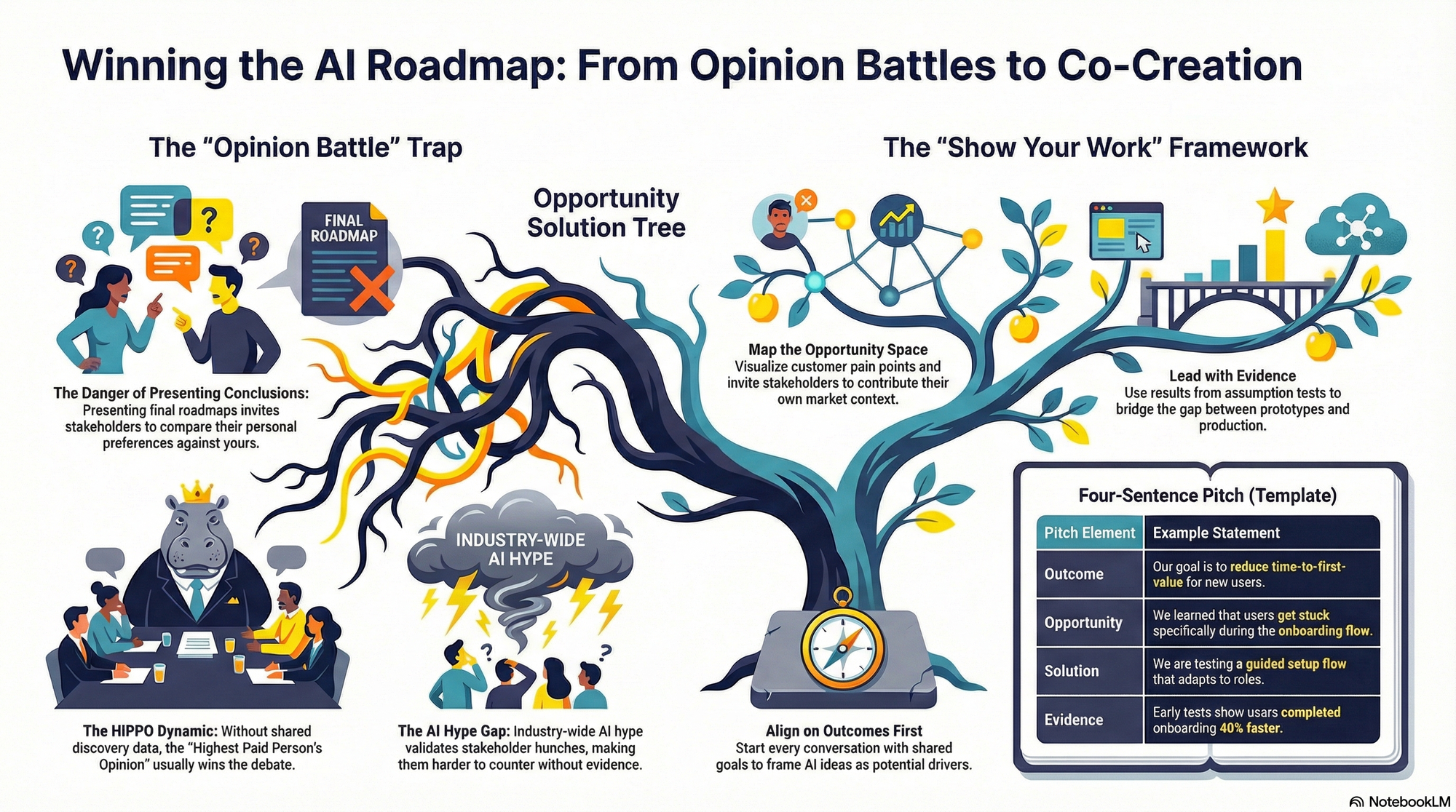
I’m seeing the same pattern in product orgs everywhere—inside HighLevel and across my network: everyone is racing to add AI to the roadmap, and every stakeholder has a strong opinion about what to build next. Delivery has never been faster, which makes it dangerously easy to confuse speed with progress.
When we chase features without grounding in continuous discovery, we drift back into a feature factory. We ship more, but we ship the wrong things faster. The antidote is simple and hard at the same time: recommit to product discovery, validate with assumption testing, and let the evidence steer our AI Strategy—not the hype.
Of course, that only works if we can bring our stakeholders along. In the AI moment, it’s deceptively easy to get to a slick prototype and painfully hard to harden it for production. Early demos make almost any idea look promising. That’s precisely why stakeholder management must evolve from pitching solutions to showing our work.
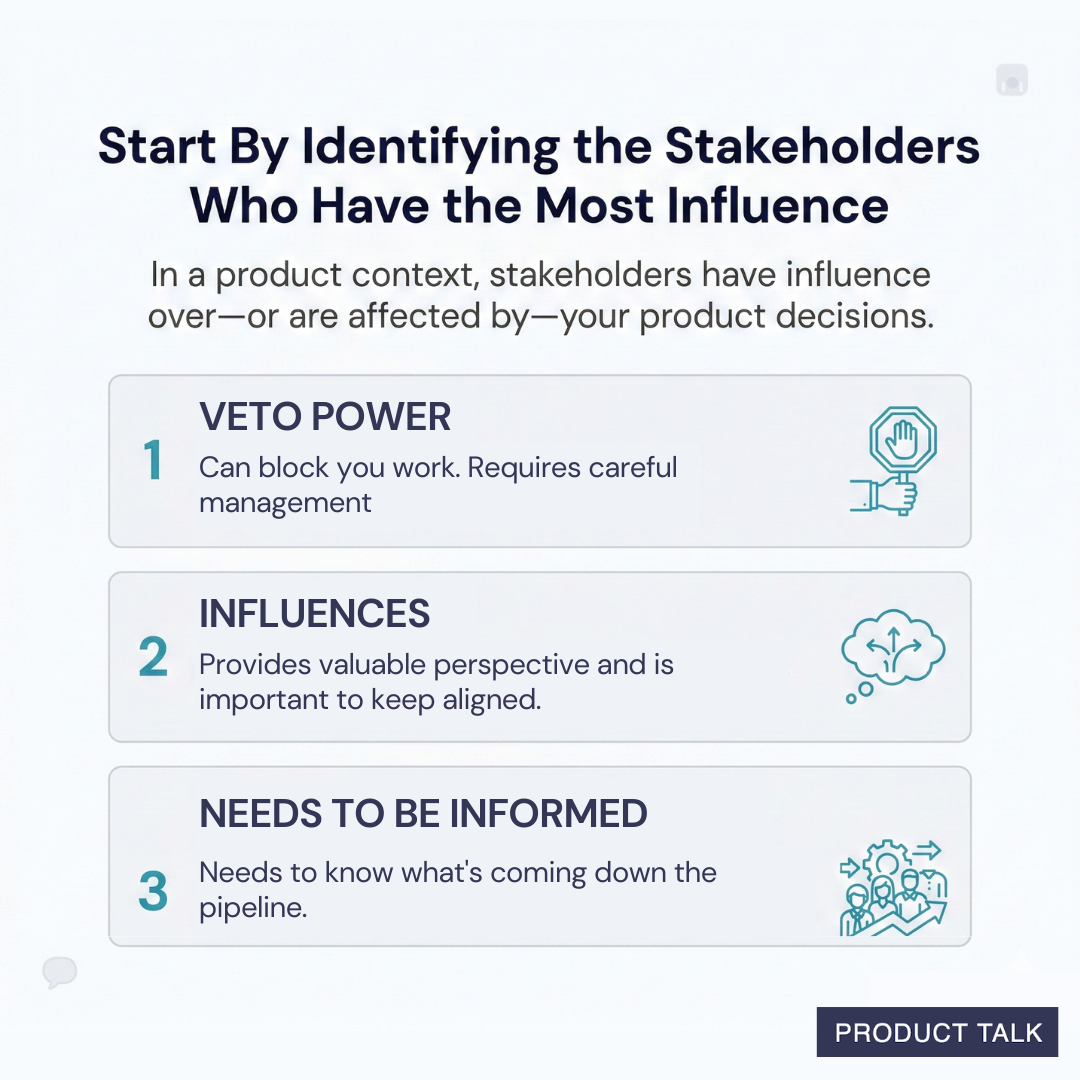
In practice, stakeholder management is about alignment with the people who influence our product decisions—executives, sales, marketing, customer success, engineering leadership, and sometimes legal or finance. Some have veto power; others have input. Knowing who can block versus who can shape is crucial for where we spend our time. Even in empowered product trios, the best discovery can derail if we reveal only conclusions at the end.
I’ve tried every mapping framework—power-interest grids, RACI matrices—and they help. But the real challenge isn’t identifying stakeholders. It’s figuring out how to bring them along so that our product roadmapping and sprint planning decisions stick.
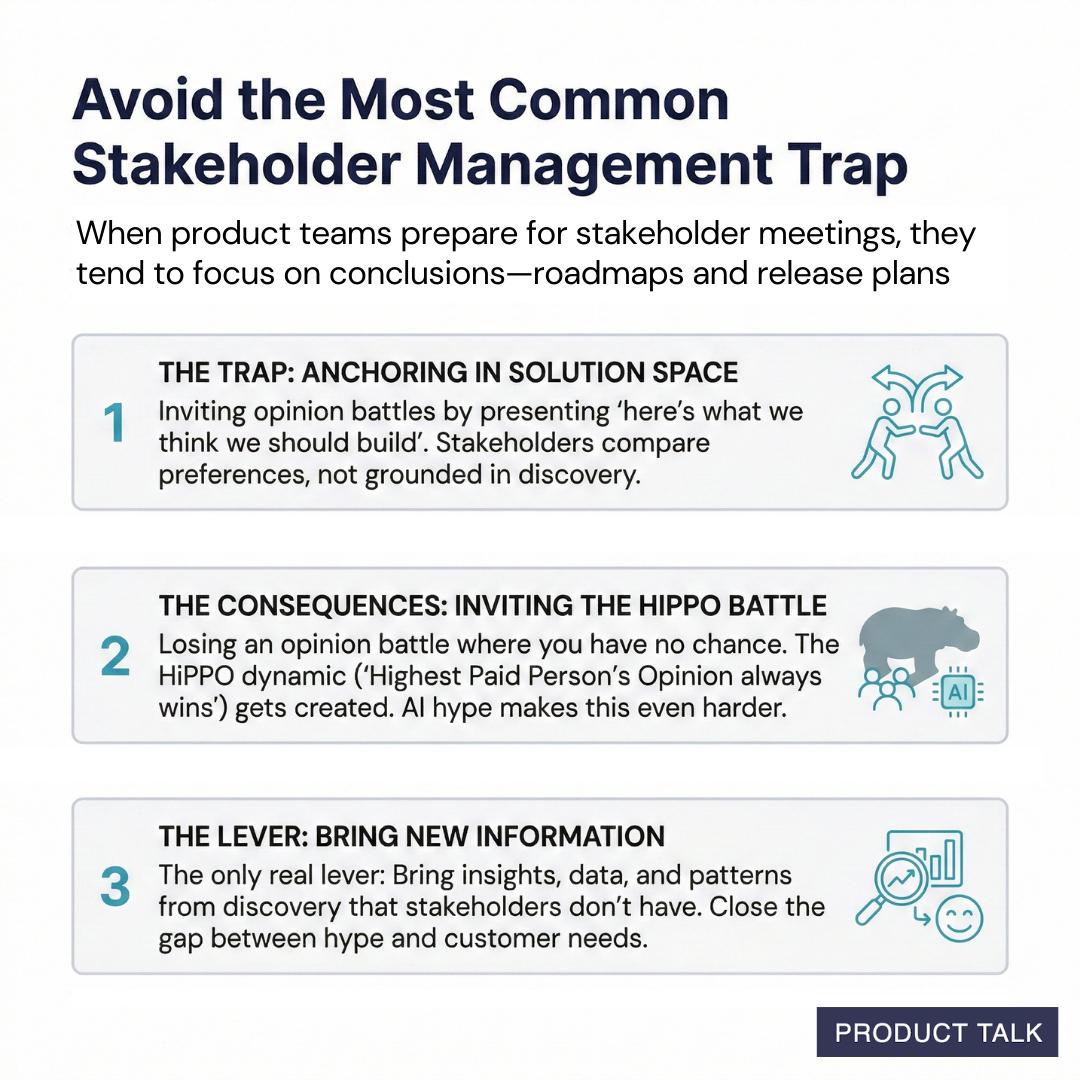
Here’s the most common trap I see (and have fallen into): focusing stakeholder reviews on the roadmap, release plan, or prioritized backlog. That invites an opinion battle. And stakeholders have their own conclusions—usually shaped by the last customer call, a board meeting, or a market headline.
This is how the HiPPO dynamic gets created. HiPPO stands for the “Highest Paid Person’s Opinion,” and the saying goes, “The HiPPO always wins.” When we present conclusions without the journey, we set ourselves up to lose. In the gen ai rush, the chorus of “everyone is doing AI” makes that opinion even harder to counter.
So I don’t try to win opinion battles. I bring new information—fresh customer interviews, clear opportunity mapping, and results from assumption tests. The gap between what the market hypes and what customers actually need is often enormous. Our edge is evidence.
The strategy that consistently works for me is simple: show your work. If you’re practicing continuous discovery, your opportunity solution tree isn’t just a thinking tool—it’s your strongest stakeholder management asset. It helps you build confidence in your decisions, and it can help your stakeholders build the same confidence.
Step 1 — Start with the outcome. I open every conversation by restating the shared goal and asking whether anything has changed. Anchoring on outcomes vs output OKRs reframes hot-button solution debates (like “we need an AI feature”) back to what will move the needle on the outcome we agreed to pursue.
Step 2 — Share the opportunity space. I show how we mapped customer needs, pain points, and desires. Then I ask, “What did we miss?” Stakeholders often surface opportunities we haven’t seen yet—signals from the field, market shifts, or partner feedback. I capture their input and commit to validating it in upcoming customer interviews.
Step 3 — Walk through prioritization. Using the tree’s structure, I explain why we prioritized one branch over another. Then I ask where they might have chosen differently. This turns debate into collaboration and lets me leverage their expertise without ceding the discovery framework.
Step 4 — Go deep on the target opportunity. Before we talk solutions, I make the customer’s problem vivid and real. Interview snapshots help stakeholders empathize and see what matters most. Once the opportunity is crisp, solution discussions become dramatically more objective.
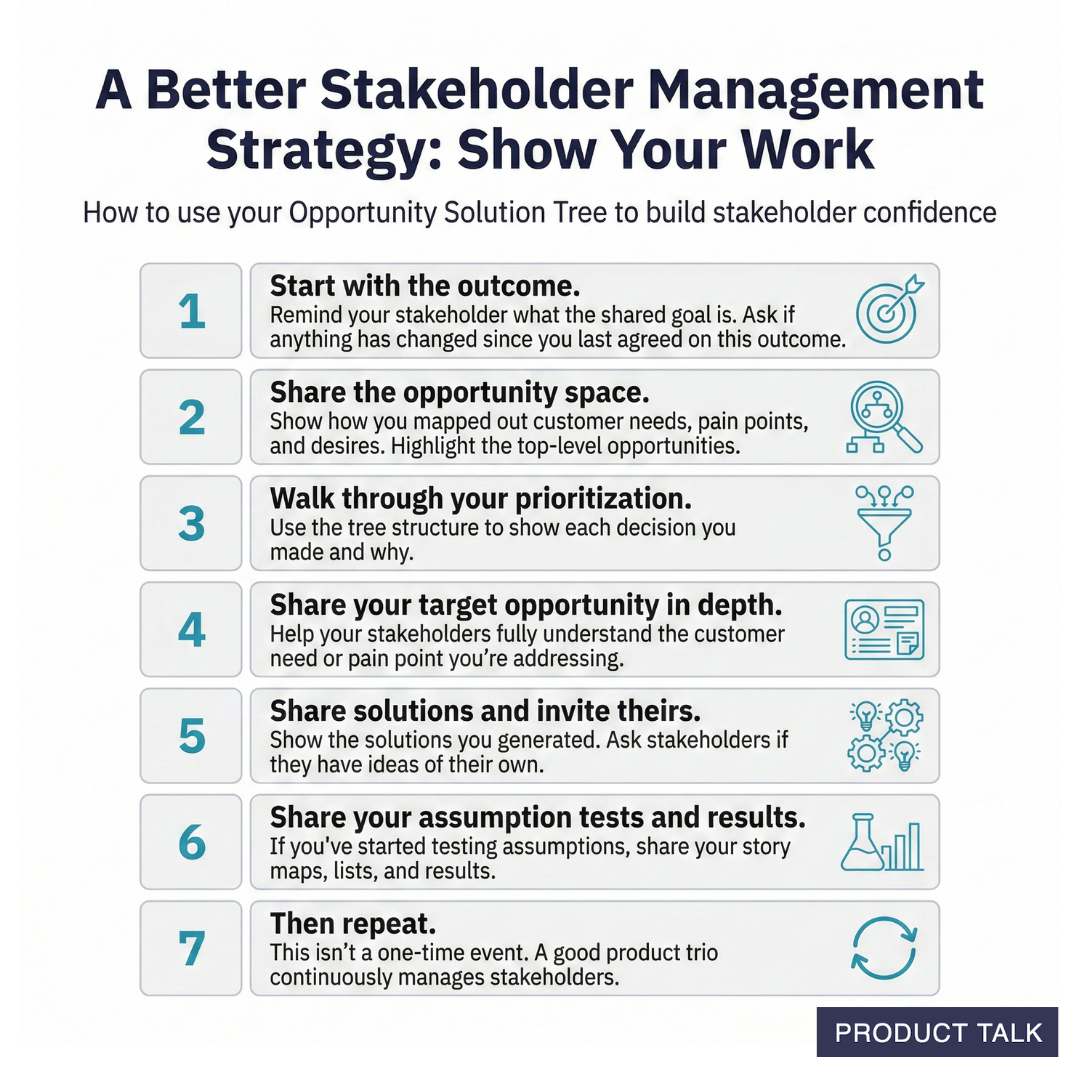
Step 5 — Share solutions and invite theirs. I present our solution set and explicitly ask for additional ideas. If their suggestions diversify our set, we include them. Solution ideas are cheap; the opportunity is what matters. This is where product trios can benefit from leadership’s pattern recognition and industry context.
Step 6 — Share your assumption tests and results. I walk through our story maps, high-risk assumptions, and what we’ve learned so far. I invite stakeholders to add assumptions—this is where their knowledge shines. If we have data, we share it; if we’re pre-data, we share the plan to get it and ask for feedback.
Step 7 — Repeat. I don’t batch this into a big reveal. I keep a steady cadence and tailor depth to each audience: weekly for my manager, monthly highlights for marketing, and concise updates for executives. Continuous discovery pairs with continuous stakeholder management.
Showing your work doesn’t mean drowning people in detail. It means tailoring the signal to the audience. My rule of thumb is outcome, opportunity, solution, evidence—walk the lines of the tree at the right altitude for each stakeholder.
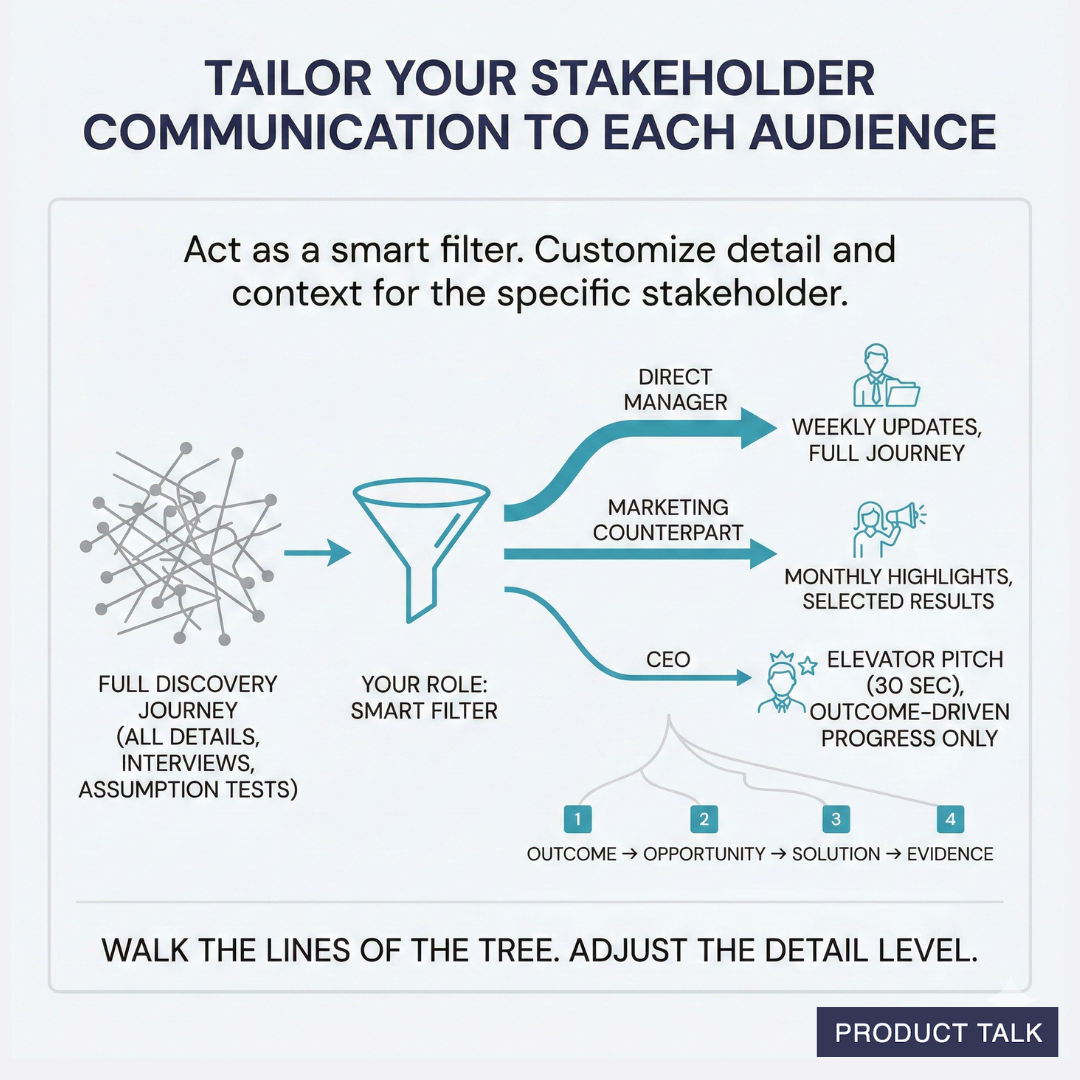
In a 30-second update with a CEO, it might sound like this:
“Our goal is to reduce time-to-first-value for new users. We’ve been interviewing customers and learned that onboarding is where most people get stuck—specifically, they don’t know which features to try first. We explored a few approaches and tested them. The most promising one is a guided setup flow that adapts based on the user’s role. In early tests, new users completed onboarding 40% faster.”
That pattern works across channels—Slack updates, monthly reviews, or quarterly planning. The format flexes, the structure doesn’t: outcome, opportunity, solution, evidence.
As you adopt this approach, watch for four anti-patterns that quietly erode trust.
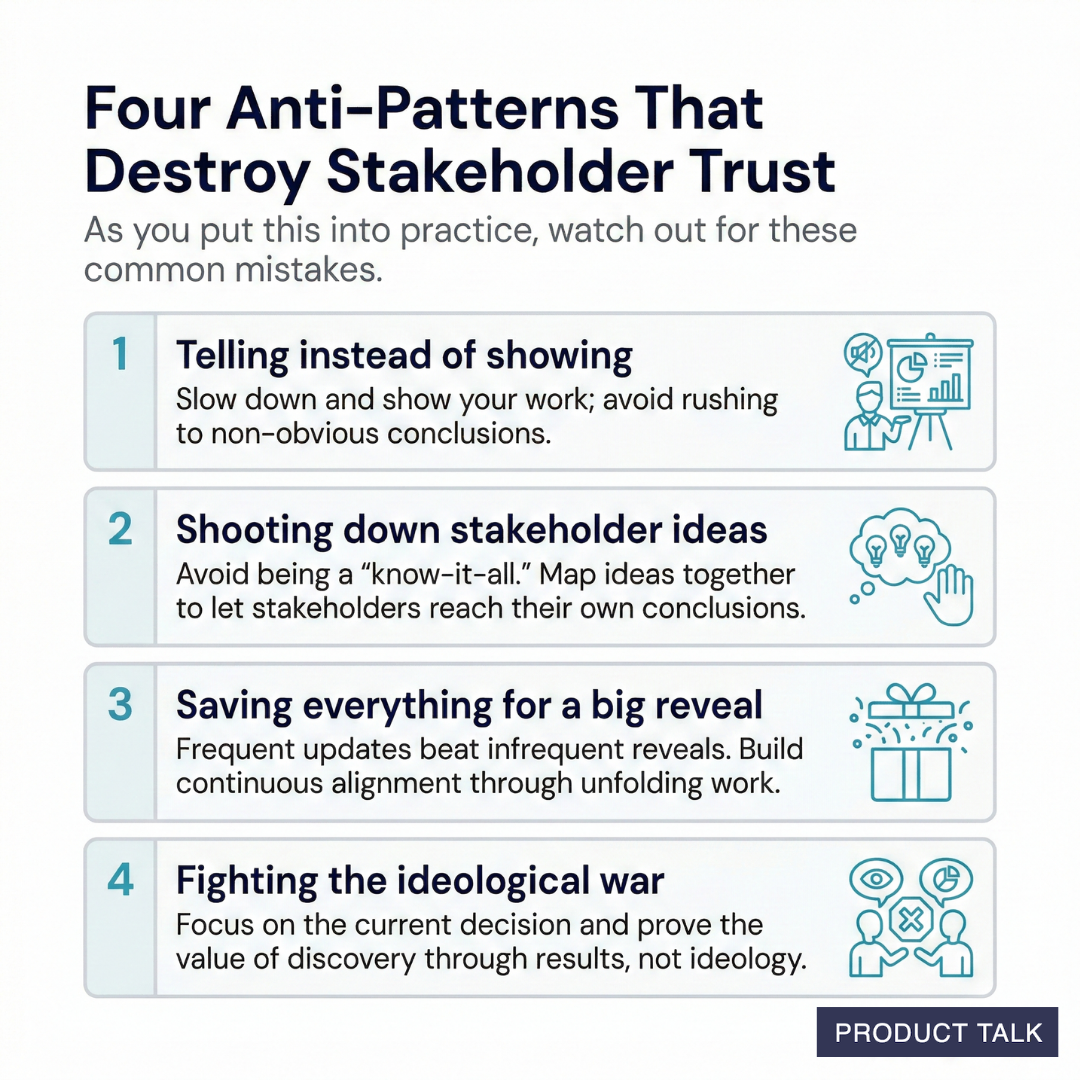
Anti-pattern 1 — Telling instead of showing. The curse of knowledge makes our conclusions feel obvious to us and opaque to others. The fix: slow down, start at the top of the tree, walk the decisions, and let stakeholders reach the conclusion with you.
Anti-pattern 2 — Shooting down stakeholder ideas. As you build a library of validated assumptions, it’s easy to spot flaws in a suggestion and say “no” too quickly. Instead, place their idea within your discovery framework. If it maps to a different opportunity, say, “That idea has promise—we’ll consider it when we address that opportunity.” If it rests on risky assumptions, story map the idea together, list the assumptions, and share what you’ve already learned. People accept the evidence they help generate.
Anti-pattern 3 — Saving everything for a big reveal. Infrequent, comprehensive updates invite opinion battles because stakeholders have formed their own conclusions in the dark. Short, frequent updates build alignment as the work unfolds.
Anti-pattern 4 — Fighting the ideological war. Sometimes a more senior stakeholder will overrule you. Don’t turn it into a debate about how product decisions “should” be made. Focus on the decision at hand, do the best work within constraints, and let results—not ideology—prove the value of discovery over time.
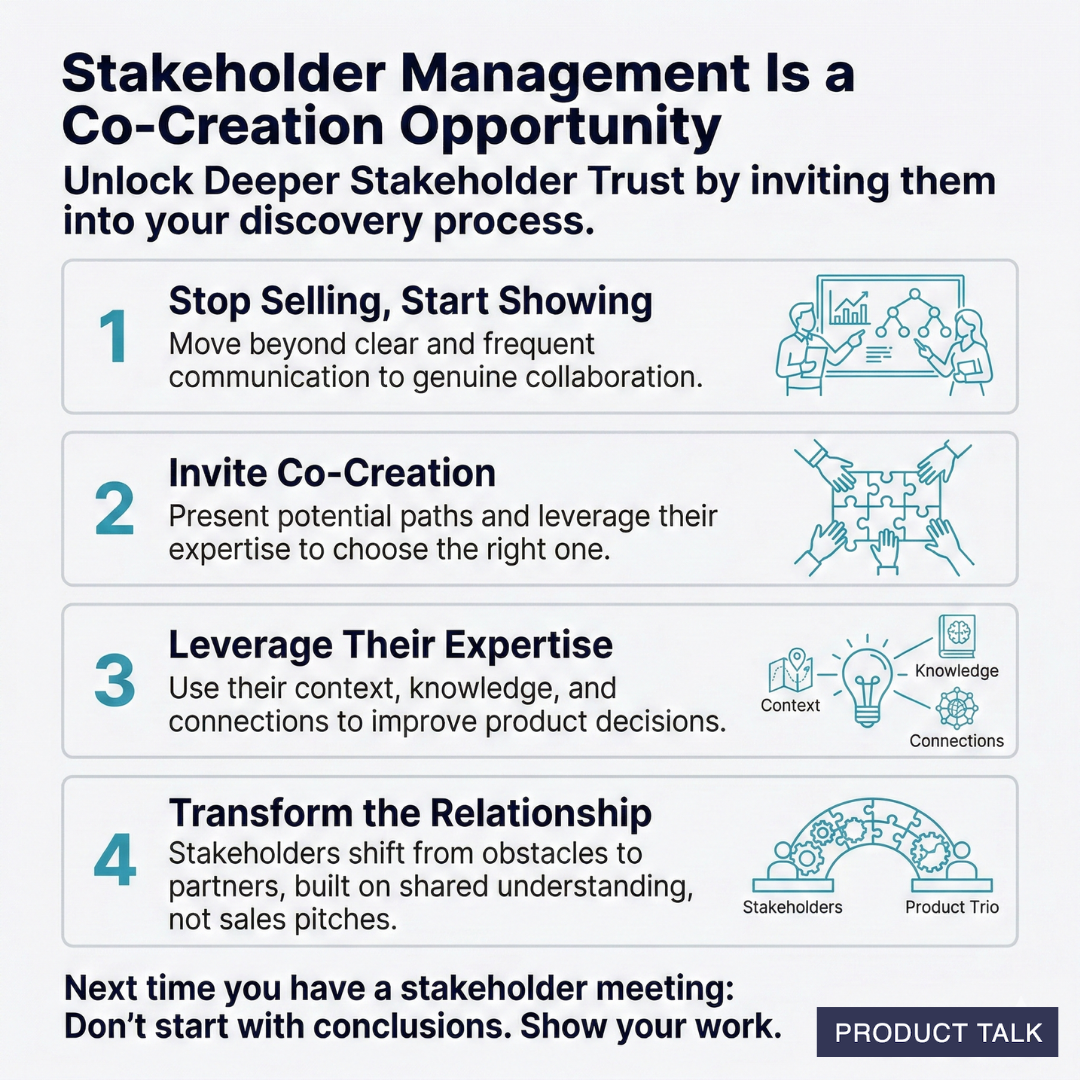
Here’s the mindset shift that changes everything: stakeholder management is a co-creation opportunity. When we show our work with artifacts like an opportunity solution tree, experience maps, and interview snapshots, we’re not just communicating—we’re inviting collaboration. We’re leveraging stakeholders’ expertise, context, and connections to make better product decisions.
When stakeholders have walked the path with us, they don’t need to be sold on the destination. They become allies. Engagement stops being a status ritual and starts being real partnership—the kind that moves outcomes and builds durable trust.
Try this in your next review: don’t start with your roadmap. Start at the top of the tree. Reaffirm the outcome. Share the opportunity space. Explain your prioritization. Show what you’re learning. Invite contribution. You might be surprised how quickly alignment—and confidence—follow when you stop selling conclusions and start showing your work.
Inspired by this post on Product Talk.