Tag: customer interviews

  • Join Me in June: Master Opportunity-First Product Strategy with Continuous Discovery Habits

    Join Me in June: Master Opportunity-First Product Strategy with Continuous Discovery Habits

    I’m celebrating the five-year anniversary of Continuous Discovery Habits by inviting you to read it with me this June. As someone who leads product management and coaches product trios, I’ve seen how a shared discovery practice tightens alignment, speeds up learning, and drives outcomes. This month, we’ll go deep on prioritizing opportunities—not solutions—and I’ll guide you step by step so you can apply the ideas on your own team.

    Each month, I’m releasing an in-depth reading guide that includes:

    We’ll discuss each month’s reading in the comments, and we’ll gather quarterly on a live call to unpack real-world applications, trade wins and missteps, and keep the momentum going.

    Joining late? No problem. I monitor the comments on each reading guide throughout the year. Start with the current month or go back to January—whatever works for you. Ask for help, share what’s working, and connect with other readers at any point.

    If you want to participate, grab a copy of the book (or dust off your old copy), share the “Spread the Love” videos with your team, block time for the exercises, and register for the community sessions. Let’s do this.

    This Month’s Reading

    Chapter:

    Estimated reading time: ~16 minutes

    This month's chapter will introduce you to:

    Need a copy? Grab the book

    Share the Love with Friends and Colleagues

    We learn best in community. Use these short videos to spread the key ideas across your product trios, engineering partners, and stakeholders. Invite them to read along with you so your discovery cadence—and your product strategy—advance together.

    Reflect & Discuss What You Read

    When we reflect and discuss what we read, we absorb more and apply it faster. This chapter challenges a deeply ingrained habit: prioritizing solutions. I’ve been in those meetings—spreadsheets full of features, heated roadmap debates, and a creeping sense that we’re optimizing outputs rather than outcomes. The shift to opportunity-first thinking changed how my teams frame bets, sequence discovery, and communicate product strategy.

    Individual Reflection

    Team Discussion

    Put It Into Practice

    This month is all about shifting from solution-first to opportunity-first thinking. These short, focused exercises will help your product trio practice opportunity prioritization and improve decision speed without sacrificing product discovery rigor.

    Exercise: Map Your Roadmap to Opportunities

    Time: 45 minutesDo this: With your product trio

    Take your current roadmap or backlog and work backwards. For each planned feature or solution:

    This exercise often reveals that you're either:

    Use these insights to inform your next prioritization conversation.

    Exercise: Practice Two-Way Door Thinking

    Time: 30 minutesDo this: With your product trio

    Choose 3-5 recent or upcoming product decisions. For each one, discuss:

    The goal is to calibrate your team's decision-making speed. Two-way door decisions should be made quickly with "just enough" evidence. One-way door decisions deserve more deliberation and data.

    Go Deeper: Additional Reading

    If you prefer an audio summary of this month’s reading, including the book chapters and the following resources, I’ve included an audio version for members at the bottom of this post.

    Related In-Depth Guides

    Supplementary Reading

    Related Courses

    Our Live Discussion Schedule

    Our live discussion sessions are for registered members. Sessions are not recorded. Invitations will go out two weeks before the scheduled event—reserve time now.

    Audio Summary

    Prefer to listen? Stream the audio overview here: June — Prioritizing Opportunities (audio).

    Ready to put continuous discovery into action? Grab the book, share the videos with your team, schedule the exercises, and join the community sessions. Opportunity-first product strategy is a muscle we can build together.

    The chapters we will be readingA preview of the most important concepts we'll be learning aboutShort videos you can share with friends and colleagues to help spread the ideasIndividual and team discussion questions to help you absorb and engage with the readingTeam exercises to help you put the ideas into practiceAdditional reading to help you go deeper on the core ideasChapter 7: Prioritizing Opportunities, Not SolutionsWhy product strategy happens in the opportunity space, not the solution spaceHow to focus on one target opportunity at a time to deliver value iterativelyUsing the tree structure to simplify prioritization decisionsThe four criteria for assessing opportunities: sizing, market factors, company factors, and customer factorsWhy treating prioritization as a messy, subjective decision leads to better outcomes than scoring formulasThe concept of two-way door decisions and how they apply to opportunity prioritizationWork on one small opportunity at a time – Reduce your batch sizeGetting started with compare and contrast decisions – Choose the right target opportunityTurn big intractable problems into smaller, more solvable problems – The power of decompositionThink about your team's current roadmap or backlog. How much of your time is spent prioritizing features versus understanding and prioritizing customer opportunities? What would change if you flipped that ratio?Reflect on the last time you made a product decision. Did you treat it as a one-way door (irreversible) or a two-way door (reversible)? How did that framing affect your decision-making process and timeline?Consider the four assessment criteria (opportunity sizing, market factors, company factors, customer factors). Which of these does your team currently emphasize most? Which do you tend to overlook or underweight?As a team, list the top 5-10 items on your current roadmap or backlog. For each one, try to identify the underlying customer opportunity it addresses. If you can't clearly articulate the opportunity, what does that tell you about how you're making decisions?The chapter argues against scoring formulas (like RICE or ICE) for prioritization, calling them "made-up math." If your team uses a scoring system, discuss: What is it really measuring? Does it help you make better decisions, or does it just make subjective decisions feel more objective?Walk through a recent prioritization decision. Did you assess options in isolation ("should we build this?") or compare and contrast them? How might your decision have been different with a compare-and-contrast approach?Identify the customer opportunity it's meant to addressWrite it as something a customer might say (e.g., "I can't find anything to watch" not "We need better search")Look for patterns: Are multiple solutions addressing the same opportunity? Are some solutions disconnected from any clear customer need?Spreading yourself thin across too many opportunitiesOver-investing in a single opportunity with multiple solutionsBuilding solutions with no clear opportunity attachedIs this a one-way door decision (hard to reverse) or a two-way door decision (easy to reverse)?If it's a two-way door, what's the smallest step we could take to learn whether we're on the right track?What would we need to see to know we made the wrong choice?If we realize we're wrong, how quickly could we course-correct?Opportunity Solution Trees: Visualize Your Discovery to Stay Aligned and Drive OutcomesCustomer Interviews: Uncover Hidden Insights from Every ConversationPrioritize Opportunities, Not Solutions7 Key Benefits of Using Opportunity Solution TreesProduct in Practice: How 2-Way Door Decisions Helped Simply Business Learn FastProduct in Practice: Getting Started with Opportunity Solution Trees at SuperAwesomeProduct Discovery Fundamentals: Learn a structured and sustainable approach to continuous discovery.Tuesday, June 16, 2026: 9am-10am PDTThursday, September 17, 2026: 9am-10am PDTWednesday, December 16, 2026: 9am-10am PST


    Inspired by this post on Product Talk.


    Book a consult png image
  • Inside My Pricing Playbook: Building Value-Based Packaging That Balances Growth and Profit

    Inside My Pricing Playbook: Building Value-Based Packaging That Balances Growth and Profit

    Pricing looks deceptively simple from the outside; inside, it’s anything but. Over the years, I’ve learned that every price tag is really a strategic statement about value, priorities, and the future we’re building toward.

    At Fin, pricing and packaging (P&P) is more than a finishing touch. It’s a research problem, a forecasting challenge, a commercial decision, and ultimately, a strategic statement, requiring deep cross-functional work. We must balance the needs and wants of our customers, the value delivered by our product, and the broader vision we are building towards.

    Our approach keeps evolving as our product and market mature. I treat it as a living system—continuously informed by research, GTM learning, and customer behavior, never "set and forget."

    Here’s how I run the process in practice, especially when we launch something new that needs to be monetized, like Fin, our AI Agent. The work moves from qualitative discovery to quantitative validation to commercial modeling, with tight partnership across product, research, data science, finance, GTM, and engineering.

    Step 1: Foundational research

    I start by talking to buyers to understand their mental models of value. How do they define ROI? What pricing models do they expect in this category? What feels intuitive, and what feels off? This early discovery shapes two crucial choices: the pricing model and the pricing metric.

    The pricing model is the overall structure; value-based, usage-based, access-based, fixed fee, and so on. With Fin, we chose a value-based model: you only pay when Fin delivers value. Our research clearly showed that buyers don’t want to pay for usage, they want to pay for results.

    The pricing metric is the unit of value within that model, the unit we anchor pricing to. For Fin, the pricing metric is “outcomes.” An outcome is defined by Fin successfully handling a customer service query.

    Small definitional changes can dramatically alter how customers perceive value, so I obsess over details. Buyers rarely hand us the “right” model; they reveal how they evaluate value, and I translate that into a model and metric that align with their goals and expectations.

    Throughout, I loop in execs, finance, GTM, and engineering to ensure alignment before proceeding. Pricing choices cut across the business; they can’t be made in isolation.

    Step 2: Willingness to pay

    Once we have a model and metric, I quantify what the market will bear. This is where rigorous willingness-to-pay (WTP) research comes in, grounded in the language we validated through the qualitative work.

    Here’s the kind of framing I use in surveys to keep things concrete and consistent with our model and metric:

    You would only pay when Fin delivers an outcome (→ the model). An outcome is counted when the AI Agent resolves a customer query with no further help needed (→ the metric). Would you be willing to pay $X per outcome for Fin?

    The foundational qual is so important as a first step. It helps us decide what we should be asking about before we start asking how much people will pay. Without the qual ground work, you risk building a very convincing answer to the wrong question.

    The goal isn’t to find a perfect price. That doesn’t exist. The goal is to ground our discussions in the reality of the market.

    I use methods like Gabor-Granger and Van Westendorp to understand WTP and to shape a demand curve that informs strategy, not just a single number.

    This chart shows us what percentage of the market is willing to buy the product at various price points. The demand curve shows that 69% of buyers were willing to pay for the product at $0.86 per outcome, whereas only 39% were willing to pay at $1.42.

    The dashed line shows the price point at which revenue for the business would be maximized (by multiplying adoption by the dollar amount).

    This allows us to debate knotty questions like: What’s the right balance between growth and revenue? How sensitive is demand to price changes? At what price do we start losing the market? If we wanted to increase adoption, would lowering our prices by $X make a meaningful difference?

    Those conversations help me weigh customer value and business outcomes side by side. At this stage, decisions feel more tangible, but I don’t finalize a price until I’ve modeled the operational realities.

    Step 3: Modeling

    By now I have a validated model, a clear metric, and a strong WTP signal. Next I translate theory into a commercially workable plan—this is where data science and finance are indispensable.

    I start with a list price aligned to our strategy and commercial goals. Then I adjust for likely discounting to estimate realized price. Next, I analyze beta usage to project outcomes per customer by segment and derive average ARR. I combine usage projections with WTP to model attach rates across conservative-to-optimistic scenarios. Finally, I connect the dots in our long-range plan—logos, ARR, margins—iterating until the numbers and narrative cohere.

    The modeling step is important because willingness-to-pay data is somewhat theoretical. It reflects intent, not behavior. Modeling helps us bridge that gap.

    The goal of this step is to land on a price point recommendation, alongside forecasts for ARR and adoption. It allows us to understand the real business impact of the decisions we’re making.

    Alongside all of this, we need to ensure any decision we make falls in line with our pricing principles and broader business objectives.

    Step 4: Sign-off and execution

    With the analysis complete, I consolidate everything into a clear P&P recommendation for executive approval. Once approved, the real work begins: enabling sales, communicating changes to customers, instrumenting ROI proof points, and monitoring performance so we can learn and iterate.

    Do we run the full process every time?

    Not always. This is the ideal process, and I apply it end-to-end for the most material decisions. In reality, time and resource constraints require judgment; rigor should mirror impact. When uncertainty crops up midstream, I run scrappier, targeted research rather than forcing a linear path.

    The ongoing challenge

    As Fin’s breadth has expanded, our pricing system has had to evolve, too. For a while, modular pricing worked well—each product had its own logic tied to a crisp outcome. As we add more products, more Agent capabilities, and more outcomes, the question shifts from “what is the right P&P for this one product?” to “how does everything fit together into a coherent pricing system?”

    We must recognize that pricing isn’t something you set once and leave alone. As products evolve, especially in a world where AI is rapidly changing how value is created and delivered, it’s important to regularly step back and review the bigger picture, not just the component parts.

    For example, outcome-based pricing has served us well, particularly when our products were tightly tied to clear, measurable outcomes. But as our products become more varied, and as we continue building toward a broader platform, it becomes less straightforward to apply a single model cleanly everywhere.

    The challenge becomes less about replacing one model with another, and more about continually looking up and asking: what pricing philosophy best reflects the value we’re delivering today? And how do we deliver that philosophy in a way that still feels right for customers?

    In short, there is no finish line, pricing is never “done” – and that’s exactly how it should be.

    Why this work matters

    Pricing and packaging is often noticeable only when it goes wrong. A confusing model, a bad metric, or a price that feels disconnected from value. And we hear about those quickly.

    When pricing is done well, it becomes nearly invisible—but it still does a lot of work. It shapes how people perceive value, clarifies what they’re paying for, and makes the product easier to sell, easier to buy, and easier to scale. Most importantly, it forces us to be honest about what the product is really worth. That’s why I take it so seriously—and why I treat pricing as a product in its own right.


    Inspired by this post on The Intercom Blog.


    Book a consult png image
  • Unlock High-Leverage PM Work: 5 Claude Cowork Playbooks to Turbocharge Your Strategy

    Unlock High-Leverage PM Work: 5 Claude Cowork Playbooks to Turbocharge Your Strategy

    In my role leading product teams, I’m relentless about freeing time for high-leverage work—clarifying strategy, sharpening positioning, and unblocking execution. Claude Cowork has become a reliable AI partner in that mission, helping me automate repeatable tasks while preserving judgment for the decisions that matter most.

    Get 5 playbooks to automate common product management tasks with Claude Cowork and free yourself for higher-leverage PM work.

    When I say “playbooks,” I mean structured, repeatable workflows that turn messy inputs into crisp outputs—without sacrificing rigor. With agentic AI, LLMs for product managers, and thoughtful prompt engineering, these playbooks plug directly into my product roadmapping and sprint planning process, accelerating discovery, analysis, and stakeholder alignment.

    Playbook 1: Continuous discovery synthesis. I route raw customer interviews, support threads, and behavioral analytics into Claude Cowork to cluster themes, extract Jobs-to-Be-Done, and propose opportunity areas. It drafts an initial opportunity solution tree with clear problem statements, target outcomes, and candidate solutions, which I then refine with the team. This shortens the loop between customer interviews and actionable insights while preserving the nuance that continuous discovery requires.

    Playbook 2: Strategy-to-roadmap alignment. Starting from our product strategy and target outcomes, I ask Claude Cowork to translate goals into a prioritized roadmap, calling out outcomes vs output OKRs and showing driver trees that connect initiatives to measurable impact. It flags dependencies and suggests stakeholder management touchpoints, making the narrative behind prioritization transparent and easier to socialize across product trios and leadership.

    Playbook 3: Experiment design and A/B testing. To move from ideas to evidence, I have Claude Cowork generate testable hypotheses, success metrics, and guardrails for A/B testing. It produces experiment briefs, checks statistical assumptions like minimum detectable effect (MDE), and suggests instrumentation plans for tools such as Amplitude analytics. I use these drafts to speed up reviews without compromising on methodological rigor.

    Playbook 4: Launch communications and in-product guidance. After we ship, I leverage Claude Cowork to assemble UX writing, release notes, and in-app guides tailored to user segments. It proposes short product tours, contextual tooltips, and support macros that keep messaging consistent across Pendo or Intercom while reinforcing our value proposition. The result is faster, more cohesive go-to-market execution with fewer round-trips.

    Playbook 5: AI risk, governance, and quality checks. Before anything goes live, I use Claude Cowork to run structured reviews for data governance, privacy-by-design, and AI risk management. It helps draft acceptance criteria, red-team prompts for edge cases, and an eval-driven development checklist so the team can track model behavior and mitigate regressions over time. These safeguards maintain trust as we scale AI workflows across the product surface.

    To make these playbooks sing, I seed Claude Cowork with a retrieval-first pipeline of canonical docs—vision, strategy, OKRs, analytics dashboards, and definition-of-done checklists—plus prompt templates tuned for our voice and review standards. Tight context window management, explicit role instructions, and lightweight evaluations keep outputs accurate, auditable, and on-brand.

    The impact has been compounding: faster discovery-to-decision cycles, clearer roadmaps tied to outcomes, stronger experiments, and launch content that lands. Most importantly, the team spends more time on creative problem solving and stakeholder partnership, not manual synthesis or formatting. If you’re ready to reclaim your calendar and elevate your product strategy, start with these five Claude Cowork playbooks and iterate from there.


    Inspired by this post on Amplitude – Perspectives.


    Book a consult png image
  • Taste vs. Evidence in the AI Era: What Product Leaders Must Invest In Now

    Taste vs. Evidence in the AI Era: What Product Leaders Must Invest In Now

    I just finished listening to "Taste – All Things Product Podcast with Teresa Torres & Petra Wille," and as a product leader shipping AI-powered capabilities at HighLevel, Inc., I wanted to pressure-test the sudden obsession with "taste."

    If you're curious, you can listen to this episode on Spotify or Apple Podcasts.

    The core question landed perfectly for our moment: Is "taste" the must-have skill of the AI era — or just the latest tech buzzword in a world where AI is eating through design, delivery, and discovery?

    Teresa pushes back hard, highlighting how slippery the term can be. "It's just this month's flavor of founder mode." She points out that "taste" is rarely defined, can't be easily taught, and too often becomes shorthand for "my preference trumps yours." Just as importantly, "It's not about your taste. It's about your customer's taste."

    Petra adds needed nuance from years in the craft: pattern-recognition is real, and some people do develop sharper product sense over time. As she put it, "I am a strong believer that you develop product sense and taste over time. It's never finished."

    Both threads lead back to familiar roots in product: product sense, founder mode, and the enduring myth of the lone visionary. They even grapple with the big question on everyone’s mind—Will AI Eat Taste Too?—and where that leaves product teams navigating GenAI, LLMs for product managers, and evolving product strategy.

    Here’s my take. "Taste" can be useful as a personal north star, but it is not a decision system. In my teams, we bias toward evidence: continuous discovery, customer interviews, discovery synthesis with opportunity solution trees, and tight collaboration in product trios. Opinion can start the conversation, but evidence should end it.

    Practically, that means investing in the skills that compound: Discovery skills — understanding customers, matching solutions to real needs. Human-to-human interaction skills. Learning to collaborate with AI effectively. Critical thinking and judgment grounded in evidence.

    On AI collaboration specifically, we treat GenAI as a force multiplier, not a decider. We prototype with AI to explore breadth, then narrow with qualitative and quantitative signals, ablation-style experiments, and clear success criteria. The bar I hold myself to is simple: taste without evidence is just opinion.

    Three lines I underlined from the conversation:

    "It's just this month's flavor of founder mode." — Teresa Torres

    "It's not about your taste. It's about your customer's taste." — Teresa Torres

    "I am a strong believer that you develop product sense and taste over time. It's never finished." — Petra Wille

    If you want to go deeper, these references are helpful for sharpening judgment without falling into the "great man" theory trap.

    Follow Teresa Torres: https://ProductTalk.org

    Follow Petra Wille: https://Petra-Wille.com

    Founder mode

    Marty Cagan: Founder-Style Leadership

    Vercel/v0 CEO Guillermo Rauch on building taste: from Lenny Rachitsky’s Linkedin post

    Continuous discovery (Read Teresa’s Everyone Can Do Continuous Discovery—Even You! Here’s How

    The "great man" theory

    Steve Jobs and the myth of the lone product visionary

    Have thoughts on this episode? Leave a comment below and share how your team balances product sense with evidence in the age of AI.


    Inspired by this post on Product Talk.


    Book a consult png image
  • Master Opportunity Mapping with Continuous Discovery Habits — Join the May 2026 Book Club

    Master Opportunity Mapping with Continuous Discovery Habits — Join the May 2026 Book Club

    Five years in, Continuous Discovery Habits continues to be one of the most practical frameworks I use to align empowered product teams, sharpen product strategy, and convert customer interviews into outcomes. To celebrate its impact, I’m hosting a community read-along and inviting you to dig in with me this May.

    Each month, I’m releasing an in-depth reading guide to make learning stick. You’ll find the chapters we’ll be reading, a preview of the essential concepts, short videos to help you spread the ideas across your organization, individual and team discussion prompts, team exercises to put the concepts into practice, and additional reading if you want to go deeper. My goal is simple: help you turn product discovery into a steady habit, not a once-a-quarter activity.

    We’ll discuss each month’s reading in the comments, and we’ll gather quarterly on a live call to compare notes and share what’s working. Joining late is absolutely fine—I monitor the conversation throughout the year. Start with the current month or rewind to January; you can ask for help, share wins and roadblocks, and connect with other readers anytime.

    If you want to participate, grab a copy of the book (or dust off your old one), share the "Spread the Love" videos with your team, block focused time for the exercises, and register for the community sessions. Let’s do this together.

    This Month’s Reading

    Chapter: Chapter 6: Mapping the Opportunity Space

    Estimated reading time: ~23 minutes

    This month’s chapter will introduce you to why opportunity mapping is critical for structuring the ill-structured problem of reaching your desired outcome; how to move from overwhelming opportunity backlogs to well-structured opportunity spaces; the power of tree structures for depicting parent-child and sibling relationships between opportunities; how to identify distinct branches in your opportunity space using key moments in time; common anti-patterns to avoid when building your first opportunity solution tree; and why structure "gets done, undone, and redone" as you continue to learn.

    Need a copy? Grab the book.

    Share the Love with Friends and Colleagues

    We learn best in community. Use these short videos to spread the core concepts from this chapter—then invite your team to join the book club with you.

    The need for opportunity mapping – You will never fully satisfy your customers' desires

    Understanding the structure of an opportunity solution tree – Depicting two types of relationships

    Turn big intractable problems into smaller, more solvable problems – The power of decomposition

    How to map an opportunity space – Getting started with opportunity solution trees

    A well-structured opportunity space has distinct branches – Identify key moments in time

    Reflect & Discuss What You Read

    Reflection turns reading into capability. This chapter asks us to shift from reacting to every request to deliberately structuring the opportunity space. If you’ve ever felt overwhelmed by a never-ending backlog or pressure to ship output over outcomes, this is where the fog starts to lift. As you read, focus on how your team currently organizes (or doesn’t organize) what you hear from customers.

    Individual Reflection

    1) Think about your current product backlog or opportunity list. Is it a flat list, or do you have some structure to it? If you were to group similar opportunities together, what patterns would emerge?

    2) When was the last time you heard a customer need and immediately jumped to a solution without exploring whether there were related opportunities? What would change if you took the time to map how that opportunity connects to others?

    3) Review the anti-patterns from the chapter (opportunities framed from your company's perspective, vertical opportunities, opportunities with multiple parents, etc.). Which of these do you recognize in how your team currently talks about opportunities?

    Team Discussion

    1) As a team, pick a top-level opportunity you're currently working on. Try breaking it down into sub-opportunities together. Where do you struggle? Where do you disagree about how to frame or group opportunities? What does that tell you about gaps in your shared understanding?

    2) Look at your experience map (from Chapter 4) and identify 3-5 distinct moments in time during your customer's experience. Could these become the top-level branches of your opportunity solution tree? Where do you see overlap, and where are there clear distinctions?

    3) Discuss the quote from Barbara Tversky: "Structure gets done, undone, and redone." How does your team currently respond when you discover new information that changes how you understand the opportunity space? Do you treat your opportunity map as fixed or as something that evolves?

    Put It Into Practice

    Reading is step one; building your first opportunity solution tree is where the real learning happens. The exercises below are exactly how I coach product trios to transform ambiguous problems into aligned action.

    Exercise: Build Your First Opportunity Solution Tree

    Time: 60 minutes. Do this: With your product trio.

    Start by reviewing your interview snapshots from the past few weeks. For each opportunity you captured, ask the three questions from the chapter:

    Is this opportunity framed as a customer need, pain point, or desire (not a solution)?

    Is this opportunity unique to one customer, or have we seen it in more than one interview?

    If we address this opportunity, will it drive our desired outcome?

    Then, using your experience map, identify 3-5 distinct moments in time to serve as your top-level opportunities. Group the opportunities from your interviews under these top-level branches.

    Look for opportunities to add structure to each branch. Group similar opportunities together and identify a parent opportunity. Look for vertical stacks (one parent, one child) and fill in missing siblings. Reframe opportunities that are too broad or that could live in multiple branches.

    Don’t aim for perfection. Get something on paper (or a digital canvas) and iterate the tree with every new interview.

    Exercise: Practice Framing Opportunities from Your Customer’s Perspective

    Time: 30-45 minutes. Do this: With your product trio.

    Take 10-15 opportunities from your current backlog or list. For each one, ask: "Can I imagine a customer saying this?" If the answer is no, reframe it from your customer’s perspective. For example:

    "Increase subscription conversions" becomes "I want to know if this product is worth paying for"

    "Reduce support tickets" becomes "I can't figure out how to do X"

    "Improve onboarding completion" becomes "I'm not sure what to do next"

    This exercise helps you spot business-centric opportunities disguised as customer opportunities. It also trains your team to listen for opportunities in interviews that are framed from the customer’s point of view.

    Go Deeper: Additional Reading

    If you prefer an audio summary of this month’s reading, including the book chapters and the following resources, I’ve included an audio version for paid subscribers at the bottom of this post.

    Related In-Depth Guides

    Opportunity Solution Trees: Visualize Your Discovery to Stay Aligned and Drive Outcomes

    Customer Interviews: Uncover Hidden Insights from Every Conversation

    Supplementary Reading

    Prioritize Opportunities, Not Solutions

    Product in Practice: Opportunity Mapping at Grailed

    Product in Practice: Opportunity Mapping at trivago

    7 Key Benefits of Using Opportunity Solution Trees

    Getting Started with Opportunity Solution Trees at SuperAwesome

    Bringing Order to Chaos: Using Opportunity Solution Trees in Everyday Life

    Other Voices

    Why Groups Struggle to Solve Problems Together by Al Pittampalli

    More PM Problem Areas by Marty Cagan

    Five Superpowers of Diagrams by Abby Covert

    Critical Thinking is Product Management by This Is Product Management

    Our Live Discussion Schedule

    Our live discussion sessions are for paid subscribers. Sessions are not recorded. Invitations will go out to Supporting Members and CDH Members two weeks before the scheduled event. But reserve the time on your calendar now.

    Tuesday, June 16, 2026: 9am-10am PDT

    Thursday, September 17, 2026: 9am-10am PDT

    Wednesday, December 16, 2026: 9am-10am PST

    Audio Summary

    This summary was produced by NotebookLM. The sources supplied were the book chapters as well as all of the additional reading.


    Inspired by this post on Product Talk.


    Book a consult png image
  • Principal Product Manager Playbook: Strategy, Leadership, and Execution That Scales

    Principal Product Manager Playbook: Strategy, Leadership, and Execution That Scales

    I’ve learned that the Principal Product Manager role is the crucible where strategy, execution, and leadership meet. It’s less about owning a backlog and more about owning an outcome—aligning a portfolio of bets to a clear vision, then guiding empowered product teams to deliver measurable impact at pace.

    Unlike a Senior PM who may anchor a single area or a Group PM who often has direct people management, I operate as a force multiplier. I set product strategy, shape cross-functional operating rhythms, mentor PMs and product trios, and influence executives and partners—without relying on formal authority. The bar is outcomes over output, clarity over activity, and learning over certainty.

    My first move is to define a crisp North Star and the driver tree beneath it. I translate company goals into outcomes using outcomes vs output OKRs, ensuring every roadmap item ties to a measurable lever (conversion, retention, activation, expansion). This structure prevents feature factory drift and creates a shared language for prioritization and trade-offs.

    Discovery is continuous, not a phase. I run weekly customer interviews, synthesize insights with journey mapping, and map opportunities with an opportunity solution tree so teams solve the right problems before building the right solutions. I use the Kano Model to calibrate expectations on “delighters” versus “must-haves,” and I document assumptions so we can invalidate them early instead of discovering them late.

    Data sharpens judgment. I rely on Amplitude analytics for behavioral analytics, retention analysis, and funnel diagnostics, pairing this with A/B testing to validate causal impact. I size experiments with minimum detectable effect (MDE) to reduce false negatives, and I instrument leading indicators to shorten feedback loops—so we can pivot weeks earlier, not quarters later.

    Execution is where strategy earns its keep. I plan in outcomes-based quarters and deliver in two-week sprints, keeping a living roadmap that reflects new learning. Product trios (PM, design, engineering) co-own problem framing and solution shaping, while I maintain stakeholder management with transparent trade-offs and crisp decision records. This balance preserves autonomy while ensuring alignment.

    High standards spread through coaching. I mentor PMs on writing testable bets, crafting compelling problem statements, and telling a metrics-first narrative. I champion empowered product teams because autonomy plus accountability consistently outperforms mandate-driven delivery—and because it attracts and retains top talent.

    As scope scales, so does storytelling. I align leaders through a brief, repeatable operating cadence: monthly business reviews tied to driver trees, quarterly OKRs grounded in outcomes, and QBRs vs OKRs alignment to keep customer-facing teams in lockstep. I choose first principles decision making for high-ambiguity calls, and I make risks explicit early.

    Go-to-market is part of product, not an afterthought. I partner with marketing and customer success to craft value propositions, then validate them in-product with in-app guides and product tours. We define user activation precisely, instrument it, and iterate messaging and onboarding until time-to-value collapses. This is how product-led growth compounds.

    Technical excellence reduces product risk. I advocate for feature flags to decouple release from launch, CI/CD to increase deployment frequency, and observability to catch regressions fast. These practices make experimentation cheaper and safer, which in turn makes bold bets possible.

    My 30-60-90 framework is simple. In 30 days, clarify outcomes, baselines, and constraints; in 60, run discovery sprints and ship the first experiments; in 90, land two to three measurable wins, prune low-signal bets, and scale the operating cadence. The goal is momentum with meaning—evidence, not theater.

    At HighLevel, I’ve seen that the Principal Product Manager unlocks leverage by combining strategic clarity with disciplined learning and empathetic leadership. When we align on outcomes, instrument for truth, and empower teams, we don’t just ship features—we shift the trajectory of the business.


    Inspired by this post on Amplitude – Best Practices.


    Book a consult png image
  • Inside Artemis’ AI vs AI Security War: Hiring at Speed, PMF Signals, and Founder-Led Sales

    Inside Artemis’ AI vs AI Security War: Hiring at Speed, PMF Signals, and Founder-Led Sales

    I’m fascinated by how fast truly AI-native companies can move when the problem is urgent, the founders have deep domain credibility, and the culture is built around customer obsession from day one. Artemis, an AI-native security platform, just emerged from stealth with $70M in combined seed and Series A funding, assembled a 30-person team in seven months, and made a bold promise to “stay on a texting basis with every customer, even at scale.” As a product leader, I see this as a masterclass in AI Strategy, go-to-market focus, and disciplined execution in cybersecurity.

    At its core, Artemis is operating in what I’d call an “AI vs AI” security war: increasingly, we’re defending against adversaries who leverage models just as aggressively as we do. That shifts the job from rule-writing to intelligence orchestration, threat detection and response at machine speed, and continuous evaluation. It also explains why AI-native companies are outperforming their AI-enabled counterparts—when intelligence is the product, the org must be built around model quality, data pipelines, and rapid iteration, not as a bolt-on.

    Founder-market fit is the early signal I look for, and here it’s unmistakable. Shachar Hirshberg’s “AWS and Palo Alto” playbook and Dan Shiebler’s path “From Twitter to Abnormal” create a rare combination: deep infrastructure and enterprise security know-how paired with production-grade machine learning at scale. When those experiences intersect, you get crisp problem statements, faster learning loops, and credibility with the exact ICP that feels the pain first.

    Timing the leap to build is more art than science, but I listen for three cues: customers describing the problem in quantified terms, a wedge that can deliver value within one buying cycle, and a data advantage that compounds. Artemis clearly identified a high-urgency buyer and ignored adjacent segments that would dilute focus—an underrated act of courage that accelerates product-market fit.

    Hiring for AI fluency is a different exercise than traditional software roles. I don’t just screen for model familiarity; I screen for product thinking under uncertainty, a bias for eval-driven development, and the ability to explain tradeoffs to security teams. Practical prompts help: “How would you diagnose precision/recall tradeoffs under evolving threat patterns?” or “Show me how you’d design a red/blue evaluation harness for a new detection.” The best candidates can translate model metrics into business outcomes and customer trust.

    Building a 30-person AI-native team in stealth requires ruthless clarity on the handful of roles that compound: forward deployed engineers who can ship with customers, solutions engineering that feeds learning back into the model, and product managers who treat data as the primary surface area. Culture-wise, I anchor on two rituals: weekly customer debriefs with actual artifacts (alerts, misclassifications, escalations) and a written log of hypotheses, evals, and next bets—so the entire team can reason from the same evidence.

    AI implementation reshapes the dashboard. Beyond the usual business KPIs, I watch a second layer: model precision/recall by scenario, alert fatigue reduction, time-to-first-signal on emerging threats, drift and data freshness, and latency under load. When these improve, downstream product metrics—activation, expansion, NRR—almost always follow. Observability isn’t an afterthought; it’s the control center for trust in AI-driven cybersecurity.

    ICP discipline is non-negotiable. Artemis focused on the segment with the highest urgency-to-adopt and the clearest data pathways, and deliberately ignored a seemingly attractive adjacent ICP that would slow learning. I’ve made that trade myself: it feels painful in the short term but pays off in faster cycles, cleaner roadmap decisions, and better founder-led GTM.

    Closing the first customers is where the magic happens—and where the most surprising signals of early product-market fit emerge. It’s rarely about feature breadth. It’s about whether customers escalate, volunteer data, and invite your team into their workflows. In founder-led sales, the most valuable insights come from the objections you lose on. I document every “no,” cluster them by root cause, and turn the top two into experiments within a sprint.

    I also believe the first product should make founders a little uncomfortable—just enough to prove the thesis in the messiest, fastest path possible. In AI security, that often means prioritizing the smallest end-to-end loop that can stop or downgrade a real threat, even if the initial UX is rough. If the loop works, you’ll earn the right to harden it.

    Co-founder dynamics matter as much as the roadmap. I liked the question “Should we be arguing more?” because it reframes conflict as a system. My rule: disagree in writing with a time box, escalate only the principle in dispute (not the plan), and commit to the decision with a pre-agreed review point. This keeps speed without calcifying bad calls.

    On structure, I’m convinced AI-native beats AI-enabled for this market. Organize around data, evaluations, and deployment rather than traditional feature teams. Blend product, research, and solutions into durable, customer-facing units. Consider forward deployed engineers who can ship safely in live environments and bring back the sharpest, most actionable learning. It’s the only way to keep pace with adversaries that iterate as fast as you do.

    The broader landscape provides context and competition. I benchmark capabilities and go-to-market motions against players like Abnormal, CrowdStrike, and Palo Alto Networks, with respect for the automation lineage from Demisto (now Cortex XSOAR). Cloud scale and data gravity from Amazon Web Services (AWS) matter, while model innovations from OpenAI and Anthropic raise the offensive and defensive bar. And Artemis is staking a claim in that intersection—where security outcomes, model excellence, and frontline customer intimacy meet.

    If you care about AI risk management, threat detection and response, and building empowered product teams that can win in this “AI vs AI” environment, the lessons here are clear: hire for AI fluency, not just titles; instrument the model like a business; let founder-led GTM shape your roadmap; and keep the customer close enough that you can text them—because that’s how you outlearn the market.


    Book a consult png image
  • Build to Learn vs. Build to Earn: My Proven Playbook for Outcomes Over Output in the AI Era

    Build to Learn vs. Build to Earn: My Proven Playbook for Outcomes Over Output in the AI Era

    Product teams rarely fail because they don’t ship enough features; they fail because they don’t learn fast enough. That’s the core tension I manage every day: when to build to learn and when to build to earn. Navigating that balance is how we protect focus, accelerate time-to-value, and ultimately deliver durable business impact.

    Over the years, I’ve seen at least two major ways to develop product: build to learn and build to earn. The first is discovery-led and evidence-seeking; the second is delivery-led and value-capturing. Both are essential. The real craft is knowing which mode to be in, when to switch, and how to keep stakeholders aligned around outcomes instead of output.

    The project model remains the default in many organizations—even in the age of AI—and it’s all about output. Stakeholders or executives assemble a prioritized roadmap of features and projects, and teams ship against it. This can create momentum, but without clear outcome metrics and customer validation, it’s easy to drift into a feature factory that looks productive while missing the mark on user value and business results.

    When I build to learn, I emphasize continuous discovery. That means using customer interviews to surface unmet needs, running lightweight prototypes to test desirability and usability, and deploying A/B testing to quantify impact. I map assumptions, risks, and opportunities with an opportunity solution tree, and I timebox experiments so we learn fast and cheap. The standard is evidence, not opinions—especially my own. The goal is simple: reduce uncertainty before we scale.

    When I build to earn, the objective shifts to capturing value with confidence. Here I align teams to outcomes vs output OKRs, commit to clear acceptance criteria, and ensure product roadmapping and sprint planning reflect the highest-leverage bets we validated in discovery. Delivery excellence matters: crisp definition, reliable release trains, observability, and a strong feedback loop to confirm we’re moving activation, conversion, or retention in the intended direction.

    Deciding when to transition from learning to earning is all about thresholds of evidence. I look for leading indicators that our solution reliably solves the target problem, shows a measurable lift in key behaviors, and can be delivered with acceptable risk. If we can’t articulate the expected outcome and how we’ll measure it, we’re not ready to scale. If we can, we invest, monitor impact, and keep guardrails in place to avoid scope drift.

    The operating model that makes this sustainable is simple and disciplined. I rely on empowered product teams organized as product trios (product, design, engineering) to run dual tracks of discovery and delivery. We socialize learning with stakeholders early and often to strengthen trust and stakeholder management. We elevate strategy by linking every roadmap item to a problem statement, a testable hypothesis, and a quantified outcome—no orphan features, no vanity launches.

    In the AI era, speed can tempt us back into shipping-by-idea. I use gen AI for product prototyping and insight synthesis, and I lean on LLMs for product managers to accelerate discovery work—without treating AI as a shortcut to validation. Our AI Strategy clarifies where AI augments discovery, where it powers the product, and how we evaluate risk, so we move faster without compromising rigor or ethics.

    My rule of thumb: spend just enough time building to learn to achieve conviction, then shift decisively to building to earn—while preserving a small discovery cadence to keep learning alive. This rhythm protects focus, compounds insight, and makes growth more predictable. It’s how we avoid the output trap, deliver meaningful outcomes, and create products that customers love and the business celebrates.


    Inspired by this post on SVPG.


    Book a consult png image
  • How Top Product Teams Roadmap Through Uncertainty: Align Faster, Adapt Smarter, Deliver

    How Top Product Teams Roadmap Through Uncertainty: Align Faster, Adapt Smarter, Deliver

    Product roadmaps should not be promises etched in stone; they are portfolios of bets made under uncertainty. When I build a roadmap, I’m not predicting the future—I’m designing a system that helps the team learn faster than the market changes, allocate capital wisely, and create alignment across engineering, design, go-to-market, and leadership.

    The best roadmaps I’ve seen and shipped anchor on outcomes rather than features. “Outcomes vs output OKRs” is more than a slogan; it’s how we translate strategy into measurable impact. I start by defining a small set of outcome metrics that matter—such as activation rate, time-to-first-value, or expansion revenue—and attach clear key results and guardrails to each theme. This reframes prioritization from “what can we build?” to “what must change in customer behavior?” and gives empowered product teams real autonomy.

    I organize the roadmap into time horizons—Now, Next, Later—with explicit confidence levels. Near-term items have higher confidence and more specificity; mid- and long-term bets are thematic with wider time windows. This approach reduces false precision and builds trust because stakeholders can see both the intent and the uncertainty. When dates matter, I use windows and service level expectations rather than single deadlines, and I pair each initiative with a lightweight risk scoring so we can discuss uncertainty explicitly rather than implicitly.

    Continuous discovery keeps the roadmap honest. I partner in tight “product trios” across product, design, and engineering to run rapid customer interviews, opportunity sizing, and assumption tests before we commit significant delivery capacity. The opportunity solution tree is my favorite artifact here; it visualizes the path from outcomes to opportunities to experiments and solutions, making trade-offs and sequencing transparent. By the time something moves into sprint planning, we’ve already reduced key uncertainties and clarified the narrowest viable slice we can ship.

    Uncertainty demands options. I plan initiatives as options with stage gates and explicit kill criteria rather than as single monolithic projects. For every significant theme, I outline base, best, and worst-case scenarios with pre-decided triggers for when we escalate, pivot, or stop. This practice prevents sunk-cost fallacy and keeps the team focused on evidence. We treat scope as a knob, not a switch, and we bias toward small, sequential bets that compound learning.

    Capacity is strategy. I routinely reserve a discovery buffer—typically 10–20%—and a contingency buffer for integration, security, and performance risks that always show up late. I ruthlessly control work-in-progress to limit thrash and protect the team’s ability to respond when new information arrives. When we must navigate dependencies, I use thin vertical slices and decouple via contracts or feature flags so discovery momentum doesn’t stall while platforms evolve underneath.

    Prioritization under uncertainty benefits from explicit models. I combine value, effort, and confidence with risk scoring to surface where the unknowns are hiding. Driver trees help us connect top-level outcomes to leading indicators, so we can place bets where they have the highest causal leverage. I also lean on the Kano Model and qualitative signals to avoid over-investing in performance attributes while neglecting excitement features that unlock differentiation and word-of-mouth.

    The most effective stakeholder management is narrative-first. For executives, I present a one-page outcomes roadmap that shows themes, expected shifts in key results, and the learning plan. For teams, I provide a more detailed plan that links discovery insights, assumptions-to-test, and decision points. I make room for a “what we’re not doing” section to reduce noise and prevent shadow backlogs from reappearing in every meeting. Most importantly, I socialize change before it happens, explaining the evidence and the trade-offs so adjustments feel like progress, not whiplash.

    Measurement closes the loop. We instrument experiments and releases with leading indicators tied to the driver tree and review them on a predictable cadence. If movement stalls, we diagnose whether we have a targeting problem (wrong audience), a value problem (weak proposition), or a friction problem (broken journey). That discipline lets us iterate with purpose instead of chasing vanity metrics or isolated anecdotes.

    Here’s a concrete example of roadmapping through uncertainty. Suppose our Q3 objective is to “Increase user activation” with key results to raise the Week-1 activation rate from 32% to 45% and cut time-to-first-value by 30%. In discovery, customer interviews reveal confusion in the first-run setup and a missing integration that advanced users expect. We map an opportunity solution tree and identify two high-leverage opportunities: simplifying the first 10 minutes and offering a guided setup for the integration. We then shape two minimal bets: an in-app guide to streamline the first three tasks and an integration wizard behind a feature flag. Each bet has an explicit decision rule and a two-sprint runway. We ship the guide first, confirm a statistically significant lift via A/B testing, then expand scope. The integration wizard underperforms initial expectations, so we pause, revisit the assumptions, and re-allocate buffer to the stronger path. The roadmap updates in real time, and everyone understands why.

    When uncertainty spikes—new competitor, pricing shock, platform deprecation—I shift the roadmap cadence to rolling-wave planning. We shorten planning horizons, increase the frequency of readouts, and elevate discovery allocations temporarily. We also create thematic “containment zones” where we explore multiple options in parallel with small budgets until one path justifies scale. This allows us to stay responsive without abandoning strategy.

    Good governance accelerates, it doesn’t slow. A lightweight product council that reviews outcomes, risks, and cross-functional dependencies prevents surprise escalations and ensures we keep shipping what matters. We avoid death-by-approval by agreeing in advance on decision rights and thresholds—for example, a product trio can pivot a bet within a theme up to a certain budget or timeline impact without additional approval, as long as it improves the outcome likelihood.

    If you’re evolving your roadmap practice, start with three moves. First, reframe your plan in outcomes and publish a driver tree that connects those outcomes to the few leading indicators you believe move them. Second, stand up a continuous discovery cadence with a visible opportunity solution tree and an assumptions-to-test backlog. Third, implement time windows and confidence levels for all mid- and long-term items, and pair each major initiative with explicit kill criteria. You’ll feel the difference in a single quarter: clearer trade-offs, faster learning, and more predictable delivery—despite uncertainty.

    In the end, a roadmap that thrives in uncertainty is an agreement about how we learn and decide together. It aligns the organization on outcomes, it funds options—not fantasies—and it gives empowered product teams room to maneuver. That’s how top product teams plan for uncertainty and still deliver with confidence.


    Inspired by this post on Product Talk.


    Book a consult png image
  • Join Me in April: Build a Continuous Interviewing Habit and Unlock Real Customer Insights

    Join Me in April: Build a Continuous Interviewing Habit and Unlock Real Customer Insights

    “Continuous Discovery Habits” turns five this year, and I’m celebrating by reading it with our community—together, in practice, not just in theory. Each month, I’m publishing an in-depth reading guide with the chapters we’ll cover, a preview of the most important concepts, short videos you can share with your teams, individual and team discussion questions, practical exercises to apply what you read, and additional resources to go deeper.

    We’ll keep the conversation active in the comments each month and meet live once a quarter to compare notes, share what’s working, and troubleshoot what’s not. If you’re joining late, no problem—start with the current month or go back to January. You can also find all of the book club articles here.

    If you want to participate, grab a copy of the book (or dust off your old one), share the “Spread the Love” videos with colleagues, block time for the team exercises, and register for the community sessions. Let’s dive in together.

    This Month’s Reading

    Chapter: Chapter 5: Continuous Interviewing. Estimated reading time: ~37 minutes.

    This chapter grounds us in why interviewing on a regular cadence is critical to the success of any product trio; how cognitive biases affect what we learn from direct questions; the difference between research questions and interview questions; how to use story-based interviewing to uncover actual customer behavior (not ideal behavior); the interview snapshot, a one-page tool for synthesizing what you learned from a single interview; how to automate the recruiting process so interviewing becomes easier than not interviewing; and why product trios should interview customers together.

    Need a copy? Grab the book.

    Share the Love with Friends and Colleagues

    We learn best in community. To help your team rally around these practices, share these concise primers and invite them to join the book club discussion with you.

    What are customer interviews? – Build a competitive advantage that compounds over time.

    What should we ask in customer interviews? – Mitigating cognitive biases.

    Research questions vs. interview questions – And why the difference matters.

    Getting reliable feedback from customer interviews – Ask the right questions.

    Who should conduct customer interviews? – My answer might surprise you.

    How do you find customers to interview? – Automate the recruiting process.

    The Interview Snapshot – How to synthesize a single customer interview.

    Reflect and Discuss What You Read

    Reflection cements learning. This month, I’m challenging you—as I challenge my own teams—to build a weekly habit of interviewing customers and to shift from direct questions (which trigger bias) to collecting specific stories about past behavior. For many teams, this is a big mindset change: from infrequent “big research projects” to lightweight, continuous conversations that fuel daily decision-making.

    Individual Reflection: Think about your last customer interview or conversation. Did you rely on direct questions, or did you excavate a specific story about what happened? How might the answers have changed if you had used the other approach?

    Consider your own behavior—buying jeans, going to the gym, choosing what to watch on Netflix. Where do your ideal intentions differ from what you actually do? How might that same gap show up in your customers’ answers to direct questions?

    Scan your calendar from the past month. How many customer interviews did you conduct? If it’s fewer than four, what got in the way? What needs to change to make weekly interviewing sustainable?

    Team Discussion: As a team, discuss your current interview cadence. If you’re not interviewing at least weekly, name the biggest obstacle—recruiting, time, or synthesis—and commit to reducing one barrier this month.

    Try this together: Ask a teammate, “How does a product idea go from concept to launch at our company?” Have them write it down. Then ask for the last specific feature or improvement that launched and capture the story. Compare the two. What’s different? What does this reveal about the gap between ideal process and actual process?

    If you already interview regularly, ask: Who participates? Is it just one person (like the designer or product manager), or does the whole trio join? What value might you be missing by not having all three perspectives in the room?

    Put It Into Practice

    Understanding the “why” is easy; building the habit is the work. The following exercises are how my teams operationalize continuous interviewing week over week.

    Exercise: Conduct a Story-Based Interview (Time: 20–30 minutes. Do this with your product trio.) Schedule a conversation with a current customer. Instead of drafting a long script, identify a handful of research questions (what you need to learn) and translate them into one story-based interview question (what you’ll ask).

    For example, research questions might include: What challenges do customers face when onboarding? Where do they get stuck? What are we asking them to do that they don’t understand? How can we make it easier for them to get to the activation moment? The corresponding interview question could be: Tell me about the first time you used our product.

    During the interview, excavate the story with temporal prompts like “What happened first?”, “What happened next?”, and “What happened before that?” If the participant drifts into generalities (“I usually…” or “In general…”), gently bring them back to the specific instance.

    After the interview, debrief as a trio. What did each of you hear? Which opportunities surfaced? What surprised you? If you want personalized, detailed feedback on your technique, consider the Interview Coach available through the Story-Based Customer Interviews course.

    Exercise: Create Your First Interview Snapshot (Time: 30 minutes. Do this with your product trio immediately after the interview.) Using the interview snapshot template, capture a photo of the participant (or a visual that represents their story), quick facts about their context, a memorable quote you’ll still recall months from now, the opportunities (needs, pain points, desires) you heard, notable insights that aren’t yet opportunities, and an experience map that illustrates the story. Over time, aim to complete each snapshot in 15–20 minutes.

    Go Deeper: Additional Reading

    If you prefer audio, I’ve included an audio summary for paid subscribers that covers this month’s chapter plus the resources below.

    Related In-Depth Guides: Customer Interviews: How to Recruit, What to Ask, and How to Synthesize What You Learn.

    The Value of Continuous Interviewing: Why Product Trios Should Interview Customers Together – How interviewing together ensures research is timely, actionable, and believable.

    How to Find Customers to Talk To: Customer Recruiting: Get Easy Access to Customers Week Over Week – Practical strategies for automating your recruiting process. Ask Teresa: How Do You Select Customers for Customer Interviews? – Who to interview and how to recruit them. Tools of the Trade: Finding People to Interview Before You Have Customers – Recruiting strategies for early-stage products.

    What to Ask in Your Interviews: Why You Are Asking the Wrong Customer Interview Questions – Understanding the gap between ideal behavior and actual behavior. Story-Based Customer Interviews Uncover Much-Needed Context – Why collecting specific stories is more reliable than asking direct questions. Ask Teresa: What Are the Best Customer Interview Questions? – Common questions and how to improve them. Ask About the Past Rather than the Future – Why memories about recent instances are more reliable than speculation.

    How to Take Notes and Synthesize What You Are Learning: How to Take Notes During Customer Research Interviews – Practical tips for capturing what you hear. The Interview Snapshot: How to Synthesize and Share What You Learned from a Single Customer Interview – A comprehensive guide to creating and using interview snapshots. Customer Interview Analysis: How AI Helps and Hurts – Learn how to use AI effectively.

    Videos: All Things Product Podcast: Customer Interview Analysis – Petra and I discuss using AI to analyze customer interviews, the risks and benefits, and why your interviewing skills matter more than any AI tool.

    Other Resources from Around the Web: The Top 5 Mistakes Product Teams Make With Customer Interviews by Pragmatic Live. Continuous interviewing with Kristian Collin Berge (CEO & Co-founder at UX Signals) by Afonso Franco. How to Make Time for Customer Interviews & Validation by Rich Mironov. Brave UX: An interview with Teresa Torres by Brendan Jarvis.

    Related Courses: Customer Recruiting for Continuous Discovery – Get easy access to customers week over week. Story-Based Customer Interviews – Collect reliable feedback from every customer conversation.

    Our Live Discussion Schedule

    Our live discussion sessions are for paid subscribers. Sessions are not recorded. Invitations will go out to members two weeks before each event—add these to your calendar now: Tuesday, June 16, 2026: 9am–10am PDT. Thursday, September 17, 2026: 9am–10am PDT. Wednesday, December 16, 2026: 9am–10am PST.

    Audio Summary

    This summary was produced by NotebookLM. The sources supplied were the book chapters as well as all of the additional reading.

    This article is part of the CDH Book Club celebrating the five-year anniversary of Continuous Discovery Habits.


    Inspired by this post on Product Talk.


    Book a consult png image
  • Staying Sane as a Product Leader: Practical Strategies I’m Using from Teresa Torres & Petra Wille

    Staying Sane as a Product Leader: Practical Strategies I’m Using from Teresa Torres & Petra Wille

    The world can feel like it’s spinning, and as a product leader, I feel that pressure acutely—juggling customer needs, stakeholder expectations, and the relentless news cycle. I recently listened to a powerful conversation with Teresa Torres and Petra Wille about staying grounded when everything feels “bonkers,” and it offered a practical, human way to keep showing up without losing yourself.

    What resonated most was the invitation to live my values through small, consistent actions. Rather than waiting for grand gestures or perfect solutions, I’m leaning into the mindset of “Something is better than nothing.” It’s the same spirit we bring to continuous improvement in product: make a change, evaluate impact, iterate.

    “Create the world you want to live in” has become a daily prompt for me. I’m applying it to how I spend my attention, time, and platform—three scarce resources for any product management leader. I’m not going to do everything perfectly, but I can make better trade-offs this week than I did last week, and I can keep improving.

    Practically, that looks like reconsidering which speaking invites I accept, especially when representation is skewed. If a stage is heavily male, I now ask organizers about their plan for balance before committing. I also question travel expectations for short talks when a high-quality virtual experience is possible—good for sustainability, budgets, and energy. These choices compound, just like product roadmapping and sprint planning decisions.

    Petra’s “under-complexity” lens was a wake-up call. In product, oversimplified narratives—whether a single KPI, a vanity metric, or a forced binary—usually increase fear and bad decisions. The same is true in civic discourse. To counter that, I’m seeking more nuance on purpose: reading multiple sources on the same story, listening for who’s not in the room, and noticing how the same facts can carry different meanings depending on who’s telling it.

    One simple habit helps: I’ll read The New York Times and The Wall Street Journal on a headline, then follow up with Tangle by Isaac Saul, which lays out “what the left says / what the right says / editor’s take,” sometimes including perspectives from affected communities. It’s a lightweight form of personal knowledge management that improves my product judgment and my citizenship.

    Another idea that stuck with me is swapping media proxies for human connection. In product, we don’t ship based on secondhand opinions—we run customer interviews, co-create with users, and build empowered product teams. The same principle applies in community: talk to someone directly affected, ask real questions, and stay curious. When conversations get heated, I try to build bridges, reduce proxies, and look people in the eye.

    I’m also reflecting on platform responsibility. Even a “small” platform can snowball through weak ties inside a company or community. I’m asking: When should I speak up? Where should I draw lines? And when is “staying in your lane” actually a way to avoid necessary leadership? These are the same stakeholder management questions we navigate in product strategy—assess impact, clarify intent, and act with integrity.

    Local grounding matters, too. I’ve found energy and clarity in community-level action: voting, attending public protests when it feels right, mentoring, and supporting nonprofits like World Pulse. I love the framing of “don’t mess with my neighbors”—it keeps me focused on tangible care when the internet starts to feel like reality. I’ve also seen leaders use angel investing in agriculture-related efforts as a counterbalance to “internet reality,” channeling resources into durable, real-world outcomes.

    If you want to experiment this week, pick one small lever you control: where you spend money, time, attention, or your platform. Add nuance by reading at least two different perspectives before reacting. Replace proxies with people by talking to someone with lived experience. Reduce polarization by asking, “what shaped that view?” before judging it. And go local—connect with neighbors or a community group and let small actions compound.

    If you’d like to hear the full conversation that inspired these reflections, you can listen on Spotify or Apple Podcasts. Here are the direct links: Spotify: https://open.spotify.com/episode/1sxEFquu73ZB9fL9gGk6Om and Apple Podcasts: https://podcasts.apple.com/kh/podcast/staying-sane/id1794203808?i=1000755696295

    Resources I’m exploring and recommend: World Pulse (https://www.worldpulse.org/), The New York Times (https://www.nytimes.com/), The Wall Street Journal (https://www.wsj.com/), and Tangle by Isaac Saul (https://www.readtangle.com/ and https://www.readtangle.com/author/isaac-saul/). For builders and writers, I also appreciate Ghost (https://ghost.org/) as an open-source publishing platform. If you work in or with the MENA ecosystem, take a look at MENA Product Summit ’26 (https://www.prdkt.plus/summit26). Colleagues like Jeff Merrell (https://jeffdmerrell.com/) and grassroots efforts such as No Kings Protest (https://www.nokings.org/) offer additional perspectives and ways to get involved.

    If this resonates, share it with a teammate who’s been feeling the weight of the world. I’d love to hear one small, values-aligned action you’re taking this month—what “something” will you try next?


    Inspired by this post on Product Talk.


    Book a consult png image
  • Stop Selling Your Roadmap: Win Stakeholder Trust by Showing Your Work, Not Conclusions

    Stop Selling Your Roadmap: Win Stakeholder Trust by Showing Your Work, Not Conclusions

    I’m seeing the same pattern in product orgs everywhere—inside HighLevel and across my network: everyone is racing to add AI to the roadmap, and every stakeholder has a strong opinion about what to build next. Delivery has never been faster, which makes it dangerously easy to confuse speed with progress.

    When we chase features without grounding in continuous discovery, we drift back into a feature factory. We ship more, but we ship the wrong things faster. The antidote is simple and hard at the same time: recommit to product discovery, validate with assumption testing, and let the evidence steer our AI Strategy—not the hype.

    Of course, that only works if we can bring our stakeholders along. In the AI moment, it’s deceptively easy to get to a slick prototype and painfully hard to harden it for production. Early demos make almost any idea look promising. That’s precisely why stakeholder management must evolve from pitching solutions to showing our work.

    In practice, stakeholder management is about alignment with the people who influence our product decisions—executives, sales, marketing, customer success, engineering leadership, and sometimes legal or finance. Some have veto power; others have input. Knowing who can block versus who can shape is crucial for where we spend our time. Even in empowered product trios, the best discovery can derail if we reveal only conclusions at the end.

    I’ve tried every mapping framework—power-interest grids, RACI matrices—and they help. But the real challenge isn’t identifying stakeholders. It’s figuring out how to bring them along so that our product roadmapping and sprint planning decisions stick.

    Infographic for product teams on stakeholder management, showing three groups—veto power, influences, and needs to be informed—with guidance on prioritizing stakeholder influence.
    Identify who shapes your product decisions. This visual groups stakeholders into three tiers—those with veto power, key influencers, and audiences to inform—so teams can align, communicate, and reduce delivery risk.

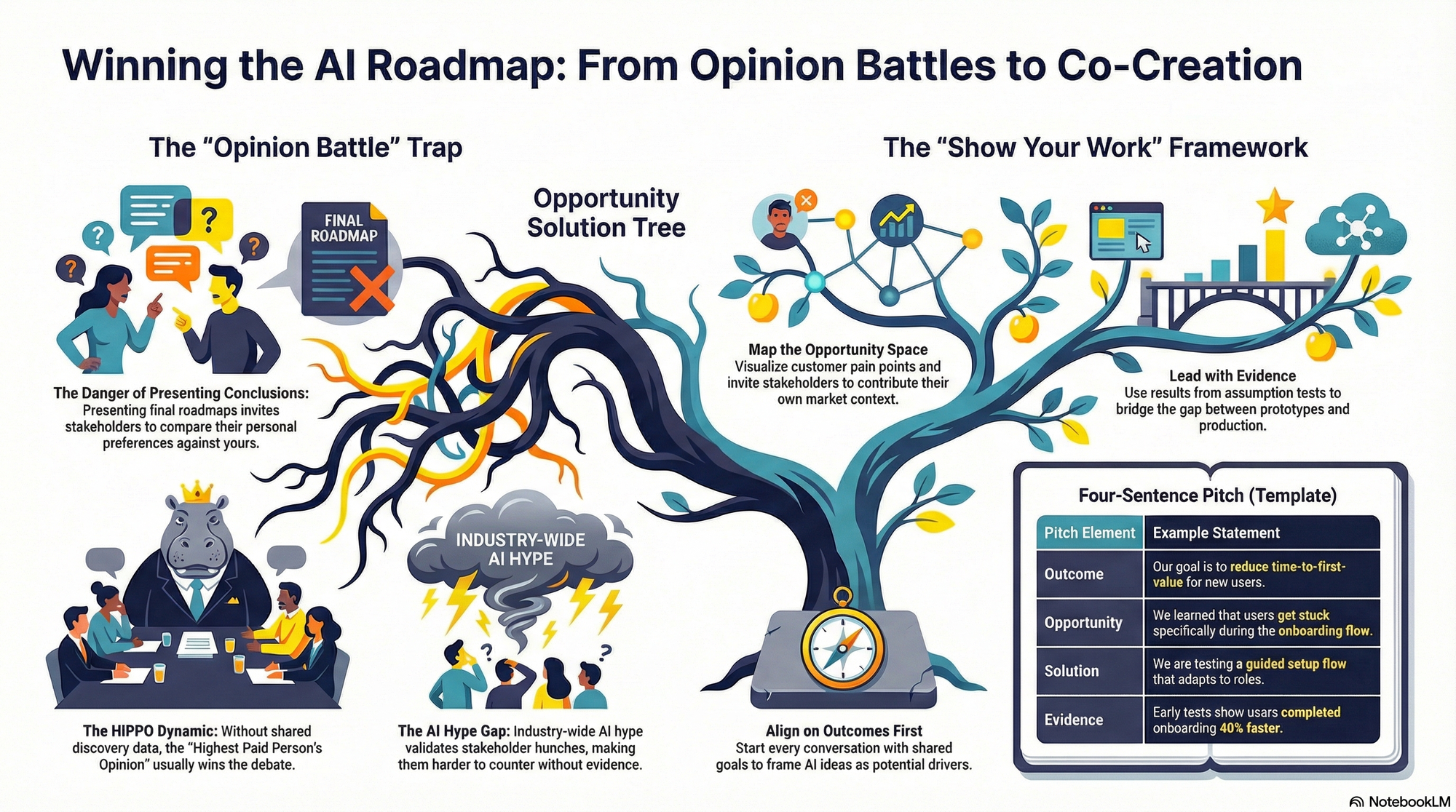
    Here’s the most common trap I see (and have fallen into): focusing stakeholder reviews on the roadmap, release plan, or prioritized backlog. That invites an opinion battle. And stakeholders have their own conclusions—usually shaped by the last customer call, a board meeting, or a market headline.

    This is how the HiPPO dynamic gets created. HiPPO stands for the “Highest Paid Person’s Opinion,” and the saying goes, “The HiPPO always wins.” When we present conclusions without the journey, we set ourselves up to lose. In the gen ai rush, the chorus of “everyone is doing AI” makes that opinion even harder to counter.

    So I don’t try to win opinion battles. I bring new information—fresh customer interviews, clear opportunity mapping, and results from assumption tests. The gap between what the market hypes and what customers actually need is often enormous. Our edge is evidence.

    The strategy that consistently works for me is simple: show your work. If you’re practicing continuous discovery, your opportunity solution tree isn’t just a thinking tool—it’s your strongest stakeholder management asset. It helps you build confidence in your decisions, and it can help your stakeholders build the same confidence.

    Infographic for product teams on stakeholder management, outlining the trap of anchoring in solution space, the HiPPO consequences, and the lever of bringing new discovery insights and data.
    Avoid the stakeholder trap of selling conclusions. This visual shows how anchoring on solutions invites HiPPO battles—and how to shift the conversation by sharing discovery evidence, insights, and data.

    Step 1 — Start with the outcome. I open every conversation by restating the shared goal and asking whether anything has changed. Anchoring on outcomes vs output OKRs reframes hot-button solution debates (like “we need an AI feature”) back to what will move the needle on the outcome we agreed to pursue.

    Step 2 — Share the opportunity space. I show how we mapped customer needs, pain points, and desires. Then I ask, “What did we miss?” Stakeholders often surface opportunities we haven’t seen yet—signals from the field, market shifts, or partner feedback. I capture their input and commit to validating it in upcoming customer interviews.

    Step 3 — Walk through prioritization. Using the tree’s structure, I explain why we prioritized one branch over another. Then I ask where they might have chosen differently. This turns debate into collaboration and lets me leverage their expertise without ceding the discovery framework.

    Step 4 — Go deep on the target opportunity. Before we talk solutions, I make the customer’s problem vivid and real. Interview snapshots help stakeholders empathize and see what matters most. Once the opportunity is crisp, solution discussions become dramatically more objective.

    Infographic titled A Better Stakeholder Management Strategy: Show Your Work, showing seven steps for product teams using the Opportunity Solution Tree to align outcomes, prioritize, test assumptions, and iterate.
    Show your work, not just your conclusions. This infographic guides product teams through seven steps to build stakeholder confidence—align on outcomes, map opportunities, prioritize, test assumptions, and repeat.

    Step 5 — Share solutions and invite theirs. I present our solution set and explicitly ask for additional ideas. If their suggestions diversify our set, we include them. Solution ideas are cheap; the opportunity is what matters. This is where product trios can benefit from leadership’s pattern recognition and industry context.

    Step 6 — Share your assumption tests and results. I walk through our story maps, high-risk assumptions, and what we’ve learned so far. I invite stakeholders to add assumptions—this is where their knowledge shines. If we have data, we share it; if we’re pre-data, we share the plan to get it and ask for feedback.

    Step 7 — Repeat. I don’t batch this into a big reveal. I keep a steady cadence and tailor depth to each audience: weekly for my manager, monthly highlights for marketing, and concise updates for executives. Continuous discovery pairs with continuous stakeholder management.

    Showing your work doesn’t mean drowning people in detail. It means tailoring the signal to the audience. My rule of thumb is outcome, opportunity, solution, evidence—walk the lines of the tree at the right altitude for each stakeholder.

    Infographic for product teams on tailoring stakeholder communication. A smart-filter funnel turns the full discovery journey into updates for a direct manager, marketing counterpart, and CEO.
    Show your work the right way for each stakeholder. Use a smart filter to turn discovery noise into clear signals—weekly journeys for your manager, focused monthly highlights for marketing, and a 30-second CEO pitch.

    In a 30-second update with a CEO, it might sound like this:

    “Our goal is to reduce time-to-first-value for new users. We’ve been interviewing customers and learned that onboarding is where most people get stuck—specifically, they don’t know which features to try first. We explored a few approaches and tested them. The most promising one is a guided setup flow that adapts based on the user’s role. In early tests, new users completed onboarding 40% faster.”

    That pattern works across channels—Slack updates, monthly reviews, or quarterly planning. The format flexes, the structure doesn’t: outcome, opportunity, solution, evidence.

    As you adopt this approach, watch for four anti-patterns that quietly erode trust.

    Infographic titled Four Anti-Patterns That Destroy Stakeholder Trust, listing: 1) telling instead of showing, 2) shooting down stakeholder ideas, 3) saving for a big reveal, 4) fighting the ideological war.
    Avoid the traps that erode stakeholder trust. This infographic guides product teams to show their work, welcome ideas, provide frequent updates, and prioritize results over ideology to build alignment and credibility.

    Anti-pattern 1 — Telling instead of showing. The curse of knowledge makes our conclusions feel obvious to us and opaque to others. The fix: slow down, start at the top of the tree, walk the decisions, and let stakeholders reach the conclusion with you.

    Anti-pattern 2 — Shooting down stakeholder ideas. As you build a library of validated assumptions, it’s easy to spot flaws in a suggestion and say “no” too quickly. Instead, place their idea within your discovery framework. If it maps to a different opportunity, say, “That idea has promise—we’ll consider it when we address that opportunity.” If it rests on risky assumptions, story map the idea together, list the assumptions, and share what you’ve already learned. People accept the evidence they help generate.

    Anti-pattern 3 — Saving everything for a big reveal. Infrequent, comprehensive updates invite opinion battles because stakeholders have formed their own conclusions in the dark. Short, frequent updates build alignment as the work unfolds.

    Anti-pattern 4 — Fighting the ideological war. Sometimes a more senior stakeholder will overrule you. Don’t turn it into a debate about how product decisions “should” be made. Focus on the decision at hand, do the best work within constraints, and let results—not ideology—prove the value of discovery over time.

    Infographic for product teams on stakeholder management as co-creation, showing four steps: stop selling, invite co-creation, leverage stakeholder expertise, and transform relationships.
    Shift from selling to showing. This co-creation guide invites stakeholders into discovery, taps their expertise, and turns relationships from obstacles into partnerships for smarter product decisions.

    Here’s the mindset shift that changes everything: stakeholder management is a co-creation opportunity. When we show our work with artifacts like an opportunity solution tree, experience maps, and interview snapshots, we’re not just communicating—we’re inviting collaboration. We’re leveraging stakeholders’ expertise, context, and connections to make better product decisions.

    When stakeholders have walked the path with us, they don’t need to be sold on the destination. They become allies. Engagement stops being a status ritual and starts being real partnership—the kind that moves outcomes and builds durable trust.

    Try this in your next review: don’t start with your roadmap. Start at the top of the tree. Reaffirm the outcome. Share the opportunity space. Explain your prioritization. Show what you’re learning. Invite contribution. You might be surprised how quickly alignment—and confidence—follow when you stop selling conclusions and start showing your work.


    Inspired by this post on Product Talk.


    Book a consult png image