
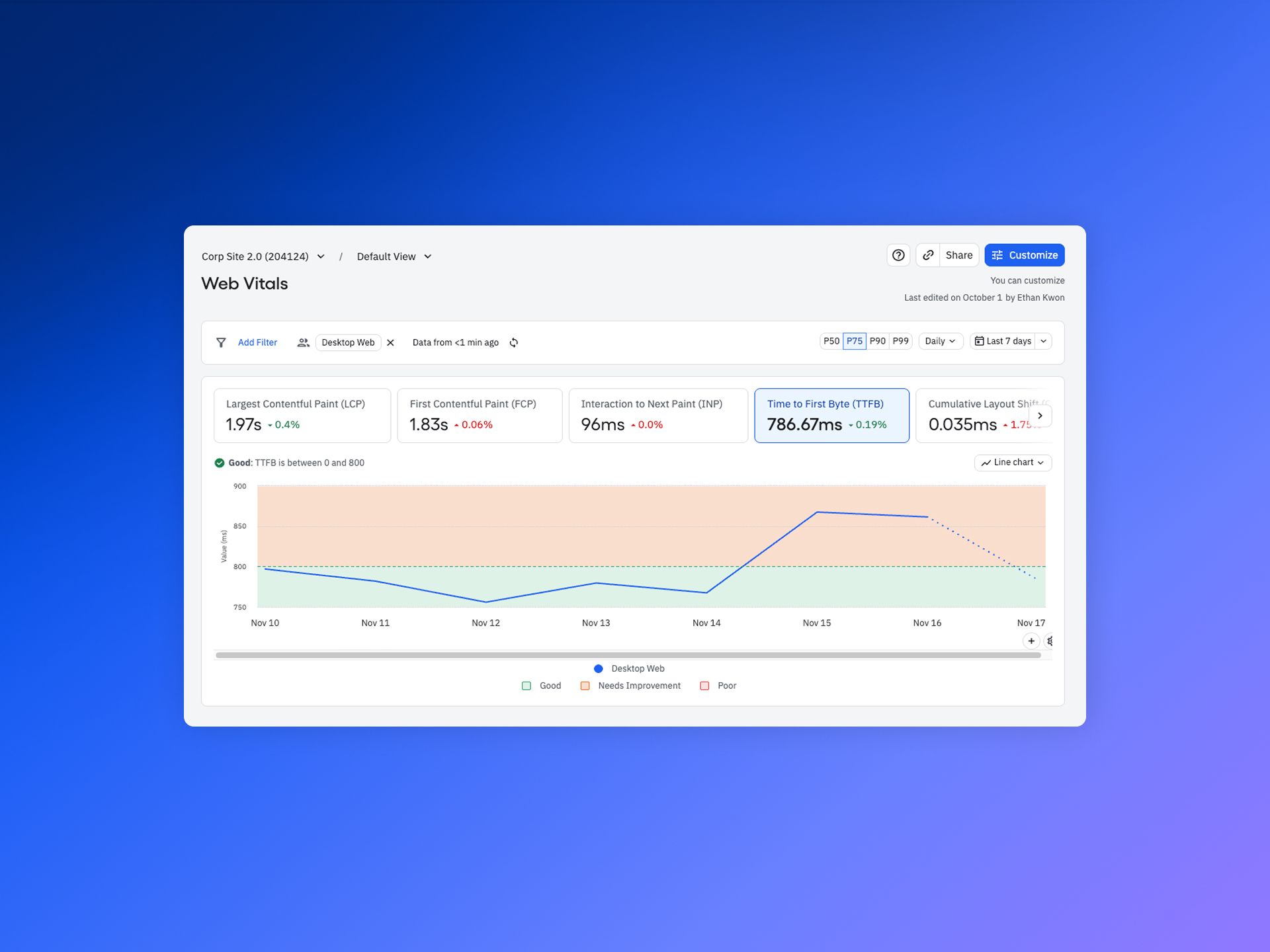
I obsess over the moments that make or break user trust: how fast a page paints, how responsive it feels, and how stable it stays as content loads. Web Vitals are the clearest lens I have to connect those micro-moments to macro outcomes—activation, conversion, retention, and, yes, SEO ranking. Bringing those signals into Amplitude lets me translate web performance into product decisions that move the business.
Now in Amplitude, improve your website user experience and SEO ranking by measuring and taking action on your Web Vitals.
In practice, I focus on the Core Web Vitals—Largest Contentful Paint (LCP), Interaction to Next Paint (INP), and Cumulative Layout Shift (CLS)—and instrument them as event properties so I can segment by page type, device, geography, traffic source, and user cohort. That gives me a single source of truth that aligns engineering performance work with product metrics like activation and revenue, all inside a unified analytics platform.
My workflow is straightforward: I instrument Web Vitals in the client (sampling if needed), stream them into Amplitude, and build dashboards that pair performance distributions with key funnels. I look for thresholds—where a user’s LCP or INP crosses a boundary and their likelihood to convert or retain drops. When I see those cliffs, I know exactly which pages or audiences to target and which improvements unlock the most value.
From there, I run experiments. A/B testing on navigation layout, image optimization, or lazy-loading strategies helps me validate that a performance lift also drives a statistically significant improvement in conversion or retention. Because the analysis lives in Amplitude, I can quickly cohort users by performance experience (for example, “green” vs “yellow” LCP) and quantify how much better experiences translate into business outcomes—reducing the risk of shipping changes that only move a synthetic score without helping users.
SEO benefits are a welcome compounding effect. When I push more sessions into the “good” Web Vitals range, I typically see lower bounce rates, stronger session depth, and better engagement—signals that support search performance. I treat rankings as an outcome of great user experience rather than the goal itself; by improving real-user metrics, I earn durable gains that don’t evaporate with the next algorithm change.
Operationalizing this is crucial. I define product-level service objectives for LCP, INP, and CLS by key page groups, review them in QBRs alongside activation and retention, and set guardrails so performance never regresses during feature velocity. This turns performance into a habit for empowered product teams rather than a one-off initiative.
If you’re starting fresh, begin with a narrow slice: instrument Web Vitals on your top three entry pages, visualize their distributions in Amplitude, and overlay conversion and retention. Within a week, you’ll see where experience degrades for specific cohorts and have a prioritized, testable roadmap for improvement. The fastest path to better UX and growth is making performance visible where you already make product decisions—and that’s exactly what this workflow delivers.
Inspired by this post on Amplitude – Best Practices.








Leave a Reply