
Once I’ve defined the right roles on my team, the next move is to design an operating model that makes progress a habit. My goal is simple: every interaction should strengthen the system so the AI Agent keeps improving over time.
I anchor the team on a mantra that has never failed me: “The first time you answer a question should be the last.” That single statement reframes support as a compounding system rather than a one-off activity.
The ambition is to ensure every resolution makes the next one faster and more accurate, so fewer issues repeat, quality compounds, and support scales naturally. That doesn’t happen by accident—it requires intentional design.
In practice, this comes down to four essentials: clear ownership of performance, guardrails that make iteration fast and safe, feedback loops that turn learning into routine upgrades, and a culture that celebrates the work of improvement—not just the outcomes. Here’s how I put that into play.
First, I start with clear ownership. Ambiguity is one of the most common reasons AI performance plateaus. When no one truly owns how the AI Agent performs, feedback gets lost, issues linger, and improvements stall.
On high-performing teams, I assign a single owner—often an AI ops lead—responsible for making the AI Agent better. They review resolution trends to spot underperformance, make targeted updates to content, configuration, and behavior, coordinate with product and engineering on systemic blockers, and set improvement priorities, targets, and timelines. The title matters less than the mandate; what matters is clear authority to drive change across teams.
Real-world example: At Dotdigital, AI performance plateaued after a strong start—resolving around 2,800 conversations per month for three consecutive months. To drive resolution rates up, the team created a dedicated support operations specialist role, filled by an experienced agent with deep product knowledge. This person will focus on refining snippets, improving content, and enhancing the AI’s resolution capabilities.
Second, I make iteration fast and safe. As the AI Agent takes on more volume and complexity, change can start to feel risky—so teams hesitate, and performance stalls. Lightweight governance fixes that by making the path from insight to action predictable.
I keep the rules simple and explicit: which changes need review (and which don’t), who the decision-makers are, how we test updates before they go live, where feedback flows so it’s seen and acted on, and when progress gets reviewed on a steady cadence. Governance isn’t bureaucracy—it’s what keeps improvement routine and safe.
Real-world example: Anthropic ran a focused “Fin hackathon” sprint to improve their AI Agent’s resolution rate. The team audited unresolved queries, identified underperforming topics, and created or updated content to close gaps. They converted frequently used macros into AI-usable snippets, monitored Fin’s performance during live support, and continuously refined content based on real interactions. This structured approach enabled rapid improvement while maintaining quality standards.
Third, I build a system that learns by default. AI performance isn’t static, but many organizations treat it like a one-time implementation. The most successful teams operationalize learning: they analyze where the AI Agent struggles and feed those insights directly into structured improvements.
The signals are straightforward: review common handoffs to humans, track unresolved queries by topic or intent, measure resolution rate trends over time, and use those inputs to prioritize fixes and content upgrades. Whether you follow a formal loop like the Fin Flywheel framework or something lighter, the goal is the same—make improvement inevitable.
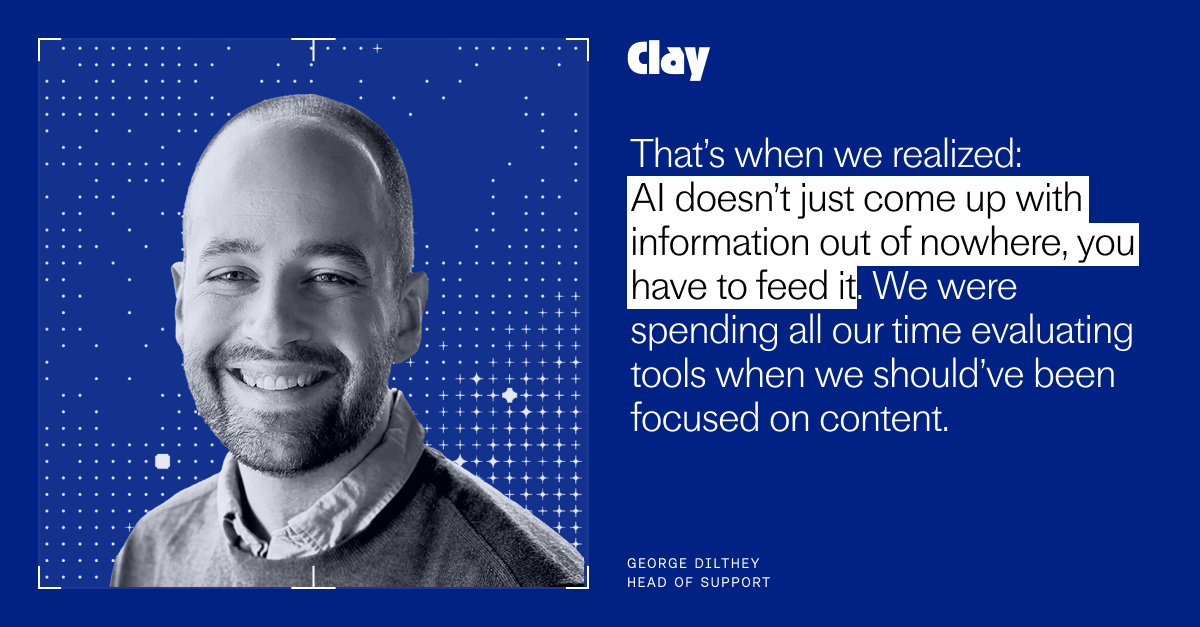
Fourth, I treat content as competitive infrastructure. Your AI Agent is only as good as what it knows. As George Dilthey, Head of Support at Clay, put it: “That’s when we realized: AI doesn’t just come up with information out of nowhere, you have to feed it. We were spending all our time evaluating tools when we should’ve been focused on content.”
I operationalize knowledge like infrastructure: every topic has a clear owner, content is structured, versioned, and ingestion-ready, new products ship with source-of-truth content by default, and changes ship on a schedule—not when someone finds time. This is the backbone that differentiates teams who scale confidently from those who stall out.
In my organization, we’ve evolved our New Product Introduction (NPI) process by aligning early with R&D on a single, canonical source of truth that becomes the foundation for all downstream content—including what the AI Agent uses to resolve queries. By embedding content creation into launch readiness, not as an afterthought, we’ve consistently hit 50%+ resolution rates on new features from day one.
Finally, I make belief visible. Even the best system will stagnate if people stop believing in it. Belief can fade quietly unless you reinforce it on purpose. I keep it strong by sharing specific wins regularly, highlighting improvements with metrics, and recognizing the people behind the gains—then giving them space to lead. This isn’t just about morale; it keeps everyone aligned on the bigger play.
When you put it all together—clear ownership, safe iteration, a learning system by default, and content as infrastructure—AI performance compounds. As the AI Agent gets better, the entire support model becomes faster, more reliable, and truly scalable. That’s the foundation of a modern, AI-first support organization.
Next, I’ll take this a level deeper and share how capacity planning changes when AI handles the majority of inbound volume and your team shifts into higher-value roles. If scaling with confidence is the goal, this is where the operating model pays off.
Inspired by this post on The Intercom Blog.





Leave a Reply