
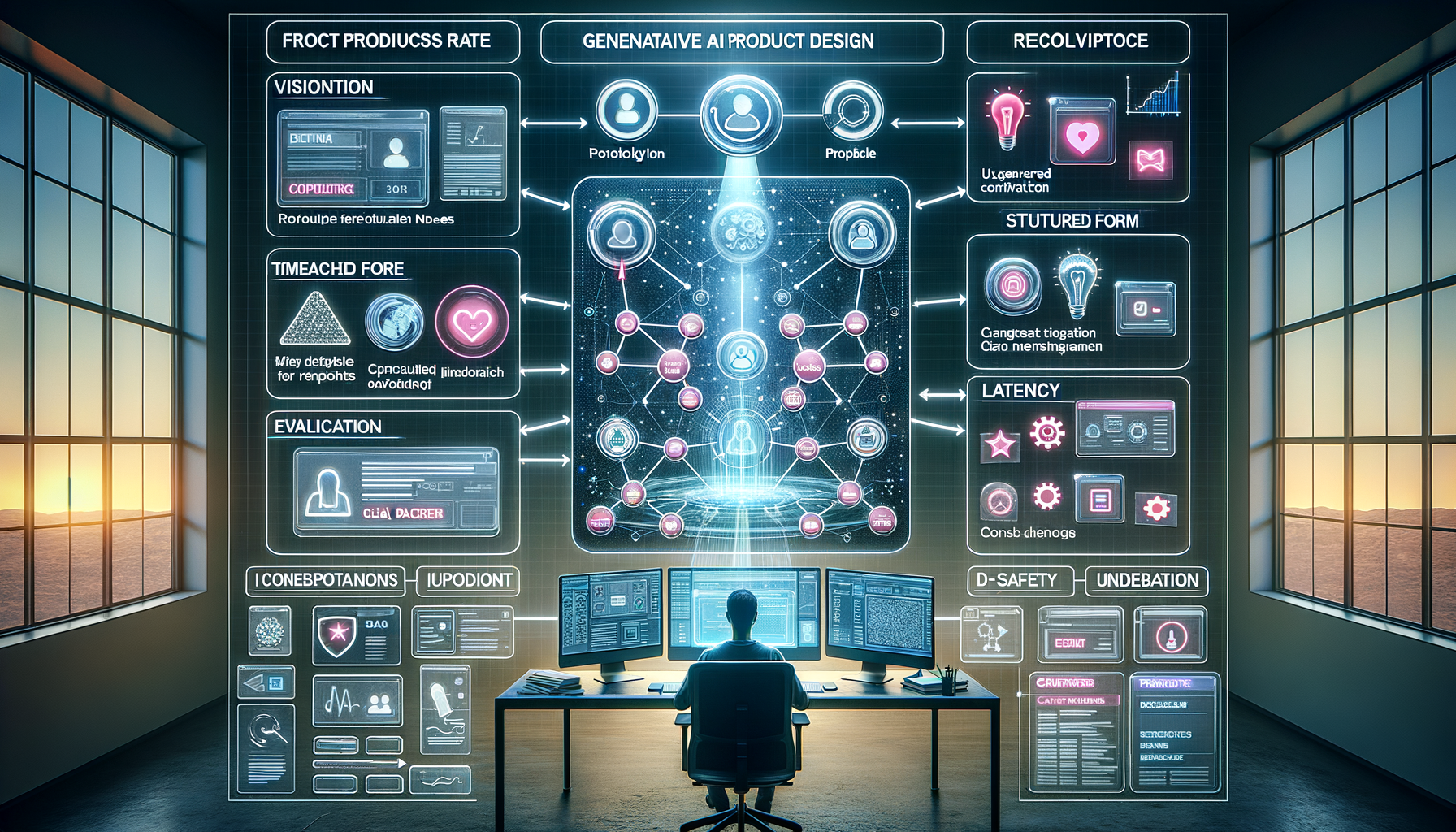
Product, design, and AI now converge at the center of how we build value. In my role leading product teams at HighLevel, Inc., I’ve experienced firsthand how generative AI amplifies the craft of product management and product design when we keep the fundamentals tight: clear problems, measurable outcomes, and deep collaboration across disciplines.
The mission hasn’t changed—deliver useful, usable, and trustworthy experiences—yet the means have. Generative AI expands our exploration space, speeds up iteration, and helps us reason over messy, real-world data. When we marry rigorous product discovery with thoughtful design and responsible AI strategy, we move from novelty to durable impact.
In discovery, I use AI to frame hypotheses, generate research questions, cluster customer feedback, and synthesize interview notes—without replacing direct conversations with customers. The goal is sharper insight, faster. I define outcomes in customer language, pressure-test assumptions, and trace every proposed AI capability to a clear job to be done. These habits keep us anchored to product-market fit lessons rather than shiny demos.
For prototyping, I pair designers with forward deployed engineers to build realistic vertical slices quickly. We practice gen ai for product prototyping by wiring prompts, system instructions, constrained outputs, and lightweight evaluators into clickable flows so we can test usefulness early. This reduces risk and helps the team learn which interaction patterns—chat, form, or guided workflows—fit the problem best, especially in product creator experiences.
Designing AI-powered UX means embracing uncertainty without eroding trust. I favor patterns like transparent confidence cues, citations or references where possible, editable outputs, easy undo/redo, and clear pathways from draft to commit. Good empty states, contextual examples, and progressive disclosure teach users how to get high-quality results while keeping them in control.
Quality requires a measurement backbone, not vibes. I define target tasks and build golden datasets, then run offline evaluations before online experiments. The core metrics stay consistent: task success rate, user confidence, time-to-first-value, latency budgets, and cost per resolution. We harden experiences with guardrails, hallucination checks, safe fallbacks, and escalation paths to humans when the model is uncertain.
Responsible AI is a product requirement, not a checkbox. I design for privacy-by-default, PII minimization, and secure data handling; I track prompt and model versions; and I test for bias and accessibility from the outset. Human-in-the-loop review, auditability, and transparent change logs protect users and the business as features evolve.
Go-to-market is part of the product. Clear onboarding, explainers, and in-product education reduce time to value. I align customer support ai strategy with telemetry so support teams can triage AI-specific issues, capture edge cases, and channel learning back into prompt libraries, data pipelines, and design improvements.
From a leadership standpoint, I set strategic guardrails and empower autonomous teams. Product management leadership owns outcomes and decision quality; design leads shape multimodal experiences; engineering owns reliability and performance; and our AI platform team standardizes evaluation, safety, and cost controls. This clarity accelerates learning and throughput.
Recently, we shipped an AI-assisted creation flow that reduced manual steps, improved time-to-first-value, and drove adoption among new users. The win wasn’t a clever prompt; it was disciplined product discovery, fast iteration with realistic data, and a crisp definition of success before we scaled.
If you’re just starting, pick one high-value, low-risk use case, define success in customer terms, and build a thin vertical slice with evaluations and guardrails. Put it in front of real users, instrument everything, and iterate until the experience feels fast, predictable, and genuinely helpful.
The intersection of product, design, and AI will keep evolving, but the bar remains the same: ship outcomes customers care about. When we combine the leverage of generative AI with sound product discovery and strong product design, we turn vision into value—reliably and repeatably.
Inspired by this post on SVPG.







Leave a Reply