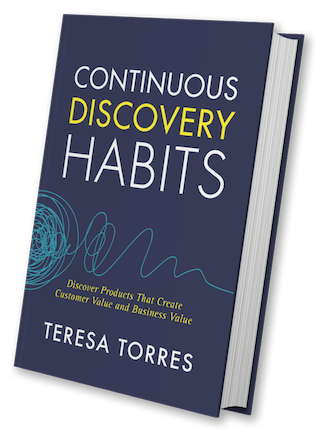
Five years in, Continuous Discovery Habits continues to be one of the most practical frameworks I use to align empowered product teams, sharpen product strategy, and convert customer interviews into outcomes. To celebrate its impact, I’m hosting a community read-along and inviting you to dig in with me this May.
Each month, I’m releasing an in-depth reading guide to make learning stick. You’ll find the chapters we’ll be reading, a preview of the essential concepts, short videos to help you spread the ideas across your organization, individual and team discussion prompts, team exercises to put the concepts into practice, and additional reading if you want to go deeper. My goal is simple: help you turn product discovery into a steady habit, not a once-a-quarter activity.
We’ll discuss each month’s reading in the comments, and we’ll gather quarterly on a live call to compare notes and share what’s working. Joining late is absolutely fine—I monitor the conversation throughout the year. Start with the current month or rewind to January; you can ask for help, share wins and roadblocks, and connect with other readers anytime.
If you want to participate, grab a copy of the book (or dust off your old one), share the "Spread the Love" videos with your team, block focused time for the exercises, and register for the community sessions. Let’s do this together.
This Month’s Reading
Chapter: Chapter 6: Mapping the Opportunity Space
Estimated reading time: ~23 minutes
This month’s chapter will introduce you to why opportunity mapping is critical for structuring the ill-structured problem of reaching your desired outcome; how to move from overwhelming opportunity backlogs to well-structured opportunity spaces; the power of tree structures for depicting parent-child and sibling relationships between opportunities; how to identify distinct branches in your opportunity space using key moments in time; common anti-patterns to avoid when building your first opportunity solution tree; and why structure "gets done, undone, and redone" as you continue to learn.
Need a copy? Grab the book.
Share the Love with Friends and Colleagues
We learn best in community. Use these short videos to spread the core concepts from this chapter—then invite your team to join the book club with you.
The need for opportunity mapping – You will never fully satisfy your customers' desires
Understanding the structure of an opportunity solution tree – Depicting two types of relationships
Turn big intractable problems into smaller, more solvable problems – The power of decomposition
How to map an opportunity space – Getting started with opportunity solution trees
A well-structured opportunity space has distinct branches – Identify key moments in time
Reflect & Discuss What You Read
Reflection turns reading into capability. This chapter asks us to shift from reacting to every request to deliberately structuring the opportunity space. If you’ve ever felt overwhelmed by a never-ending backlog or pressure to ship output over outcomes, this is where the fog starts to lift. As you read, focus on how your team currently organizes (or doesn’t organize) what you hear from customers.
Individual Reflection
1) Think about your current product backlog or opportunity list. Is it a flat list, or do you have some structure to it? If you were to group similar opportunities together, what patterns would emerge?
2) When was the last time you heard a customer need and immediately jumped to a solution without exploring whether there were related opportunities? What would change if you took the time to map how that opportunity connects to others?
3) Review the anti-patterns from the chapter (opportunities framed from your company's perspective, vertical opportunities, opportunities with multiple parents, etc.). Which of these do you recognize in how your team currently talks about opportunities?
Team Discussion
1) As a team, pick a top-level opportunity you're currently working on. Try breaking it down into sub-opportunities together. Where do you struggle? Where do you disagree about how to frame or group opportunities? What does that tell you about gaps in your shared understanding?
2) Look at your experience map (from Chapter 4) and identify 3-5 distinct moments in time during your customer's experience. Could these become the top-level branches of your opportunity solution tree? Where do you see overlap, and where are there clear distinctions?
3) Discuss the quote from Barbara Tversky: "Structure gets done, undone, and redone." How does your team currently respond when you discover new information that changes how you understand the opportunity space? Do you treat your opportunity map as fixed or as something that evolves?
Put It Into Practice
Reading is step one; building your first opportunity solution tree is where the real learning happens. The exercises below are exactly how I coach product trios to transform ambiguous problems into aligned action.
Exercise: Build Your First Opportunity Solution Tree
Time: 60 minutes. Do this: With your product trio.
Start by reviewing your interview snapshots from the past few weeks. For each opportunity you captured, ask the three questions from the chapter:
Is this opportunity framed as a customer need, pain point, or desire (not a solution)?
Is this opportunity unique to one customer, or have we seen it in more than one interview?
If we address this opportunity, will it drive our desired outcome?
Then, using your experience map, identify 3-5 distinct moments in time to serve as your top-level opportunities. Group the opportunities from your interviews under these top-level branches.
Look for opportunities to add structure to each branch. Group similar opportunities together and identify a parent opportunity. Look for vertical stacks (one parent, one child) and fill in missing siblings. Reframe opportunities that are too broad or that could live in multiple branches.
Don’t aim for perfection. Get something on paper (or a digital canvas) and iterate the tree with every new interview.
Exercise: Practice Framing Opportunities from Your Customer’s Perspective
Time: 30-45 minutes. Do this: With your product trio.
Take 10-15 opportunities from your current backlog or list. For each one, ask: "Can I imagine a customer saying this?" If the answer is no, reframe it from your customer’s perspective. For example:
"Increase subscription conversions" becomes "I want to know if this product is worth paying for"
"Reduce support tickets" becomes "I can't figure out how to do X"
"Improve onboarding completion" becomes "I'm not sure what to do next"
This exercise helps you spot business-centric opportunities disguised as customer opportunities. It also trains your team to listen for opportunities in interviews that are framed from the customer’s point of view.
Go Deeper: Additional Reading
If you prefer an audio summary of this month’s reading, including the book chapters and the following resources, I’ve included an audio version for paid subscribers at the bottom of this post.
Related In-Depth Guides
Opportunity Solution Trees: Visualize Your Discovery to Stay Aligned and Drive Outcomes
Customer Interviews: Uncover Hidden Insights from Every Conversation
Supplementary Reading
Prioritize Opportunities, Not Solutions
Product in Practice: Opportunity Mapping at Grailed
Product in Practice: Opportunity Mapping at trivago
7 Key Benefits of Using Opportunity Solution Trees
Getting Started with Opportunity Solution Trees at SuperAwesome
Bringing Order to Chaos: Using Opportunity Solution Trees in Everyday Life
Other Voices
Why Groups Struggle to Solve Problems Together by Al Pittampalli
More PM Problem Areas by Marty Cagan
Five Superpowers of Diagrams by Abby Covert
Critical Thinking is Product Management by This Is Product Management
Our Live Discussion Schedule
Our live discussion sessions are for paid subscribers. Sessions are not recorded. Invitations will go out to Supporting Members and CDH Members two weeks before the scheduled event. But reserve the time on your calendar now.
Tuesday, June 16, 2026: 9am-10am PDT
Thursday, September 17, 2026: 9am-10am PDT
Wednesday, December 16, 2026: 9am-10am PST
Audio Summary
This summary was produced by NotebookLM. The sources supplied were the book chapters as well as all of the additional reading.
Inspired by this post on Product Talk.