
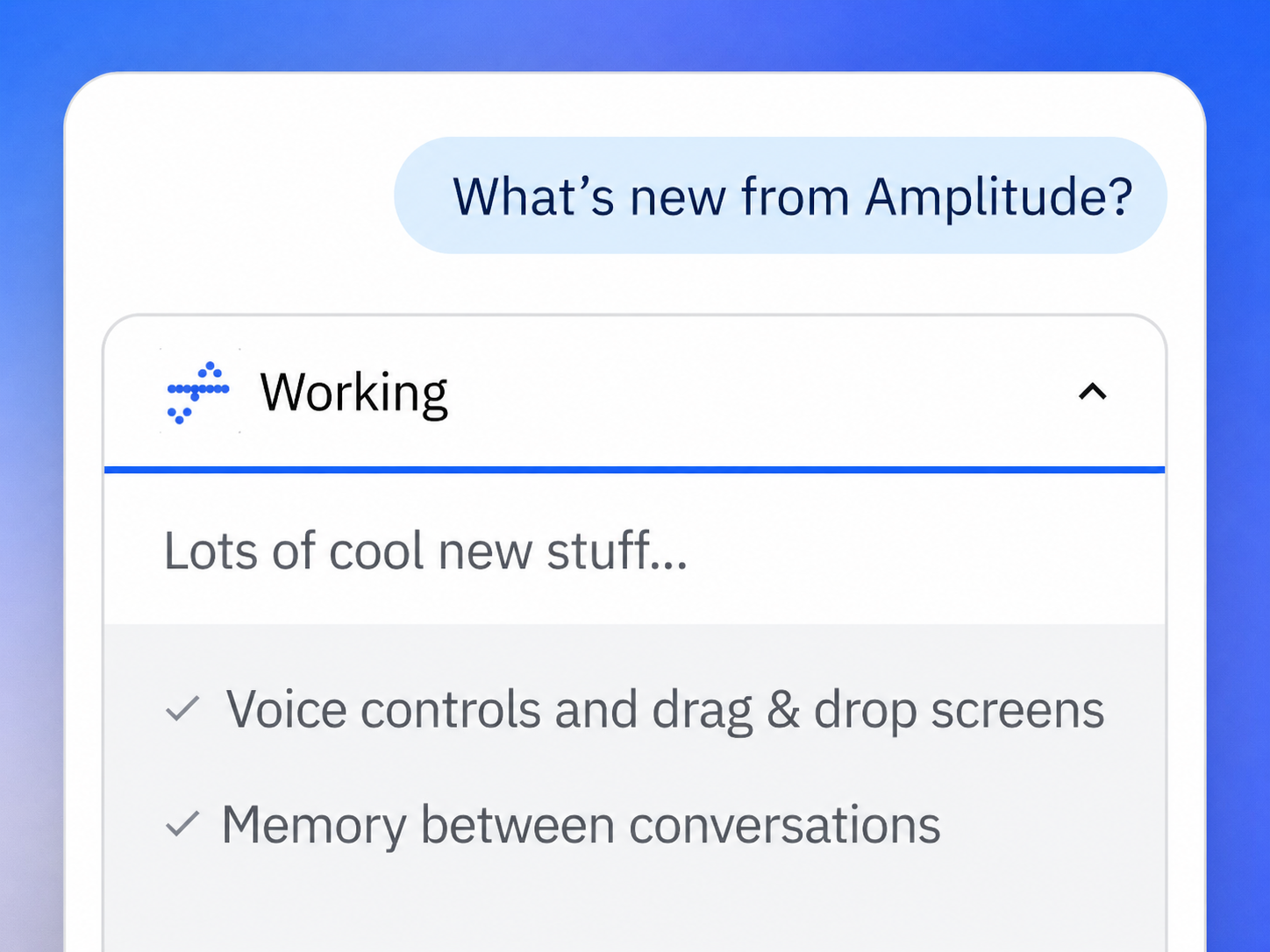
I’ve been deep in the work of turning agentic AI from a promising idea into reliable, measurable outcomes. Today, I want to share a concise, practitioner’s update on what’s new with Amplitude Agents—and, more importantly, how to get real value fast using proven product management techniques.
We launched AI Agents a few weeks ago. We’ve been shipping pretty fast since then, so we wanted to loop you in on what’s new and what’s worth trying.
Rapid releases only matter if they translate into user value. My approach is to treat every agent improvement as a learning opportunity: instrument it, set clear success metrics, run controlled experiments, and iterate. This eval-driven development mindset keeps us honest about what’s truly working in the wild.
If you’re trying Amplitude Agents now, start with a narrowly scoped, high-signal workflow where success is unambiguous—think a single journey with a clear “done” state. Connect the experience to your unified analytics platform so you can see the full picture across events, funnels, and cohorts. In practice, I lean on Amplitude analytics and Agent Analytics to make this visibility effortless.
Define how you’ll measure impact before you ship. Identify activation and completion events, baseline them, and then A/B test your agentic AI flow against the status quo. Behavioral analytics will show whether users are discovering the agent, sticking with it, and returning for more. When the story in the data is clean, it’s much easier to scale the win.
Hardening matters as much as headlines. As you expand use, apply sensible guardrails—input validation, clear prompts, and transparent handoffs to deterministic flows when confidence is low. Pair this with observability so you can spot anomalies early and recover gracefully. These practices reduce risk while preserving the speed and creativity that make AI workflows powerful.
Once the basics are working, dig into adoption patterns: segment by cohort, study user activation paths, and run retention analysis to find where the agent is truly changing behavior. These insights shape roadmap priorities and help you invest in the moments that drive durable value.
We’ll keep shipping quickly and sharing practical guidance. If you have feedback, experiments to showcase, or questions about instrumentation, send them our way—I use that signal to refine our next set of improvements and learning agendas. Expect more short, focused updates and deeper dives on evaluation frameworks, prompt strategies, and rollout playbooks.
In short: keep it scoped, instrument everything, test deliberately, and let the data guide your next move. That’s how Amplitude Agents becomes not just new, but indispensable.
Inspired by this post on Amplitude – Best Practices.






Leave a Reply