
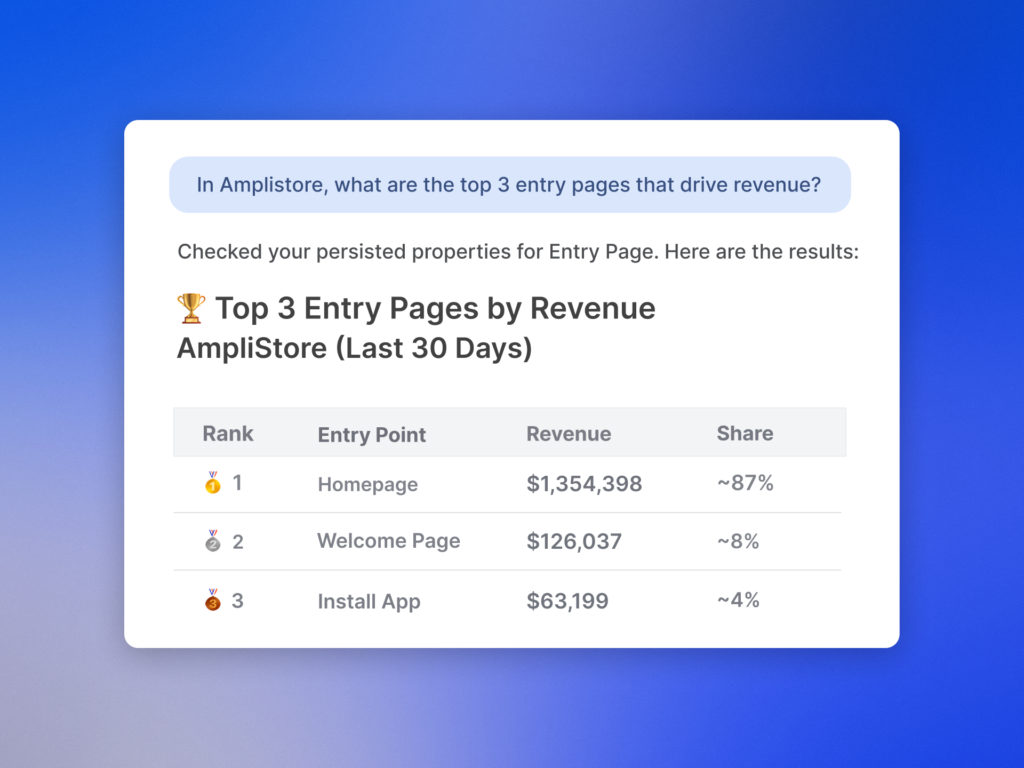
When I guide teams building agentic AI features, I’ve seen a single prompt turn Amplitude Global Agent into either a world-class analyst or a well-meaning rambler. The difference isn’t magic—it’s method. With the right structure and iteration, we consistently get faster, clearer insights that stand up to product and analytics scrutiny.
AI has gotten really good, but success still depends on the quality of your prompts. Explore three best practices for prompting in Amplitude Global Agent.
Tip 1 — Define the role, goal, and guardrails. I begin every prompt by stating the agent’s role (for example: “You are a product analyst”), the business objective (“identify activation drop-offs by cohort”), and the boundaries (“use only Amplitude analytics events and properties provided; return JSON with metric, segment, timeframe”). This simple pattern reduces ambiguity, improves context window management, and yields outputs I can compare across runs.
Tip 2 — Ground the model with concrete context and examples. Agent outputs improve dramatically when I supply the exact data it should reference: event names, properties, segments, filters, and timeframes. I often include a short example—one ideal question and one ideal answer—to anchor tone, structure, and depth. Think retrieval-first pipeline: feed the agent authoritative snippets (definitions, dashboards, prior queries) rather than hoping it guesses. That’s how I cut hallucinations and make results reproducible for LLMs for product managers.
Tip 3 — Iterate with measurement, not vibes. I version prompts, A/B test variants, and log inputs/outputs so I can score quality with lightweight evals (accuracy against known answers, clarity, and actionability). Over time, a small library of “winning” prompts emerges for common AI workflows—activation analysis, retention cohorts, anomaly detection—so the team can move from tinkering to repeatable performance. This is where Agent Analytics practices pay off: we inspect outcomes, not just outputs.
A practical starter structure I use: Role and Audience; Objective and Success Criteria; Data Context (events, properties, segments, timeframe); Constraints (sources, methods, privacy); Output Format (tables/JSON, fields, length); Examples (one good Q/A); and Fallbacks (what to do when data is insufficient). Even written as plain language, that scaffold reliably steers Amplitude Global Agent to precise, defensible answers.
The emotional arc here is familiar: when the agent nails a complex funnel question in one pass, the team gets that “oh wow” moment; when it meanders, morale dips. Clear prompting turns those spikes of delight into a steady cadence of wins—less rework, faster learning loops, and cleaner handoffs from discovery to delivery. In short, invest in prompt engineering once, and you compound gains across every analysis session.
If you’re just getting started, pick one critical question (for example, activation or retention), apply the three tips above, and commit to two to three prompt iterations with scoring. Within a single sprint, you’ll have a robust template you can reuse and adapt—helping Amplitude Global Agent deliver trustworthy insights at the speed your product strategy demands.
Inspired by this post on Amplitude – Perspectives.




Leave a Reply