Built for Your Biggest Days: How We Engineer Fair, Reliable Scale Without Downtime
I’m getting sharper, more specific questions about scale from enterprise customers every quarter, and that’s exactly how it should be. Teams want to know how our platform behaves during their highest-volume moments — the Black Friday sales, the sporting events, the production incidents — and they want confidence their growth won’t outpace the systems they depend on.
We welcome those questions. They’re the right ones to ask of any critical component of your business.
Today, our systems handle serious scale. At daily peak, we see over 150,000 customer requests per second coming into the platform, with more than 70,000 asynchronous requests per second flowing through the background systems. During our busiest days of the week, we handle over five million conversations and more than 100 million comments being added across the platform.
We also design for individual customer spikes, not just aggregate platform traffic. We can handle a single customer workspace spiking with hundreds of comments per second, or around 100 new conversations per second. Sustained over a full day, that would map to millions of conversations from a single customer.
While those numbers matter, they age quickly. Every growing software company can publish a bigger number every year, month, week. What ultimately matters is whether the architecture has clear scaling levers, whether we understand the pressure points in the system, and whether we can add capacity before customers need it.
Every system has limits. Competence is knowing where they are, measuring them, and moving them before customers reach them.
Here’s how we do that in practice.
We build on boring foundations because at the edges, we try hard not to be clever. We use AWS for the infrastructure primitives AWS is very good at running. We do not want our engineers spending their best energy recreating S3, load balancers, queues, or commodity infrastructure patterns. We want that energy spent on the parts of the system that are specific to our customers and our product.
“That is a deliberate trade-off. It gives us fewer systems to understand, deeper expertise in the ones we do run, and more leverage when we need to scale.”
This extends a principle I’ve embraced for years: run less software. The point isn’t to minimize the stack for its own sake; it’s to compound expertise. When many teams build on the same small set of technologies, our tooling, observability, and operational practice all improve together. Boring technology choices aren’t a lack of ambition — they reserve our ambition for the nuanced scaling challenges that matter.
The source of truth is the hard part. You can scale stateless web traffic by adding machines, add queue consumers, and add cache. Those are real problems — just not the hardest ones. The source-of-truth database is where the most important data lives, where the hardest correctness guarantees exist, and where maintenance windows often come from. It has to be correct, fast, resilient to failover, capable of large migrations, and able to keep serving traffic while we improve it. As customers grow, it cannot require a full re-architecture every time the next ceiling appears.
That is why we moved to Vitess, managed by PlanetScale. The goals were clear: improve availability, reduce operational complexity, make large table migrations safer, simplify MySQL scaling, and eliminate customer downtime from routine database maintenance and failovers. When we first laid out this direction, the largest part of the migration was still ahead of us. We completed that migration in 2025, and the benefits are now part of how we operate the platform day to day.
Today, our highest-scale source-of-truth data is spread across 128 shards. The database layer handles around two million requests per second, with more than ten million cache reads per second in front of it. For the largest customers, we can isolate and scale database capacity independently, including dedicating a shard to a single customer when needed.
We have not come close to needing that, which is significant. The goal of architecture like this is not to run every system at the edge of its capacity, but rather to have room to move before customers need it. Vitess gives us native sharding, query routing, online schema change capabilities, connection pooling, and resharding primitives built for this kind of workload. Instead of application code carrying all of the sharding complexity, the database layer can do more of the work. That reduces cognitive load for engineers and removes whole classes of operational risk.
Ultimately, this gives us practical scaling options instead of hard architectural rewrites, and lets us do routine database improvement without planned customer-impacting maintenance windows.
Search is not a hidden bottleneck for us. Search underpins core product surfaces across the platform — from vector search in our AI features to realtime reporting — and if it’s slow or unhealthy, customers feel it. Scaling isn’t just adding more machines; often the better approach is making the product do less unnecessary work. Today, our Elasticsearch clusters support a much higher-throughput product than in the past, with more than 650TB of storage, more than 1.7 trillion documents, and peaks above 40,000 requests per second. We’re serving a larger product surface more efficiently, not just running a bigger cluster.
More importantly, when an index gets too large or traffic distribution turns unhealthy, we don’t want a high-risk, manual migration. We reshape Elasticsearch indexes online by partitioning by customer ID, dual-writing to old and new indexes, backfilling, validating, gradually moving customers with feature flags, and deleting the old index only when we’re confident. We’ve used this pattern for years to make large search migrations safer and more incremental — a core playbook in our platform scalability and SRE practices.
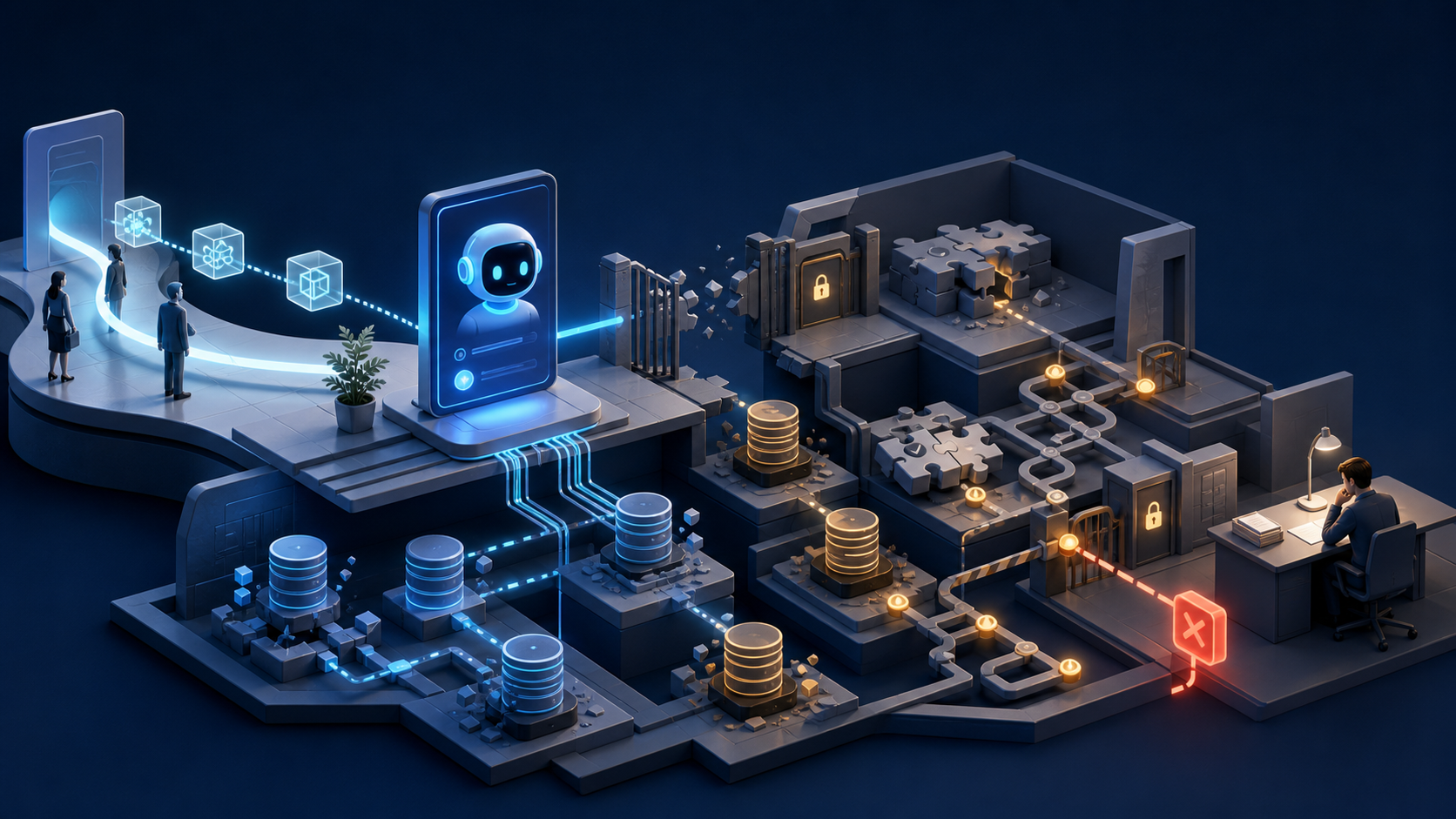
Fairness is non-negotiable in a multi-tenant system. A single customer’s high-volume moment should not quietly become everyone else’s latency problem. We design for this at multiple layers. For asynchronous work, we use overflow queues and queueing strategies that prevent one high-volume workload from consuming shared capacity in a way that hurts quieter tenants. AWS SQS fair queues are one example of a primitive we use extensively. They’re designed for exactly this class of problem. When one tenant creates a backlog in a shared queue, fair queues help reduce the dwell-time impact on other tenants.
We also build application-level guardrails so customer isolation doesn’t depend on every engineer remembering every rule in every code path. In a large multi-tenant Rails application, the safe path must be built into the system. The focus is primarily about correctness and customer data separation, but the broader operating principle is the same: important customer boundaries should be enforced by infrastructure and application frameworks.
The same thinking applies to scale. We want customer-specific load to be visible, attributable, and controlled. When a customer spike happens, we should be able to understand it as that customer’s workload, protect the rest of the platform, and add capacity where it’s actually needed.
Fin adds a new dimension to scaling. Our AI Agent Fin introduces a new set of infrastructure challenges. To provide reliable AI-powered support at scale, we need to operate across multiple model providers, route across them based on capacity and latency, and protect customer-facing workloads from lower-priority work. The details differ from traditional SaaS infrastructure, but the principle is the same: understand the bottlenecks, build clear scaling levers, and monitor the customer outcome. AI providers are not commodity storage systems, and we do not design as if they are.
That is why we have invested in Fin-specific reliability systems. Fin now fully resolves over two million conversations per week. At that scale, high availability cannot depend on a single model, a single provider, a single region, or a single pool of capacity. Our LLM routing layer supports cross-vendor failover, cross-model failover, latency-based routing, capacity isolation, and load testing. We also maintain buffer capacity with major providers, with headroom to handle 2x to 3x normal Fin traffic at any point. For enterprise customers, this matters because AI support volume can spike just like human support volume — and the AI layer must absorb that spike without relying on one fragile upstream path.
When customers depend on Fin to absorb a spike in support demand, the AI layer needs the same operational discipline as the rest of the platform.
Performance tests help, but production traffic is reality. Real customers use products in ways no synthetic test will perfectly predict: launches, incidents, seasonal patterns, gaming events, sudden changes in end-user behavior. Those moments give us data that no lab can fully reproduce. Often, a large customer event barely moves the platform-wide graphs because our customer base is broad enough that one industry’s peak aligns with another’s quiet period. Black Friday and Cyber Monday are good examples. Many ecommerce customers are at their busiest, while many B2B SaaS customers are quieter. At the aggregate platform level, the change can be much less dramatic than people expect.
“That does not mean those events are unimportant. It means we need to look at both levels: the health of the overall platform and the experience of the individual customer having the spike.”
Sometimes, these events teach us something specific. In one case, a very large customer used the Messenger in a way that exercised the full Messenger lifecycle even though the visible user experience did not require it. Under normal traffic, this was fine. During a major customer-side incident, their users refreshed aggressively, generating a much larger burst of Messenger traffic than the integration actually needed. The platform stayed available, but the event exposed unnecessary work in that integration path. We built a lighter-weight integration path that served the customer’s actual use case with far less work per request, making future spikes easier to absorb.
We treat large customer events this way even when there’s no broad customer impact. They’re opportunities to understand real scaling properties and make the next event safer — a habit that anchors our incident management, observability, and FinOps practices.
Scale is also an operating model. The infrastructure matters, but it’s not enough. You can have the right database architecture and still hurt customers if you detect issues late, recover slowly, communicate poorly, or fail to learn from incidents.
“That is why our operating model starts with customer outcomes. If the customer cannot do the job they came to do, the system is unhealthy. It does not matter how many dashboards are green.”
Heartbeat metrics tell us whether customers can do the core jobs they hire us to do. They cut through infrastructure noise and answer the question that matters most during an incident: are customers able to use the product successfully?
This shapes how we ship. Today, we average around 250 ships to production per workday, with an average merge-to-production time under 10 minutes. That isn’t a vanity metric — it’s part of the safety model. Smaller changes are easier to understand, easier to observe, and easier to roll back. Feature flags let us separate deployment from release. Automatic rollback and heartbeat-driven detection help us recover quickly when a change hurts customers. These are the very DORA metrics we hold ourselves to in order to balance CI/CD speed with stability.
“Fast shipping is not the opposite of reliability. Done properly, it is one of the ways you stay in control of change.”
The bar is high. Engineers are expected to understand the impact of their changes, watch them go live, and act quickly if something looks wrong. Resuming service is not the end of an incident. We expect teams to understand the root cause, fix the contributing systems, and prevent recurrence. That’s how scale stays safe over time.
Scheduled maintenance should be extraordinary. Historically, database maintenance was a main reason for maintenance windows: upgrading a database, changing instance sizes, performing failovers, or moving large tables could require customer-impacting downtime. With the move to Vitess and PlanetScale, we changed what routine database improvement looks like. We can upgrade, scale, and improve critical database infrastructure without turning that work into planned customer-impacting downtime — and we do this in practice, not just as a goal.
This matters because customers rely on our platform for live operations. If their support team, Messenger, Help Desk, or AI Agent is unavailable, the impact is immediate. Scheduled maintenance cannot be treated as a casual operational convenience.
“Our posture is simple: routine infrastructure improvement should not require planned customer-impacting downtime.”
Scheduled maintenance should be exceptional, non-routine, clearly communicated, and minimized in frequency, duration, and customer impact. That’s the practical benefit of the architecture work: better scaling is not only about handling more traffic, but also reducing the operational moments that might inconvenience customers.
What this means for customers is simple: be skeptical of vague scale claims. The question isn’t whether a vendor says they can scale — it’s whether they can explain how, where the limits are, what they measure, how they recover, and what they’ve changed after learning from production. We understand the scaling properties of our systems, have clear levers to add capacity at the right layers, design for customer isolation and fairness, monitor customer outcomes directly, and use real production events to make the next one safer. Scale is never finished. Every large customer event, traffic spike, migration, and incident teaches us something about the real behavior of the system — and we use that data to keep improving. That’s what you should expect from a platform you depend on during your busiest moments.