At Pioneer 2025, Fin 3 was announced as the most capable AI Agent yet for resolving deep, complex queries across every channel. As a VP of Product Management, I’ve been eager to see whether an agent can match concierge-level service at scale—and this is the first time I’ve seen the pieces come together in a way that genuinely raises the bar for customer experience and operational efficiency.
The goal is simple and ambitious: give customer service teams the tools to deliver concierge-level service to every customer, every time. To do that, the team built Fin 3 and invested deeply in the Fin Flywheel—train, test, deploy, and analyze—so the system learns faster, behaves predictably, and performs consistently across channels like Voice, Slack, and Discord.
The evolution here matters. We’ve come a long way since we launched Fin 1 just over two years ago. It was the very first AI Agent for customer service and focused on using your knowledge content to resolve informational queries, enabling it to do all frontline support and free teams to do higher-level work. Then we launched Fin 2. It answered the question of whether AI Agents could deliver human-quality service (it could).
Since we launched Fin 2, its average resolution rate has continued to climb to 66% across our 6,000+ customers. Over 20% of our customers are getting above 80%.
Those numbers are impressive, but they revealed an important truth I’ve seen across many product organizations: resolution rate isn’t the whole story. Answering a quick FAQ in chat isn’t the same as investigating a payment dispute or verifying a refund over the phone. The real measure to optimize is automation rate—the share of overall workload handled end-to-end. Fin 3 is built for that frontier, with a focus on two levers: solving increasingly complex queries and expanding into more channels.
Procedures are the big breakthrough for training. They let teams encode multi-step workflows and nuanced business logic—like troubleshooting login issues, handling return requests, or investigating potential fraud—so Fin can resolve them from start to finish. In practice, that means Fin is trained to follow your standard operating procedures carefully while exercising judgment just like a seasoned teammate.
1. Natural language instructions
Teach Fin the same way you’d train a new teammate. You can copy and paste your existing SOPs straight in (most support teams already have them written up in Google Docs or Notion) and describe how Fin should act using natural language. The editing experience feels familiar and lightweight, so teams can start writing Procedures immediately without needing engineers or special syntax.
2. Deterministic controls
When a Procedure needs more structure or precision, you can layer in deterministic elements. Data connectors let Fin check information or take actions directly in your tools. Conditional steps handle decision points (for example, whether a refund should be approved) so Fin’s behavior is consistent and predictable. And when absolute accuracy is essential, you can add small code snippets that guarantee the same input always produces the same output. You can also add checkpoints where Fin pauses for approval or hands off to a teammate before taking certain actions, keeping sensitive workflows under human control.
3. Fully agentic behavior
Conversations rarely follow a happy path. Procedures are designed so Fin reasons in real time, moves up and down steps, or switches between Procedures without getting stuck. If a customer changes an answer, Fin adapts and continues naturally. The result is a fluid conversation that still follows your process end-to-end.
4. AI Assistant support
AI Assistant helps teams write and maintain Procedures faster. You can start with a brief overview and supporting documents; it drafts an initial version based on what Fin already knows from your knowledge base and past conversations. As you expand, it suggests additional controls or generates boilerplate code for API connectors, lowering the barrier to entry and accelerating iteration.
Together, these elements let Fin reason like a human with the precision of software. Most teams can begin with no-code or low-code Procedures and bring in engineering only for advanced integrations. That balance of power and control is exactly what high-performing support leaders need.
“Support needs natural conversation and control. Procedures optimize for both – agentic where you want it, designed where you need it – rather than a generic agent builder.”
– Chris Dalley, Director of Product Management at Intercom
Of course, adding agentic power requires robust testing. That’s where Simulations come in. Real-world workflows explode into dozens of paths across policy thresholds, customer states, and edge cases. Manual testing won’t scale, so Simulations let you pick any Procedure, choose a user or segment, and run a full, multi-turn simulated conversation from start to finish. You see exactly how Fin reasons and where to refine, then re-run as needed.
AI Assistant is integrated here too. If a Procedure needs an adjustment, it suggests changes you can accept with a click. It also recommends additional Simulations for complex Procedures to ensure coverage. As you create scenarios, you store them in a Simulation library so that when products, policies, or teams change, you can run the entire suite to catch regressions early. This is how you build confidence that Fin behaves exactly as intended while your automation expands.
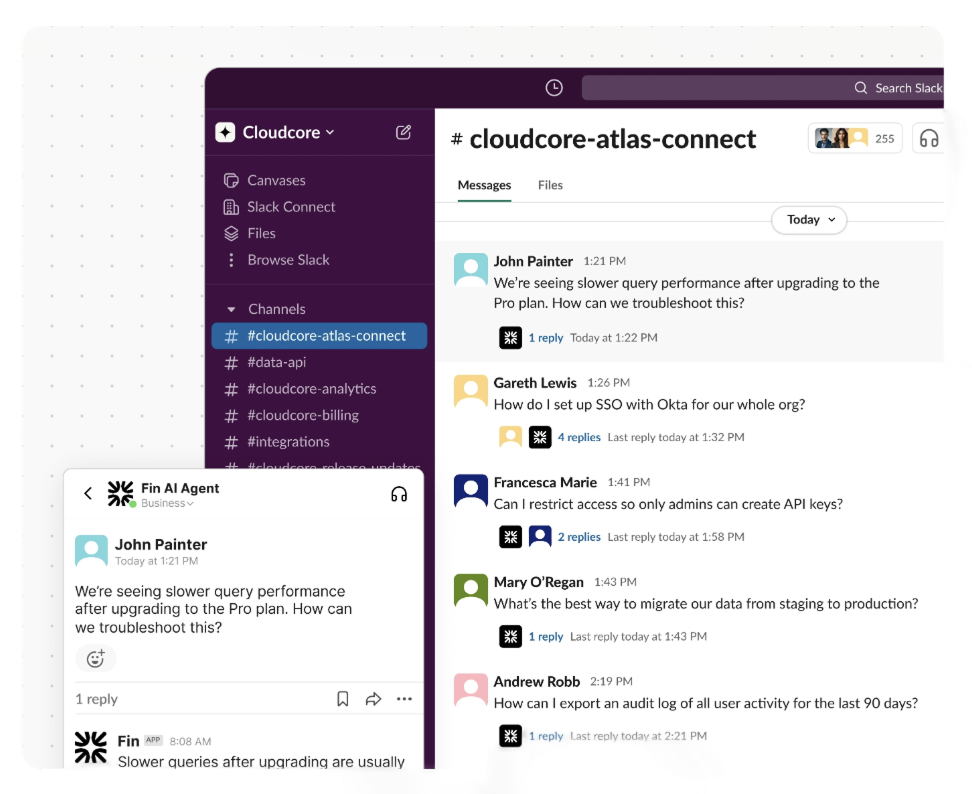
Channel coverage is equally critical for customer service. Customers expect help wherever they are. Fin already works across more channels than any other AI Agent, and now it extends to Slack and Discord with meaningful upgrades to Voice.
Fin in Slack feels native—threaded replies, proper formatting, and controls to determine when Fin responds versus when a human steps in. If a teammate joins, Fin automatically steps back. Every interaction is logged for reporting and analysis, which matters when you’re tuning automation rate and resolution quality.
Discord support brings the same benefits to communities that increasingly serve as support hubs. Meeting customers where they are is how you compound both satisfaction and efficiency.
Voice has evolved dramatically since launch, and this matters because phone expectations are different. Rather than waiting on hold, navigating IVRs, or getting one-word answers from a brittle bot, customers get immediate, natural conversation. Since we launched Fin Voice, we’ve added much more power and configurability: better guidance, more customization, better testing and deployment, and call transcripts and summaries. These make Voice practical to run at scale.
Voice isn’t just chat with speech. Latency must be low because long pauses feel wrong. Answer shape matters—shorter, chunked replies outperform long paragraphs. Interruptions and endpointing are the norm, so the Agent must detect when to talk and when to listen. And cost pressures are higher on phone, which makes automation even more valuable.
How natural the Agent sounds shapes customer trust. When a voice bot sounds robotic, people assume it’s limited and escalate immediately. Fin avoids that by speaking naturally, pacing correctly, and adjusting tone as it listens. It can detect sentiment directly from audio—laughter, frustration, or urgency—and respond with empathy to keep conversations on track.
“We’ve seen that how natural the Agent sounds signals to people how smart it is. If it sounds robotic, they escalate immediately – especially on phone where issues are more urgent.”
– Peter Bar, Principal Product Manager at Intercom
Performance has improved significantly, with latency down around 30–40% since launch—conversations now feel fluid rather than stop-start. Unlike voice systems that falter against large help centers, Fin handles real-world knowledge bases at scale using the same reasoning engine that powers chat. Fin Voice is multilingual out of the box and can currently answer calls in 28 languages, with configurable voices and greetings. You can tailor how it operates day-to-day, from call start to escalation rules and office-hour routing. Every call is logged automatically in Intercom, complete with a transcript, summary, and outcome, giving your team full visibility to review performance and refine over time.
Practically, this means Fin can take on more of the phone workload—triaging calls, summarizing transcripts, and handing off cleanly when needed—reducing average handle time and freeing agents to focus elsewhere. Because Voice runs on the same foundation as chat, improvements to Fin’s knowledge apply everywhere, creating consistent behavior across channels.
“Customers often say they’re amazed it’s not a real person – Fin Voice sounds natural, responds in context, and doesn’t feel robotic at all.”
With Fin set up to tackle more complex queries across more channels, the next question is measurement—how well is it working, and where should you improve? The Insights product answers this with upgrades to CX Score, Topics Explorer, and AI-powered Suggestions.
CX Score gives a unified view of support quality across interactions. The new CX Score Reasons provide a more representative and transparent picture—was a low score driven by product feedback or answer quality? These attributes are built into reporting for full filtering and segmentation, which is essential for targeted improvements.
Topics Explorer analyzes and organizes every conversation into topics and sub-topics to reveal what’s driving volume and impacting quality. The new Topic Trends report highlights the most important weekly changes—volume spikes, drops in Fin resolution, and emerging issues—so teams can act before customer experience is impacted. You can now curate topics with merge, rename, move, and create controls, then get AI-powered reporting on the areas you care about most.
AI-powered Suggestions close the loop by proposing exact, ready-to-publish updates to your help content based on what your support team is saying. Suggestions now spots duplications and contradictions, learns from rejections to improve future recommendations, provides one-click updates if you use Zendesk or Salesforce, and proposes changes to data, actions, and guidance—not just content. That last capability is especially important because it helps you unlock higher automation on complex queries.
Fin 3 builds on everything learned since the first AI Agent for customer service launched in 2023. It’s trained through Procedures, tested with Simulations, deployed across every major channel including Voice, Slack, and Discord, and measured through richer Insights. All of it adds up to a simple outcome: Fin now does more of the work for you, resolving the complex, time-consuming queries that used to belong only to humans.
Learn more about Fin 3 here: https://fin.ai/fin3 . Some capabilities are available now, with the rest rolling out quickly. From a product leadership perspective, the takeaway is clear—optimize for automation rate, govern with Procedures and Simulations, expand channel coverage, and instrument with Insights. That’s how you deliver concierge-level CX at scale with a single AI Agent.
Inspired by this post on The Intercom Blog.