At Pioneer 2025, we shared our most ambitious goal since we first set out to build Fin. I’ve spent my career building products that remove friction, and this is the boldest, most consequential shift I’ve seen for customer experience in years.
Fin will not be just the world’s best Customer Service Agent. It will be the world’s best Customer Agent, capable of handling the entire customer experience.
We’ll continue to obsess about Fin’s ability to support your customers, but now we’re broadening our focus. Fin will be able to contact your customers for the very first time; hold their hands through consideration and purchase; be there with them at every step; and know everything about their life with your business. That’s the level of continuity, empathy, and performance I expect from a truly unified AI Agent.
It’s a big shift, and it reflects the changing future of customer service and experience. As someone who lives at the intersection of product strategy and operations, I see an incredible opportunity for teams to elevate their impact.
Customer service leaders have been at the forefront of the AI transformation for the past two plus years. As this next evolution plays out, you’ll be uniquely positioned to lead how AI powers the entire customer experience. Your playbooks, data discipline, and operational rigor are the blueprint for what comes next.
You can watch the full Customer Agent keynote from Pioneer 2025 here.
Why we believe in the Customer Agent future comes down to two clear ideas that I’ve witnessed in practice across multiple organizations.
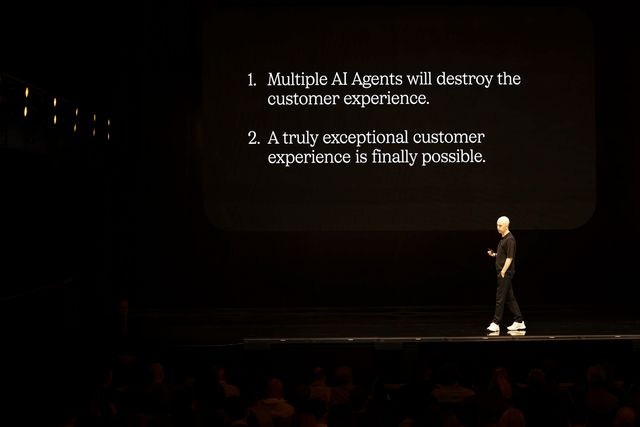
1. Multiple AI Agents will destroy the customer experience
We know that AI isn’t just changing customer service. Other teams like sales, success, and marketing are seeing the potential and starting to adopt it too. But if every function deploys its own Agent, you’ll end up with competing priorities, fragmented context, and inconsistent brand voice—exactly the kind of friction customers notice instantly.
But if all of these teams use their own AI Agent, you’ll end up with a mess of competing Agents that will destroy the customer experience. Each one will have its own priorities and configuration parameters; they won’t talk to each other or share customer information by default, and will likely engage with customers in different ways. This is a trap we need to avoid.
2. A truly exceptional customer experience is finally possible
If we can avoid that trap, we’ll finally be able to provide the type of seamless experience that customers have long expected, and long deserved. The AI Agents of today, like Fin, are capable of handling many different use cases across the entire customer journey: lead qualification, onboarding, support, success, and upsell. That opens the door for the first time to previously unimaginable customer experience; one that’s truly seamless, personal, and concierge-level.
We’ve reached another turning point in AI’s trajectory, and for customer service leaders, the opportunity around the corner is huge. In my own teams, the leaders who lean in now will shape standards for governance, measurement, and ROI across the business.
Customer service has been the proving ground for AI transformation. The systems, strategies, and learnings leaders in this space have accumulated over the last two years can define how AI is adopted by other functions. The keynote made this clear: you have the opportunity to lead how AI is rolled out across your organization, not just in customer service.
You already manage the most complex, high-volume customer interactions; you have rich data on customer needs and behavior; and you know how AI Agents perform in the real world. Those insights will be invaluable as AI scales across your business. The Customer Agent future will elevate the role of the customer service leader and give you the opportunity to lead AI implementation across the entire customer journey.
To achieve this vision of Fin becoming a unified Customer Agent, it will need to evolve from being a task-based system into a true agentic system that uses AI to make decisions and pursue high-level objectives. That shift—from task execution to outcome ownership—is the inflection point I’ve been anticipating.
Roles: Fin will have a range of roles (customer service being one) that it can fluidly move between and blend together. Each role will be deeply trained to be a world-class expert at what it does.
Goals: Fin will also have goals to pursue. You’ll be able to tell it your objectives and priorities (for your customers, company, and revenue) and Fin will pursue them, making appropriate trade-offs between goals as needed.
Memory: Fin will develop memory that persists and grows over the customer lifecycle, building deep context of who the customer is and what they’re trying to achieve. The customer priorities it learns on day one will be considered in year 10.
Knowledge: Fin will accumulate deep knowledge of your business – every product detail, policy, process, your history, and plans – to act on a complete view of your customer.
Interoperability: Fin will interoperate with different tools, systems, and channels.
This system will be able to do much more than answer questions or complete tasks. It will adapt on the fly, learn to get better, and use all the context it has to efficiently guide each customer to great outcomes. That’s how we turn AI from a helpful assistant into a dependable operator.
The Customer Agent vision isn’t a far-off idea. Many of our most pioneering customers have started to put Fin to work beyond customer service. They’re using it across the customer journey and want to push it further by applying it to other use cases to create a single, seamless customer experience. I’ve seen this expansion accelerate once leaders prove value in one high-stakes workflow.
Here’s an example: fitness wearables company WHOOP, facing one of their biggest product launches ever, needed a way to handle a very large influx of sales conversations. They used Fin to help manage this surge, and it’s now resolving 84% of their sales conversations.
These early examples show how Fin is already capable of handling multiple use cases across the customer journey. The signal is clear: a unified Customer Agent can drive measurable outcomes in both revenue and retention.
The Customer Agent future will be built from the inside out, starting with the customer service leaders who have been pioneering AI transformation since the very beginning. Your frameworks for quality, escalation, and measurement will set the bar for every other team that follows.
You know how to balance powerful AI with human empathy, and how to translate that into great customer experiences. Other teams will look to you, and you have the ability to lead them through this transformation. In my experience, this is the moment to define standards, instrument the journey, and scale wins deliberately.
The very best brands compete on customer experience. The Customer Agent opens that playing field for the brands that jump first. Those who move now will own the new benchmarks for responsiveness, personalization, and ROI.
We’ll be starting to roll out this new functionality to Fin – roles, goals, memory, knowledge, interoperability, and more – over the coming months. Stay tuned.
Inspired by this post on The Intercom Blog.