To truly transform with AI, I’ve learned it’s never just about the technology—it’s about redesigning how we work. The teams that win don’t bolt AI on; they re-architect around it. That means rethinking roles, workflows, and governance to build a system that sustains and improves AI performance over time.
In The 2026 Customer Service Transformation Report, teams at every stage of maturity describe human agents taking on more proactive work—training AI systems, handling the hardest queries, and owning tasks that demand judgment. Job descriptions are shifting, too, with many organizations explicitly adding AI-related responsibilities.
I’m also seeing a clear rise in dedicated AI specialists. Conversation analysts, knowledge managers, and AI operations leads are fast becoming standard. For support professionals, this opens new, higher-leverage career paths—and creates a talent pipeline that blends service excellence, data fluency, and product thinking.
Support once centered on queue-level activity—ticket triage, routing, translations, and answering FAQs. Now, as AI handles more frontline interactions, our human roles are moving up the stack toward optimization, oversight, and continuous improvement.
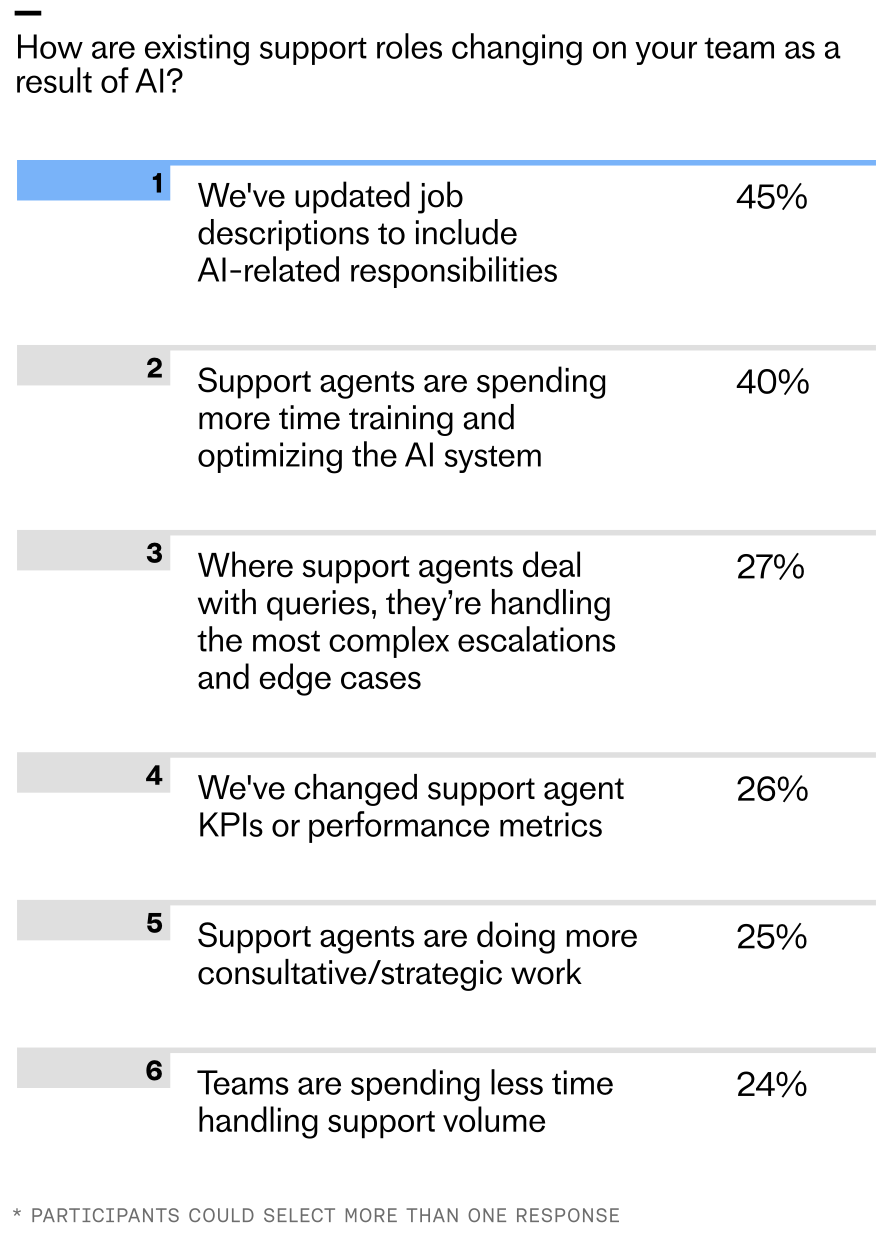
According to the latest research, 45% of teams report updating job descriptions to include AI-related responsibilities, with 40% saying their human agents are now more focused on training AI systems. Another 27% report that human agents primarily handle the most complex escalations and edge cases, while a quarter say agents are doing more consultative and strategic work.
Even at the initial deployment stage, 16% of teams report spending less time handling support volume since implementing AI – and among teams who’ve reached maturity, that figure rises to 28%.
When Intercom’s Research, Analytics & Data Science (RAD) team interviewed 166 of our customers, similar themes emerged. Nearly all participants (≈95%) reported meaningful workflow changes, with manual processes being handled by AI, and humans focusing more on monitoring or fine-tuning AI outputs. Eighty-three percent of participants also reported seeing their team’s roles and responsibilities change to become more strategic and supervisory in nature.
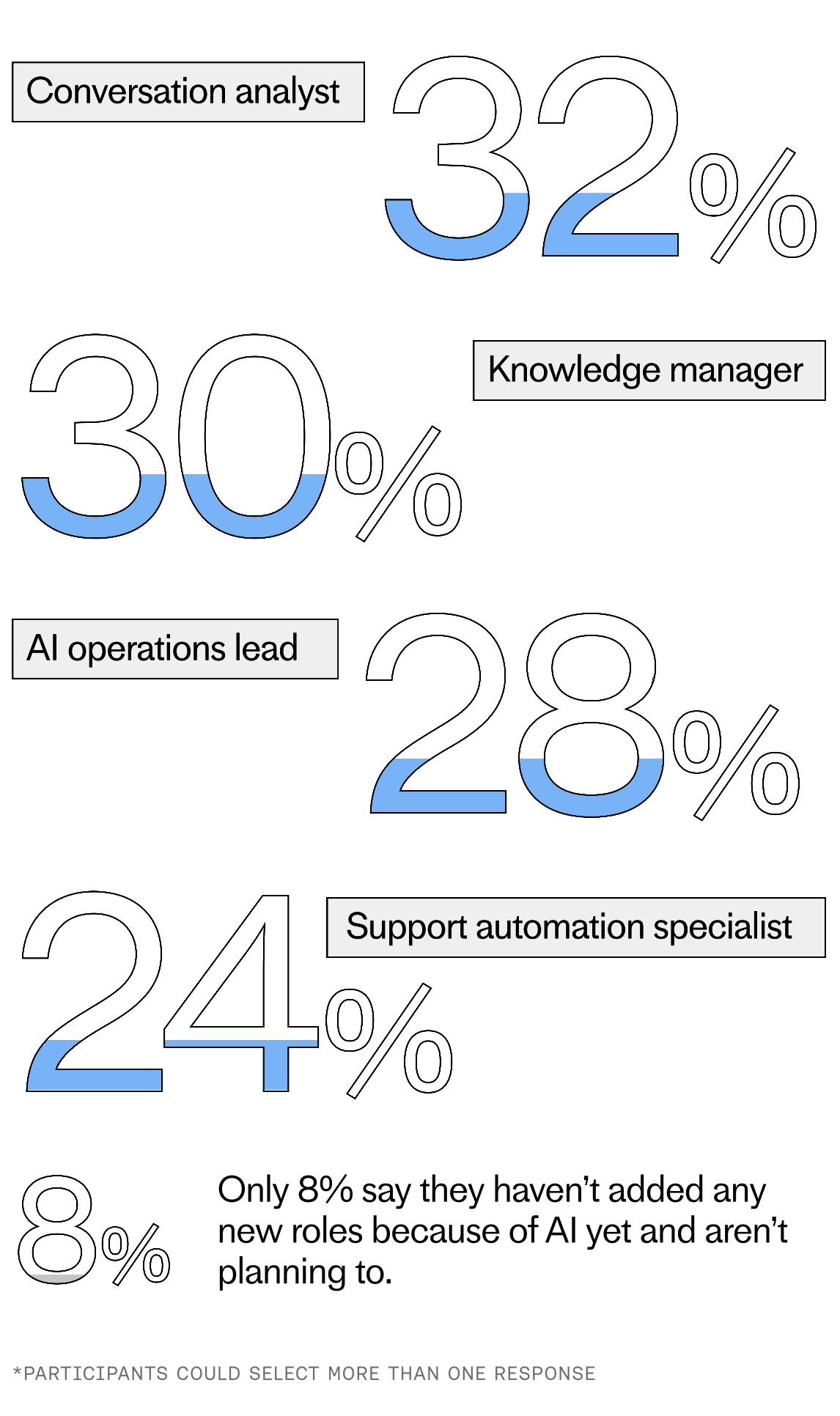
It’s not just the work that’s evolving; organizational structures are, too. Some teams are reallocating existing talent into AI-focused roles; others are hiring entirely new skill sets. Many of the most common job titles in this space didn’t exist two years ago.
Consider a Senior AI Knowledge Manager, Beth-Ann Sher, who transitioned from a help center manager role. Like many careers transformed by AI, her work evolved from administrative to strategic. Instead of focusing solely on customer-facing, self-serve content, her mandate expanded to designing and optimizing knowledge inputs that directly improve AI Agent Fin’s performance—work that materially lifts resolution rates.
Or look at a Senior Conversation Designer, Fred Walton, hired specifically for an AI-first function. He focuses on frictionless customer journeys with Fin, smoothing handoffs between automation and human support while keeping customer satisfaction front and center—hallmarks of mature AI workflows and conversation design.
In high-performing organizations, roles like these typically sit within a dedicated AI support team under senior CS leadership. Clear ownership and accountability for AI performance is critical; without it, optimization stalls and trust erodes.
These shifts aren’t isolated. Take Robb Clarke from RB2B. He went from Head of Technical Operations to Head of AI. With Fin, his focus moved from repetitive support questions to managing knowledge and improving the system behind it—freeing him to be proactive about product improvements and fix issues before they hit customers.
Or consider Eric Broulette from Bloomerang, a support leader who leaned into AI and became the VP of Support and Education. By deploying Fin, his team found breathing room to invest in what’s next. Agents stepped into new roles, contributed to meaningful projects, and built skills that had previously felt out of reach. As Eric puts it: “Do not wait to embrace AI. It will unlock more career growth for your teams than you can imagine.”

Bringing AI into support will eventually change every agent’s day-to-day work. For leaders at the start of the journey, that can feel daunting. My perspective: the most successful teams treat this as an operating model shift, not a tooling rollout—anchored in AI Strategy, governance, and continuous improvement.
Be transparent about what’s changing, why it matters, and how success will be measured. Define how AI performance will be evaluated (resolution rate, containment, CSAT impact), empower agents to train and improve the system, and communicate how responsibilities will evolve. When teams help build the AI, they’re invested in making it great.
Here’s the playbook I rely on with support leaders: First, reset expectations about time allocation—less time in the queue, more time improving the AI system that serves the queue. Second, elevate knowledge management as a core capability. Prioritize content quality and coverage for your AI Agent, and carve out dedicated “out of the inbox” time so every agent contributes. Third, keep outcome metrics—especially resolution rate—front and center. It gives the team a north star for experimentation and iteration.
Scaling AI is as much a people challenge as it is a technology challenge. As automation takes on more work, support roles become more proactive, strategic, and cross-functional—even early in the journey. Responsibilities expand, new roles emerge, and team structures adapt to concentrate on and amplify AI performance. In the process, support careers are transformed.
If you’re leading this shift, now’s the moment to reimagine your operating model: clarify ownership, invest in knowledge and conversation design, adopt eval-driven development, and build the muscle for continuous improvement. That’s how you move from tickets to strategy—and unlock compounding value for your customers, your business, and your teams.
Inspired by this post on The Intercom Blog.