Over the last year, I’ve had the same conversation with a lot of support leaders.
They’ve deployed AI and are seeing initial efficiency gains, but want to push beyond these early results and achieve meaningful transformation.
When AI is first introduced, the gains show up quickly. Teams resolve higher volumes of queries, free up capacity, and deliver faster responses. But the real opportunity for impact extends well beyond those initial wins. As AI becomes more deeply integrated into support operations, taking on harder, more complex work, those results compound, new ways to create and measure value open up, and the economics of support change entirely. That shift is where I spend most of my time with leaders—turning early efficiency into durable business value.
This sits at the heart of “The 2026 Customer Service Transformation Report.” In this reflection, I explore how deeper integration compounds impact and why that makes business value easier to articulate across the organization—especially to finance and product peers who need to see outcomes, not just output.
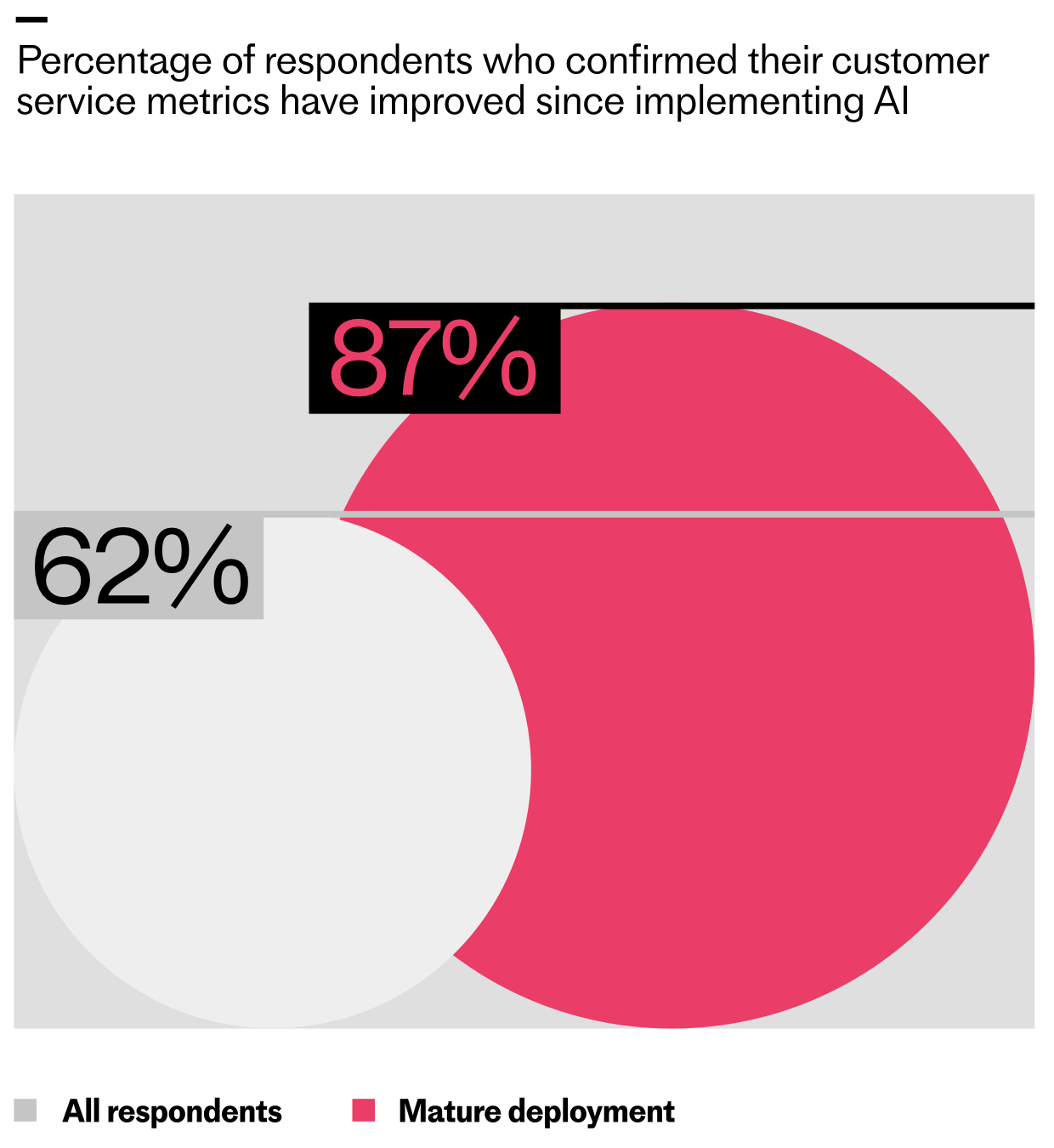
The teams going deeper are seeing higher returns. The research shows that 62% of support teams have seen their customer service metrics improve since implementing AI, with early wins showing up most clearly in speed and efficiency. But for teams that have reached mature deployment (where AI is fully integrated into operations) that number jumps to 87%.
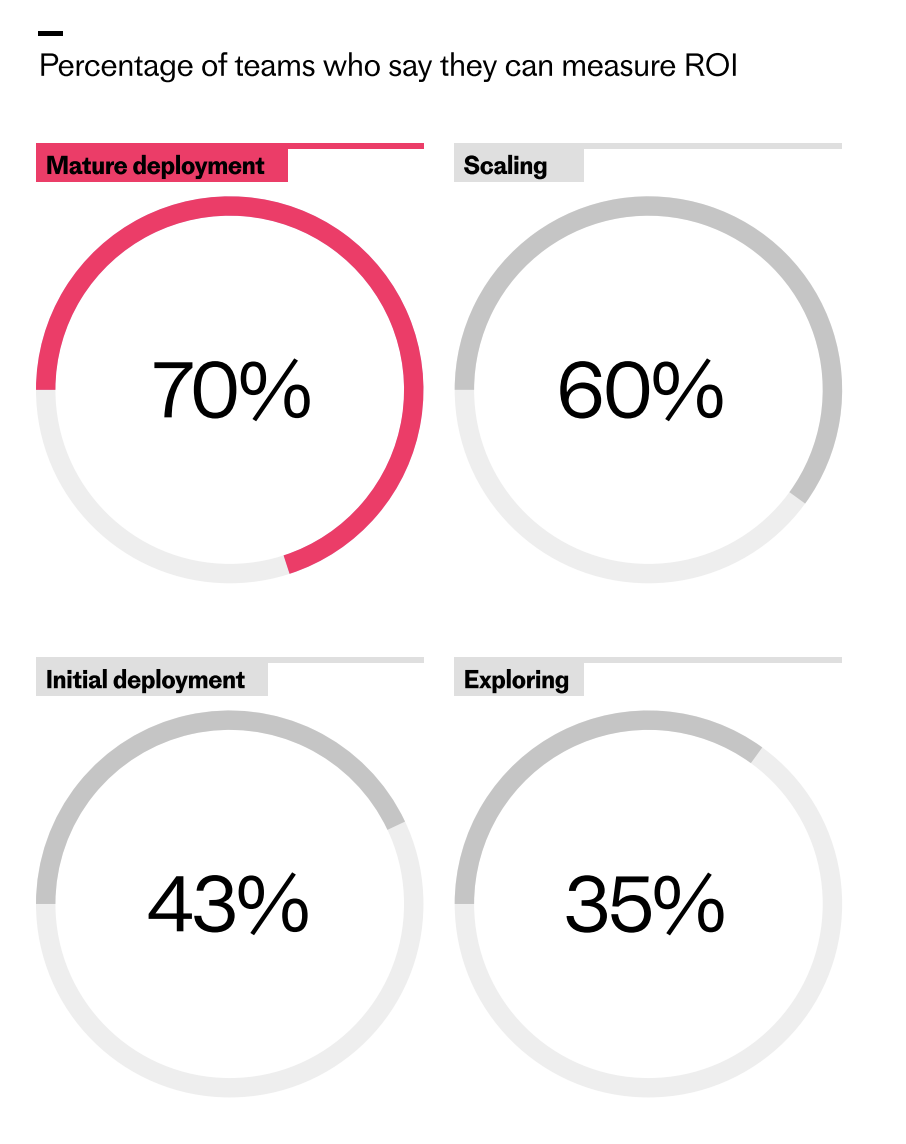
The same pattern holds for the ability to measure ROI. Among teams in early exploration, just 35% say they can measure their return on AI investment, but for teams at the mature deployment stage, that rises to 70%. In my experience, this is the moment the conversation shifts from “is AI working?” to “how much leverage are we creating?”
As AI becomes more embedded in support workflows, what teams choose to measure starts to change. In the early stages of deployment, ROI is typically understood through improved customer response times, lower cost to serve, and freeing up capacity. Teams focus on how much time AI creates and whether it’s relieving pressure on the support organization. These signals help validate that the system is working, but they say little about how that capacity is ultimately used.
As deployments mature, measurement starts to reflect a different intent. Instead of stopping at time saved, teams look at where that capacity is reinvested—into higher value customer work and revenue-generating activities. ROI becomes less about relief and more about leverage. I encourage teams to set targets for capacity redeployment and tie them directly to activation, retention, and expansion outcomes.
The report data shows this clearly. Across all maturity stages, the most commonly cited measure of ROI is "time freed up that the support team can use to focus on value-adding activities for customers." But at mature deployment, that signal intensifies, with 73% of teams citing it, compared to 56% at early exploration.
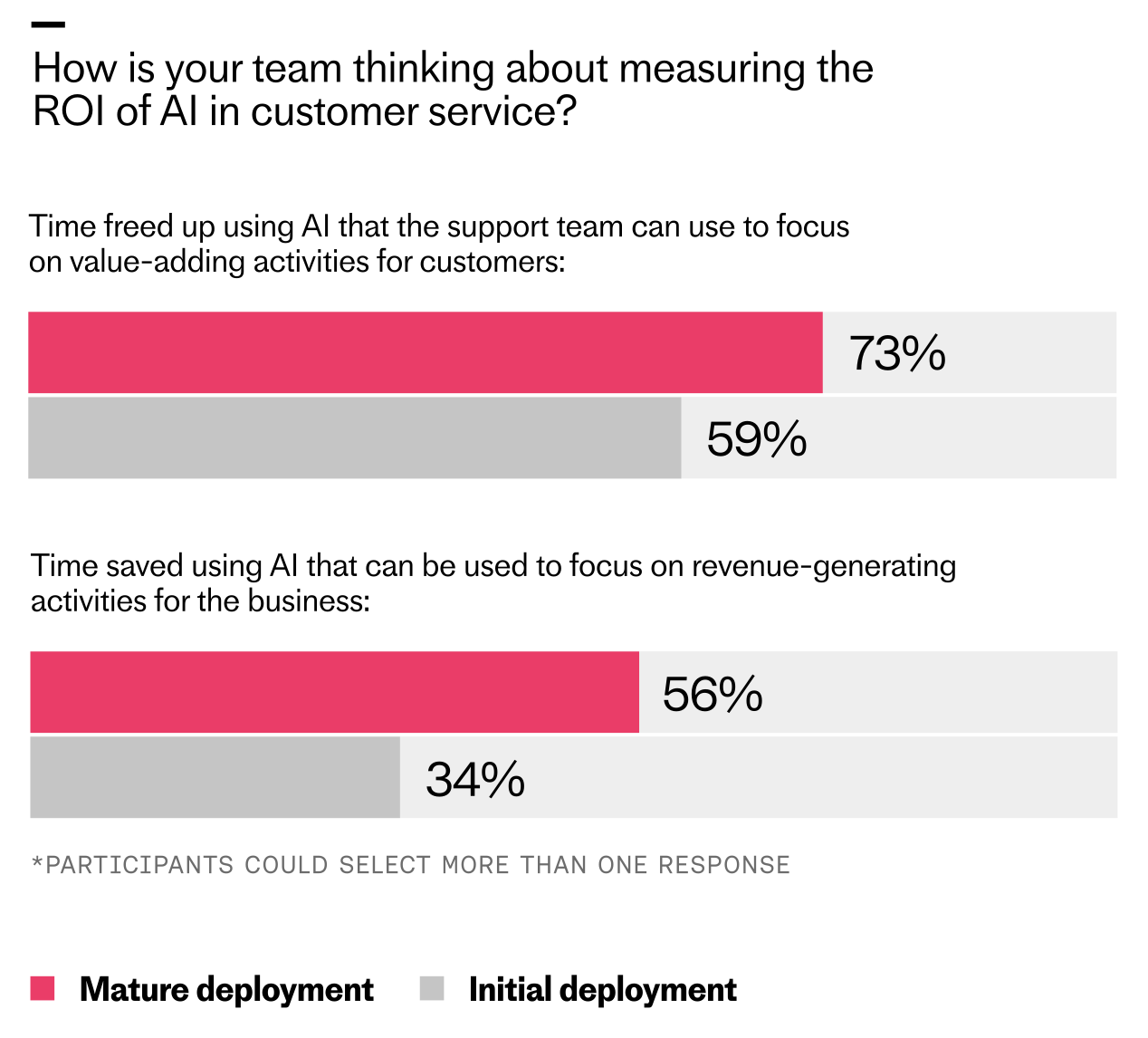
What’s also interesting is that 56% of mature teams say freed capacity is being directed toward revenue-generating activities, up from 34% at initial deployment. That’s a powerful indicator that AI is shifting from a cost narrative to a growth narrative.
The result is a shift in economic intent: from measuring what AI saves to demonstrating how the capacity it creates is reinvested to drive growth. As a product leader, I anchor this conversation in outcome-based metrics and clear counterfactuals: what would it have cost to deliver the same experience without AI?
As AI takes on more work, the question moves from “does it save money?” to “how does it change the economics of support?” Legacy support economics were built for linear growth: more customer tickets meant more headcount, more outsourcing, and more software costs. Success was measured through containment—the number of queries that didn’t reach human agents. These models worked when volume and effort were tightly linked, but AI doesn’t scale linearly, and it needs to be evaluated differently.
To sustain AI investment and expand its impact, teams need to move beyond cost-cutting narratives and build a clearer case for business value. When done right, AI goes far beyond improving support efficiency. It rewires the financial model, breaking the link between support costs and revenue growth, and turning support into a contributor to customer activation, retention, and lifetime value. This means treating your AI Agent as a new workforce capability that changes how your support function creates and captures value. Here’s what value looks like in an AI-first model:

Human productivity: Your team focuses on more strategic areas, not the queue.
System improvement: Every resolved query makes the system smarter.
Revenue influence: Support becomes a lever for activation, retention, and growth.
Organizational agility: You scale service without scaling headcount.

How does this look in practice? Intercom offers a compelling example with Fin. What started as a focused effort to improve their customer support experience has become one of the clearest illustrations of what happens when AI is fully embraced across an organization.
Since 2022, Fin has helped Intercom absorb more than a 300% increase in customer demand while improving the consistency of delivery—including supporting new routes into support for trial customers and website visitors. Today, Fin is involved in 97% of their customers' conversations. Of those, it resolves 83.5% end-to-end, putting their overall automation rate at 81%.
That depth of deployment allowed Intercom to scale service without scaling headcount. Without Fin, they would have needed at least 100 additional support teammates to meet rising demand and service standards.
As Fin took on the majority of day-to-day volume, the human support team shifted toward consultative work—helping customers adopt Fin more deeply, succeed faster, and unlock more value from the platform. Intercom now tracks metrics like “direct revenue generated” and “expansion revenue influenced” to understand the impact of these consultative support activities. This repositioned support from a cost center to an active contributor to long-term growth.
The throughline from The 2026 Customer Service Transformation Report is that deployment depth makes a significant difference. Teams that are investing in deeply integrating AI are reshaping how support scales and contributes to growth. Value becomes clearer as AI takes on more work, and support leaders can articulate that value to the rest of the business.
The gap between these teams and those still in the early stages is widening. A select group of pioneers are setting a new bar for what AI-powered customer service can deliver, and understanding what they’re doing differently is the first step toward closing that gap. If you want to dive deeper into the data and frameworks, you can download the report here: https://www.intercom.com/customer-transformation-report?utm_source=blog&utm_medium=internal&utm_campaign=20260128-report-owned-2026cstransformationreport&utm_content=chapterseries_2
Inspired by this post on The Intercom Blog.