
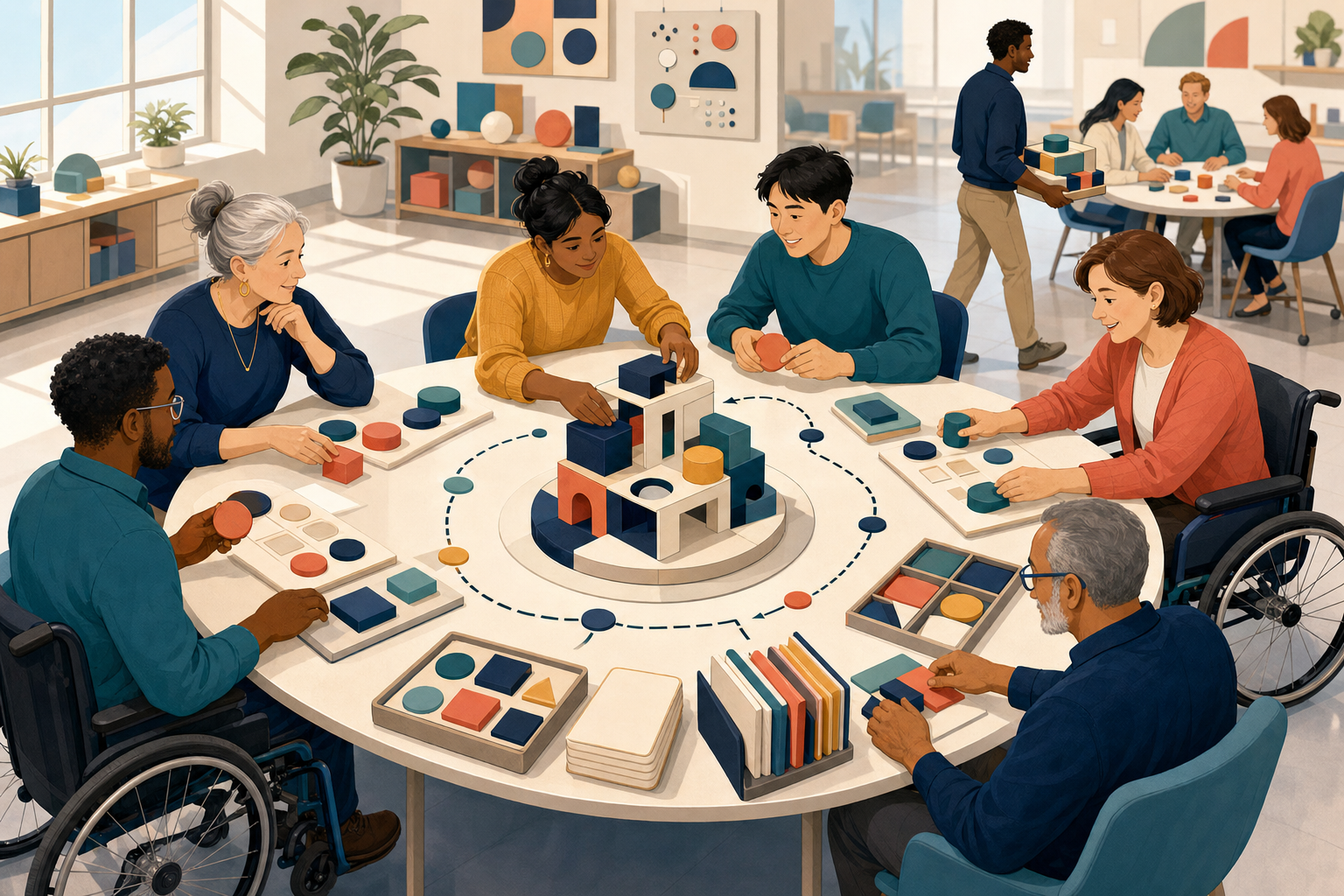
If your community of practice needs constant reminders, fills its agenda with updates, and produces little that teams use afterward, the problem probably is not motivation. The community was given a meeting cadence before it was given a job.
Your job as a product leader is to create a repeatable path from a live problem to a better decision, a stronger practice, and knowledge another team can reuse. That is how you design continuous learning as a system instead of hoping it emerges from another recurring call.
Give the community a practice to improve, not a topic to discuss
A broad subject can attract interest without changing anyone’s work. Product strategy, discovery, AI, leadership, and experimentation are all reasonable areas of interest, but each is too large to serve as an operating purpose.
Start with a practice that members perform and can inspect. Opportunity framing is a practice. Writing an AI evaluation plan is a practice. Preparing an experiment decision is a practice. Stakeholder management is still too broad until you identify the behavior you want to improve, such as exposing trade-offs before a roadmap commitment is made.
A useful purpose statement has four parts:
- Members: Who needs to learn together?
- Practice: What recurring part of their work should get better?
- Learning activity: What will they examine, attempt, or critique together?
- Work consequence: What should change in a decision, artifact, or team behavior?
For example: This community helps product trios improve opportunity framing by critiquing active discovery artifacts, so teams can separate evidence from assumptions before choosing a solution.
That statement is narrow enough to guide an agenda. It tells members what to bring, tells a facilitator what kind of discussion belongs, and gives a sponsor something more meaningful to inspect than attendance.
Choose a quarterly learning theme with these filters:
- Members are encountering the problem in current work, not merely expressing general interest in it.
- The practice is shared enough that one person’s case can teach something useful to others.
- A real artifact can make the practice visible. That might be an opportunity map, discovery plan, evaluation set, experiment brief, decision record, or stakeholder narrative.
- Improvement can be noticed in later work. You should be able to point to a changed question, assumption, method, trade-off, or decision.
- The theme is narrow enough to defer adjacent subjects. A community without boundaries becomes an internal conference with no coherent learning loop.
Write those choices into a short charter. Include the theme, target practice, current definition of good, artifact members will examine, evidence of progress, and what is out of scope. Treat the definition of good as a starting hypothesis. Learning can reveal a stronger standard after the work begins; the charter should be stable enough to focus the community but not so rigid that it prevents that discovery.
Combine learning from people with learning with people
A community needs external input and collaborative practice. Input without practice becomes content consumption. Collaboration without input can recycle the same local assumptions. Design both modes deliberately.
| Learning mode | Use it when you need | Useful inputs | Expected output |
|---|---|---|---|
| Learning from people | Depth, a reference point, or a clearer definition of good | A tightly curated personal learning network, talks, books, courses, examples, and practitioners whose decisions you can examine | A heuristic, annotated example, sharper question, or alternative approach to test |
| Learning with people | Feedback, accountability, new patterns, or pressure-testing | Peer circles, artifact critiques, hackathons, meetups, and cross-functional working sessions | A revised artifact, changed decision, new experiment, or reusable lesson |
The bridge between the two modes matters more than the volume of material consumed. Begin with a live question from the work. Curate external input that can sharpen that question. Bring the work artifact to peers. Critique its assumptions and trade-offs. Record what changed. Store the lesson where the next person facing the problem can retrieve it.
For an AI product community, the live question might concern an evaluation plan for a support agent. External examples can help the group notice missing failure cases, but reading alone does not improve the plan. Members need to inspect the proposed evaluation set, challenge what it represents, identify gaps, and document the resulting change. The work becomes the learning surface.
Your personal learning network should be curated around the same quarterly theme. Start with one practitioner whose judgment you respect, learn who they regularly exchange ideas with, attend a relevant meetup with a specific learning goal, and follow up with a structured exchange. Do not confuse a large feed with a useful network.
Track the network as working infrastructure. For each person or resource, note the practice you are learning, the artifact or decision that demonstrates it, the question it helps answer, and the action you intend to try. Prune the list when the theme changes or an input repeatedly fails to affect your thinking. The goal is not to follow everyone worth knowing. It is to make the right expertise retrievable when a decision needs it.
Build a cadence that ends in changed work and reusable artifacts
A community meeting is only one step in the learning loop. If the loop begins with an agenda and ends when the call finishes, members may enjoy the conversation while the organization loses most of its value.
A lightweight operating model can fit alongside product delivery:
- Set a quarterly theme. Tie it to a practice teams currently need to improve.
- Curate a small learning network. Gather examples and perspectives that challenge the community’s current standard.
- Run monthly critiques. Use current work from product, design, and engineering rather than hypothetical exercises.
- Publish one teaching artifact. Turn the strongest learning into a talk, guide, workshop, template, annotated example, or decision pattern.
- Close the loop. Write down what changed in a decision, discovery cadence, product bet, or working method.
This cadence connects a quarterly theme, monthly peer critique, a teaching commitment, and a record of changed decisions. Each element compensates for a weakness in the others. A theme creates focus. Critique creates feedback. An artifact creates reuse. The change record creates evidence that the community is affecting work.
Make every critique artifact-first
Do not ask a member to present everything they know about the theme. Ask them to bring something unfinished that matters to a real decision. The critique should answer a small set of questions:
- Decision: What decision is the owner preparing to make?
- Artifact: What document, model, prototype, dataset, or plan exposes the current thinking?
- Evidence: What is known, what is assumed, and where is confidence weak?
- Trade-off: Which constraint or competing objective makes the decision difficult?
- Critique request: What does the owner want peers to challenge?
- Change: What will the owner revise, test, reject, or investigate after the session?
The final question prevents critique from dissolving into commentary. Advice is not yet learning. Learning becomes visible when the owner changes an artifact, runs a test, revises a decision, or explains why the critique did not alter the course.
Keep the feedback about the work, not the person’s competence. Sensitive examples can be anonymized, but stripping out every constraint makes the exercise artificial. Preserve the decision context, evidence, and trade-offs that peers need in order to give useful criticism.
Separate community roles so the founder is not the system
A community becomes fragile when one enthusiastic leader selects every topic, provides every answer, facilitates every discussion, and writes every note. Distribute the work:
- Steward: Maintains the charter, boundaries, and relationship to organizational priorities.
- Curator: Finds relevant people, examples, and learning inputs for the current theme.
- Facilitator: Keeps sessions focused on the stated decision and critique request.
- Artifact owner: Brings live work and decides what to do with the feedback.
- Synthesizer: Captures the reusable lesson, change made, and retrieval metadata.
A small community can combine roles, but the responsibilities should still be explicit. Rotating artifact ownership also prevents the group from becoming an expert’s help desk. Members learn to expose their reasoning, offer precise critique, and teach what they have understood.
A commitment to teach is especially useful because it forces vague understanding into a form another person can inspect. Committing to a talk, guide, course, or workshop creates productive pressure to clarify the thinking. Public does not have to mean published on the open internet. For confidential work, the relevant public can be the product organization or another approved internal audience.
Use the same structure for every durable artifact: context, decision, evidence, critique, change, result still to be observed, and reusable principle. Tag it by practice and decision type rather than only by meeting date. A folder full of chronological notes is an archive. A collection organized around future retrieval is a knowledge system.
Diagnose failure modes and show evidence of impact
Community leaders often respond to weak participation by adding speakers, reminders, or more topics. Those actions can increase activity while preserving the design flaw. Read the symptom as evidence about the operating model.
| What you notice | Likely design problem | What to change |
|---|---|---|
| Sessions become status updates | Live work is being reported rather than examined | Remove the progress round. Require a decision, artifact, and explicit critique request. |
| Conversations are energetic but nothing changes afterward | The learning loop ends at discussion | Close every critique with a named change, test, investigation, or reason for retaining the current approach. |
| The same experts do most of the talking | The community has become a help desk or lecture series | Rotate artifact ownership and ask members to expose their judgment, not just request answers. |
| Every session covers a different subject | The theme is too broad or absent | Return to one quarterly practice and place adjacent requests in a backlog. |
| Notes accumulate but are rarely reused | Capture is organized around meetings rather than retrieval | Use a common artifact template and tag lessons by practice, decision, and problem. |
| People attend but stop bringing unfinished work | Critique may feel unsafe, performative, or disconnected from current decisions | Review the invitation, keep feedback about the artifact, and let owners state the feedback they need. |
| The community depends on its founder | Operational knowledge and authority have not been distributed | Make roles explicit, rotate them, and document the cadence. |
Do not make attendance your primary success measure. Attendance can show reach, but it cannot tell you whether anyone learned, changed a practice, or made a better-informed decision. It is possible to fill every session and still run a content club with no operational effect.
Use an evidence chain that a product or executive sponsor can inspect:
- Participation: Members bring relevant work and a real decision question.
- Artifact change: A plan, model, evaluation, narrative, or discovery artifact is revised after critique.
- Practice change: A team adopts, tests, or deliberately rejects a method with its reasoning recorded.
- Knowledge reuse: Another person can find the artifact and apply it to a later decision.
- Decision trace: The close-loop note identifies what changed in the team’s cadence, choices, or bets.
This chain is more defensible than claiming the community directly produced a business outcome. Product teams still own delivery and results. The community improves the quality and availability of the practices those teams use. Connect it to business impact when the trace is real, but do not skip the intermediate evidence.
At the end of the quarterly theme, review the artifacts and ask: Which critiques changed work? Which lessons were reused? Which assumptions survived testing? Which part of the definition of good became clearer? Which unresolved practice deserves the next theme? If you cannot answer those questions, adjust the design before adding another meeting.
Key takeaways
- Define the community around a recurring practice and a visible change in work, not a broad topic or an attendance goal.
- Combine curated learning from people with artifact-based learning alongside peers.
- Use a quarterly theme, monthly critique, teaching artifact, and change record to complete the learning loop.
- Make unfinished work the center of each session and end with a revision, test, investigation, or explicit decision.
- Organize knowledge for retrieval by practice and decision type, not merely by meeting date.
- Show impact through artifact changes, practice changes, reuse, and decision traces before connecting the community to business results.
Before scheduling the next session, write the purpose sentence and name the artifact members will examine. Invite them to bring a live decision, then publish a short record of what changed after the critique. If you cannot name the practice or the expected output yet, keep designing the community before you create its calendar.








Leave a Reply