

You are probably not wondering whether UX matters. You are trying to decide whether to move closer to design, how to make that move without becoming a second designer, and what evidence will convince a hiring manager that you can own the work.
The answer is not another UX certificate or a more polished portfolio. You need proof that you can connect customer friction to a product decision, shape an experience with design and engineering, and measure whether the resulting behavior creates business value. This playbook shows you how to build that proof.
Decide whether you want the work, not just the title
A UX product manager owns the customer experience end to end while steering toward measurable outcomes. That does not mean producing every wireframe, conducting every research session, or making every interface decision. It means remaining accountable for the connection between a user’s problem, the experience the team ships, and the behavior that follows.
The distinction matters because the role sits in an overlap, not in a gap. A designer should not need a product manager to practice design. A product team does need someone who can turn customer evidence into a prioritized problem, make trade-offs explicit, and keep discovery connected to delivery.
| Role emphasis | Primary question | Strong evidence |
|---|---|---|
| Product design | How should this experience work for the user? | Research synthesis, flows, interaction decisions, usability findings, and design-system judgment |
| Product management | Which problem should the team solve, for whom, and why now? | Prioritization, value proposition, outcome definition, trade-offs, and business impact |
| UX-oriented product management | Which experience change will help a defined user reach value, and how will the team know? | Customer evidence, experience strategy, cross-functional decisions, instrumentation, and behavioral outcomes |
You are likely suited to the overlap if you want to do all of the following:
- Investigate why users struggle before debating what the team should build.
- Move comfortably between a journey-level problem and a specific piece of microcopy.
- Accept accountability for an outcome even though design, engineering, marketing, support, and the user all affect it.
- Use qualitative evidence to explain behavior and quantitative evidence to establish its scale.
- Partner closely with a designer without treating collaboration as permission to direct every screen.
If those are not the decisions you want to own, do not force a title change. A product manager can deepen UX judgment without becoming a UX product manager, and a designer can develop product sense without leaving design. Choose the work you want to be accountable for.
Build the three capabilities around one real user problem
The fastest way to look shallow is to collect disconnected skills: a research course, an analytics dashboard, a prototype, and a prioritization framework that never touch the same decision. Build customer insight, product strategy, and experience design around one observable problem instead.
Onboarding is a useful practice field because it exposes the whole system. You must identify the user’s intended value, find where progress breaks, decide what not to explain yet, shape guidance, and measure whether people reach a meaningful action. If onboarding is not relevant to your product, choose a core workflow with a clear start, a meaningful completion event, and visible friction.
Customer insight: explain the friction before proposing a fix
Start with a defined segment and a job the user is trying to complete. Then combine behavioral evidence with direct customer evidence. Funnel data can show where people leave; interviews, support conversations, and usability observation can help explain why.
Create a compact evidence packet containing:
- The target segment and the situation that brings the user into the experience.
- The job the user believes they are completing, stated in the user’s terms.
- The current critical path from entry to value.
- Observed drop-off, delay, confusion, or repeated support demand.
- Direct evidence behind the suspected cause, separated from your interpretation.
- Assumptions that remain untested.
That last distinction is career evidence. A strong UX product manager can say, “Users leave at this step” as an observation, “They may not understand the permission request” as a hypothesis, and “Changing the explanation should improve completion” as a testable prediction. Blending those statements into one confident story makes weak discovery look stronger than it is.
Product strategy: turn the insight into a choice
Customer pain is not automatically a priority. Connect it to a value proposition and an outcome. A useful framing is: “For this segment, improve this meaningful behavior by removing this verified barrier, because the behavior is part of reaching product value.”
Now compare problem-level alternatives. The team might remove a step, change its sequence, defer a decision through progressive disclosure, clarify the value with UX writing, or provide contextual guidance. Do not jump from “users are confused” to “build a product tour.” A tour, an in-app guide, and a tooltip are interventions, not strategies. Each is appropriate only when it addresses the cause of the friction.
Record what you will not pursue and why. This is where prioritization becomes visible. A hiring manager learns more from a rejected alternative with a sound trade-off than from a long feature list with no decision logic.
Experience design: make the hypothesis concrete enough to test
Work with design and engineering to turn the chosen problem into a testable flow. Trace the happy path, but also inspect empty states, errors, permission requests, loading behavior, recovery paths, and the moment when the user must make a consequential choice.
Treat language as product behavior. A vague button label, an unexplained requirement, or a tooltip shown without context can create the same friction as a poor interaction. Good UX writing tells the user what will happen, why an input is needed, and how to recover when something goes wrong.
Your artifact does not need visual polish. It needs enough fidelity to expose assumptions. Annotate the flow with the user question each step must answer, the behavior you expect, and the event required to measure it. That turns a prototype into a decision instrument rather than a gallery piece.
Use activation as a diagnostic system, not a vanity metric
Activation is a strong practice area because it forces you to define what “reaching value” means. It can also mislead you. Account creation, a completed tour, or a clicked button is not necessarily activation. The event should represent meaningful progress toward the reason the user adopted the product.
Use this sequence for an activation project:
- Choose the segment. Different users may enter with different jobs, permissions, data, or expectations. Do not let an overall average hide a segment-specific failure.
- Define the value event. Name the behavior that indicates the user has experienced a meaningful part of the product’s promise. Explain why it matters rather than selecting the easiest event to count.
- Map the critical path. Identify the necessary steps between entry and value. Separate required complexity from friction the product has introduced.
- Locate the barrier. Combine funnel behavior with usability observation, customer language, and support evidence. A drop-off identifies a location, not a cause.
- Write the hypothesis. State the segment, barrier, intervention, expected behavioral change, and reason the change should occur.
- Define the read before launch. Specify the primary outcome, relevant guardrails, instrumentation, segments, and the decision you will make under each plausible result.
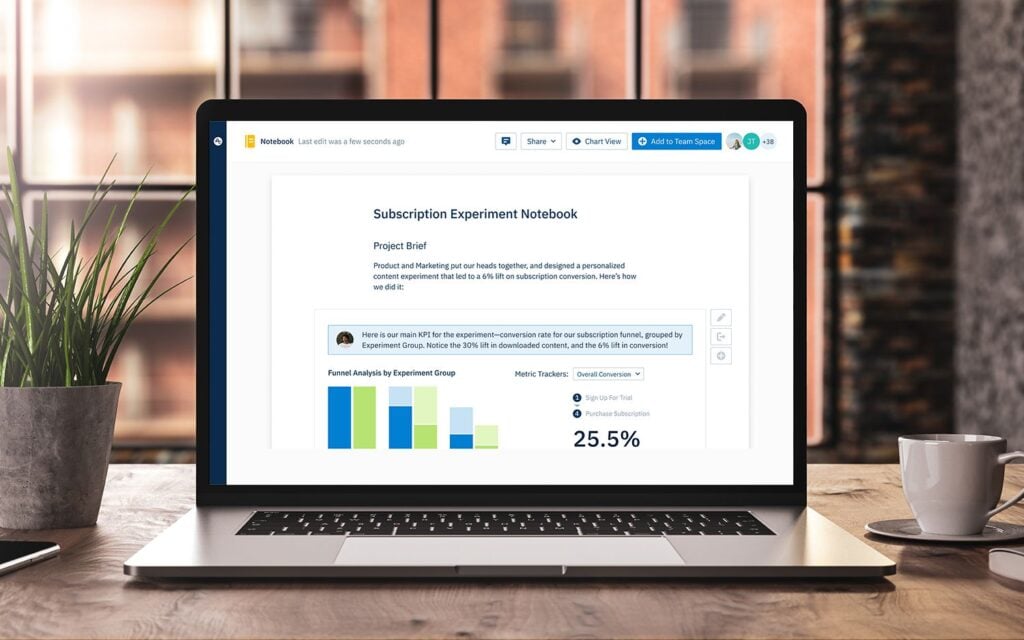
Your tooling might include Amplitude, Pendo, or Intercom for funnels, product behavior, experiments, and customer signals. The brand matters less than the discipline: events must represent the intended behavior, properties must support the relevant segmentation, and exposure to an experiment must be distinguishable from eligibility for it.
If you run an A/B test, set the minimum detectable effect before interpreting the result. Without an explicit MDE, an inconclusive read is easy to recast as success or failure after the fact. The purpose is not to make experimentation look scientific. It is to decide what size of change would matter and whether the test can detect it.
Read activation alongside time-to-value and adoption of the core capability. Then inspect retention rather than assuming an early lift created durable value. If activation improves while retention does not, you may have accelerated an action without improving the underlying experience. If usability feedback improves but the behavioral metric does not, the altered friction may not have been the limiting factor. Both outcomes are useful when they lead to a sharper next decision.
A practical experiment brief should answer these questions before delivery begins:
- Which user segment is eligible?
- What verified barrier are you addressing?
- Which behavior should change, and why?
- What is the smallest experience change that can test the causal assumption?
- What is the primary outcome, and what must not degrade?
- Which events and properties are required?
- What MDE makes the test worthwhile?
- What decision follows a positive, negative, mixed, or inconclusive result?
This is how you keep discovery attached to delivery. A sprint should carry a learning goal or an outcome, not merely a collection of screens to complete.
Build a portfolio that exposes your decisions
A UX product management portfolio is not a design portfolio with extra charts. Its job is to make your reasoning inspectable. A reviewer should be able to see what you knew, what you assumed, which choices were available, why you selected one, and how evidence changed the next decision.
Structure each case study as a decision journal:
- Context: Identify the segment, user job, product state, business relevance, and constraints.
- Problem evidence: Show the qualitative and quantitative signals. Distinguish observations from interpretations.
- Outcome: Define the behavior the team intended to change. Explain why it represented customer and business value.
- Alternatives: Present the credible options, including a smaller intervention and the option to do nothing.
- Decision: Explain the trade-off, who contributed, and which uncertainty the team accepted.
- Validation: Describe the prototype, usability work, production experiment, instrumentation, or retention analysis used.
- Result and next move: Report what the evidence justified. If it was ambiguous, explain what remained unresolved and what you changed next.
Include screens only when they help the reader understand a decision. An annotated flow showing where a hypothesis enters the experience is more valuable than a polished sequence with no explanation. Likewise, a metric screenshot is not evidence of impact unless you define the segment, behavior, comparison, and decision attached to it.
If the work was exploratory or self-directed, label it clearly. Do not imply that a concept shipped, that users were interviewed, or that business impact occurred when it did not. You can still demonstrate strong judgment by showing how you would instrument the experience, which assumptions require validation, and what evidence would cause you to stop.
Your starting discipline determines which gaps the portfolio must close:
- If you are a designer: make prioritization, value proposition, business trade-offs, outcome definition, and sequencing visible. Do not let the quality of the screens carry the case.
- If you are a product manager: make the research plan, critical path, journey decisions, usability evidence, UX writing, and interaction trade-offs visible. Do not reduce UX to a feature requirement handed to design.
Prepare interview stories around consequential decisions, not project tours. Start with the tension. Name the alternatives. Explain the riskiest assumption and how you tested it. Then state what you decided and what the evidence changed. This gives the interviewer material to assess your judgment under uncertainty.
A strong resume bullet follows the same logic: “Changed [behavior] for [segment] through [experience decision], using [evidence or method], which informed [product or business decision].” Replace every bracket with facts you can defend. If you cannot name the behavior or the decision, the bullet is probably describing output.
Lead the product trio without taking over another craft
Your career will stall if UX fluency turns into design control. The useful version of the role creates a tighter product trio: product keeps the segment, problem, priority, and outcome visible; design leads the coherence and usability of the experience; engineering brings feasibility, system constraints, delivery insight, and instrumentation into the decision early. Important choices are shaped together.
Use a lightweight operating loop:
- Before planning: align on the user problem, current evidence, target behavior, unresolved assumptions, and the next learning goal.
- During discovery: pair customer evidence with prototypes and technical investigation. Involve engineering before the team commits to a flow whose cost or constraints are unknown.
- During delivery: preserve the hypothesis in the acceptance criteria and instrumentation. Do not let the ticket retain the interface while losing the reason for it.
- After release: review behavior and customer signals together. Decide whether to continue, adjust, investigate, or stop.
Tailor the decision narrative to the audience. Executives need the trade-off, business consequence, evidence strength, and decision required. Engineers need constraints, sequencing, edge cases, event definitions, and the reason behind the behavior. Designers need the user job, journey context, friction evidence, and experience assumptions. Other stakeholders need to know what changed, why it changed, how success will be judged, and which new evidence could alter the plan.
A reusable update can stay simple: “For [segment], we are trying to change [behavior] because [evidence] indicates [barrier]. We chose [intervention] over [alternative] because [trade-off]. We will judge it through [outcome and guardrail]. The next decision occurs when [evidence condition].” That format reduces status theater because it keeps the decision and its evidence in view.
Key takeaways
- A UX product manager connects customer insight, experience decisions, and measurable product outcomes; the role is not a substitute for product design.
- Build customer insight, product strategy, and experience design around the same real problem so your skills form a coherent body of evidence.
- Use activation to diagnose the path to value, but verify downstream adoption and retention before claiming durable impact.
- Define segments, events, guardrails, MDE, and decision rules before reading an experiment.
- Make your portfolio a decision journal that includes constraints, alternatives, ambiguous evidence, and rejected ideas.
- Demonstrate leadership by improving the product trio’s decisions, not by absorbing the responsibilities of design or engineering.
Choose one experience in your current product and build the full evidence chain: segment, problem, critical path, hypothesis, experience change, instrumentation, outcome, and next decision. When you can show that chain clearly, you are no longer asking a hiring manager to infer your UX product judgment. You are giving them proof.







Leave a Reply