
Continuous customer interviews can overwhelm even seasoned product teams. I see it all the time: we commit to weekly conversations, transcripts pile up, and synthesis slips down the priority stack.
When I interview every week, the data builds quickly. Hours of transcripts accumulate, and if I don’t synthesize as I go, I fall behind. I’ve heard countless teams say, "We need to stop interviewing so we can catch up on what we’ve already learned." That’s a red flag—many teams pause and never restart.
I get why this happens. Interview synthesis is cognitively demanding and time-consuming. That’s why so many teams reach for generative AI to help. I use AI a lot—but I’m also careful about where it helps and where it hurts.
Before I explain how I use AI in practice, I want to ground us in the goal of continuous interviewing, why story-based interviews matter, and what good synthesis looks like. With that foundation, it’s much easier to see how AI can accelerate the right work without undermining our judgment, empathy, or product discovery skills.
The goal of continuous interviewing is to develop a deep and rich understanding of who our customers are, what their goals are, the context in which they pursue those goals, and what opportunities (needs, pain points, and desires) arise along the way. I get there by asking for specific stories about past behavior. Goals, context, and opportunities emerge from those stories.
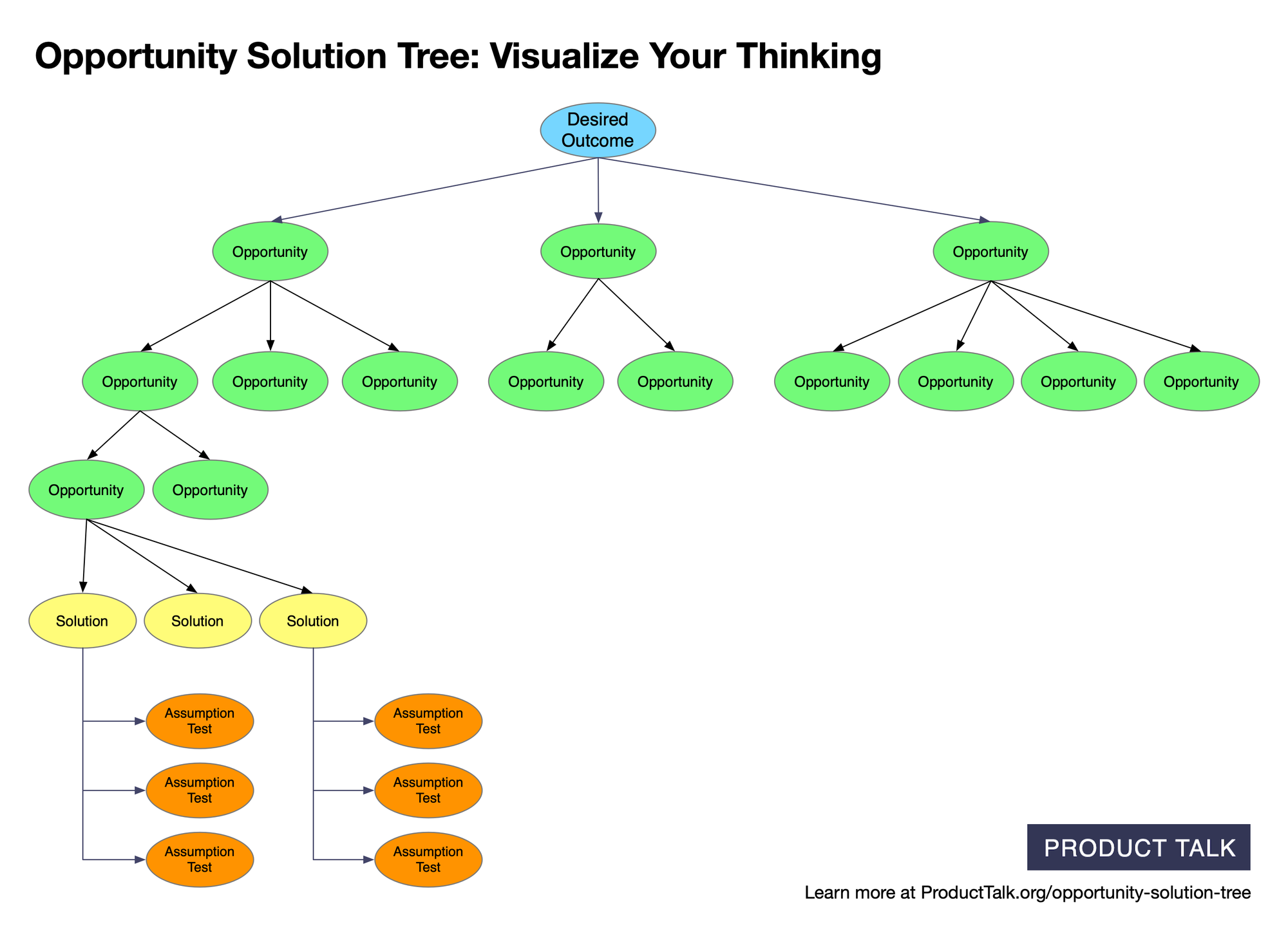
My flow is simple and disciplined: I synthesize each story using an interview snapshot, then I synthesize across stories by mapping the opportunity space in an opportunity solution tree. Habits vary, but in my experience this approach consistently yields actionable insights and keeps the team anchored in real customer context.
There’s a prerequisite almost nobody talks about: you need deep, rich stories. Many teams haven’t invested in interviewing skill. They ask hypothetical questions about the future (e.g., "Would you use this?") or spend precious interview time seeking solution feedback instead of learning about the customer’s world.

Even when teams ask about goals, context, and needs, they often ask in the abstract (e.g., "How do you decide what to watch?") or speculate (e.g., "What do you typically watch?"). That leads to unreliable feedback. When teams do ask for past stories, they often collect shallow narratives because they haven’t honed their craft to probe for detail and meaning.
Here’s the crux: if you aren’t good at collecting a rich story about past behavior, no amount of AI synthesis can help you. AI can’t add missing context. It can’t infer missing goals and motivations. It can’t create actionable opportunities from shallow stories. This is also why humans struggle to synthesize weak interviews. Better interviewing unlocks better synthesis—human or AI.
Once I have strong stories, I synthesize in two steps. First, I synthesize what I learned from each interview. Second, I synthesize what I’m learning across interviews. That separation matters.
For single-interview synthesis, I use interview snapshots. Each snapshot includes quick facts to contextualize the story, a memorable quote, an experience map of key moments, and—most importantly—a list of opportunities expressed in the customer’s own context. This keeps insights actionable and traceable.
When I synthesize across interviews, I review multiple interview snapshots to ask: what are we learning that can help us reach our desired outcome? Key moments give structure to the opportunity space, and the specific unmet needs, pain points, and desires help me see where our product can meaningfully help. With this foundation, I can reason clearly about where AI helps—and where it hurts.
Where do teams go wrong with AI synthesis? The biggest mistake I see is combining the two synthesis steps into one. Teams dump all their transcripts into an AI workspace or NotebookLM and ask the model to “tell us what we learned.” The second error is using low-quality prompts: asking for a summary, themes, or common pain points. Those outputs are easy to read but rarely actionable.
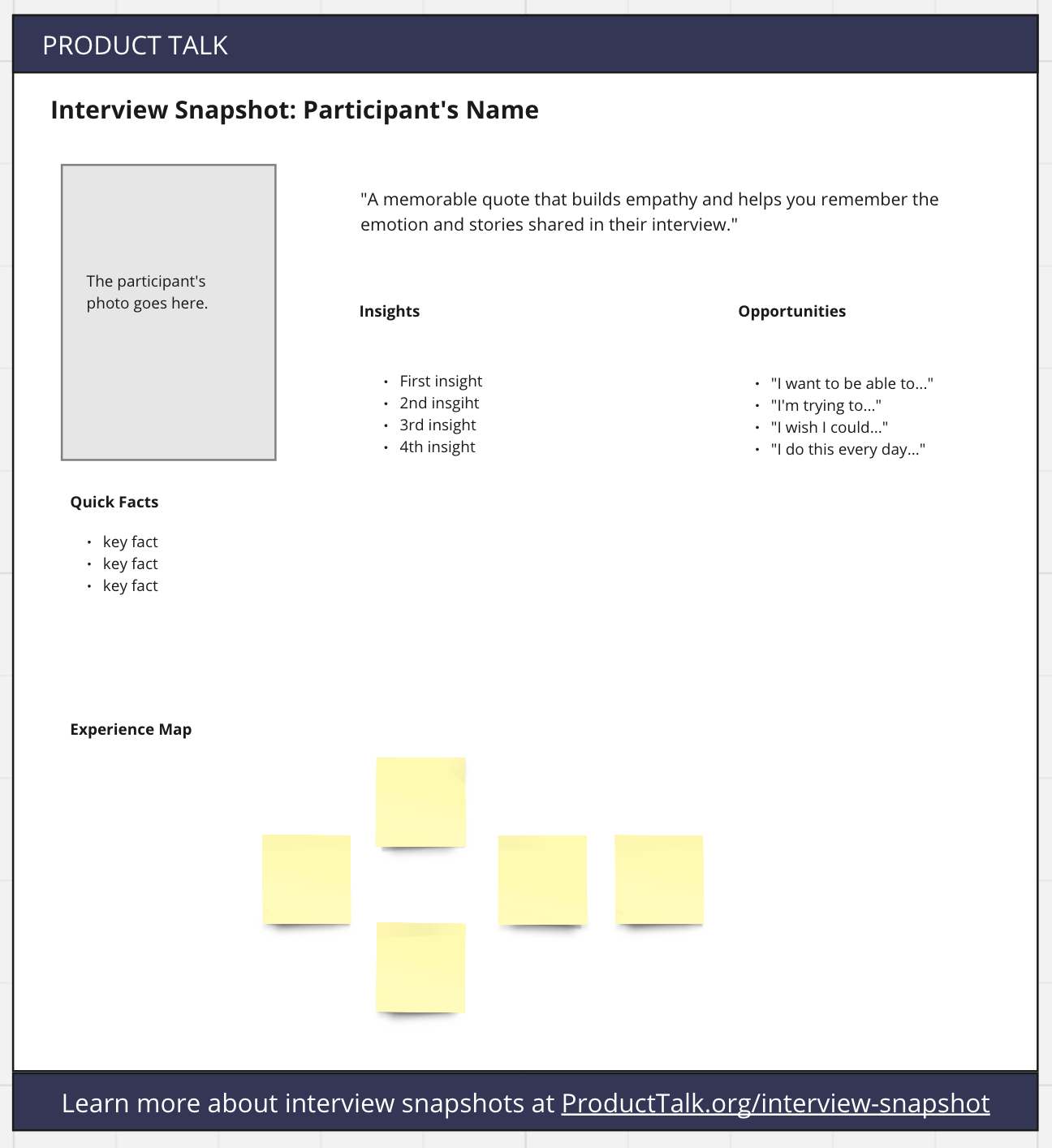
If I learn the three most common pain points across interviews but don’t know who experienced them or in what context, I can’t design effective solutions. The interview snapshot is designed to avoid that trap by preserving opportunities within the customer’s story and context, tied to a real person. That link is critical for validation and iteration.
Summaries, in particular, are problematic. If you condense a 20–30 minute interview into a paragraph or two, you’ll lose the context, nuance, and detail that makes that customer story unique. One study found that large language models "frequently generated summaries that oversimplified or omitted critical details." Another study found that models struggle to "adequately represent the deep meaning" when summarizing text.
Bias is another concern. Pre-training data can shape outputs in ways that distort meaning. The first study found that pre-training data "introduced biases that affected summarization outputs" and that models often "defaulted to generalizations or inaccuracies." Hallucinations also show up in summaries, theme extraction, and even fabricated direct quotes. I’ve seen this first-hand: when I tested ChatGPT on real interviews, a surprising share of “quotes” were inaccurate or invented.
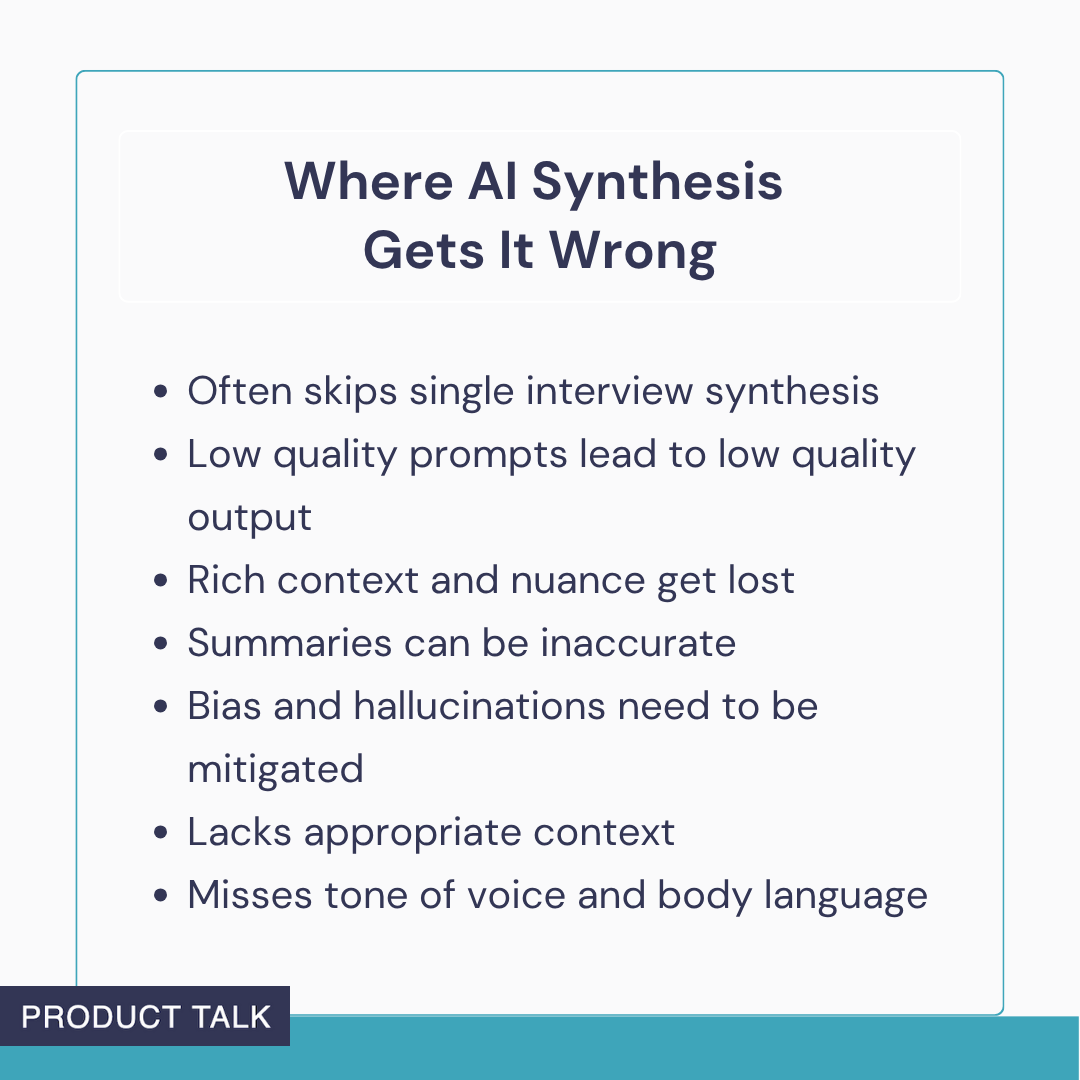
There’s also a context gap. Synthesizing an interview well often requires business, product, and customer context to correctly interpret what was said. Unless we provide that context deliberately, the AI doesn’t have what it needs. Finally, most AI synthesis works off text only, missing tone of voice and body language—both of which can materially change meaning.
Despite those risks, I don’t avoid AI—far from it. I use it deliberately in three ways that consistently add value without eroding empathy or skill.
First, AI as a notetaker. AI transcription is excellent and essentially free. I often add structured metadata—date, participant, role, company, topics—so my transcripts are easy to search. Tools like Granola can organize notes, but I always verify those notes against the transcript to avoid subtle misreads.
Second, AI as a fresh perspective. In my product trio, each of us synthesizes the interview separately before we discuss. I then add AI as an additional perspective by running the same material through carefully configured Claude and ChatGPT spaces that have the right research context and synthesis instructions. Because I’ve already done my own synthesis, I can evaluate the model’s output, borrow useful frames, and catch anything I might have missed—without outsourcing my judgment.
Here’s the workflow I rely on for using AI as a fresh perspective: I set up a dedicated, persistent space (a Project or equivalent) for synthesis. I define the right context up front—ideal customer profile, current outcome, target opportunity, research questions, and short instructions on how to do each step. I keep single-interview synthesis and cross-interview synthesis separate, using new conversations to prevent context rot. I treat AI as another teammate—not the source of truth. And when AI surfaces opportunities I didn’t capture, I go back to the source to verify.
In practice, Claude (via Projects or Claude Code) is excellent for collaborative synthesis and handling long transcripts. ChatGPT (via CustomGPTs or Projects) offers a complementary perspective, and I’ll often run the same material through both. Granola helps with note organization, provided I review its outputs before using them. One caution: many “interview analysis” tools skip single-interview synthesis and jump straight to patterning—don’t let that happen. Do step one before step two.
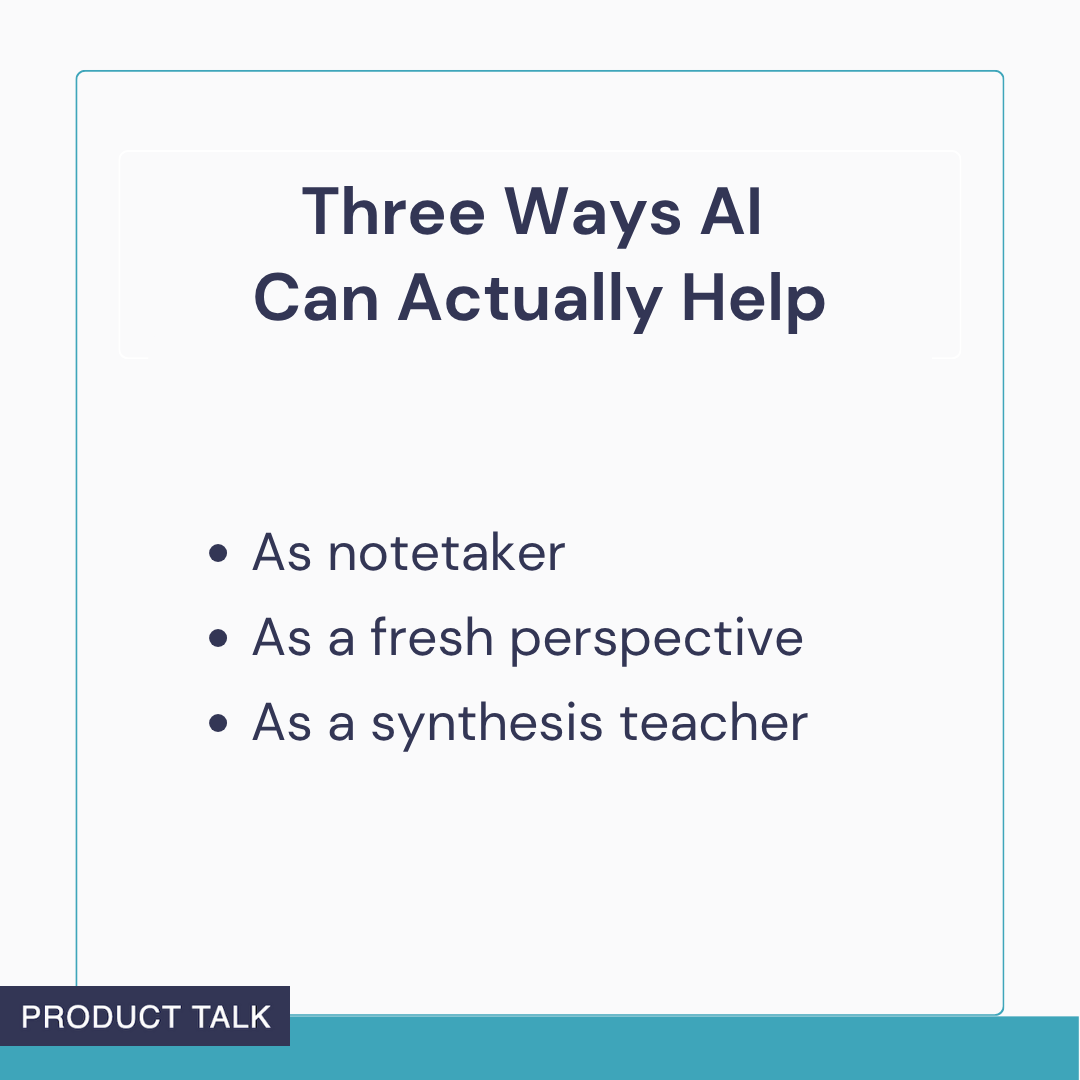
Third, AI as a customer synthesis teacher. Synthesis is a skill. AI can suggest alternative opportunity framings, propose interpretations of the same passage, and flag when an “opportunity” is really a solution in disguise. I’ve had strong results using AI as a thought partner and coach, especially when I’m deliberate about what good looks like and I verify everything against source material.
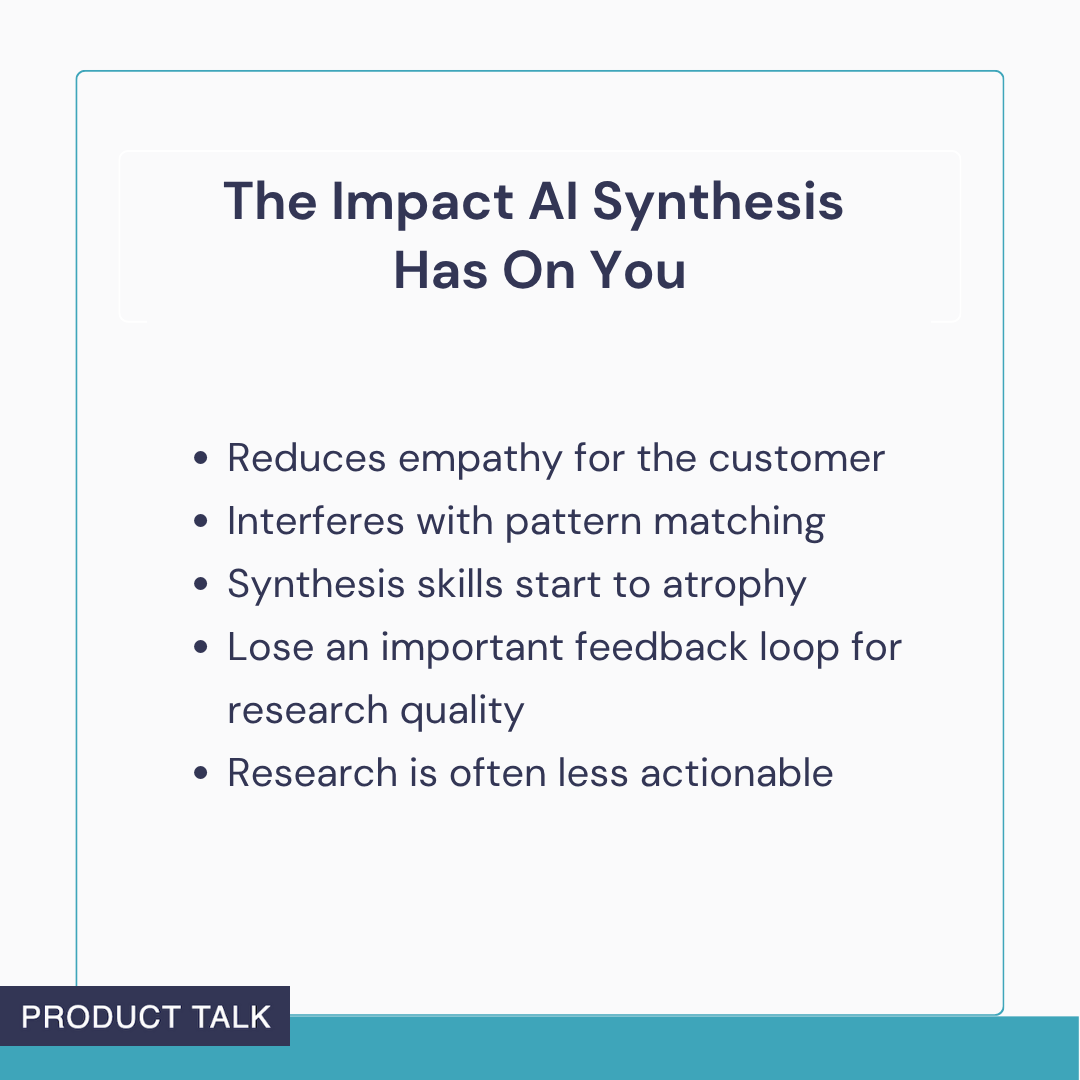
There’s an important human dimension to all of this. When I do the deep work of synthesis, I develop empathy for customers. Creating an interview snapshot forces me to ask: What happened? What did we really hear? How can we help? That cognitive effort is what unlocks both empathy and pattern recognition. If I outsource that work to AI, I lose both the learning and the mental connections that fuel better decisions.
There’s another risk: skill atrophy. If I let AI do the synthesis, my ability to synthesize degrades—and that makes me worse at evaluating AI’s output. Two recent studies (see here and here) found that experts are much better than novices at catching the subtle mistakes LLMs tend to make. So if we don’t keep our edge, we not only lose skill—we also get less value from AI.
A final benefit of doing the work yourself: when I revisit transcripts, I see my own interviewing gaps. I spot missed follow-ups, leading questions, or places I misread what was said. Synthesis becomes a feedback loop that improves my interviewing craft. If I outsource synthesis, I sever that loop.
Can AI help humans do better synthesis, faster? The research is encouraging. Those same two studies found that AI can raise the performance of novices. But they also show that experts working with AI perform best. In my experience, the sweet spot is expert human synthesis aided by AI—fast enough to keep pace, rigorous enough to build empathy and insight.
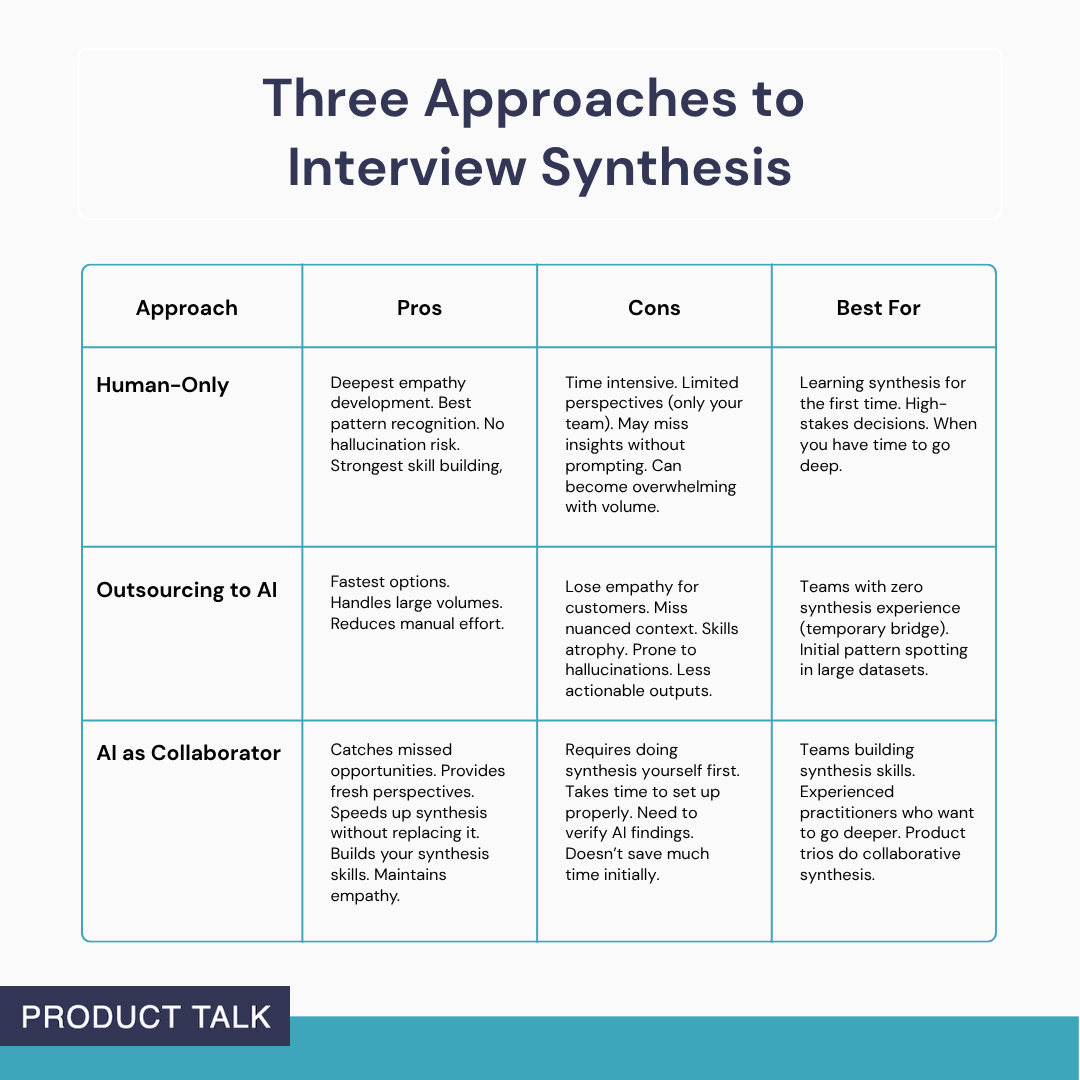
Practically, there are three approaches to interview synthesis. Human-only is the deepest path to empathy and pattern recognition, with no hallucination risk and maximum skill-building—but it’s time-intensive and can be overwhelming at scale. Outsourcing to AI is the fastest and handles volume well, but you risk losing context and empathy, your skills can atrophy, and outputs are often less actionable. AI as collaborator sits in the middle: it catches missed opportunities, adds fresh perspectives, speeds up work without replacing it, and strengthens your synthesis muscles—provided you do your own synthesis first and verify AI’s contributions.
My recommendation is simple. Start with human-only synthesis until you can recognize what good looks like. Then bring in AI as a collaborator once you can evaluate the quality of its output. Only outsource to AI if you’re genuinely blocked and need a temporary bridge—and if you do, plan to build your synthesis muscle alongside it.
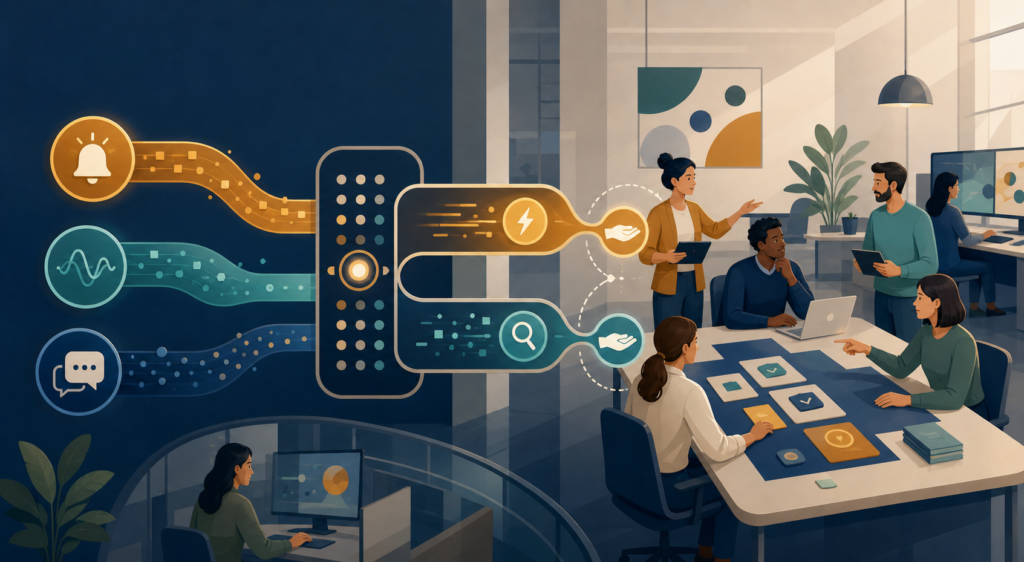
So what does AI as a collaborator look like day to day? It looks like tight loops: rigorous single-interview synthesis by each member of the product trio, a second pass with AI configured to your outcome, ICP, and target opportunities, careful verification back to the transcript, and only then cross-interview synthesis that maps the opportunity space. That cadence preserves empathy, sharpens judgment, and gives you the speed benefits of AI without sacrificing what makes product discovery work.
Bottom line: use AI to accelerate clarity, not to replace the human judgment that drives product management leadership. When we protect empathy, preserve context, and practice disciplined synthesis, generative AI becomes a powerful amplifier for product discovery—not a shortcut that dulls our edge.
Inspired by this post on Product Talk.







Leave a Reply