
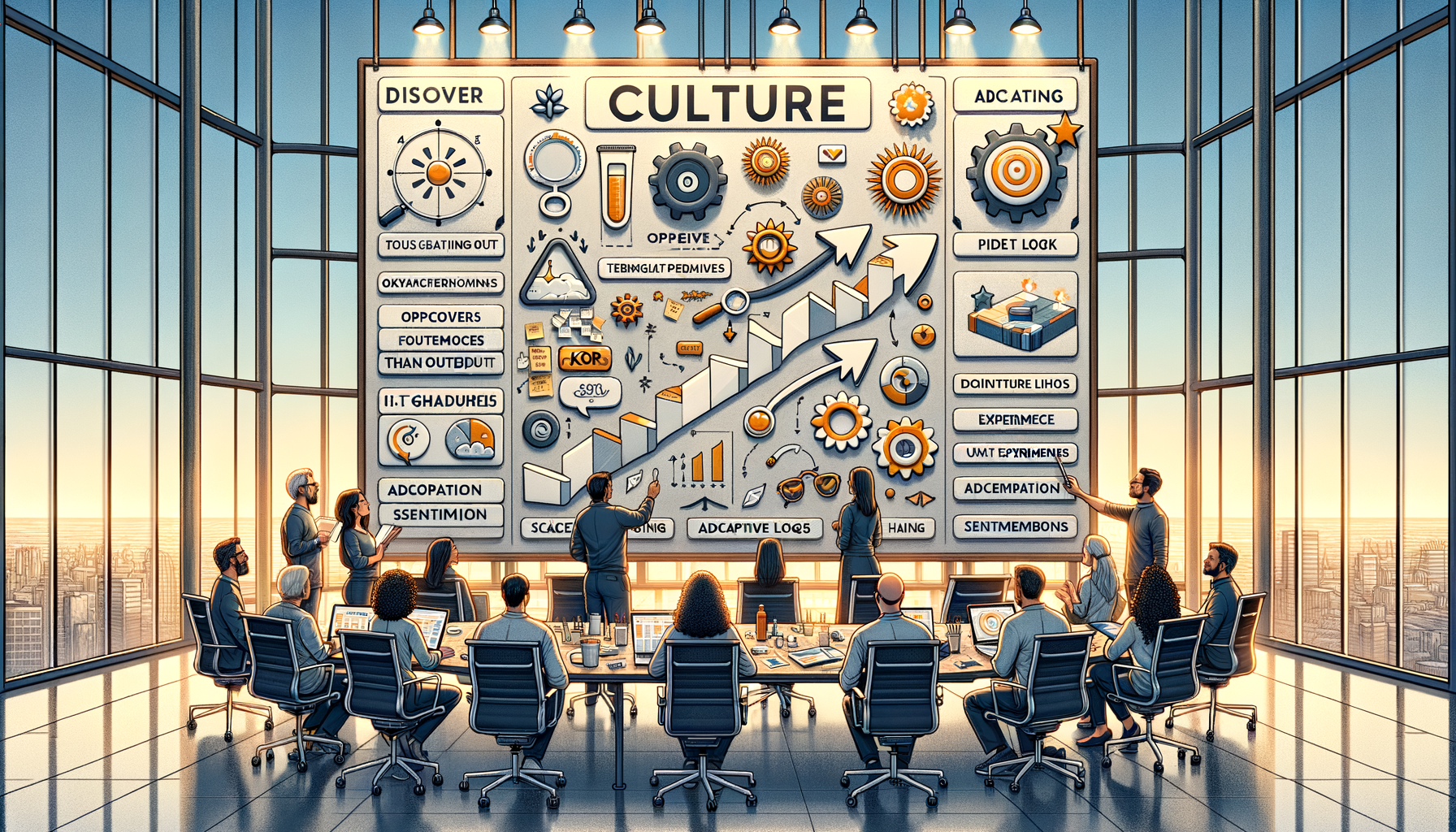
I’ve long believed that culture deserves the same rigor we bring to product management. That view crystallized in a recent deep dive with Anna Binder, Head of People at Asana, where we explored what it truly means to build culture like a product — with clear goals, tight feedback loops, and iterative learning.
We revisited the earliest days when she first took on the role, zeroing in on how she prioritized the initial things to tackle as a new People exec and combed through a slew of opinions that bubbled up from other folks at the company. What stood out to me is how much this mirrors product discovery: define the problem precisely, gather qualitative signals, and validate with small, high-leverage experiments before scaling.
Translating that into my own operating system, I treat cultural work like a roadmap. I write crisp problem statements, hypothesize the behavioral change we seek, run lightweight pilots, and measure adoption and sentiment. I anchor success on outcomes vs output OKRs so we avoid mistaking activity for impact. This mindset not only accelerates learning, it also builds trust because leaders can explain the why behind each cultural bet.
Anna shared her tactical playbook for creating a culture of feedback for not just low-performers, but high-performers, too. That nuance matters. High performers often get praise but little developmental tension; I’ve seen careers plateau when strengths go unsharpened. My practice: institutionalize upward feedback, time-box “bright spots and blind spots” in 1:1s, and ensure managers are trained to ask for evidence and examples, not just opinions. It’s an essential step in the IC to manager transition as well, where modeling curiosity sets the tone for the entire team.
She also unpacked her methodology of conscious leadership, and how the best leaders always interrogate how the opposite might be true. I’ve adopted that as a mental circuit breaker when I feel certain: I write the opposite hypothesis and list evidence for it. This habit reduces ego, surfaces hidden risks, and leads to more durable decisions — a hallmark of product management leadership.
From working on Asana’s executive team for nearly 7 years, Anna emphasized building habits that keep the exec team a healthy nucleus at the center of the company. I’ve seen the same: meeting hygiene (clear intents, pre-reads, decision logs), decision-making cadences that separate debate from decide, and transparent communication that closes loops with the broader org. Treating the exec group as a high-trust product squad prevents thrash and models the behaviors we want everywhere else.
We ended with a rapid-fire exchange that maps cleanly to everyday leadership. On onboarding: design a 30-60-90 plan with explicit outcomes, shadowing for context, and early relationship-building across functions. On all-hands meetings: prioritize clarity over spectacle, celebrate learning (not just wins), and reserve time for unscripted Q&A to keep the dialogue authentic. On mentors: build a personal board of advisors with complementary strengths — operators for execution, coaches for reflection, and domain experts for sharp edges.
If you’re looking to uplevel your culture, start small and think like a product creator: define outcomes, run thoughtful experiments, and iterate in the open. The compound interest from these practices shows up in engagement, execution velocity, and ultimately, sustainable performance.
Inspired by this post on First Round.








Leave a Reply