Tag: product-led growth

  • 8 Proven Strategies I Use to Upskill Teams Fast and Future-Proof Our Edge in the AI Era

    8 Proven Strategies I Use to Upskill Teams Fast and Future-Proof Our Edge in the AI Era

    Your team’s skills have an expiry date. Here’s how to upskill employees before the clock runs out and your edge goes with it.

    I’ve learned that upskilling isn’t a one-off training day—it’s an operating system for building resilient, empowered product teams. When we treat learning as a product, with clear outcomes, feedback loops, and constant iteration, we future-proof both our people and our roadmap. Below are the eight strategies I rely on to upskill employees quickly and sustainably while strengthening employee retention and execution quality.

    1) Anchor upskilling to strategy and outcomes. I start by mapping critical capabilities to our company strategy and outcomes vs output OKRs. This makes learning unambiguously relevant: every course, cohort, and coaching session ladders up to measurable value. If a skill doesn’t advance our north-star metrics or customer outcomes, it doesn’t make the cut.

    2) Build a learning operating system, not a library. Content without cadence is shelfware. I establish a predictable rhythm—monthly skill sprints, short microlearning modules embedded in workflows, and quarterly capability reviews during planning. We integrate upskilling into onboarding, QBRs vs OKRs check-ins, and product roadmapping so learning time is protected, visible, and non-negotiable.

    3) Design role-based paths with clear ladders. I create skill matrices for PMs, designers, engineers, and GTM partners, then craft levelled learning paths to close gaps. We use the 70-20-10 model (doing, coaching, coursework) and pair it with individual development plans, so growth is personalized but standardized enough to scale. This clarity boosts motivation and speeds up onboarding.

    4) Learn by shipping real value. The fastest learning happens on real products. I pair courses with stretch assignments tied to live initiatives—product discovery sprints, customer shadowing, rapid prototyping with gen ai, and cross-functional product trios. We treat these as safe-to-try experiments with clear success criteria, so teams upgrade skills while moving the roadmap forward.

    5) Institutionalize coaching and peer learning. I formalize mentorship, guilds, and weekly critique sessions to turn tacit knowledge into shared practice. We run cross-team demos and communities of practice so lessons travel fast. Managers coach to outcomes, not checklists, and we reward people who teach—because knowledge multiplied beats knowledge hoarded.

    6) Measure capability, not attendance. I avoid vanity metrics. Instead, I look for leading indicators that learning is changing behavior and outcomes: higher quality product discovery, clearer product positioning, tighter stakeholder management, improved deployment frequency, and stronger retention analysis. Where appropriate, we set a minimum detectable effect (MDE) for skill experiments to ensure we can actually see impact.

    7) Fund time, not just tools. Upskilling dies when calendars are full. I carve out recurring maker time for learning, set explicit expectations in performance plans, and tie promotions to demonstrable capability growth. We provide stipends for courses and certifications, but the real unlock is creating space and manager accountability so learning sticks.

    8) Use AI strategically to accelerate practice. We embed AI Strategy thoughtfully: gen ai co-pilots for research synthesis, scenario role-plays for stakeholder conversations, and guided feedback for UX writing and product tours. The rule is simple—AI should compress cycle time and elevate judgment, not replace it. I encourage teams to document prompts and playbooks so good patterns compound.

    To align and de-risk, I bring stakeholders into the loop early—finance to co-own ROI, HR to integrate paths into career frameworks, and functional leaders to ensure parity across teams. This alignment reduces friction, strengthens product-led growth, and keeps the effort resilient through reorgs and strategy shifts.

    The outcome of this approach is simple: faster time to competency, higher confidence, and a culture where learning is part of how we build. Upskilling is the most durable competitive advantage I know—because tools change, but teams that learn together win together. If your edge feels like it’s slipping, start small, make it visible, and iterate. Your future roadmap—and your people—will thank you.


    Inspired by this post on Product School.


    Book a consult png image
  • User Activation Is My North Star: The Most Reliable Signal Your Product Will Truly Scale

    User Activation Is My North Star: The Most Reliable Signal Your Product Will Truly Scale

    I’ve learned the hard way that growth isn’t about dashboards crowded with vanity metrics. When I evaluate whether a product is poised to scale, I start with one question: are new users truly activating? If not, everything else is noise.

    "Forget vanity metrics. User activation is the compass that shows if your product or organization is lost or scaling."

    When I say user activation, I mean the precise, observable milestone where a new user experiences core product value—often within their first session or first week. That might be launching a first campaign, connecting a CRM integration, or completing the key workflow that makes the product indispensable. Activation rate then becomes my primary KPI, far more meaningful than signups or pageviews because it ties directly to retention, expansion, and long-term revenue.

    Why does activation predict scale? Because it’s a leading indicator of sustained product-market fit. High activation correlates with stronger retention curves, higher feature adoption, and healthier unit economics. If activation improves, cohorts decay more slowly and customer value compounds. If activation stalls, no amount of top-of-funnel spend or go-to-market strategy will save you from churn.

    Here’s how I operationalize activation. First, I define the activation event from first principles, grounded in our value proposition and product positioning. I pressure-test that definition with real users through product discovery, then codify it as a measurable event so it’s unambiguous and auditable across teams.

    Second, I instrument the end-to-end journey. Using a unified analytics platform with tools like Amplitude analytics and Pendo, I track time-to-value, drop-off points, and the exact steps users take before and after the activation milestone. I design experiments with a clear minimum detectable effect (MDE) so A/B testing yields decisions, not debates.

    Third, I build onboarding that accelerates value realization. In-app guides, contextual product tours, and thoughtful tooltip design reduce friction while keeping users focused on the critical path to activation. Every element in onboarding earns its place by improving activation rate or shortening time-to-value—otherwise, it goes.

    Finally, I align the organization around outcomes, not outputs. I set outcomes vs output OKRs tied to activation, run weekly reviews with empowered product teams and product trios, and ensure our product-led growth motion reinforces the activation moment. This creates a shared language from product to sales to customer success.

    When activation rises, the path forward gets clear: retention strengthens, expansion opportunities emerge, and scaling becomes a matter of capacity rather than guesswork. When activation falters, it’s a signal to pause, refine the value narrative, and fix the experience. Either way, activation tells the truth. If you want to build a product that truly scales, make user activation your north star.


    Inspired by this post on Product School.

    Book a consult png image
  • Unlock Product Value: Define, Measure, and Scale What Customers Truly Pay For—Sustainably

    Unlock Product Value: Define, Measure, and Scale What Customers Truly Pay For—Sustainably

    When I think about what separates resilient products from forgettable ones, it always comes back to product value. In my role leading product at HighLevel, I’ve learned that value isn’t a slogan—it’s the measurable, compounding outcomes customers experience that make your product indispensable and your growth durable.

    Discover what product value means, how to measure it with key metrics, and proven ways to increase product value for long-term growth.

    Here’s how I define it in practice: product value is the net benefit a clearly defined ideal customer profile realizes over time, relative to their next best alternative and the total cost to achieve that benefit. That framing forces me and my team to zoom in on two questions: who exactly are we building for, and what outcomes do they consistently achieve with us that they can’t achieve as easily or as affordably elsewhere?

    Value shows up twice in a customer’s journey—first as perceived value (do they believe it will help?) and then as realized value (did it actually help?). Great product management closes the gap between the two by aligning product positioning, onboarding, user activation, and ongoing engagement with the outcomes customers care about most.

    To manage product value rigorously, I look through three lenses: perception, behavior, and economics. Together, they give me an end-to-end picture that is actionable for product discovery, go-to-market strategy, and product-led growth.

    Perception tells me how customers feel about their trajectory with our product. I track signals like NPS, CSAT, and CES, and I rely on structured interviews to capture Jobs-to-be-Done narratives. These qualitative insights often reveal points of parity we must meet just to be considered, and the points of differentiation we must elevate in our value proposition to win.

    Behavior tells me what customers actually do. Time-to-value, onboarding completion, activation rate, retention curves, feature adoption depth, and weekly active teams are my go-tos. Instrumentation matters: with Amplitude analytics, Pendo, and Intercom, I map funnels and cohorts so I can see where users stall and where they surge. When I spot friction in the first session or first week, I treat it as an opportunity to tighten product tours, improve tooltip design, and personalize in-app guides.

    Economics tells me what value means to the business over time. I watch LTV, Net Revenue Retention, expansion revenue, gross margin, and CAC payback. Cohort-based retention analysis is especially revealing—if expansion offsets logo churn, I know we’re delivering value strong enough to merit deeper adoption, not just initial curiosity.

    Anchoring this with a North Star Metric helps my teams aim at outcomes, not output. I choose a metric directly tied to customer value creation—something like “activated accounts achieving the aha moment weekly”—and wire it through outcomes vs output OKRs. That way, product roadmapping and sprint planning reflect what customers pay for, not what’s easiest to ship.

    Growing product value starts with sharpening the ICP and clarifying the value proposition. I map pains and desired outcomes, articulate points of parity we must satisfy, and highlight the differentiators that change the decision. From there, I revisit SaaS pricing and packaging to ensure customers pay in proportion to realized value, not feature count.

    Next, I systematically compress time-to-value. Fast, context-aware onboarding and user activation are non-negotiable. I combine in-app guides, product tours, and progressive tooltips with CRM integration through platforms like HubSpot to trigger the right message at the right step. A/B testing then helps me identify which experiences reduce setup friction and accelerate that first meaningful outcome.

    Sustained engagement compounds value. I design habit loops around core jobs, reduce cognitive load in key workflows, and surface proofs of progress at moments when users are most likely to disengage. For advanced users, I introduce higher-order use cases and templates that inspire expansion without overwhelming new users who are still finding their footing.

    None of this works without empowered product teams. I rely on product trios to align discovery and delivery, and I keep feedback loops tight so real customer signals inform every release. This is how we move from shipping features to earning outcomes, from intuition-only to evidence-backed decision making.

    If you need a starting plan, try this: define your North Star Metric and its leading indicators, instrument your critical paths, identify the three biggest drop-offs between sign-up and activation, and run focused experiments to improve them. Tie these to clear OKRs and review the impact weekly. You’ll see perception, behavior, and economics begin to reinforce each other—and that’s when product value truly scales.


    Inspired by this post on Product School.

    Book a consult png image
  • Global Product Manager Playbook: Build Borderless Products, Align Teams, Win Every Market

    Global Product Manager Playbook: Build Borderless Products, Align Teams, Win Every Market

    Products without borders are exhilarating—and unforgiving. In my role leading product strategy, I’ve learned that “global” isn’t a launch plan; it’s a system. It’s the discipline of creating one product vision that flexes to many markets without breaking the core experience, the roadmap, or the business.

    Here’s what a Global Product Manager does, key skills, tools, challenges, and how to grow into this high-impact role.

    At its heart, the Global Product Manager role orchestrates product-market fit in multiple regions simultaneously. I translate a unified value proposition into localized realities—aligning product positioning, go-to-market strategy, pricing and packaging, and compliance—while keeping the platform cohesive. That means partnering closely with product trios, regional leaders, sales, customer success, and marketing to drive outcomes vs output OKRs that actually move the business.

    Operationally, I start with deep product discovery across segments and geographies: what pains are universal, and where do we need regional nuance? From there, I map points of parity we must maintain globally and the differentiators we’ll localize—copy, workflows, payments, support models, and integrations. The art is delivering a consistent core with flexible edges so we can scale without fragmenting the codebase or the customer experience.

    Trust is the non-negotiable. I build privacy-by-design into the product and roadmap, and I collaborate early with legal and security on data governance, data residency, and evolving regulations like GDPR. The right guardrails reduce rework later and enable faster regional launches—because compliance is a feature customers feel, even when they don’t see it.

    On the commercial side, I partner on consumption SaaS pricing, product-led growth motions, and country-level market entry. Some markets need lighter onboarding and in-app guides; others demand concierge support or partner-led distribution. I use retention analysis to identify fit and inform sequencing, then adjust messaging and activation flows to shorten time-to-value and improve user activation by region.

    My analytics and enablement stack is intentionally boring—and ruthlessly consistent. A unified analytics platform with Amplitude analytics gives us comparable funnels across countries. For experimentation, I run A/B testing with a clear minimum detectable effect (MDE) and disciplined rollout plans. Pendo powers product tours and in-app guides tailored by locale, while Intercom and CRM integration with HubSpot help me close the loop with GTM and support teams. The outcome is a learning system, not just a dashboard.

    The hardest part isn’t translation—it’s alignment. Time zones, competing priorities, and matrixed ownership test even strong cultures. I rely on stakeholder management, crisp decision records, and product roadmapping and sprint planning rituals that respect regional input without derailing the global plan. When tension rises, I return to first principles decision making and the try do consider framework to make trade-offs transparent and repeatable.

    If you’re growing into this role, start by owning a multi-region initiative end to end: lead localization for a critical workflow, run market-specific A/B testing with clear MDE, and publish a country launch plan that ties discovery insights to OKRs and resourcing. Build your credibility by shipping outcomes, not artifacts—then scale your impact by mentoring peers and creating shared templates for pricing, positioning, and experimentation. That’s how you shift from capable PM to trusted global operator.

    Ultimately, a Global Product Manager is a force multiplier. We reduce complexity for the organization while increasing resonance for customers. If “products without borders” is your mandate, build the systems—analytics, governance, enablement, and decision-making—that make borderless execution reliable, repeatable, and fast.


    Inspired by this post on Product School.

    Book a consult png image
  • What I Learned from Trainline’s Agentic AI: Building a Trusted Travel Assistant at Scale

    What I Learned from Trainline’s Agentic AI: Building a Trusted Travel Assistant at Scale

    Over the past year, I’ve been shipping agentic AI into production and coaching product teams on what it really takes to make these systems trustworthy in the wild. One story that crystallizes the playbook comes from Trainline’s move to an agentic architecture for travel assistance—an approach that mirrors what I’ve seen work in high-stakes, real-time customer experiences.

    Trainline—the world’s leading rail and coach platform—helps millions of travelers get from point A to point B. Now, they’re using AI to make every step of the journey smoother.

    I studied how "David Eason (Principal Product Manager) Billie Bradley (Product Manager), and Matt Farrelly (Head of AI and Machine Learning)" approached the build of "Travel Assistant, an AI-powered travel companion that helps customers navigate disruptions, find real-time answers, and travel with confidence." Their work exemplifies the kind of end-to-end thinking required to move beyond demos into dependable, on-the-go assistance.

    They share how they: Identified underserved traveler needs beyond ticketing; Built a fully agentic system from day one, combining orchestration, tools, and reasoning loops; Designed layered guardrails for safety, grounding, and human handoff; Expanded from 450 to 700,000 curated pages of information for retrieval; Developed LLM-as-judge evals and a custom user context simulator to measure quality in real-time; Balanced latency, UX, and reliability to make AI assistance feel trustworthy on the go.

    I align strongly with their core takeaways: "AI assistants need both scalable reasoning and deep domain context to be useful." "Tool design and guardrails are as critical as prompt design in agent systems." "LLM-as-judge evals make it possible to measure open-ended systems without massive labeling costs." And perhaps most importantly, "Even legacy companies can move fast when they embrace experimentation and tight PM–engineering collaboration."

    From an AI strategy perspective, starting "fully agentic" was the right call. When the problem space is dynamic—disruptions, route changes, fare conditions—reasoning loops and orchestration aren’t luxuries; they’re table stakes. Tool selection becomes product design: you need the right retrieval interfaces, constraint-aware planners, and API contracts that are resilient to partial failures. Layered guardrails for safety, grounding, and human handoff reduce hallucination risk while preserving responsiveness—critical when users are standing on a platform waiting for an answer.

    The retrieval scale-up—"Expanded from 450 to 700,000 curated pages of information for retrieval"—is a classic inflection point. I’ve seen teams stall here when they treat content growth as a pure indexing problem. The winning move is curation and structure: normalize sources, encode policy-level constraints, and align retrieval chunks to decision boundaries the agent actually uses. That’s how you keep precision high while coverage explodes.

    Evaluation is where most open-ended assistants fail quietly, which is why I was encouraged to see "Developed LLM-as-judge evals and a custom user context simulator to measure quality in real-time." In practice, LLM-as-judge gives you scalable, scenario-based scoring without prohibitive labeling, while a user context simulator surfaces regressions tied to persona, itinerary state, and device constraints. The combination closes the loop between model behavior, tool layer changes, and UX outcomes.

    On product delivery, the decision to have the system "Balanced latency, UX, and reliability to make AI assistance feel trustworthy on the go" shows mature prioritization. For travel, trust accrues in seconds: fast-enough responses, graceful degradation when upstream data lags, and explicit handoff when confidence dips. This is where guardrails meet UX writing—clear, bounded language signals competence even when the system defers.

    Finally, the organizational pattern matters. The teams that win in agentic AI are cross-functional, experimentation-driven, and ruthless about instrumentation. Tight PM–engineering collaboration, explicit safety thresholds, and an eval stack that mirrors real user journeys are what turn promising architectures into dependable products.

    It’s a behind-the-scenes look at how an established company is embracing new AI architectures to serve customers at scale.

    If you’re building agentic AI in production, borrow these moves: invest early in tool and guardrail design, scale retrieval with curation not just volume, adopt LLM-as-judge plus context simulation for continuous evaluation, and treat latency and reliability as core product requirements—not afterthoughts. That’s how you ship AI assistance that customers trust when it matters most.


    Inspired by this post on Product Talk.


    Book a consult png image
  • Why We’re Building Our Next AI R&D Hub in Berlin—and Hiring 100 to Power Fin’s Growth

    Why We’re Building Our Next AI R&D Hub in Berlin—and Hiring 100 to Power Fin’s Growth

    I’m excited to share that we’re opening our next R&D hub in Berlin to support significant investment in our AI customer service platform, Intercom, and market-leading AI Agent, Fin. We intend to hire 100 people in Berlin over the year ahead across engineering, AI, data science, product, and design. This move reflects our AI Strategy, our commitment to product management leadership, and our focus on building enduring product-led growth.

    We believe that in a short number of years, the vast majority of customer service will be done by AI. Fin is already the world’s best Customer Service Agent. At Pioneer, our recent summit for AI customer service leaders in NYC, we talked about how Fin will become a true end-to-end Customer Agent, extending far beyond service. We showcased how companies like WHOOP, Anthropic, and Lightspeed are already pushing Fin in ways that help them grow their business.

    This market opportunity is massive and expanding at unprecedented pace. Our ambition is to earn our place as one of the most successful AI businesses during this wave of AI disruption, and we want more brilliant people on our team to pursue this as aggressively as possible. If you’re motivated by Generative AI, LLMs, and building real products that scale, you’ll find both challenge and impact here.

    We are already on track to be one of the fastest growing private software companies. Fin is the primary contributor to this, and is months away from passing $100m in ARR. So far, more than 7000 businesses have transformed their customer service with Fin, including German companies like electricity provider Ostrom, smart home technology provider tado°, and grocery delivery company Flink, along with global leaders like Vanta, Clay, Lovable, and Miro.

    Why Berlin? We’re drawn to the city’s rare blend of deep technical talent and rich creative culture—within a vibrant, globally connected ecosystem close to our R&D hubs in Dublin and London. It’s a place where top-tier engineers and designers thrive, and where ambitious builders from around the world want to relocate and create category-defining products.

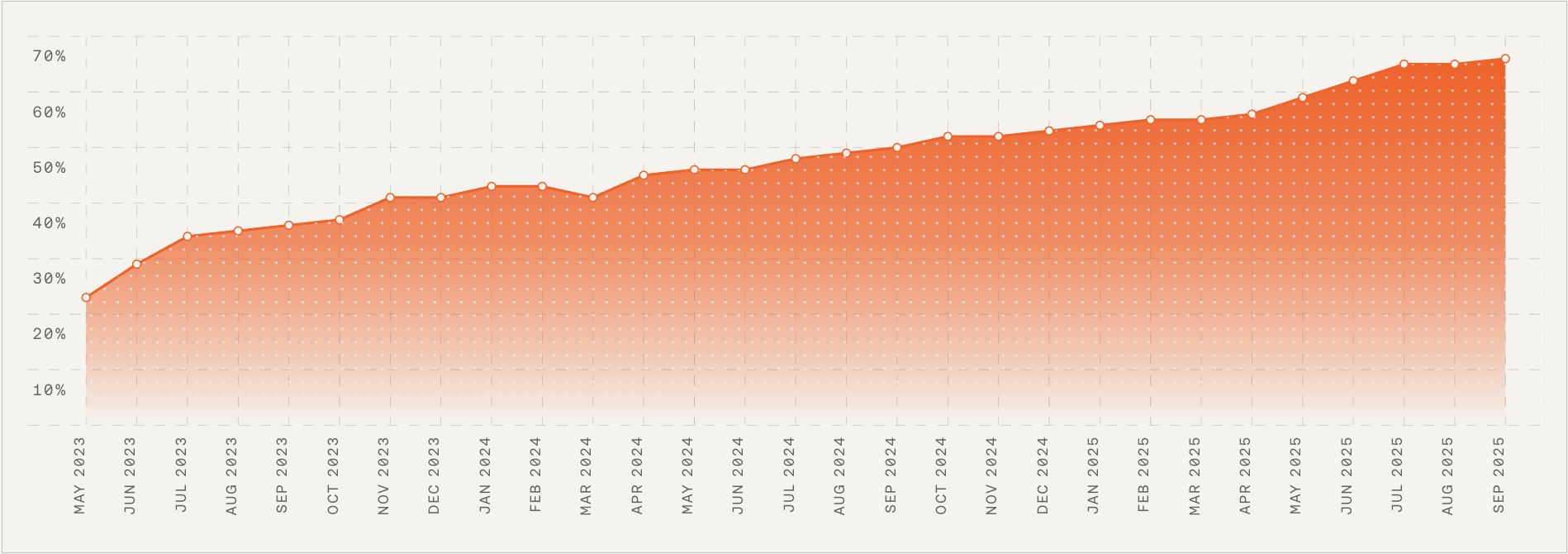
    Orange gradient area chart with a white line and circular markers showing steady growth from about 26% to nearly 70% across monthly labels from May 2023 to Sep 2025, on a light grid with percentage ticks.
    Momentum is building: this month-by-month chart shows a consistent rise from the mid-20s to nearly 70% between May 2023 and Sep 2025—signaling strong progress as we expand engineering, AI, and automation at our new Berlin R&D hub.

    We needed a new location that would sustain the high ambition and standards held by our world-class AI teams in Dublin and London. Berlin has emerged as one of Europe’s hottest centers for AI talent, with a high density of AI-focused startups, applied research labs, and practitioners who bring exceptional literacy, optimism, and ambition. It’s the right accelerator for our AI hiring and a place to bring in brilliant minds to shape the future of our product and business.

    While Intercom’s reach is global with our headquarters in San Francisco, our R&D leadership remains anchored in Dublin, where half of the executive team sits—making Berlin both geographically and strategically an ideal next location for our growth.

    This isn’t our first time expanding our footprint; we previously bet on London and are delighted with how that’s been working. When we shared our Berlin news internally, the energy was palpable, with many teammates volunteering to help spin up the hub successfully—including colleagues who helped make London a big success, like Danny. That level of ownership and momentum is exactly what we aim to cultivate in Berlin.

    We’re looking for people who thrive in a high-intensity, high-ambition, high-standards environment and want to help build one of the world’s best AI companies. For builders like that, the opportunity for impact, growth, and career progression is extraordinary. As with London and Dublin before it, the early Berlin cohort will have a disproportionate influence on team norms, culture, and long-term outcomes. We are in the middle of a huge disruptive wave with AI, and Fin is one of the leading examples of commercially successful AI applications. Joining Intercom is an opportunity to be part of this disruptive wave, and help us build out our vision for Fin becoming the world’s best Customer Agent.

    Four panelists seated on a dark stage during an AI engineering discussion, with on-screen titles above them, at an event announcing a new R&D hub in Berlin.
    On a minimalist stage, four speakers share insights on AI research, automation, and engineering as part of a panel tied to Berlin expansion and the launch of a new European R&D hub.

    There are plenty of AI companies to join, but our technology and culture set us apart. Any AI product is only as good as the AI layer powering it. Ours is industry-leading, built by a highly talented, ambitious, and technical team of over 40 machine learning scientists, engineers, and designers in Europe who continuously optimize Fin’s performance through cutting-edge research, experimentation, and innovation. Fin’s average resolution rate increases 1% every month. That kind of steady, compounding improvement is exactly what great customer support AI strategy looks like in practice.

    We also build in public and share our progress and learnings with the AI community at large. Recently, our Chief AI Officer Fergal Reid and SVP of Engineering Jordan Neill joined leaders from Cognition, Harvey, and Perplexity in San Francisco to share real lessons, challenges, and breakthroughs from building frontier AI products. Our AI team regularly publishes their insights on the AI research blog; from optimizing inference speed and availability, to building our own proprietary models that outperform general purpose models for CX.

    Our AI group and the broader R&D org they operate within work at extraordinary scale and speed. We recognize that moving fast can’t be taken for granted—you must fight for it—and we’re doing just that, embracing the capabilities AI tooling brings us to achieve 2x the throughput. One example of this mindset in practice is us “Betting on the future of frontend at Intercom,” making a technology choice that optimizes for our teams’ ability to build high-quality product, fast.

    Our design and product teams are world-class and forward-thinking; they’re embracing AI to evolve how they work, as shared in our 3-point framework for AI-driven design and recently presented by Emmet Connolly, our SVP of Design, at this year’s Hatch conference in Berlin. As a product leader, I’m grateful to work alongside brilliant product and design thinkers—it gives me confidence that we’re solving the right problems, solving them well, and driving real impact.

    Tech conference collage with a speaker on stage beside four panels: AGI teaser on a tablet, code editor, webcam demo with hand tracking, and a simulation. Banner reads Hatch Conference 2025 Main Stage.
    From live demos to hands-on coding, this snapshot captures the momentum we're bringing to our Berlin R&D hub – AI experiments, hand-tracking prototypes, and simulation tools powering our next wave of engineering.

    We plan to open our Berlin office space in December or January. To get the office started, we’re hiring Senior Product Engineers, Machine Learning Scientists, Product Managers, Senior Product Designers, Engineering Managers, and Data Scientists immediately. If your craft sits at the intersection of LLMs for product managers, agentic AI, and empowered product teams, you’ll be right at home.

    You can learn more about our open roles, company, culture, and locations on our careers site, or feel free to reach out to me, Jordan, Fergal, or Brian directly on LinkedIn if you have any questions.

    Some of our engineering team will also be at LeadDev Berlin on November 3rd—come say hi if you’re attending.

    I’m looking forward to continuing to build Intercom as one of our generation’s best AI companies—and I’m excited for our expansion into Berlin to be a major contribution to that success.


    Inspired by this post on The Intercom Blog.


    Book a consult png image
  • Beyond Digital: How AI Transformation Builds Adaptive, Intelligent Organizations That Win

    Beyond Digital: How AI Transformation Builds Adaptive, Intelligent Organizations That Win

    Digital transformation rewired our systems; AI transformation rewires how we learn, decide, and compete. “AI transformation goes beyond automation to create adaptive, intelligent organizations. Discover why it’s the next imperative and how to measure success.” That statement captures what I experience daily: we’re moving from scripted workflows to living systems that improve with every interaction.

    When I talk about AI transformation, I’m not describing a tool rollout. I’m describing an operating model where data, models, and product strategy converge to create compounding advantage. In practice, that means agentic AI orchestrating tasks, robust data governance and privacy-by-design from day one, and empowered product teams that ship, measure, and iterate at high tempo.

    The imperative is strategic, not merely technical. Markets are compressing cycle times, and customers now expect intelligent experiences by default. Organizations that master AI Strategy and product-led growth will set the pace—using AI for competitive differentiation rather than feature parity.

    This shift changes how I build teams and backlogs. I lean on product trios, forward deployed engineers, and tight product discovery loops to reduce uncertainty early. We design for resilience and learning: human-in-the-loop feedback, clear escalation paths, and telemetry that turns every interaction into a hypothesis test.

    Governance is a first-class feature. AI risk management, data governance, and threat detection and response sit alongside performance metrics in the same dashboard. We codify guardrails—policy, provenance, and permissions—so innovation scales safely and sustainably.

    Measurement is where transformation becomes real. I anchor on outcomes vs output OKRs tied to customer value and revenue impact. At the product layer, I track activation, time-to-value, retention, and adoption by persona. For ML quality, I monitor precision/recall, coverage, hallucination rate, and model drift. In experimentation, A/B testing with a thoughtful minimum detectable effect (MDE) prevents false wins, while Amplitude analytics, Pendo, and Intercom instrumentation expose where guidance or UX writing can unlock activation.

    The fastest wins often start in service and sales. A customer support ai strategy can deflect tickets with high-resolution answers while escalating edge cases to humans with full context. CRM integration with HubSpot and a ChatGPT connector enables reps to generate next-best-actions, summarize calls, and personalize outreach—measurably lifting conversion and lowering cost-to-serve.

    On the build side, LLMs for product managers and gen ai for product prototyping accelerate discovery cycles. I use CustomGPT workflows to validate value propositions quickly, then harden successful flows with engineering. Throughout, product positioning and a crisp value proposition ensure that what we ship is understandable, differentiated, and priced to match ROI—consumption SaaS pricing when usage scales value.

    If you’re getting started, begin with a single, high-frequency journey, instrument it deeply, and publish transparent OKRs. Pair empowered product teams with clear governance, and iterate toward agentic AI experiences. The payoff isn’t a one-time launch; it’s a continuously learning system—and a culture—that compounds advantage release after release.


    Inspired by this post on Pendo – Perspectives.


    Book a consult png image
  • Unlock Customer Gold: Securely Access Intercom Data in ChatGPT to Align Every Team

    I see customer conversations as a goldmine for every team—yet too often, they’re trapped inside the support platform. That silo makes it harder to make confident, customer-first decisions across product, sales, marketing, and leadership. I’ve felt that pain firsthand, which is why this update matters.

    From today, the new Intercom connector for ChatGPT changes this. Intercom customers can now allow all teams to securely access conversations, tickets, and user data directly inside ChatGPT. Without having to switch tools, you can now get all the context you need to put the customer first across every area of your business.

    Here’s how I approach it in practice: when frontline insights are accessible in the same workspace where I ideate, plan, and write, my team moves faster with more conviction. It’s the difference between guessing at customer needs and grounding decisions in real conversations.

    How to connect Intercom to ChatGPT

    Connecting Intercom to ChatGPT is easy:

    1. In ChatGPT, open Settings → Connectors.

    2. Search for “Intercom” and select it.

    3. Sign in with your Intercom account to approve the secure connection.

    (The connector is read-only and respects your existing Intercom permissions, so people only see what they already have access to. See more about security and setup details here.)

    Once you’re in, you can start exploring your customer data using prompts written in natural language, like:

    “Help me prepare for a meeting with customer X by updating me on outstanding issues raised in the last four weeks.”

    “Find positive Intercom conversations mentioning our new feature Y, and add customer quotes to my campaign brief in Drive.”

    “Build a list of the most common feature requests based on customer inquiries.”

    What this unlocks

    Connecting Intercom to ChatGPT makes customer feedback available across the company in a usable way. In my own workflow, this turns previously buried signals into actionable inputs for roadmaps, messaging, and enablement—without hopping between tools.

    Support tickets contain direct information about what’s breaking, what’s confusing, and what people actually need. Normally, that information stays siloed in the support team. When I can query those conversations in plain language, I get immediate clarity on friction points and opportunities, and I can share that context with cross-functional partners in minutes.

    When anyone can query it in plain language, it becomes useful for decision-making across the board. Teams stop working at cross-purposes because they’re looking at different parts of the picture. Now, product can see what’s actually frustrating users. Sales can understand common objections. Marketing can use the language customers actually use. Leadership can spot trends as they’re happening.

    My recommendation: establish a lightweight ritual around this data. For example, build a weekly highlights digest sourced from Intercom conversations and review it in your product sync or go-to-market standups. It’s a simple way to align stakeholders and keep customer reality front and center.

    We’ll be adding more connectors soon so you can access Intercom data in other AI tools your team already uses.


    Inspired by this post on The Intercom Blog.


    Book a consult png image
  • Make Data Work Together: Build a High-Trust, Data-Driven Culture with Amplitude and Slack

    Make Data Work Together: Build a High-Trust, Data-Driven Culture with Amplitude and Slack

    Data collaboration isn’t a tool you buy; it’s a culture you build. In my role leading product teams, I’ve learned that the fastest way to better decisions is aligning on a shared language of metrics and weaving insights into our daily rituals. When we do that well, momentum compounds—roadmaps clarify, stakeholder debates get healthier, and teams ship with confidence.

    Break down data silos and align teams with Amplitude: define shared metrics, share insights in Slack, and build better habits together.

    Here’s how I operationalize that guidance. First, we create a crisp measurement framework—one North Star metric supported by a few input metrics that map to customer value. We document definitions in a living “metrics glossary,” enforce data governance, and design a clean Amplitude taxonomy so events, properties, and user identities are consistent across the product. This is the foundation of a unified analytics platform that everyone can trust.

    Next, we make insights unavoidable. Amplitude dashboards are curated by product trios and subscribed into Slack channels so context meets people where they work. I ask teams to pair charts with a one-paragraph narrative: what changed, why it likely changed, and what we’ll try next. This simple habit closes the loop between analysis and action—and it catalyzes product-led growth.

    We institutionalize these behaviors in our operating cadence. Weekly insights reviews focus on outcomes vs output OKRs. Sprint planning starts with what the data says, not what we wish were true. In QBRs, we connect customer journeys to retention analysis and A/B testing results, making sure tests are designed with an appropriate minimum detectable effect (MDE). Empowered product teams own decisions; stakeholder management shifts from opinion trading to hypothesis testing.

    A few pragmatic enablers make this stick: clean CRM integration to join product usage with lifecycle and segment data; privacy-by-design guardrails; clear ownership for instrumentation; and lightweight documentation that evolves with the product. I also encourage teams to ship in-app guides when we launch a feature so we can measure activation and iterate quickly based on Amplitude analytics.

    The cultural side matters just as much. I celebrate learnings (even when metrics dip) and spotlight teams that translate insights into experiments quickly. Psychological safety unlocks better questions, and better questions unlock better products. Over time, this builds the high-trust environment required for durable, data-informed decision-making.

    If you’re just getting started, pick one product surface and one customer journey. Define the shared metrics, wire up Amplitude, pipe key dashboards into Slack, and run a single, well-powered experiment. You’ll feel the difference in a sprint or two—and you’ll have a repeatable playbook to make data truly work together across your organization.


    Inspired by this post on Amplitude – Best Practices.


    Book a consult png image
  • Pendo’s Summer Release: How I Reimagine Onboarding, Support, and Expansion in the SaaS + AI Era

    Pendo’s Summer Release: How I Reimagine Onboarding, Support, and Expansion in the SaaS + AI Era

    I’ve been reflecting on How Pendo’s Summer Release reimagines onboarding, support, and expansion in the SaaS + AI era, and it resonates deeply with the product-led playbooks my team and I use every day. The core promise is simple and powerful: “These three best practices aren’t new, but how you achieve them is.” That framing captures the shift I see across high-performing product organizations—same outcomes, radically upgraded execution through AI, in-app experiences, and unified analytics.

    For onboarding, I prioritize accelerating user activation with clear product tours, in-app guides, and great UX writing that removes cognitive load. The difference now is how precisely we personalize these moments: segmentation driven by product usage, CRM integration, and experiments (A/B testing with a disciplined minimum detectable effect) help us craft paths that meet users where they are. When onboarding is instrumented this way, it becomes a scalable engine for product-led growth rather than a one-time setup task.

    Support is undergoing an equally meaningful transformation. Contextual, in-app help combined with agentic AI can diagnose issues, surface relevant knowledge, and guide users without forcing channel switches. I’m bullish on this, but only when it’s anchored in privacy-by-design, AI risk management, and strong data governance—trust is the prerequisite for any customer support AI strategy. When done right, support shifts from reactive ticket resolution to proactive value delivery.

    Expansion, to me, is the earned outcome of consistent product value. In the SaaS + AI era, we can use unified analytics to identify readiness signals—feature adoption, outcomes achieved, and time-to-value—and trigger timely, ethical nudges in-app. The best motions align offers with real customer milestones, whether that’s consumption SaaS pricing upgrades, role-based add-ons, or advanced capabilities unlocked through demonstrated need. This is product-led growth at its most customer-centric.

    Underpinning all three motions is measurement discipline. I push for a unified analytics platform that ties together behavioral data, retention analysis, funnels, and cohorts with downstream CRM integration. That allows product trios to make fast, informed decisions and connect activation, support efficiency, and expansion to business outcomes. Whether your stack includes Pendo, Amplitude analytics, or custom pipelines, the principle is the same—one source of truth that informs action.

    Execution matters as much as strategy. Empowered product teams working in tight product trios can ship small, valuable increments, run clean experiments, and learn faster than the market shifts. Strong stakeholder management and clear product roadmapping keep leadership aligned on outcomes vs output OKRs, so we’re funding what works and pruning what doesn’t. In my experience, this operational rigor is what turns promising ideas into durable competitive differentiation.

    If you’re looking to operationalize these ideas, start by defining activation and expansion milestones that map to your value proposition. Instrument your in-app guides and product tours to support those milestones, and commit to an experimentation cadence with well-defined MDE. Layer in agentic AI carefully—pilot in the support surface where context is rich and stakes are clear—and enforce privacy and governance from day one. Finally, close the loop with unified analytics so every improvement compounds.

    Pendo’s Summer Release highlights a broader reality: our industry isn’t inventing new destinations, we’re modernizing the routes. Onboarding, support, and expansion remain the pillars—but AI, in-app experiences, and integrated data make them smarter, faster, and more human. That’s the shift I’m leaning into—and the one customers feel immediately.


    Inspired by this post on Pendo – Best Practices.


    Book a consult png image
  • The Only 3 Dashboards Product Executives Actually Use to Drive Outcomes, Alignment, and Growth

    The Only 3 Dashboards Product Executives Actually Use to Drive Outcomes, Alignment, and Growth

    I’ve learned the hard way that more charts don’t equal more clarity. One challenge that comes with this is knowing what matters at the right level of leadership. Executives everywhere are busy, and they don’t need the nitty-gritty details to do their jobs well. When I’m operating at the VP level, I rely on just three dashboards that give me fast signal, reduce noise, and keep teams aligned to outcomes—not output.

    These dashboards sit on top of a unified analytics platform that connects product analytics (Amplitude analytics or Pendo), CRM and revenue data (e.g., HubSpot), billing, and support signals. Consistent definitions, data governance, and outcomes vs output OKRs ensure we’re making decisions with confidence, not gut feel. The goal is simple: a shared, executive-ready view that ties product strategy to business impact.

    Dashboard 1: Outcomes and Strategy Alignment. This is the north star view I use to orient the company. It highlights ARR, NRR, and GRR trends; progress against our outcomes vs output OKRs; our product-led growth funnel; and our primary value proposition metric (e.g., activation-to-time-to-value). I include a 12-month view with quarter-over-quarter deltas, a short written narrative, and the top three strategic bets we’re funding. In board management and QBRs vs OKRs discussions, this keeps focus on what we achieved, what moved, and what we’re changing next.

    Dashboard 2: Customer Value, Adoption, and Retention. This is where retention analysis meets product discovery. I track activation rate, time-to-value, feature adoption cohorts (from Amplitude analytics or Pendo), retention curves by segment, and expansion vs contraction signals. Leading indicators include NPS and CES alongside qualitative themes from support and sales. I also monitor funnel drop-offs and in-app guides or product tours performance to see where users get stuck. The intent is to connect behavior to revenue so we can prioritize changes that actually improve customer outcomes.

    Dashboard 3: Execution Health and Quality. This helps me assess whether our operating system is working. I look at delivery predictability against product roadmapping and sprint planning, cycle time and throughput, escaped defects, incident volume, and MTTR. I also review experiment velocity and A/B testing readiness (including minimum detectable effect) to ensure we’re learning at pace. Resource allocation across strategic initiatives and a clear risk register support proactive stakeholder management.

    I review these dashboards weekly with my product trios and monthly with cross-functional leaders, then synthesize a concise narrative for the executive team and the board. Each dashboard is a decision engine: it has an owner, a single source of truth, clear thresholds, and a list of next actions. By grounding conversations in the same views, we reduce back-and-forth and keep momentum high.

    A few implementation rules have served me well: keep the signal dense and the visuals simple; lock metric definitions and ownership; avoid vanity metrics; and instrument privacy-by-design from the start. When data is trustworthy and the story is tight, teams focus on the right problems and progress compounds.

    If you find yourself wading through dozens of reports, try consolidating to these three executive dashboards. You’ll spend less time arguing about the data and more time driving product-led growth, accelerating alignment, and delivering customer value at scale.


    Inspired by this post on Pendo – Best Practices.


    Book a consult png image
  • 4 Costly Misconceptions About AI Agents—and What Product Leaders Must Do Instead

    Building AI agents looks deceptively simple right now. After leading multiple agentic AI initiatives, I’ve learned that the difference between a demo and a dependable product comes down to disciplined product discovery, ruthless scoping, and a clear AI Strategy that aligns with business outcomes. Here are four common misconceptions I correct early with stakeholders—and the practices I use to avoid expensive detours.

    Misconception 1: “An LLM plus a few prompts is a production-ready agent.” In reality, production-grade agents require orchestration and rigor: tool-use and retrieval, memory design, state management, deterministic fallbacks, and continuous evaluation. I instrument Agent Analytics from day one to trace tool calls, latency, error codes, and cost per task; then I use A/B testing with a clear minimum detectable effect (MDE) to validate improvements before broad rollout. This is where product roadmapping and sprint planning matter—sequencing capabilities so we avoid building speculative features that don’t move outcomes.

    Misconception 2: “More autonomy is always better.” The right autonomy level is contextual and risk-adjusted. For high-stakes workflows, I design for human-in-the-loop and role-based guardrails, grounded in privacy-by-design and data governance. Policies like least-privilege access, audit logs, and reversible actions reduce operational risk while still delivering leverage. In practice, this hybrid approach also controls cost: narrower scopes, clearer prompts, and bounded tool access reduce hallucination surface area and improve reliability—key to AI risk management.

    Misconception 3: “If we build it, users will adopt it.” Adoption is earned with thoughtful onboarding and in-app guidance, not promised by a feature launch. I pair agent launches with targeted product tours, contextual tooltips, and progressive disclosure to drive user activation and product-led growth. Increase revenue, cut costs, and reduce risk with Pendo’s Software Experience Management platform. Optimize the entire software experience to drive adoption and improve engagement. Whether you use Pendo or a comparable solution, the principle stands: instrument the experience, run experiments, and iterate quickly based on evidence, not intuition.

    Misconception 4: “Security, compliance, and governance can wait.” Deferring controls is a false economy. I embed AI risk management from day zero: prompt injection defenses, PII redaction, DLP, grounding and citation strategies, and threat detection and response. Clear data retention policies, vendor diligence, and model evaluation standards keep leadership, security, and legal aligned. This is the crux of building trust—and it’s far easier to design up front than to retrofit under pressure.

    How I execute in practice: start with a tightly framed use case tied to a measurable outcome; define outcomes vs output OKRs; build a slim vertical slice to validate feasibility; instrument Agent Analytics from the first commit; ship behind feature flags; and operationalize learning loops across support, success, and GTM. The result is a durable path to product-market fit for agentic AI—one that compounds learning while minimizing blast radius.

    The leaders who win with AI agents won’t be the ones who move fastest in a demo. They’ll be the ones who manage risk transparently, learn in public with their users, and turn continuous insight into competitive differentiation. If you’re planning your next agent milestone, align the roadmap to outcomes, treat governance as a feature, and make adoption your North Star.


    Inspired by this post on Pendo – Best Practices.


    Book a consult png image