Tag: product-led growth

  • Intercom is now a Shopify Plus Technology Partner: AI-powered support to scale ecommerce

    Intercom is now a Shopify Plus Technology Partner: AI-powered support to scale ecommerce

    I’m thrilled to share that Intercom is now a certified Shopify Plus Partner on the Technology Track. As someone who obsesses over product quality, speed, and measurable outcomes, this milestone reflects the rigorous standards we hold ourselves to and the trust Shopify Plus merchants can place in our solution.

    The Shopify Partner Program Technology Track supports the largest Shopify merchants by helping them find the apps and solutions they need to build and scale their business. The program is available specifically for Shopify Partners who provide a level of product quality, service, performance, privacy, and support that meets the advanced requirements of Shopify Plus merchants.

    As a Technology Partner, Shopify has recognized Intercom as a provider trusted to help high-growth ecommerce brands scale.

    “The Shopify Partner Program Technology Track is designed to meet the advanced requirements of the world’s fastest growing brands. We’re happy to welcome Intercom to the program, bringing their insight and experience in Customer Support to the Plus merchant community.”

    — Jeff Kennedy, Head of Product Partnerships, Shopify

    For Shopify Plus merchants, this certification means that our integration is vetted and optimized, and that our roadmap aligns with Shopify’s priorities. In practice, that translates into faster resolutions, less context switching, and more personalized conversations—without compromising privacy or performance.

    Over the past year, we’ve launched a series of enhancements to our Shopify integration to give merchants more control and speed in support, including:

    Data Connector templates so our AI Agent Fin can fully resolve requests from customers who want to get information about their Shopify order.

    Multi-store support for merchants to manage conversations from multiple storefronts in one inbox.

    Inbox order actions for merchants to take actions like editing shipping addresses, cancelling and refunding whole orders, deduplicating or creating duplicate orders based on existing ones, all without leaving the conversation.

    EU workspace support to ensure merchants stay aligned with EU data residency requirements.

    Space-themed gradient banner with large serif headline 'Get started with the #1 AI Agent today' and a prominent white button reading 'Start a free trial'; minimal, cinematic website hero.
    Launch your AI customer service faster—this hero graphic invites users to try the #1 AI agent with a bold headline and clear CTA, emphasizing practical, real‑world demos over polished Hollywood sizzle.

    Updated data mapping and custom fields to keep Shopify order data and customer profiles fully in sync.

    These updates make it faster and easier for merchants to resolve queries, personalize conversations, and drive loyalty, all from one platform. I’ve seen these capabilities reduce average handle time and minimize escalations—especially for complex order changes and post-purchase workflows.

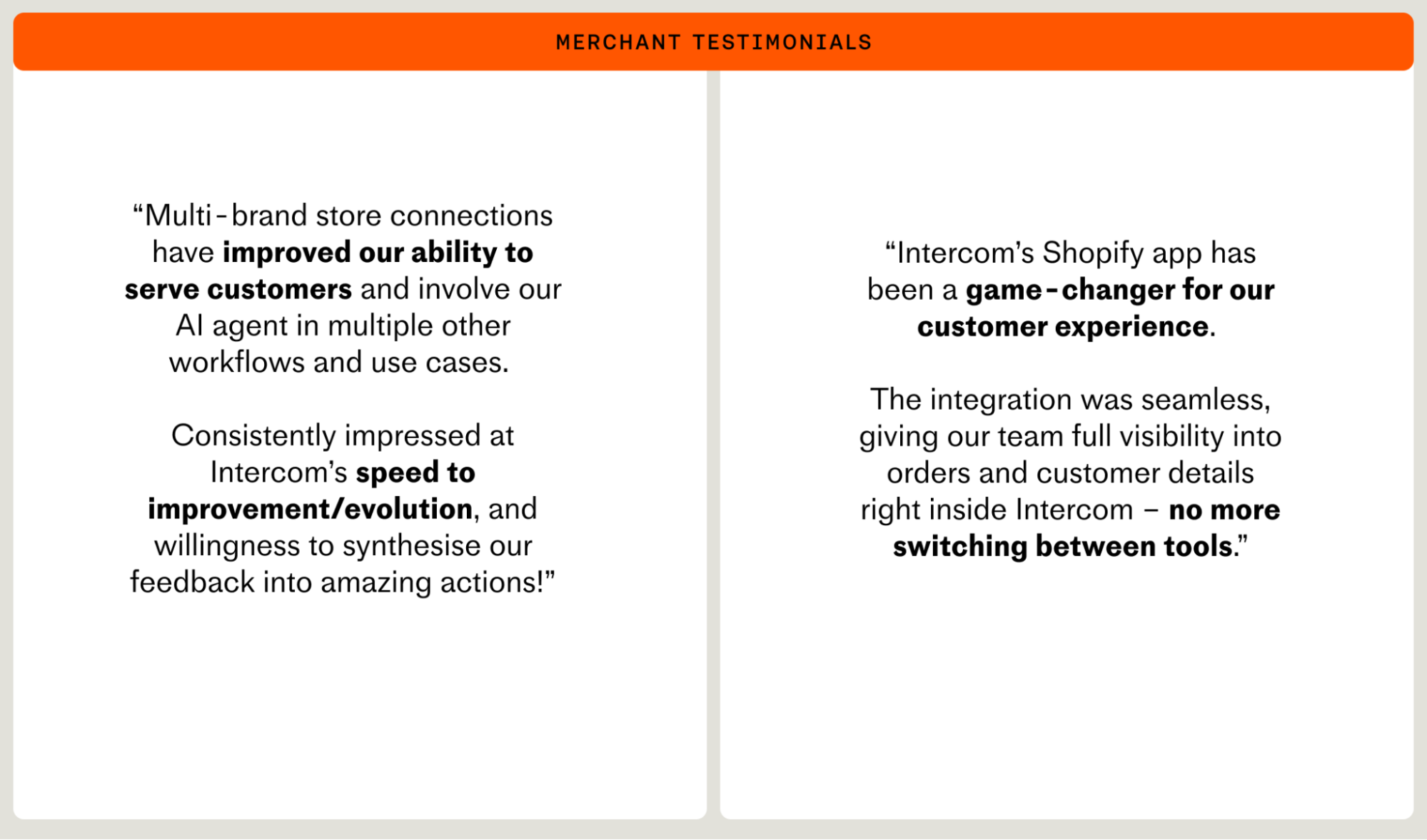
    We’re already seeing how our Shopify integration is helping merchants scale their support and deliver better customer experiences: teams are deflecting routine inquiries with AI while empowering agents to focus on high-value, relationship-building conversations.

    Our team is continuing to invest in Shopify-specific capabilities. Here’s what we’re working on:

    Expanded Fin Tasks for complex order actions with new pre-built workflows.

    Enabling Model Context Protocol (MCP) support.

    Smarter product search powered by Shopify data.

    These additions will help merchants resolve faster, personalize at scale, and stay ahead of rising customer expectations – particularly as we approach peak season. We’ll continue to ship in tight feedback loops with Plus merchants to ensure each improvement moves the needle.

    If you’re a Shopify Plus merchant, learn more about how we can help you scale your support with Fin, the best performing AI Agent for ecommerce. Ready to move fast? Get started with Fin now.


    Inspired by this post on The Intercom Blog.


    Book a consult png image
  • From KPIs to Comebacks: How I Lead Through Setbacks with Curiosity, Care, and Discovery

    From KPIs to Comebacks: How I Lead Through Setbacks with Curiosity, Care, and Discovery

    Setbacks are the tax we pay for doing meaningful product work. As a VP of Product Management, I’ve learned that what separates resilient teams from the rest isn’t a lack of failures—it’s how we metabolize them. This episode of All Things Product with Teresa Torres and Petra Wille is a powerful reminder that recovery, reflection, and rigorous product discovery are as essential as speed and execution.

    Listen to this episode on: Spotify https://open.spotify.com/episode/10LYRya7boYJBHTYBnE79E?ref=producttalk.org | Apple Podcasts https://podcasts.apple.com/kh/podcast/dealing-with-setbacks/id1794203808?i=1000737190520&ref=producttalk.org

    What struck me most is how Teresa shares a deeply personal story about her long recovery from an injury—and how that journey mirrors the nonlinear reality of product development. In product, just like in healing, progress is rarely a straight line. We have surges, stalls, and moments that feel like reversals. Yet with the right mindset and rituals, we still move forward.

    Professionally, we all face moments when your product fails to move a single KPI, when a launch falls flat, or when you just feel stuck. I’ve been there—in quarterly reviews, post-launch standups, and board prep. The instinct is to sprint straight into solutions. The wiser move is to respond with curiosity, emotional honesty, and resilience, then re-engage our discovery habits with intention.

    If you’re a PM, designer, or researcher, consider this an invitation to rebalance. Recovery and reflection are just as important as velocity and success. That’s not soft talk—it’s how empowered product teams build durable performance without burning out.

    On the emotional reality of setbacks, I’ve learned to normalize naming the loss. We put immense pressure on ourselves, and it’s okay (and necessary) to grieve product failures. When we acknowledge the disappointment, we regain the ability to observe clearly—and to learn.

    Leaders play a crucial role here. I create space for teams to recover before jumping into post-mortems. We don’t whiteboard over feelings; we schedule time for decompression, then conduct a crisp, blameless review. That sequencing transforms the quality of insights and strengthens psychological safety.

    Another lesson that resonates is the danger of tying performance too tightly to outcomes. Outcomes matter, but they are lagging indicators influenced by many externalities. I evaluate performance on behaviors: clarity of problem framing, rigor in discovery, quality of decision-making, and stakeholder alignment. This aligns with outcomes vs output OKRs and keeps us focused on controllable excellence.

    How do we build resilience? Continuous discovery builds resilience by normalizing failure. When we test assumptions routinely with customers and data, we turn large, risky bets into a series of small, learnable steps. Teams recover faster because failure becomes feedback—frequent, cheap, and informative.

    For perspective, I often use the 10–10–10 framework (from Decisive by Chip & Dan Heath). I ask: How will this setback feel in 10 minutes, 10 months, and 10 years? The answers de-escalate urgency, expand our time horizon, and produce better, calmer decisions.

    Here are the key takeaways I’m carrying forward. Setbacks are not just inevitable—they’re part of doing meaningful product work. Giving teams time and space to process failure builds long-term resilience. Mourning losses is just as important as celebrating wins.

    Healthy discovery cultures embrace reflection, psychological safety, and emotional honesty. And most importantly, staying consistent with discovery habits helps teams recover faster and learn more deeply.

    Notable moments that stood out for me include: [00:02:00] Teresa shares the story of her injury and what it’s taught her about patience and setbacks. The parallel to product cadence is both humbling and motivating.

    [00:10:00] Petra talks about a team whose carefully planned launch didn’t move a single KPI. I’ve led similar debriefs; when we anchor on customer insight gaps rather than blame, the next iteration improves dramatically.

    [00:20:00] Discussion on allowing space for grief and frustration after failure. In my teams, we time-box “emotional processing” before we enter analysis mode—it humanizes the work and sharpens the learning.

    [00:30:00] Why organizations must decouple performance reviews from short-term outcomes. I align evaluations to strategy execution quality, hypothesis discipline, and cross-functional collaboration.

    [00:40:00] How continuous discovery can help teams normalize—and even learn to appreciate—setbacks. When discovery is weekly, momentum becomes self-healing.

    If you want to dig deeper, here are useful links from the episode. Follow Teresa Torres: https://ProductTalk.org

    Follow Petra Wille: https://Petra-Wille.com

    Mentioned in the episode: Decisive by Chip & Dan Heath — The 10–10–10 framework for perspective in decision-making https://heathbrothers.com/books/decisive/?ref=producttalk.org

    Teresa Torres’ Continuous Discovery Habits — Building resilience through ongoing discovery practices. https://www.amazon.com/Continuous-Discovery-Habits-Discover-Products/dp/1736633309?dchild=1&keywords=continuous+discovery+habits&qid=1621385051&sr=8-2&linkCode=sl1&tag=teresatorres-20&linkId=34bc439ac78da06e1398f7bf069b219e&language=en_US&ref_=as_li_ss_tl&ref=producttalk.org

    Join the Conversation: Have thoughts on this episode? Leave a comment below. I’d love to hear how you create space for recovery while sustaining product velocity.

    Full Transcript: Full transcripts are only available for paid subscribers.


    Inspired by this post on Product Talk.


    Book a consult png image
  • Inside PendomoniumX London: AI Transformation, Real-World Wins, and Product Innovation

    Inside PendomoniumX London: AI Transformation, Real-World Wins, and Product Innovation

    Walking into PendomoniumX London, I could feel the AI revolution hitting its stride. The conversations were sharper, the demos more grounded, and the outcomes more measurable—a clear signal that AI Strategy is moving from slideware to shipped value in modern product management. PendomoniumX’s sixth stop brought 350+ software leaders together for a day of AI transformation, real-world stories, and product innovation. What stood out to me was the shift from hype to execution. Teams compared playbooks for gen ai and Generative AI, shared lessons from LLMs for product managers, and showed how they’re threading AI into product discovery, product roadmapping and sprint planning, and go-to-market motions. The focus was pragmatic: drive adoption, accelerate time-to-value, and make better decisions with cleaner signals. On the product-led growth front, I saw compelling examples of using Pendo’s in-app guides and product tours to increase user activation and reduce friction in key onboarding moments. When AI-enhanced experiences are paired with clear guidance and behavioral analytics, customers don’t just try features—they build habits. What I appreciated most were the leadership narratives: empowered product teams aligning around outcomes, candid retros on where AI prototypes missed the mark, and crisp frameworks for prioritizing the highest-leverage bets. The conference networking felt purposeful, with operators trading hard-won insights on experimentation velocity, data governance, and building trust into AI-infused experiences. My takeaway: AI is no longer a side project—it’s a core capability in product management. If we anchor our AI Strategy in clear customer problems, instrument for learning, and iterate with discipline, we can consistently turn innovation into impact. And with the right mix of PLG mechanics, in-app education, and thoughtful design, those gains compound across the product lifecycle.

    Inspired by this post on Pendo – Perspectives.


    Book a consult png image
  • Crack the AI Answer Engine: How I Boost Brand Visibility in ChatGPT — Proven, Ethical Playbook

    Crack the AI Answer Engine: How I Boost Brand Visibility in ChatGPT — Proven, Ethical Playbook

    I hear the same question in nearly every executive review and go-to-market strategy session: how do we get our brand to show up more often inside ChatGPT? As a product leader, I treat this as an AI Strategy problem, not a mystery. The path forward looks a lot like modern SEO, adapted to how large language models (LLMs) discover, trust, and summarize information across the web and via tools.

    Understand how ChatGPT works and how to make your brand appear more often. Like SEO, but for AI chats.

    First, let me set expectations. We can’t force mentions, but we can systematically raise the probability that an LLM chooses our content as a trusted source. My playbook centers on three levers: strengthen your public footprint (so you’re easy to learn from), amplify trustworthy signals (so you’re chosen), and enable high-fidelity retrieval and actions (so you’re accurate and current when the model reaches out).

    Public footprint: I build topical authority around the entity that is our brand. That means canonical naming, clean information architecture, and interlinked explainers, how-tos, and case studies that answer real tasks. I use schema.org (Organization, Product, HowTo, FAQPage) to make our pages machine-readable, and I back claims with credible citations. Think of this as “entity-first content design” for gen ai and LLMs for product managers.

    Content design for LLMs: I write like I’m teaching a capable assistant. I define acronyms in-line, structure pages with crisp headings, include concise summaries up top, and add Q&A sections that mirror natural prompts. I avoid heavy gating on foundational docs so models can ingest the essentials. I also optimize for context window management by keeping key facts succinct and repeated consistently across properties.

    Authority and distribution: Models overweight high-credibility surfaces. I prioritize documentation, API references, GitHub repos, conference talks, reputable media, and third‑party reviews. Where appropriate, I pursue eligibility for knowledge bases (e.g., Wikidata) and ensure consistent facts across partner sites and directories. This isn’t about gaming; it’s about being verifiably useful wherever professionals already look.

    Technical hygiene: I keep robots.txt and sitemaps friendly to docs, ensure semantic HTML, fast performance, and rich alt text, and use canonical tags to concentrate signals. Changelogs, release notes, and comparison pages help LLMs answer "what’s new" and "versus" questions with precision—core to product positioning and product-led growth.

    Tools and connectors: Visibility isn’t only pre-training; it’s also in-session. I invest in a reliable ChatGPT connector and CustomGPT workflows so assistants can call our APIs via well-scoped actions. I publish a high-quality OpenAPI spec, implement a retrieval-first pipeline over our docs, and tune chunking and metadata so answers stay grounded. Good context window management, privacy-by-design, and clear guardrails are non-negotiable.

    Intent coverage: I map the customer journey and write to the prompts users actually type: definitions, quick starts, integrations, troubleshooting, and “compare vs” pages with transparent points of parity. This doubles as strong customer support ai strategy while reinforcing our go-to-market strategy.

    Measurement: I maintain a prompt panel representing priority intents and track our share of voice in model outputs over time. When we ship content improvements, I use disciplined A/B testing where possible and set a minimum detectable effect to avoid overfitting to anecdotal wins. I pair qualitative spot checks with analytics to see which pages, entities, and citations correlate with improved inclusion.

    Governance and ethics: I avoid manipulative tactics, fabricated claims, or spammy link schemes. Sustainable AI visibility comes from trustworthy content, clear provenance, and user value. Treat LLMs like discerning editors: they reward clarity, credibility, and consistency.

    The bottom line: you can’t control when an assistant mentions your brand, but you can earn it. Build an authoritative, structured footprint; show up on credible surfaces; enable high-quality retrieval and actions; and measure rigorously. Done well, AI visibility compounds—just like great SEO—only faster, and with outsized leverage for teams who execute with focus and integrity.


    Inspired by this post on Amplitude – Perspectives.


    Book a consult png image
  • Vibe Check Part 2: Feel Something, Measure Everything with High-Impact Amplitude Analytics

    Vibe Check Part 2: Feel Something, Measure Everything with High-Impact Amplitude Analytics

    I build products with equal parts intuition and instrumentation. When a campaign’s purpose is to spark a feeling, I still demand proof that those moments translate into measurable outcomes. Learn how you can use Amplitude to better track your vibe marketing initiatives in part 2 of our 3-part series.

    Vibe marketing works when emotion and evidence move in lockstep. In my practice, I rely on Amplitude analytics as a unified analytics platform to connect the emotional resonance of a message to product-led growth—tracking how a compelling story influences user activation, retention, and revenue. The goal is simple: feel something, measure everything.

    I start by instrumenting the journey around the vibe itself. That means a clean event taxonomy and consistent properties that capture the creative theme, channel, audience segment, and context (for example: campaign_id, creative_theme, entry_channel, audience_mood, landing_variant). Good data governance is non-negotiable—if the data isn’t trustworthy, neither are the insights. With this foundation, I can attribute emotional narratives to downstream behaviors with confidence.

    From there, I map the funnel and define activation with intent. I track how vibe-forward touchpoints influence key milestones—first value moments, time-to-activation, and early feature engagement—then ladder those signals into retention analysis. Cohorting users by creative theme or channel helps me see which vibes convert initial curiosity into durable product habits, and which only produce short-lived spikes.

    Experimentation is where the rigor shows. I use A/B testing to isolate the impact of a specific narrative, headline, or creative treatment, and I size tests based on minimum detectable effect (MDE) to avoid underpowered decisions. Guardrail metrics (activation, retention, and NPS) protect the experience while I iterate. When the numbers are tight, I supplement with directional reads—session quality, content depth, and return visits—while staying honest about causality.

    Operationally, my team lives in shared Amplitude dashboards and notebooks. We annotate launches, align on outcomes vs output OKRs, and review weekly trendlines with our GTM partners. This cadence keeps empowered product teams focused on what matters: which vibes accelerate onboarding, deepen engagement, and ultimately improve unit economics. When a story resonates, the data should echo it across the funnel.

    The biggest pitfalls I see are vanity metrics and disconnected systems. To avoid them, I link campaign data to product behavior, unify identifiers across tools, and ensure CRM integration so we can follow the customer journey end-to-end. The payoff is clarity: I can tell a creative team exactly which narrative unlocked user activation and which one stalled—then iterate with speed and precision.

    Vibe marketing isn’t soft; it’s strategic. When we respect the craft of emotion and the discipline of measurement, we build experiences that people love and businesses depend on. If you’re ready to upgrade how you track the intangibles, Amplitude gives you the instrumentation to turn feelings into forward motion.


    Inspired by this post on Amplitude – Best Practices.


    Book a consult png image
  • The Product Positioning Statement Playbook: Build a Message That Wins and Endures

    The Product Positioning Statement Playbook: Build a Message That Wins and Endures

    Your product positioning statement decides if you stand the test of time. I’ve seen this truth play out across launches, pivots, and category-defining moments—when the positioning is razor sharp, everything from roadmap to revenue snaps into alignment. When it’s vague, teams ship features, but customers don’t buy the story.

    At HighLevel, I’ve led product trios and go-to-market teams through the hard work of distilling complex value into a single, credible promise. The pattern is consistent: the best positioning clarifies who we serve, the problem we own, the market category we play in, and the competitive differentiation that earns us the right to win.

    Positioning is not a tagline or a homepage headline; it’s the narrative spine that informs value proposition, messaging, pricing, user activation, sales enablement, and product-led growth. It’s also how we drive internal focus—shaping outcomes vs output OKRs, roadmap trade-offs, and investment bets with discipline.

    Here’s the anatomy I rely on: target customer and context; problem worth solving; category anchor (what buyers already recognize); value proposition (the outcome we deliver); points of parity (table stakes we meet) and points of differentiation (where we win); and proof—evidence that reduces risk for the buyer. When each element is explicit, your product positioning becomes both compelling and testable.

    Use a simple scaffold to draft quickly: For [target customer], who [urgent need or job-to-be-done], [product] is a [recognized category] that [core value proposition]. Unlike [primary alternatives], it [distinct, defensible differentiation]—proven by [evidence: results, usage, social proof, or integrations]. Write it plainly enough that a sales rep can say it and a customer can repeat it.

    Then pressure-test. In product discovery, validate the language with real customers—do they self-identify as the target and echo the outcome? In analytics, check if activation and retention analysis improve when onboarding, in-app guides, and product tours mirror the positioning. In go-to-market strategy, A/B test messaging in campaigns and sales conversations, and listen for shorter time-to-understanding and cleaner objection handling.

    Expert products operationalize positioning across the journey. The category and value proposition show up consistently on the pricing page, inside onboarding tooltips, in CRM integration notes, and within sales collateral. Product management leadership, marketing, and sales align weekly on one narrative, and product-led growth metrics verify that narrative with behavior, not just opinions.

    To write one that sticks, I take this sequence: define the narrowest viable target; articulate the must-solve problem in the customer’s words; choose a category buyers already understand; frame a value proposition that promises an outcome, not a feature; document points of parity so you don’t over-claim; highlight two to three competitive differentiation pillars; add proof; and cut jargon until a smart outsider gets it in one read.

    Common failure modes include trying to be for everyone, leaning on feature soup instead of outcomes, skipping proof, and drifting from what the product can actually deliver. The fix is focus: fewer claims, clearer benefits, and evidence that eliminates buyer uncertainty.

    If you need a fast start, run a 30-minute working session: five minutes to align on the target and problem, five to choose the category, ten to draft value proposition plus parity and differentiation, five to add proof, and five to define two experiments (one discovery conversation, one A/B test) that validate the language this week. Learn how other expert products do it and how to write one that sticks—then let data and customer language refine every word.

    Great positioning earns clarity, confidence, and compounding advantage. When we get it right, the market tells us quickly—prospects move faster, users activate with less friction, and the team finally feels like it’s rowing in the same direction.


    Inspired by this post on Product School.


    Book a consult png image
  • Inside-Out vs Outside-In: How I Balance Both to Build Products Users Love—and CFOs Trust

    Inside-Out vs Outside-In: How I Balance Both to Build Products Users Love—and CFOs Trust

    Inside-out or outside-in thinking? I choose both. The strongest product strategies fuse a bold internal vision with relentless customer evidence, creating a flywheel that lifts adoption, engagement, and revenue while reducing risk.

    When I lead with inside-out thinking, I articulate a clear product thesis, technical roadmap, and platform leverage. This is where we define points of parity and differentiation, sharpen our value proposition, and ensure our architecture scales. It’s disciplined, outcomes-first, and anchored in product positioning—not output checklists.

    Outside-in thinking ensures that vision stays honest. I listen to customers, analyze friction in onboarding, instrument user activation, and study retention analysis to validate whether our promises translate into real user value. This is where product discovery, A/B testing, and in-app signals tell me what’s working, what needs refinement, and what we should stop doing.

    In practice, I operationalize this balance through Software Experience Management. “Increase revenue, cut costs, and reduce risk with Pendo’s Software Experience Management platform. Optimize the entire software experience to drive adoption and improve engagement.” That promise captures the core of how I align strategy with reality inside the product, not just around it.

    Concretely, I combine product analytics with in-app guides and product tours to accelerate onboarding and improve user activation. I run targeted experiments to de-risk decisions, and I iterate quickly based on what users actually do—not just what they say. The result is a product-led growth engine that compounds over time.

    This approach also builds trust with finance and go-to-market partners. Inside-out clarity gives us confident, sequenced bets; outside-in data provides proof that those bets pay off. When engagement expands and adoption climbs, the business case writes itself.

    If you’re deciding where to start, begin with three moves: define activation events aligned to your value proposition, instrument the experience end-to-end, and ship one high-impact in-app guide to remove a known onboarding blocker. Then measure, learn, and iterate—quickly.

    The truth is, great products emerge when conviction meets evidence. Inside-out sets the vision. Outside-in earns the right to scale it.


    Inspired by this post on Pendo – Perspectives.


    Book a consult png image
  • Cut Time to Value, Boost Retention: My Proven Playbook for Activation, Growth, and Loyalty

    Cut Time to Value, Boost Retention: My Proven Playbook for Activation, Growth, and Loyalty

    Time to value is the most reliable early indicator of long-term user retention I know. When customers experience meaningful product impact fast, they stick around, expand, advocate, and cost less to support. Over the years leading product teams, I’ve learned that speed-to-impact isn’t a nice-to-have—it’s the engine behind sustainable product-led growth and efficient go-to-market.

    Accelerate retention by reducing time to value. Learn how faster product impact drives growth, reduces costs, and keeps users engaged in the long term.

    Practically, I define time to value as the duration from first touch (or first login) to the moment a user achieves their “aha” outcome—something tangibly useful aligned to their job-to-be-done. The shorter that journey, the higher the likelihood of user activation, trial conversion, and durable engagement. This is why I obsess over onboarding, in-app guides, product tours, and the clarity of our value proposition.

    My first move is to map the Minimum Path to Value (MPV): the smallest set of actions needed to deliver a real result for a new user. I strip away everything non-essential in that path—fields, clicks, choices, and jargon. Opinionated defaults, smart templates, sample data, and single-player workflows let customers succeed in minutes, not days. The goal is to reduce cognitive load while making the next best action unmistakably clear.

    Instrumentation turns TTV from a hunch into a system. I track activation events, cohort retention, and conversion using platforms like Amplitude analytics and Pendo, with timely nudges through Intercom when users stall. I look at the distribution of TTV (not just the average), correlate it with retention analysis, and set explicit targets such as “new users reach first value within 10 minutes.” Those targets become team-level outcomes—not outputs—and we review them weekly.

    Experimentation is how we iterate toward the fastest path to value. I rely on A/B testing to compare onboarding flows, progressive profiling to delay non-critical inputs, and opinionated setup wizards to remove guesswork. Auto-generated example projects, pre-configured integrations, and guided checklists accelerate user activation without sacrificing flexibility for advanced users.

    Content and guidance matter as much as UX. Tooltips, contextual in-app guides, and short product tours should be timely, skippable, and laser-focused on the outcome, not the feature. I pair these with a concise knowledge base and short explainer videos that reinforce the same value narrative a user sees inside the product.

    Cross-functional alignment is essential. Product, marketing, sales, and customer success must rally around the same activation metric and TTV target. That alignment ensures our trial messaging, onboarding emails, and CS playbooks don’t compete—they compound. When everyone points to the same first-value moment, friction drops and adoption rises.

    Pricing and packaging can also accelerate time to value. Free trials should be long enough for users to credibly reach first value; usage-based gates should never block the MPV. I prefer to unlock everything needed to hit the “aha” moment, then meter after the value is viscerally felt—this respects the user’s time and reinforces trust.

    There’s a cost story, too. Faster time to value reduces tickets, shortens onboarding cycles, and lowers cost-to-serve. It also clarifies product discovery: when we see where users stall, we don’t guess at roadmap priorities—we let the data guide our next bet.

    In my experience at HighLevel, I’ve repeatedly seen activation rates jump when we cut time to value from days to minutes. The specific tactics vary by product, but the pattern holds: when the first outcome is undeniable and fast, retention follows—and so does efficient growth.

    If you’re looking for a starting point, try this: define one activation event that clearly signals value, instrument it end-to-end, design a Minimum Path to Value that gets new users there in under 10 minutes, and run weekly experiments until you consistently hit the target. Do that, and you won’t just improve onboarding—you’ll build a product that earns loyalty from the very first session.


    Inspired by this post on Amplitude – Best Practices.


    Book a consult png image
  • Win AI Search: Proven Playbook to Get Your Startup Recommended by ChatGPT & Perplexity

    Win AI Search: Proven Playbook to Get Your Startup Recommended by ChatGPT & Perplexity

    AI search is quickly becoming the new homepage for startups. When a buyer asks a model for the best tools, they often take the short list at face value. I treat this moment as a product surface I can influence with strategy, content, structure, and distribution—much like any other go-to-market channel.

    Early on, I set a simple objective for my team and me: "Learn how LLMs like ChatGPT and Perplexity decide which startups to recommend and what signals help a brand get discovered in AI search." That sentence became our north star for experiments, instrumentation, and content architecture.

    Here is the mental model that consistently holds up in practice. Large language models synthesize answers from a knowledge graph built from crawled content, citations, and high-signal sources. They weight consensus, clarity, recency, authority, and machine-readability. I don’t pretend to know the internals, but across hundreds of tests, the same patterns correlate with being surfaced and cited.

    First, I make our entity unambiguous. I standardize the company name, product names, and leadership bios across the site and external profiles. I implement Organization and Product markup with schema.org and link out with sameAs to authoritative profiles like LinkedIn, Crunchbase, GitHub, and key directory listings. The goal is to collapse ambiguity so AI search knows exactly who we are and which claims are attributable to us.

    Next, I publish definitive, answer-first pages. For every core query—what we do, who it’s for, outcomes, differentiators, pricing, comparisons, and integrations—I ship a page that leads with a crisp summary, then supports it with evidence, examples, and plain language. I include Q&A sections, realistic use cases, and named case studies so models can quote and ground responses in verifiable facts.

    I then make the site maximally machine-readable. I add schema.org for SoftwareApplication, Product, FAQPage, and HowTo where relevant. I keep titles, H1/H2 structure, internal links, and metadata descriptive and consistent. I expose last-modified dates, maintain an XML sitemap, and keep a visible changelog and release notes. Freshness matters—Perplexity, in particular, tends to privilege recent, well-cited material when answering time-sensitive questions.

    Citations are non-negotiable. I earn credible mentions on third-party properties, analyst lists, comparison pages, and customer reviews. I prioritize authoritative placements over volume, then make sure our site references those sources to reinforce the signal. When Perplexity cites our page alongside a respected third-party review, our inclusion rate in answers rises noticeably.

    I also design for developers, buyers, and machines at once. That means clean docs, integration pages, and transparent security and trust content. Clear API references, integration guides, and reliability notes give models concrete artifacts to summarize. Pricing, privacy, and support policies reduce uncertainty and increase the likelihood that an answer will include us.

    Measurement turns this from a hunch into a system. I run controlled content experiments, track minimum detectable effect on discovery and mentions, and instrument referral patterns from AI assistants when citations appear. I monitor which prompts surface our brand, which sources are cited, and which pages are repeatedly used as references. When we move a KPI, we codify the pattern into our playbook and scale it.

    Trust is the compounding advantage. I maintain a transparent trust center, privacy-by-design posture, and clear data governance practices. I remove vague claims, back up benefits with evidence, and keep all performance or security statements auditable. Models tend to lift brands that feel low-risk, well-documented, and widely corroborated.

    If you want a fast start, here’s the checklist I rely on. Standardize your entity and ship schema.org. Publish answer-first pages for core jobs-to-be-done, comparisons, and integrations. Earn authoritative third-party citations and reference them. Keep release notes, changelogs, and dates current. Instrument AI discovery and iterate based on what gets cited. Do this consistently, and your startup earns a fair shot at being recommended when buyers ask AI for the best options.


    Inspired by this post on Amplitude – Best Practices.


    Book a consult png image
  • My Product Positioning Playbook: Craft Unforgettable Messaging That Wins Markets and Endures

    My Product Positioning Playbook: Craft Unforgettable Messaging That Wins Markets and Endures

    Every market-winning product I’ve helped build started with a positioning statement that was clear, defensible, and memorable. When I lead new initiatives at HighLevel, Inc., I treat positioning as a product decision—because it sets the guardrails for what we prioritize, how we execute, and how we tell the story across the entire go-to-market engine.

    Your product positioning statement decides if you stand the test of time. Learn how other expert products do it and how to write one that sticks.

    At its core, a positioning statement is the sharpest articulation of who we serve, the problem we solve, the category we compete in, the value proposition we deliver, and why we win. It is not a tagline or a pitch deck sentence; it’s the decision calculus that aligns product, marketing, sales, and customer success so we can move fast in one direction.

    Here’s the simple template I use and coach teams on: For [target customer/segment] who [urgent need or job-to-be-done], [product name] is a [category or frame of reference] that [core value proposition]. Unlike [primary alternative or status quo], it [competitive differentiation and reasons to believe]. When this fits, everything from roadmaps to demos becomes easier—and conversions tend to follow.

    Start with the target segment. Be precise about who you are for. I triangulate with retention analysis and behavioral data (e.g., Amplitude analytics) to find the cohorts that activate quickly, retain well, and expand. If you cannot name the segment in one line, you’ll struggle to land positioning anywhere else.

    Next, define the customer outcome. Tie the promise to measurable “outcomes vs output OKRs.” Customers buy progress, not features. State the job-to-be-done in their language and anchor it to a business result they already track.

    Choose your category and points of parity. Category is a cognitive shortcut; it tells buyers where you sit on their mental map. Points of parity are table stakes you must match to be considered. If you skip parity, you look incomplete; if you skip category, you look confusing.

    Then sharpen your competitive differentiation and value proposition. What do you do uniquely well that competitors can’t easily copy? Back it up with reasons to believe—proof points like speed-to-value, measurable ROI, data governance, or privacy-by-design and cybersecurity commitments. Credibility turns claims into confidence.

    Validate the statement through rigorous A/B testing. I pressure-test the language across landing pages, onboarding flows, in-app guides, sales call talk tracks, and nurture sequences. Tools like Pendo, Intercom, and HubSpot make it easy to instrument message experiments and see what actually moves activation, conversion, and expansion.

    Operationalize the winning statement across go-to-market strategy and product-led growth motions. Bake it into onboarding, product tours, pricing pages, and demo narratives. A strong positioning statement should shape prioritization in the roadmap as much as it shapes the headline on your website.

    Beware common pitfalls. Don’t confuse vibe marketing for positioning. Avoid vague superlatives that any competitor could claim. Don’t aim for universal appeal; specificity sells. And never let the statement drift—revisit it after major launches, new segments, or shifts in competitive dynamics.

    Here’s an example using the template: For revenue teams at mid-market SaaS companies who need faster, more predictable pipeline creation, SignalFlow is a unified analytics platform that turns product usage signals into qualified opportunities. Unlike generic CRMs and static lead scoring, it surfaces intent in real time and automates outreach, improving conversion by 22% within 30 days.

    If your team debates features more than outcomes, it’s time to revisit your positioning. In my experience, one crisp sentence can unlock alignment, accelerate execution, and make your message stick. Write it, test it, and make it the north star for every decision you ship.


    Inspired by this post on Product School.


    Book a consult png image
  • The Product Playbook: Measuring Agent Performance with Pendo and Agent Analytics to Drive ROI

    The Product Playbook: Measuring Agent Performance with Pendo and Agent Analytics to Drive ROI

    I treat agent performance analytics as a strategic product lever, not a back-office metric. When I combine Pendo’s product signals with Agent Analytics from our support systems, I get a unified view of where users struggle, how agents intervene, and which in-app experiences accelerate resolution. That visibility lets my team drive product-led growth and improve customer experience while lowering support costs.

    Increase revenue, cut costs, and reduce risk with Pendo’s Software Experience Management platform. Optimize the entire software experience to drive adoption and improve engagement.

    In practice, I build a clear scorecard that blends both product and support KPIs: first response time, resolution rate, first contact resolution, CSAT, containment/deflection rate, average handle time, ticket volume per active account, onboarding completion, user activation, and time-to-value. This balanced view ensures we reward not just speed, but durable outcomes that reduce repeat contacts and improve retention.

    To make the data actionable, we connect our CRM integration, ticketing events, and Pendo product analytics in a unified analytics platform. That gives me cohort-level clarity—who needed help, what they were doing before opening a ticket, how agents responded, and whether users stayed engaged afterward. With clean instrumentation and consistent taxonomies, Agent Analytics becomes a reliable operating system for both product and support leadership.

    I then use in-app guides, tooltips, and product tours to proactively address the top friction points that drive ticket volume. Through A/B testing, we compare cohorts exposed to guided workflows versus control groups, measuring deflection, faster task completion, and downstream conversion. When a guide meaningfully reduces tickets for a given workflow, we promote it from experiment to standard onboarding, and we feed those learnings back into our roadmap.

    The real unlock comes from tying outcomes to business impact. I track how improvements in resolution quality and self-serve adoption influence expansion revenue, support cost per account, and risk signals like churn propensity. Retention analysis helps us validate whether reduced friction and better agent coaching translate into sustained engagement and healthier accounts.

    Operationally, Agent Analytics helps me coach teams with precision. I spotlight high-performing behaviors, identify knowledge gaps, and standardize winning playbooks directly in the product via in-app guidance. This approach empowers agents, shortens onboarding for new hires, and keeps our best practices current as the product evolves.

    None of this works without trust. We apply privacy-by-design principles and strong data governance, ensuring that analytics, coaching, and automation respect user consent and data minimization standards. With that foundation, we can scale confidently—experiment faster, learn from every interaction, and continuously improve the software experience.

    If you’re getting started, begin by baselining your agent and product KPIs, ship one high-impact guide to deflect a top ticket driver, and review results weekly. Within a quarter, you’ll have a repeatable loop: diagnose friction, test an in-app solution, measure deflection and satisfaction, and reinvest the gains into the next set of improvements.


    Inspired by this post on Pendo – Best Practices.


    Book a consult png image
  • Build a Product Messaging Framework That Converts: Clarity, Consistency, Customer Connection

    Build a Product Messaging Framework That Converts: Clarity, Consistency, Customer Connection

    I’ve learned the hard way that features don’t win on their own—clear, consistent messaging does. When our teams at HighLevel rally around a single product messaging framework, we move faster, tell one story, and connect with customers in a way that actually converts. The right framework doesn’t just make marketing sharper; it aligns product, sales, and customer success on what we promise, why it matters, and how we prove it.

    When I say “product messaging framework,” I mean a structured system that defines who we serve, the problems we solve, the outcomes we enable, and the value proposition that sets us apart. It includes points of parity that establish table stakes, differentiation that creates competitive separation, and proof points that make our claims credible. It maps features to benefits, organizes a messaging hierarchy from company to product to feature, and guides voice, tone, and lexicon so UX writing and go-to-market strategy stay consistent across channels.

    Why does this matter? Because clarity reduces friction for buyers, consistency builds trust, and customer connection drives conversion and retention. A strong framework accelerates product discovery, strengthens product positioning, and improves onboarding and user activation. It also makes product-led growth repeatable by ensuring every touchpoint—from website to in-app guides—reinforces the same value proposition.

    Here’s how I build a framework that stands up in the real world. I start with customer research and win/loss analysis to anchor on the ideal customer profile and jobs-to-be-done. I craft a positioning statement that articulates the target, problem, category, differentiation, and payoff. Then I define value pillars, each with concrete reasons to believe—customer quotes, data, and feature proof. I document points of parity and differentiation, map features to benefits and outcomes, and codify voice and terminology to keep UX writing tight. Finally, I build a messaging hierarchy (company, product, feature, segment) and an objection-handling guide so sales and support are equipped to respond consistently.

    A simple litmus test keeps me honest: can a salesperson deliver a crisp elevator pitch, can a PM write a release note, and can a designer craft an in-app tooltip—all from the same source of truth? If yes, the framework is doing its job. If not, I iterate until the story is simple, believable, and memorable.

    Operationalizing the framework is where impact compounds. I enable product trios and go-to-market teams with talk tracks, one-pagers, narrative decks, and a living glossary. I translate the framework into site copy, product tours, onboarding flows, and help content so customers experience the same story everywhere. I also thread it into product roadmapping and sprint planning to keep prioritization aligned with the core value proposition.

    I measure what matters and refine relentlessly. I use A/B testing to validate headlines and calls to action, monitor activation and conversion across segments, and review retention analysis to see which value pillars correlate with long-term use. Feedback loops from sales calls, support tickets, and customer interviews feed back into the framework so it evolves with the market.

    There are predictable pitfalls I try to avoid. Going feature-first instead of outcome-first makes messaging forgettable. Overselling differentiation without points of parity undermines credibility. Spreading across too many personas dilutes signal. And inconsistent tone across channels confuses buyers. A disciplined framework helps prevent all of these.

    Treat your product messaging framework as a living system, not a slide. Revisit it when the market shifts, when your roadmap unlocks new value, or when your go-to-market strategy evolves. The payoff is real: tighter alignment, sharper positioning, faster execution, and a customer story that consistently earns attention—and conversion.


    Inspired by this post on Product School.


    Book a consult png image