Category: AI Strategy

  • How I Structure Documentation for AI and Humans: Battle‑Tested, SEO‑Smart Tactics That Scale

    How I Structure Documentation for AI and Humans: Battle‑Tested, SEO‑Smart Tactics That Scale

    Every week, I coach product and documentation teams on a simple truth I keep pinned above my desk: "AI is reading your documentation! Learn tips from the Amplitude docs team about how to structure your documentation for both human and AI audiences." That line captures the shift we’re all living through—our docs must now serve customers, support engineers, and increasingly, LLMs powering chat, search, and in‑product help.

    My AI strategy for documentation starts with intent. I map the core questions users ask at activation, onboarding, escalation, and renewal, then shape information architecture to reduce ambiguity. This helps humans find answers faster and helps LLMs retrieve the right chunks with higher precision—a win for UX writing, product-led growth, and support deflection.

    Structure beats style when AI is in the loop. I rely on semantic headings (H1–H3), consistent slugs, stable anchors, and one‑topic pages that can stand alone. Short paragraphs, scannable summaries, and canonical references reduce duplication and improve retrieval quality. Treat docs-as-code with CI/CD so changes are reviewed, versioned, and shipped reliably—documentation deserves the same rigor as product releases.

    Chunking matters for LLMs. I design content for context window management: one concept per section, tight procedures with numbered steps, and FAQs that mirror real queries. Glossaries define canonical terms and accepted synonyms so retrieval-first pipelines match user language without fragmenting meaning. Error messages and parameter names appear verbatim to strengthen search and grounding.

    Metadata is a multiplier. I add clear titles, descriptions, last‑updated dates, product area tags, and audience labels (admin, developer, analyst) to boost SEO and machine readability. Stable IDs for components, examples, and API objects improve deep linking and evaluation. Where appropriate, I include structured examples that align with prompt engineering best practices so AI assistants can extract inputs, outputs, and constraints cleanly.

    Quality is measured, not hoped for. I pair content audit checklists with analytics to see what’s searched, where users pogo‑stick, and which articles drive successful task completion. Tools like Amplitude analytics reveal gaps and dead‑ends, while lightweight evals (answer accuracy, grounding rate, latency) ensure LLMs retrieve the right doc chunks at the right time.

    Consistency is a feature. I standardize terminology across UI, API, and docs, and I avoid synonym sprawl that confuses both readers and LLMs. Page intros state the job-to-be-done; conclusions link to adjacent tasks; and deprecation notes are explicit with forward paths. This coherence lowers cognitive load and improves both RAG performance and human trust.

    Governance keeps it scalable. I assign owners per section, define SLAs for updates, and automate checks for broken links, orphaned pages, and outdated screenshots. Redirect rules avoid 404s, and version banners prevent LLMs from mixing deprecated guidance into current answers—small details that cumulatively protect customer experience.

    If you’re just getting started, begin with three moves: clarify intents, restructure pages into atomic, linkable units, and add metadata that reflects how customers actually search. From there, tighten your retrieval-first pipeline and run regular evals. The payoff is durable: faster time to value for users, lower support load, and AI assistants that answer accurately, confidently, and consistently.


    Inspired by this post on Amplitude – Perspectives.


    Book a consult png image
  • Kaizen for the AI Era: Tiny Daily Wins That Build Smarter, Scalable Customer Support

    Kaizen for the AI Era: Tiny Daily Wins That Build Smarter, Scalable Customer Support

    Every day, I challenge my teams to make one small, meaningful improvement—something so lightweight it’s impossible to ignore and easy to repeat. That tiny daily motion compounds, and over time it reshapes customer experience, operational quality, and team culture.

    That’s the essence of Kaizen, the Japanese philosophy of continuous improvement. Developed in post-war Japan and popularized by companies like Toyota, Kaizen proves that small, steady changes lead to significant long-term results. In product management and customer support, this approach transforms big ambitions into daily behaviors that actually stick.

    Crucially, Kaizen isn’t passive or unstructured. It thrives on three principles I reinforce across my org. First, small changes reduce resistance—when you lower the activation energy, teams move faster. Second, improvement is continuous, not occasional; instead of waiting for quarterly reviews or major releases, you ask: “What can we improve right now?” Third, everyone participates—the people closest to the work are best positioned to improve it. That’s how momentum spreads.

    In practice, the cycle is simple: identify a small problem, test the change, measure the result, refine, and repeat. The point isn’t radical transformation in a single swing; it’s steady progress guided by data and observation—a rhythm that aligns beautifully with eval-driven development and continuous discovery.

    At Intercom, we apply this same philosophy to how we manage our Agent Fin through a process we call the “Fin Flywheel”. Here’s how this works.

    Train: Teach Fin how to handle and resolve the most complex customer queries.

    Test: Run fully simulated customer conversations from start to finish to see exactly how Fin will behave before going live.

    Deploy: Launch Fin across all channels so customers get consistent support wherever they reach out.

    Analyze: Use AI-powered insights to review and improve Fin’s performance so it can deliver better customer experiences.

    This isn’t a one-time setup; it’s a continuous loop where every interaction feeds ongoing improvement. Rather than deploying AI and assuming it will perform as expected, improvement is built into the system itself. The more Fin is used, the better it gets. That’s the hallmark of agentic AI done right—tight feedback loops, purposeful conversation design, and clear Agent Analytics that illuminate what to tune next.

    But continuous improvement doesn’t stop with AI. Within our Human Support operations, I emphasize the same mindset that drives great LLMs for product managers: you instrument the experience, learn from real usage, and close gaps fast. We operate with a simple mindset: the first time that you solve a customer issue should be the last time it happens.

    When a conversation reaches a human, we pause to diagnose and prevent recurrence. Why did this reach me? Why couldn’t Fin resolve it? How can we prevent this from happening again? Those questions anchor a culture of root-cause thinking and accelerate product-led growth by removing friction at the source.

    To make this effortless, we’ve built a lightweight, AI-powered way to log suggestions in the moment—no long explanations or heavy admin required. Ideas are reviewed quickly and implemented by subject matter experts or by the team themselves. This keeps the flywheel spinning: insights flow in, fixes go out, and measurable outcomes improve.

    The result is a frontline that evolves from reactive problem-solvers into a proactive improvement engine. The people closest to customers spot friction, suggest fixes, and see their insights shaped into meaningful change. It’s continuous discovery embedded in everyday work, not a side project.

    Kaizen demonstrates that lasting progress doesn’t come from occasional transformation; it comes from intentional, everyday refinement. The “Fin Flywheel” applies that philosophy to AI. Our Human Support continuous improvement process applies it to human insights. Together, they create a shared system where both people and AI learn continuously from customer interactions.

    When improvement is built into the mechanics of how you work, it stops being a one-off project and becomes an ingrained capability. Over time, those small daily improvements don’t just add up—they compound into a sustainable, data-driven advantage that elevates customer experience and differentiates your customer support ai strategy.


    Inspired by this post on The Intercom Blog.


    Book a consult png image
  • We Built Agent Analytics After Observability Broke—Why Your AI Team Needs It Now

    We Built Agent Analytics After Observability Broke—Why Your AI Team Needs It Now

    I remember the exact moment our product crossed the threshold from scripted automation to truly agentic AI. The excitement was real—so was the pit in my stomach when our dashboards went dark. Our trusted analytics and observability stack, which had served us flawlessly for traditional software, suddenly couldn’t explain what the agent was doing, why it made certain choices, or how to reproduce outcomes across runs.

    "The moment our product became a AI agent, our entire observability stack became irrelevant—not something you want as an analytics company. Here's what we did."

    Why does this happen? Agentic AI doesn’t behave like conventional apps. Instead of deterministic flows and neatly tagged events, we face non-deterministic trajectories, tool-use chains, evolving prompts, context window dynamics, and policy guardrails that influence outcomes in real time. Clicks and pageviews give way to tokens, tool calls, and conversation turns. Without purpose-built observability, you can’t do credible product discovery, measure behavioral analytics, or run eval-driven development with confidence.

    That’s why we built Agent Analytics. We needed a unified lens to trace every step of an AI workflow—from user intent to model prompts, function calls, retrievals, tool outputs, and final responses—while capturing latency, cost, guardrail hits, fallbacks, and outcome tags. We instrumented runs end-to-end, added experiment support for prompt engineering and policy variants, and wired in evaluations so we could turn subjective quality into objective signals the team could act on.

    The impact on product management was immediate. We shortened iteration cycles by making failure states obvious and reproducible, turned ambiguous feedback into structured data, and gave engineers and designers a shared source of truth for conversation design and AI workflows. With visibility into containment, escalation, autonomy ratio, and step-level success, we could ship confidently, rollback safely, and align roadmap bets to measurable outcomes—not anecdotes.

    Building this capability demanded more than logging. We invested in data governance and privacy-by-design to mask sensitive content while preserving semantic context, and we separated human-identifiable data from model telemetry. We treated prompts and policies like code—versioned, diffable, and safely rolled out behind feature flags and CI/CD—so we could experiment without risking regressions in production.

    What should every team measure? Start with outcome quality (task success, resolution, containment), reliability (tool success rate, guardrail triggers, fallbacks), performance (time-to-first-token, total latency, step-level latency), and efficiency (tokens and cost per successful task). Add groundedness checks for retrieval steps, regression evals for core journeys, and post-release anomaly detection to catch drift before users do. These metrics become your operating system for agent performance and your compass for product strategy.

    If you’re building or scaling AI agents, you need Agent Analytics before you hit your first incident. It’s the difference between guessing and knowing—between reactive firefighting and proactive iteration. With the right observability, your team can move faster, manage risk intelligently, and translate agent behavior into business outcomes that compound over time.


    Inspired by this post on Amplitude – Best Practices.


    Book a consult png image
  • Building Foundational AI Platforms That Ignite Innovation and Redefine Analytics Strategy

    Building Foundational AI Platforms That Ignite Innovation and Redefine Analytics Strategy

    I’ve spent my career building and scaling product platforms, and I’ve seen firsthand how the right AI Strategy can unlock disproportionate impact. Foundational AI platforms are the engine room of modern analytics—when they’re done well, they compress time-to-insight, improve quality, and empower empowered product teams to deliver outcomes that matter.

    Across leading analytics ecosystems, including Amplitude analytics, the winning pattern is consistent: invest in a unified analytics platform that abstracts complexity while enabling rapid iteration. By standardizing data governance and privacy-by-design, teams gain the freedom to experiment confidently without sacrificing compliance or security.

    For me, “foundational AI platforms” means pragmatic building blocks that product and engineering can trust: evaluation harnesses for models, retrieval pipelines that surface the right context, feature stores that ensure consistency, and CI/CD with robust observability. When these AI workflows are in place, behavioral analytics, anomaly detection, and A/B testing stop being one-off projects and become repeatable capabilities.

    The payoff isn’t just efficiency—it’s strategic differentiation. Internal innovation accelerates when teams can go from idea to live experiment in days, not quarters. That speed shapes the future of AI analytics: richer insights woven directly into product experiences, LLMs for product managers to prototype faster, and analytics that feel conversational, contextual, and deeply actionable.

    Execution still makes or breaks the vision. I align product strategy around outcomes vs output OKRs, pair product trios with forward-deployed engineers, and use a clear build vs buy rubric for platform components. The goal is platform scalability without reinventing the wheel—own the parts that differentiate, integrate the rest, and keep your interfaces painfully simple.

    If you’re leading this journey, start by mapping your critical use cases to platform capabilities, close gaps in data governance, and stand up an eval-driven development loop. Within one or two quarters, you should see a measurable lift in deployment frequency, a sharper signal on performance, and a culture that ships with confidence. That’s how foundational AI platforms empower internal innovation and help define the future of AI analytics.


    Inspired by this post on Amplitude – Best Practices.


    Book a consult png image
  • Inside Medable’s Agent Studio: The Agentic AI Blueprint to Accelerate Safer Clinical Trials

    Inside Medable’s Agent Studio: The Agentic AI Blueprint to Accelerate Safer Clinical Trials

    What if AI could help reduce the 10-plus years it takes to get a new drug to market? That question has shaped much of my own product strategy thinking, and it’s exactly why I was drawn to Medable’s bold move with Agent Studio. It’s a rare look inside an enterprise AI platform built for one of the most regulated industries in the world—and a team that’s still figuring it out in real time.

    In this episode of Just Now Possible, Teresa Torres talks with four members of the Medable team: Luke Bates (Product Leader, Agent Studio), Jen Brown (Product Manager), Matt Schoolfield (Product Designer), and Fiachra Matthews (Principal Architect). Listening through a product management lens, I focused on how their choices reflect a modern agentic AI strategy that balances speed, safety, and scale.

    Medable does something uniquely hard: enabling global clinical trials across 100+ languages and accelerating drug-to-market timelines. That scope demands more than clever prompts—it requires a durable platform approach. Their answer is Agent Studio, a no-code/low-code platform for configuring and deploying agents across the clinical trial lifecycle.

    What impressed me most was how clearly the platform’s primitives map to repeatable value: models, skills, knowledge bases, MCP connectors, versioning, and trigger types. In my experience, platforms win when these building blocks are composable, governed, and observable—exactly the direction Medable is taking.

    You’ll also hear about the two agents they’ve built on top of it: an ETMF agent that automates document classification across 80,000-plus documents per year, and a CRA agent that monitors patient safety and data quality across 13 different clinical systems. For a domain where errors carry real human consequences, this is the right mix of automation and oversight.

    Under the hood, their architecture choices echo what I’ve seen work in other high-stakes environments. They walk through RAG approaches at scale: embeddings vs. markdown hierarchies vs. just-in-time MCP retrieval, and explain Why they built custom MCPs with an authentication and credentialing wrapper. They also detail Context window management with sub-agents and automatic tool filtering—critical to keep agents focused and reliable as complexity grows.

    Data alignment is often the unsung hero of agent reliability. I appreciated how they described How they built a unified ontology layer to map terminology across 13 different clinical data systems. Equally important, they show their paper trail: How they document agent intent → specification → test evidence to satisfy regulatory bodies. In a GXP context, this kind of lineage isn’t “nice to have”—it’s the price of admission.

    Infographic showing how Medable Agent Studio applies agentic AI to shorten clinical trial timelines from 10 years to 1 year, using no-code agents, automated document classification, unified data monitoring, and human oversight.
    Discover how Medable's Agent Studio reimagines clinical operations, shrinking drug-to-market timelines from a decade to a year with no-code agents, automated eTMF document classification, unified data monitoring, and human-in-the-loop validation.

    Strategically, I love that Medable chose a platform approach to agents instead of one-off builds. They outline Three deployment models: Medable-built products, services-led custom builds, and self-serve platform access. This mirrors a healthy platform business model: prove value with first-party solutions, extend via services for complex needs, and unlock scale with self-serve—while keeping governance centralized.

    Reliability is a theme throughout. They describe Evaluation design in a GXP-regulated environment: golden datasets, production monitoring, and the challenge of human feedback as ground truth. We also get a concrete picture of what human-in-the-loop really looks like when clinical decisions are on the line—tight feedback cycles, auditable interventions, and clear escalation paths.

    Looking forward, they don’t shy away from ambition. The "full self-driving" vision for clinical trials and what it would take to get there is both provocative and grounded. My read: the path runs through stronger domain ontologies, standardized interfaces (MCP done right), eval-driven development, and relentless simplification of agent skills.

    If you’re a product leader building in regulated spaces, this discussion is a masterclass in balancing innovation with compliance. The takeaways map cleanly to AI Strategy: define platform primitives, invest in retrieval-first pipeline patterns, design for context window management, lean into eval-driven development, and operationalize regulatory compliance from day one.

    To dive deeper, listen to the conversation on Spotify or Apple Podcasts, and explore Medable’s broader platform work at medable.com. I left both inspired and practically equipped—an uncommon combo in today’s AI noise.


    Inspired by this post on Product Talk.


    Book a consult png image
  • Agentic Architecture Demystified: How Modern AI Systems Plan, Learn, and Execute at Scale

    Agentic Architecture Demystified: How Modern AI Systems Plan, Learn, and Execute at Scale

    In my role leading product teams at HighLevel, I’m often asked to explain what’s really happening behind the scenes of today’s AI products. The short answer is that modern systems are built on "Agentic Architecture: How Modern AI Systems Actually Work"—not just a single model, but a coordinated loop of planning, tool use, memory, and evaluation. Once you see that pattern, the design decisions snap into focus and the roadmap becomes far easier to prioritize.

    At its core, agentic AI treats the model as a reasoning engine embedded within an AI workflow. The agent interprets intent, plans steps, calls the right tools and APIs, grounds itself in trusted data, and then evaluates outcomes before deciding to continue or stop. This loop creates reliability, reduces hallucinations, and enables the system to operate in real-world, multi-step scenarios.

    Here’s the practical lifecycle I rely on. A user provides intent (a goal or request). We run a retrieval-first pipeline to ground the model in accurate, current data. Prompt engineering structures the task and primes the agent with constraints and success criteria while managing context window management. The agent generates a plan, executes steps by calling tools or services, evaluates intermediate results, reflects or revises as needed, and only then returns a final answer with clear citations or evidence.

    For more complex work, I orchestrate multiple specialized agents—commonly a planner, a solver, and a critic—coordinated by a lightweight controller. This multi-agent pattern reduces single-agent blind spots, encourages self-checking, and mirrors how empowered product teams collaborate. Whether it’s conversation design for support flows or a voice AI agent driving hands-free tasks, orchestration is the difference between a clever demo and a dependable product.

    Memory is the second pillar. Short-term working context sits in the prompt, while long-term memory lives in vector stores or databases to track past interactions, preferences, and outcomes. Retrieval augments the model with the right facts at the right time, and tight context window management ensures the agent stays focused on signal, not noise. The result is faster responses, lower costs, and far better accuracy.

    Reliability is earned through eval-driven development and robust AI risk management. I define offline and online evaluations, guardrails, and human-in-the-loop checkpoints before scaling traffic. These evaluations become living, automated tests that protect against regressions as prompts, models, and tools evolve. The payoff is real: fewer escalations, higher trust, and measurable improvements to quality over time.

    From a product strategy perspective, I resist over-engineering. Start with a simple retrieval-first pipeline and a single agent; prove value; then layer in multi-agent orchestration only where it moves key metrics. Instrument everything—latency, cost, grounding coverage, and outcome quality—and build Agent Analytics dashboards so teams can diagnose issues and iterate with confidence.

    If you’re looking for a practical playbook, here’s mine: clarify the user intent and success criteria; design the tools the agent can call; ground with authoritative data; write prompts that constrain scope and define termination conditions; add reflection and automated evaluations; and ship behind feature flags for safe, staged rollout. Each step compounds reliability without killing velocity.

    The diagram and the video above bring these patterns to life. If you watch closely, you’ll see the same loop—plan, retrieve, act, evaluate—show up in every effective implementation, regardless of domain. That repetition isn’t accidental; it’s the backbone of agentic architecture and a blueprint you can adapt to your own stack.

    Ultimately, what matters is outcomes. When we build around agentic AI, we create systems that are explainable to stakeholders, maintainable by engineers, and genuinely helpful to customers. That’s how we move past hype to durable impact—shipping AI products that plan, learn, and execute at scale.


    Inspired by this post on Product School.


    Book a consult png image
  • How We Automated 81% of Customer Support with AI—While Uplifting CX, Speed, and ROI

    How We Automated 81% of Customer Support with AI—While Uplifting CX, Speed, and ROI

    Leading the Support function for a company that builds a leading Agent and AI-forward customer service platform has been, for me, unique, exciting, and yes—daunting. It’s where product ambition meets operational reality, and where every decision I make is immediately tested by customers who expect excellence.

    It’s unique because we use the same technology as our customers. We live in the product every day, which puts us in a privileged position to be the voice of the customer across the organization. That tight feedback loop has shaped how I prioritize, what I build next, and how I measure success.

    It’s exciting because we get to try all of the new features and capabilities of Fin and the Intercom helpdesk. With a relentless focus on AI innovation, I’ve had access to remarkable tools that help us deliver an incredible customer experience—and I’ve seen firsthand how the right workflows and guardrails turn those tools into outcomes.

    And it’s daunting because expectations for our own Customer Support (CS) team are sky high. If we can’t deliver incredible support using our own technology, we undermine its value proposition. That imperative has kept me honest, focused, and fast.

    In our new research, “The 2026 Customer Service Transformation Report,” we’ve been sharing how forward-looking teams use AI to transform their support models. If you’d like to get straight to the report, download it here.

    When Intercom changed its focus in late 2022 to prioritize the customer service use case, we undertook a critical review of the support experience we were delivering and committed to driving meaningful change under an AI-first framework. That was a turning point: I aligned product strategy and operations around a single north star—automate with quality, and elevate humans to higher-value work.

    Three years on, Fin now resolves over 81% of all our customer support volume, delivering immediate and high-quality resolutions. We have absorbed a 300%+ increase in customer demand since 2022 without proportional headcount growth. Without Fin, we would have needed at least 100 additional CS team members to meet that demand and our improved service levels – a net saving to Intercom of between $7.5M–$9M annually.

    Throughout this work, we drew on research from the 2026 Customer Service Transformation Report and applied the lessons directly to our own org design, knowledge management, and AI workflows. What follows is our story of transformation and how we achieved a mature deployment of Fin.

    The problems we set out to solve

    Back in 2022, our challenges looked familiar to any modern support organization, and I knew we needed a step-change—not incremental tweaks.

    We faced increased support demand from new and existing customers: Intercom was launching major features and changes at speed, driving up overall customer conversation volume and requiring additional headcount for the CS team. I could see we were scaling people faster than processes—unsustainable without automation.

    Our support policy (as defined by our service level objectives) was not based on a high bar: In most cases, we were only committed to “business hours” coverage for the majority of our customers, impacting first response times. Even with SLOs that were not considered best in class, we were struggling to meet our commitments. I wanted 24/7 coverage and faster first responses without sacrificing quality.

    We wanted to do more: As we pivoted our strategy, we wanted to open new routes to our support team, such as providing support to website visitors with technical questions and to trial customers. That meant meeting customers earlier in their journey with accurate, on-brand responses—at scale.

    What we did

    We made a very conscious decision to become our own best reference customer. As Intercom embraced the opportunity that generative AI presented to transform customer service, we intentionally moved to an AI-first strategy for our Customer Support team. I set a simple operating principle: ship value quickly, measure relentlessly, and let evidence guide the next bet.

    We started with the highest-volume, informational queries and saw our resolution rates climb quickly. With that foundation in place, we pushed Fin further, training it on deeper documentation and internal procedures, and eventually giving it the ability to take actions on behalf of customers. As Fin took on more complex work, our results started to compound—and trust in the system grew across the organization.

    Early adoption and building trust. When “AI Assist” features came to the Intercom Inbox, the CS team got early exposure to AI and were empowered to provide feedback directly to our product teams. This built awareness and trust across the team about what we were trying to achieve with AI, and helped shape the product roadmap. We were also the first beta customer for Fin, rolling it out to a subset of customers to watch sentiment and outcomes closely. With no adverse reaction and an initial resolution rate of over 25%, we deployed Fin to most customer segments within weeks. I’ll never forget the first week we put Fin in front of real customers—the silence of issues that never reached humans was the loudest signal of success.

    Knowledge management as a product. We recognized quickly that time spent tuning our help center and knowledge assets for Fin would pay dividends. We transitioned our Help Center Manager into a “Knowledge Manager,” with a dedicated remit to optimize content for Fin. We embedded knowledge creation into our “New Product Introduction” (NPI) process, targeting that Fin would resolve at least 50% of customer issues at every new product and feature launch. Over time, we added new sources, including “Developer Documents,” enabling Fin to handle increasingly complex issues. We built a culture of continuous improvement—allocating “out of the inbox” time so every teammate could close content gaps and raise the bar.

    Conversation design end-to-end. To ensure a consistent, high-quality customer experience, we created a new “Conversation Designer” role that owns the journey across automation and human handoffs. Using Intercom’s Workflows, we introduced “skills-based routing” so that when a customer asks for a human, the conversation reaches someone with the right expertise quickly. This is now handled by Fin directly using a feature called “Attributes.” The result: a seamless, on-brand experience regardless of channel or escalation path.

    Neon green hero graphic reading 'The 2026 Customer Service Transformation Report', with subhead 'The AI deployment gap is widening' and a black 'Get the report' button over a bar-chart pattern.
    Leaders are racing ahead with real AI in support. Explore the 2026 Customer Service Transformation Report to see where deployment is stalling, benchmark your team, and get practical steps to scale automation that delights.

    Organization changes that unlocked leverage. As we scaled Fin, we stood up a dedicated AI Support team under a senior CS leader to continuously optimize automation and define our AI adoption strategy across the journey. We restructured human roles into “Technical Support Specialist” and “Technical Support Engineer” to better align with the complexity of incoming work. We also expanded Support Operations to focus on optimization—using AI to uplevel Enablement, Workforce Management, QA, Process Management, and Data Insights. Just as important, we reset expectations about the balance between time spent supporting customers directly versus improving AI. That mindset shift created compounding returns.

    Pushing Fin further with new capabilities. As capabilities matured, we were early adopters and saw measurable wins:

    Fin Guidance: Multiple Guidance rules provide additional controls and a more personalized, targeted experience for customers.

    Fin Tasks and Procedures: Enables Fin to carry out activities such as updating customers on incident status and deep troubleshooting for technical issues.

    Insights: AI-driven dashboards provide deep insight into Fin’s performance and surface recommendations for further optimization. Insights also provides a Customer Experience (CX) Score for every customer interaction, enabling more targeted improvement efforts and opening up new ways to close the loop with customers who have had a poor experience.

    What we achieved

    What started as a focused effort to improve our customer support experience became the strongest proof point for what’s possible when you fully embrace AI. Fin now resolves over 81% of all our customer support volume and has allowed us to absorb a 300%+ increase in demand without proportional headcount growth. Over 90% of our customers now benefit from improved first response performance, 24/7 coverage, and outbound phone support.

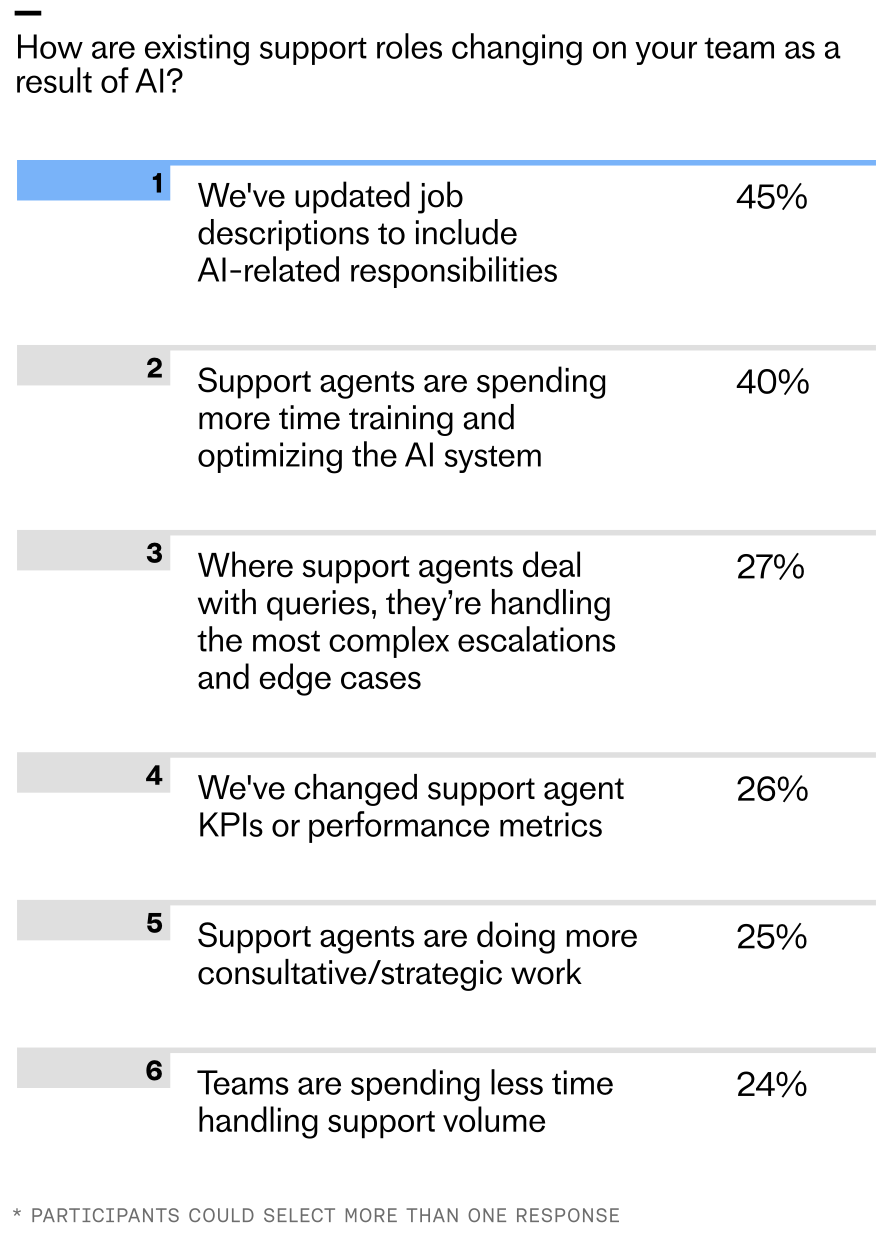
    What the numbers don’t fully capture is the shift in how our team operates. With volume absorbed by Fin, our CS teammates now deliver consultative support—guiding next best actions, deepening product adoption, and contributing directly to retention and expansion. Customers that receive these engagements adopt Fin at a much deeper level and achieve greater support success. What was once a reactive, volume-driven team is now a function that generates significant revenue.

    What’s next

    Customer expectations are always rising, so we’re building on our progress by embracing the Fin Flywheel—an actionable framework for ongoing improvement and optimization. This keeps us honest about the discipline required to sustain AI performance at scale.

    Train: Teach Fin to resolve even the most complex queries with Procedures, knowledge, and policies.

    Test: Run fully simulated customer conversations from start to finish to see exactly how Fin will behave before going live.

    Deploy: Set Fin live across every channel – voice, email, chat, and social – for consistent support wherever customers reach out.

    Analyze: Use AI-powered Insights to analyze and improve Fin’s performance and deliver better customer experiences.

    We are also investing in our support teammates so they can adjust to the new world of AI—taking on more complex work and being valued for the subject matter expertise, consultative engagement, and empathy they bring to the role. That human layer is where differentiation shines.

    We will continue to develop and share best practices for deploying an Agent, based on our own experience with Fin and the lessons learned from our most forward-looking customers. These are captured and continually evolving in The Agent Blueprint.

    Transformation takes commitment

    The most successful teams aren’t bolting AI onto old processes; they’re rebuilding support around it—investing in knowledge and people alongside technology, and treating AI as a continuous discipline rather than a one-time deployment. That’s the real change required. For support teams willing to make it, there’s a rare opportunity to redefine what customer service can deliver—higher CSAT, faster resolution, and durable ROI.


    Inspired by this post on The Intercom Blog.


    Book a consult png image
  • From Resolutions to Outcomes: How We Price AI Agents Fairly and Amplify Customer Value

    From Resolutions to Outcomes: How We Price AI Agents Fairly and Amplify Customer Value

    I’ve long believed a simple truth about AI in customer support: if AI is going to earn trust, pricing has to be aligned with value. That principle has guided my product decisions and the way I hold our teams accountable for measurable outcomes, not activity.

    When we shared our perspective on pricing AI Agents in 2023, we made a simple argument: if AI is going to earn trust, pricing has to be aligned with value. At the time for Fin, that value was clear. You pay when the AI resolves a customer’s problem. If it doesn’t, you don’t. That’s fair, easy to understand, and grounded in results, not activity. We were the first to introduce this pricing model because we believed that pricing and value should be inherently linked.

    That belief hasn’t changed, it’s grown stronger over time. What’s changed is what Fin can do. As we expanded capabilities and pushed deeper into complex workflows, it became clear that measuring value solely by end-to-end resolutions no longer captured the full picture of impact.

    Resolutions were the right place to start. Historically, we measured value based on whether Fin fully resolved a conversation on its own. These are known as resolutions and they gave support teams a clear way to measure ROI, easily comparing the cost of AI versus human support. They also aligned our incentives with our customers, as our revenue was directly tied to Fin’s performance.

    That clarity worked. Today, more than 7,000 teams use Fin. Our average resolution rate across customers has increased every month and now stands at 67%, even as Fin increasingly handles more complex queries. That progress came from building an Agent that could take on harder problems and still deliver.

    But as Fin got more powerful, “success” stopped being binary. I saw this first-hand in customer design sessions where policy, risk, and compliance needs rightly demanded human-in-the-loop confirmation. We weren’t failing to deliver value; we were delivering it differently.

    Over the last couple of years, we invested heavily to ensure Fin could handle the most complex parts of support. As Fin’s capabilities expanded, customers began pushing what Fin can do for them by deploying Fin deeper into their workflows to handle the toughest queries.

    In some cases, this required Fin to work in tandem with a human agent because that’s what customer policies and oversight needs dictated. Subscription changes, transaction disputes, billing issues, and other multi-step support scenarios can often require Fin to gather context, read and write to external systems, and execute actions before handing off to a human agent for confirmation.

    Fin is still doing what it was configured for – intentionally handing off after doing more of the heavy lifting, saving valuable time for support teams and overall time to serve for their customers. But our pricing metric only recognized value when the conversation ended in a full “AI resolution” (i.e. a human was never involved).

    That’s why we’re evolving Fin’s pricing metric from resolutions to outcomes. This shift reflects how customers now define value: not just in full automation, but in safe, efficient progress toward the right result across complex, multi-step, and policy-constrained workflows.

    An outcome represents when Fin successfully completes the action it was configured to perform, as part of a conversation. Resolutions are still one type of outcome Fin can deliver, where it handles the issue end-to-end. Another type of outcome can be a Procedure where Fin gathers context, takes action, and hands the conversation off when that’s what customers configured it to do.

    Promotional banner reading "Get started with the #1 Agent today" over a dark, aurora-like gradient background, featuring a white button labeled "Start a free trial"; marketing graphic for an AI support agent.
    Kick off your journey with the #1 Agent—an AI partner designed to turn resolutions into real outcomes. Tap “Start a free trial” to explore faster, smarter customer service and see how Fin delivers value from day one.

    Increasing end-to-end AI resolutions is still a core component of scaling Agents, but they are no longer the only measure of Fin's success and utility. Especially as Fin takes on more complex work. Moving to outcomes recognizes that solving a customer problem with full automation isn’t always appropriate. It’s about getting to the right result, safely, and efficiently.

    As Fin’s capabilities expand, teams should feel empowered to use it in more nuanced, collaborative work. Outcomes support that by allowing customers to design workflows that meet compliance requirements and include a human agent when necessary. From a product management standpoint, this is how we align incentives, keep risk controls intact, and still accelerate time-to-value.

    Fin is becoming even more powerful at handling complex, multi-step support queries. With outcomes, we can support that growth without constantly reinventing how value is measured. And this change gives us a strong pricing foundation that can scale as Fin continues to grow and take on more roles beyond service. This aligns with our vision of Fin becoming a “Customer Agent,” capable of handling the entire customer experience.

    What this means for pricing is intentionally straightforward. An outcome will be counted when Fin successfully completes an action it was configured to perform, as part of a conversation. That keeps the model predictable for finance leaders while staying transparent for operators and product teams managing AI workflows.

    The pricing model stays simple and the definition of value becomes more accurate. In other words, we’re doubling down on fairness, predictability, and competitiveness—core tenets for any consumption SaaS pricing strategy tied to real business impact.

    When we first wrote about outcome-based pricing, we said that trust is the currency of AI. That’s still true. Trust is earned when customers see pricing move in lockstep with utility and risk posture, especially as gen AI and agentic AI take on higher-stakes tasks.

    Pricing has to feel fair, it has to be predictable, and it has to stay competitive. Evolving from resolutions to outcomes isn’t a departure from that belief. It’s the natural maturation of how we measure value as AI moves from simple Q&A into complex procedures and human-in-the-loop collaboration.

    Fin has grown more powerful because customers asked more of it. Outcomes are how we reflect that progress honestly, while staying true to the same principles that guided us from the start. This is product strategy in action: align incentives, measure what matters, and scale what works.

    And as Fin continues to get stronger, we’ll keep holding ourselves to the same standard: price based on the value delivered. That’s how we build durable trust, sustainable ROI, and a better customer experience at scale.


    Inspired by this post on The Intercom Blog.


    Book a consult png image
  • Inside Amplitude’s AI Acquisition: Career Lessons Product Managers Can Use to 10x Impact

    Inside Amplitude’s AI Acquisition: Career Lessons Product Managers Can Use to 10x Impact

    I’m often asked how to translate early-stage experience into outsized product impact at scale. In my own practice, I study real career arcs that crystallize the habits of high-leverage product managers—especially those operating at the intersection of analytics and AI strategy.

    Consider this path: Lucas is a Product Manager at Amplitude. Previously, he was employee #1 at Command AI, acquired by Amplitude in October 2024. Lucas studied computer science at Princeton.

    What stands out to me is the compounding effect of being an early builder. When you are employee #1, you live close to the user problem, own outcomes end-to-end, and develop a bias toward focused, continuous discovery. That foundation creates durable instincts around product strategy, sharp prioritization, and empowered product teams—skills that transfer directly to later-stage environments where clarity and speed become competitive advantages.

    Acquisition integration is where those instincts meet enterprise rigor. Folding Command AI into a unified analytics platform like Amplitude requires disciplined product roadmapping and sprint planning, precise stakeholder management, and a strong POV on where AI augments core “Amplitude analytics” versus where it creates net-new value. The north star remains unchanged: deliver measurable customer outcomes that strengthen product-led growth and reduce time-to-value.

    On the AI front, I’ve seen the most successful PMs treat gen ai and LLMs for product managers as means, not ends. They anchor use cases to concrete analytics workflows—accelerating insight generation, surfacing anomaly detection, improving retention analysis, and driving user activation—while validating each step through continuous discovery and rigorous experiment design. This balance of ambition and evidence protects teams from shiny-object drift and keeps investment tethered to business impact.

    Execution-wise, the playbook is straightforward but unforgiving: clarify the problem through customer interviews; define crisp outcomes vs output OKRs; map the journey end-to-end; ship in thin slices; and iterate with observability baked into every release. Along the way, keep your cross-functional partners close—solutions engineering, customer success, and GTM—so that your learning loops extend beyond the product surface and into real adoption dynamics.

    If you’re building analytics or AI-powered experiences today, borrow these lessons: translate early-stage builder energy into enterprise-scale focus; make AI serve the product, not the other way around; and use Amplitude analytics to close the loop from idea to impact. That is how PMs compound credibility, accelerate careers, and, most importantly, create products customers can’t live without.


    Inspired by this post on Amplitude – Best Practices.


    Book a consult png image
  • How I Used Claude Code to Run a Full Content Audit in Hours—and Uncovered Big SEO Wins

    How I Used Claude Code to Run a Full Content Audit in Hours—and Uncovered Big SEO Wins

    Can an AI agent actually run a credible content audit end to end? I put that to the test. In my role leading product at a high-growth SaaS and as a hands-on content strategist, I’m constantly balancing depth with reach. During a recent office-hours discussion, someone asked me to zoom out and explain when to use Claude Code. That prompt inspired me to launch a running series—Conversations with Claude—showing exactly how I apply it to real product management and SEO problems.

    I’m a heavy user and share what works for me. I receive no compensation from Anthropic for this series; if that ever changes, I’ll disclose it. With that out of the way, let’s dive into how I had Claude conduct a full content audit—and why the results exceeded my expectations.

    For the first installment, I chose a fairly complex use case: a comprehensive content audit of my site. I expected this to be a slog. Instead, it was refreshingly fast and rigorous once I set Claude up with the right scaffolding.

    I kicked off with a simple directive: start by asking clarifying questions, proceed step by step, and capture notes in a shared task file. I also provided deep context—specifically, the CDH Book (15 chapters + intro) and my entire blog archive in markdown—so the model could reason with my actual corpus rather than guessing from sparse prompts.

    Claude began with smart clarifying questions that framed the analysis well. Scope of keywords: Should it focus strictly on concepts unique to or heavily associated with my work like "opportunity solution tree" and "continuous discovery," or also include broader product management terms such as "product outcomes," "assumption testing," and "customer interviewing"? Keyword geography: Start with US-only or include UK/global? Blog coverage assessment: What counts as "well covered"—dedicated deep dives or credible coverage within broader posts? Output format: Add findings to the task file or create a separate deliverable?

    Dark-mode notes workspace titled content-audit showing task properties (type: task, due 03/06/2026, tags product-talk and content) and step-by-step instructions for a content audit.
    Peek inside a Notion-style page that turns content strategy into action: a content-audit task with due date and tags, plus clear steps for keyword research, blog gap analysis, and SEO improvements.

    I replied: 1. both 2. us only is a good place to start 3. evaluate this based on how well we rank for the keyword, if we rank reasonably well, you might suggest content improvements to rank better, if we don't rank at all, then you might suggest a whole new article 4. add to the task file

    From there, Claude read the CDH Book, extracted roughly 100 keywords, ran them through Keywords Everywhere in two batches of 50 to capture search volume, and pulled current domain rankings and traffic metrics. Within minutes, I had a high-signal view of what’s working, where we’re invisible, and how to prioritize fixes.

    The good news came first: we own our branded terms—#1 for "product discovery," "opportunity solution tree," "continuous discovery," and "product trio." That brand equity is doing real work for us.

    The biggest gaps were in broad topics the CDH Book covers but where there’s no targeted content. "Outcomes vs outputs" (1,300/mo) — Arguably THE central thesis of CDH, and no ranking. This is the single biggest gap. "Product roadmap" (4,400/mo) — I have a strong anti-roadmap POV but no content targeting this. "Product strategy" (1,900/mo) — Ch 7 argues strategy = opportunity selection. Strong differentiator, no ranking. "Story mapping" (5,400/mo) — I use story maps uniquely (for surfacing assumptions). Huge volume. "Stakeholder management" (2,900/mo) — Ch 13 is entirely about this. No ranking. "Pre-mortem" (4,400/mo) — I cover this as a product discovery technique. No ranking.

    Dark-mode markdown editor shows a chapter titled 'The What and Why of Continuous Discovery' and a left sidebar of organized folders and notes, indicating a structured, searchable content library.
    Inside a dark-themed writing workspace, a long-form chapter is open while a tidy folder tree catalogs pages and chapters. The scene invites readers to think like auditors—inventory content, track structure, and surface gaps with AI assistance.

    The trojan horse opportunity: High-volume generic terms like story mapping, pre-mortem, and usability testing could bring in readers who don't know about CDH yet. Write about these broadly-searched topics with my specific product-discovery angle.

    In just a few minutes, Claude generated an analysis of what keywords we ranked for and at what position, a ranked set of high-, medium-, and lower-volume (but strategic) keywords where we didn’t rank yet had relevant content, concrete net-new topics to close the gaps, and a list of existing articles to update to lift their SERP positions. It worked far better than I expected.

    Here’s how I set it up so the model could deliver: I didn’t simply ask Claude.ai to "audit my site" and hope for the best. I supplied rich, relevant context (my book and all blog posts as markdown) so it could anchor on my language, frameworks, and mental models. I paired that with live data via APIs like Keywords Everywhere to ground recommendations in actual search volume and competitive rankings. With the right inputs, Claude Code behaved like a capable research analyst and an SEO strategist—able to reason, prioritize, and suggest high-leverage actions.

    Next, I went deeper and used the findings to draft a long-form article that addresses the biggest gap—"Outcomes vs outputs"—and ties it directly to product roadmapping and sprint planning. I wove in continuous discovery practices, opportunity solution tree techniques, and product trios collaboration to make it actionable for empowered product teams. I’ll share the end-to-end workflow—including files, prompts, and the editorial QA checklist—in a follow-up.

    If you’re new to Claude Code and want a practical starting point, replicate the setup above: assemble your canonical sources in markdown, define a clear evaluation rubric, and ground keyword research with reliable volume data. If you want my exact task file, clarifying-question template, and step-by-step audit rubric, tell me which content gap you’d prioritize first and why—I’ll tailor the walkthrough to the highest-interest topic.


    Inspired by this post on Product Talk.


    Book a consult png image
  • February Fin Breakthroughs: Master complex workflows, natural voice, 2-minute Shopify, smarter ops

    February Fin Breakthroughs: Master complex workflows, natural voice, 2-minute Shopify, smarter ops

    Every update we shipped this month removed a specific constraint on what teams can do with Fin. In my world, the demo-to-production gap shows up as complexity, control, and confidence. Can the agent handle the query that actually matters? Will it sound right on a call? Can the team deploy it without filing an engineering ticket? Can managers understand what it’s doing? That’s the bar I hold us to.

    This month, we delivered answers to all four. Here’s how.

    Procedures and Simulations (0:51). The hardest problem in AI-powered customer service isn’t answering FAQs—it’s executing complex queries with real business logic and real consequences if anything goes wrong. Think billing refunds, multi-step flows, and actions that must be right the first time.

    We made it dramatically easier to build and manage Fin for those complex queries—without pulling in an engineer. You can author in natural language, test every step in simulation, and deploy with confidence.

    The workflow starts with AI drafting the procedure from your existing source material. You edit in natural language, with structured hooks to pull in live data, apply business logic, and add code for deterministic control where you need it. That’s how you handle multi-step flows with the precision that matters when things go wrong.

    Simulations are the test environment. Define a test case, pass in the data Fin would receive in a real conversation, and watch it work through each step. You see what Fin is doing, why, and whether it’s meeting the criteria you set. Full transparency at every point. I’ve run these end-to-end myself, and there’s a particular confidence that comes from watching it work before it goes anywhere near a customer.

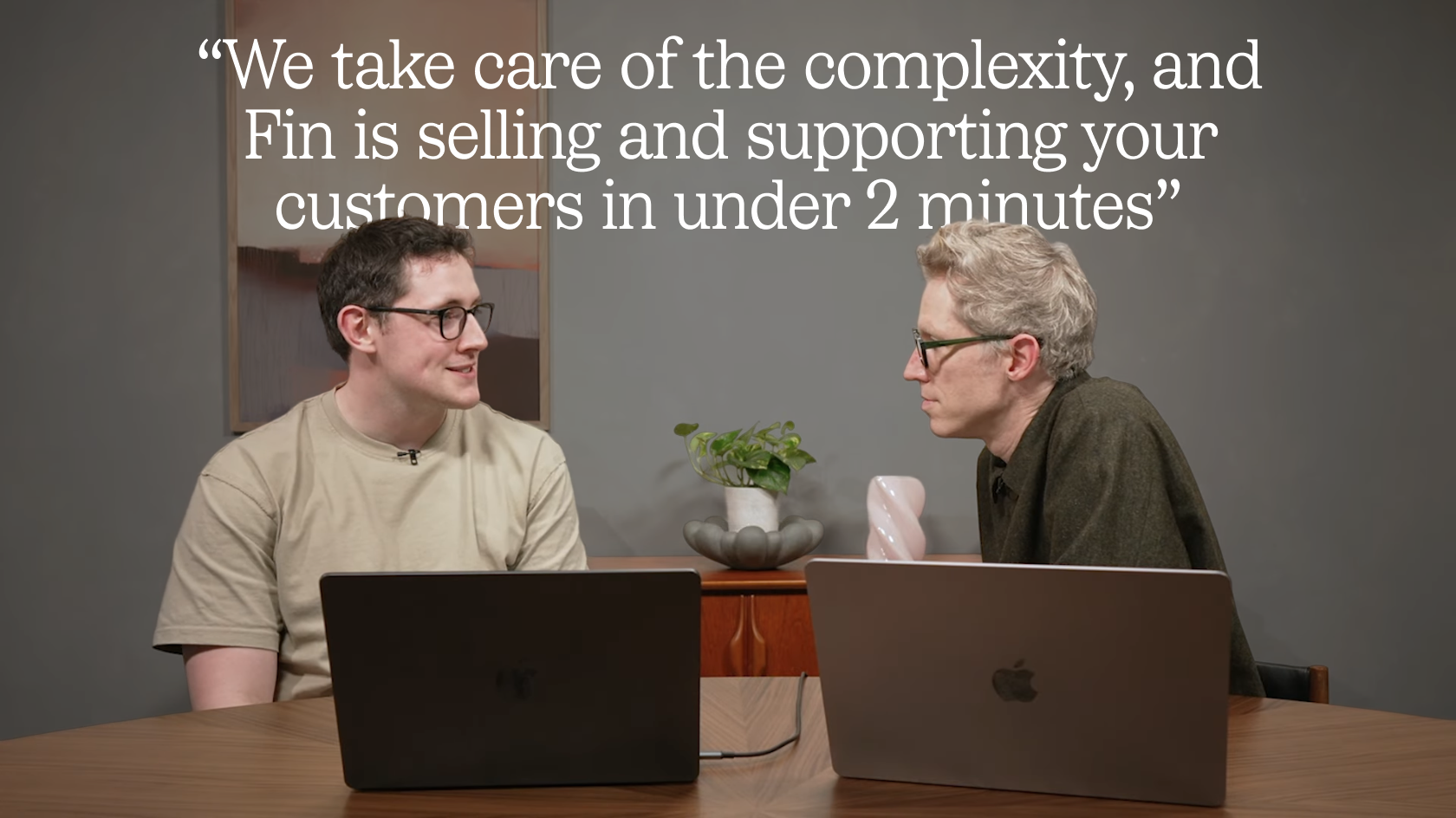
    Two colleagues in a studio sit at a wooden table with laptops during a Fin Product Updates discussion; an overlaid quote highlights selling and supporting customers in under two minutes.
    A conversational moment from the February Fin Product Updates recap: two teammates trade insights with laptops open, while a bold pull-quote drives home the promise—Fin removes complexity to start selling and supporting in under two minutes.

    For a deeper look at Procedures and Simulations, head to fin.ai/procedures.

    Fin Voice: three major updates. When something’s off in chat, it can take a few exchanges to notice; on a call, it’s immediate. Pronunciation, noise handling, and tone all matter because they’re the customer’s first impression.

    Pronunciation rules (4:18). Fin has high out-of-the-box pronunciation accuracy, but it doesn’t know your brand—your product names, your industry terminology, the way your company uses certain words. Alihan Zinna, Staff ML Scientist, showed this with an IKEA example: without pronunciation rules, Fin mispronounced both “IKEA” and a product name; after adding rules, both were corrected and sounded natural.

    New natural voices (5:48). We’ve added 11 new voices tuned to a range of brand tones so you can choose one that sounds like it truly belongs to your company—not a generic AI assistant.

    Background noise reduction (6:28). People call from airports, shops, and busy offices. Fin now monitors background noise continuously and increases noise reduction when the environment demands it. No configuration needed. As Alihan put it, “This is one of those things customers really notice when it’s not working. The goal was to make it invisible. That’s what we built.”

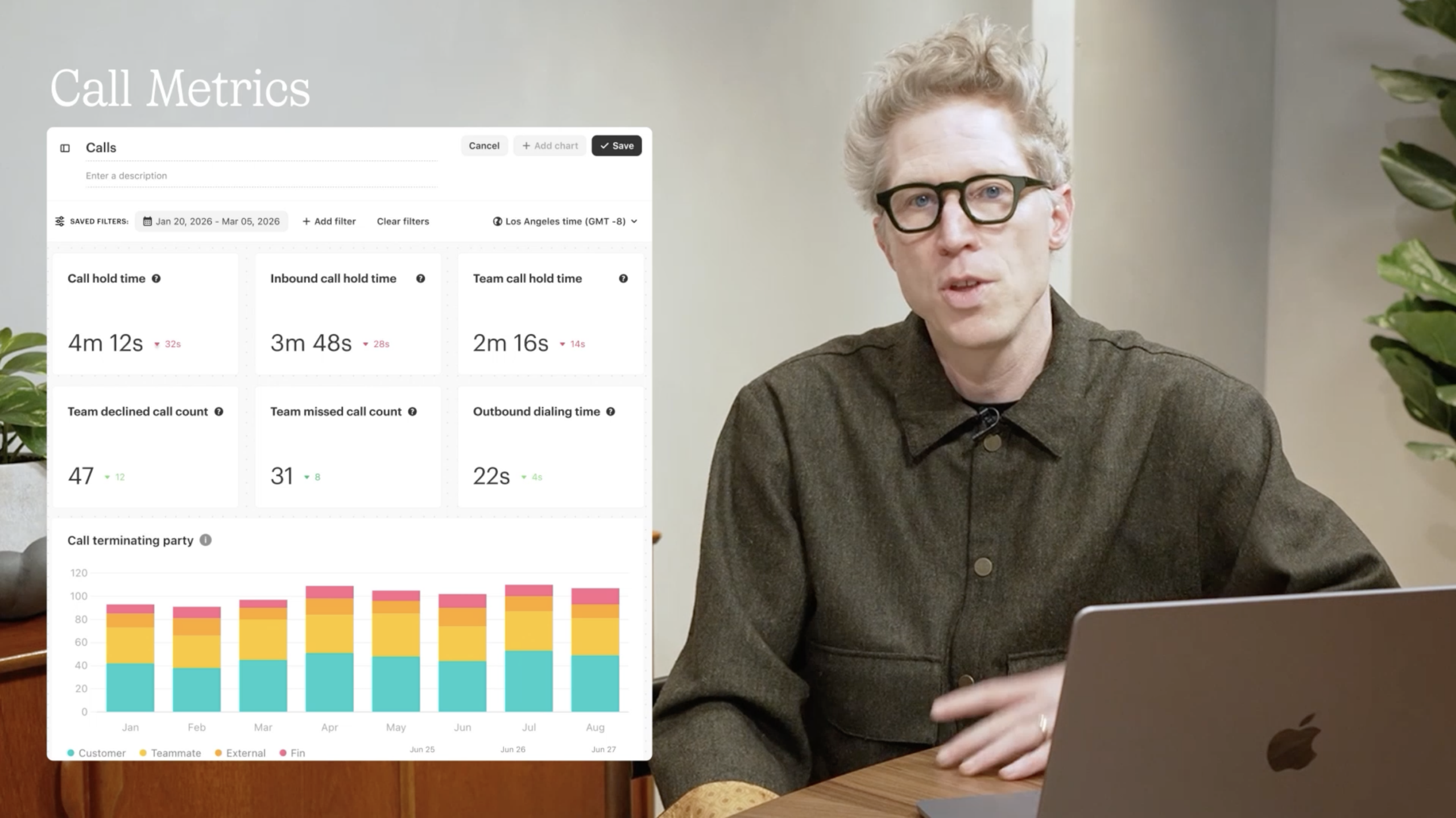
    Video still of a presenter beside a laptop and the Fin Call Metrics dashboard, showing tiles for hold times, missed and declined call counts, outbound dialing time, and a monthly stacked bar chart.
    Catch up on February’s Fin Product Updates with a walkthrough of the Call Metrics dashboard—saved filters, hold‑time tiles, missed and declined call counts, and a monthly breakdown that helps support teams act faster.

    Shopify setup experience (8:21). Fin began as a Service Agent and is quickly becoming a Customer Agent—working across the whole lifecycle to support, sell, and guide, even before a customer has an issue. The revamped Shopify setup is a clear step forward.

    Shopify catalogs are complex—thousands of products, variants, and dynamic inventory—and connecting all of that to an agent has historically been painful. We removed the friction.

    Setup now takes three steps: first, connect your store. Second, install the Messenger directly in Shopify—no code, just a few clicks. Third, deploy Fin. Total time: under two minutes. We timed it live.

    What that unlocks is real. In the demo, a first-time snowboarder asked for recommendations. Fin searched the catalog, reasoned about attributes that matter to a beginner (there’s no “beginner” tag in the catalog), personalized suggestions by height and weight, and added a board to the cart.

    Even better, one customer updated their website copy to promote a sale. Fin immediately picked up the new context and began recommending sale items, nudging shoppers to add more to the cart to access a discount—no extra configuration required. It read the situation and acted.

    Presenter explains Fin's Holiday Office Hours feature beside a laptop, with a UI screen showing office hours, reply times, and holiday closures settings for customer support teams.
    See how the latest Fin update streamlines support scheduling. A product expert walks through Holiday Office Hours, showing how to set default hours, track response metrics, and add closures so teams stay consistent.

    Three steps, and you have a real-time shopping assistant that knows your store and sells on your behalf.

    Helpdesk improvements (12:31). Fin works with any helpdesk, but many teams consolidate to take advantage of our native Intercom helpdesk integration. We’ve shipped 19 helpdesk improvements in 2026 so far; two from this month stand out.

    11 new call metrics. Hold time, outbound dial time, missed and declined calls, call terminating party, and more. These give leaders the visibility to analyze workload distribution and call handling quality in detail.

    Holiday office hours. Teams no longer need to manually update office hours for every public holiday. This was the most upvoted request in our community, and we shipped it.

    Across the board, we removed the constraints that hold teams back: the complexity ceiling in automation, the quality ceiling in voice, the setup barrier in Shopify, and the operational overhead in the helpdesk.

    We closed out the month with a Star Wars–style crawl of 22 additional updates. All features mentioned here are live and available now. Explore more at fin.ai/updates. More to come—see you next month.


    Inspired by this post on The Intercom Blog.

    Book a consult png image
  • Ship MVPs in Days, Not Months: My Proven Prompt Prototyping Playbook for Product Teams

    Ship MVPs in Days, Not Months: My Proven Prompt Prototyping Playbook for Product Teams

    Most MVPs take too long, cost too much, and still miss the mark. Over the past year, I’ve shifted my team to a prototyping prompts approach that lets us validate problem-solution fit in days, not months. The result is faster learning loops, clearer tradeoffs, and a dramatically higher hit rate on features that actually move the needle.

    When I say prototyping prompts, I mean structured, layered instructions that guide gen ai systems to produce the right artifacts at the right fidelity. Instead of jumping straight to code, we generate concise problem briefs, user stories, interaction flows, low-fidelity UI descriptions, and test plans. Each pass is constrained by acceptance criteria and business outcomes, which keeps the work grounded in value rather than output.

    Here’s the playbook my product trios use to go from idea to a testable MVP in 48–72 hours. First, we anchor on outcomes vs output OKRs and clarify the customer job-to-be-done using evidence from customer interviews and support data. This is classic continuous discovery, but we compress it by focusing on the single riskiest assumption to de-risk this week.

    Second, we build a prompt scaffold. We specify the role, constraints, target users, success metrics, and the exact output format we expect. We also define evaluation upfront, borrowing from eval-driven development. For example, before any generation, we list the acceptance tests that a good solution must pass, including edge cases and compliance considerations. This discipline keeps hallucinations in check and improves repeatability.

    Third, we spin up multiple prototypes in parallel. One prompt generates a lean product brief; another outlines user flows; a third proposes UI states and error handling. If we’re exploring voice, we add prompt engineering for voice to script dialogs and repair strategies. For data-heavy features, we call out retrieval-first pipeline patterns so the model references source-of-truth data rather than guessing.

    Fourth, we validate with real users using the lightest-weight experiment possible. Fake-door tests, concierge workflows, and guided click-throughs let us measure intent before we invest. Where we can, we run quick A/B testing and size the effort using minimum detectable effect (MDE) so we don’t over- or under-sample. The point isn’t perfection; it’s fast, directional signal to inform the next iteration.

    Fifth, we instrument and ship behind feature flags. We track activation, task completion, and time-to-value from day one. On the delivery side, we watch DORA metrics and deployment frequency to ensure we’re learning continuously rather than batching big bets. This bridges discovery and delivery so roadmaps reflect real-world feedback, not assumptions.

    One recent example: we needed to evaluate a voice AI agent for appointment scheduling. In 72 hours, prompts produced the problem brief, dialog flows, error recovery strategies, and a sandbox to simulate inbound requests across three user personas. We exposed a thin slice to a pilot cohort, captured call outcomes, and iterated the repair prompts twice before writing any production code. The pilot converted at a higher rate than our control flow and gave us the confidence to invest in full integration.

    This approach only works if we treat governance as a first-class concern. We bake in privacy-by-design, clear data governance boundaries, and AI risk management from the start. Prompts include guardrails on personally identifiable information, explicit constraints on data use, and links to approved sources. We also maintain a prompt repository with versioning and automated evaluations so changes are observable and reversible.

    Practically, strong prompt scaffolds share three traits. They’re specific about context and constraints, they define success in measurable terms, and they separate concerns by artifact type. I’ll often ask for three variants with different tradeoffs, then run a quick synthesis prompt that highlights points of parity and differentiation. This gives the team structured options rather than a single, brittle path.

    If you’re starting from zero, begin with one high-leverage workflow. Write a crisp outcome statement, draft your acceptance tests, and create a prompt that outputs a one-page brief, three user flows, and the top five risks with mitigations. Validate with five users in 48 hours, then decide: double down, pivot, or park. Rinse and repeat, and your product roadmapping and sprint planning will shift from speculation to evidence.

    The bottom line is simple. Prototyping prompts won’t replace product judgment, but they will accelerate it. By turning ideas into testable artifacts in hours, you minimize waste, maximize learning, and ship better MVPs—fast.


    Inspired by this post on Product School.


    Book a consult png image