Tag: value proposition

  • Global Invoicing Nightmares: Hard-Won Product Lessons on EU Tax, Compliance, and Customer Value

    Global Invoicing Nightmares: Hard-Won Product Lessons on EU Tax, Compliance, and Customer Value

    I hit play on Global Invoicing – All Things Product Podcast with Teresa Torres & Petra Wille and felt an immediate jolt of recognition. We’ve all launched a feature that looked solid—until a small, overlooked detail broke everything. Their stories about global invoicing and taxes echoed challenges I’ve faced leading product for international customers: if you don’t design for the last mile of compliance, you can accidentally block the very "moment of value creation" your product promises.

    Listen to this episode on: Spotify | Apple Podcasts

    The conversation starts as a candid rant about EU tax compliance and quickly becomes a precise product management lesson: when we fail to map the entire path to customer value—down to the tiniest regulatory requirement—we can ship something “done” that still doesn’t work in the real world. That gap between intention and outcome is where good product teams live or die.

    In my experience, the nightmare of global invoicing for small online businesses is very real. Even big platforms (like Squarespace and Teachable) miss the mark on EU tax compliance, and when they do, customers feel it immediately. It’s the kind of edge case that doesn’t show up in a demo but absolutely shows up in revenue. Or as Teresa put it, “It’s not a little detail when your client won’t pay the invoice.” — Teresa Torres

    I appreciated how the episode digs into the difference between passing a regulatory checklist and actually meeting customer needs. Put plainly: the product isn’t “done” when the ticket moves to Done; it’s done when the customer completes the job—receives an acceptable invoice, pays successfully, and can reconcile it without friction. That’s why I lean hard on story mapping for regulatory work; it exposes the invisible steps where value creation can silently fail.

    Here’s how the episode resonates with my own playbook: the nightmare of global invoicing for small online businesses is a systems problem; why even big platforms (like Squarespace and Teachable) miss the mark on EU tax compliance is a prioritization and discovery problem; how Petra and Teresa navigated invoicing across borders with Ableify and LearnWorlds highlights pragmatic tool choices and trade-offs; the key difference between meeting regulations and meeting customer needs is an outcomes-over-output mindset; what product teams can learn from regulatory edge cases is how to find the seams where markets, laws, and workflows collide; how missing a single detail can block the "moment of value creation" is a reminder that value is defined by customers; and why story mapping is critical for finding gaps between "we shipped it" and "customers got value" is the method that connects all of the above.

    Practically, that means I treat regulatory features like any other high-stakes product surface: do real product discovery with affected users; co-design the happy path and the ugly edge cases; write acceptance criteria that include jurisdictional and document-level specifics (e.g., VAT numbers, invoice formats, timing rules); align with finance and legal early; and instrument the journey from invoice issued to invoice paid so we can see where real customers get stuck. This is outcomes vs output OKRs in action, and it’s one of the fastest ways to earn trust with stakeholders.

    Key takeaways worth bookmarking: Customers define value, not your compliance checklist. Regulatory work still requires discovery—you can’t skip understanding user needs. The path to value doesn’t end when your feature works; it ends when your customer succeeds. “Sweating the details” isn’t micromanagement—it’s good product management.

    Memorable quotes to bring back to your team: “If you don’t sweat the details, people choose other platforms.” — Petra Wille. “It’s not a little detail when your client won’t pay the invoice.” — Teresa Torres.

    Follow Teresa Torres: https://ProductTalk.org | Follow Petra Wille: https://Petra-Wille.com

    Mentioned in the episode: Squarespace | Stripe | Product at Heart | Teachable | LearnWorlds | Ablefy | Become a Better Product Leader: A 52-Week Transformation Journey | Product Talk Academy

    Have thoughts on this episode? Leave a comment below.

    Full transcripts are only available for paid subscribers.


    Inspired by this post on Product Talk.


    Book a consult png image
  • Cut Time to Value, Boost Retention: My Proven Playbook for Activation, Growth, and Loyalty

    Cut Time to Value, Boost Retention: My Proven Playbook for Activation, Growth, and Loyalty

    Time to value is the most reliable early indicator of long-term user retention I know. When customers experience meaningful product impact fast, they stick around, expand, advocate, and cost less to support. Over the years leading product teams, I’ve learned that speed-to-impact isn’t a nice-to-have—it’s the engine behind sustainable product-led growth and efficient go-to-market.

    Accelerate retention by reducing time to value. Learn how faster product impact drives growth, reduces costs, and keeps users engaged in the long term.

    Practically, I define time to value as the duration from first touch (or first login) to the moment a user achieves their “aha” outcome—something tangibly useful aligned to their job-to-be-done. The shorter that journey, the higher the likelihood of user activation, trial conversion, and durable engagement. This is why I obsess over onboarding, in-app guides, product tours, and the clarity of our value proposition.

    My first move is to map the Minimum Path to Value (MPV): the smallest set of actions needed to deliver a real result for a new user. I strip away everything non-essential in that path—fields, clicks, choices, and jargon. Opinionated defaults, smart templates, sample data, and single-player workflows let customers succeed in minutes, not days. The goal is to reduce cognitive load while making the next best action unmistakably clear.

    Instrumentation turns TTV from a hunch into a system. I track activation events, cohort retention, and conversion using platforms like Amplitude analytics and Pendo, with timely nudges through Intercom when users stall. I look at the distribution of TTV (not just the average), correlate it with retention analysis, and set explicit targets such as “new users reach first value within 10 minutes.” Those targets become team-level outcomes—not outputs—and we review them weekly.

    Experimentation is how we iterate toward the fastest path to value. I rely on A/B testing to compare onboarding flows, progressive profiling to delay non-critical inputs, and opinionated setup wizards to remove guesswork. Auto-generated example projects, pre-configured integrations, and guided checklists accelerate user activation without sacrificing flexibility for advanced users.

    Content and guidance matter as much as UX. Tooltips, contextual in-app guides, and short product tours should be timely, skippable, and laser-focused on the outcome, not the feature. I pair these with a concise knowledge base and short explainer videos that reinforce the same value narrative a user sees inside the product.

    Cross-functional alignment is essential. Product, marketing, sales, and customer success must rally around the same activation metric and TTV target. That alignment ensures our trial messaging, onboarding emails, and CS playbooks don’t compete—they compound. When everyone points to the same first-value moment, friction drops and adoption rises.

    Pricing and packaging can also accelerate time to value. Free trials should be long enough for users to credibly reach first value; usage-based gates should never block the MPV. I prefer to unlock everything needed to hit the “aha” moment, then meter after the value is viscerally felt—this respects the user’s time and reinforces trust.

    There’s a cost story, too. Faster time to value reduces tickets, shortens onboarding cycles, and lowers cost-to-serve. It also clarifies product discovery: when we see where users stall, we don’t guess at roadmap priorities—we let the data guide our next bet.

    In my experience at HighLevel, I’ve repeatedly seen activation rates jump when we cut time to value from days to minutes. The specific tactics vary by product, but the pattern holds: when the first outcome is undeniable and fast, retention follows—and so does efficient growth.

    If you’re looking for a starting point, try this: define one activation event that clearly signals value, instrument it end-to-end, design a Minimum Path to Value that gets new users there in under 10 minutes, and run weekly experiments until you consistently hit the target. Do that, and you won’t just improve onboarding—you’ll build a product that earns loyalty from the very first session.


    Inspired by this post on Amplitude – Best Practices.


    Book a consult png image
  • Win AI Search: Proven Playbook to Get Your Startup Recommended by ChatGPT & Perplexity

    Win AI Search: Proven Playbook to Get Your Startup Recommended by ChatGPT & Perplexity

    AI search is quickly becoming the new homepage for startups. When a buyer asks a model for the best tools, they often take the short list at face value. I treat this moment as a product surface I can influence with strategy, content, structure, and distribution—much like any other go-to-market channel.

    Early on, I set a simple objective for my team and me: "Learn how LLMs like ChatGPT and Perplexity decide which startups to recommend and what signals help a brand get discovered in AI search." That sentence became our north star for experiments, instrumentation, and content architecture.

    Here is the mental model that consistently holds up in practice. Large language models synthesize answers from a knowledge graph built from crawled content, citations, and high-signal sources. They weight consensus, clarity, recency, authority, and machine-readability. I don’t pretend to know the internals, but across hundreds of tests, the same patterns correlate with being surfaced and cited.

    First, I make our entity unambiguous. I standardize the company name, product names, and leadership bios across the site and external profiles. I implement Organization and Product markup with schema.org and link out with sameAs to authoritative profiles like LinkedIn, Crunchbase, GitHub, and key directory listings. The goal is to collapse ambiguity so AI search knows exactly who we are and which claims are attributable to us.

    Next, I publish definitive, answer-first pages. For every core query—what we do, who it’s for, outcomes, differentiators, pricing, comparisons, and integrations—I ship a page that leads with a crisp summary, then supports it with evidence, examples, and plain language. I include Q&A sections, realistic use cases, and named case studies so models can quote and ground responses in verifiable facts.

    I then make the site maximally machine-readable. I add schema.org for SoftwareApplication, Product, FAQPage, and HowTo where relevant. I keep titles, H1/H2 structure, internal links, and metadata descriptive and consistent. I expose last-modified dates, maintain an XML sitemap, and keep a visible changelog and release notes. Freshness matters—Perplexity, in particular, tends to privilege recent, well-cited material when answering time-sensitive questions.

    Citations are non-negotiable. I earn credible mentions on third-party properties, analyst lists, comparison pages, and customer reviews. I prioritize authoritative placements over volume, then make sure our site references those sources to reinforce the signal. When Perplexity cites our page alongside a respected third-party review, our inclusion rate in answers rises noticeably.

    I also design for developers, buyers, and machines at once. That means clean docs, integration pages, and transparent security and trust content. Clear API references, integration guides, and reliability notes give models concrete artifacts to summarize. Pricing, privacy, and support policies reduce uncertainty and increase the likelihood that an answer will include us.

    Measurement turns this from a hunch into a system. I run controlled content experiments, track minimum detectable effect on discovery and mentions, and instrument referral patterns from AI assistants when citations appear. I monitor which prompts surface our brand, which sources are cited, and which pages are repeatedly used as references. When we move a KPI, we codify the pattern into our playbook and scale it.

    Trust is the compounding advantage. I maintain a transparent trust center, privacy-by-design posture, and clear data governance practices. I remove vague claims, back up benefits with evidence, and keep all performance or security statements auditable. Models tend to lift brands that feel low-risk, well-documented, and widely corroborated.

    If you want a fast start, here’s the checklist I rely on. Standardize your entity and ship schema.org. Publish answer-first pages for core jobs-to-be-done, comparisons, and integrations. Earn authoritative third-party citations and reference them. Keep release notes, changelogs, and dates current. Instrument AI discovery and iterate based on what gets cited. Do this consistently, and your startup earns a fair shot at being recommended when buyers ask AI for the best options.


    Inspired by this post on Amplitude – Best Practices.


    Book a consult png image
  • Build a Company You’ll Run Forever: Bootstrapping vs VC, PMF, and the Art of ‘Eating Glass’

    Build a Company You’ll Run Forever: Bootstrapping vs VC, PMF, and the Art of ‘Eating Glass’

    I’ve spent my career building products and teams that I intend to steward for the long haul, and I’m drawn to founders who treat company-building as a craft you can practice forever. In this analysis, I break down a journey that crystallizes what it takes: going from a teenage wholesale hustle to an API-first healthcare clearinghouse, and in the process, learning why execution isn’t a moat, why venture capital is “going pro,” and how “eating glass” can become a durable advantage.

    Here’s the arc that anchored my thinking: a founder who, at 16, turned $2,500 into a wholesale empire; later bootstrapped a wildly profitable auto-parts business; then sold it to tackle “the most complicated problem” he’d ever encountered: business-to-business transaction exchange. He spent years building EDI infrastructure, threw away the entire codebase eight times, and found extraordinary traction in healthcare. The company recently raised a $70M Series B co-led by Stripe and Addition. The throughline is a consistent, high-agency approach to product management and go-to-market strategy, guided by first principles decision making.

    The first customer is often the trickiest—not because demand doesn’t exist, but because the product’s value proposition, points of parity, and competitive differentiation are still coalescing. I push teams to do founder-led GTM early, speak in the user’s language, and orchestrate high-signal conversations that expose real switching costs. That’s how we avoid mistaking polite interest for product-market fit.

    Bootstrapping forces rigor, but it also means being “constrained by capital.” There’s a ceiling to the speed at which you can iterate, validate, and scale. Venture capital, in the right context, is like “going pro”: you trade a bit of optionality for time, talent density, and a faster feedback loop. I often see confusion between ownership vs. control; structurally, you can design for alignment while still moving with the urgency a competitive market demands.

    One theme I return to with my own teams: execution is never actually a moat. Processes can be copied. Culture can be mimicked superficially. What can’t be easily replicated is the willingness to do the unglamorous, compounding work—what the founder here called “eating glass.” It’s the daily discipline of simplifying the system, instrumenting the edge cases, and standing up operational excellence that compounds into true competitive differentiation.

    When product-market fit hits in enterprise infrastructure, it can feel like “the snake swallowing a deer.” Capacity, process, and architecture are stretched to their limits all at once. I’ve experienced the same pattern: everything slows down so the organization can re-architect for scale. The trick is to make those constraints visible—measure service levels, queuing, and error budgets like you would in a production system—so you’re not flying blind.

    Some of the strongest product-management instincts I’ve seen borrow from discount retail and Toyota. From discount retail, we learn to obsess over unit economics, operational throughput, and ruthless simplification. From the Toyota production system, we adopt Kanban / TPS (Toyota), continuous improvement, and respect for constraints. In software terms, this becomes fast deployment frequency, small batch sizes, and defect prevention at the source—because “All software is a cascade of miracles.”

    Scaling decision-making is where most teams stall. I favor clear ownership, lightweight written narratives, and a bias for first principles decision making over committee compromise. That structure lets high-agency individuals move quickly while keeping cross-functional stakeholders aligned on outcomes vs output OKRs. It’s how you build empowered product teams without sacrificing focus.

    Hiring is where philosophy becomes practice. I resonate with the onboarding mantra “everything’s your fault now”—not as blame, but as an invitation to own outcomes end to end. I look for high-agency people who demonstrate systems thinking and the capacity to simplify. Manager hiring should lag role clarity; bring in managers when coordination overhead is the limiting factor, not when it merely feels uncomfortable.

    Longevity comes from founder-approach fit as much as product-market fit. Build a company you don’t want to leave by aligning operating cadence, decision rights, and cultural norms with how you actually work best. Maintain conviction in unconventional practice when the evidence supports it, while remembering that “Reality has a surprising amount of detail.” The more I zoom in on the real work—interfaces, edge cases, workflows—the more the right design emerges.

    In healthcare EDI, that realism matters. HIPAA overview (HHS) sets the compliance baseline. Payer integrations with Aetna, Blue Cross Blue Shield, and Cigna demand reliability and deep domain fidelity. Cloud and back-office ecosystems—from AWS and NetSuite to Slack, Microsoft Teams, Zapier, and Clay—shape the surrounding workflow. Lessons from Amazon, Target, Walmart, and Costco inform operational rigor; supply chain analogies from Ford Motor Company and GM clarify interface contracts. Porter’s five forces helps frame market structure; perspectives from Jeff Bezos and Peter Thiel sharpen strategic posture.

    If you’re building for the long run, here’s the blueprint I use with product leaders: validate painfully specific jobs-to-be-done before you scale; prefer founder-led GTM until messaging closes the intent-to-adoption gap; instrument throughput and quality like a production system; invest in people who treat ambiguity as a chance to lead; and don’t confuse speed with hurry. When the “snake swallowing a deer” moment arrives, re-architect deliberately, protect your margins, and let operational excellence carry you from product discovery to durable product-led growth.

    References and resources: Aetna: https://www.aetna.com/, Amazon: https://www.amazon.com/, AWS: https://aws.amazon.com/, Blue Cross Blue Shield: https://www.bcbs.com/, Change Healthcare: https://www.changehealthcare.com/, Cigna: https://www.cigna.com/, Clay: https://www.clay.com/, Costco: https://www.costco.com/, Ford Motor Company: https://www.ford.com/, GM: https://www.gm.com/, HIPAA overview (HHS): https://www.hhs.gov/hipaa/index.html, Jeff Bezos: https://x.com/JeffBezos, Kanban / TPS (Toyota): https://global.toyota/en/company/vision-and-philosophy/production-system, Microsoft Teams: https://www.microsoft.com/microsoft-teams, NetSuite: https://www.netsuite.com/, O’Reilly Auto Parts: https://www.oreillyauto.com/, Peter Thiel: https://x.com/peterthiel, Porter’s five forces: https://www.isc.hbs.edu/strategy/pages/the-five-forces.aspx, “Reality has a surprising amount of detail”: https://johnsalvatier.org/blog/2017/reality-has-a-surprising-amount-of-detail, Slack: https://slack.com/, Stedi: https://www.stedi.com/, Summit Racing: https://www.summitracing.com/, Target: https://www.target.com/, Walmart: https://www.walmart.com/, Zapier: https://zapier.com/


    Book a consult png image
  • Turn Claude Code Into a Trusted Teammate: My 3-Layer Memory System You Can Copy

    Turn Claude Code Into a Trusted Teammate: My 3-Layer Memory System You Can Copy

    "Can you critique the landing page for my new Story-Based Customer Interviews course?" That simple ask used to kick off hours of back-and-forth where I fed an AI the same context over and over—only to get generic feedback that wouldn’t land with my audience or fit my products. As a product leader, that inefficiency was unacceptable; as a writer, it was just plain frustrating.

    Not anymore. Today, Claude not only critiques my work, it helps me produce it. It generates marketing copy—in my voice. It helps me write blog posts. It knows what search terms are relevant to my business and helps me optimize my articles for SEO and now AEO. It helps me with competitive research, academic research, and discovery research. And it does all of this with little prompting from me.

    I don’t upload files to a web-based project. I don’t manage elaborate prompt libraries. I don’t repeat myself. I ask for help and Claude knows exactly what to do. The shift happened when I learned how to give Claude Code a memory. Claude now knows who my target customer is, the key value propositions I focus on, the specific opportunities each product addresses, my revenue model, my marketing channels, and so much more.

    Dark-mode slide with monospaced white text outlining an SEO plan: add CLAUDE.md to an AI glossary as the entry point, with bullets on article focus, audience, and search architecture for Give Claude Code a Memory.
    A dark-themed strategy slide for the post Stop Repeating Yourself: Give Claude Code a Memory, showing how to lead with a CLAUDE.md glossary page, write clearly for nontechnical readers, and link glossary and article to boost discovery and engagement.

    With that memory, I consistently get high-quality output tailored to my audience and aligned to my products and services. I don’t retype the same context; Claude just remembers. In this article, I’ll show you exactly how I set up that memory. It relies on Claude Code (which requires a Pro subscription), and it’s worth it. If you’re new to Claude Code, start with "Claude Code: What It Is, How It’s Different, and Why Non-Technical People Should Use It."

    Here’s the underlying problem: with large language models, every conversation starts from scratch. Yes, ChatGPT can remember some things and Claude can search past conversations, but practically speaking each new thread wipes the slate clean. If I were working on a new landing page, I’d normally need to upload target customer context, product details, primary and secondary value propositions, FAQ questions and answers, plus testimonials and logos for social proof—every single time.

    Dark-theme screenshot of the Claude interface with a large prompt field, model selector set to Sonnet 4.5, and quick-action buttons for Write, Learn, Code, Life stuff, and Claude’s choice on the home screen.
    Start fast with Claude’s home screen: Sonnet 4.5 is ready, and quick actions for writing, learning, and coding sit beneath a clean prompt box—ideal for showing how memory cuts repetition and streamlines daily development.

    Projects in web-based tools help a bit, but they introduce a new dilemma. When I move to the next landing page targeting the same customer but a different product and value proposition, do I start a new Project (tedious) or keep expanding the old one (which muddies the context window and degrades output quality)? The good news: Claude Code solves this by giving the model a precise, durable memory without overloading any single conversation.

    Claude Code can read files on my local machine, which is an understated superpower. I use those files to create a persistent, reusable memory that works across all chats and Projects. Files can be mixed and matched, so I give Claude exactly what it needs for the task at hand—and nothing more. For a first landing page, I reference the target customer and the relevant product; for the second, I reuse the same target customer file and point to the new product file.

    Screenshot of a macOS Notes window in dark mode showing an AI-assisted review of producttalk.org, listing Fetch and Read steps and a "Homepage Evaluation" for a first-time B2C visitor.
    Dark-mode Notes screenshot captures Claude Code in action: it fetches producttalk.org, reads context files, and delivers a concise homepage evaluation—showing how memory streamlines repeated analysis tasks.

    When you give an LLM the exact right context, output quality jumps. More context only helps if it’s the right context. For a landing page, Claude needs to know about the current product and perhaps related products for differentiation—but it doesn’t need to know about unrelated offerings. Structure your memory so Claude gets precisely what’s required.

    Once I did this, Claude shifted from “intern who needs handholding” to trusted advisor and capable teammate. It doesn’t guess at my value propositions—I’ve already told it. It writes in my voice because it has my writing guide and samples. It knows who owns which course and which use cases map to which features. The setup takes a bit of upfront work, but it compounds: update a file when something changes and you’re done. Most of this information already lives in your system; the trick is making it easy for Claude to use.

    Diagram of the Claude Code interface with a terminal-style dashboard. Arrows show Global Preferences (~/.claude/CLAUDE.md), Project Preferences (Project/CLAUDE.md), and Custom Files feeding memory into the coding chat.
    See how Claude Code stops repetition: global and project CLAUDE.md files, plus custom reference docs, flow into the editor so the assistant remembers your preferences and context while you code and run commands.

    Because the files live on my machine, I own the system. No vendor or device lock-in. I decide when and who to share with. I can work with Claude on one project and ChatGPT on another—both can rely on the same file-based memory strategy. It’s an AI strategy that scales with product discovery, accelerates go-to-market content, sharpens competitive differentiation, and supports product-led growth.

    Here’s how I design the memory: I use three layers. Claude Code already encourages global preferences and Project-specific instructions, but the third layer—reference context—is where the real power lives.

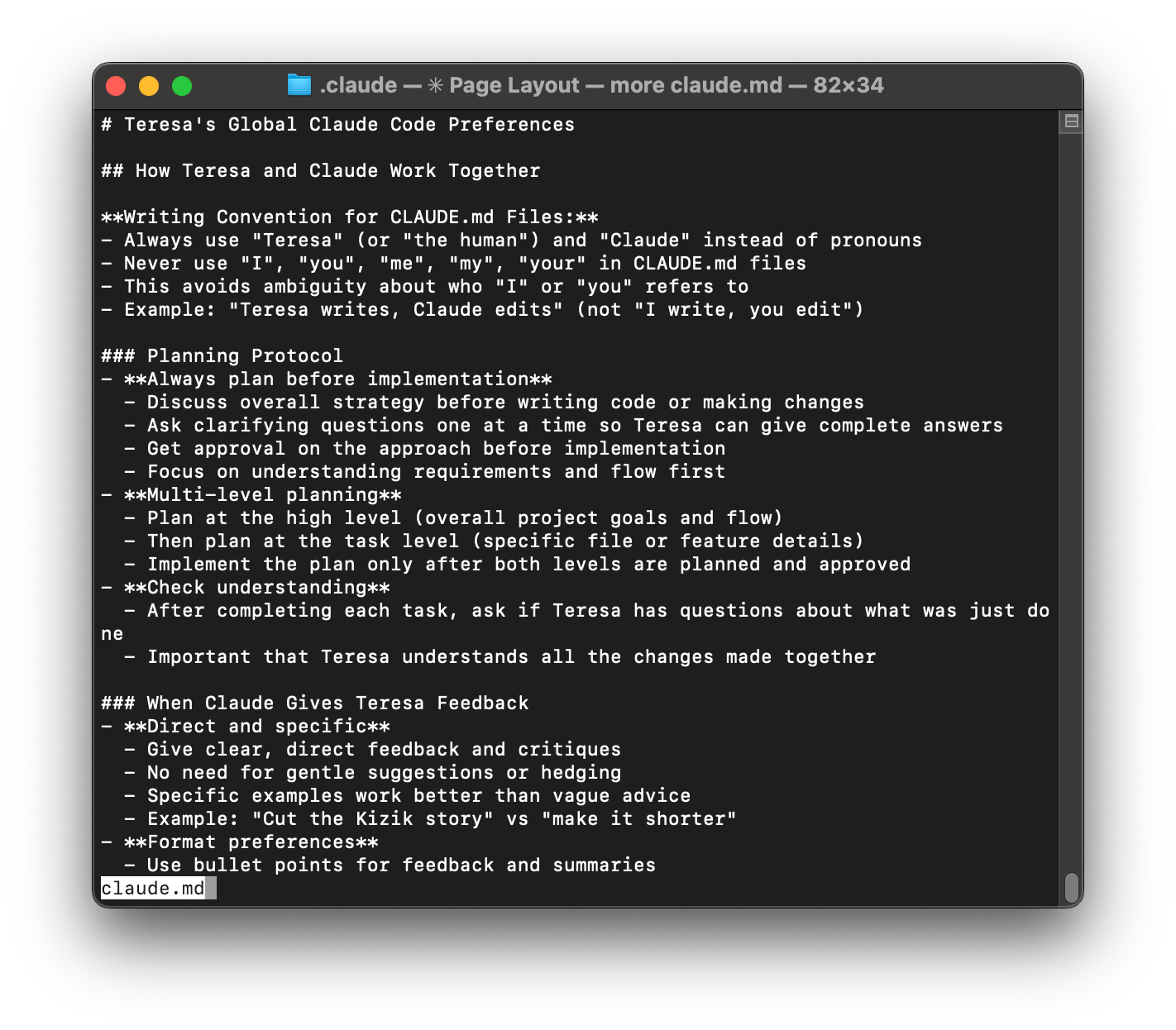
    Dark-mode screenshot of a macOS editor showing a 'Claude Code Preferences' markdown file with sections on writing conventions, planning protocol, and feedback for collaborating with Claude.
    Peek inside a markdown playbook for Claude Code: concise rules for writing, multi-level planning, and clear feedback that turn repeated reminders into reusable memory and smoother, faster coding sessions.

    Layer 1: Global Preferences (Always on). The first time I launched Claude Code, I created a CLAUDE.md file at ~/.claude/CLAUDE.md. This is where I keep the cross-project rules of engagement—how I like to work with Claude. Mine includes: Always create a plan for me to review before you start any work; Give me direct feedback (no hedging, no gentle suggestions); Use bullet points for summaries; Ask clarifying questions one at a time so I can give complete answers; No emojis unless I explicitly ask for them. Claude Code automatically loads this file at the start of every session, so I never restate my preferences.

    Layer 2: Project-Specific Instructions. Different projects have different rules. In my writing workspace, the Project CLAUDE.md sets the roles (I’m the primary writer; Claude is my thought partner and editor), defines a multi-round review flow (content → structure → accuracy → typos), prioritizes human readability over SEO, and points to my writing style guide. In my task management system, I include how my Trello integration works, file naming conventions for tasks, and how to process research papers into summaries. In my code projects, I specify the technology stack (Node.js vs. Python), testing framework (Jest for Node.js, pytest for Python), code style and conventions, project architecture and directory structure, and which dependencies and libraries to use. Each project directory has its own CLAUDE.md, and Claude automatically loads the relevant file when I’m working there.

    Dark-themed text editor screenshot of a markdown file titled 'Claude Instructions,' featuring sections for session setup, working relationship, editor responsibilities, and research and development guidelines.
    Peek inside a markdown playbook for collaborating with Claude—covering session setup, roles, editorial standards, and research steps—to show how saved instructions create consistent results without repeating yourself.

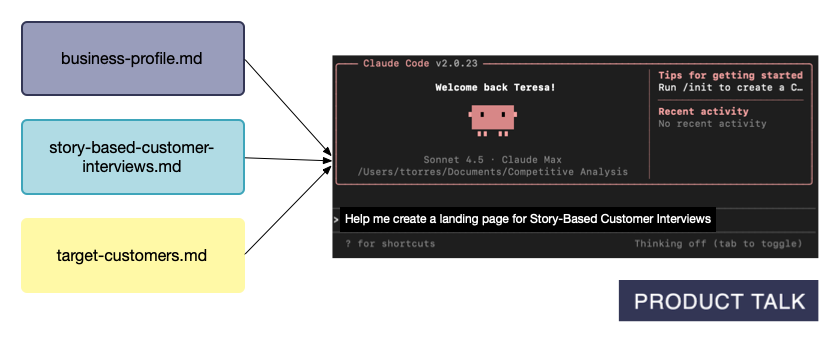
    Layer 3: Reference Context (Pull as Needed)—the real power. LLMs have a context window—a limit to how much they can process at once. Even within that limit, loading too much degrades performance due to “context rot.” The remedy is ruthless context management: small, targeted files that load only when needed. Keep CLAUDE.md files concise and focused on rules and workflows. For detailed knowledge, create separate reference files and list them in your CLAUDE.md so Claude knows they exist and when to fetch them. When I ask for help creating a landing page, Claude knows to use my business profile, the product file, and my target customers context.

    Here’s what most people miss: you don’t cram everything into global or Project files. You maintain small, reusable reference files that Claude only loads on demand. In my walkthrough, I share exactly which context files I created and why; how I got Claude Code to help me create them; how I break them into small, reusable components so Claude gets precisely what it needs; how I keep everything up to date; and step-by-step instructions so you can set up a similar memory system.

    Diagram of three markdown files (business-profile.md, story-based-customer-interviews.md, target-customers.md) feeding into a Claude Code IDE panel, showing context files powering an AI assistant.
    Three project notes funnel into Claude Code, turning reusable context into working output. This visual shows how saving key docs as memory lets the AI pick up where you left off and skip repetitive prompting across tasks.

    Let’s dive in.


    Inspired by this post on Product Talk.


    Book a consult png image
  • My Product Positioning Playbook: Craft Unforgettable Messaging That Wins Markets and Endures

    My Product Positioning Playbook: Craft Unforgettable Messaging That Wins Markets and Endures

    Every market-winning product I’ve helped build started with a positioning statement that was clear, defensible, and memorable. When I lead new initiatives at HighLevel, Inc., I treat positioning as a product decision—because it sets the guardrails for what we prioritize, how we execute, and how we tell the story across the entire go-to-market engine.

    Your product positioning statement decides if you stand the test of time. Learn how other expert products do it and how to write one that sticks.

    At its core, a positioning statement is the sharpest articulation of who we serve, the problem we solve, the category we compete in, the value proposition we deliver, and why we win. It is not a tagline or a pitch deck sentence; it’s the decision calculus that aligns product, marketing, sales, and customer success so we can move fast in one direction.

    Here’s the simple template I use and coach teams on: For [target customer/segment] who [urgent need or job-to-be-done], [product name] is a [category or frame of reference] that [core value proposition]. Unlike [primary alternative or status quo], it [competitive differentiation and reasons to believe]. When this fits, everything from roadmaps to demos becomes easier—and conversions tend to follow.

    Start with the target segment. Be precise about who you are for. I triangulate with retention analysis and behavioral data (e.g., Amplitude analytics) to find the cohorts that activate quickly, retain well, and expand. If you cannot name the segment in one line, you’ll struggle to land positioning anywhere else.

    Next, define the customer outcome. Tie the promise to measurable “outcomes vs output OKRs.” Customers buy progress, not features. State the job-to-be-done in their language and anchor it to a business result they already track.

    Choose your category and points of parity. Category is a cognitive shortcut; it tells buyers where you sit on their mental map. Points of parity are table stakes you must match to be considered. If you skip parity, you look incomplete; if you skip category, you look confusing.

    Then sharpen your competitive differentiation and value proposition. What do you do uniquely well that competitors can’t easily copy? Back it up with reasons to believe—proof points like speed-to-value, measurable ROI, data governance, or privacy-by-design and cybersecurity commitments. Credibility turns claims into confidence.

    Validate the statement through rigorous A/B testing. I pressure-test the language across landing pages, onboarding flows, in-app guides, sales call talk tracks, and nurture sequences. Tools like Pendo, Intercom, and HubSpot make it easy to instrument message experiments and see what actually moves activation, conversion, and expansion.

    Operationalize the winning statement across go-to-market strategy and product-led growth motions. Bake it into onboarding, product tours, pricing pages, and demo narratives. A strong positioning statement should shape prioritization in the roadmap as much as it shapes the headline on your website.

    Beware common pitfalls. Don’t confuse vibe marketing for positioning. Avoid vague superlatives that any competitor could claim. Don’t aim for universal appeal; specificity sells. And never let the statement drift—revisit it after major launches, new segments, or shifts in competitive dynamics.

    Here’s an example using the template: For revenue teams at mid-market SaaS companies who need faster, more predictable pipeline creation, SignalFlow is a unified analytics platform that turns product usage signals into qualified opportunities. Unlike generic CRMs and static lead scoring, it surfaces intent in real time and automates outreach, improving conversion by 22% within 30 days.

    If your team debates features more than outcomes, it’s time to revisit your positioning. In my experience, one crisp sentence can unlock alignment, accelerate execution, and make your message stick. Write it, test it, and make it the north star for every decision you ship.


    Inspired by this post on Product School.


    Book a consult png image
  • Build a Product Messaging Framework That Converts: Clarity, Consistency, Customer Connection

    Build a Product Messaging Framework That Converts: Clarity, Consistency, Customer Connection

    I’ve learned the hard way that features don’t win on their own—clear, consistent messaging does. When our teams at HighLevel rally around a single product messaging framework, we move faster, tell one story, and connect with customers in a way that actually converts. The right framework doesn’t just make marketing sharper; it aligns product, sales, and customer success on what we promise, why it matters, and how we prove it.

    When I say “product messaging framework,” I mean a structured system that defines who we serve, the problems we solve, the outcomes we enable, and the value proposition that sets us apart. It includes points of parity that establish table stakes, differentiation that creates competitive separation, and proof points that make our claims credible. It maps features to benefits, organizes a messaging hierarchy from company to product to feature, and guides voice, tone, and lexicon so UX writing and go-to-market strategy stay consistent across channels.

    Why does this matter? Because clarity reduces friction for buyers, consistency builds trust, and customer connection drives conversion and retention. A strong framework accelerates product discovery, strengthens product positioning, and improves onboarding and user activation. It also makes product-led growth repeatable by ensuring every touchpoint—from website to in-app guides—reinforces the same value proposition.

    Here’s how I build a framework that stands up in the real world. I start with customer research and win/loss analysis to anchor on the ideal customer profile and jobs-to-be-done. I craft a positioning statement that articulates the target, problem, category, differentiation, and payoff. Then I define value pillars, each with concrete reasons to believe—customer quotes, data, and feature proof. I document points of parity and differentiation, map features to benefits and outcomes, and codify voice and terminology to keep UX writing tight. Finally, I build a messaging hierarchy (company, product, feature, segment) and an objection-handling guide so sales and support are equipped to respond consistently.

    A simple litmus test keeps me honest: can a salesperson deliver a crisp elevator pitch, can a PM write a release note, and can a designer craft an in-app tooltip—all from the same source of truth? If yes, the framework is doing its job. If not, I iterate until the story is simple, believable, and memorable.

    Operationalizing the framework is where impact compounds. I enable product trios and go-to-market teams with talk tracks, one-pagers, narrative decks, and a living glossary. I translate the framework into site copy, product tours, onboarding flows, and help content so customers experience the same story everywhere. I also thread it into product roadmapping and sprint planning to keep prioritization aligned with the core value proposition.

    I measure what matters and refine relentlessly. I use A/B testing to validate headlines and calls to action, monitor activation and conversion across segments, and review retention analysis to see which value pillars correlate with long-term use. Feedback loops from sales calls, support tickets, and customer interviews feed back into the framework so it evolves with the market.

    There are predictable pitfalls I try to avoid. Going feature-first instead of outcome-first makes messaging forgettable. Overselling differentiation without points of parity undermines credibility. Spreading across too many personas dilutes signal. And inconsistent tone across channels confuses buyers. A disciplined framework helps prevent all of these.

    Treat your product messaging framework as a living system, not a slide. Revisit it when the market shifts, when your roadmap unlocks new value, or when your go-to-market strategy evolves. The payoff is real: tighter alignment, sharper positioning, faster execution, and a customer story that consistently earns attention—and conversion.


    Inspired by this post on Product School.


    Book a consult png image
  • Impact Analysis Mastery: Proven Steps to Predict, Measure, and Maximize Product Outcomes

    Impact Analysis Mastery: Proven Steps to Predict, Measure, and Maximize Product Outcomes

    When I think about the difference between a roadmap that moves the business and one that simply ships output, impact analysis is the habit that changes everything. It gives me and my product trios a disciplined way to forecast value, align stakeholders, and de-risk bets before a single sprint starts. Over the years, I’ve seen great ideas fail not because they were bad, but because we couldn’t articulate, test, and track their true impact. That’s the problem impact analysis solves.

    Impact analysis, in practice, is a structured method for predicting how a proposed change will influence user behavior and business outcomes—and then validating those predictions with data. Uncover what impact analysis is, why it matters, and how to do it with proven methods and clear steps for product teams. When done well, it translates strategy into evidence-backed choices that strengthen our value proposition and accelerate product-led growth.

    I use impact analysis at three key moments: during product discovery to vet opportunities, in product roadmapping and sprint planning to prioritize, and post-launch to confirm that outcomes beat expectations. It is equally useful for net-new features, UX improvements, pricing changes, and even enablement like in-app guides or product tours.

    Step 1: Define the outcome with precision. I anchor every proposal to outcomes vs output OKRs, choose one primary success metric, and record the current baseline. If we plan to experiment, I estimate the minimum detectable effect (MDE) to ensure our A/B testing can actually validate the expected lift. This protects us from investing in ideas that are too small to measure or too broad to manage.

    Step 2: Map the causal chain. I translate the idea into a simple impact map: feature change → user behavior (activation, frequency, conversion, retention) → business outcome (revenue, cost, risk, satisfaction). This clarifies what must change in user behavior and why users would care—forcing us to revisit our value proposition if the link feels thin.

    Step 3: Size the upside and reach. I estimate who will be exposed (reach), how often (frequency), and the expected behavior change (conversion delta). I complement this with RICE (reach, impact, confidence, effort) or cost of delay to compare options. The goal isn’t perfect math; it’s consistent, transparent assumptions that we can pressure test with data.

    Step 4: Evaluate risk, complexity, and dependencies. I assess technical effort, privacy-by-design considerations, data governance needs, and cross-team sequencing. This is where stakeholder management becomes essential—aligning Engineering, Design, GTM, and Security early so we don’t discover hidden blockers mid-sprint.

    Step 5: Design the evidence plan. For changes where causality matters, I prefer A/B testing with the right MDE and guardrail metrics. I instrument events and set up dashboards in a unified analytics platform (Amplitude analytics, Pendo, or a homegrown stack) so we can monitor leading indicators quickly. If experiments aren’t feasible, I use sequential rollouts, synthetic controls, or pre-post analyses with clear caveats.

    Step 6: Communicate the decision. I share a one-page impact brief that summarizes objectives, hypotheses, metric choices, expected lifts, risks, and the test plan. This reduces debate time, improves stakeholder trust, and enables empowered product teams to move faster with clarity.

    Step 7: Ship, monitor, and learn. After launch, I track leading indicators within days and validate lagging outcomes over weeks. I run retention analysis and cohort reviews to confirm that behavior change sticks, and I write a short learning memo—especially when we miss—so future bets get sharper.

    On a recent initiative, our team debated whether to build a new onboarding flow or invest in targeted in-app guides. The impact analysis showed the guide approach would reach 3x more users in the next quarter, require half the effort, and be easier to A/B test end-to-end. We shipped the guides, saw a measurable lift in activation, and then recycled those insights to inform the broader onboarding redesign. The analysis didn’t just pick a winner—it created a faster path to compounding outcomes.

    Common pitfalls I watch for: chasing vanity metrics, assuming linear impact at scale, ignoring confidence and variance, and skipping instrumentation. Another trap is treating impact analysis as a heavyweight doc—keep it lightweight, comparable across initiatives, and tightly tied to decision-making.

    My lightweight template: one sentence on the desired outcome and OKR; a causal chain with the key behavior change; a simple sizing with reach, impact, and confidence; risk and dependency notes; the experimentation plan; and the decision. If we can’t write that in one page, we probably don’t understand the bet well enough to pursue it yet.

    The next time you review your roadmap, pick your top three bets and run this playbook. You’ll sharpen your prioritization, increase stakeholder confidence, and give your team a clear line of sight from product discovery to measurable outcomes. That’s how we build momentum, quarter after quarter.


    Inspired by this post on Product School.


    Book a consult png image
  • Product Tree 101: The Visual Prioritization Framework I Rely on to Align Teams Fast

    Product Tree 101: The Visual Prioritization Framework I Rely on to Align Teams Fast

    When my team is drowning in requests, the Product Tree is the visual tool that brings clarity and momentum. "Learn what a product tree is, how to use the product tree framework, and why it’s a powerful tool for smarter product prioritization." That’s exactly what I aim to share here—how I use it to align stakeholders, sharpen product strategy, and translate ideas into outcomes.

    A product tree is a simple yet powerful metaphor for your product. The trunk represents the core value, the roots are the technical foundations and platform capabilities, the branches are product areas or themes, and the leaves are features, experiments, or opportunities. By placing ideas as leaves on the right branches—and making sure roots can actually sustain that growth—we turn a messy backlog into a coherent product roadmap.

    Why do product managers swear by it? Because it forces outcomes over outputs, exposes trade-offs visually, and reveals where strategy is thin or overgrown. In one view, you see customer value, technical debt, and strategic focus—crucial for empowered product teams, product discovery, and stakeholder management. It’s also an excellent way to connect outcomes vs output OKRs to tangible delivery paths.

    Here’s how I set it up. First, I define the trunk with a crisp product value proposition and the minimum set of experiences that make the product viable. This anchors everything else so we don’t mistake a shiny leaf for the core of the tree.

    Next, I map branches to clearly named themes that mirror how customers perceive value—onboarding, activation, collaboration, analytics, or reliability. I keep branches aligned to outcomes to avoid feature-first thinking; this pays dividends during product roadmapping and sprint planning.

    Then I add leaves: research insights, customer requests, experiments, and enabling features. I note intent (e.g., drive activation, reduce churn), expected impact, and a rough effort signal. This quickly surfaces which leaves grow the product and which are just twigs.

    Finally, I draw roots—the enabling platform work and technical investments that make the branches sustainable. Performance, data governance, privacy-by-design, and scalability belong here. If the roots can’t support the canopy, the tree is at risk, and that becomes a visible, prioritizable problem rather than an invisible liability.

    Once the tree is sketched, I facilitate a collaborative session with product trios and cross-functional partners. We prune low-impact leaves, cluster work by outcomes, and explicitly link branches to OKRs. In QBRs vs OKRs reviews, the tree becomes our single source of truth for trade-offs, helping stakeholders see why some requests move up and others wait.

    In practice, I use the Product Tree to shape a near-term delivery plan and a longer-horizon narrative. Near term, it informs sprint planning and sequencing by ensuring the right roots land before the heavier branches. Longer term, it clarifies the growth story for product-led growth—what we’ll grow next and why it matters for customers.

    A few tips from the trenches: anchor branches to customer outcomes, not internal org charts; spotlight enabling work so platform investments aren’t deprioritized; and revisit the tree after each discovery cycle to keep it fresh. The moment the tree feels lopsided, that’s your signal to rebalance bets or revisit assumptions in product discovery.

    If you’re preparing for your next planning cycle, try a 60-minute Product Tree workshop. You’ll come away with a shared mental model, sharper prioritization, and a roadmap that is easy to communicate and defend—because everyone can see the product’s future taking shape right in front of them.


    Inspired by this post on Product School.


    Book a consult png image
  • Stop Shipping for the Sake of It: Master Outputs vs. Outcomes to Build Products That Win

    Stop Shipping for the Sake of It: Master Outputs vs. Outcomes to Build Products That Win

    Too many teams still celebrate what they ship rather than what they change. I’ve learned—sometimes the hard way—that the most expensive mistake in product management is confusing outputs with outcomes. Understand the key differences between output vs. outcome in product management — and how to keep your team focused on what really drives results.

    Here’s how I draw the line: outputs are the features, tickets, and releases we produce; outcomes are the measurable changes in user behavior and business performance we create—activation rates, retention, expansion, and time-to-value. If an initiative doesn’t move a metric that matters, it’s output without impact. That’s how feature factories are born.

    The confusion is costly because it distorts incentives. Teams optimize for velocity, story points, or deployment frequency and mistake motion for progress. Engineering excellence and DORA metrics matter, but they’re not substitutes for product outcomes. When OKRs drift into task lists, we ship more and learn less. I’ve seen ambitious roadmaps hit every delivery date and still miss the market because we didn’t change customer behavior.

    To break that cycle, I anchor planning and reviews to outcome-based OKRs. A good objective might be: increase new-account user activation from 28% to 45% this quarter. The anti-pattern is: ship onboarding redesign v2. The former sets a clear behavioral target; the latter constrains creativity and locks us into a solution before discovery. This is the practical heart of outcomes vs output OKRs.

    From there, I define leading indicators that predict the desired outcome—time-to-first-value, completion of core actions, day-7 retention—and instrument them early. Tools like Amplitude analytics help us see whether an experiment is unlocking behavior change or just producing activity. I also set guardrail metrics (support volume, performance, and NPS) so we don’t “succeed” by creating a new failure mode.

    The delivery model matters, too. Empowered product teams—built as product trios of product, design, and engineering—own the problem and the outcome. We invest in product discovery to validate assumptions, size opportunities, and find the minimum viable change that moves the metric. A/B testing with a clear minimum detectable effect (MDE) makes our experiments faster, cheaper, and more conclusive.

    Roadmaps then become strategic bets rather than feature lists. Each bet articulates the opportunity, the hypothesized solution, the expected outcome, and the evidence that would change our mind. In sprint planning, we slice increments to learn sooner, not just to deliver sooner. CI/CD accelerates shipping; outcome instrumentation accelerates learning.

    Stakeholder conversations shift as well. Instead of debating which features to build, we align on the customer problem, the value proposition, and the measures of success. QBRs showcase what changed—activation, adoption, retention—not just what shipped. This is how we move from feature requests to outcome commitments and sustain product-led growth.

    I’ve found that outcomes-first execution energizes teams. Clarity of purpose invites creativity, and the autonomy to experiment fuels ownership. When we celebrate behavior change over backlog burn-down, we stop playing to the roadmap and start playing to win the market.

    If your team is stuck in output mode, start small: rewrite one key objective as an outcome, instrument a leading indicator, and run a scoped experiment. When the metric moves, let that win reset the culture. Momentum follows outcomes.


    Inspired by this post on Product School.


    Book a consult png image
  • 9 Corporate Innovation Trends Redefining Business—and How I’m Turning Them into Wins

    9 Corporate Innovation Trends Redefining Business—and How I’m Turning Them into Wins

    Corporate innovation isn’t a side project anymore—it’s the operating system for how we build, scale, and win. In my product leadership work, I’ve watched the pace of change accelerate across every function, from engineering and data to go-to-market and customer success. The companies pulling ahead are the ones translating trends into execution with clarity, speed, and measurable outcomes.

    We researched corporate innovation to reveal top trends, types, and examples that can spark growth and keep your business ahead.

    Here’s how I’m seeing that play out right now—and the nine trends I’m actively using to guide roadmaps, prioritize bets, and ship value faster.

    Trend 1: Generative AI is moving from pilots to products. Teams are evolving beyond demos into durable capabilities powered by gen ai, LLMs for product managers, and agentic AI patterns that automate workflows end-to-end. The winners pair bold AI Strategy with AI risk management, privacy-by-design, and clear value propositions so customers trust what we ship and can see its impact on outcomes, not just outputs.

    Trend 2: Product-led growth is becoming the default go-to-market motion. I’m doubling down on onboarding, in-app guides, product tours, and activation loops that reduce time-to-value. We back this with disciplined A/B testing, well-chosen minimum detectable effect (MDE), and retention analysis to prove what actually moves the needle. PLG isn’t a tactic—it’s a cultural shift toward continuous learning and self-serve experience design.

    Trend 3: Unified analytics and experimentation are the new backbone. A unified analytics platform, instrumented with tools like Amplitude analytics, Pendo, and CRM integration via HubSpot or Intercom, gives us a single source of truth from acquisition through expansion. I push teams to connect user journeys to revenue and to operationalize insights into roadmapping and sprint planning—not monthly reports that sit on a shelf.

    Trend 4: Outcome-driven operating models are replacing feature factories. We align on outcomes vs output OKRs, empower product teams, and structure product trios to balance customer insight, technical feasibility, and commercial impact. First principles decision making helps us cut through noise, set sharper points of parity, and focus on differentiation that customers will pay for.

    Trend 5: Velocity and reliability matter more than ever in engineering. Continuous delivery via CI/CD, healthy deployment frequency, and DORA metrics are my leading indicators for a team’s ability to learn fast. I’ve seen forward deployed engineers and thoughtful developer evangelism tighten the feedback loop with customers and speed up iteration without compromising quality.

    Trend 6: Data governance and security are strategic differentiators. Trust is a product feature. I prioritize data governance, cybersecurity, and threat detection and response alongside usability. Privacy-by-design isn’t a compliance checkbox; it’s table stakes for enterprise adoption and a durable moat when paired with transparent controls and auditability.

    Trend 7: Pricing and packaging innovation is unlocking growth. We’re testing SaaS pricing models, including consumption SaaS pricing, to align value delivered with value captured. Clear articulation of the value proposition and thoughtful packaging reduce friction in sales and support product-led expansion. Pricing experiments belong in the product backlog—not just in finance spreadsheets.

    Trend 8: Customer-in-the-loop discovery is the fastest path to relevance. I treat product discovery as a continuous practice, weaving QBR-style business reviews into roadmaps and using stakeholder management to align incentives across sales, success, and product. Customer support ai strategy helps surface high-signal insights from tickets and conversations, turning support into a discovery engine.

    Trend 9: Open platforms and ecosystems amplify innovation. From API-first thinking and ChatGPT connector patterns to integrations that meet customers where they work, ecosystems drive stickiness and reduce time-to-value. The strongest roadmaps combine a focused core with extensibility that partners and customers can build on.

    How to act now: I recommend a simple try do consider framework. Try one high-conviction AI use case with clear guardrails. Do instrumented experiments across onboarding and activation to fuel product-led growth. Consider pricing and packaging tests tied to measurable outcomes. With disciplined learning cycles and empowered teams, these trends stop being headlines—and start becoming compounding advantages.

    Innovation favors teams that ship, learn, and adapt. If these trends are on your roadmap, align them to outcomes, measure obsessively, and keep customers in the loop. That’s how we turn momentum into durable growth.


    Inspired by this post on Product School.


    Book a consult png image
  • User Activation Is My North Star: The Most Reliable Signal Your Product Will Truly Scale

    User Activation Is My North Star: The Most Reliable Signal Your Product Will Truly Scale

    I’ve learned the hard way that growth isn’t about dashboards crowded with vanity metrics. When I evaluate whether a product is poised to scale, I start with one question: are new users truly activating? If not, everything else is noise.

    "Forget vanity metrics. User activation is the compass that shows if your product or organization is lost or scaling."

    When I say user activation, I mean the precise, observable milestone where a new user experiences core product value—often within their first session or first week. That might be launching a first campaign, connecting a CRM integration, or completing the key workflow that makes the product indispensable. Activation rate then becomes my primary KPI, far more meaningful than signups or pageviews because it ties directly to retention, expansion, and long-term revenue.

    Why does activation predict scale? Because it’s a leading indicator of sustained product-market fit. High activation correlates with stronger retention curves, higher feature adoption, and healthier unit economics. If activation improves, cohorts decay more slowly and customer value compounds. If activation stalls, no amount of top-of-funnel spend or go-to-market strategy will save you from churn.

    Here’s how I operationalize activation. First, I define the activation event from first principles, grounded in our value proposition and product positioning. I pressure-test that definition with real users through product discovery, then codify it as a measurable event so it’s unambiguous and auditable across teams.

    Second, I instrument the end-to-end journey. Using a unified analytics platform with tools like Amplitude analytics and Pendo, I track time-to-value, drop-off points, and the exact steps users take before and after the activation milestone. I design experiments with a clear minimum detectable effect (MDE) so A/B testing yields decisions, not debates.

    Third, I build onboarding that accelerates value realization. In-app guides, contextual product tours, and thoughtful tooltip design reduce friction while keeping users focused on the critical path to activation. Every element in onboarding earns its place by improving activation rate or shortening time-to-value—otherwise, it goes.

    Finally, I align the organization around outcomes, not outputs. I set outcomes vs output OKRs tied to activation, run weekly reviews with empowered product teams and product trios, and ensure our product-led growth motion reinforces the activation moment. This creates a shared language from product to sales to customer success.

    When activation rises, the path forward gets clear: retention strengthens, expansion opportunities emerge, and scaling becomes a matter of capacity rather than guesswork. When activation falters, it’s a signal to pause, refine the value narrative, and fix the experience. Either way, activation tells the truth. If you want to build a product that truly scales, make user activation your north star.


    Inspired by this post on Product School.


    Book a consult png image