I build MVPs to learn, not to launch—and AI lets me compress those learning loops from weeks into days. When the stakes are high and the clock is ticking, I default to simple architectures, ruthless scoping, and instrumentation from the very first commit. What follows is the practical playbook I use to reduce uncertainty quickly, keep risk contained, and ship value with intent.
This is a practical guide for product people who move with purpose. Build smarter, test faster, fail cheaper. This is how AI reshapes the MVP game.
I start by framing the problem in business terms and picking a single success metric tied to the customer’s core job-to-be-done. I document the riskiest assumptions, define guardrails (quality, safety, latency, cost), and choose a minimum detectable effect (MDE) so my A/B testing has statistical teeth. This forces clarity: What has to be true for this AI MVP to matter?
Then I scope the thinnest, testable slice of the experience—one clear user, one context, one outcome. I write the happy path first, instrument the key events, and resist the urge to boil the ocean. If it can’t be demoed in five minutes and measured in five days, it’s not an MVP.
Data comes next. I adopt privacy-by-design, set up basic data governance, and map inputs and outputs to avoid silent failures. I define an AI risk management checklist (prompt injection, PII leakage, hallucinations) and set budget limits to keep inference costs predictable. Responsible scaffolding early saves me from operational drag later.
On the model strategy, I prefer the simplest option that can win the experiment. I often start with an off‑the‑shelf LLM and a retrieval-first pipeline (RAG) for grounding, plus light context window management to keep prompts lean. If the workflow demands autonomous steps or tool use, I add agentic AI behaviors incrementally; fine‑tuning only comes after I’ve validated repeatable value.
For prototyping speed, I lean on my AI product toolbox: CustomGPT workflows for rapid flows, a ChatGPT connector for quick integrations, and Claude Code for code scaffolding and refactors. I stitch the MVP into the existing stack with pragmatic CRM integration, then layer in in-app guides and product tours so users immediately understand what to try and why it matters.
Measurement is non‑negotiable. I set up Amplitude analytics to track activation and retention, add Pendo for in‑product guidance and usage heatmaps, and wire Intercom for qualitative feedback inside the flow. With A/B testing in place and an agreed MDE, I can make crisp calls on whether the AI feature clears the bar or needs another iteration.
Shipping must stay frictionless. I keep a simple CI/CD pipeline, monitor deployment frequency, and prepare basic incident management with SRE hygiene appropriate to an MVP. Small, reversible releases let me learn safely while protecting user trust.
The learning loop is continuous discovery, not a one‑off demo. I run quick research sprints with product trios, capture edge cases, and turn user feedback into structured prompts, examples, and evaluation sets. As signal strengthens, I harden guardrails, improve retrieval quality, and elevate the value proposition in messaging.
When the metrics move and the experience feels reliable, I scale deliberately: tighten privacy-by-design controls, document outcomes vs output OKRs, and explore product-led growth motions. Only then do I consider pricing experiments, broader go-to-market strategy, and heavier investments like fine‑tuning or bespoke infrastructure.
If you want a simple way to start: day one, define the problem and metric; day two, wire a thin RAG prototype with guardrails; day three, put it in front of real users with analytics and a clear activation path. The goal isn’t perfection—it’s validated learning you can scale with confidence.
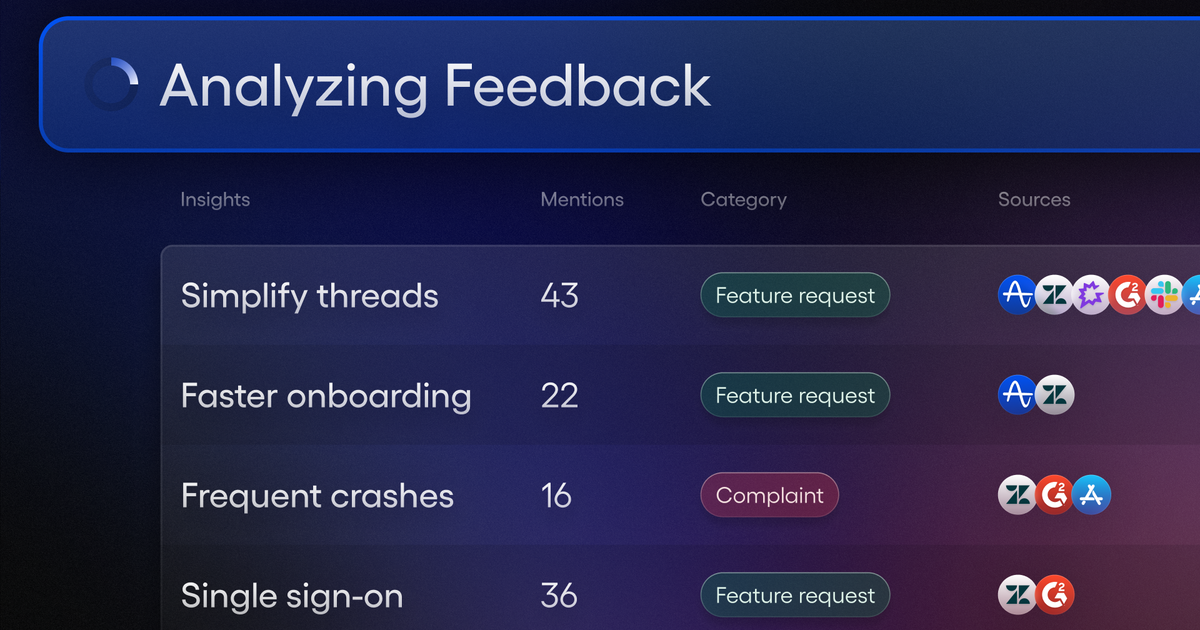
I’ve spent enough time in the trenches of product management to know the hardest part isn’t collecting feedback—it’s separating signal from noise. When every channel is buzzing, the real question becomes: what should we build next, and why? That’s where Amplitude AI Feedback has changed how I work. It gives me a disciplined, data-informed way to turn messy qualitative input into clear, defensible roadmap decisions.
Learn how Amplitude AI Feedback leverages AI to transform massive volumes of customer feedback into actionable product insights.
In practice, this means I can synthesize input from support tickets, NPS responses, user interviews, sales notes, and reviews—then connect those insights to product behavior data from Amplitude analytics. The result isn’t just a list of requests; it’s a ranked problem set grounded in evidence, which makes product discovery and continuous discovery faster, clearer, and less biased.
A recent example: we were hearing recurring complaints about onboarding friction, but it wasn’t obvious which steps truly mattered. By pairing feedback themes with activation and retention signals, I could zero in on the first-session setup tasks that correlated with drop-off. That clarity guided product roadmapping and sprint planning decisions we could stand behind, and it accelerated user activation without bloating the backlog.
My workflow is straightforward: aggregate feedback, cluster themes, validate with behavioral metrics, and translate insight into outcomes. I look for patterns tied to user activation, retention analysis, and moments that drive product-led growth. When the evidence shows a request is both frequent and high-impact, it earns a place on the roadmap; when it’s loud but low-impact, it becomes a targeted experiment rather than a default commitment.
What I appreciate most is the confidence this brings to stakeholder conversations. Instead of debating opinions, we review the evidence: quantified themes, clear user stories, and measurable KPIs. That turns “Finally, Signal That Tells You What to Build” from a slogan into an operating principle, and it helps empowered product teams move faster with fewer reversals.
If you’re building your AI Strategy or exploring LLMs for product managers, this is one of the highest-leverage moves you can make: use a unified analytics platform to connect qualitative feedback with quantitative behavior. It sharpens prioritization, improves time-to-learning, and keeps the team focused on outcomes—not outputs.
Inspired by this post on Amplitude – Best Practices.
Every successful AI initiative I’ve led or advised has shared the same foundation: we treat data as a product. Models will improve, infrastructure will evolve, and use cases will expand—but only high-quality, well-governed, and well-structured data compounds value over time.
“Companies that prioritize data quality, governance, and structure will accelerate their AI initiatives the fastest.” That line has become a non-negotiable principle in my playbook because it consistently separates prototypes that stall from platforms that scale.
When I say data quality, I mean trustworthy signals: clear definitions, deduplication, lineage, and timely freshness. Governance adds accountability and safety: ownership, access controls, auditability, and privacy-by-design aligned with regulatory compliance. Structure makes it all usable: consistent schemas, event taxonomies, and feature stores that let product teams ship faster without reinventing pipelines.
In practice, this looks like aligning an AI Strategy with a unified analytics platform so every team works from the same truth. It means instrumenting feedback loops, labeling outcomes, and building a retrieval-first pipeline that brings the right context to LLMs at the right time. It also means thoughtful context window management so models remain grounded, relevant, and cost-efficient.
I’ve seen the difference firsthand. Early gen ai prototypes built on messy, conflicting data looked promising in demos but failed in the wild—hallucinations spiked, confidence scores dipped, and user trust eroded. Once we tightened governance, standardized schemas, and implemented human-in-the-loop evaluation, accuracy climbed, risk dropped, and feature velocity increased without sacrificing safety.
For product managers, the mandate is clear: treat data work as core product work. Define quality SLAs, make data contracts explicit, and give empowered product teams the tools to observe, debug, and improve signals continuously. Pair AI risk management with measurable product outcomes, and you’ll turn experimentation into a durable advantage.
The payoff is more than model performance; it’s organizational clarity and speed. With the right data foundation, LLMs for product managers become easier to deploy, customer experiences feel coherent, and roadmaps shift from firefighting to compounding wins. Invest in data quality, governance, and structure now, and your AI initiatives won’t just move faster—they’ll sustain momentum.
Inspired by this post on Amplitude – Best Practices.
Every time I ship a new generative AI capability with my product teams, I’m reminded that governance isn’t a compliance afterthought—it’s a strategic advantage. In today’s landscape, the way we govern data determines how quickly we can innovate, how confidently we can scale, and how credibly we can talk about risk with customers, regulators, and our own board.
New AI pressures are redefining what good governance takes. Learn how to build better frameworks, move fast with confidence, and keep your data from being a black box.
My north star for AI Strategy is simple: align business outcomes with responsible practices that are auditable, repeatable, and fast. Practically, that means codifying AI risk management, privacy-by-design, and regulatory compliance into the product lifecycle—requirements, design, build, deploy, and operate. When those guardrails live inside our workflows (not just in policy docs), we accelerate delivery without increasing exposure.
Visibility breaks the “black box.” I start by establishing a unified analytics platform and a living data catalog with lineage, classification, and stewardship. When we pair that with a retrieval-first pipeline for LLMs, we can trace exactly which sources informed a response, who had access, and whether consent and retention rules were honored. Provenance, RBAC/ABAC, encryption, and deterministic masking stop sensitive data from leaking into training sets while keeping our teams productive.
Speed with safety comes from engineering the right controls into CI/CD. Before any AI feature hits production, we run automated checks for PII exposure, policy violations, adversarial prompts, and data drift; then we add human-in-the-loop review where stakes are high. Continuous monitoring, audit logs, and playbooks for incident management and threat detection and response turn governance into an everyday habit rather than a once-a-quarter ritual.
In the first 30 days, I inventory systems, map data flows, and assign clear ownership. We define data quality SLAs, document lawful bases for processing, and publish a concise policy that product managers and engineers can actually use. This anchors stakeholder management and sets expectations for trade-offs.
By day 60, we implement fine-grained access controls, consent-aware tracking, and consistent metadata standards across sources. We wire dashboards for high-signal metrics—access attempts, data minimization, model input/output risk flags—so leaders can see governance health at a glance and course-correct quickly.
By day 90, we close the loop with outcomes vs output OKRs, tying governance to business impact: faster cycle times, fewer incidents, and higher customer trust. Training for LLMs for product managers and communities of practice ensure empowered product teams can make judgment calls confidently, not wait for gatekeepers.
If you’ve felt the friction between innovation and oversight, you’re not alone. The good news is that the right framework lets us do both: move fast with confidence, demonstrate responsible AI, and earn the trust that compounds into product-led growth. That’s the real promise of modern data governance—and it’s how we make sure our AI is powerful, reliable, and never a black box.
Inspired by this post on Amplitude – Best Practices.
AI doesn’t fail because the model is bad, it fails because ownership is missing.
When someone truly owns your AI, everything changes. Resolution and automation rates climb, the system self-improves, and the customer experience transforms in ways a dashboard alone will never show you.
This is part three of our five-part series on customer service planning for 2026. We’ll be sharing all five editions on our blog and on LinkedIn.
If you’d rather have them emailed to you directly as they’re published, drop your details here.
Last week, we introduced the four roles that make AI actually work in a support organization. These roles are already showing up inside the teams who are scaling AI the fastest, and this week, we get closer to the ground.
Here’s what these roles look like in practice — what they do, how they work, and why your AI performance will inevitably drift without them.
AI operations lead — owns AI performance, every day. I think of this person as the air-traffic controller for our AI Agent. I treat the AI as a living system that needs ongoing supervision, evaluation, and tuning. This role is accountable for what leaders care about most: quality, reliability, and continuous improvement.
The AI ops lead sees the whole picture: conversation quality, missing knowledge, flawed assumptions, unexpected failures, new opportunities for automation, and the subtle signals that the system is beginning to drift. In practice, that vigilance is the difference between steady gains and slow decline.
Day-to-day, here’s what I expect from this role.
1. Reviews AI conversations and surfaces performance patterns. The AI ops lead monitors the AI Agent’s behavior — the tone shift after a product launch, a sudden dip in resolution for a specific intent, or conversation clusters revealing new customer behavior. They scan for anomalies, trends, and early warnings, with an emphasis on what’s happening right now, not last week. Without this intentional ownership, I’ve watched a 2% dip turn into a 10% drop in days.
2. Prioritizes fixes and improvements. Once patterns emerge, they triage fixes like a product team handles bugs. Missing or incorrect content? They route it to the knowledge manager. Behavioral issues? They adjust guidance and guardrails. Action or system issues? They partner with the automation specialist. This connective tissue turns individual fixes into compounding improvements.
3. Defines and maintains AI guardrails. Leaders everywhere worry about AI doing things it shouldn’t. This role answers that fear by establishing clarification logic, escalation rules, “never answer” policies, and safety boundaries. The goal is predictable behavior that protects customer trust — an essential pillar of any AI Strategy and AI risk management practice.
4. Aligns reporting with leadership. The AI ops lead reports on resolution rate, CX Score, CSAT, automation coverage, and hours saved — making the economic impact visible. That visibility is a foundational step in any credible customer support ai strategy.
Why this role exists now. AI systems are dynamic and require constant tuning. A small dip in quality quickly becomes an operational issue, and no existing role naturally owns that. When someone does, teams feel the benefit almost immediately.
Knowledge manager — builds and maintains the structured knowledge AI depends on. I hear the same thing from leaders again and again: AI is only as good as the content you give it. This role is rapidly evolving from classic knowledge management into knowledge strategy — part content designer, part systems thinker, part information architect. Their job is to build the knowledge scaffolding that lets AI answer accurately, consistently, and safely.
Here’s how the knowledge manager creates leverage.
1. Writes, maintains, and improves support knowledge — continuously. After every product change, they update articles, remove duplication, resolve contradictions, and pay down “knowledge debt” that quietly erodes accuracy. The upkeep is shaped by AI performance; when patterns expose gaps, they fix the source.
2. Structures knowledge for AI, not for browsing. Traditional help centers are for humans skimming pages. AI needs clean intent signals, crisp formatting, and clearly structured language. The knowledge manager designs that structure as intentionally as the content itself.
3. Works hand-in-hand with AI ops. Many performance issues stem from missing or unclear knowledge. When the AI ops lead surfaces recurring misunderstandings or low-resolution categories, the knowledge manager resolves the root cause at the source.
4. Ensures accuracy and compliance at scale. As AI handles more sensitive situations, the knowledge manager safeguards correctness, currency, and compliance — critical for data governance and regulatory alignment.
5. Develops a cross-functional knowledge strategy. The role creates a canonical, cross-functional source of truth that product, engineering, product marketing, go-to-market, and support (AI and human) can all rely on.
Why this role exists now. This is one of the highest-leverage positions in an AI-first support org. Teams like Rocket Money and Anthropic are hiring knowledge managers because AI accuracy depends on the quality of knowledge feeding it. Without this role, resolution rate caps out early and never climbs.
Conversation designer — designs how the AI speaks, clarifies, and interacts. AI isn’t just a tool customers use; it’s a representative they interact with. Tone, clarity, pacing, and conversational structure matter, especially in voice. Every word affects perceived expertise, trustworthiness, and brand. The conversation designer ensures the AI feels human-friendly without pretending to be human — the sweet spot that builds trust without misleading customers.
In my experience, staffing conversation design early accelerates results. It changes not only how we tune AI, but how we understand the end-to-end customer experience.
Here’s what great conversation design looks like.
1. Shapes the AI’s tone, voice, and communication style. This role refines phrasing, tunes politeness, adjusts how confusion is handled, and shapes micro-interactions that determine whether customers feel cared for or dismissed. On voice channels, natural cadence is make-or-break.
2. Designs flows for high-value conversations. They design how the AI clarifies intent, branches, communicates uncertainty, verifies details, escalates, hands off, and returns to the main thread without feeling mechanical — treating customer experience as a product with language as the interface.
3. Translates procedures and complex workflows into natural language and logic. As AI runs structured procedures and actions, this role becomes a conversational system architect, translating SOPs into conditional logic with exceptions and fallbacks. For example, in Intercom, our conversation designer uses Simulations to run simulated conversations to see where the AI Agent gets confused, over-confident, or awkward, and refine flows until the interaction feels effortless end-to-end.
4. Ensures transitions to humans feel smooth and respectful. Handoffs should provide clear context to the human agent and maintain continuity so customers never feel dropped.
Why this role exists now. As AI becomes the primary interface, conversation design directly influences trust, brand perception, and operational outcomes. It’s a core competency for any Generative AI and LLMs for product managers program.
Support automation specialist — builds the backend actions that allow AI to do real work. If the conversation designer shapes expression, this role shapes capability. They transform AI from an answering machine into an outcome engine by bridging AI and the systems it must safely and deterministically act on.
Support teams increasingly expect AI to do what a human would do: refund a charge, adjust a subscription, verify an identity, update an account setting, or pull relevant data. That expectation creates a new technical role at the edge of support, ops, and engineering.
What I rely on this specialist to deliver.
1. Creates and maintains backend workflows the AI executes. This includes building and maintaining: Fin Tasks. Fin Procedures with embedded steps. Action flows that call internal and external APIs. Automations that span billing systems, user identity layers, CRM objects, subscription entitlements, refund tools, and more. They ensure the AI can act compliantly and predictably — the playbooks that turn intent into action.
2. Owns the integrations required for advanced automation. Many problems require data elsewhere — billing platforms, internal databases, systems of record. The specialist ensures the AI can retrieve, validate, and use that information safely, often partnering closely on CRM integration and internal services.
3. Partners closely with product and engineering. Some workflows require new endpoints, permission layers, safety gates, or deterministic fallbacks. This role drives those changes across the stack.
4. Ensures reliability and safety at every step. Guardrails, validation logic, exception handling, safe execution paths — all are essential. They confirm that the AI has access to the correct data, the action matches policy, edge cases are accounted for, risky flows have deterministic constraints, and every action is auditable and reversible.
Why this role exists now. Customers don’t want answers, they want outcomes. AI can now deliver those outcomes, but only with the right backend scaffolding. This role modernizes operational architecture and unlocks end-to-end automation.
How these roles work together — the new operating loop. These roles aren’t silos; they’re interdependent parts of one system. The AI ops lead identifies patterns and performance gaps. The knowledge manager resolves inaccuracies or missing content. The conversation designer improves clarity, tone, and flow. The automation specialist expands the system’s ability to take action. Each improvement compounds the next, moving you from early automation to transformational resolution rates through continuous refinement.
This loop is what separates teams that plateau early from teams that scale AI into a reliable, high-performing system — the essence of a durable AI Strategy.
How to get started (even if you can’t hire all four roles today). Most teams phase into this model: assign partial ownership, formalize responsibilities, then specialize as AI volume grows. Here’s the progression I recommend.
Phase 1: Assign ownership. Give each role’s core responsibilities to someone who can devote five to 10 hours weekly. Early on, support ops, enablement, senior ICs, and technically inclined teammates can anchor the work.
Phase 2: Formalize the responsibilities. As AI resolves more queries, optimization becomes core operational work. Formalizing ownership prevents performance drift and knowledge debt.
Phase 3: Specialize and hire. Once AI handles 50–70% of incoming volume, these responsibilities become full-time roles. Investing in specialization becomes essential infrastructure for the next scale stage.
The bottom line. AI changes the shape of your support team. These four roles — AI operations lead, knowledge manager, conversation designer, and support automation specialist — form the backbone of the AI-first support organization. They bring order to a constantly changing environment and enable AI to deliver the outcomes leaders and customers expect heading into 2026.
Next week, we’ll continue the 2026 planning series with a deep dive into org design models for AI-first support teams — how to structure people, workflows, and accountability in a world where AI resolves most conversations before a human ever sees them.
To follow along with the series and have each new edition emailed to you directly, drop your details here.
I recently revisited a topic I once pushed back on: using AI to analyze (and maybe even synthesize) customer interviews. After six months of real-world experiments and countless conversations with seasoned product leaders, I’ve evolved my perspective. There is meaningful value here—but only when we’re clear about where AI helps and where it quietly erodes the hard-won customer understanding that powers great product decisions.
If you want to experience the conversation that sparked this reflection, you can listen to the episode on Spotify or Apple Podcast, and watch the discussion here: YouTube. It’s a candid, practical exploration of AI’s role in continuous discovery, and it mirrors what I’m seeing on the ground with product trios and empowered product teams.
Here’s the crux: AI raises the floor for beginners but accelerates experts even more. That matches my experience—early-career PMs get structure, momentum, and a confidence boost, while experienced interviewers can move faster without sacrificing nuance. But there’s a catch. If your interviewing skills aren’t solid yet, AI can create a veneer of insight that masks shallow understanding. In other words, it can help you go wrong more efficiently.
The conversation makes an important distinction between analysis and synthesis. Analysis is about extracting signals from the interview. Synthesis is about building meaning—connecting patterns, weighing contradictions, and deciding what to do next. AI can speed up the former with summaries and highlights. The latter—true synthesis—still demands expert judgment, context, and empathy.
One line from the episode stuck with me: your unpolished interview skills matter more than any shiny new AI workflow. I’ve felt that firsthand. When interview quality is uneven, dropping transcripts into an LLM won’t save you. You still need to synthesize every interview individually so the signals remain traceable and credible. That discipline keeps teams aligned, prevents overfitting to noise, and builds the organizational memory that fuels better bets.
We also explored the operational reality most teams face: interviews pile up. Backlogs grow. Leaders want speed. This is where “expert + AI” shines. With the right prompts, templates, and context, tools like ChatGPT and Claude can help transform raw transcripts into structured artifacts you can trust—provided a strong interviewer sets the frame and makes the calls. That balance preserves both velocity and quality.
What changed my mind most was the evidence from experiments—running sets of interviews through different LLMs and comparing outcomes. The patterns were consistent: beginner + AI is usually better than nothing, but the real performance gains come from expert + AI. When experts guide the process, AI becomes an accelerant rather than a crutch.
A favorite story in the episode takes a detour into building a gaming PC—an unexpected but perfect metaphor for AI’s limits. You can get great step-by-step guidance from a model, but when context shifts or edge cases appear, expertise is what keeps you from making expensive mistakes. Customer interviews are like that. Empathy comes from human interaction; AI can’t replace the experience of talking directly to your customers.
My practical guidance for teams integrating AI into continuous discovery: start with interviewing fundamentals, separate analysis from synthesis, and standardize how you capture single-interview learnings. If you need a tight template for this, refer to “The Interview Snapshot: How to Synthesize and Share What You Learned from a Single Customer Interview.” Use AI for summaries, clustering, and draft artifacts—but have an expert finalize the narratives, evaluate trade-offs, and document assumptions.
If you’re scaling this across an organization, invest in training first, then in workflows. Build a lightweight operating system for discovery: consistent interview guides, “story-based” techniques, and a shared library of prompts. Consider resources like “The Interview Coach,” as well as practical write-ups such as “Customer Interview Analysis: Where AI Helps and Hurts.” These help teams avoid common pitfalls and make better use of AI in high-judgment moments.
My bottom line: AI isn’t magic. It can help, but only if your interviews are strong and you provide the right context. Customer understanding is a competitive moat; outsourcing it entirely will cost you in the long run. Use AI to accelerate—not replace—the human judgment that makes product discovery work.
Resources and links worth exploring: ChatGPT, Claude, The Interview Snapshot: How to Synthesize and Share What You Learned from a Single Customer Interview, The Interview Coach, and Customer Interview Analysis: Where AI Helps and Hurts.
I’d love to hear how your team is using AI in discovery. What’s working, what’s risky, and where do you draw the line between automation and judgment? Share your experiences in the comments—our community learns faster when we compare notes.
In my role leading product teams, the AI product roadmap isn’t just a plan—it’s the operating system for how we discover value, prioritize with rigor, and ship with confidence. The pace has changed, the stakes are higher, and the best product managers are now orchestrating AI capabilities, data, and customer insight in near-real time.
Master the evolving art of the AI product roadmap. Prioritize smarter, turn data into direction and insight into action, only much faster.
When I say “AI product roadmap,” I’m talking about a living system that blends strategy, discovery, and delivery. It’s less about dates and more about outcomes, risk reduction, and sequencing learning. In practice, that means combining AI Strategy with product roadmapping and sprint planning, then validating each bet with real customer signals.
For prioritization, I anchor on outcomes vs output OKRs and connect them to measurable signals across the funnel. Continuous discovery keeps insights flowing, while a unified approach to analytics and retention analysis tells me where the lift is. This lets me rank initiatives not just by impact and effort, but by how quickly we can learn, iterate, and compound value.
On discovery, product trios are non-negotiable. We prototype early with gen ai and LLMs for product managers to accelerate concept validation and reduce ambiguity. When customers can co-create through in-app guides or lightweight product tours, we turn vague needs into crisp problem statements and testable hypotheses far faster.
On delivery, I pair tight feedback loops with experimentation. A deliberate cadence of A/B testing and strong instrumentation ensures we’re learning every sprint, not just launching. The goal is to de-risk decisions quickly, keep momentum high, and translate signals into roadmap movement without thrash.
Under the hood, the AI stack matters. I rely on a retrieval-first pipeline to ground models in trusted data, and I’m intentional about privacy-by-design and data governance from day one. As agentic AI patterns emerge, I put evaluation workflows in place so we can ship confidently—and safely—without slowing down innovation.
Finally, alignment is the multiplier. Clear narrative roadmaps tied to customer outcomes help stakeholders see trade-offs, while crisp interfaces with go-to-market and CRM integration close the loop from roadmap to revenue. When everyone can trace a line from AI strategy to shipped value, prioritization becomes easier and trust grows.
If you’re feeling the acceleration, you’re not alone. With the right AI product toolbox—rooted in discovery, grounded in data, and delivered through tight feedback loops—you can move faster, learn smarter, and build products your customers can’t live without.
By 2026, the AI Product Owner will be the keystone role that turns AI strategy into measurable business outcomes. In my teams, this seat bridges market insight, model capability, data governance, and shipping velocity—so product decisions are not just clever, but compliant, reliable, and fast.
I often describe the remit simply: "Here is your clear guide to the AI product owner role (skills, responsibilities, how it differs from PM) and ways AI tools supercharge delivery." In practice, the AI Product Owner translates business goals into model-backed experiences, aligns cross-functional execution, and ensures the product’s AI behavior remains safe, lawful, and on-brand under real-world constraints.
How does this differ from a traditional PM? While Product Management sets portfolio strategy, positioning, and market narratives, the AI Product Owner owns the AI experience end-to-end—data readiness, evaluation harnesses, safety guardrails, and the iterative model improvements that drive outcomes vs output OKRs. I anchor the role inside empowered product teams and product trios (PM/Design/ML Eng) to keep discovery continuous and delivery disciplined.
On responsibilities, I expect four pillars. First, discovery: continuous discovery with customers and internal experts to uncover use cases where generative AI or LLMs beat the status quo. Second, experience: define the right interaction patterns for AI UX, including retrieval-first pipeline choices, context window management, and feedback loops for human-in-the-loop correction. Third, governance: privacy-by-design, AI risk management, data governance, and regulatory compliance baked into the roadmap. Fourth, delivery: CI/CD for models and prompts, observable evaluation with A/B testing and minimum detectable effect (MDE), and SRE-grade incident management when AI behavior drifts.
Skills-wise, I look for product sense plus technical fluency. That includes LLMs for product managers (prompting, grounding, RAG), analytics mastery (Amplitude analytics, retention analysis, activation metrics), and comfort with DORA metrics and deployment frequency to keep iteration high but safe. Strong stakeholder management and clear writing are non-negotiable—AI capabilities evolve fast, and leaders must see risk, cost, and ROI with no ambiguity.
AI tools truly supercharge delivery when they eliminate bottlenecks. My practical stack: an AI product toolbox with Claude Code and a ChatGPT connector for rapid prototyping; CustomGPT workflows for support triage and internal knowledge; Pendo product tours and in-app guides to validate behavior changes; Intercom for customer support ai strategy; and tight CRM integration via HubSpot to measure revenue impact. The outcome is faster idea-to-learning cycles, sharper telemetry, and far cleaner handoffs.
For roadmapping, I prioritize thin slices that prove value early—shipping narrowly scoped assistants or copilots, then expanding with product roadmapping and sprint planning that ties capability unlocks to outcomes. A unified analytics platform helps compare human-only baselines to augmented workflows, while agentic AI patterns automate routine steps under strict guardrails.
Risk is a product surface, not a side task. I require explicit policy gates (PII handling, red-teaming, bias audits), clear escalation paths, and incident playbooks. When we treat policy and reliability as features, customers reward us with deeper adoption and higher trust.
If you’re pursuing the AI Product Owner path, build a portfolio around shipped learnings: the experiment you killed with data, the safety constraint you designed, the postmortem you led, and the business metric you moved. That story—evidence of disciplined discovery, responsible delivery, and real-world results—is exactly what teams (and boards) want to see in 2026.
I’m stepping into 2026 with a practical playbook for marketing analytics—one forged at the intersection of product management, go-to-market strategy, and AI Strategy. My lens is simple: connect data to decisions, decisions to outcomes, and outcomes to revenue. If you’re serious about product-led growth, this is the year to turn your unified analytics platform into a true competitive advantage.
Start 2026 off with a bang with exclusive insights and predictions from some of marketing analytics’ most influential voices. See what they have to say.
The biggest shift I expect is from channel-centric dashboards to journey-centric systems that stitch together product usage, CRM integration, and campaign performance. When Amplitude analytics or Pendo data sits alongside HubSpot pipeline metrics, we stop arguing about attribution models and start instrumenting the full revenue motion. That’s how marketing, product, and sales align around one truth: activation, engagement, and expansion drive sustainable growth.
I’m betting on deeper adoption of A/B testing with a rigorous minimum detectable effect (MDE) discipline and cohort-led retention analysis. Vanity metrics won’t cut it. Teams that operationalize outcomes vs output OKRs and tie experiments to LTV, CAC, and payback will outperform. The win is not more tests—it’s better tests that translate into compounding user activation and retention.
Gen AI will supercharge analysis, but not replace analytical thinking. I see LLMs for product managers accelerating root-cause analysis, surfacing anomalies, and explaining drivers behind conversion shifts. The craft moves from “pulling reports” to “asking higher-quality questions,” then validating with sound statistical methods. The highest-leverage teams will pair gen ai with strong taxonomies, clean event schemas, and clear definitions of North Star metrics.
Data governance becomes a growth enabler, not a compliance cost. With privacy-by-design, consented data, and well-documented schemas, your models become more accurate and your campaigns more resilient. When governance is strong, personalization sharpens, lookalike models improve, and executive confidence in the numbers rises—unlocking faster, bolder bets.
Product-led growth analytics will mature from “feature usage” to “value moments.” I’m focusing my teams on measuring time-to-value, depth-of-use, and expansion signals embedded in in-app guides, product tours, and contextual tooltips. The companies that make value visible earlier—and measure it precisely—will see outsized improvements in trial-to-paid and expansion.
Operationally, I expect tighter cadences between discovery and delivery. Product trios will partner with marketing to run continuous discovery on messaging, onboarding friction, and pricing signals. When insights flow directly into campaign creative and in-product experiments, learning cycles compress and the cost of delay drops.
If you’re building your 2026 roadmap, here’s my short list: consolidate tools into a unified analytics platform, standardize event taxonomies across web, product, and CRM, formalize MDE for every A/B test, and align OKRs to activation and retention milestones. Do this, and you’ll turn fragmented data into a durable growth engine—one that compounds every quarter.
Inspired by this post on Amplitude – Perspectives.
When AI Agents resolve the majority of customer conversations, the shape of your support team has to change. I’ve experienced this shift firsthand: the moment AI begins to carry the volume, your people must pivot from answering individual questions to engineering the system that consistently delivers quality outcomes.
The old tiered model built around queue management, handoffs, and volume-based productivity no longer fits. AI now handles the bulk of customer interactions, and that changes the role of your human team entirely. Responsibilities evolve, and success is measured differently. It goes beyond just adding automation to existing ways of working. You’re building an operating model that’s entirely new.
Most teams don’t hire a dedicated AI function from day one. They start by distributing a few critical responsibilities across existing team members, and formalize those responsibilities as AI becomes central to how support works. That’s exactly how I recommend getting momentum without over-hiring too early: prove value fast, name clear owners, and then scale.
Once you have executive support and a clear strategy in place, these are the four foundational roles we believe are key to getting AI off the ground in a meaningful way:
Skillset/background: Often promoted from support ops. Deep understanding of workflows, systems, and tooling. Strong analytical and cross-functional coordination skills.
Why you need this: Without clear ownership, performance drifts. This role ensures the AI Agent constantly improves.
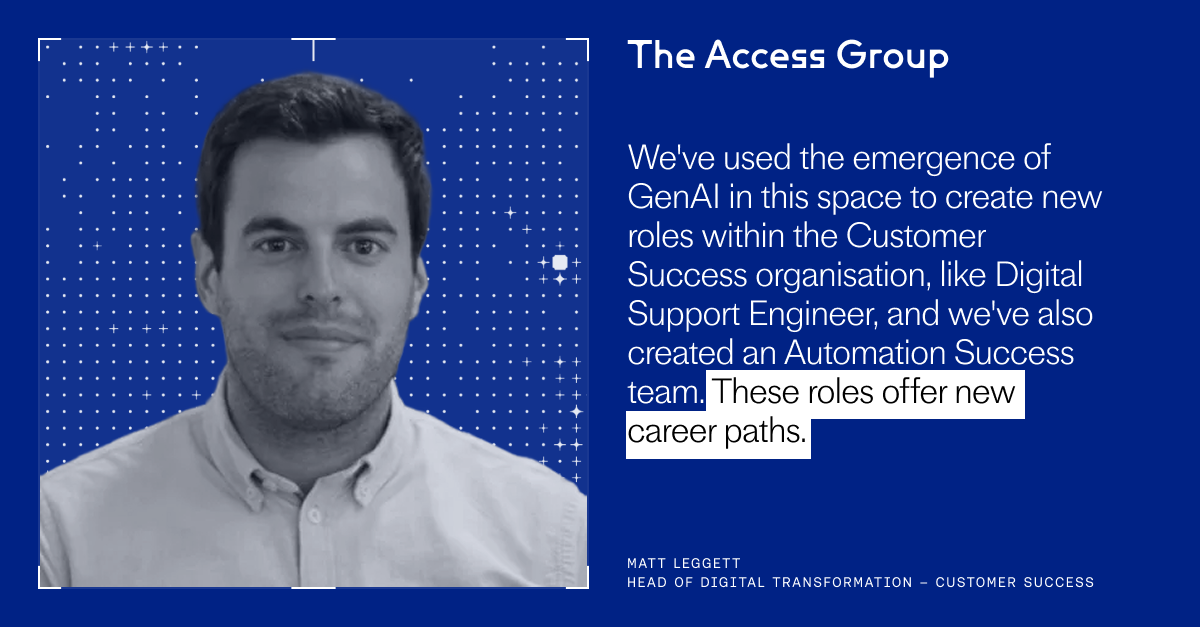
AI isn’t replacing support—it’s opening doors. This visual highlights how GenAI is spawning roles in customer success, from digital support engineers to automation success teams, and unlocking clearer, upward career paths.
In my teams, this role becomes the heartbeat of AI performance—instrumenting quality feedback loops, triaging failure modes, and aligning fixes across product, data, and support ops.
2. Knowledge manager
Responsibilities: Owns macros, snippets, and help content. Maintains structured, accurate inputs the AI Agent depends on.
Skillset/background: Often promoted from support ops. Deep understanding of workflows, systems, and tooling. Strong analytical and cross-functional coordination skills.
Why you need this: Without clear ownership, performance drifts. This role ensures the AI Agent constantly improves.
Every generative AI system is only as good as its knowledge. I’ve learned the hard way that inconsistent or stale content erodes trust—both for customers and internal stakeholders. A rigorous knowledge manager prevents that.
3. Conversation designer
Build a winning AI support team with four core roles: an ops lead to drive quality, a knowledge manager to keep content accurate, a conversation designer for tone and flow, and an automation specialist to power customer actions.
Responsibilities: Designs how the AI Agent communicates by focusing on tone of voice, structure, handoff logic, and interaction flow. Tunes how responses feel.
Skillset/background: Background in content design, UX writing, or support enablement. Deep grasp of policy, CX standards, and conversational nuance.
Why you need this: This role ensures the AI Agent speaks like your brand – clearly, helpfully, and in line with customer expectations.
This is your brand’s voice in motion. A strong conversation designer sets the guardrails that keep interactions on-brand, compliant, and empathetic while still efficient.
4. Support automation specialist
Responsibilities: Builds workflows and backend actions the AI Agent can execute.
Skillset/background: Background in support engineering, systems, or tooling. Works closely with product and engineering teams.
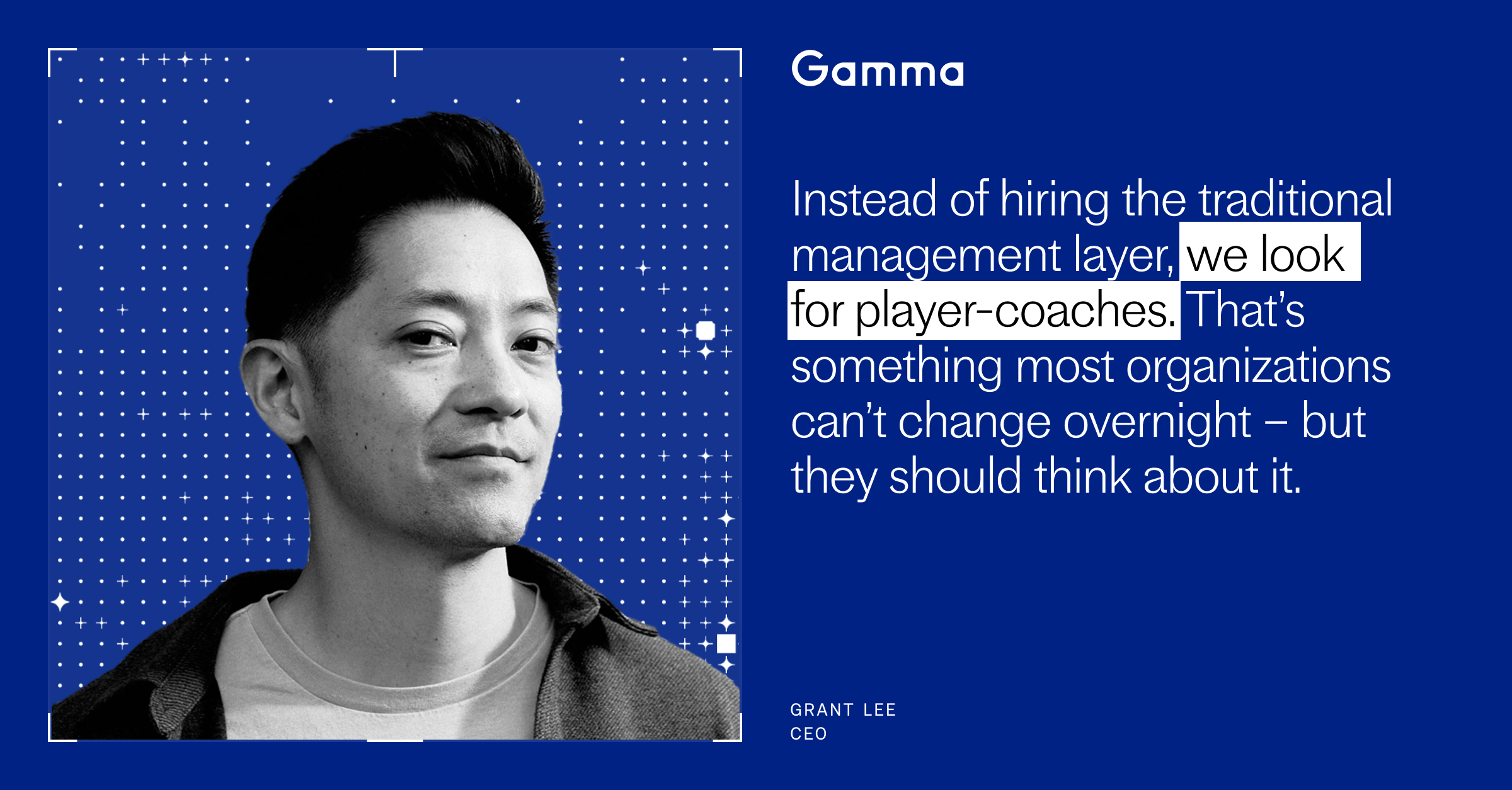
AI in customer service thrives with player‑coaches—hands‑on leaders who build, mentor, and iterate with the team. This quote-driven graphic signals a move away from heavy management toward agile, coaching‑first support operations.
Why you need this: Enables the AI Agent to take action – not just respond. This role translates customer intents into business systems.
In practice, this role unlocks the jump from “answering” to “resolving.” They wire up secure actions, map intents to outcomes, and partner with engineering to keep latency low and reliability high.
Introducing new AI-first roles doesn’t mean your existing functions disappear. But they do need to evolve. For AI to scale effectively, every function in your support organization must shift its focus from managing queue-level activity to improving the system’s performance:
Enablement trains human agents to work with the AI Agent: managing handoffs, tuning responses, and understanding how to give feedback that improves the system.
QA evolves from reviewing conversations to reviewing the quality of the customer experience and behavior of the AI Agent: where the AI succeeds, where it falls short, and how the system as a whole performs.
Workforce management plans capacity based on automation coverage, not just inbound volume.
You’ll also need a new kind of leadership to make this model work. The traditional support leader doesn’t map cleanly to an AI-first organization. You need a new layer: leaders who are part strategist, part operator. They roll up their sleeves to analyze the AI Agent’s performance, refine content, and debug handoffs, but they also coach the team through a new way of working.
Customer service is reorganized for the AI era: a VP of Support leads human support, ops and optimization, and a new AI support function—adding conversation design, knowledge management, and systems analysis alongside agents, insights, and WFM.
This is the “player-coach model” – leaders who actively shape both the system and the people within it.
These leaders see the AI Agent as a teammate to manage, not just a tool to monitor. They can’t be purely people leaders or purely systems thinkers. They need to be both, and they’re emerging as a critical hire in support right now.
Some teams are restructuring their organizations around the AI Agent as a core product, not just a support tool. Here are some real-world examples:
At Dotdigital, a dedicated “Fin Ops” specialist role was created to refine content and improve AI performance.
At Clay, a dedicated GTM engineer role has been established as part of the ops team with a focus on making support more efficient at scale using Fin. Additionally, a support engineering function has been embedded directly in the CX organization to help reduce volume by fixing bugs and building internal tools.
Lightspeed created a dedicated Digital Engagement team to manage Fin’s optimization, and formalized a triangular model that brings together technical teams, frontline experts, and content specialists.
In my experience, the most resilient org designs align around three pillars: Human Support, AI Support, and Support Operations and Optimization. Each pillar carries distinct ownership yet shares accountability for AI performance. That structure keeps the team focused on outcomes over output and makes continuous improvement everyone’s job.
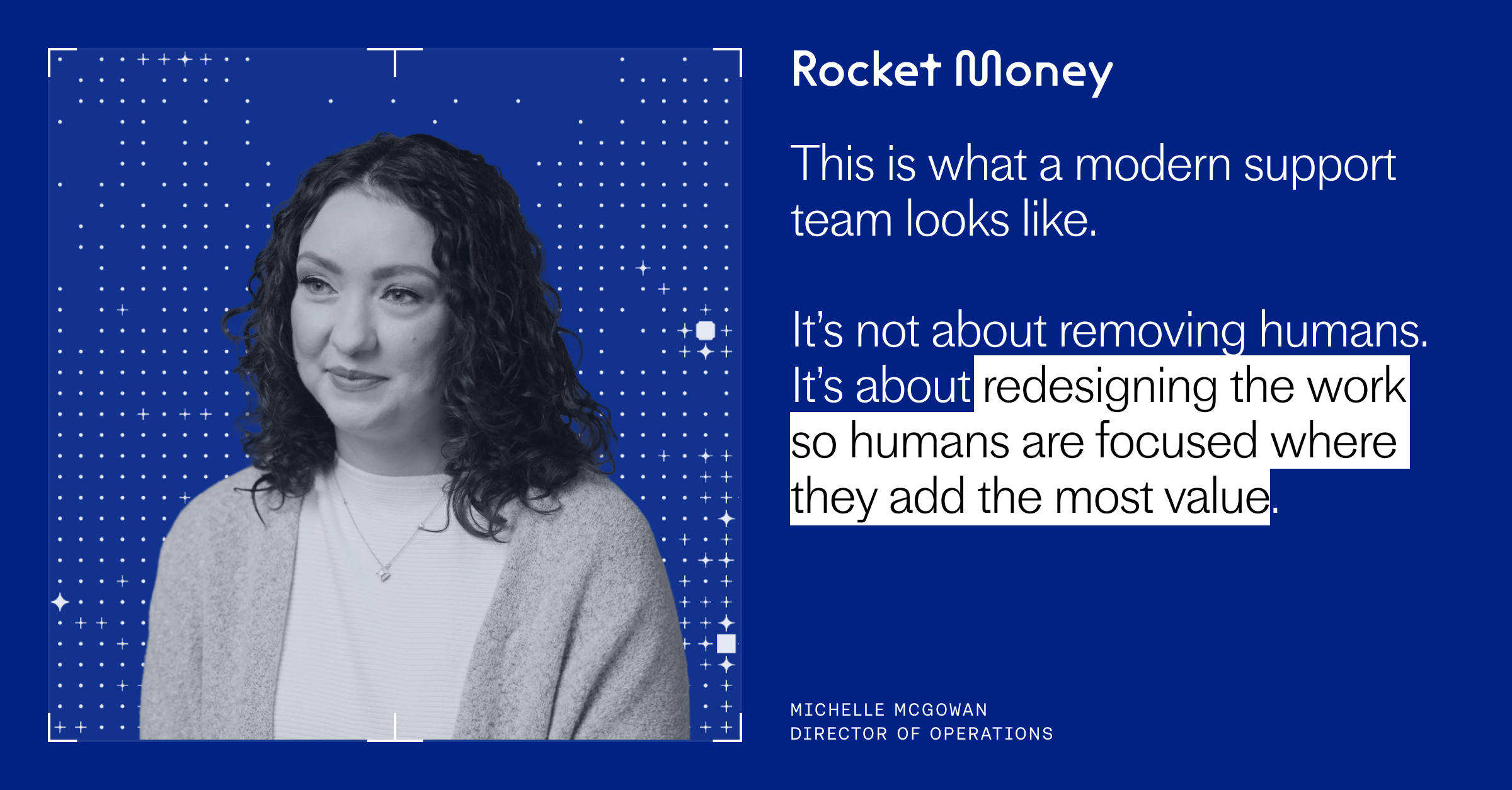
AI shouldn’t replace your agents—it should elevate them. This Rocket Money quote highlights a modern support model where automation handles the busywork and people concentrate on high‑value, human moments.
Once AI Agents handle most conversations, your team’s work moves from “answering questions” to “designing and improving the system that answers questions.” They become the force that steers quality, rather than the one that carries the volume.
This is why new roles are important. It’s not because they’re trendy, but because the performance of your support organization now depends on the performance of AI, and no AI Agent succeeds without clear ownership of content, behavior, workflows, and improvement cycles.
That’s the pattern we’ve seen from working with so many teams:
They name owners early.
They distribute responsibilities before they formalize them.
They anchor teams around AI outcomes, not ticket outcomes.
And they hire leaders who can manage both the system and the people.
If you take one thing away from this week’s article, let it be this: if AI is going to handle the majority of your customer conversations, your team needs to be designed to help it do that well.
Your roles, responsibilities, and leadership approach are now part of the architecture of AI performance.
Next week, we’ll go deeper into how these roles actually operate day-to-day – the workflows, responsibilities, rhythms, and collaboration patterns that make an AI-first support organization run.
I’ve spent years helping talented engineers explore what’s next when pure coding no longer feels like the only—or best—path. From hiring across cross-functional teams to mentoring career pivots, I’ve seen firsthand how engineering strengths translate into high-leverage roles that shape product, strategy, and growth.
Software engineers have alternative career options leveraging their skills in roles like product manager, data scientist, business analyst, and 22 more.
When an engineer moves into product management, they’re not starting from scratch—they’re redirecting problem-solving, systems thinking, and customer empathy toward outcomes. In practice, that means mastering product discovery, strengthening stakeholder management, and getting fluent in product roadmapping and sprint planning, so decisions are guided by impact rather than “outputs vs outcomes” confusion. I’ve watched this transition unlock empowered product teams and clearer prioritization across complex backlogs.
Data-oriented paths are equally compelling. If you enjoy experimentation and evidence-based decisions, roles in analytics or data science reward rigor. Think A/B testing, identifying the minimum detectable effect (MDE), and using tools like Amplitude analytics to translate behavioral signals into product bets. Pair that with retention analysis and you’ll become indispensable to growth conversations.
Business-facing roles such as business analyst or product marketing manager are ideal if you’re energized by customer problems and market narratives. Your engineering fluency sharpens value propositions, product positioning, and go-to-market strategy in a way that resonates with both buyers and builders. In my teams, the best bridges between product and revenue often came from former engineers who could articulate trade-offs with clarity.
If operational excellence is your edge, consider SRE, DevOps, or cybersecurity. The same instincts that push you toward clean CI/CD pipelines and resilient architectures translate well into incident management, threat detection and response, and privacy-by-design practices. These roles reward systems thinking and the ability to balance reliability with delivery speed.
For engineers who love community and storytelling, developer evangelism is a natural fit. You’ll translate complex concepts into actionable guidance, from in-app guides and product tours to UX writing and documentation. The best evangelists I’ve worked with turn feedback loops into product insight, strengthening activation and product-led growth without heavy sales pressure.
Customer-facing technical roles—solutions engineer, forward deployed engineer, or technical consultant—let you stay close to the product while solving real-world problems. You’ll drive onboarding quality, user activation, and adoption while surfacing insights that influence roadmaps. Done well, this work tightens the loop between customer outcomes and product decisions.
AI-centered roles are expanding rapidly. If you’re curious about AI Strategy, retrieval-first pipelines, or the practical use of LLMs for product managers, you can bring an engineer’s discernment to a noisy space. The most valuable contributors here pair pragmatic architecture choices with clear risk management and measurable business value, not hype.
Leadership tracks remain a strong option too. The IC to manager transition isn’t about title; it’s about raising the ceiling for others. You’ll coach empowered product teams, shape organizational development, and align initiatives to defensible metrics—think DORA metrics for flow, leading indicators for value, and OKRs that measure outcomes over output.
If you’re exploring a pivot, start small and intentional. Run “career A/B tests” by taking on cross-functional projects, shadowing adjacent roles, or shipping a lightweight portfolio that demonstrates the new muscle. Join a ProductCon session, practice conference networking, and refine a narrative that links your engineering foundation to the outcomes your target role owns.
Finally, map your personal unfair advantages—domain knowledge, systems thinking, customer empathy, or operational rigor—to the roles that value them most. With focus, you can reposition your engineering experience into a differentiated story that accelerates your next chapter. The breadth of options is real, and with a deliberate plan, you’ll turn curiosity into conviction—and conviction into impact.
Every week, I’m in conversations with product leaders, engineers, and security teams who are trying to ship AI features faster without compromising trust. The tension is real: stakeholders want velocity, customers want transparency, and regulators want accountability. That’s exactly where modern data governance earns its keep.
New AI pressures are redefining what good governance takes. Learn how to build better frameworks, move fast with confidence, and keep your data from being a black box.
In my role leading product management, I’ve learned that robust data governance isn’t a compliance checkbox—it’s a strategic capability. When we treat governance as a product, we architect for clarity, safety, and speed. That means aligning AI Strategy with day-to-day delivery so teams know what they can ship, when, and why.
Here’s the practical blueprint I rely on. First, establish ownership and a shared language. Create a living data catalog, lineage maps, and clear data classifications so teams know which assets are sensitive, regulated, or eligible for training LLMs. Second, harden privacy-by-design and least-privilege access. Bake PII detection, secrets management, and role-based policies directly into your workflows. Third, bring quality and observability to the forefront: instrument data contracts, monitor drift, and track model performance across environments. Finally, implement model governance end to end—dataset cards, model cards, bias testing, human-in-the-loop review, and a repeatable evaluation harness.
To move fast with confidence, make governance invisible and automated. Treat policies as code in CI/CD, gate deployments with pre-merge checks, and fail builds that violate data contracts. Log prompts and outputs responsibly, route unsafe patterns to red-teaming, and use a retrieval-first pipeline to anchor models on verified sources rather than fragile context stuffing. This is how we scale AI product development while keeping audit trails complete and costs in check.
Avoiding the black-box problem starts with transparency. Document assumptions, training data sources, and known limitations—then expose explanations where it matters in the product experience. Pair this with a unified analytics platform to tie telemetry, feature flags, and user feedback to model changes. When something goes sideways, your observability, incident management playbooks, and threat detection and response processes should make root-cause analysis fast and defensible.
If you’re building your program from scratch, use a 30-60-90 approach. In the first 30 days, inventory systems, classify data, and map high-risk use cases. By day 60, formalize RACI for governance, deploy access controls, and set up your evaluation pipeline with golden datasets and measurable acceptance thresholds. By day 90, operationalize incident response, conduct tabletop exercises, and wire governance outcomes into OKRs—think time-to-approval for high-risk changes, reduction in production incidents, and model evaluation pass rates.
This playbook pays off in board conversations and with customers. You can articulate your AI risk management posture, show measurable progress on regulatory compliance, and demonstrate how governance accelerates—not hinders—delivery. Most importantly, your teams gain the confidence to experiment, knowing there’s a safety net that protects users, the brand, and the business.
If your organization is wrestling with how to balance innovation and control, start small, codify what works, and scale with intent. With the right foundations in data governance, AI becomes an engine for durable advantage—not a source of sleepless nights.
Inspired by this post on Amplitude – Perspectives.