I’m excited to share two opportunities this season to uplevel your craft, connect with peers, and leave with practical, repeatable techniques you can apply immediately to your product work.
We will be doing another round of Claude Code: Show and Tell on May 26th at 9am PDT. These community-driven sessions are hands-on and fast-paced—we swap proven workflows, compare prompts, and pressure-test approaches together. You’ll see how product teams are operationalizing AI workflows in real contexts and walk away with ideas you can adapt for your own roadmap and experimentation pipeline. Invites will go out to Supporting Members and CDH Members tomorrow. If you'd like to join us, keep an eye on your inbox for the invite.
I love these Show & Tell sessions because they translate tacit knowledge into clear, reusable playbooks. Whether you’re refining evaluation loops for LLMs, streamlining discovery synthesis, or standardizing prompts for consistency, the shared rigor and camaraderie make it a high-signal hour for any product leader invested in AI workflows.
I also want to share that I'll be teaching our June 4th – July 9th cohort of Product Discovery Fundamentals. This is the last time I'll be teaching this cohort in its current format. If you've been thinking of enrolling in this program, and want to take it with me, this is your last chance. Register here.
Across this cohort, we’ll practice continuous discovery habits—framing opportunities, tightening assumptions, running lean experiments, and aligning product trios on evidence-backed decisions. If you want a rigorous, repeatable system for turning customer insight into confident prioritization and compelling product strategy, I’d be thrilled to have you in the room.
Churn is a lagging indicator—and by the time I see it in a dashboard, the moment to change a customer’s mind has usually passed. At HighLevel, I’ve learned that durable retention starts long before a cancellation ticket, with product-led growth habits, customer success partnerships, and a clear view of user behavior that flags risk early and often.
Stop chasing SaaS churn after it happens. Learn how proactive product and service experiences, powered by behavioral analytics, help reduce churn before users leave.
My operating model is simple: treat retention as a design problem, not a rescue mission. I anchor our strategy in behavioral analytics and retention analysis, translating leading indicators—activation milestones, time-to-first-value, depth of feature adoption, and expansion intent—into outcomes like Net Recurring Revenue (NRR) and cohort-based retention. When these inputs move in the right direction, churn becomes the exception, not the trend.
To get there, I start with rigorous journey mapping and continuous discovery. We define the exact “aha” moments that signal value realization, instrument events across the funnel, and segment cohorts by persona, plan, and use case. Tools in a unified analytics platform (e.g., Amplitude analytics or Pendo) help us pinpoint where engagement decays, which features predict stickiness, and which friction points block activation. This evidence replaces hunches and lets us prioritize the highest-leverage work.
From those signals, I build a transparent risk score that anyone can use. It blends usage momentum (DAU/WAU), core feature frequency, anomaly detection on key behaviors, billing and payment health, and support sentiment. When the score crosses a threshold, we trigger plays—inside the product and through customer success—so we’re helping users before they drift, not pleading after they’ve left.
On the product side, I favor lightweight, contextual interventions: in-app guides tailored to stalled tasks, checklists that shorten time-to-value, adaptive product tours, and tooltip design that clarifies the next best action. We A/B test these experiences with a clear minimum detectable effect (MDE), watching both local metrics (feature completion, error rate) and global metrics (activation, retention). The goal is precision—right nudge, right user, right moment—without adding cognitive load.
On the service side, we run consultative support and customer success plays keyed to the same behavioral triggers. A sudden drop in core usage may prompt a quick diagnostic call; repeated failed integrations can route to solutions engineering; stalled accounts get value reviews or QBRs focused on outcomes, not feature checklists. Because product and service draw from the same data, customers experience a single, coherent journey.
Proactive retention also depends on smart packaging and pricing. When value metrics mirror how customers win, plan boundaries reinforce the right behaviors and reduce “silent churn” caused by misaligned tiers. Outcome-based pricing and clear upgrade paths can turn potential risk into expansion rather than attrition.
Operationally, I keep a weekly retention review with product trios and customer success leaders. We walk driver trees from inputs (activation, engagement depth, support friction) to outputs (NRR, churn), review session replay where confusion spikes, and commit to small, measurable experiments. This cadence compounds learning and keeps us honest about what’s moving the needle.
If you’re starting fresh, begin with four moves: define an activation milestone tied to value; instrument the few events that prove users are on track; build a basic risk score from those events; and craft three plays—one in-product, one lifecycle message, one success outreach—triggered by that score. You’ll create a flywheel where insights power interventions, and interventions feed better insights.
Churn will always exist, but it doesn’t have to be a cliff. With behavioral analytics guiding both product and service experiences, we can make retention the natural outcome of how we build, communicate, and support—long before a customer ever thinks about leaving.
Inspired by this post on Amplitude – Perspectives.
I’ve learned that customers don’t just buy features—they buy the way we discover, decide, build, ship, and support. In other words, the operating model is the product. That realization has shaped how my team and I at HighLevel translate product strategy into tangible, repeatable outcomes that show up in quality, reliability, onboarding, and consultative support every single day.
We created Product Partners to codify that operating model and scale it with discipline. It’s a blueprint and operating rhythm that unifies product strategy with go-to-market strategy, customer success, and solutions engineering—so empowered product teams can move faster without sacrificing clarity, governance, or customer trust.
First, we anchored on continuous discovery. Product trios work shoulder-to-shoulder with customer-facing teams to run customer interviews, journey mapping, and A/B testing, then validate insights with session replay and behavioral analytics. We use driver trees and opportunity solution trees to connect problems to outcomes, ensuring prioritization is evidence-based and aligned to product-market fit—not just output.
Second, we elevated delivery excellence. Our practices emphasize CI/CD, feature flags, observability, SRE-informed incident management, and DORA metrics to shorten feedback loops while raising the bar on stability. Privacy-by-design, data governance, and regulatory compliance are built into our workflows, and we make deliberate build vs buy decisions to protect platform scalability and long-term velocity.
Third, we integrated go-to-market alignment from day one. Solutions engineering and customer success shape requirements early, so launches include in-app guides, product tours, onboarding paths, and consultative support that accelerate user activation. We tie outcomes vs output OKRs to stakeholder management rituals, ensuring sales-led and product-led growth motions reinforce each other instead of competing for focus.
Finally, we closed the loop with a unified analytics platform. Activation, retention analysis, and Net Recurring Revenue (NRR) sit alongside qualitative signals from customer interviews and support. This single source of truth helps us refine product positioning, sharpen value propositions, and improve roadmapping and sprint planning with clear, testable hypotheses.
What does this mean for our partners and customers? Faster time-to-value, fewer handoffs, clearer expectations, and a shared lens on the metrics that matter. Product Partners isn’t a side program; it’s how we operationalize trust—through transparency, consistent rituals, and a bias toward learning that compounds.
If this resonates, you’ll feel it in how we discover, build, and support together. I’ll continue to share our playbooks—covering continuous discovery, onboarding, and outcome-based planning—so we can keep raising the standard for product management leadership and product-led growth, one operating rhythm at a time.
Most teams ship AI agent personalities by accident—emergent quirks, brittle prompts, and uneven behavior. We refused to let that happen. From day one, we treated personality as a first-class product surface, one that should be designed, instrumented, and iterated with the same rigor as any core capability.
Learn how we designed Global Agent’s personality and fine-tuned its inquisitiveness and helpfulness using Agent Analytics.
In my role leading product at HighLevel, Inc., I framed our approach around agentic AI and conversation design: personality is not “flavor text”; it is the control system for how an agent interprets context, asks questions, and decides when to act. Our product strategy prioritized clarity, empathy, and consistency—so the agent would be curious enough to resolve ambiguity without becoming interrogatory, and helpful enough to move work forward without overstepping.
We made that intent measurable. Using behavioral analytics, we defined operational signals such as clarification-question rate, resolution-path efficiency, and escalation quality. We combined eval-driven development with targeted A/B testing to compare prompt patterns and tool strategies, ensuring each change had a clear hypothesis and measurable outcome.
To calibrate inquisitiveness, we mapped decision points where the agent should ask follow-ups versus proceed autonomously. Prompt engineering codified those thresholds, while a retrieval-first pipeline reduced unnecessary questions by improving context completeness up front. When the agent did ask, we constrained tone and cadence to keep queries concise, respectful, and progress-oriented.
To enhance helpfulness, we prioritized precise action-taking and unambiguous guidance. Context window management preserved relevant facts without diluting intent, and guardrails aligned with AI risk management principles ensured the agent stayed within policy, privacy, and compliance boundaries. The result was an assistant that resolved more tasks end-to-end, with fewer stalls and clearer handoffs when human help was warranted.
Agent Analytics became our nervous system. We instrumented every dialog turn to attribute outcomes to design choices, then used driver trees to connect micro-behaviors to macro results like time-to-resolution and customer satisfaction. This closed-loop view let us ship confidently, knowing which levers improved helpfulness, which sharpened curiosity, and which merely added noise.
Process mattered as much as tooling. Product trios ran continuous discovery with customers to surface edge cases—ambiguous intents, multi-intent turns, and sensitive scenarios—while our engineering partners operationalized experiments with clean rollback paths. We favored small, testable changes over sweeping rewrites, building momentum and trust with each iteration.
The payoff is a personality that feels consistent across use cases: curious when clarity is missing, decisive when action is obvious, and transparent when limits are reached. Users experience fewer dead ends, faster resolutions, and a brand voice that shows up the same way every time—because it was defined, measured, and improved on purpose.
If you’re building agentic AI, don’t leave personality to chance. Treat it like a product: set clear outcomes, instrument deeply with Agent Analytics, and iterate with eval-driven development and A/B testing. That’s how curiosity becomes a feature, helpfulness becomes a habit, and your agent becomes reliably, intentionally excellent.
Inspired by this post on Amplitude – Best Practices.
I just wrapped an all-out engineering sprint. That still sounds odd coming from me, because while I’ve written code on and off for years, I don’t self-identify as an engineer. I’m a product manager who used to be a designer. It’s been a long time since I wrote code for a living.
But AI has expanded what’s just now possible—for our products, and for us. It’s pushed me to do more than I imagined. In that spirit, I want to share a recent engineering story. It includes technical details, and a year ago I couldn’t have done any of it. I learned it with the help of AI, and my aim is to show what’s now within reach.
I’ve been building two services with a partner at Vistaly: AI-generated interview snapshots and AI-generated opportunity solution trees. We put out a call for alpha partners, received over 100 applicants, and selected eight design partners to start.
A clear, color‑coded map from desired outcome to opportunities, solutions, and assumption tests—showing how to structure discovery work and prompt AI to generate, compare, and validate product ideas.
Each team uploaded three customer interviews. I identified the key moments and opportunities and then generated an opportunity solution tree from those snapshots. I provide the AI services; Vistaly is building the UI and workflows around them.
Early feedback was strong. Teams immediately asked to upload more interviews—exactly the kind of demand signal you hope to see—so we got to work making that possible.
Go behind the scenes as AI turns raw feedback into a clear Opportunity Solution Tree. Linked cards reveal user needs—onboarding, support offload, and bot-readiness signals—so product teams can spot priorities and next steps at a glance.
Updating an opportunity solution tree with new interview content is far harder than generating a new tree from scratch. I initially underestimated the complexity. Our goal wasn’t to produce a tree and declare it truth. We wanted teams to engage, correct, and collaborate with the AI—scaffolding cross-interview synthesis instead of doing it for them.
To support that, we needed a way to communicate precisely how a tree would change after new interviews were added. We took inspiration from git diff and set out to build the equivalent for opportunity solution trees—step-by-step change sets that explain each proposed modification.
A clear visual of AI‑generated opportunity solution trees: outcomes feed opportunities that branch into sub‑opportunities, while evidence is preserved. The structure ensures updates stay traceable and never cause data loss.
That decision was right, but the lift was larger than I expected. It wasn’t enough to generate an updated tree; I also had to provide a clear, ordered walkthrough of what changed and why.
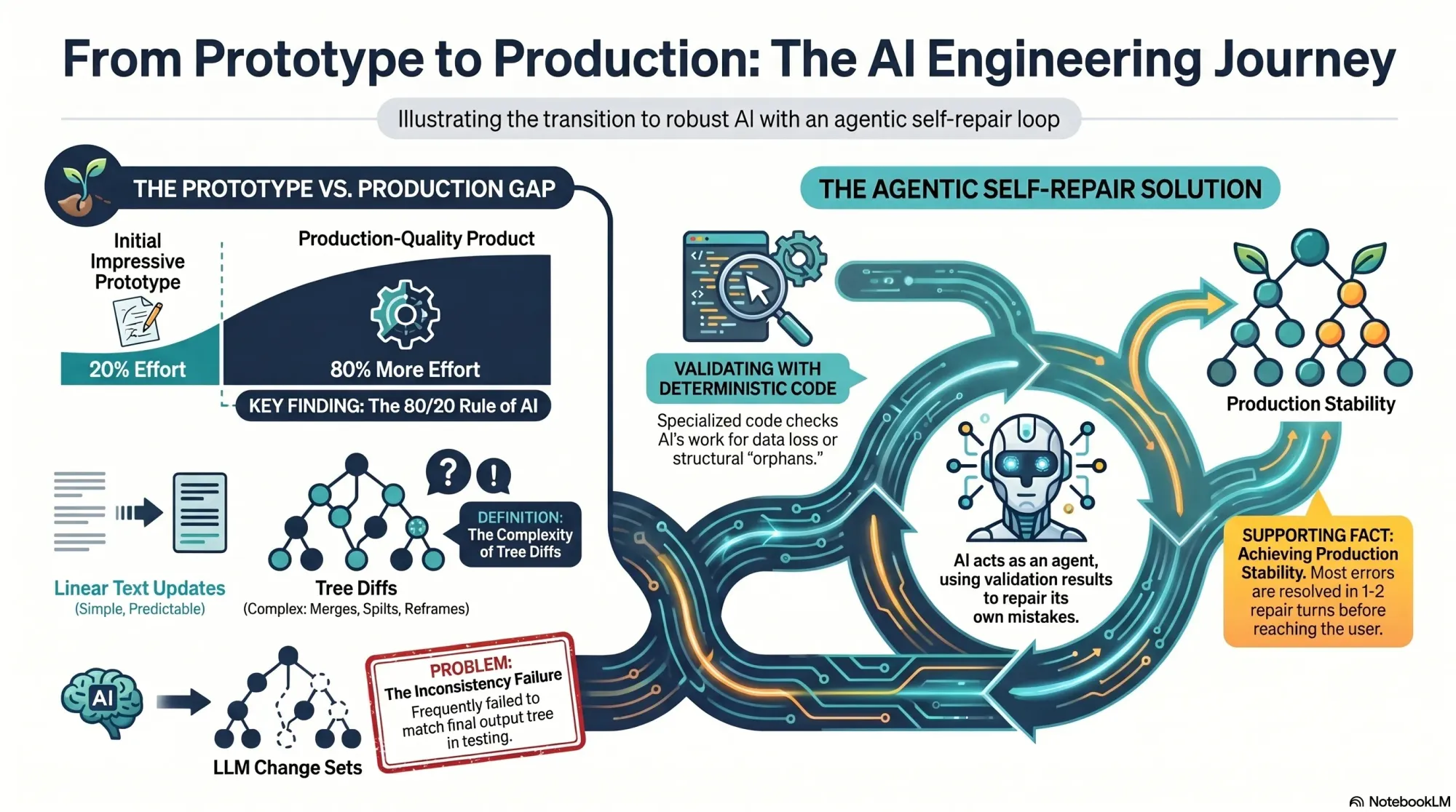
I often see the same pattern with AI: it’s easy to get to an impressive prototype, but much harder to reach a production-grade product. That was exactly my experience here. My service actually comprised two sub-services: generating a new tree from scratch and updating an existing tree with new interviews. The first worked well in alpha; the second had to be built before anyone could add a fourth interview.
Explore how an outcome expands into an Opportunity Solution Tree: Opportunities A and B stem from the goal, with C and D nested under B, while a concise change set tracks every node added along the way.
On the surface, these services look similar. In reality, updates must preserve existing structure unless new evidence requires a change. You have to account for compound operations—merges, splits, deletes—while guaranteeing no data loss. Every node has source opportunities (supporting evidence from interviews) and children (tree sub-opportunities), and neither can be dropped.
In classic AI fashion, I got a reasonable version working in a few days and shipped it to our design partners. One team quickly hit our beta limits and asked to convert to a paid subscription so they could keep going. They showed a willingness to pay, converted, and started uploading aggressively.
Watch an Opportunity Solution Tree evolve: the original parent A with x, y, z branches is split into A and B, shifting evidence while preserving links—mirroring how AI refines scope and structure in discovery.
At the 14th, 15th, and 16th uploads, the cracks appeared. We saw odd behavior in some trees. The Vistaly team noticed that the change sets—the step-by-step instructions emitted by my service—didn’t always reconstruct the final tree my service also emitted. We needed those steps to match exactly, so teams could review and accept, modify, or reject each change with confidence.
They flagged the issue the day I was flying to New Orleans for Jazz Fest. In hindsight, I’m glad I didn’t grasp the scope of what awaited me. I had roughly 80% of the work still to do to make tree updates rock solid. At least I got to enjoy the music first.
From fragments to focus: this diagram shows how Opportunities B and C are merged into a single Opportunity Solution Tree, removing duplicates and unifying context so AI can rank and explore five related opportunities with clarity.
Back home, I started diagnosing. My service was a pipeline: several LLM-driven steps followed by deterministic code to compare trees and produce change sets. As I dug in, I realized that approach was flawed. Tree diffs, unlike linear document diffs, are ambiguous.
In a document, if I add a sentence, the diff shows an addition. If I delete a paragraph and rewrite it, the diff shows a removal and an addition. Simple. But trees are different. Suppose I split opportunity A into A and B, and later merge B with C. The split can disappear from the final diff.
Peek inside our process: a simple opportunity solution tree maps an outcome to prioritized opportunities A and C with downstream options x-z and t-v. A clear snapshot of how AI organizes product discovery.
When the model splits an opportunity, it must distribute A’s source opportunities and children between A and B. For instance, if A has source opportunities 1, 2, 3 and children x, y, z, after the split A might keep 1, 2, and x, while B takes 3, y, and z.
Now suppose the model merges B into C. If C originally had source opportunities 4 and 5 and children t, u, v, then after the merge C now has source opportunities 3, 4, 5 and children t, u, v, y, z. When you compare the original and final trees, it looks like A somehow donated some evidence and children directly to C. The split and merge that explain why are invisible to a naive diff.
See how an AI-generated Opportunity Solution Tree unfolds: one Outcome flows to Opportunities A and C, then into options x–v. Clean colors and arrows reveal the hierarchy from goal to opportunities at a glance.
That was the core insight: we didn’t just need to show what changed—we needed to show why it changed. I had to reconstruct each move step-by-step. That meant getting the model to show its work, which opened a new can of worms.
I refactored my prompts so the model produced both the final output and the exact change set it used to get there. The action language was explicit: add, delete, reframe, merge, split, and so on. Crucially, I asked the model to describe its moves in user-meaningful terms—“split A into A and B, then merge B into C”—not as opaque reassignments of sources and children.
Watch an opportunity solution tree take shape: start with the outcome, add opportunities A and B, then extend B to C and D. The paired change set makes every edit transparent—ideal for AI-assisted product discovery.
For each LLM step, the model now emitted its recommendation and the corresponding change set. This helped, but it wasn’t perfect. After extensive testing and error analysis, two classes of errors emerged: (1) the model attempted an invalid move, and (2) the change set didn’t actually generate the recommendation.
Category 1 felt like designing a game while the model played it creatively. For example, what happens when the model tries to merge a parent with a child? If opportunity A has children B, C, and D and the model merges A with B, the merge is directional. If the instruction is “keep A, delete B,” that works—the parent absorbs the child. But if the instruction is “keep B, delete A,” then C and D become orphans. These puzzles were solvable and even fun.
Visual explainer from Product Talk on AI-generated Opportunity Solution Trees. It contrasts an allowed merge (B into A) with a not-allowed merge (A into B) that leaves child opportunities orphaned, guiding safe hierarchy edits.
Category 2 was harder. Despite prompt iterations, I could only push the discrepancy rate down to about 1 in 40 instances. With 10–20 LLM calls per run, that meant roughly half of all runs still failed. Not acceptable for production. I hit a wall. A paying customer was waiting, and more design partners were queued up.
Next, I tried to correct the model’s mistakes with deterministic code. I had promised that my change sets would generate the output tree, so I wrote verifiers: detect conflicts (e.g., delete a node, then try to use it later), guard against data loss, prevent orphaned nodes, and more. Detection was straightforward; correction was not. Fixing issues required guessing the model’s intent. If the sequence said “delete A, then merge A with B,” should I remove A entirely or salvage A’s sources and children by merging into B? There were dozens of such cases with no unambiguous answer.
A step-by-step loop shows how changes are validated: generate a change set, run a validation tool, review the result, then repeat on failure and exit on pass—mirroring iterative work behind AI-built Opportunity Solution Trees.
After 11 straight days of deep work—including weekends—I was exhausted. I dislike hustle culture; this isn’t how I design my life. But I was stuck, and then I had an insight.
On a walk with my husband (also an engineer), I realized I could have the LLM repair its own mistakes. My data contract with Vistaly requires that the change set must generate the output tree. I had already built robust validation code. I knew exactly when a change set failed—and why. No amount of prompt tuning alone was fixing it. So I turned the validator into a tool for the model and created a simple agentic loop.
The loop works like this: the model proposes a change set, calls the validation tool, and gets back a pass/fail plus specific feedback. If it fails, the model uses those instructions to repair the change set and calls the tool again. Iterate until success or a max number of turns.
I prototyped in Node.js with a single model call, a verifier pass, and a repair attempt. At first, the loop didn’t converge—it just accumulated compute. I experimented with how to communicate errors, how much context to include, and how to sequence feedback. Eventually, it clicked: the model began fixing its own mistakes and typically returned a valid change set in one or two repairs. It was, in practice, eval-driven development applied to LLM outputs.
I had already built an agent loop utility for another AI workflow, so I productionized quickly: model call, optional tool invocation, tool result returned to the model, repeat until the validator signals success or the loop times out. I integrated the new loop into the pipeline and shipped the revamped service to Vistaly on Monday at noon. They’re integrating now, and it will be in the hands of our design partners shortly. I’m relieved—and ready for a day off.
Reflecting on the last two weeks, a few things stand out. First, I shed limiting beliefs about being an engineer. To make this reliable, I had to solve legitimately hard problems, and that feels good.
Second, this was genuinely fun. Designing the action set and watching the model push those boundaries was like working through elegant puzzles. Models are incredibly creative, and harnessing that creativity with the right constraints is deeply satisfying.
Third, I learned when I can and can’t trust Claude to write code for me. Since Opus 4.6 came out, I gave Claude a much longer leash. After the past two weeks, Claude is back on a short leash. I found a lot of gaps in my implementation in areas where I simply trusted that Claude got it right, when in fact it didn’t. If you don’t have the right infrastructure—planning, testing, code review—this can be disastrous. I’ll be investing more here and sharing what I learn.
Finally, if this work had been spread over two months, it would have been thoroughly enjoyable. I’m discovering how much I like being an AI engineer. It feels like a new chapter where I can combine opportunity solution trees with modern AI engineering—and deliver real value to product teams doing continuous discovery.
I’m excited to share more of what we’re building with Vistaly and to onboard more design partners soon. If you’re interested, get on the waiting list. And if you’ve been hesitant to stretch beyond your current skill set, I hope this story nudges you to take the first small step toward what’s just now possible.
I’ve spent my career building products that move the needle, and as a Principal Product Manager and product leader at HighLevel, I focus on the work that compounds: clear strategy, rigorous discovery, and measurable outcomes. My role is to turn ambition into traction by aligning vision with execution, then proving impact with data, not anecdotes.
Great product strategy starts with customer value and ends with business results. I frame the narrative around a defensible value proposition, clarify points of parity and points of differentiation, and translate that into driver trees tied to outcomes vs output OKRs. This creates line-of-sight from our roadmap to metrics that matter—Net Recurring Revenue (NRR), activation, retention, and expansion—so teams know exactly why their work matters.
Discovery is continuous, not a phase. I partner in product trios to run continuous discovery through customer interviews, journey mapping, and an opportunity solution tree that separates signal from noise. By keeping a weekly cadence of learning, we reduce risk early, refine problem statements, and ensure we’re solving the highest-leverage jobs to be done for our customers.
Evidence beats opinion, so I obsess over instrumentation and experimentation. I rely on Amplitude analytics for behavioral analytics, cohorting, funnel health, and retention analysis, and I validate hypotheses with A/B testing designed around a minimum detectable effect (MDE). With feature flags, we decouple deployment from release, ramp value safely, and learn fast without exposing the entire base to risk.
Execution only works when planning is pragmatic and transparent. I run product roadmapping and sprint planning as living systems informed by discovery insights and real usage data. That means tighter stakeholder management, clearer trade-offs, and fewer surprises for go-to-market partners—so we ship confidently and tell a crisp story from beta through scale.
I also apply modern AI practices where they create real leverage. For exploration and prototyping, I use gen ai for product prototyping and practical workflows from LLMs for product managers to accelerate research synthesis, scenario mapping, and content generation—always with human-in-the-loop judgment, data governance, and privacy-by-design as non-negotiables.
The result is a disciplined, human-centered, and data-powered approach. I build empowered product teams that learn faster than the market, align on few-but-mighty bets, and compound outcomes over outputs. That’s how a Principal Product Manager consistently turns strategy into durable, product-led growth.
Inspired by this post on Amplitude – Perspectives.
In my role leading product teams, I’m relentless about freeing time for high-leverage work—clarifying strategy, sharpening positioning, and unblocking execution. Claude Cowork has become a reliable AI partner in that mission, helping me automate repeatable tasks while preserving judgment for the decisions that matter most.
Get 5 playbooks to automate common product management tasks with Claude Cowork and free yourself for higher-leverage PM work.
When I say “playbooks,” I mean structured, repeatable workflows that turn messy inputs into crisp outputs—without sacrificing rigor. With agentic AI, LLMs for product managers, and thoughtful prompt engineering, these playbooks plug directly into my product roadmapping and sprint planning process, accelerating discovery, analysis, and stakeholder alignment.
Playbook 1: Continuous discovery synthesis. I route raw customer interviews, support threads, and behavioral analytics into Claude Cowork to cluster themes, extract Jobs-to-Be-Done, and propose opportunity areas. It drafts an initial opportunity solution tree with clear problem statements, target outcomes, and candidate solutions, which I then refine with the team. This shortens the loop between customer interviews and actionable insights while preserving the nuance that continuous discovery requires.
Playbook 2: Strategy-to-roadmap alignment. Starting from our product strategy and target outcomes, I ask Claude Cowork to translate goals into a prioritized roadmap, calling out outcomes vs output OKRs and showing driver trees that connect initiatives to measurable impact. It flags dependencies and suggests stakeholder management touchpoints, making the narrative behind prioritization transparent and easier to socialize across product trios and leadership.
Playbook 3: Experiment design and A/B testing. To move from ideas to evidence, I have Claude Cowork generate testable hypotheses, success metrics, and guardrails for A/B testing. It produces experiment briefs, checks statistical assumptions like minimum detectable effect (MDE), and suggests instrumentation plans for tools such as Amplitude analytics. I use these drafts to speed up reviews without compromising on methodological rigor.
Playbook 4: Launch communications and in-product guidance. After we ship, I leverage Claude Cowork to assemble UX writing, release notes, and in-app guides tailored to user segments. It proposes short product tours, contextual tooltips, and support macros that keep messaging consistent across Pendo or Intercom while reinforcing our value proposition. The result is faster, more cohesive go-to-market execution with fewer round-trips.
Playbook 5: AI risk, governance, and quality checks. Before anything goes live, I use Claude Cowork to run structured reviews for data governance, privacy-by-design, and AI risk management. It helps draft acceptance criteria, red-team prompts for edge cases, and an eval-driven development checklist so the team can track model behavior and mitigate regressions over time. These safeguards maintain trust as we scale AI workflows across the product surface.
To make these playbooks sing, I seed Claude Cowork with a retrieval-first pipeline of canonical docs—vision, strategy, OKRs, analytics dashboards, and definition-of-done checklists—plus prompt templates tuned for our voice and review standards. Tight context window management, explicit role instructions, and lightweight evaluations keep outputs accurate, auditable, and on-brand.
The impact has been compounding: faster discovery-to-decision cycles, clearer roadmaps tied to outcomes, stronger experiments, and launch content that lands. Most importantly, the team spends more time on creative problem solving and stakeholder partnership, not manual synthesis or formatting. If you’re ready to reclaim your calendar and elevate your product strategy, start with these five Claude Cowork playbooks and iterate from there.
Inspired by this post on Amplitude – Perspectives.
I recently spent time with the debate behind the "product builder" trend—asking whether it’s the future of product management or just another wave of tech FOMO. The conversation featuring Teresa Torres and Petra Wille is a useful prompt, but what matters most is how we translate these ideas into healthy product practices inside our own organizations.
Here’s my take: the product builder movement is neither a mandate nor a fad—it’s a tool. The right question isn’t "should product managers code?" but whether leaning into building advances outcomes for our customers and our teams. In practice, that means letting interest and skill—not pressure—set the pace.
Petra captured it perfectly: "Just because I can do it — is it something I enjoy doing? And do I have enough experience to really get into the flow?" Those two tests—joy and depth—are underrated filters. I’ve seen PMs light up when prototyping or vibe coding a thin slice, and I’ve also seen well-meaning dabbling create hidden complexity that slows everyone down later.
Org design determines whether this works. It’s not about the tools—it’s about clarity of roles, healthy interfaces between product, design, and engineering, and explicit guardrails for where experiments stop and production begins. AI has raised the stakes: "AI can make unskilled work look polished. That’s a feature and a bug — executives see the shine, engineers inherit the mess." If you’ve ever watched a glossy demo turn into weeks of refactors, you know exactly what this looks like.
To avoid that trap, I deliberately separate the three layers where AI is changing product work: personal productivity, team process, and product strategy. Treating these as different stacks keeps expectations clean: a prompt that accelerates personal workflows isn’t the same as an AI-enhanced process that reshapes delivery, and neither automatically produces durable product advantage. Don’t conflate them.
Discovery remains stubbornly human. "Why discovery still requires talking to your customers (sorry)" is more than a friendly nudge. AI can broaden our search space and sharpen analysis, but it doesn’t replace qualitative conversations or the judgment that comes from pattern recognition across real customer contexts. Continuous discovery and disciplined customer interviews are still the most reliable compasses we have.
Where does "vibe coding" fit? It’s great for roughing out concepts, de-risking slices, and communicating intent when words or static mocks won’t cut it. Tools like Claude Code make this faster than ever, and familiar stacks like Ruby on Rails lower the bar for spinning up functional prototypes. But remember the design system trap: AI can make bad decisions look good on the surface. If you don’t control for architecture, accessibility, data contracts, and handoff quality, your team pays the integration tax later.
In well-set-up orgs, the output-oriented muscle memory gets rewired. When AI frees up time, strong teams reinvest it into better problem framing, sharper opportunity solution trees, and tighter product strategy—rather than simply chasing more output. That’s a leadership challenge, not a tooling problem, and it shows up quickly in how teams make trade-offs.
Here’s how I operationalize this with empowered product teams: we articulate clear boundaries for prototypes versus shippable code, define decision rights for when PMs or designers "build," and align on review gates that protect quality without stifling speed. We also make the three AI layers explicit in roadmapping and retros, so improvements to personal workflows don’t get mistaken for strategic advantage.
My distilled guidance echoes the episode’s throughline. The product builder trend isn’t a mandate — it’s a tool. Let enjoyment and skill guide who on your team leans into it. Organizational readiness determines whether AI empowers your team or creates chaos. Don’t conflate personal efficiency, process change, and product impact—they require different responses. Discovery fundamentals haven’t changed; AI helps you go deeper, not skip the work. And the real takeaway on product builders: not everyone has to build, but everyone can if they want to.
If you want to hear the full discussion that sparked these reflections, listen on Spotify or Apple Podcasts. Then tell me: where will you apply builder energy in your team—and where will you deliberately say no?
Resources & Links: Follow Teresa Torres: https://ProductTalk.org. Follow Petra Wille: https://Petra-Wille.com. Mentioned in this episode: Claude Code, Vibe coding, Ruby on Rails.
One more quote I loved because it centers autonomy and craft: "It’s a tool in our toolbox. We can decide who on our team has fun with it, wants to do it, wants to contribute." That’s the mindset that sustains both momentum and morale.
Data has always been my compass for building products that customers love and businesses depend on. Few sentences distill that imperative as crisply as the one below—and it continues to inform how I prioritize, experiment, and scale outcomes across the roadmap.
Krista is a digital analytics leader, product strategist, and industry evangelist. She helps businesses use data to drive growth, retention, and monetization.
That mandate mirrors how I run product: leverage behavioral analytics to uncover patterns, translate those insights into hypotheses, and validate them through rigorous A/B testing. I start by instrumenting the user journey end to end, then use cohort analysis, funnel diagnostics, and retention analysis to pinpoint where activation, engagement, or monetization is stalling. From there, I map driver trees to connect inputs (feature adoption, time-to-value, onboarding friction) to outputs (retention, conversion, revenue), so every experiment has a clear line of sight to business impact.
On experimentation, I hold the bar high: define the minimum detectable effect (MDE) up front, ensure clean experiment design, and size samples to reduce noise. I combine Amplitude analytics with qualitative signals from continuous discovery to prioritize tests that move the needle, not just the vanity metrics. When a variant wins, I don’t stop at the lift—I track downstream effects on user activation, long-term retention, and monetization, ensuring we’re compounding gains rather than optimizing in silos.
For product-led growth, I focus on the moments that matter most: first-value, aha, and habit formation. Journey mapping helps me identify the shortest, clearest path to value, while targeted in-app experiences and contextual nudges accelerate activation without adding friction. Every iteration feeds a learning loop—measure, learn, and ship—so we can pursue step-change outcomes, not incremental tweaks.
Ultimately, the craft is in translating analytics into action. When teams can trace a feature idea to a specific behavioral pattern, test it with a well-powered A/B experiment, and observe durable improvements in retention and revenue, momentum takes care of itself. That’s how I operationalize data to deliver growth, retention, and monetization at scale.
Inspired by this post on Amplitude – Best Practices.
I just finished listening to "Taste – All Things Product Podcast with Teresa Torres & Petra Wille," and as a product leader shipping AI-powered capabilities at HighLevel, Inc., I wanted to pressure-test the sudden obsession with "taste."
If you're curious, you can listen to this episode on Spotify or Apple Podcasts.
The core question landed perfectly for our moment: Is "taste" the must-have skill of the AI era — or just the latest tech buzzword in a world where AI is eating through design, delivery, and discovery?
Teresa pushes back hard, highlighting how slippery the term can be. "It's just this month's flavor of founder mode." She points out that "taste" is rarely defined, can't be easily taught, and too often becomes shorthand for "my preference trumps yours." Just as importantly, "It's not about your taste. It's about your customer's taste."
Petra adds needed nuance from years in the craft: pattern-recognition is real, and some people do develop sharper product sense over time. As she put it, "I am a strong believer that you develop product sense and taste over time. It's never finished."
Both threads lead back to familiar roots in product: product sense, founder mode, and the enduring myth of the lone visionary. They even grapple with the big question on everyone’s mind—Will AI Eat Taste Too?—and where that leaves product teams navigating GenAI, LLMs for product managers, and evolving product strategy.
Here’s my take. "Taste" can be useful as a personal north star, but it is not a decision system. In my teams, we bias toward evidence: continuous discovery, customer interviews, discovery synthesis with opportunity solution trees, and tight collaboration in product trios. Opinion can start the conversation, but evidence should end it.
Practically, that means investing in the skills that compound: Discovery skills — understanding customers, matching solutions to real needs. Human-to-human interaction skills. Learning to collaborate with AI effectively. Critical thinking and judgment grounded in evidence.
On AI collaboration specifically, we treat GenAI as a force multiplier, not a decider. We prototype with AI to explore breadth, then narrow with qualitative and quantitative signals, ablation-style experiments, and clear success criteria. The bar I hold myself to is simple: taste without evidence is just opinion.
Three lines I underlined from the conversation:
"It's just this month's flavor of founder mode." — Teresa Torres
"It's not about your taste. It's about your customer's taste." — Teresa Torres
"I am a strong believer that you develop product sense and taste over time. It's never finished." — Petra Wille
If you want to go deeper, these references are helpful for sharpening judgment without falling into the "great man" theory trap.
Follow Teresa Torres: https://ProductTalk.org
Follow Petra Wille: https://Petra-Wille.com
Founder mode
Marty Cagan: Founder-Style Leadership
Vercel/v0 CEO Guillermo Rauch on building taste: from Lenny Rachitsky’s Linkedin post
Continuous discovery (Read Teresa’s Everyone Can Do Continuous Discovery—Even You! Here’s How
The "great man" theory
Steve Jobs and the myth of the lone product visionary
Have thoughts on this episode? Leave a comment below and share how your team balances product sense with evidence in the age of AI.
Weekly product reviews are where strategy meets execution, and over the past year I’ve turned them into a high-signal, low-friction ritual by leaning on agentic AI. As VP of Product Management at HighLevel, Inc., I’ve standardized a set of agent skills that compress preparation time, surface the right insights, and keep PMs, engineers, and designers focused on decisions—not document wrangling.
"Learn how our teams use agent skills with claude, cursor and codex to run product reviews as PMs, engineers, and designers. Here are 5 killer use cases for builder."
Below, I walk through the five skills I rely on most in our weekly cadence—each one mapped to a clear product management outcome. They’re simple to set up, easy to govern, and aligned with core practices like continuous discovery, product roadmapping and sprint planning, and eval-driven development.
Skill 1 — Backlog triage with signal extraction: I point an agent at fresh tickets, customer notes, and experiment results to cluster themes, tag impact, and flag regressions. Using a retrieval-first pipeline and Agent Analytics, the assistant ranks items by value, effort, and risk so our meeting starts with a prioritized, explainable shortlist instead of a raw queue.
Skill 2 — PRD and spec synthesizer: Ahead of the review, an agent drafts a one-page PRD update from design diffs, git history, and decision logs. With Claude Code and Cursor, it highlights interface changes, acceptance criteria, and open questions, linking back to sources. The result is a crisp, auditable brief that keeps product trios aligned without re-litigating context.
Skill 3 — Experiment and metrics analyzer: An analytics agent pulls A/B testing readouts, checks minimum detectable effect assumptions, and annotates anomalies. It turns raw telemetry into a narrative: what moved, by how much, and whether we trust it. This makes our discussion about tradeoffs, not spreadsheets, and speeds commitments on next steps.
Skill 4 — Voice-of-customer synthesizer: The assistant clusters interviews, support threads, and NPS verbatims into jobs-to-be-done and pain themes. It proposes opportunity solution tree updates and calls out places where our roadmap diverges from customer signal. That keeps continuous discovery alive in the room—even when time is tight.
Skill 5 — Roadmap and sprint planning co-pilot: After decisions, an agent converts outcomes into scoped backlog items, engineering tasks, and stakeholder updates. It drafts sprint goals, flags dependency risks, and aligns work to objectives. Because it’s grounded in the meeting record, it preserves intent while removing ambiguity.
Under the hood, prompt engineering patterns and guardrails keep these workflows predictable: a retrieval-first pipeline for context, eval-driven development for quality checks, and role-specific prompts for PMs, engineers, and designers. With Claude Code I generate structured diffs and test scaffolds; with Cursor I accelerate code-review summaries; and with codex I bootstrap utility scripts that keep the loop tight between insights and implementation.
The payoff is tangible: higher decision velocity, fewer meetings to “re-clarify,” and clearer accountability across the product organization. Just as important, governance and privacy-by-design are built in—every agent logs rationale, cites sources, and respects data boundaries—so leaders can scale AI workflows confidently.
If you’re looking to level up your product reviews, start with these five skills, measure impact with Agent Analytics, and iterate. Small automations compound quickly, and the more consistently you run them, the more your team’s attention shifts from preparing content to making better product decisions.
Inspired by this post on Amplitude – Perspectives.
Five years in, Continuous Discovery Habits continues to be one of the most practical frameworks I use to align empowered product teams, sharpen product strategy, and convert customer interviews into outcomes. To celebrate its impact, I’m hosting a community read-along and inviting you to dig in with me this May.
Each month, I’m releasing an in-depth reading guide to make learning stick. You’ll find the chapters we’ll be reading, a preview of the essential concepts, short videos to help you spread the ideas across your organization, individual and team discussion prompts, team exercises to put the concepts into practice, and additional reading if you want to go deeper. My goal is simple: help you turn product discovery into a steady habit, not a once-a-quarter activity.
We’ll discuss each month’s reading in the comments, and we’ll gather quarterly on a live call to compare notes and share what’s working. Joining late is absolutely fine—I monitor the conversation throughout the year. Start with the current month or rewind to January; you can ask for help, share wins and roadblocks, and connect with other readers anytime.
If you want to participate, grab a copy of the book (or dust off your old one), share the "Spread the Love" videos with your team, block focused time for the exercises, and register for the community sessions. Let’s do this together.
This Month’s Reading
Chapter: Chapter 6: Mapping the Opportunity Space
Estimated reading time: ~23 minutes
This month’s chapter will introduce you to why opportunity mapping is critical for structuring the ill-structured problem of reaching your desired outcome; how to move from overwhelming opportunity backlogs to well-structured opportunity spaces; the power of tree structures for depicting parent-child and sibling relationships between opportunities; how to identify distinct branches in your opportunity space using key moments in time; common anti-patterns to avoid when building your first opportunity solution tree; and why structure "gets done, undone, and redone" as you continue to learn.
Need a copy? Grab the book.
Share the Love with Friends and Colleagues
We learn best in community. Use these short videos to spread the core concepts from this chapter—then invite your team to join the book club with you.
The need for opportunity mapping – You will never fully satisfy your customers' desires
Understanding the structure of an opportunity solution tree – Depicting two types of relationships
Turn big intractable problems into smaller, more solvable problems – The power of decomposition
How to map an opportunity space – Getting started with opportunity solution trees
A well-structured opportunity space has distinct branches – Identify key moments in time
Reflect & Discuss What You Read
Reflection turns reading into capability. This chapter asks us to shift from reacting to every request to deliberately structuring the opportunity space. If you’ve ever felt overwhelmed by a never-ending backlog or pressure to ship output over outcomes, this is where the fog starts to lift. As you read, focus on how your team currently organizes (or doesn’t organize) what you hear from customers.
Individual Reflection
1) Think about your current product backlog or opportunity list. Is it a flat list, or do you have some structure to it? If you were to group similar opportunities together, what patterns would emerge?
2) When was the last time you heard a customer need and immediately jumped to a solution without exploring whether there were related opportunities? What would change if you took the time to map how that opportunity connects to others?
3) Review the anti-patterns from the chapter (opportunities framed from your company's perspective, vertical opportunities, opportunities with multiple parents, etc.). Which of these do you recognize in how your team currently talks about opportunities?
Team Discussion
1) As a team, pick a top-level opportunity you're currently working on. Try breaking it down into sub-opportunities together. Where do you struggle? Where do you disagree about how to frame or group opportunities? What does that tell you about gaps in your shared understanding?
2) Look at your experience map (from Chapter 4) and identify 3-5 distinct moments in time during your customer's experience. Could these become the top-level branches of your opportunity solution tree? Where do you see overlap, and where are there clear distinctions?
3) Discuss the quote from Barbara Tversky: "Structure gets done, undone, and redone." How does your team currently respond when you discover new information that changes how you understand the opportunity space? Do you treat your opportunity map as fixed or as something that evolves?
Put It Into Practice
Reading is step one; building your first opportunity solution tree is where the real learning happens. The exercises below are exactly how I coach product trios to transform ambiguous problems into aligned action.
Exercise: Build Your First Opportunity Solution Tree
Time: 60 minutes. Do this: With your product trio.
Start by reviewing your interview snapshots from the past few weeks. For each opportunity you captured, ask the three questions from the chapter:
Is this opportunity framed as a customer need, pain point, or desire (not a solution)?
Is this opportunity unique to one customer, or have we seen it in more than one interview?
If we address this opportunity, will it drive our desired outcome?
Then, using your experience map, identify 3-5 distinct moments in time to serve as your top-level opportunities. Group the opportunities from your interviews under these top-level branches.
Look for opportunities to add structure to each branch. Group similar opportunities together and identify a parent opportunity. Look for vertical stacks (one parent, one child) and fill in missing siblings. Reframe opportunities that are too broad or that could live in multiple branches.
Don’t aim for perfection. Get something on paper (or a digital canvas) and iterate the tree with every new interview.
Exercise: Practice Framing Opportunities from Your Customer’s Perspective
Time: 30-45 minutes. Do this: With your product trio.
Take 10-15 opportunities from your current backlog or list. For each one, ask: "Can I imagine a customer saying this?" If the answer is no, reframe it from your customer’s perspective. For example:
"Increase subscription conversions" becomes "I want to know if this product is worth paying for"
"Reduce support tickets" becomes "I can't figure out how to do X"
"Improve onboarding completion" becomes "I'm not sure what to do next"
This exercise helps you spot business-centric opportunities disguised as customer opportunities. It also trains your team to listen for opportunities in interviews that are framed from the customer’s point of view.
Go Deeper: Additional Reading
If you prefer an audio summary of this month’s reading, including the book chapters and the following resources, I’ve included an audio version for paid subscribers at the bottom of this post.
Related In-Depth Guides
Opportunity Solution Trees: Visualize Your Discovery to Stay Aligned and Drive Outcomes
Customer Interviews: Uncover Hidden Insights from Every Conversation
Supplementary Reading
Prioritize Opportunities, Not Solutions
Product in Practice: Opportunity Mapping at Grailed
Product in Practice: Opportunity Mapping at trivago
7 Key Benefits of Using Opportunity Solution Trees
Getting Started with Opportunity Solution Trees at SuperAwesome
Bringing Order to Chaos: Using Opportunity Solution Trees in Everyday Life
Other Voices
Why Groups Struggle to Solve Problems Together by Al Pittampalli
More PM Problem Areas by Marty Cagan
Five Superpowers of Diagrams by Abby Covert
Critical Thinking is Product Management by This Is Product Management
Our Live Discussion Schedule
Our live discussion sessions are for paid subscribers. Sessions are not recorded. Invitations will go out to Supporting Members and CDH Members two weeks before the scheduled event. But reserve the time on your calendar now.
Tuesday, June 16, 2026: 9am-10am PDT
Thursday, September 17, 2026: 9am-10am PDT
Wednesday, December 16, 2026: 9am-10am PST
Audio Summary
This summary was produced by NotebookLM. The sources supplied were the book chapters as well as all of the additional reading.