Tag: continuous discovery

  • Inside AITropos: Lightning-Fast AI Employees for Hospitality That Take Orders on WhatsApp

    Inside AITropos: Lightning-Fast AI Employees for Hospitality That Take Orders on WhatsApp

    I’ve been closely tracking how agentic AI reshapes frontline operations, and few case studies are as instructive as AITropos. Their north star is deceptively simple: take a food order over WhatsApp — correctly, every time, fast enough that customers can’t tell it’s not a person. That’s the challenge Santi Marchiori and Juan Haedo embraced, and it’s a masterclass in product strategy, conversation design, and systems engineering.

    What they’ve built is an AI order-taking agent that handles the full flow — menu recommendations, modifiers, delivery zones, payment links, and status updates — entirely inside WhatsApp. Choosing the customer’s preferred channel wasn’t just a UX decision; it set the bar for speed, reliability, and trust. In hospitality, seconds matter. Latency becomes brand.

    Their path to this solution reflects disciplined continuous discovery. They spent two years exploring hundreds of startup ideas before finding the niche of AI-powered order taking in hospitality, then iterated through three product forms — hardware for waiters, a waiter app, and finally a customer-facing WhatsApp agent — before landing on the right form factor. In my experience, this is what real product-market fit lessons look like: follow the problem, not the artifact.

    Under the hood, the hardest problem is translating "non-deterministic human conversation" into structured "POS-compatible order data." To hit real-time response speed requirements, they chose a "tools-based architecture" over "MCP" or pipelines. That decision minimizes orchestration overhead and keeps the agent focused on the shortest path from intent to action — a pragmatic approach I recommend when SLAs are tight and context changes fast.

    They also engineered for throughput and precision. A parallelized pipeline searches for multiple products simultaneously and pre-fetches product context before the agent even calls a tool. Complementing that, smaller, fast sub-agents assemble an "immediate system prompt" that injects relevant data into each turn without extra tool calls. Think of it as a retrieval-first pipeline designed to slash latency while preserving accuracy — a pattern every team building AI workflows should study.

    Focus is evident in their KPIs. They identified order item identification accuracy as their single most important KPI. Picking one metric that truly governs customer trust is a hallmark of strong product management; it clarifies trade-offs in model selection, prompt engineering, and fallback behavior.

    Quality assurance is equally rigorous. Before going live in any new venue, they test with thousands of agent-simulated customer conversations overnight. This approach de-risks deployment, surfaces edge cases early, and provides the data backbone for Agent Analytics and iteration. It’s a practical blueprint for teams operationalizing LLMs for product managers who need both scale and safety.

    Operationally, the payoff shows up in onboarding. They reduced new customer onboarding from three months to a few weeks — and continue to shrink it as they build domain templates. Standardizing schemas, prompts, and flows for repeatable segments is exactly how you turn bespoke wins into a scalable go-to-market engine.

    Stepping back, a few lessons stand out for product leaders building agentic AI in high-velocity environments: meet customers where they already are (WhatsApp), pick an architecture that serves your latency constraints (tools over complex workflows), pre-inject context to reduce tool calls, simulate at scale before launch, and anchor teams around one trust-defining KPI. Do these consistently, and you transform AI from a novelty into an always-on employee your customers actually prefer to use.


    Inspired by this post on Product Talk.


    Book a consult png image
  • Stop Obsessing Over the Roadmap: The High-Impact CPO Playbook for Ambition, AI, and Focus

    Stop Obsessing Over the Roadmap: The High-Impact CPO Playbook for Ambition, AI, and Focus

    I used to treat the roadmap like a sacred artifact. Over time, I learned the uncomfortable truth: the best product leaders stop obsessing over the roadmap and start obsessing over ambition. My number one job isn’t shipping features—it’s raising the bar for what the team believes is possible and carving out the time to think deeply. When I spend half my time thinking (not doing), the business moves faster, customers feel the lift, and outcomes finally outpace output. The impact of a great product leader starts with context-setting. Under a founder, the role often skews toward influence without deference—pressure-testing ideas, bringing data and customer insight, and helping translate founder vision into a portfolio and product strategy. Under a hired CEO, it’s about aligning capital allocation, setting clear investment theses, and ensuring product roadmapping and sprint planning connect directly to financial and go-to-market realities. Ambition beats activity. I push teams beyond “what we can fit this quarter” and anchor on value creation: how does this create net-new customer advantage? We measure with outcomes vs output OKRs, tie initiatives to activation, retention, and Net Recurring Revenue (NRR), and celebrate learning velocity as much as shipping velocity. When the narrative moves from features to outcomes, customers notice—and so does the business. I’m demanding without breeding fear. The trick is a high bar plus psychological safety: crisp quality standards, blameless postmortems, and an expectation of intellectual honesty. I separate people from problems, model curiosity over certainty, and use stakeholder management to align early, not late. The result is a culture where empowered product teams volunteer for the hard problems because the path to excellence is transparent. Most “politics” is an incentives problem. When functions optimize for different scorecards, status games fill the vacuum. I fix this with a shared driver tree, clarified decision rights, and compensation aligned to company-wide outcomes. Once incentives match the strategy, alignment stops being a meeting and starts being momentum. I use a three-bucket framework to delegate decisions. Bucket 1: I decide (irreversible, cross-company implications, or existential risk). Bucket 2: Team decides; I’m consulted (reversible or scoped risk with clear guardrails). Bucket 3: Team decides; I’m informed (local optimization and execution details). This creates speed without surrendering strategic coherence, and it’s a practical approach to building empowered product teams. I’m militant with my calendar to protect thinking time. I block two to three mornings per week for deep work, partner with executive assistants to defend those blocks, and aggressively prune low-ROI rituals. “Thinking time” isn’t a luxury; it’s where product strategy is forged, complex bets are sequenced, and product-market signals get synthesized. I also fly at a low altitude—joining customer calls, reviewing designs and PRDs weekly—so judgment stays grounded without micromanaging. The AI era demands more risk in our roadmaps. I place a few venture-like bets, timebox them, and instrument eval-driven development so we can kill or scale quickly. The concept of an app is changing—from static screens to adaptive workflows, assistants, and agentic AI. This shifts product roadmapping and sprint planning toward capabilities, data leverage, and safety systems (privacy-by-design, data governance, and AI risk management) rather than a linear feature list. Innovation teams need shelter from the core. I separate their KPIs from immediate monetization, create technical sandboxes with clear guardrails, and run a parallel discovery track. Forward deployed engineers sit with customers; continuous discovery ensures we converge on problems worth solving; and when something works, we integrate it into the core without smothering it with legacy processes. I use a barbell planning horizon: 12 weeks of executional clarity and 12–24 months of strategic theses. Anything beyond that is scenario planning, not a promise. We revisit the theses quarterly, tie them to product strategy and go-to-market strategy, and ensure each increment is measurable. This balances focus with optionality. Excellence in 2026 looks different. It requires fluency in AI Strategy, strong data governance, and the ability to move from feature leadership to system leadership. Product leaders must be bilingual—equally comfortable discussing LLMs and retrieval-first pipelines as they are speaking in NRR, gross margin, and payback periods. The job is to translate technology shifts into durable customer advantage. Being a great C-suite partner means acting enterprise-first. I co-own capital allocation with finance, sequence hiring with people and engineering, and encode our strategy into operating cadence. I treat sales-led growth and product-led growth as complementary systems, not rival religions, and I bring clarity to trade-offs with driver trees and scenario plans. Chase impact, not titles. The fastest growth I’ve seen comes from optimizing for scope, learning rate, and mentors—not for role labels. If you want comp and career to compound, maximize the value you create: fix activation, improve retention, unlock expansion, or reduce cost-to-serve. Titles follow impact, not the other way around. Four bottlenecks stall careers repeatedly. First, a scope ceiling—holding too much IC work and not scaling through delegation. Second, stakeholder friction—underinvesting in alignment and communication. Third, weak people leadership—not hiring, coaching, and performance-managing decisively. Fourth, fuzzy strategy—if your strategy can’t be drawn as a driver tree, your teams can’t execute it. Remove these bottlenecks and your trajectory changes fast. In the end, the roadmap is an instrument, not the strategy. Raise the team’s ambition, align incentives, protect deep work, and take smarter AI-informed risks. Do that consistently and the roadmap stops being a crutch—it becomes a flywheel.
    Book a consult png image
  • Principal Product Manager Playbook: Strategy, Leadership, and Execution That Scales

    Principal Product Manager Playbook: Strategy, Leadership, and Execution That Scales

    I’ve learned that the Principal Product Manager role is the crucible where strategy, execution, and leadership meet. It’s less about owning a backlog and more about owning an outcome—aligning a portfolio of bets to a clear vision, then guiding empowered product teams to deliver measurable impact at pace.

    Unlike a Senior PM who may anchor a single area or a Group PM who often has direct people management, I operate as a force multiplier. I set product strategy, shape cross-functional operating rhythms, mentor PMs and product trios, and influence executives and partners—without relying on formal authority. The bar is outcomes over output, clarity over activity, and learning over certainty.

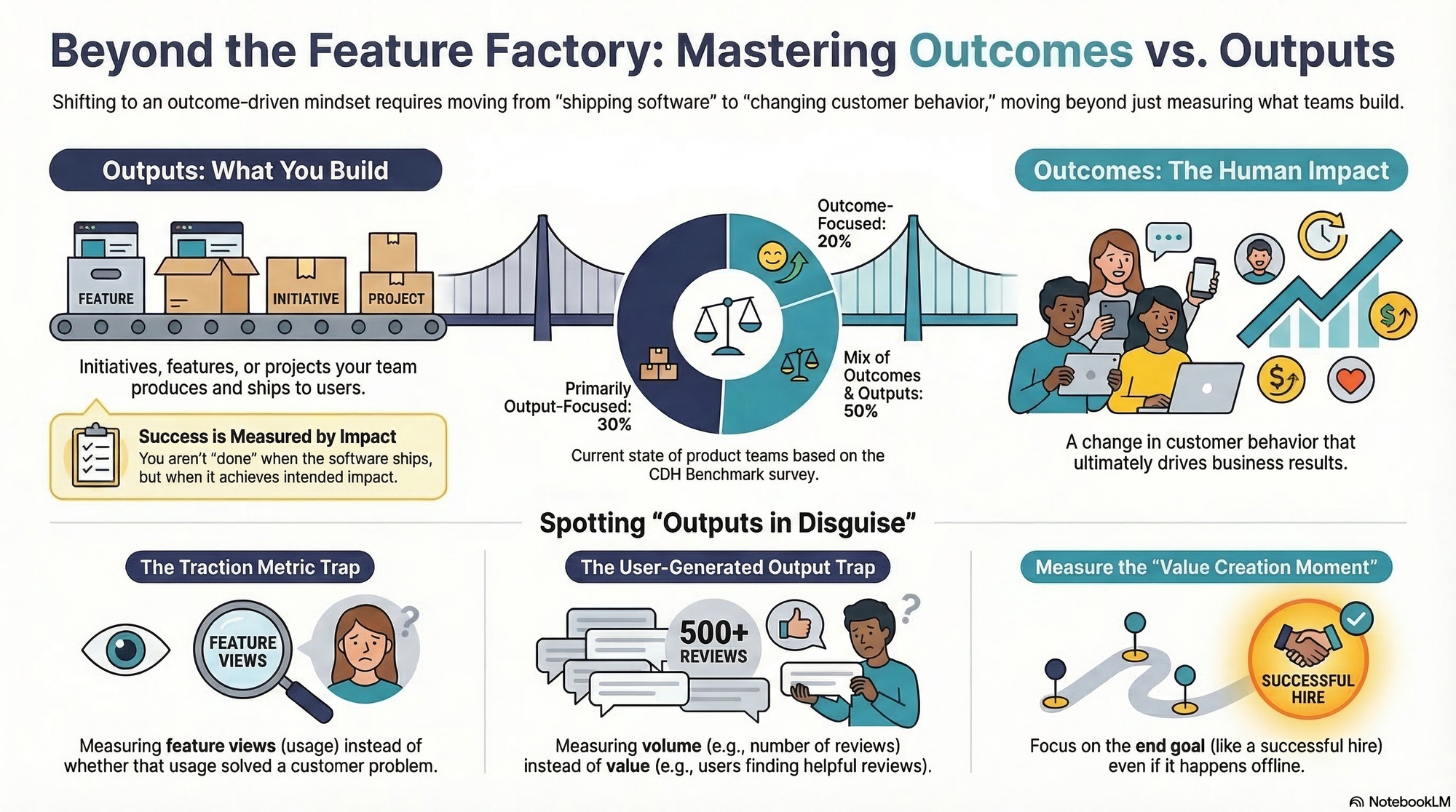
    My first move is to define a crisp North Star and the driver tree beneath it. I translate company goals into outcomes using outcomes vs output OKRs, ensuring every roadmap item ties to a measurable lever (conversion, retention, activation, expansion). This structure prevents feature factory drift and creates a shared language for prioritization and trade-offs.

    Discovery is continuous, not a phase. I run weekly customer interviews, synthesize insights with journey mapping, and map opportunities with an opportunity solution tree so teams solve the right problems before building the right solutions. I use the Kano Model to calibrate expectations on “delighters” versus “must-haves,” and I document assumptions so we can invalidate them early instead of discovering them late.

    Data sharpens judgment. I rely on Amplitude analytics for behavioral analytics, retention analysis, and funnel diagnostics, pairing this with A/B testing to validate causal impact. I size experiments with minimum detectable effect (MDE) to reduce false negatives, and I instrument leading indicators to shorten feedback loops—so we can pivot weeks earlier, not quarters later.

    Execution is where strategy earns its keep. I plan in outcomes-based quarters and deliver in two-week sprints, keeping a living roadmap that reflects new learning. Product trios (PM, design, engineering) co-own problem framing and solution shaping, while I maintain stakeholder management with transparent trade-offs and crisp decision records. This balance preserves autonomy while ensuring alignment.

    High standards spread through coaching. I mentor PMs on writing testable bets, crafting compelling problem statements, and telling a metrics-first narrative. I champion empowered product teams because autonomy plus accountability consistently outperforms mandate-driven delivery—and because it attracts and retains top talent.

    As scope scales, so does storytelling. I align leaders through a brief, repeatable operating cadence: monthly business reviews tied to driver trees, quarterly OKRs grounded in outcomes, and QBRs vs OKRs alignment to keep customer-facing teams in lockstep. I choose first principles decision making for high-ambiguity calls, and I make risks explicit early.

    Go-to-market is part of product, not an afterthought. I partner with marketing and customer success to craft value propositions, then validate them in-product with in-app guides and product tours. We define user activation precisely, instrument it, and iterate messaging and onboarding until time-to-value collapses. This is how product-led growth compounds.

    Technical excellence reduces product risk. I advocate for feature flags to decouple release from launch, CI/CD to increase deployment frequency, and observability to catch regressions fast. These practices make experimentation cheaper and safer, which in turn makes bold bets possible.

    My 30-60-90 framework is simple. In 30 days, clarify outcomes, baselines, and constraints; in 60, run discovery sprints and ship the first experiments; in 90, land two to three measurable wins, prune low-signal bets, and scale the operating cadence. The goal is momentum with meaning—evidence, not theater.

    At HighLevel, I’ve seen that the Principal Product Manager unlocks leverage by combining strategic clarity with disciplined learning and empathetic leadership. When we align on outcomes, instrument for truth, and empower teams, we don’t just ship features—we shift the trajectory of the business.


    Inspired by this post on Amplitude – Best Practices.


    Book a consult png image
  • Inside AI Product Management at Amplitude: How Leaders Turn Data into Better Products

    Inside AI Product Management at Amplitude: How Leaders Turn Data into Better Products

    When I think about the impact of AI on product management, one line sums it up for me: "Spencer Whittaker is a senior AI product manager at Amplitude. He focuses on using AI to advance Amplitude's mission of helping companies build better products." That focus on outcomes reflects how I frame AI Strategy—grounding every model and workflow in customer value and product-led growth.

    In practice, that means pairing Amplitude analytics and behavioral analytics with A/B testing and continuous discovery. I lean on eval-driven development to keep models honest, and I coach LLMs for product managers techniques so teams can prototype safely while we protect signal. Using a unified analytics platform clarifies what to build next and how to iterate faster.

    On teams I lead, product discovery stays tightly coupled to AI workflows: we map hypotheses to metrics, design experiments, and close the loop with instrumentation before we ship. That discipline turns AI from a demo into durable value, accelerating activation, retention, and feature adoption without sacrificing quality. A pragmatic AI product toolbox keeps us focused on measurable outcomes, not just novel capabilities.

    If you’re building with AI today, take a page from leaders pushing the craft forward: start with clear outcomes, connect your data in a unified analytics platform, and let A/B testing and continuous discovery guide your roadmap. With the right foundations—Amplitude analytics, behavioral analytics, and a sharp AI Strategy—you’ll transform insight into impact and build better products, faster.


    Inspired by this post on Amplitude – Perspectives.


    Book a consult png image
  • Beyond Command and Control: How I Build Trust, Speed, and Autonomy in Product Teams

    Beyond Command and Control: How I Build Trust, Speed, and Autonomy in Product Teams

    When uncertainty spikes, I notice many organizations snap back to "Command and control." It feels fast, safe, and decisive—especially when the stakes are high. But in product management leadership, speed without shared context is often an illusion, and control without trust rarely scales. I’ve learned that what looks like strength from the top can quietly create bottlenecks, missed signals, and disengaged teams.

    Why do smart companies revert in tough times? Familiarity. Centralizing decisions can reduce short-term cognitive load and signal clarity. Yet the cost shows up quickly: leaders become single-threaded on context they cannot possibly hold, and teams spend cycles asking for permission rather than creating value. The result is slower learning and weaker product strategy just when continuous discovery and iteration matter most.

    Here’s the hard truth: no single leader can hold all the context required to make every decision in a modern, cross-functional environment. The hidden complexity of customer segments, technical debt, data signals, and go-to-market constraints outstrips any one person’s bandwidth. That’s why empowered product teams, staffed with domain experts, outperform command centers—provided they’re aligned on outcomes and guardrails.

    I like the burning house analogy: in a true emergency, crisp direction helps—"take the stairs, not the elevator"—because the problem is clear, the time horizon is short, and the action is obvious. But most product work is not a single burning house; it’s a city with evolving fire codes, shifting weather, and neighborhoods that look different block to block. In that environment, distributed action scales better than centralized control.

    Strong leadership is not the same as command-and-control. In practice, it means setting a compelling direction, defining guardrails, and running tight feedback loops. I aim for what I call the "Flotilla of kayaks": we’re all headed to the same lighthouse, but each kayak navigates its own currents based on local information. That’s aligned autonomy—fast, resilient, and deeply accountable.

    People often ask why some command-and-control companies still succeed. My view: beneath the surface, there’s usually more trust and unofficial autonomy than their org charts suggest. Teams earn freedom by shipping reliably, sharing decision rationales, and showing outcomes. Leaders tolerate—and even quietly endorse—those pockets of autonomy because they see the results.

    It’s a spectrum, not a binary. I flex my style based on risk, reversibility, and time horizon—what I’d call spectrum thinking. Early in a bet, or when risks are existential, I raise the altitude and tighten the cadence. As confidence builds, I widen autonomy and shift the team to outcomes over outputs. Beware "Founder mode" when it drifts from vision-setting into day-to-day decision vetoes; it’s intoxicating early and suffocating at scale.

    On decision-making, I prefer a simple principle: let the person with the most relevant expertise decide, while incorporating the right input. That’s "Consultative decision-making" in practice. In some regions, you’ll hear it called "Konsultativer Einzelentscheid." The point is to seek counsel without defaulting to consensus that bogs down speed. One person owns the call, and everyone commits to the decision once it’s made.

    Practically, here’s what works for my teams: we clarify decision rights up front, draft pre-reads with clear options and risks, involve the smallest set of stakeholders required, and document the decision and expected signals ahead of time. Product trios keep discovery tight with design and engineering, while stakeholder management focuses on context, not sign-offs. We track outcomes vs output OKRs and hold regular decision reviews so we can reverse or double down fast.

    My key takeaways are consistent: "Command and control" can feel efficient, but it doesn’t scale in complex environments. No leader can hold all the context. Strong leadership is about direction, guardrails, and feedback loops—not control. High-performing teams balance autonomy with alignment. Decision-making should sit with the person closest to the problem, supported by the right input and transparent reasoning. Trust is built and earned over time—and it changes how teams operate.

    Reflection prompts I use with my leads: Where does your team sit on the command-and-control ↔ autonomy spectrum? Are the highest-context people truly making the decisions? What would it take to increase trust and autonomy—better instrumentation, clearer guardrails, or tighter cadences? Which calls require consensus, and which deserve a decisive, single-threaded owner?

    If you’re wrestling with speed, alignment, and autonomy in your organization, start small: pilot "Consultative decision-making" on one consequential decision, set explicit guardrails, and measure the outcome. You may be surprised how quickly aligned autonomy compounds into better product discovery, sharper product strategy, and stronger execution.


    Inspired by this post on Product Talk.


    Book a consult png image
  • Master Build-to-Learn: The Essential FAQ to Supercharge Product Discovery in the AI Era

    Master Build-to-Learn: The Essential FAQ to Supercharge Product Discovery in the AI Era

    In the age of AI, I’ve come to believe we’re all builders—yet not all building is the same. There is a very meaningful difference between building to learn (known as product discovery) versus building to earn (known as product delivery). When we confuse the two, we waste precious time, budget, and team energy on output over outcomes. My goal in this FAQ-style reflection is to clarify when and how to choose each mode so we can make smarter, faster, more confident product decisions.

    Why does this distinction matter so much right now? Because as the cost of product delivery continues to drop, the scarce resource shifts from shipping capacity to clarity of problem, solution, and value. Cloud infrastructure, CI/CD, feature flags, and even gen AI code assistance have made it cheaper to launch. That’s great—but if we don’t learn the right things before we scale, we’ll efficiently deliver the wrong product. Discovery is how we de-risk that.

    What do I mean by build to learn? I use discovery to quickly validate problems, test value, and shape solutions before committing delivery teams to scale. In practice, that means continuous discovery with customer interviews, rapid prototyping, and lightweight experiments that put us in front of real users fast. I rely on product trios and empowered product teams to co-own outcomes, not just output, and I anchor decisions with outcomes vs output OKRs so we stay focused on measurable impact.

    How do I structure discovery sprints? I start with an opportunity solution tree to map customer pain points and candidate solutions, then select the smallest test that can invalidate a risky assumption. When signals are ambiguous, I refine the questions and instrument better learning loops rather than pushing harder on delivery. For experiments, I keep a bias to speed: clickable prototypes, concierge tests, or gen ai for product prototyping often reveal more in days than a coded MVP does in weeks. When experiments go live, I use a clear minimum detectable effect (MDE) and resist reading noise as signal.

    Where does AI change the calculus? LLMs for product managers are turbocharging discovery by accelerating research synthesis, persona drafts, and early concept validation. I pair that with eval-driven development to set crisp acceptance criteria for AI behaviors before any production integration. Prompt engineering and conversation design are part of the toolkit, but the same rule applies: prototype to learn, not to impress. AI can make bad ideas cheaper to build—so disciplined discovery matters more than ever.

    So when do I switch to build to earn? Once I have evidence of value and feasibility, I shift into product delivery to scale with quality, security, and reliability. This is where I bring in product roadmapping and sprint planning, DORA metrics to monitor deployment frequency and lead time, and strong SRE and observability practices to safeguard the user experience. The handoff isn’t a wall; discovery continues inside delivery to refine scope, reduce risk, and maintain momentum.

    What pitfalls do I watch for? The biggest is treating delivery as discovery—shipping features to “see what happens” without a clear learning thesis. Another is tech-first decisions driven by technology FOMO instead of product strategy and customer value. I also see teams set output-based commitments that crowd out learning; outcomes vs output OKRs keep us honest. And when considering build vs buy, I evaluate whether the capability differentiates us; if not, I’ll buy to preserve discovery capacity on what truly matters.

    My operating conviction is simple: invest early and deliberately in build to learn so build to earn becomes high-confidence, high-velocity, and high-impact. In practical terms, that means smaller bets, faster feedback, clearer outcomes, and tighter collaboration across product, design, and engineering. If we get discovery right, delivery feels inevitable—and customers feel understood.


    Inspired by this post on SVPG.


    Book a consult png image
  • Pretotyping vs. Prototyping: How I Validate Ideas Fast and Build Products Customers Love

    Pretotyping vs. Prototyping: How I Validate Ideas Fast and Build Products Customers Love

    I learned early in my career that beautiful prototypes don’t save you when you’re solving the wrong problem. What does save you is separating market risk from solution risk and choosing the fastest, lowest-cost way to get evidence. That’s why I rely on pretotyping to test demand in days and prototyping to refine usability and feasibility once I see a strong signal. The result: faster cycles, fewer wasted sprints, and products customers genuinely want.

    Pretotyping vs. prototyping explained: differences, benefits, examples, and when to use each approach to validate ideas before you build.

    Here’s how I define the two in practice. Pretotyping answers, “Should we build this at all?” Its goal is to validate real user intent and behavior with the lightest-weight artifact possible—often before any code. Think painted-door (fake door) experiments, Wizard-of-Oz flows powered by humans behind the scenes, concierge tests, landing-page smoke tests with waitlists or preorders, and simple A/B testing to gauge click-through intent. It optimizes for time-to-signal and cost-to-learn.

    Prototyping answers, “Can we build this well?” and “How should it work?” Once demand is evidenced, I prototype to de-risk solution details: usability, architecture, performance, and integration. This might include interactive UI models, high-fidelity flows, technical spikes, or service stubs. Here, I optimize for learning about user experience and technical feasibility without fully committing to production.

    When should you use each? If your biggest unknown is market risk—whether customers care at all—start with pretotyping. If your biggest unknown is solution risk—how to deliver an experience that’s usable, reliable, and scalable—move to prototyping. In other words, validate the “right thing” before you perfect the “thing right.”

    My decision rule is simple: identify the dominant risk, then pick the smallest experiment that can credibly invalidate it. For market risk, I look for evidence of behavior, not opinions: clicks on a painted door, signups on a landing page, willingness to pay (deposits, preorders), or sustained repeat usage in a Wizard-of-Oz flow. For solution risk, I look for task completion, time-on-task, error rates, and qualitative friction from usability sessions with a realistic prototype.

    Concrete examples from recent work help illustrate the difference. When exploring a new analytics insight, I shipped a fake door inside our product nav; a simple tooltip explained the concept and captured interest. Click-through rate, conversion to a short explainer, and waitlist signups told me whether the value proposition resonated before building anything. For a complex AI-assisted workflow, I ran a Wizard-of-Oz experiment: users experienced the end-to-end flow while our team manually handled the “AI” behind the curtain. That gave us real engagement data and edge cases to inform the prototype and later the MVP.

    Metrics matter. I set a clear hypothesis with a guardrail on sample size and a minimum detectable effect I’d consider actionable. For pretotyping, I focus on time-to-first-signal, intent conversion (CTR to interest, interest to signup), cost-per-qualified-lead, and evidence of willingness to pay. For prototyping, I prioritize task success rates, usability severity findings, and qualitative insights that materially change the design or technical approach. Above all, I avoid vanity metrics and anchor decisions to outcomes, not output.

    My repeatable playbook looks like this: (1) Frame the problem and value proposition in one crisp sentence. (2) Choose the leanest pretotyping method that can reveal real behavior. (3) Define success metrics and a decision rule before you run the test. (4) Launch quickly, instrument well, and let the data run long enough to be credible. (5) If demand is strong, promote to a prototype to refine UX and de-risk technicals; if not, iterate the proposition or stop. This keeps product discovery continuous and ensures roadmapping and sprint planning are guided by evidence.

    There are ethical guardrails I never skip. Painted doors must set correct expectations once clicked; waitlists or learn-more pages are honest and respectful. For Wizard-of-Oz and concierge tests, I’m explicit about data handling and provide timely follow-up. Trust compounds when experiments are transparent and user time is valued.

    Tooling can accelerate the cycle without diluting rigor. I often use lightweight design systems and no-code automations to stitch together realistic flows, and I’ll leverage gen AI for product prototyping to generate copy, microinteractions, or data scaffolding. But the principle remains: don’t over-invest until evidence earns the investment. Empowered product teams thrive when they optimize for learning velocity, not feature velocity.

    If you’ve ever felt the tension between shipping fast and shipping right, this approach resolves it. Pretotype to prove the market; prototype to perfect the solution. Do that consistently and you’ll spend more time delivering outcomes customers value—and far less time debating outputs.


    Inspired by this post on Product School.


    Book a consult png image
  • The AI PM One-Pager: Radical prototyping requirements for speed, clarity, and truth

    The AI PM One-Pager: Radical prototyping requirements for speed, clarity, and truth

    I move fastest in Generative AI when I strip work down to its essential signals. At HighLevel, I rely on a single-page format—”Prototyping Requirements: The One-Pager for AI PMs”—to turn ideas into testable artifacts within hours, not weeks. This approach reinforces AI Strategy, minimizes coordination overhead, and keeps Product Management focused on learning over ceremony.

    “Prototyping requirements go rogue: one page, zero bureaucracy, built for AI. Shape concepts fast, prompt tools directly, and get to the truth sooner.”

    In practice, my one-pager captures only what’s required to run an immediate experiment: the user problem, the target behavior change, success signals, core constraints, intended AI workflows, and the smallest realistic path to an evaluable demo. I also include example prompts, guardrails, and evaluation criteria so the team can apply prompt engineering and LLMs for product managers without guessing.

    This is eval-driven development in action. I document a minimal hypothesis, concrete inputs/outputs, and a quick plan for metrics, including qualitative signals from product discovery and continuous discovery. By prompting tools directly, we expose assumptions early, shorten feedback loops, and build an AI product toolbox that compounds learning sprint after sprint.

    I run this with a product trio to ensure we balance feasibility, usability, and value. We align on risks, dependencies, and what “good” looks like, then we integrate the learnings into product roadmapping and sprint planning. The result: fewer meetings, tighter collaboration, and empowered product teams delivering sharper outcomes with less friction.

    If you want speed and clarity without sacrificing rigor, adopt the one-pager. It centers the conversation on evidence, accelerates AI workflows from prompt to prototype, and makes it obvious what to try next—and what to stop doing. Most importantly, it keeps the team focused on truth over theater, which is how great AI products actually ship.


    Inspired by this post on Product School.


    Book a consult png image
  • My Essential AI Toolbox for Product Managers: Tested Picks, Prompts, Workflows + Checklists

    My Essential AI Toolbox for Product Managers: Tested Picks, Prompts, Workflows + Checklists

    I created this practical guide to help product managers cut through the hype and apply AI where it genuinely moves the needle—faster discovery, clearer strategy, sharper execution, and measurable outcomes.

    A practical guide to AI tools for product managers: tested picks, what each tool is best for, copy-paste prompts, workflows, and screenshot checklists.

    Leading product management at HighLevel, I’ve pressure-tested dozens of gen AI solutions across product discovery, roadmap planning, delivery, and go-to-market. In this guide, I map an AI product toolbox to core PM jobs-to-be-done so you can move from experimentation to repeatable impact with confidence.

    Expect clear recommendations on where each tool excels—LLMs for product managers, research synthesis for customer interviews, behavioral analytics for opportunity sizing, and lightweight automation for in-app guides and product tours. I connect these tools to proven practices like continuous discovery, outcomes vs output OKRs, and product roadmapping and sprint planning so you can operationalize AI inside your existing workflows.

    I also share the evaluation criteria I use before rollout—AI Strategy alignment, data governance and privacy-by-design, AI risk management, observability, and total cost of ownership. This eval-driven development approach helps teams avoid technology FOMO while creating defensible, trustworthy workflows that scale.

    To accelerate adoption, I’ve included copy-paste prompts (including prompt engineering patterns for both chat and voice), retrieval-first pipeline blueprints to ground your models in product docs and decision logs, and conversation design tips for support and success use cases. You’ll see step-by-step AI workflows that tie directly to journey mapping, opportunity solution trees, and Kano Model trade-offs.

    Every workflow comes with screenshot checklists you can use for onboarding or stakeholder management, making it easy to align ICs and leaders on the same operating picture. Whether you’re optimizing A/B testing, retention analysis, or QBRs vs OKRs, these checklists turn good intentions into repeatable rituals.

    Use this guide as your field companion to ship faster with higher confidence—reducing cycle time, improving signal in discovery, and building momentum for product-led growth. If you’re ready to translate generative AI into reliable PM leverage, start with the workflows, adapt the prompts, and make them your own.


    Inspired by this post on Product School.


    Book a consult png image
  • How AI Product Leaders Drive Better Products: My Take on Amplitude’s Mission and Impact

    How AI Product Leaders Drive Better Products: My Take on Amplitude’s Mission and Impact

    I’m constantly studying how AI is elevating product organizations, and Amplitude offers a compelling example of how to turn data into durable, customer-centered outcomes.

    Spencer Whittaker is a senior AI product manager at Amplitude. He focuses on using AI to advance Amplitude's mission of helping companies build better products.

    From my vantage point leading product teams, that focus translates into practical AI Strategy across behavioral analytics and Amplitude analytics: turning raw event streams into decision-ready insights that accelerate product-led growth and continuous discovery.

    In my own roadmap reviews, the highest-impact patterns are consistent: pair A/B testing with eval-driven development, coach PMs on LLMs for product managers to sharpen problem framing, and amplify signal quality through thoughtful instrumentation and journey mapping. When these practices come together, empowered product teams ship with confidence and reduce time-to-learning.

    Equally important are the guardrails: clear build vs buy criteria for gen ai components, privacy-by-design and data governance from day one, and a crisp measurement model that ties experiments to activation, retention analysis, and customer success outcomes.

    Practically, this means instrumenting hypotheses with the right metrics, setting a minimum detectable effect (MDE) where relevant, and looping insights back into the opportunity solution tree so the next sprint is smarter than the last. This disciplined rhythm separates hype from durable value.

    Seeing peers push this mission forward reinforces a core belief of mine: when AI helps teams find the right problems faster, we build products people truly love—and we do it responsibly, repeatably, and at scale.


    Inspired by this post on Amplitude – Best Practices.


    Book a consult png image
  • Forget Crystal Balls: How Scenario Planning Helps Me Ship Smarter in the Age of AI

    Forget Crystal Balls: How Scenario Planning Helps Me Ship Smarter in the Age of AI

    AI headlines are everywhere—and many claim they know exactly what’s coming next. In product management, I’m often asked to make single-point predictions about gen ai and LLMs for product managers. I resist that temptation because confident forecasts are seductive—and usually wrong.

    Listening to Teresa Torres and Petra Wille unpack why certainty fails reinforced what I practice with my product trios: scenario planning. Instead of betting on one future, I explore several plausible ones, define the signals that would confirm or disconfirm each, and translate those insights into product strategy and product roadmapping and sprint planning we can adapt as evidence evolves.

    Their argument mirrors what I see with customers and stakeholders: people are bad at predicting the future, and overconfidence creates fragility. Early adopters don’t represent everyone, so when we extrapolate from enthusiasts to the mainstream, we waste time and erode trust by building the wrong things.

    Here’s how I apply this to avoid technology FOMO and make sharper AI Strategy decisions. I treat every bold claim as one possible future, then ask, “what else could happen?” I push extremes—AI everywhere vs. AI as invisible utility; GUIs vanish vs. GUIs evolve; centralized vs. edge compute—and hunt for the needs that stay true across scenarios. Those invariants anchor empowered product teams to outcomes, not outputs, and they help us stage bets responsibly.

    Listen to this episode on: Spotify | Apple Podcasts

    My key takeaways: Confident predictions are often wrong. Early adopters don’t represent everyone. Treat predictions as one possible future. Scenario planning > trying to be right. Focus on patterns, not hype.

    In short: We’re in a period of change—but no one can predict exactly how it plays out. Strong predictions often ignore uncertainty.

    A better approach in practice: Treat every prediction as a scenario. Ask: what else could happen? Use multiple futures to guide decisions.

    As you evaluate roadmaps, watch for traps like “My experience = everyone’s future” thinking, over-indexing on early adopters, and ignoring real-world constraints like budgets, compliance, and change management.

    Tactically, we run quick scenario exercises, push ideas to extremes to explore implications, and extract the underlying insight (not the exact prediction). This complements continuous discovery and helps us write outcomes vs output OKRs that are resilient to uncertainty.

    00:00 – The problem with future predictions

    04:00 – Why experts get it wrong

    06:00 – Scenario planning explained

    12:00 – Early adopters vs. reality

    20:00 – AI, GUIs, and extreme takes

    27:00 – Using scenarios in product work

    34:00 – Final thoughts

    Resources & Links:

    Follow Teresa Torres: https://ProductTalk.org

    Follow Petra Wille: https://Petra-Wille.com

    Mentioned in this episode:

    Claude Code

    What did I miss—or what scenarios are you considering for your team? Leave a comment below and let’s compare notes.


    Inspired by this post on Product Talk.


    Book a consult png image
  • Build to Learn vs. Build to Earn: My Proven Playbook for Outcomes Over Output in the AI Era

    Build to Learn vs. Build to Earn: My Proven Playbook for Outcomes Over Output in the AI Era

    Product teams rarely fail because they don’t ship enough features; they fail because they don’t learn fast enough. That’s the core tension I manage every day: when to build to learn and when to build to earn. Navigating that balance is how we protect focus, accelerate time-to-value, and ultimately deliver durable business impact.

    Over the years, I’ve seen at least two major ways to develop product: build to learn and build to earn. The first is discovery-led and evidence-seeking; the second is delivery-led and value-capturing. Both are essential. The real craft is knowing which mode to be in, when to switch, and how to keep stakeholders aligned around outcomes instead of output.

    The project model remains the default in many organizations—even in the age of AI—and it’s all about output. Stakeholders or executives assemble a prioritized roadmap of features and projects, and teams ship against it. This can create momentum, but without clear outcome metrics and customer validation, it’s easy to drift into a feature factory that looks productive while missing the mark on user value and business results.

    When I build to learn, I emphasize continuous discovery. That means using customer interviews to surface unmet needs, running lightweight prototypes to test desirability and usability, and deploying A/B testing to quantify impact. I map assumptions, risks, and opportunities with an opportunity solution tree, and I timebox experiments so we learn fast and cheap. The standard is evidence, not opinions—especially my own. The goal is simple: reduce uncertainty before we scale.

    When I build to earn, the objective shifts to capturing value with confidence. Here I align teams to outcomes vs output OKRs, commit to clear acceptance criteria, and ensure product roadmapping and sprint planning reflect the highest-leverage bets we validated in discovery. Delivery excellence matters: crisp definition, reliable release trains, observability, and a strong feedback loop to confirm we’re moving activation, conversion, or retention in the intended direction.

    Deciding when to transition from learning to earning is all about thresholds of evidence. I look for leading indicators that our solution reliably solves the target problem, shows a measurable lift in key behaviors, and can be delivered with acceptable risk. If we can’t articulate the expected outcome and how we’ll measure it, we’re not ready to scale. If we can, we invest, monitor impact, and keep guardrails in place to avoid scope drift.

    The operating model that makes this sustainable is simple and disciplined. I rely on empowered product teams organized as product trios (product, design, engineering) to run dual tracks of discovery and delivery. We socialize learning with stakeholders early and often to strengthen trust and stakeholder management. We elevate strategy by linking every roadmap item to a problem statement, a testable hypothesis, and a quantified outcome—no orphan features, no vanity launches.

    In the AI era, speed can tempt us back into shipping-by-idea. I use gen AI for product prototyping and insight synthesis, and I lean on LLMs for product managers to accelerate discovery work—without treating AI as a shortcut to validation. Our AI Strategy clarifies where AI augments discovery, where it powers the product, and how we evaluate risk, so we move faster without compromising rigor or ethics.

    My rule of thumb: spend just enough time building to learn to achieve conviction, then shift decisively to building to earn—while preserving a small discovery cadence to keep learning alive. This rhythm protects focus, compounds insight, and makes growth more predictable. It’s how we avoid the output trap, deliver meaningful outcomes, and create products that customers love and the business celebrates.


    Inspired by this post on SVPG.


    Book a consult png image