Education is often labeled a “bad market”—fragmented buyers, long sales cycles, and entrenched systems that resist change. Yet that framing misses a powerful truth: when you build directly for the people who care most—teachers, students, and families—you can unlock extraordinary adoption and defensibility. That’s the core product lesson I drew from the ClassDojo story and one I return to often as a product leader.
ClassDojo is a multi-product education platform used in 95% of U.S. schools and over 180 countries globally to connect teachers, students, and families. The scale is impressive, but the path there is what matters: start with the consumer, design for delight, and let community power distribution. In a space where enterprise selling is slow and political, that decision to serve families first wasn’t just contrarian—it was strategically correct.
Why build for families, not schools? Because enterprise education is broken. District procurement often prioritizes compliance and consensus over usability and joy. By focusing on the “end customer” experience—teachers in classrooms, students eager to learn, parents seeking connection—ClassDojo built pull instead of push. The platform earned trust the hard way: one classroom at a time, one interaction at a time.
The origin story included false starts. A group-making tool didn’t land, and early skepticism about the education market was warranted. But meeting co-founder Liam Don at a hackathon and getting into Imagine K12 provided momentum and mentorship. This is where the founder mindset showed up clearly: relentless resourcefulness. Instead of forcing a PMF narrative, they iterated until they found a communication platform that teachers loved and families valued.
One inflection point I found especially instructive was the conversation with Reid Hoffman that changed everything. The takeaway wasn’t about advice for advice’s sake; it was about reframing distribution. If you want to reach more families, you need to build the network and community that carry your product forward. That means designing every surface for shareability, trust, and repeat use—so your users become your go-to-market.
ClassDojo grew entirely by word-of-mouth. That doesn’t happen by accident. It happens when the product is genuinely delightful, solving a real problem with minimal friction. As a product manager, I think about “designed virality” not as gimmicks, but as a byproduct of exceptional UX: faster onboarding, clear moments of value, and emotional resonance that makes people want to invite others.
The team waited seven years to launch the first monetization feature. That restraint isn’t common, and it’s not always advisable—but in this case, it compounded trust and created a broader surface area for durable revenue later. The principle is timeless: earn the right to monetize by compounding value. When you do, paid experiences can feel like natural extensions rather than distractions.
Market selection decisions were equally thoughtful. Start focused; go broad when the network is strong enough to support new products. The explosive expansion into the tutoring industry is a great example of a logical adjacency: serve an existing community with a new solution that aligns to core jobs-to-be-done. That’s not opportunism—it’s strategy built on distribution strength.
Creating safe online spaces for kids is non-negotiable. Beyond compliance, safety is a product and brand promise. You earn parent and teacher loyalty when you treat trust as a first-class feature—clear controls, default safeguards, and purposeful content environments. In education, this is a core differentiator.
Harnessing AI in education adds a new dimension. The opportunity isn’t to replace teachers; it’s to augment them and personalize learning at scale while preserving safety and transparency. For teams building in this space, the bar is higher: align AI features to measurable learning outcomes, ensure explainability, and keep humans in the loop. That’s how you turn “gen ai” from a buzzword into durable product value.
What’s the enduring playbook I take from ClassDojo? Build for consumers in a system that undervalues them. Pursue word-of-mouth with product excellence, not marketing spend. Sequence monetization after trust. Expand into adjacencies when your community is ready. And above all, practice relentless resourcefulness—keep learning, keep iterating, and keep showing up for the people you serve.
I’m endlessly fascinated by companies that turn raw customer obsession into enduring advantage. Listening to the story behind Samsara’s rise, I saw a roadmap that every product leader can learn from: start with real problems in physical operations, build unreasonably tight feedback loops, and keep a startup mindset even as you scale. Kiren Sekar, the CPO of Samsara, has lived this playbook. Before Samsara, he was an early leader at Meraki, which was acquired by Cisco for $1.2B—a formative experience that shaped how he thinks about product quality, go-to-market, and culture.
What struck me most was how the company’s origin story moved from hardware hacking in a basement to a cross-industry IoT platform by rigorously following customer signals. Early on, they said yes to on-the-ground learning, iterated fast, and let mid-market operators guide their priorities. As someone who’s led product teams through rapid growth, I’ve learned that the discipline to be customer-centric—especially when the signal is messy—is what separates hopeful roadmaps from high-velocity execution.
The decision to start with the mid-market wasn’t accidental; it was a deliberate go-to-market strategy. Mid-market buyers often make decisions faster, adopt products with less friction, and generate clearer product feedback loops. That dynamic accelerates discovery, sharpens positioning, and creates a foundation for a scalable sales motion. I’ve seen the same pattern: when you nail “ease of use,” adoption compounds and sales efficiency climbs.
Several themes stood out to me as powerful lessons in product management leadership. Lessons from Meraki’s acquisition by Cisco inform how to keep product quality uncompromising while scaling. Hiring for intrinsic motivation ensures teams stay close to the customer, not just the metrics. Building for operations industries means embracing real-world constraints, where reliability and clarity beat novelty and complexity every time.
The early hardware prototype—and the Cowgirl Creamery insight—illustrate why field research matters. Early customer research even surfaced a failed fridge monitoring idea, a reminder that the right near-miss can be more valuable than a false-positive win. I’ve learned to treat these moments as the price of market truth: when a hypothesis fails, your search space gets sharper.
Balancing depth and breadth was a recurrent tension. Building broad vs. niche from day one requires a crisp POV about platform versus verticalization. Samsara chose a platform approach while still solving acute, industry-specific use cases. That choice made it easier to transition from founder-selling to a scalable sales motion—because the product could flex to multiple profiles without fracturing the roadmap.
Organizing product teams around revenue vs. experience is another area where I’ve felt the trade-offs firsthand. Revenue squads drive near-term outcomes; experience squads protect long-term usability. The best model is often hybrid: scorecards that hold teams accountable to both pipeline impact and customer satisfaction while preserving a single, coherent user journey. That’s how “ease of use” becomes a growth secret rather than a slogan.
Pricing strategies and market positioning evolved in lockstep with customer value. As product-market fit deepened, pricing clarity improved, and packaging aligned with outcomes rather than features. The throughline: when customers trust you to help them navigate change management, they’re more willing to expand into new modules and adopt new workflows.
It was also energizing to hear how Samsara uses LLMs and AI today. In operations, AI becomes practical when it reduces cognitive load: summarizing events, flagging anomalies, and automating routine decisions. My rule of thumb is simple—AI should be invisible when it’s working well, surfacing the right insight at the right moment, with humans always in control. That’s where LLMs shine in IoT at scale.
A few timestamped moments I found especially useful: (01:27) Meraki’s growth and acquisition by Cisco; (03:25) The “evaporating” exit strategy from Meraki; (04:42) Identifying the IoT market gaps; (07:38) The early keys to success at Samsara; (09:39) What does quality mean to Kiren?
More highlights worth revisiting: (10:54) Building a customer-centric roadmap; (17:34) Early customer research and the failed fridge monitoring idea; (20:57) How a cheese producer helped create Samsara’s first prototype; (28:06) Balancing depth and breadth in customer profiles; (33:45) Developing customer trust to build feedback loops; (40:27) How “ease of use” became a growth secret; (44:23) Pricing strategies and market positioning; (51:51) How Meraki influenced Samsara’s GTM strategy; (57:19) Helping customers navigate change management; (1:00:48) How Samsara’s team evolved during rapid growth; (1:04:03) What AI means for an IoT giant.
My takeaway as a product leader: saying yes to customer truth—especially when it’s inconvenient—creates momentum you can’t fake. When you combine a customer-centric roadmap, a scalable sales motion, clear pricing, and an unwavering commitment to “ease of use,” you don’t just ship features—you build a durable IoT platform that compounds with every feedback loop.
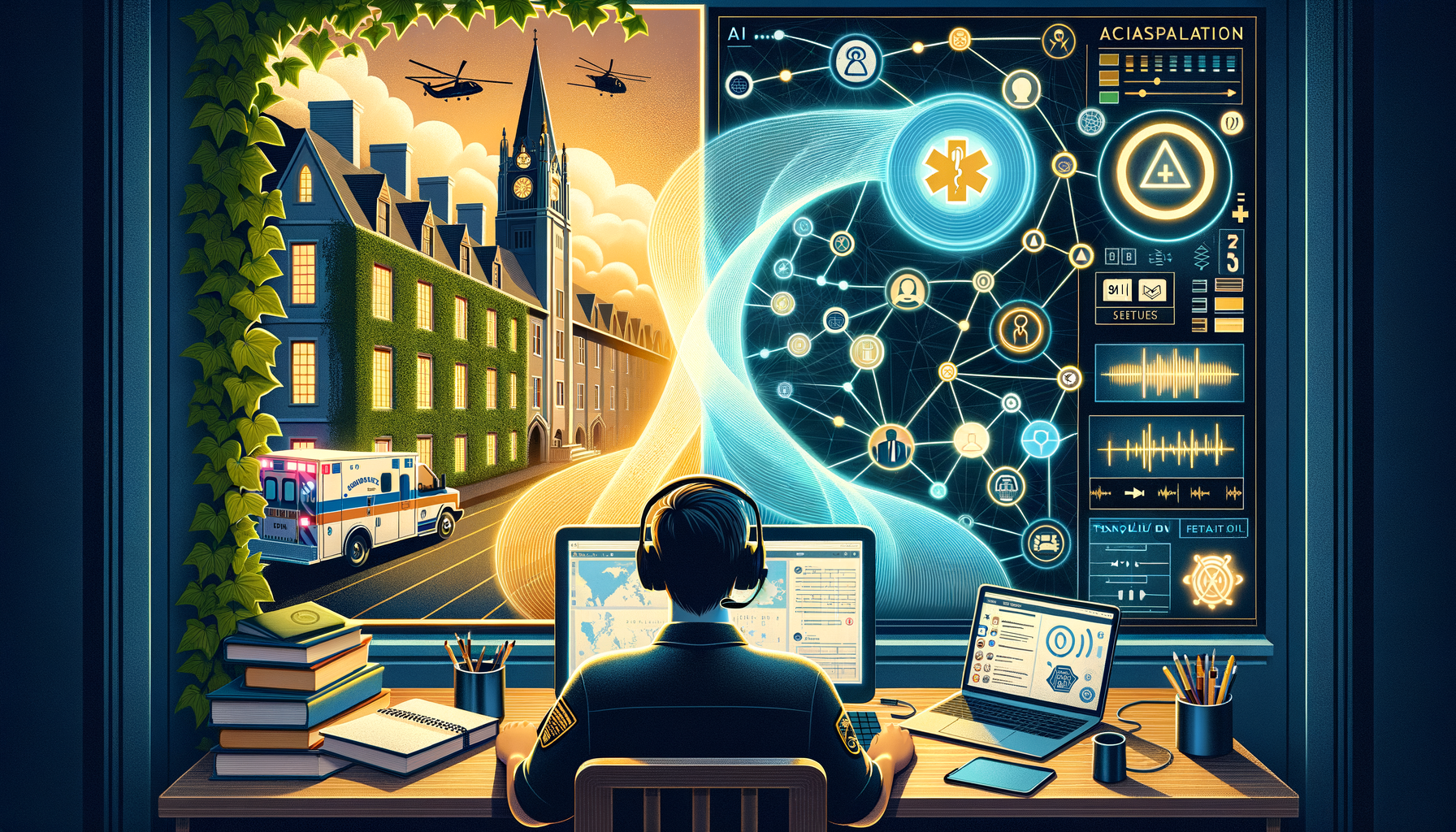
I’m fascinated by products that earn their right to exist in the toughest markets, and Prepared is one of those rare cases. Michael is the co-founder and CEO of Prepared, the AI assistant for 911 calls that helps dispatchers capture information faster, translate emergency calls in real time, and deliver lifesaving context to first responders. Founded out of Yale in 2019, Prepared grew from a school safety app into a critical platform for emergency communications, disrupting a notoriously tough market. This mission-driven journey just reached a major milestone: Prepared was acquired by Axon, the global public safety technology company.
From a product leadership lens, several choices stand out. The catalyst—tragically, school shootings—anchored the team’s conviction and sharpened their definition of value: every second saved and every bit of context delivered could change an outcome. That clarity enabled an unusual go-to-market motion for govtech: give away the first product for years to earn trust, validate workflows, and build a wedge that later expanded into an AI-driven suite. Counterintuitive? Yes. But in a market defined by risk, compliance, and procurement inertia, it was precisely the kind of strategy that compounds.
I’ve spent years navigating complex buyers, and Prepared’s approach to government and public safety agencies is a case study in disciplined product discovery. When systems are “so outdated,” pushing a modern layer requires empathy for the incumbent stack, forward deployed engineers who embed with users, and a readiness to translate mission need into procurement-friendly outcomes. It’s also a reminder that in govtech, distribution is a feature: partnerships, integrations, and interoperability often unlock more value than any single UX improvement.
One lesson I keep returning to is mission as competitive moat. Mission creates resilience during headwinds—endless rejections, long sales cycles, and the grind of security reviews—and it focuses prioritization when tailwinds arrive. Along the way, the team balanced conviction with customer feedback, asking not just “What did we hear?” but “Which signals matter?” That’s the only way to move from a wedge product to a robust platform without drifting into feature sprawl.
A few moments from the story hit me personally. Staying mission-oriented under pressure is more than a slogan; it’s the muscle memory of teams doing the work when no one’s watching. Negotiating an acquisition from a hospital bed underscores how founder endurance and timing often collide in ways you can’t plan for. And the self-aware quip—“I want to be terrible at sales”—captures a product ideal: build something so indispensable that champions sell it for you. It’s not anti-sales; it’s pro-traction.
On the AI front, Prepared’s evolution mirrors what I see across high-stakes operations: start with a narrow, high-value job-to-be-done and expand as trust accrues. Real-time translation and structured data capture are obvious force multipliers for dispatchers. Expanding the product surface area with AI requires rigorous guardrails, model performance transparency, and tight human-in-the-loop workflows—especially in public safety. That’s where gen ai earns its keep: augmenting judgment, not replacing it.
For founders and product leaders, here are the takeaways I’m carrying forward. Use a wedge that maps to urgent, measurable outcomes; then earn the right to broaden. Consider free or subsidized entry when trust and standardization are prerequisites to adoption. Treat procurement like a product: reduce friction, de-risk the choice, and make integration paths obvious. Balance conviction with a learner’s mindset to keep the signal-to-noise ratio high. And build investor relationships early and often so capital is an accelerant, not a lifeline.
If you’re exploring product-market fit in an enterprise or govtech context, ask the hard questions: How much should you listen to customers? Are you building in headwinds or tailwinds—and why? What partnerships both de-risk and differentiate? And when the mission is non-negotiable, how do you sustain it across phases—from first user to acquisition—without losing the soul of the product?
Where to find Michael:
LinkedIn: https://www.linkedin.com/in/michaelchime/
References:
Axon: https://www.axon.com/
Dylan Gleicher: https://www.linkedin.com/in/dylan-gleicher/
March for Our Lives: https://marchforourlives.org/
Neal Soni: https://www.linkedin.com/in/neal-soni/
OpenAI: https://openai.com/
Peter Thiel Fellowship: https://thielfellowship.org/
Prepared: https://www.prepared911.com/
Sam Altman: https://x.com/sama
Slack: https://slack.com/
Uber Eats: https://www.ubereats.com/
Yale University: https://www.yale.edu/
When millions of conversations flow through a platform every day, reliability isn’t just a technical metric—it’s the foundation of customer trust. I’ve learned the hard way that green dashboards can still mask red-hot customer pain. That’s why I push teams to focus on outcomes, not just infrastructure signals.
For me, reliability starts with one essential question: “Can our customers do the job they’ve hired us to do?” That single question cuts through complexity and forces a customer-outcome lens on everything from alerting to SLAs.
That mindset leads naturally to what I call “heartbeat metrics” — vital signs that instantly tell us if systems are truly serving their purpose. Think of them as a pulse check on real customer outcomes. If the pulse weakens, customers feel it instantly. A heartbeat metric is the clearest signal you can get that a product is alive and doing its job.
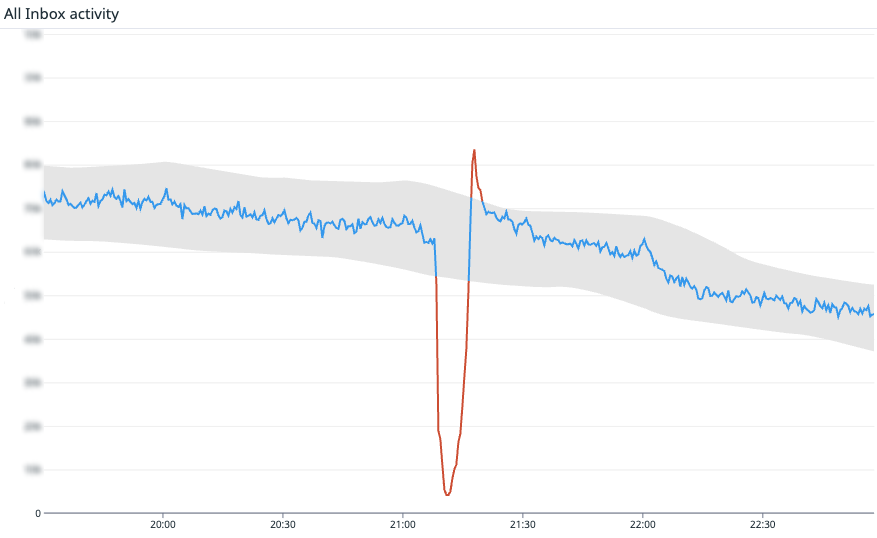
I’ve seen this put into practice at scale. At Intercom, where the AI Agent Fin resolves millions of customer inquiries autonomously, their fundamental heartbeat metric is the rate of new messages and replies across Intercom. For Fin, it’s successful AI responses. If those dip, it’s hitting the ability to connect. It might be a database failover, a misconfigured fleet, or a bad code change — it doesn’t matter. What matters is that it’s hitting customers’ ability to use Intercom.
Intercom isn’t alone. Amazon tracks order volume as their heartbeat. Affirm watches checkout attempts. If those numbers fall below expected levels, they don’t wait for a support ticket—they investigate immediately, because they know their customers’ success depends on it.
Not every metric qualifies as a heartbeat. The best ones share three traits: they’re directly tied to customer value (the main job your product is hired to do), high-volume and predictable (so anomaly detection can spot small drifts quickly), and binary in spirit (a drop is a clear sign something is broken, not just “a bit slower than usual”).
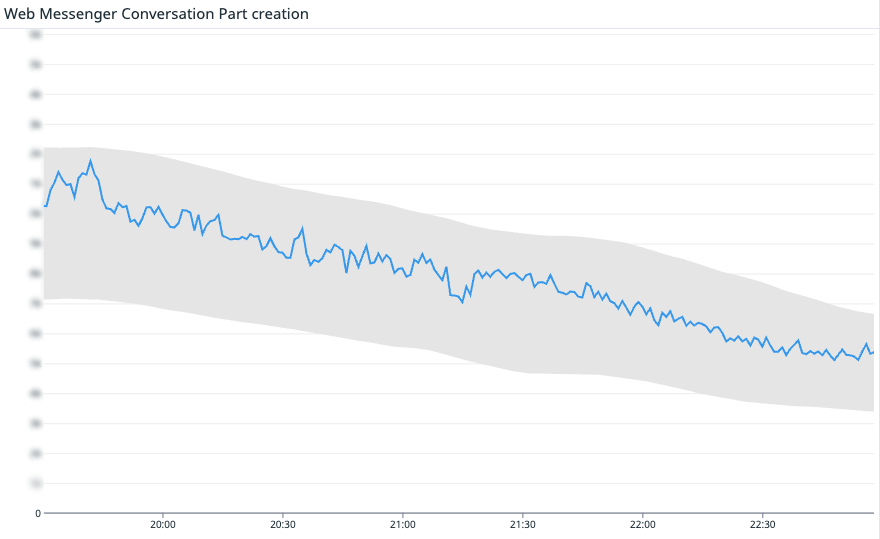
Stop watching servers—start watching customer impact. This chart tracks conversation-part creation over time; the blue line descends within a shaded band, indicating expected behavior and clear SLIs aligned to your SLA.
When we anchor on heartbeat metrics, three benefits show up fast: we detect issues faster than user reports or support tickets, we keep teams focused on what truly matters to customers, and we create a direct tie to our SLA—a system-level answer to, “Is the promise we made being kept?”
To be clear, I still monitor the usual suspects—latency, error rates, and infrastructure health. Heartbeat metrics don’t replace those; they complement them. They’re the fastest shortcut to understanding customer impact.
At scale, one pulse isn’t enough. Complex systems need multiple vital signs that reflect how different user groups succeed. Intercom started simple—are customers creating messages at the expected rate?—and then broke that signal down across core systems. Together, these metrics form a complete picture: Fin replies to your customers. Teammates reply in the Inbox. Teammates interact with the Inbox UI. Users on your website can message with the Web Messenger. Users on your app can message with the Mobile Messenger. If even one of them drops, it’s a major customer-impacting problem.
Speed matters when the heartbeat alarm fires. After months of reliable signal, automation becomes a force multiplier—paired with human oversight. Here’s what happens when a heartbeat metric drops: If we have just deployed new code to production, we automatically roll it back. Rolling back recent changes is a safe, and fast operation. We automatically create an incident in incident.io and page in engineering and an incident commander. If this alarm fires, it’s likely we will need our full incident response including status page updates. The system automatically suggests initial actions to first responders. For example, we use incident.io’s Investigations feature to get a head start on suggesting root causes.
This kind of automation pays off. On April 24th, a server issue slowed the Inbox, impacting teammates’ ability to use the Inbox. Heartbeat metrics caught it fast, and the issue was resolved in 10 minutes. End-user messaging was unaffected. This counted as downtime toward the SLA, with a full root cause analysis shared publicly here. That level of transparency keeps trust intact even when incidents happen.
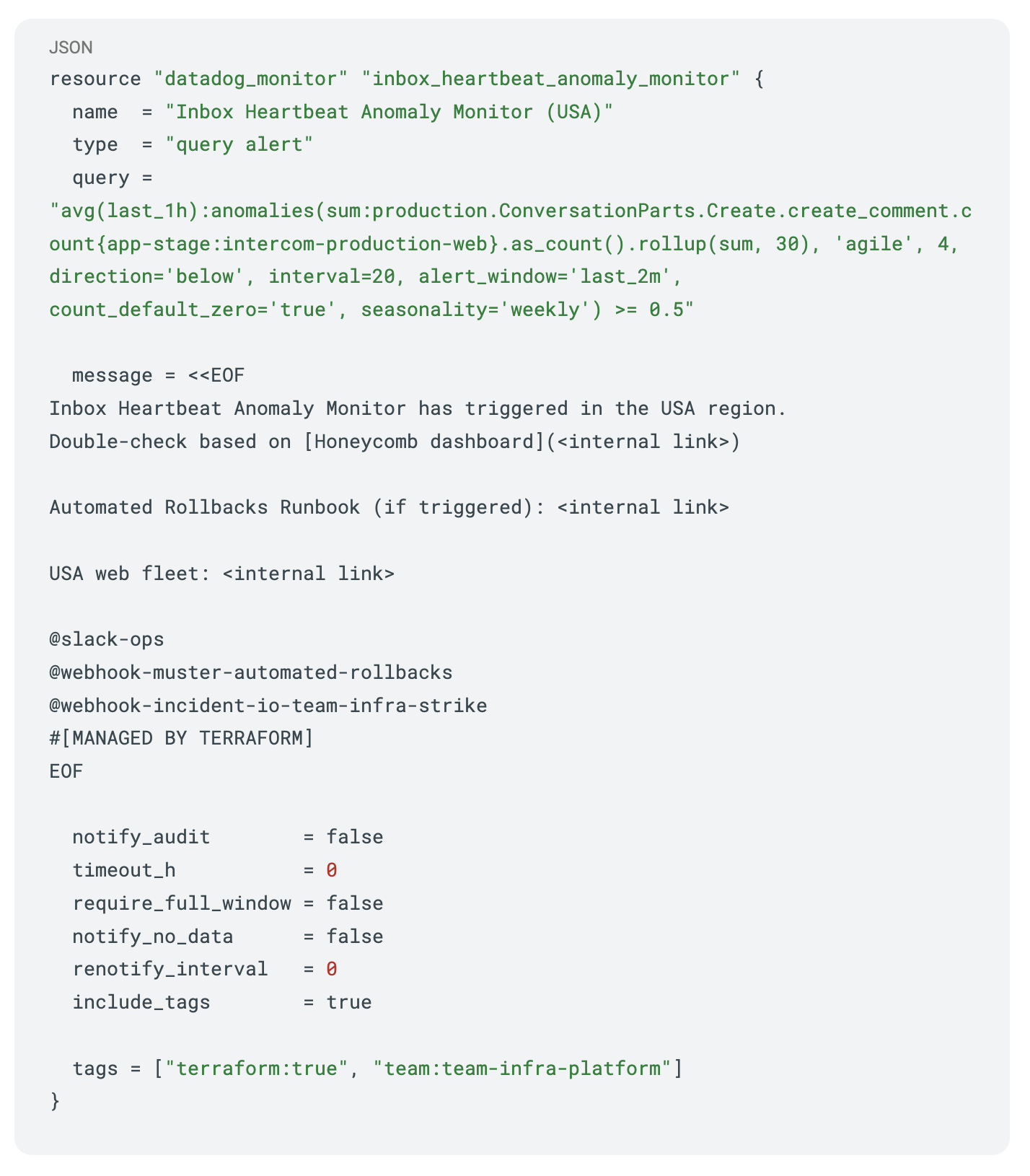
Outcome-first monitoring in action: a Terraform-managed Datadog heartbeat anomaly alert with Honeycomb double-checks, rollback runbook links, and Slack/webhook routing for SLA-conscious operations.
Where heartbeat metrics truly shine is in how they define and enforce accountability. They don’t just monitor; they inform SLAs in a way customers understand. Two independent SLAs matter most in this model: Core Platform SLA: If your team can’t reply in the Inbox or customers can’t message via the Messenger, that’s downtime. Fin SLA: If Fin cannot generate text answers, we record downtime.
Measurement matters. Many status pages stay green as long as an HTTP probe returns 200 OK, even when users are stuck. Heartbeat metrics close that gap by checking real customer outcomes, not just server responses. I also favor anomaly detection—tracking expected patterns over time and flagging when something looks off—and tooling that lets us drop to a per-customer level when we need to understand individual impact.
If you don’t have a heartbeat metric yet, start simple. Pinpoint your product’s must-do job—the one thing customers must accomplish to succeed. Choose a metric with volume so you can detect drifts quickly, not just total failures. Make it binary in spirit so a drop clearly signals breakage. Hook it to your alerts so it’s loud and reaches the right responders. Use it to align teams on what to do when the heartbeat falters. And stick to it, 24/7—reliability isn’t a 9-to-5 job.
For monitoring, I like practical guardrails. Here’s a Datadog monitor pattern I recommend for an Inbox-style heartbeat (Terraform syntax, simplified for clarity): keep a tight baseline window, alert on negative deviations beyond statistically expected ranges, auto-page responders, and attach standard operating procedures for immediate rollback and incident initiation. It’s simple, auditable, and fast.
Modern systems grow more complex every quarter. The question that matters stays refreshingly simple: “Can our customers do what they came here to do?” Build a reliability heartbeat that answers that question in real time, and you’ll keep your teams honest, aligned, and fast. Define yours—it might become your most valuable signal.
How do you lead a support team in this new world with AI metrics? That question has been front and center for me as we integrate AI-first customer service tools into our daily operations.
The technology is amazing, but our assumptions and processes for understanding and leveraging AI metrics are very different from traditional support metrics. Our new CX Score is the perfect example.
Two months ago, we launched CX Score – a new way to analyze every single conversation and give you a complete view of your support experience. I was genuinely excited as someone who’s battled with CSAT survey mechanics, teammate exclusion processes for CSAT, and the nagging truth that this is only a small portion of our volume. As we’ve navigated CX Score, we’ve learned lessons that apply broadly to AI metrics. Two takeaways stand out for me.
First, lots of data calls for new processes. One of the first things we noticed was the sheer amount of data. For better or worse, CSAT was a small enough sample size to review every comment – particularly unhappy ones. Our QA team would read and categorize each response, and follow up with customers. Managers would read most comments for their team (~15 in total per manager), and discuss in 1:1s.
But what do you do with 1,600+ reviews across the org? This is the reality of AI metrics, and when you have more data than ever before, the old processes don’t scale. We briefly tried reviewing all unhappy CX ratings. We tried taking a sample, but this felt just as limited as CSAT. We exported the trends and conversation data back into an LLM for analysis, but without in-depth prompting the results were only okay.
What worked was reframing how we use the signal. Because CX Score is great for reviewing trends, we use it to measure week-over-week performance for both Fin and as a team wide KPI for human support. We also use CX Score to review specific targeted areas, like a new hire’s conversations on a certain product area. And we use it to review the customer experience for a group of customers, or to analyze a customer’s entire case history so we can lean in at the customer level.
An isometric blueprint reveals how an AI agent powers modern support—from triage to resolution—linking chat, knowledge, and workflows so teams scale service without losing accuracy, context, or the human touch.
Second, the complexities of AI mean we won’t always know the “why” – and that’s ok! People naturally want to know “the why” – especially support folks. When we started using CX Score, one of the biggest challenges was the team wanting to dig deeper into why a specific score was given. While the score provides a great overview, people wanted a detailed, step-by-step explanation. But LLMs are mostly a “black box” – especially to the everyday person. As AI becomes more and more ingrained in our work, we’ll need to accept not always knowing every detail.
This required a mindset shift for both the wider team and leadership as we moved into a world of AI metrics. We focused on the outcome vs. the process, celebrating positives and highlighting insights and actions previously impossible with only CSAT. We refused to compare to humans, reminding ourselves that many of the unknowns of AI are equally true with humans; even with a large survey, we never know for sure how customers feel. And we acknowledged emotions. Our Ops Manager William would poll the leadership team in our weekly ops meeting, asking, “In one word, how did the CX Score make you feel last week?” That simple ritual gave managers space to surface wins and challenges, and it kept us grounded.
What’s next is continuing to revamp how we work and adjusting our collective mindset for AI tools and metrics. The pros highly outweigh the cons, so I encourage you to jump in and start experimenting with AI metrics, especially where they can augment customer experience, operational cadence, and product feedback loops.
Lastly, this technology is improving very quickly. Just yesterday we added deeper AI explanations and additional attributes to explain the CX Score and aggregate summaries across topics. I’m excited to try it out!
Subscribe to The Ticket here – a bi-weekly LinkedIn newsletter delivering key insights for customer service professionals in this time of mind-blowing change.
In my role leading product management and partnering with forward deployed engineers, I’ve worked with countless companies on AI adoption. Across sizes, budgets, and ambitions, I see the same pattern: teams start with the right intentions and still end up disappointed.
The problem isn’t that AI doesn’t work. The problem is that AI done wrong wastes time, money, and trust — and most teams aren’t set up to vet tools, ask the right questions, or structure implementation for success.
To help teams evaluate and deploy with confidence, I often point leaders to The AI Agent Blueprint. It’s a practical roadmap for a moment when everyone’s trying to figure out what comes next.
In this post, I share the lessons I wish every team had before they started. Whether you’re evaluating a solution like Intercom’s Fin or just exploring what gen AI can do, these are the patterns I rely on to make smart, scalable decisions.
Core concepts to help you vet AI solutions like an expert
Before we get into the common pitfalls, let’s cover a few key concepts. You don’t need to become an engineer to thoroughly evaluate AI Agents, but you do need to understand a few foundational terms. This knowledge will help you:
– Ask sharper questions during demos.
– Spot red flags in vendor pitches.
– Choose scalable, future-proof solutions.
– Guide internal alignment and buy-in.
– Build confidence in your final decision.
A little technical fluency goes a long way. Keep in mind these are just a few of the many terms out there. But here are the ones I’d suggest getting comfortable with today:
Retrieval-Augmented Generation (RAG)
RAG enhances generative AI by pulling in real-time, relevant information from your company’s data sources before generating a response.
Why it matters: Most AI tools claiming to “know your business” only use pre-uploaded or static training data. RAG-based systems dynamically search live sources like help centers, product docs, or internal wikis, making them far more accurate and adaptable (assuming your data hygiene and permissions are in good shape).
Easy way to remember: Think of RAG as an AI assistant with an open-book exam. Instead of relying only on memory (pre-trained data), it searches for the latest, most relevant information before responding. This makes RAG especially useful for AI Agents, customer support systems, and AI-driven search engines, ensuring responses are more accurate and up to date.
Vector search
Vector search enables AI to match by meaning, not just keywords. It converts both the user’s question and your documentation into numerical vectors and retrieves the closest semantic match even when the phrasing differs.
Why it matters: Without vector search, your AI may only work if the user phrases things “just right.” With it, users can speak naturally and still get the correct response.
Easy way to remember it: Vector search is like finding a song by its vibe, not its title. It works by intent, not exact match – essential for intuitive AI experiences.
Agentic AI
Agentic AI goes beyond answering simple questions; it can initiate actions, pursue goals, and carry out multi-step tasks.
Why it matters: Most AI tools today are passive. They only respond when prompted. Agentic AI drives outcomes. For example, Intercom’s Fin is evolving to handle actions like checking order status, triggering refunds, or escalating issues, all without human involvement.
Easy way to remember it: Agentic AI is like a rockstar project manager, not just a note-taker. It doesn’t just reply with information when simple questions are asked. It plans, acts, and follows through to get the job done.
MCP (Model Context Protocol) Server / Client
MCP is an emerging approach for managing AI agents at scale. It involves three core components:
– The model (the AI system itself).
– The context (what data and information it can access).
– The protocol (the rules for how it talks to other tools and data).
Why it matters: As AI gets embedded across your organization, centralized governance becomes critical. MCP ensures agents act within rules, respect permissions, and scale responsibly – without needing to hard-code logic into every use case.
Easy way to remember it: Think of MCP as a control tower for your AI agents. It manages what they know, what data they can use, and what boundaries they stay within.
Understanding concepts matters because they help you ask better questions and spot red flags during vendor evaluations. But understanding terminology alone isn’t enough.
Common mistakes I see teams make
Here are five mistakes I see even well-informed teams make, and how I advise product and support leaders to avoid them.
Mistake #1: Treating all AI tools the same
The AI space is moving fast. It’s a constantly evolving landscape and full of buzzwords, which can create confusion. I often see teams treat “chatbots” and AI Agents as interchangeable, without realizing there’s a massive difference between things like:
– A legacy rules-based bot with generative copy slapped on top.
– A true agentic AI system that takes action, learns from context, and scales with your business.
If you don’t understand core terms like RAG, MCP, or the differences between LLMs and agentic AI, it’s nearly impossible to ask the right questions during your evaluation process. I’ve heard of too many teams buying solutions that are outdated or require heavy upkeep after deployment. Educating your team on the fundamentals gives you the confidence to separate real capability from flashy demos.
Mistake #2: Assuming you can build it in-house
There’s a real cost and complexity of building AI Agents internally – orchestration, retrieval systems, prompt chaining, governance, and more. It’s not just a weekend project. It’s a long-term infrastructure investment. And for most companies, it quickly becomes a distraction rather than a differentiator.
Many teams assume building their own AI Agent will be faster, cheaper, or more flexible than buying. On paper, it sounds reasonable – especially if you’ve got a strong engineering team, access to top-tier models, and a healthy budget. But in practice, that path is much harder than it looks.
I smile writing this because I’ve been there. I’ve built multiple AI apps on nights and weekends. Early wins feel amazing — then reality sets in. Shipping something truly polished, even at tiny scale, demands far more infrastructure, reliability work, and governance than most teams anticipate.
At a company level, those challenges only grow. Building an AI Agent from scratch means committing to:
– Data chunking, embedding, and relevance tuning.
– Prompt chaining, context management, and hallucination reduction.
– Real-time retrieval architecture and RAG pipelines.
– Fine-tuning, model upgrades, and fallback orchestration.
– Security, permissions, audit logs, AI governance… and so much more!
Even well-resourced teams often circle back to buying after burning time, money, and momentum. The true cost of building isn’t just engineering — it’s maintenance and velocity. High-performing teams focus on their differentiators and partner for the rest.
Mistake #3: Betting on the wrong vendor
I often see teams focus too narrowly on slick demos or assume a vendor will “figure it out later.” In a market moving this fast, that’s a risky bet. The result is a tool that can’t keep up, needs constant hand-holding, or becomes too rigid to scale.
The best vendors learn quickly, ship frequently, and keep driving value. When I evaluate, I ask:
– Is the vendor investing meaningfully in AI R&D?
– Does their team have a clear roadmap for improvement?
– Can this system adapt to your workflows without needing engineering support at every step?
– How much ongoing maintenance will be needed?
These questions separate vendors building for tomorrow from those selling yesterday’s technology. You want a partner who’s staying ahead, not catching up.
Mistake #4: Ignoring your internal foundation
Even the best AI Agents need fuel. Your content and systems are the inputs that determine quality. If your help center is outdated, documentation is thin, or APIs are missing, you’ll get “garbage in, garbage out.”
I’ve watched teams buy best-in-class AI and still stall because they hadn’t invested in the inputs that make it powerful:
– A well-structured help center.
– Clear, detailed documentation.
– Internal process visibility (for things like internal AI/copilot).
– Robust APIs.
You don’t need to overhaul everything on day one. But clean, accessible content dramatically improves accuracy, confidence, and resolution rate.
Another misconception is expecting AI to resolve 100% of support conversations immediately. In reality, no AI tool starts at perfection — and your team needs a shared understanding of how resolution rate works to set expectations.
For context, Fin typically resolves over 65% of support questions out of the box, with minimal training needed, and continues to improve month-over-month. What separates great implementations isn’t just where you start; it’s how you optimize. Tightening content, closing automation gaps, and iterating on prompts and retrieval all compound over time.
If you’re not tracking your current resolution rate or don’t know how your vendor defines it, it’s hard to see progress. Establish a baseline, set realistic targets, and measure consistently. Treat resolution rate as a growth metric, not a fixed score.
Final thoughts
The teams that win with AI don’t just adopt tools — they implement future-proof systems that connect knowledge, workflows, and decision-making to drive real business outcomes.
– They don’t build everything from scratch.
– They don’t fall for flashy demos of stale technology.
– They partner with vendors already building what’s next.
If your team is exploring AI — whether you’re starting fresh or rethinking your stack — start with the concepts and lessons here. Use them to evaluate options, align stakeholders, and choose partners who are building what’s next, not just what’s trendy.
And if you want a broader strategic roadmap, The AI Agent Blueprint is a great place to dive deeper. It lays out how to go from launching an AI Agent to building successful systems that scale and drive real business value.
AI isn’t just a trend. It’s a capability your business will depend on. Done right, it becomes your most powerful teammate.
Rolling out an AI Agent doesn’t just change how your team works – it changes who your team is.
I learned that in the crucible of a fast-moving launch. Before we launched Fin publicly, our Support team became its first alpha/beta tester and we had to move fast. No roadmap. No step-by-step guide. Just a powerful new technology, and a steep learning curve.
That experience is exactly what led us to create The AI Agent Blueprint – a resource we wish we’d had when we were starting out, and one we hope will give other support teams a clearer path forward.
Looking back, I won’t lie and say I was cool, calm, and confident about how to do this – I was nervous as hell. I had no idea how to implement an AI Agent and ensure it resulted in huge cost savings and stellar customer experiences.
We had older machine learning technology available to us (shout out to our first-gen chatbot, Resolution Bot), but as a complex software business, we really only used it for basic FAQs. In all honesty, we still had a way to go – both in using automation more effectively and in making the chatbot experience actually enjoyable for our customers.
So why the urgency?
When ChatGPT burst onto the scene nearly three (!!) years ago, Intercom’s Machine Learning team immediately spotted the opportunity and dived into building the world’s first (and objectively best) AI Customer Service Agent.
Suddenly, we were being asked to pilot this brand new technology with real customers and go all in ASAP. Because we were selling this powerful new functionality, we had to use it ourselves and show it off in the best possible light so customers would want to use it too. #nopressure
There was no playbook, just a lot to figure out. As a product management leader, I had to switch into rigorous product discovery while staying execution-minded.
Steady involvement, rising resolutions. From February to July, teams maintain a high 87–93 involvement range as resolution rates climb from 65 to 82—signaling how AI-driven workflows can boost support efficiency and outcomes.
How do we do a phased rollout, but scale very quickly?
How do we QA Fin’s responses and make continuous improvements?
How will we produce and manage all the content Fin needs?
What will we do about all the outdated content we already have?
What are the success metrics now? Should they be different to original Support KPIs?
Who’s responsible for the success metrics? Who manages this newcomer to our team?
It was daunting. We had to take a brand new technology, figure out how to use it, build a team around it, and move at breakneck speed to implement every new feature that rolled out. It was ambiguous, fast-moving, and a massive lift.
But we got there and the results speak for themselves: Fin is now resolving over 75% of our inbound support volume.
An isometric blueprint reveals how an AI agent powers modern support—from triage to resolution—linking chat, knowledge, and workflows so teams scale service without losing accuracy, context, or the human touch.
That outcome didn’t happen by accident. We embedded forward deployed engineers with Support, treated our AI Agent like a product creator in its own right, and used gen ai for product prototyping to tighten our iteration loops. We prioritized a customer support AI strategy that balanced containment with quality: containment rate, CSAT on AI-resolved conversations, first-response latency, and recontact rates became our core scorecard.
That success led to real change for me and my team: new roles, new responsibilities, and new career paths. I now run a whole new function that didn’t exist before: AI Support. We’ve created new and elevated roles like Conversation Designers and Knowledge Managers. Fin hasn’t just changed how we support customers – it’s transformed the structure of our team and the trajectory of our careers.
And now, we’re helping our customers do the same.
In all transparency, if I hadn’t been this close to the work, I might have waited to see how generative AI played out before committing. I might have waited for a blueprint for how to deploy and scale an AI Agent. I wish I had something like that when we got started, or even later when we had a solid foundation but needed to scale our AI strategy.
How much less scary would it be to implement an AI Agent if something like that existed?
Whether you’re just getting started or already using AI in some way, you’re not early anymore—and you shouldn’t have to figure it all out alone. Strong product management leadership, a clear change plan, and tight feedback loops are what separate experiments from outcomes.
That’s why we created The AI Agent Blueprint – a practical map for launching and scaling AI in support. It brings together everything we’ve learned from our own journey, and from working closely with our customers who are doing the same.
If you’re ready to operationalize gen ai in support, align on the right metrics, and redesign roles for the future, this blueprint will help you move from pilots to pervasive impact with confidence.
Bold, pragmatic bets separate teams that merely deliver from teams that truly accelerate. As a product leader, I’m drawn to decisions that reduce friction, empower engineers, and compound over time. Intercom’s recent investment in a new frontend direction is a standout example of this mindset—and it offers lessons any product, engineering, or design leader can apply.
Over the past two years, Intercom made one of the most significant changes an engineering organization can make: moving its core frontend from Ember to React. That choice fits a clear pattern of high-agency decision making in service of speed, quality, and developer experience.
Back in 2014, Ember was the right call for their main application. Its strong opinions and “batteries-included” approach aligned with a strategy I respect: make big decisions once, enable teams to move fast, and spend energy on customer problems instead of endless architecture debates. The result was scale few achieve—more than two million lines of code and 100,000+ pull requests merged.
I’ve been in the room when constraints outgrow the original bet. By 2023, “local builds stretched beyond 90 seconds,” and they were stuck on older framework versions that blocked adoption of modern build tools. Even with deep community engagement and contributions to the Embroider Initiative, the cost of staying put was compounding. Something had to change.
What I admire is the rigor behind their pivot. They ran workshops, health checks, and set explicit trigger conditions—then honored those triggers. When the evidence crossed the threshold, they chose a new path and framed the work with a clear, galvanizing banner: “The Future of Frontend.” That’s the kind of governance and narrative clarity that de-risks large platform shifts.
React quickly emerged as the right fit—not because of hype, but because it met practical criteria at scale. “React was already a core technology at Intercom (powering Messenger, Help Center, and our marketing site),” backed by a robust ecosystem, strong documentation, and broad familiarity internally and across the industry. Most importantly, it integrates naturally with AI-driven developer tools—a non-negotiable for the next decade of engineering productivity.
Fast forward to today, and the momentum is clear. “React is now the default for new UI development at Intercom.” That single sentence says a lot about organizational alignment and execution readiness.
The outcomes speak for themselves. “Blazing fast feedback loops: React builds in under 10 seconds locally, with sub-1s rebuilds – much faster than our Ember app’s 90+ seconds.” That kind of drop in cycle time unlocks more iteration, tighter designer–engineer collaboration, and faster learning loops.
Speed without joy is a half-win. “Higher developer velocity: Engineers consistently report being faster, happier, and more effective, particularly when paired with AI tools like Cursor, Augment, and Claude Code.” I’ve seen similar effects: once teams feel flow again, quality and ambition both rise.
Adoption at breadth matters as much as depth. “Wider adoption: Since March 2025, 10+ Product teams have shipped React features, contributing over 840 pull requests.” That level of traction signals a platform shift that’s not just technically sound but operationally viable.
The AI-enabled developer experience is the real unlock. “AI synergy: React just “clicks” with modern AI tooling. Designers and engineers are using agents to write code, generate components from Figma, and even build design playgrounds themselves.” That’s the future: product creators working in shared, generative environments where ideas move from Figma to code in minutes.
One engineer captured the productivity gain perfectly: “The work I had predicted would take me a week to achieve took me two days”. That’s not a marginal improvement—that’s a step-change.
This story isn’t just about frameworks; it’s about preparing for a decade where velocity, AI-native workflows, and developer experience determine competitive advantage. The ambition to “double our productivity over the next 12 months” requires removing friction, leaning into AI, and standardizing on tools that compound learning across teams. React is a pragmatic enabler for that journey.
I also appreciate the organizational design behind the change. A small, focused group—Team Frontend Tech—partnered tightly with Product teams to shape the new stack, build a design system, and accelerate adoption. That model creates a high-trust bridge between platform and product, which is essential for landing a migration at scale.
For leaders navigating similar crossroads, the playbook is clear: set explicit trigger conditions, articulate the future state, pick a stack that compounds with AI, and invest in a cross-functional nucleus to shepherd adoption. For engineers and designers, this is an exciting moment—one where your tools finally catch up with your ambition.
The takeaway I’m carrying forward: make the bold call when the evidence is conclusive, optimize for feedback loops and flow, and treat AI as a first-class partner in the creative process. That’s how we keep shipping fast, raise the quality bar, and focus on what really matters—solving meaningful problems for customers.
Over the past 18 months, I’ve watched the ground shift under support leaders. For many support leaders, the world before and after AI feels drastically different—and I feel it too.
Rewind to before Q1 of 2023, and while the details varied, the challenges support leaders faced were largely the same as they had been for decades. Before AI, support leaders were tasked with improving the customer experience with under-resourced teams; finding ways to improve the cost-to-revenue ratio; preventing team attrition (despite managing people with difficult jobs and low compensation); and representing customers’ needs to teams with competing priorities.
Support was expected to operate behind the scenes, often absorbing work from other departments. Despite being essential for customer retention, it was still viewed primarily as a cost center, and leaders rarely had strong executive advocacy. Those conditions sharpened valuable muscles—creativity, scrappiness, and people leadership—but they didn’t prepare most teams to operate in an AI-first world.
Now with AI, the mandate has expanded. The core responsibilities persist, but the “how” has changed. Leaders are suddenly expected to be AI experts, spearhead large AI implementation initiatives, and keep operations rock-solid while the plane is being rebuilt mid-flight.
They’re being asked to step out from behind the scenes to center stage and lead the company in its first large adoption of AI. They’re being asked to regularly communicate with executives who previously had little interest in their initiatives or ideas. They’re being asked to run high-lift, high-impact, cross-functional projects without the infrastructure in place to manage it. They’re also now expected to hit AI performance metrics that an executive heard somewhere were possible—targets that might be unrealistic for the actual use case.
Oh, and if they fail, they’ll likely lose their job. And if they succeed, they could cause job loss for their team members. I’ve felt that tension firsthand: accelerate AI to drive outcomes, while also protecting the humans who make your customer experience exceptional.
It’s tempting to wait for the storm to pass—to delay AI change until someone else takes it over and hope they don’t undo what you’ve built. I’ve seen that playbook, and it rarely ends well.
There’s a better approach: harness the storm’s energy to elevate your customer experience, your team, and your own influence.
Harnessing AI’s momentum
This new era can reduce your support operation to a transactional, robotic experience—or transform it into what you’ve always envisioned. The outcome depends on how you respond to the demand to implement AI. This is one of the most unique opportunities of your career: you will have your executives’ attention, unprecedented access to product and engineering resources, and far less friction persuading stakeholders that change is essential for customers and the business.
With the right plan, you can reframe your team from cost center to value driver, expand services instead of sweating basic metrics, and move from surviving to thriving.
Here are the three areas I encourage every support leader to master.
Become the AI subject matter expert
Start by learning. Understand what is actually possible with AI now, and what may be possible in the near future. Go at least a layer or two deeper than the average person using ChatGPT. Know what it takes to implement more than a glorified answer bot—especially if your goal is end-to-end resolution, not just deflection.
Then anticipate the pitfalls I see most often in AI adoption.
Not digging deep enough with vendors. Demos often look similar and impressive with minimal lift. The truth emerges in a proof of concept. Run multiple trials with different vendors to uncover real capabilities and limitations—and to calibrate what “good” looks like for your environment.
Only finding a technology solution, not a partnership. Many tools can deliver similar outcomes; partners are not interchangeable. Choose a vendor whose values align with yours, who will support your use cases post-sale, who moves at a pace you can absorb, and who is committed for the long haul (not merely positioning for acquisition in a year or two).
Not knowing what good actually looks like. Ask each vendor about AI involvement rate and AI resolution rate. Ask what AI CSAT typically looks like in your industry. Document these answers to build benchmarks and set realistic expectations with executives.
Not learning from others’ mistakes. Many teams have overestimated AI’s impact and underestimated the human resources still required. Some laid off hundreds of support team members—only to rehire later—damaging their brand and wasting resources. Move with purpose and pace, but not so fast that you repeat these mistakes.
Not communicating your plan effectively. Be able to articulate why deflecting 50% of inquiry volume does not equal a 50% headcount reduction. Cite logistics like coverage windows and redundancy for SLAs, growth needs, natural attrition, and all the non-inquiry work your team handles. Practice a concise, compelling rationale for executives.
Create a clear AI plan
Your company is in uncharted territory. Unless you’ve hired a specialist recently, none of your executives have deployed AI in support. That makes you the most qualified person to draw the map and lead the way. Here’s what your plan should include.
1) A vendor evaluation plan. Define how you’ll research providers, who advances from demo to trial, how many you’ll test, and in what timeframe. Establish criteria for what AI must accomplish and the effectiveness and quality metrics you’ll use to evaluate it.
2) Implementation phases. AI is not a “set it and forget it” tool. Because AI touches customers so quickly, mitigate risk with phased rollouts. Phases don’t have to be slow—just deliberate. Sequence by audience, use case, and channel, and publish a clear timeline so cross-functional partners can plan resources.
3) How you’ll measure success. Reuse your evaluation metrics and go deeper. Track AI involvement rate and AI resolution rate (together, your deflection rate). Measure quality through CSAT and CX Scores, and run regular QA. Quantify impact on your support cost-to-revenue ratio—your CFO cares deeply about this.
4) How your team will use reclaimed time. If your AI program frees 20% of capacity, what value will you create? How will you improve the customer experience, drive revenue or retention, and upskill your team? Quantify the upside and set milestones for capability-building and value-added work. If you fail to plan this, you will be pushed to let too many people go.
5) How you’ll report on progress. Communication failures sink AI programs. Align with your executive sponsor on format and cadence, then over-communicate—regularly, clearly, concisely. You can’t afford to under-communicate.
Own the initiative at a higher level
Support leaders are great at taking ownership, often absorbing projects other teams drop. This initiative is different: it’s highly visible and enterprise-critical. Treat it like a flagship product rollout.
Project management. Use a tool your team can execute in and that lets you summarize progress succinctly for executives. Borrow best practices from your product managers and signal early that you’ll be partnering with them. Learn your sponsor’s preferred update style and tailor to it.
Communication. Overcommunicate—with brevity and rhythm. Don’t let a week pass without your sponsor knowing status. For executives, I recommend weekly or bi-weekly updates with a one-line summary, three impact statements, and a link to the plan. For example: “Saved customers 30K waiting hours M/M,” “Improved full resolution time by 30% M/M,” “Next initiative will improve X metric by Y%.”
Showcase your thought leadership. Reference industry benchmarks proactively when you set goals, and reactively when questions arise. Having succinct, data-backed answers that tie to benchmarks signals expertise and builds trust.
The storm is here—what will you do?
The pressure around AI is intensifying and isn’t fading anytime soon. This storm can crush your team as you know it—or become the wind under your wings that elevates your support operation to its maximum potential. The choice is yours: wait and risk cuts, or step up as the support AI expert, form a plan, and transform your team into a value engine. I’ve chosen the latter—and I invite you to do the same.
At Pioneer 2025, Fin 3 was announced as the most capable AI Agent yet for resolving deep, complex queries across every channel. As a VP of Product Management, I’ve been eager to see whether an agent can match concierge-level service at scale—and this is the first time I’ve seen the pieces come together in a way that genuinely raises the bar for customer experience and operational efficiency.
The goal is simple and ambitious: give customer service teams the tools to deliver concierge-level service to every customer, every time. To do that, the team built Fin 3 and invested deeply in the Fin Flywheel—train, test, deploy, and analyze—so the system learns faster, behaves predictably, and performs consistently across channels like Voice, Slack, and Discord.
The evolution here matters. We’ve come a long way since we launched Fin 1 just over two years ago. It was the very first AI Agent for customer service and focused on using your knowledge content to resolve informational queries, enabling it to do all frontline support and free teams to do higher-level work. Then we launched Fin 2. It answered the question of whether AI Agents could deliver human-quality service (it could).
Since we launched Fin 2, its average resolution rate has continued to climb to 66% across our 6,000+ customers. Over 20% of our customers are getting above 80%.
Those numbers are impressive, but they revealed an important truth I’ve seen across many product organizations: resolution rate isn’t the whole story. Answering a quick FAQ in chat isn’t the same as investigating a payment dispute or verifying a refund over the phone. The real measure to optimize is automation rate—the share of overall workload handled end-to-end. Fin 3 is built for that frontier, with a focus on two levers: solving increasingly complex queries and expanding into more channels.
Procedures are the big breakthrough for training. They let teams encode multi-step workflows and nuanced business logic—like troubleshooting login issues, handling return requests, or investigating potential fraud—so Fin can resolve them from start to finish. In practice, that means Fin is trained to follow your standard operating procedures carefully while exercising judgment just like a seasoned teammate.
1. Natural language instructions
Teach Fin the same way you’d train a new teammate. You can copy and paste your existing SOPs straight in (most support teams already have them written up in Google Docs or Notion) and describe how Fin should act using natural language. The editing experience feels familiar and lightweight, so teams can start writing Procedures immediately without needing engineers or special syntax.
2. Deterministic controls
When a Procedure needs more structure or precision, you can layer in deterministic elements. Data connectors let Fin check information or take actions directly in your tools. Conditional steps handle decision points (for example, whether a refund should be approved) so Fin’s behavior is consistent and predictable. And when absolute accuracy is essential, you can add small code snippets that guarantee the same input always produces the same output. You can also add checkpoints where Fin pauses for approval or hands off to a teammate before taking certain actions, keeping sensitive workflows under human control.
3. Fully agentic behavior
Conversations rarely follow a happy path. Procedures are designed so Fin reasons in real time, moves up and down steps, or switches between Procedures without getting stuck. If a customer changes an answer, Fin adapts and continues naturally. The result is a fluid conversation that still follows your process end-to-end.
4. AI Assistant support
AI Assistant helps teams write and maintain Procedures faster. You can start with a brief overview and supporting documents; it drafts an initial version based on what Fin already knows from your knowledge base and past conversations. As you expand, it suggests additional controls or generates boilerplate code for API connectors, lowering the barrier to entry and accelerating iteration.
Together, these elements let Fin reason like a human with the precision of software. Most teams can begin with no-code or low-code Procedures and bring in engineering only for advanced integrations. That balance of power and control is exactly what high-performing support leaders need.
“Support needs natural conversation and control. Procedures optimize for both – agentic where you want it, designed where you need it – rather than a generic agent builder.”
– Chris Dalley, Director of Product Management at Intercom
Of course, adding agentic power requires robust testing. That’s where Simulations come in. Real-world workflows explode into dozens of paths across policy thresholds, customer states, and edge cases. Manual testing won’t scale, so Simulations let you pick any Procedure, choose a user or segment, and run a full, multi-turn simulated conversation from start to finish. You see exactly how Fin reasons and where to refine, then re-run as needed.
AI Assistant is integrated here too. If a Procedure needs an adjustment, it suggests changes you can accept with a click. It also recommends additional Simulations for complex Procedures to ensure coverage. As you create scenarios, you store them in a Simulation library so that when products, policies, or teams change, you can run the entire suite to catch regressions early. This is how you build confidence that Fin behaves exactly as intended while your automation expands.
Channel coverage is equally critical for customer service. Customers expect help wherever they are. Fin already works across more channels than any other AI Agent, and now it extends to Slack and Discord with meaningful upgrades to Voice.
Fin in Slack feels native—threaded replies, proper formatting, and controls to determine when Fin responds versus when a human steps in. If a teammate joins, Fin automatically steps back. Every interaction is logged for reporting and analysis, which matters when you’re tuning automation rate and resolution quality.
Discord support brings the same benefits to communities that increasingly serve as support hubs. Meeting customers where they are is how you compound both satisfaction and efficiency.
Voice has evolved dramatically since launch, and this matters because phone expectations are different. Rather than waiting on hold, navigating IVRs, or getting one-word answers from a brittle bot, customers get immediate, natural conversation. Since we launched Fin Voice, we’ve added much more power and configurability: better guidance, more customization, better testing and deployment, and call transcripts and summaries. These make Voice practical to run at scale.
Voice isn’t just chat with speech. Latency must be low because long pauses feel wrong. Answer shape matters—shorter, chunked replies outperform long paragraphs. Interruptions and endpointing are the norm, so the Agent must detect when to talk and when to listen. And cost pressures are higher on phone, which makes automation even more valuable.
How natural the Agent sounds shapes customer trust. When a voice bot sounds robotic, people assume it’s limited and escalate immediately. Fin avoids that by speaking naturally, pacing correctly, and adjusting tone as it listens. It can detect sentiment directly from audio—laughter, frustration, or urgency—and respond with empathy to keep conversations on track.
“We’ve seen that how natural the Agent sounds signals to people how smart it is. If it sounds robotic, they escalate immediately – especially on phone where issues are more urgent.”
– Peter Bar, Principal Product Manager at Intercom
Performance has improved significantly, with latency down around 30–40% since launch—conversations now feel fluid rather than stop-start. Unlike voice systems that falter against large help centers, Fin handles real-world knowledge bases at scale using the same reasoning engine that powers chat. Fin Voice is multilingual out of the box and can currently answer calls in 28 languages, with configurable voices and greetings. You can tailor how it operates day-to-day, from call start to escalation rules and office-hour routing. Every call is logged automatically in Intercom, complete with a transcript, summary, and outcome, giving your team full visibility to review performance and refine over time.
Practically, this means Fin can take on more of the phone workload—triaging calls, summarizing transcripts, and handing off cleanly when needed—reducing average handle time and freeing agents to focus elsewhere. Because Voice runs on the same foundation as chat, improvements to Fin’s knowledge apply everywhere, creating consistent behavior across channels.
“Customers often say they’re amazed it’s not a real person – Fin Voice sounds natural, responds in context, and doesn’t feel robotic at all.”
With Fin set up to tackle more complex queries across more channels, the next question is measurement—how well is it working, and where should you improve? The Insights product answers this with upgrades to CX Score, Topics Explorer, and AI-powered Suggestions.
CX Score gives a unified view of support quality across interactions. The new CX Score Reasons provide a more representative and transparent picture—was a low score driven by product feedback or answer quality? These attributes are built into reporting for full filtering and segmentation, which is essential for targeted improvements.
Topics Explorer analyzes and organizes every conversation into topics and sub-topics to reveal what’s driving volume and impacting quality. The new Topic Trends report highlights the most important weekly changes—volume spikes, drops in Fin resolution, and emerging issues—so teams can act before customer experience is impacted. You can now curate topics with merge, rename, move, and create controls, then get AI-powered reporting on the areas you care about most.
AI-powered Suggestions close the loop by proposing exact, ready-to-publish updates to your help content based on what your support team is saying. Suggestions now spots duplications and contradictions, learns from rejections to improve future recommendations, provides one-click updates if you use Zendesk or Salesforce, and proposes changes to data, actions, and guidance—not just content. That last capability is especially important because it helps you unlock higher automation on complex queries.
Fin 3 builds on everything learned since the first AI Agent for customer service launched in 2023. It’s trained through Procedures, tested with Simulations, deployed across every major channel including Voice, Slack, and Discord, and measured through richer Insights. All of it adds up to a simple outcome: Fin now does more of the work for you, resolving the complex, time-consuming queries that used to belong only to humans.
Learn more about Fin 3 here: https://fin.ai/fin3 . Some capabilities are available now, with the rest rolling out quickly. From a product leadership perspective, the takeaway is clear—optimize for automation rate, govern with Procedures and Simulations, expand channel coverage, and instrument with Insights. That’s how you deliver concierge-level CX at scale with a single AI Agent.
At Pioneer 2025, we shared our most ambitious goal since we first set out to build Fin. I’ve spent my career building products that remove friction, and this is the boldest, most consequential shift I’ve seen for customer experience in years.
Fin will not be just the world’s best Customer Service Agent. It will be the world’s best Customer Agent, capable of handling the entire customer experience.
We’ll continue to obsess about Fin’s ability to support your customers, but now we’re broadening our focus. Fin will be able to contact your customers for the very first time; hold their hands through consideration and purchase; be there with them at every step; and know everything about their life with your business. That’s the level of continuity, empathy, and performance I expect from a truly unified AI Agent.
It’s a big shift, and it reflects the changing future of customer service and experience. As someone who lives at the intersection of product strategy and operations, I see an incredible opportunity for teams to elevate their impact.
Customer service leaders have been at the forefront of the AI transformation for the past two plus years. As this next evolution plays out, you’ll be uniquely positioned to lead how AI powers the entire customer experience. Your playbooks, data discipline, and operational rigor are the blueprint for what comes next.
You can watch the full Customer Agent keynote from Pioneer 2025 here.
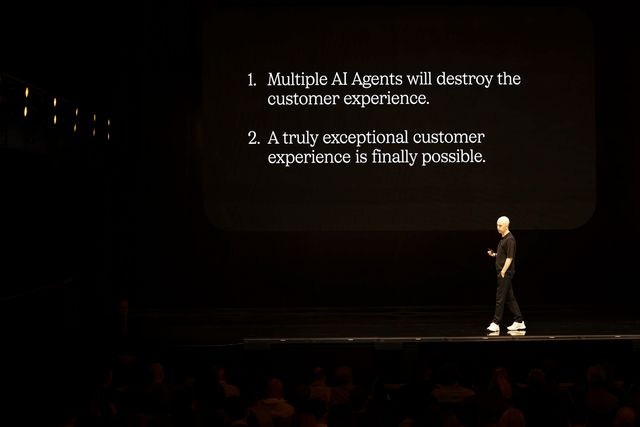
Why we believe in the Customer Agent future comes down to two clear ideas that I’ve witnessed in practice across multiple organizations.
1. Multiple AI Agents will destroy the customer experience
We know that AI isn’t just changing customer service. Other teams like sales, success, and marketing are seeing the potential and starting to adopt it too. But if every function deploys its own Agent, you’ll end up with competing priorities, fragmented context, and inconsistent brand voice—exactly the kind of friction customers notice instantly.
But if all of these teams use their own AI Agent, you’ll end up with a mess of competing Agents that will destroy the customer experience. Each one will have its own priorities and configuration parameters; they won’t talk to each other or share customer information by default, and will likely engage with customers in different ways. This is a trap we need to avoid.
2. A truly exceptional customer experience is finally possible
If we can avoid that trap, we’ll finally be able to provide the type of seamless experience that customers have long expected, and long deserved. The AI Agents of today, like Fin, are capable of handling many different use cases across the entire customer journey: lead qualification, onboarding, support, success, and upsell. That opens the door for the first time to previously unimaginable customer experience; one that’s truly seamless, personal, and concierge-level.
We’ve reached another turning point in AI’s trajectory, and for customer service leaders, the opportunity around the corner is huge. In my own teams, the leaders who lean in now will shape standards for governance, measurement, and ROI across the business.
Customer service has been the proving ground for AI transformation. The systems, strategies, and learnings leaders in this space have accumulated over the last two years can define how AI is adopted by other functions. The keynote made this clear: you have the opportunity to lead how AI is rolled out across your organization, not just in customer service.
You already manage the most complex, high-volume customer interactions; you have rich data on customer needs and behavior; and you know how AI Agents perform in the real world. Those insights will be invaluable as AI scales across your business. The Customer Agent future will elevate the role of the customer service leader and give you the opportunity to lead AI implementation across the entire customer journey.
To achieve this vision of Fin becoming a unified Customer Agent, it will need to evolve from being a task-based system into a true agentic system that uses AI to make decisions and pursue high-level objectives. That shift—from task execution to outcome ownership—is the inflection point I’ve been anticipating.
Roles: Fin will have a range of roles (customer service being one) that it can fluidly move between and blend together. Each role will be deeply trained to be a world-class expert at what it does.
Goals: Fin will also have goals to pursue. You’ll be able to tell it your objectives and priorities (for your customers, company, and revenue) and Fin will pursue them, making appropriate trade-offs between goals as needed.
Memory: Fin will develop memory that persists and grows over the customer lifecycle, building deep context of who the customer is and what they’re trying to achieve. The customer priorities it learns on day one will be considered in year 10.
Knowledge: Fin will accumulate deep knowledge of your business – every product detail, policy, process, your history, and plans – to act on a complete view of your customer.
Interoperability: Fin will interoperate with different tools, systems, and channels.
This system will be able to do much more than answer questions or complete tasks. It will adapt on the fly, learn to get better, and use all the context it has to efficiently guide each customer to great outcomes. That’s how we turn AI from a helpful assistant into a dependable operator.
The Customer Agent vision isn’t a far-off idea. Many of our most pioneering customers have started to put Fin to work beyond customer service. They’re using it across the customer journey and want to push it further by applying it to other use cases to create a single, seamless customer experience. I’ve seen this expansion accelerate once leaders prove value in one high-stakes workflow.
Here’s an example: fitness wearables company WHOOP, facing one of their biggest product launches ever, needed a way to handle a very large influx of sales conversations. They used Fin to help manage this surge, and it’s now resolving 84% of their sales conversations.
These early examples show how Fin is already capable of handling multiple use cases across the customer journey. The signal is clear: a unified Customer Agent can drive measurable outcomes in both revenue and retention.
The Customer Agent future will be built from the inside out, starting with the customer service leaders who have been pioneering AI transformation since the very beginning. Your frameworks for quality, escalation, and measurement will set the bar for every other team that follows.
You know how to balance powerful AI with human empathy, and how to translate that into great customer experiences. Other teams will look to you, and you have the ability to lead them through this transformation. In my experience, this is the moment to define standards, instrument the journey, and scale wins deliberately.
The very best brands compete on customer experience. The Customer Agent opens that playing field for the brands that jump first. Those who move now will own the new benchmarks for responsiveness, personalization, and ROI.
We’ll be starting to roll out this new functionality to Fin – roles, goals, memory, knowledge, interoperability, and more – over the coming months. Stay tuned.
I have been emphasizing that the heart of the product manager job is product creation.
The job is not about being a facilitator or cheerleader, it’s not about being a project manager, and it’s definitely not about being a backlog administrator.
Rather, the necessary role of a product manager is a product creator, working alongside…
In practice, that means I pair closely with engineering, design, data, and go-to-market partners to explore, prototype, and validate solutions during product discovery. I set a clear problem statement, define success metrics, and align on the smallest coherent release so we can learn quickly and de-risk the path to value.
When the problem demands deep context, I embed forward deployed engineers with customers so we can observe workflows, capture constraints, and iterate on generative AI prototypes in days, not months. Those in-the-field insights shorten feedback loops and expose edge cases that never surface in a conference room or a ticketing system.
GenAI lets me reduce the cost of learning: with lightweight agents, synthetic data, and prompt-driven scaffolding, I can run multiple experiments in parallel and converge on what truly delivers value. This approach turns ambiguity into testable hypotheses and transforms discovery from a meeting cadence into a hands-on, evidence-driven practice.
This is product management leadership in action—setting outcomes, defining success metrics, and aligning a cross-functional team on the smallest coherent release—instead of shuffling tickets in a backlog. The difference is night and day: we move from output to outcomes, from activity to impact.
My weekly cadence is simple: articulate the customer problem, frame hypotheses, build the thinnest possible prototype, put it in front of real users, and measure behavior against leading indicators. That loop creates momentum, builds credibility with engineering, and keeps us honest about whether we’re creating something customers will adopt and pay for.
If you’re feeling stuck in coordination mode, reclaim your time for discovery and creation: carve out maker hours, ship prototypes, invite engineers to customer calls, and let evidence—not opinions—steer the roadmap. The more you build, the more you learn; the more you learn, the better you lead.
The fastest teams I’ve led are the ones that treat product management as a hands-on craft, embrace generative AI for product prototyping, and maintain a relentless focus on learning, not merely launching. That is how we earn trust, create enduring products, and make product creator more than a title—it becomes our daily practice.