Continuous Discovery Habits turned five this year, and I see that milestone as a useful reminder: great product teams do not discover customer value through occasional workshops. We build the habit of discovery through repeated practice, structured reflection, and honest conversations about what we are learning.
This month, I am focusing on Chapter 8: Supercharged Ideation. For product leaders, product trios, and empowered product teams, this chapter is especially practical because it challenges one of the most persistent myths in product discovery: that traditional brainstorming is the best path to better ideas.
In my own product management work, I have seen teams move too quickly from opportunity to solution. We often identify a real customer problem, feel the pressure to show momentum, and then rally around the first plausible idea. The problem is not that the first idea is always bad. The problem is that our first idea is rarely our best idea.
This Month’s Reading
Chapters:
- Chapter 8: Supercharged Ideation
Estimated reading time: ~18 minutes
This chapter introduces several ideas that matter deeply for product discovery, prioritization, and product strategy:
- Why quantity of ideas leads to quality – your first idea is rarely your best idea
- The four reasons traditional brainstorming doesn’t work (and what to do instead)
- How to generate 15-20 ideas for a single opportunity without getting stuck
- Why individuals outperform groups at ideation – and how to get the best of both
- Using dot-voting to whittle ideas down to three for a compare-and-contrast decision
I find the compare-and-contrast framing particularly important. Too many product decisions are framed as whether or not decisions: should we build this, should we not build this, is this feature good, is this feature bad? A stronger product discovery process forces us to compare multiple viable paths before we commit.
Why Supercharged Ideation Matters
Supercharged ideation is not about being louder, more creative on command, or filling a whiteboard with random concepts. It is about creating enough solution diversity that the team can make a more informed choice. That distinction matters because product teams are not rewarded for having ideas; we are rewarded for solving customer problems in ways that support business outcomes.
Traditional brainstorming often feels productive because everyone is in the same room and ideas are moving quickly. But group dynamics can quietly narrow the range of thinking. Senior voices carry more weight, early suggestions anchor the conversation, and quieter team members may never share the insight that could reshape the direction.
The individual-then-share approach gives each person space to think before the group converges. I have found this especially useful with cross-functional product trios because design, engineering, and product often see different constraints and possibilities. When each discipline ideates independently first, the team gets a richer set of options.
Reflect and Discuss What You Read
When we reflect and discuss what we read, we absorb more of the material. It helps us put what we learn into practice. Don’t skip this step.
This chapter challenges how most of us think about ideation. We’ve all been taught that brainstorming is the answer, but research tells a different story. This month, I am examining my own relationship with idea generation and where I may be falling into common traps.
Individual Reflection
- Think about the last time your team generated ideas for a solution. Did you generate multiple ideas for one opportunity, or did you generate one idea per opportunity? What was the outcome?
- When you ideate, where do you get stuck? Is it after the first few obvious ideas? Do you struggle with wild ideas that feel unrealistic? Or do you find it hard to avoid jumping into evaluation mode too early?
- Be honest: Do you have a favorite idea right now that you’re pushing for? What assumptions are you making about why it’s the best option? Are you falling in love with your idea before testing it?
That third question is the one I would push every product manager to answer honestly. Attachment to an idea can feel like conviction, but conviction without evidence can become a liability. Continuous discovery gives us a healthier path: generate multiple options, expose assumptions, and test before we over-invest.
Team Discussion
- Walk through your team’s typical ideation process. Does it look more like traditional brainstorming (everyone sharing ideas out loud) or more like the individual-then-share approach the chapter recommends? What’s working and what isn’t?
- Pick one opportunity from your current tree. As a team, can you generate 15-20 ideas for how to address it? If you get stuck before reaching 15, use the chapter’s techniques: look at analogous products, consider extreme users, or think about wild ideas.
- Discuss: When you evaluate ideas as a team, do you tend to set up “whether or not” decisions (Is this idea good?) or “compare and contrast” decisions (Which of these ideas looks best?)? How might you shift to more compare-and-contrast decisions?
Put It Into Practice
The best way to learn supercharged ideation is to practice it with your team. These exercises help turn the concepts into a working product discovery habit rather than a theory we agree with but never operationalize.
Exercise: Generate 15-20 Ideas for One Opportunity
Time: 45-60 minutes
Do this: With your product trio (and consider inviting other team members for more diversity)
Choose a target opportunity from your opportunity solution tree. Set a timer and go through this process:
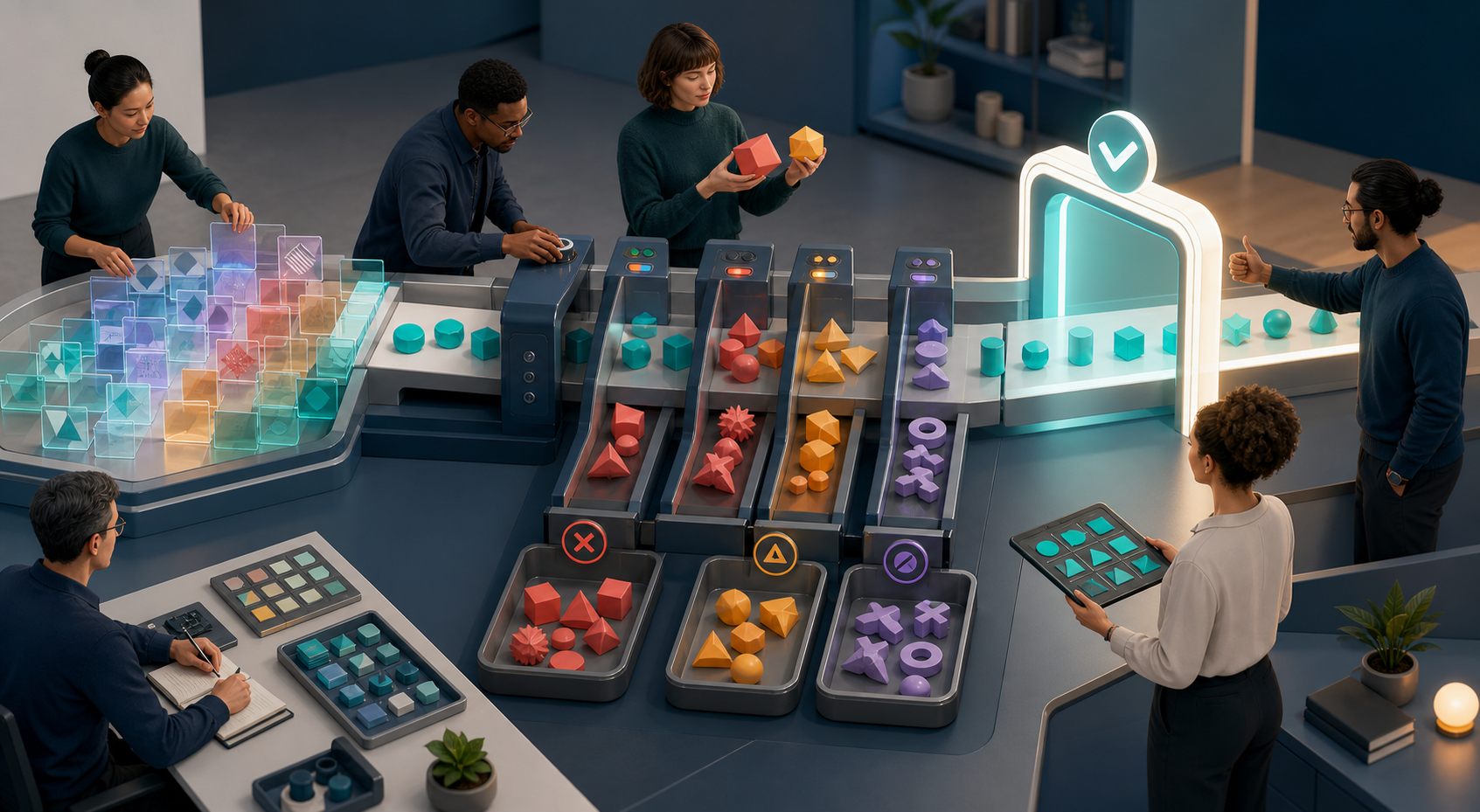
- Individual ideation (5 minutes): Everyone generates ideas on their own. Aim for at least 7-10 ideas each. Write them down on sticky notes or in a shared doc.
- Share round one (15 minutes): Take turns sharing your ideas. No evaluation yet – just share and ask clarifying questions if needed.
- Individual ideation round two (5 minutes): Generate more ideas individually. The first round should have sparked new thinking. Push yourself to consider analogous products, extreme users, or wild ideas.
- Share round two (15 minutes): Share your new ideas with the group.
- Review and refine (10 minutes): Count your ideas. Did you reach 15-20? If not, do another quick round. Then, review the list together and remove any ideas that don’t actually address the target opportunity.
After the exercise, I would ask the team to pause before evaluating the ideas. What did we learn? Were the later ideas more creative than the earlier ones? How did hearing others’ ideas spark new thinking? Those questions help the team understand not only which ideas emerged, but how the quality of thinking changed through the process.
Exercise: Practice Dot-Voting
Time: 20 minutes
Do this: With your product trio
Using the 15-20 ideas generated in the previous exercise, I would use dot-voting to narrow the field to three ideas:
- Set the criteria: Remind everyone that you’re voting based on how well each idea addresses the target opportunity – not on feasibility, not on how “cool” it is.
- Vote (5 minutes): Give each person three votes. You can put all three on one idea, split them across three ideas, or any combination.
- Review the results (10 minutes): Which ideas got the most votes? If it’s clear that three ideas stand out, you’re done. If several ideas have similar vote counts, take a few minutes for people to advocate for their top picks, then vote again.
- Check alignment (5 minutes): Once you have your top three, do a quick poll: Is everyone excited about at least one of these ideas? Does each idea have a strong advocate on the team?
Save these three ideas – you’ll use them for assumption testing in Chapter 9.
The discipline here is subtle but powerful. Dot-voting is not a popularity contest when it is used well. It is a lightweight mechanism for helping a product trio move from an overwhelming idea set to a manageable comparison set, while preserving enough variation to support real learning.
Go Deeper: Additional Reading
For teams that want to go deeper on product discovery, team creativity, and structured ideation, I would keep the following resources close. They are useful companions for product managers, designers, engineers, and leaders who want to build stronger discovery habits.
Supplementary Reading
- Stop Brainstorming and Generate Better Ideas
- That’s Not Brainstorming
- How to Turn Bad Ideas Into Good Ideas
- Product in Practice: Getting Engineers Involved in Brainstorming
Other Voices
- On the Quest for Originality, Recombine the Familiar by Adam Alter
- Creativity Is Not an Accident by Scott Berkun
- A Data-Driven Approach to Group Creativity by Bastian Bergmann and Joe Schaeppi
Live Discussion Schedule
For teams following the July 2026 reading cadence, the live discussion schedule is:
- Thursday, September 17, 2026: 9am-10am PDT and 4pm-5pm PDT
- Wednesday, December 16, 2026: 9am-10am PST and 4pm-5pm PST
My Product Leadership Takeaway
My biggest takeaway from Chapter 8 is that better ideation requires both independence and collaboration. We need independent thinking to expand the solution space, and we need collaborative discussion to clarify, combine, and compare ideas. When we skip either side, the quality of our product decisions suffers.
For me, this is where continuous discovery becomes a leadership practice, not just a team ritual. Leaders have to create the conditions where teams are not punished for exploring multiple options, questioning favorite ideas, or slowing down long enough to test assumptions. That is how product discovery becomes more than a process. It becomes a product culture.
If I were applying this immediately with a product trio, I would choose one opportunity from the current opportunity solution tree, generate 15-20 ideas, dot-vote down to three, and carry those three into assumption testing. That simple sequence can turn a vague conversation about creativity into a concrete product management habit.
Inspired by this post on Product Talk.