Tag: empowered product teams

  • Pretotyping vs. Prototyping: How I Validate Ideas Fast and Build Products Customers Love

    Pretotyping vs. Prototyping: How I Validate Ideas Fast and Build Products Customers Love

    I learned early in my career that beautiful prototypes don’t save you when you’re solving the wrong problem. What does save you is separating market risk from solution risk and choosing the fastest, lowest-cost way to get evidence. That’s why I rely on pretotyping to test demand in days and prototyping to refine usability and feasibility once I see a strong signal. The result: faster cycles, fewer wasted sprints, and products customers genuinely want.

    Pretotyping vs. prototyping explained: differences, benefits, examples, and when to use each approach to validate ideas before you build.

    Here’s how I define the two in practice. Pretotyping answers, “Should we build this at all?” Its goal is to validate real user intent and behavior with the lightest-weight artifact possible—often before any code. Think painted-door (fake door) experiments, Wizard-of-Oz flows powered by humans behind the scenes, concierge tests, landing-page smoke tests with waitlists or preorders, and simple A/B testing to gauge click-through intent. It optimizes for time-to-signal and cost-to-learn.

    Prototyping answers, “Can we build this well?” and “How should it work?” Once demand is evidenced, I prototype to de-risk solution details: usability, architecture, performance, and integration. This might include interactive UI models, high-fidelity flows, technical spikes, or service stubs. Here, I optimize for learning about user experience and technical feasibility without fully committing to production.

    When should you use each? If your biggest unknown is market risk—whether customers care at all—start with pretotyping. If your biggest unknown is solution risk—how to deliver an experience that’s usable, reliable, and scalable—move to prototyping. In other words, validate the “right thing” before you perfect the “thing right.”

    My decision rule is simple: identify the dominant risk, then pick the smallest experiment that can credibly invalidate it. For market risk, I look for evidence of behavior, not opinions: clicks on a painted door, signups on a landing page, willingness to pay (deposits, preorders), or sustained repeat usage in a Wizard-of-Oz flow. For solution risk, I look for task completion, time-on-task, error rates, and qualitative friction from usability sessions with a realistic prototype.

    Concrete examples from recent work help illustrate the difference. When exploring a new analytics insight, I shipped a fake door inside our product nav; a simple tooltip explained the concept and captured interest. Click-through rate, conversion to a short explainer, and waitlist signups told me whether the value proposition resonated before building anything. For a complex AI-assisted workflow, I ran a Wizard-of-Oz experiment: users experienced the end-to-end flow while our team manually handled the “AI” behind the curtain. That gave us real engagement data and edge cases to inform the prototype and later the MVP.

    Metrics matter. I set a clear hypothesis with a guardrail on sample size and a minimum detectable effect I’d consider actionable. For pretotyping, I focus on time-to-first-signal, intent conversion (CTR to interest, interest to signup), cost-per-qualified-lead, and evidence of willingness to pay. For prototyping, I prioritize task success rates, usability severity findings, and qualitative insights that materially change the design or technical approach. Above all, I avoid vanity metrics and anchor decisions to outcomes, not output.

    My repeatable playbook looks like this: (1) Frame the problem and value proposition in one crisp sentence. (2) Choose the leanest pretotyping method that can reveal real behavior. (3) Define success metrics and a decision rule before you run the test. (4) Launch quickly, instrument well, and let the data run long enough to be credible. (5) If demand is strong, promote to a prototype to refine UX and de-risk technicals; if not, iterate the proposition or stop. This keeps product discovery continuous and ensures roadmapping and sprint planning are guided by evidence.

    There are ethical guardrails I never skip. Painted doors must set correct expectations once clicked; waitlists or learn-more pages are honest and respectful. For Wizard-of-Oz and concierge tests, I’m explicit about data handling and provide timely follow-up. Trust compounds when experiments are transparent and user time is valued.

    Tooling can accelerate the cycle without diluting rigor. I often use lightweight design systems and no-code automations to stitch together realistic flows, and I’ll leverage gen AI for product prototyping to generate copy, microinteractions, or data scaffolding. But the principle remains: don’t over-invest until evidence earns the investment. Empowered product teams thrive when they optimize for learning velocity, not feature velocity.

    If you’ve ever felt the tension between shipping fast and shipping right, this approach resolves it. Pretotype to prove the market; prototype to perfect the solution. Do that consistently and you’ll spend more time delivering outcomes customers value—and far less time debating outputs.


    Inspired by this post on Product School.


    Book a consult png image
  • The AI PM One-Pager: Radical prototyping requirements for speed, clarity, and truth

    The AI PM One-Pager: Radical prototyping requirements for speed, clarity, and truth

    I move fastest in Generative AI when I strip work down to its essential signals. At HighLevel, I rely on a single-page format—”Prototyping Requirements: The One-Pager for AI PMs”—to turn ideas into testable artifacts within hours, not weeks. This approach reinforces AI Strategy, minimizes coordination overhead, and keeps Product Management focused on learning over ceremony.

    “Prototyping requirements go rogue: one page, zero bureaucracy, built for AI. Shape concepts fast, prompt tools directly, and get to the truth sooner.”

    In practice, my one-pager captures only what’s required to run an immediate experiment: the user problem, the target behavior change, success signals, core constraints, intended AI workflows, and the smallest realistic path to an evaluable demo. I also include example prompts, guardrails, and evaluation criteria so the team can apply prompt engineering and LLMs for product managers without guessing.

    This is eval-driven development in action. I document a minimal hypothesis, concrete inputs/outputs, and a quick plan for metrics, including qualitative signals from product discovery and continuous discovery. By prompting tools directly, we expose assumptions early, shorten feedback loops, and build an AI product toolbox that compounds learning sprint after sprint.

    I run this with a product trio to ensure we balance feasibility, usability, and value. We align on risks, dependencies, and what “good” looks like, then we integrate the learnings into product roadmapping and sprint planning. The result: fewer meetings, tighter collaboration, and empowered product teams delivering sharper outcomes with less friction.

    If you want speed and clarity without sacrificing rigor, adopt the one-pager. It centers the conversation on evidence, accelerates AI workflows from prompt to prototype, and makes it obvious what to try next—and what to stop doing. Most importantly, it keeps the team focused on truth over theater, which is how great AI products actually ship.


    Inspired by this post on Product School.


    Book a consult png image
  • How AI Product Leaders Drive Better Products: My Take on Amplitude’s Mission and Impact

    How AI Product Leaders Drive Better Products: My Take on Amplitude’s Mission and Impact

    I’m constantly studying how AI is elevating product organizations, and Amplitude offers a compelling example of how to turn data into durable, customer-centered outcomes.

    Spencer Whittaker is a senior AI product manager at Amplitude. He focuses on using AI to advance Amplitude's mission of helping companies build better products.

    From my vantage point leading product teams, that focus translates into practical AI Strategy across behavioral analytics and Amplitude analytics: turning raw event streams into decision-ready insights that accelerate product-led growth and continuous discovery.

    In my own roadmap reviews, the highest-impact patterns are consistent: pair A/B testing with eval-driven development, coach PMs on LLMs for product managers to sharpen problem framing, and amplify signal quality through thoughtful instrumentation and journey mapping. When these practices come together, empowered product teams ship with confidence and reduce time-to-learning.

    Equally important are the guardrails: clear build vs buy criteria for gen ai components, privacy-by-design and data governance from day one, and a crisp measurement model that ties experiments to activation, retention analysis, and customer success outcomes.

    Practically, this means instrumenting hypotheses with the right metrics, setting a minimum detectable effect (MDE) where relevant, and looping insights back into the opportunity solution tree so the next sprint is smarter than the last. This disciplined rhythm separates hype from durable value.

    Seeing peers push this mission forward reinforces a core belief of mine: when AI helps teams find the right problems faster, we build products people truly love—and we do it responsibly, repeatably, and at scale.


    Inspired by this post on Amplitude – Best Practices.


    Book a consult png image
  • Forget Crystal Balls: How Scenario Planning Helps Me Ship Smarter in the Age of AI

    Forget Crystal Balls: How Scenario Planning Helps Me Ship Smarter in the Age of AI

    AI headlines are everywhere—and many claim they know exactly what’s coming next. In product management, I’m often asked to make single-point predictions about gen ai and LLMs for product managers. I resist that temptation because confident forecasts are seductive—and usually wrong.

    Listening to Teresa Torres and Petra Wille unpack why certainty fails reinforced what I practice with my product trios: scenario planning. Instead of betting on one future, I explore several plausible ones, define the signals that would confirm or disconfirm each, and translate those insights into product strategy and product roadmapping and sprint planning we can adapt as evidence evolves.

    Their argument mirrors what I see with customers and stakeholders: people are bad at predicting the future, and overconfidence creates fragility. Early adopters don’t represent everyone, so when we extrapolate from enthusiasts to the mainstream, we waste time and erode trust by building the wrong things.

    Here’s how I apply this to avoid technology FOMO and make sharper AI Strategy decisions. I treat every bold claim as one possible future, then ask, “what else could happen?” I push extremes—AI everywhere vs. AI as invisible utility; GUIs vanish vs. GUIs evolve; centralized vs. edge compute—and hunt for the needs that stay true across scenarios. Those invariants anchor empowered product teams to outcomes, not outputs, and they help us stage bets responsibly.

    Listen to this episode on: Spotify | Apple Podcasts

    My key takeaways: Confident predictions are often wrong. Early adopters don’t represent everyone. Treat predictions as one possible future. Scenario planning > trying to be right. Focus on patterns, not hype.

    In short: We’re in a period of change—but no one can predict exactly how it plays out. Strong predictions often ignore uncertainty.

    A better approach in practice: Treat every prediction as a scenario. Ask: what else could happen? Use multiple futures to guide decisions.

    As you evaluate roadmaps, watch for traps like “My experience = everyone’s future” thinking, over-indexing on early adopters, and ignoring real-world constraints like budgets, compliance, and change management.

    Tactically, we run quick scenario exercises, push ideas to extremes to explore implications, and extract the underlying insight (not the exact prediction). This complements continuous discovery and helps us write outcomes vs output OKRs that are resilient to uncertainty.

    00:00 – The problem with future predictions

    04:00 – Why experts get it wrong

    06:00 – Scenario planning explained

    12:00 – Early adopters vs. reality

    20:00 – AI, GUIs, and extreme takes

    27:00 – Using scenarios in product work

    34:00 – Final thoughts

    Resources & Links:

    Follow Teresa Torres: https://ProductTalk.org

    Follow Petra Wille: https://Petra-Wille.com

    Mentioned in this episode:

    Claude Code

    What did I miss—or what scenarios are you considering for your team? Leave a comment below and let’s compare notes.


    Inspired by this post on Product Talk.


    Book a consult png image
  • From 70 Employees to Dominance: My Playbook for Hypergrowth, Focus, and Top-Down Goals

    From 70 Employees to Dominance: My Playbook for Hypergrowth, Focus, and Top-Down Goals

    Scaling a real-world marketplace from scrappy to dominant takes a different kind of product leadership. Reflecting on Christopher Payne’s decade leading DoorDash as President and COO — growing from roughly 70 employees to the dominant food delivery platform in the US — I’m struck by how much of that success hinged on mastering an atoms-based business while still operating with software-level rigor. As a VP of Product Management, I see the same patterns in my own work: relentless clarity on inputs, a bias for builder-executives, and a cadence that keeps leaders close to product details without becoming bottlenecks.

    Running an atoms-based business versus a pure software company forces you to obsess over operational physics: unit economics, quality control, on-time reliability, and dense local liquidity. It’s precisely where traditional “bits” executives can stumble. What’s worked for me is a simple “plate spinning” framework for executive attention: identify the five or six plates that must never stop — customer experience, marketplace health, quality and safety, product velocity, platform reliability, and P&L — then schedule recurring deep dives to keep those plates spinning. If a plate wobbles, I drop in, fix the root cause, re-instrument the inputs, and zoom back out.

    Hiring at hypergrowth speed only works when you bias toward a “builder mentality.” I look for executives who run toward fuzzy problems, write clearly, and can prove they’ve shipped value with incomplete information. Prior industry experience can be a liability when you’re reinventing the market; first-principles thinkers outlearn domain experts who try to port yesterday’s playbooks. In executive hiring, I’ve found structured work samples and narrative memos far more predictive than marathon interview loops — companies routinely spend too much time on job interviews and too little time evaluating how candidates think and execute.

    Great executives never outgrow the details. Staying close doesn’t mean micromanaging — it means sampling the customer journey and instrumenting the system so you can feel where it hurts. In my own practice, I rotate through frontline touchpoints weekly: support transcripts, NPS verbatims, failed checkout sessions, and reliability dashboards. Small signals often reveal systemic issues. A single ciabatta bread moment — the kind of edge-case substitution that seems trivial — can expose broken handoffs, unclear policies, and misaligned incentives across the marketplace.

    Top-down goal setting beats bottom-up when you’re aiming for category leadership. Bottom-up targets tend to regress to comfort; they calibrate to today’s constraints, not tomorrow’s possibilities. I set ambitious, top-down outcomes (not output), frame the non-negotiables, and map driver trees to clarify the input metrics that matter. Then I ask empowered product teams to pressure-test the plan, propose approaches, and own the how. This preserves ambition while unlocking creativity — a practical balance of clarity and autonomy that outcomes vs output OKRs were designed to achieve.

    One-size-fits-all management is a myth. Early-stage teams need hands-on coaching and fast decisions; later-stage teams need mechanisms that scale: crisp PRDs, pre-mortems, and operating cadences that separate strategy, planning, and execution. The mark of a high-functioning executive team is not uniform style — it’s high candor, fast escalation paths, and visible commitment after debate. In tough moments, a little charisma goes a long way; in practice, that’s not theatrics, it’s steady optimism, simple language, and consistent follow-through that keeps people moving forward.

    The hypergrowth skill stack for executives is surprisingly learnable: ruthless prioritization under uncertainty, narrative writing that aligns cross-functionally, structured delegation with clear “inspection points,” and a weekly rhythm that protects maker time. I leverage a cadence of business reviews (inputs > outputs), customer-scent checks, and decision logs so we can move fast without losing the thread. CEO and executive time management is the ultimate forcing function — if we can’t show where our attention maps to goals, the team won’t either.

    Some of my enduring lessons echo the best of Amazon and eBay: customer obsession beats competitor obsession, input metrics beat lagging vanity metrics, and simple mechanisms beat heroics. From Jeff Bezos’s playbook I borrow the insistence on written narratives, single-threaded ownership, and clarity on what will not change. Those principles remain the backbone of platform scalability and resilient product strategy, especially when markets get noisy.

    AI is about to flatten organizations. With agentic AI, retrieval-first pipelines, and AI workflows embedded into product development, managers can widen their span without losing fidelity. I see LLMs for product managers accelerating discovery, PRD drafting, and experiment analysis — while raising the bar on decision quality. The implication for leadership: fewer layers, more transparency, and even greater pressure to define sharp, top-down outcomes that teams can autonomously pursue.

    If I had to compress this into a playbook, it’s this: set audacious, top-down goals; keep your “plate spinning” calendar sacred; write more than you talk; hire builders, not resume archetypes; sample the customer journey every week; and build mechanisms that make the right thing easier than the heroic thing. That’s how you scale product management leadership from dozens to thousands — in atoms, in bits, and in the messy, exhilarating space where they meet.


    Book a consult png image
  • Build to Learn vs. Build to Earn: My Proven Playbook for Outcomes Over Output in the AI Era

    Build to Learn vs. Build to Earn: My Proven Playbook for Outcomes Over Output in the AI Era

    Product teams rarely fail because they don’t ship enough features; they fail because they don’t learn fast enough. That’s the core tension I manage every day: when to build to learn and when to build to earn. Navigating that balance is how we protect focus, accelerate time-to-value, and ultimately deliver durable business impact.

    Over the years, I’ve seen at least two major ways to develop product: build to learn and build to earn. The first is discovery-led and evidence-seeking; the second is delivery-led and value-capturing. Both are essential. The real craft is knowing which mode to be in, when to switch, and how to keep stakeholders aligned around outcomes instead of output.

    The project model remains the default in many organizations—even in the age of AI—and it’s all about output. Stakeholders or executives assemble a prioritized roadmap of features and projects, and teams ship against it. This can create momentum, but without clear outcome metrics and customer validation, it’s easy to drift into a feature factory that looks productive while missing the mark on user value and business results.

    When I build to learn, I emphasize continuous discovery. That means using customer interviews to surface unmet needs, running lightweight prototypes to test desirability and usability, and deploying A/B testing to quantify impact. I map assumptions, risks, and opportunities with an opportunity solution tree, and I timebox experiments so we learn fast and cheap. The standard is evidence, not opinions—especially my own. The goal is simple: reduce uncertainty before we scale.

    When I build to earn, the objective shifts to capturing value with confidence. Here I align teams to outcomes vs output OKRs, commit to clear acceptance criteria, and ensure product roadmapping and sprint planning reflect the highest-leverage bets we validated in discovery. Delivery excellence matters: crisp definition, reliable release trains, observability, and a strong feedback loop to confirm we’re moving activation, conversion, or retention in the intended direction.

    Deciding when to transition from learning to earning is all about thresholds of evidence. I look for leading indicators that our solution reliably solves the target problem, shows a measurable lift in key behaviors, and can be delivered with acceptable risk. If we can’t articulate the expected outcome and how we’ll measure it, we’re not ready to scale. If we can, we invest, monitor impact, and keep guardrails in place to avoid scope drift.

    The operating model that makes this sustainable is simple and disciplined. I rely on empowered product teams organized as product trios (product, design, engineering) to run dual tracks of discovery and delivery. We socialize learning with stakeholders early and often to strengthen trust and stakeholder management. We elevate strategy by linking every roadmap item to a problem statement, a testable hypothesis, and a quantified outcome—no orphan features, no vanity launches.

    In the AI era, speed can tempt us back into shipping-by-idea. I use gen AI for product prototyping and insight synthesis, and I lean on LLMs for product managers to accelerate discovery work—without treating AI as a shortcut to validation. Our AI Strategy clarifies where AI augments discovery, where it powers the product, and how we evaluate risk, so we move faster without compromising rigor or ethics.

    My rule of thumb: spend just enough time building to learn to achieve conviction, then shift decisively to building to earn—while preserving a small discovery cadence to keep learning alive. This rhythm protects focus, compounds insight, and makes growth more predictable. It’s how we avoid the output trap, deliver meaningful outcomes, and create products that customers love and the business celebrates.


    Inspired by this post on SVPG.


    Book a consult png image
  • Inside Amplitude’s AI Platform: Powerful Lessons for Product Leaders Shaping Analytics

    Inside Amplitude’s AI Platform: Powerful Lessons for Product Leaders Shaping Analytics

    Every so often, a single line captures the essence of platform thinking at scale. "Vinay is a Staff AI Engineer at Amplitude. He builds the foundational AI platforms that empower internal innovation and help define the future of AI analytics." That statement crystallizes the mandate many of us share: create durable AI capabilities that compound value across teams, products, and customers.

    When I think about "foundational AI platforms" in the context of Amplitude analytics and behavioral analytics, I see more than infrastructure. I see a product strategy choice: invest in a unified analytics platform that lowers the cost of experimentation, increases the trustworthiness of insights, and speeds time-to-learning for empowered product teams. That’s the engine behind sustainable product-led growth.

    For me, the platform blueprint starts with three layers: high-quality data foundations (schema design, governance, lineage), model lifecycle rigor (evaluation, observability, versioning), and safe, self-serve interfaces that meet teams where they work. Without strong data governance and clear accountability, even the smartest gen ai features struggle to gain adoption. With them, platform scalability and reliability become a competitive advantage—not just an operational checkbox.

    Empowering internal innovation requires thoughtful constraints. I’ve seen the best teams pair self-serve tooling with guardrails: templates for use cases, bias and risk checks, and well-documented pathways from prototype to production. This balance turns AI Strategy from a slide into a system—one that helps teams decide when to build vs buy, how to measure value, and how to retire what no longer serves the roadmap.

    Looking ahead, the future of AI analytics is about making intelligence ambient. That means stitching together event data, product usage, and customer context so insights surface exactly when decisions are made. It also means bringing gen ai responsibly into the workflow—summarizing behavior, explaining anomalies, and suggesting next best actions—while maintaining transparency and auditability.

    My practical takeaways: invest early in shared components that everyone can use (feature stores, evaluation harnesses, data contracts); standardize interfaces so teams ship faster with fewer handoffs; and measure platform outcomes with product metrics, not just infrastructure metrics. Done well, this approach compounds: faster cycles, higher confidence, and a steady drumbeat of wins that reinforce a culture of learning.

    In short, building the right AI foundations is how we unlock scale, create leverage for every team, and keep our edge in a dynamic market. That one line about building foundational AI platforms isn’t just a role description—it’s a north star for any product leader serious about shaping the next era of analytics.


    Inspired by this post on Amplitude – Perspectives.


    Book a consult png image
  • Product Work Is Relationship Work: How I Align Stakeholders Faster and Cut Team Politics

    Product Work Is Relationship Work: How I Align Stakeholders Faster and Cut Team Politics

    Lately, I keep hearing a familiar question: with AI making it so easy to generate ideas and build products, do we still need product managers? My answer is unequivocal—yes. Tools accelerate delivery, but they don’t build trust, reconcile competing incentives, or create the shared understanding teams need to ship outcomes. Product work is relationship work.

    I recently listened to “Product Work Is Relationship Work – All Things Product with Teresa & Petra,” and it echoed what I see every day in high-performing product organizations. If you prefer to watch, here’s the episode on YouTube: https://www.youtube.com/embed/d-0f8uAfc8w?feature=oembed

    Listen to this episode on: Spotify | Apple Podcasts

    While AI can help build things faster, it can’t replace the relationship work required to align stakeholders, navigate competing priorities, and create shared understanding across teams. That’s the hard, human part of product management—and it’s not going away.

    In my experience, product teams stall when collaboration becomes transactional. We jump to negotiation (“What can you commit by Friday?”) before establishing context (“What problem are we solving and why now?”). When I slow down to get curious—about constraints, incentives, and assumptions—momentum actually increases because we’re rowing in the same direction.

    Stakeholder alignment often breaks down when we conflate advocacy with exploration. We argue our viewpoint as if it were the only lens that matters, rather than making space to surface how others see the system. I’ve found the distinction between “dialogue vs. discussion,” rooted in work by Chris Argyris and elaborated in The Fifth Discipline by Peter Senge, to be a powerful reset. Dialogue builds shared understanding; discussion decides. You need both, in the right order.

    Language matters in the room. The improv principle “Yes, and” is deceptively simple but transformative. When a designer, engineer, or executive feels heard (“Yes”) and we build on their idea (“and”), we create psychological safety without sacrificing critical thinking. I use “Yes, and” to explore perspectives before we converge on decisions—especially with product trios and senior stakeholders.

    Here are the moves I rely on to keep collaboration relational and outcomes-focused. First, we align on outcomes before solutions. I explicitly separate outcomes vs output OKRs so we’re clear on what success looks like, independent of the features we ship. That clarity reduces rework and speeds up decision-making later.

    Second, we operationalize curiosity with continuous discovery. I schedule recurring, lightweight touchpoints with customers and internal stakeholders so insights compound. When learning is continuous, debates quiet down—evidence does the heavy lifting.

    Third, we invest in relationship rituals. Regular 1:1s with key partners, stakeholder maps that capture motivations, and pre-reads that frame trade-offs all prevent misalignment from surfacing in the last mile. These small habits pay huge dividends in trust and speed.

    Fourth, I’m explicit about mode-switching in meetings: are we advocating a position or exploring perspectives? Calling the mode out loud prevents people from mistaking questions for opposition and keeps the conversation productive.

    Fifth, we use “Yes, and” to move from possibility to practicality. We explore generously, then converge rigorously—ranking options by impact, effort, and risk so decisions are transparent and fair.

    If stakeholder alignment, team dynamics, or product “politics” slow your team down, this conversation offers a practical reframe. You’ll move faster when you build the relational tissue first—because alignment is an accelerant, not a tax.

    Resources & Links:

    Follow Teresa Torres: https://ProductTalk.org

    Follow Petra Wille: https://Petra-Wille.com

    Mentioned in this episode:

    Petra’s Coaching Packages

    Work by Chris Argyris on organizational learning and dialogue vs. discussion

    The Fifth Discipline: The Art and Practice of the Learning Organization by Peter Senge

    Improv principle “Yes, and”: Saying “Yes, and” — A principle for improv, business & life and Yes, and …

    Have thoughts on this episode or examples from your team? Leave a comment below—I’d love to learn what’s working (and what’s not) in your stakeholder landscape.


    Inspired by this post on Product Talk.


    Book a consult png image
  • Commercial vs. Internal Products: Hard Truths, High Leverage, and How I Make the Call

    Commercial vs. Internal Products: Hard Truths, High Leverage, and How I Make the Call

    Internal Products Are Hard; Commercial Products Are Harder. That line captures years of hard-won lessons from leading both internal platforms and market-facing SaaS at HighLevel. I’ve seen how the two demand different muscles—even when the tech stack, talent, and timelines look the same on paper.

    When I talk about internal products, I mean services and solutions that our own employees use to take care of customers—customer-enabling tools and services, agent consoles, fulfillment and billing workflows, operations dashboards, and the underlying platforms that keep them fast, compliant, and resilient. These tools don’t generate revenue directly, but they quietly determine customer experience, gross margin, and how quickly we can ship, resolve issues, and scale.

    Commercial products, by contrast, add a second challenge layer. Beyond discovery, usability, and reliability, we must conquer positioning, pricing and packaging, competitive differentiation, sales enablement, procurement hurdles, and ongoing customer success motion. The surface area for failure is bigger, and the time-to-signal on product-market fit is slower and noisier.

    Here’s how I decide where to invest. First, I anchor on outcomes, not output. If the business priority is net revenue retention, faster onboarding, or reduced cost-to-serve, internal products often provide the highest-leverage path. If the priority is new revenue, new market entry, or a must-have differentiator, we lean commercial. I make the trade explicit in outcomes vs output OKRs so we can defend the decision when pressure mounts.

    Second, I run a clear build vs buy calculus. For internal needs, the default is buy if a mature, configurable solution exists that meets our security, data governance, and integration requirements. I only build when the workflow is core to our differentiation, the TCO of customization is lower than vendor sprawl, or we can capture unique proprietary advantage. For commercial products, I avoid embedding third-party IP in a way that caps differentiation or compresses margins as we scale.

    Third, I insist on continuous discovery. Internal audiences are not a captive market—they’re discerning experts with real jobs to do. I treat them like customers, with structured customer interviews, journey mapping, and opportunity solution trees. I rely on empowered product teams and product trios to validate problems and reduce solution risk before we commit engineering time.

    Fourth, I frame commercial vs internal work with capacity guardrails. In most planning cycles, I reserve explicit allocation for platform scalability and internal tooling, separate from feature bets. Without this, internal products become backlog filler, which guarantees we’ll pay the interest later in churn, SLA breaches, and slower delivery.

    Execution differs too. For internal products, change management is the make-or-break. I plan enablement as a first-class deliverable: clear rollouts, in-app guides, training, and feedback loops with frontline champions. I track adoption, time-to-resolution, error rate, and satisfaction for internal users with the same rigor we apply to external users.

    For commercial products, I design the discovery-to-GTM handshake early. Pricing and packaging must reflect value drivers discovered in research, not what’s easiest to meter. Sales and solutions engineering need crisp narratives, objection handling, and proof points. Customer success needs activation plans and health signals tied directly to leading indicators of retention.

    Across both, I instrument the product and process. I lean on feature flags and progressive delivery to manage risk, and I protect SLOs with error budgets so teams balance reliability with iteration speed. CI/CD isn’t a badge—it’s how we earn the right to ship continuously without eroding trust.

    Common pitfalls recur. Teams skip UX for employee tools because “they have to use it”—which backfires as shadow workflows and rework. Leaders underfund internal platforms, then wonder why velocity stalls. On the commercial side, teams over-index on features and under-invest in positioning and onboarding, leading to poor activation and elongated sales cycles.

    What’s the payoff? When we treat internal products as products, we unlock scale: shorter handling times, fewer escalations, clearer accountability, and higher customer satisfaction. When we approach commercial products with the same discovery rigor plus smart GTM, we compress time-to-value and amplify differentiation. The craft is knowing which lever to pull when—and having the discipline to measure what matters.

    My rule of thumb is simple. If the goal is operational excellence that compounds across the entire customer journey, invest in internal products with the same intensity you reserve for revenue-generating features. If the goal is market expansion or category leadership, invest in commercial products with a tight discovery-to-GTM loop. In either case, clarity of outcomes, disciplined discovery, and empowered teams win the day.


    Inspired by this post on SVPG.


    Book a consult png image
  • How Top Product Teams Roadmap Through Uncertainty: Align Faster, Adapt Smarter, Deliver

    How Top Product Teams Roadmap Through Uncertainty: Align Faster, Adapt Smarter, Deliver

    Product roadmaps should not be promises etched in stone; they are portfolios of bets made under uncertainty. When I build a roadmap, I’m not predicting the future—I’m designing a system that helps the team learn faster than the market changes, allocate capital wisely, and create alignment across engineering, design, go-to-market, and leadership.

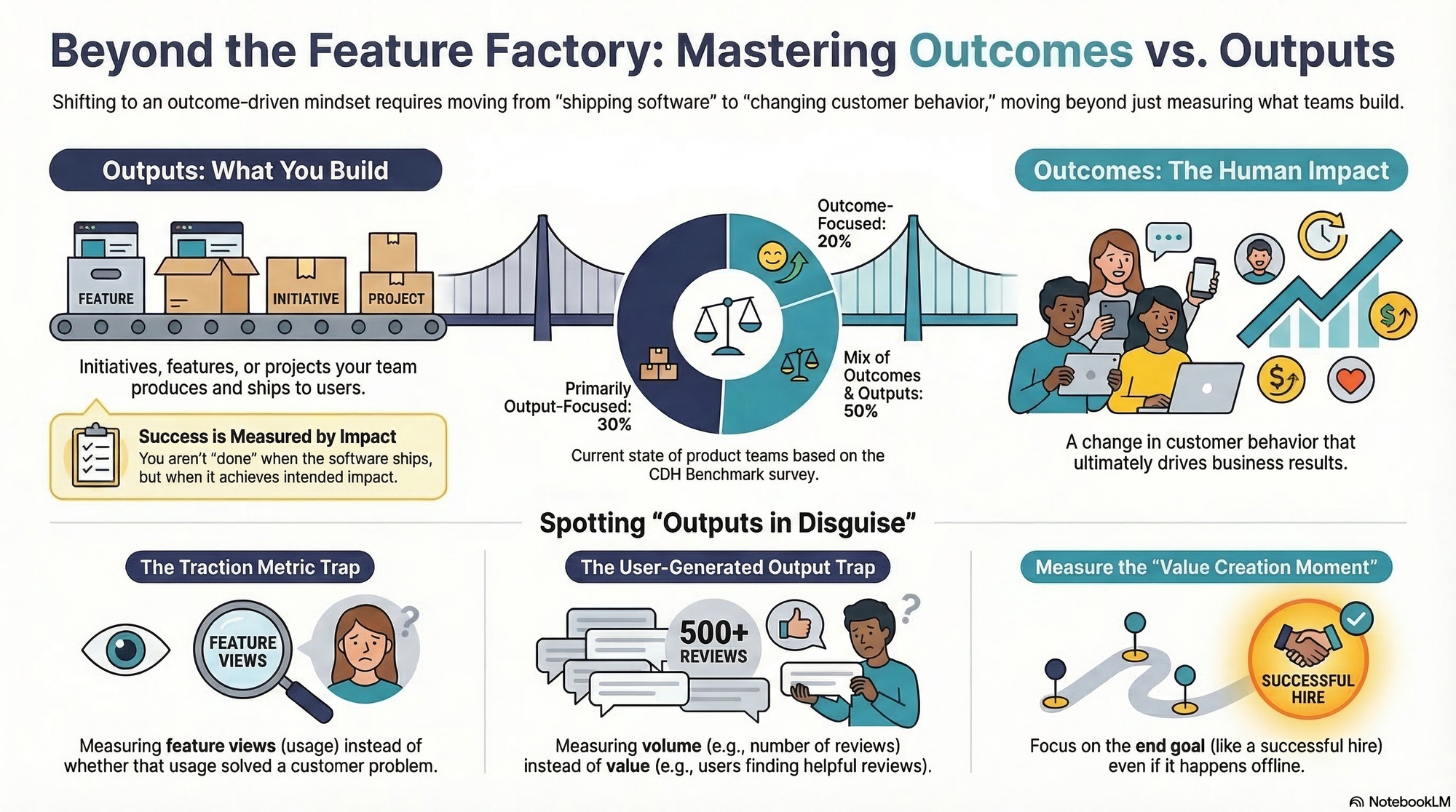
    The best roadmaps I’ve seen and shipped anchor on outcomes rather than features. “Outcomes vs output OKRs” is more than a slogan; it’s how we translate strategy into measurable impact. I start by defining a small set of outcome metrics that matter—such as activation rate, time-to-first-value, or expansion revenue—and attach clear key results and guardrails to each theme. This reframes prioritization from “what can we build?” to “what must change in customer behavior?” and gives empowered product teams real autonomy.

    I organize the roadmap into time horizons—Now, Next, Later—with explicit confidence levels. Near-term items have higher confidence and more specificity; mid- and long-term bets are thematic with wider time windows. This approach reduces false precision and builds trust because stakeholders can see both the intent and the uncertainty. When dates matter, I use windows and service level expectations rather than single deadlines, and I pair each initiative with a lightweight risk scoring so we can discuss uncertainty explicitly rather than implicitly.

    Continuous discovery keeps the roadmap honest. I partner in tight “product trios” across product, design, and engineering to run rapid customer interviews, opportunity sizing, and assumption tests before we commit significant delivery capacity. The opportunity solution tree is my favorite artifact here; it visualizes the path from outcomes to opportunities to experiments and solutions, making trade-offs and sequencing transparent. By the time something moves into sprint planning, we’ve already reduced key uncertainties and clarified the narrowest viable slice we can ship.

    Uncertainty demands options. I plan initiatives as options with stage gates and explicit kill criteria rather than as single monolithic projects. For every significant theme, I outline base, best, and worst-case scenarios with pre-decided triggers for when we escalate, pivot, or stop. This practice prevents sunk-cost fallacy and keeps the team focused on evidence. We treat scope as a knob, not a switch, and we bias toward small, sequential bets that compound learning.

    Capacity is strategy. I routinely reserve a discovery buffer—typically 10–20%—and a contingency buffer for integration, security, and performance risks that always show up late. I ruthlessly control work-in-progress to limit thrash and protect the team’s ability to respond when new information arrives. When we must navigate dependencies, I use thin vertical slices and decouple via contracts or feature flags so discovery momentum doesn’t stall while platforms evolve underneath.

    Prioritization under uncertainty benefits from explicit models. I combine value, effort, and confidence with risk scoring to surface where the unknowns are hiding. Driver trees help us connect top-level outcomes to leading indicators, so we can place bets where they have the highest causal leverage. I also lean on the Kano Model and qualitative signals to avoid over-investing in performance attributes while neglecting excitement features that unlock differentiation and word-of-mouth.

    The most effective stakeholder management is narrative-first. For executives, I present a one-page outcomes roadmap that shows themes, expected shifts in key results, and the learning plan. For teams, I provide a more detailed plan that links discovery insights, assumptions-to-test, and decision points. I make room for a “what we’re not doing” section to reduce noise and prevent shadow backlogs from reappearing in every meeting. Most importantly, I socialize change before it happens, explaining the evidence and the trade-offs so adjustments feel like progress, not whiplash.

    Measurement closes the loop. We instrument experiments and releases with leading indicators tied to the driver tree and review them on a predictable cadence. If movement stalls, we diagnose whether we have a targeting problem (wrong audience), a value problem (weak proposition), or a friction problem (broken journey). That discipline lets us iterate with purpose instead of chasing vanity metrics or isolated anecdotes.

    Here’s a concrete example of roadmapping through uncertainty. Suppose our Q3 objective is to “Increase user activation” with key results to raise the Week-1 activation rate from 32% to 45% and cut time-to-first-value by 30%. In discovery, customer interviews reveal confusion in the first-run setup and a missing integration that advanced users expect. We map an opportunity solution tree and identify two high-leverage opportunities: simplifying the first 10 minutes and offering a guided setup for the integration. We then shape two minimal bets: an in-app guide to streamline the first three tasks and an integration wizard behind a feature flag. Each bet has an explicit decision rule and a two-sprint runway. We ship the guide first, confirm a statistically significant lift via A/B testing, then expand scope. The integration wizard underperforms initial expectations, so we pause, revisit the assumptions, and re-allocate buffer to the stronger path. The roadmap updates in real time, and everyone understands why.

    When uncertainty spikes—new competitor, pricing shock, platform deprecation—I shift the roadmap cadence to rolling-wave planning. We shorten planning horizons, increase the frequency of readouts, and elevate discovery allocations temporarily. We also create thematic “containment zones” where we explore multiple options in parallel with small budgets until one path justifies scale. This allows us to stay responsive without abandoning strategy.

    Good governance accelerates, it doesn’t slow. A lightweight product council that reviews outcomes, risks, and cross-functional dependencies prevents surprise escalations and ensures we keep shipping what matters. We avoid death-by-approval by agreeing in advance on decision rights and thresholds—for example, a product trio can pivot a bet within a theme up to a certain budget or timeline impact without additional approval, as long as it improves the outcome likelihood.

    If you’re evolving your roadmap practice, start with three moves. First, reframe your plan in outcomes and publish a driver tree that connects those outcomes to the few leading indicators you believe move them. Second, stand up a continuous discovery cadence with a visible opportunity solution tree and an assumptions-to-test backlog. Third, implement time windows and confidence levels for all mid- and long-term items, and pair each major initiative with explicit kill criteria. You’ll feel the difference in a single quarter: clearer trade-offs, faster learning, and more predictable delivery—despite uncertainty.

    In the end, a roadmap that thrives in uncertainty is an agreement about how we learn and decide together. It aligns the organization on outcomes, it funds options—not fantasies—and it gives empowered product teams room to maneuver. That’s how top product teams plan for uncertainty and still deliver with confidence.


    Inspired by this post on Product Talk.


    Book a consult png image
  • Join Me in April: Build a Continuous Interviewing Habit and Unlock Real Customer Insights

    Join Me in April: Build a Continuous Interviewing Habit and Unlock Real Customer Insights

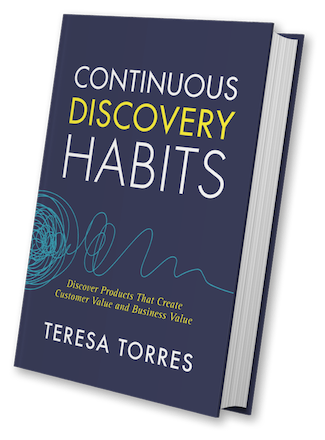
    “Continuous Discovery Habits” turns five this year, and I’m celebrating by reading it with our community—together, in practice, not just in theory. Each month, I’m publishing an in-depth reading guide with the chapters we’ll cover, a preview of the most important concepts, short videos you can share with your teams, individual and team discussion questions, practical exercises to apply what you read, and additional resources to go deeper.

    We’ll keep the conversation active in the comments each month and meet live once a quarter to compare notes, share what’s working, and troubleshoot what’s not. If you’re joining late, no problem—start with the current month or go back to January. You can also find all of the book club articles here.

    If you want to participate, grab a copy of the book (or dust off your old one), share the “Spread the Love” videos with colleagues, block time for the team exercises, and register for the community sessions. Let’s dive in together.

    This Month’s Reading

    Chapter: Chapter 5: Continuous Interviewing. Estimated reading time: ~37 minutes.

    This chapter grounds us in why interviewing on a regular cadence is critical to the success of any product trio; how cognitive biases affect what we learn from direct questions; the difference between research questions and interview questions; how to use story-based interviewing to uncover actual customer behavior (not ideal behavior); the interview snapshot, a one-page tool for synthesizing what you learned from a single interview; how to automate the recruiting process so interviewing becomes easier than not interviewing; and why product trios should interview customers together.

    Need a copy? Grab the book.

    Share the Love with Friends and Colleagues

    We learn best in community. To help your team rally around these practices, share these concise primers and invite them to join the book club discussion with you.

    What are customer interviews? – Build a competitive advantage that compounds over time.

    What should we ask in customer interviews? – Mitigating cognitive biases.

    Research questions vs. interview questions – And why the difference matters.

    Getting reliable feedback from customer interviews – Ask the right questions.

    Who should conduct customer interviews? – My answer might surprise you.

    How do you find customers to interview? – Automate the recruiting process.

    The Interview Snapshot – How to synthesize a single customer interview.

    Reflect and Discuss What You Read

    Reflection cements learning. This month, I’m challenging you—as I challenge my own teams—to build a weekly habit of interviewing customers and to shift from direct questions (which trigger bias) to collecting specific stories about past behavior. For many teams, this is a big mindset change: from infrequent “big research projects” to lightweight, continuous conversations that fuel daily decision-making.

    Individual Reflection: Think about your last customer interview or conversation. Did you rely on direct questions, or did you excavate a specific story about what happened? How might the answers have changed if you had used the other approach?

    Consider your own behavior—buying jeans, going to the gym, choosing what to watch on Netflix. Where do your ideal intentions differ from what you actually do? How might that same gap show up in your customers’ answers to direct questions?

    Scan your calendar from the past month. How many customer interviews did you conduct? If it’s fewer than four, what got in the way? What needs to change to make weekly interviewing sustainable?

    Team Discussion: As a team, discuss your current interview cadence. If you’re not interviewing at least weekly, name the biggest obstacle—recruiting, time, or synthesis—and commit to reducing one barrier this month.

    Try this together: Ask a teammate, “How does a product idea go from concept to launch at our company?” Have them write it down. Then ask for the last specific feature or improvement that launched and capture the story. Compare the two. What’s different? What does this reveal about the gap between ideal process and actual process?

    If you already interview regularly, ask: Who participates? Is it just one person (like the designer or product manager), or does the whole trio join? What value might you be missing by not having all three perspectives in the room?

    Put It Into Practice

    Understanding the “why” is easy; building the habit is the work. The following exercises are how my teams operationalize continuous interviewing week over week.

    Exercise: Conduct a Story-Based Interview (Time: 20–30 minutes. Do this with your product trio.) Schedule a conversation with a current customer. Instead of drafting a long script, identify a handful of research questions (what you need to learn) and translate them into one story-based interview question (what you’ll ask).

    For example, research questions might include: What challenges do customers face when onboarding? Where do they get stuck? What are we asking them to do that they don’t understand? How can we make it easier for them to get to the activation moment? The corresponding interview question could be: Tell me about the first time you used our product.

    During the interview, excavate the story with temporal prompts like “What happened first?”, “What happened next?”, and “What happened before that?” If the participant drifts into generalities (“I usually…” or “In general…”), gently bring them back to the specific instance.

    After the interview, debrief as a trio. What did each of you hear? Which opportunities surfaced? What surprised you? If you want personalized, detailed feedback on your technique, consider the Interview Coach available through the Story-Based Customer Interviews course.

    Exercise: Create Your First Interview Snapshot (Time: 30 minutes. Do this with your product trio immediately after the interview.) Using the interview snapshot template, capture a photo of the participant (or a visual that represents their story), quick facts about their context, a memorable quote you’ll still recall months from now, the opportunities (needs, pain points, desires) you heard, notable insights that aren’t yet opportunities, and an experience map that illustrates the story. Over time, aim to complete each snapshot in 15–20 minutes.

    Go Deeper: Additional Reading

    If you prefer audio, I’ve included an audio summary for paid subscribers that covers this month’s chapter plus the resources below.

    Related In-Depth Guides: Customer Interviews: How to Recruit, What to Ask, and How to Synthesize What You Learn.

    The Value of Continuous Interviewing: Why Product Trios Should Interview Customers Together – How interviewing together ensures research is timely, actionable, and believable.

    How to Find Customers to Talk To: Customer Recruiting: Get Easy Access to Customers Week Over Week – Practical strategies for automating your recruiting process. Ask Teresa: How Do You Select Customers for Customer Interviews? – Who to interview and how to recruit them. Tools of the Trade: Finding People to Interview Before You Have Customers – Recruiting strategies for early-stage products.

    What to Ask in Your Interviews: Why You Are Asking the Wrong Customer Interview Questions – Understanding the gap between ideal behavior and actual behavior. Story-Based Customer Interviews Uncover Much-Needed Context – Why collecting specific stories is more reliable than asking direct questions. Ask Teresa: What Are the Best Customer Interview Questions? – Common questions and how to improve them. Ask About the Past Rather than the Future – Why memories about recent instances are more reliable than speculation.

    How to Take Notes and Synthesize What You Are Learning: How to Take Notes During Customer Research Interviews – Practical tips for capturing what you hear. The Interview Snapshot: How to Synthesize and Share What You Learned from a Single Customer Interview – A comprehensive guide to creating and using interview snapshots. Customer Interview Analysis: How AI Helps and Hurts – Learn how to use AI effectively.

    Videos: All Things Product Podcast: Customer Interview Analysis – Petra and I discuss using AI to analyze customer interviews, the risks and benefits, and why your interviewing skills matter more than any AI tool.

    Other Resources from Around the Web: The Top 5 Mistakes Product Teams Make With Customer Interviews by Pragmatic Live. Continuous interviewing with Kristian Collin Berge (CEO & Co-founder at UX Signals) by Afonso Franco. How to Make Time for Customer Interviews & Validation by Rich Mironov. Brave UX: An interview with Teresa Torres by Brendan Jarvis.

    Related Courses: Customer Recruiting for Continuous Discovery – Get easy access to customers week over week. Story-Based Customer Interviews – Collect reliable feedback from every customer conversation.

    Our Live Discussion Schedule

    Our live discussion sessions are for paid subscribers. Sessions are not recorded. Invitations will go out to members two weeks before each event—add these to your calendar now: Tuesday, June 16, 2026: 9am–10am PDT. Thursday, September 17, 2026: 9am–10am PDT. Wednesday, December 16, 2026: 9am–10am PST.

    Audio Summary

    This summary was produced by NotebookLM. The sources supplied were the book chapters as well as all of the additional reading.

    This article is part of the CDH Book Club celebrating the five-year anniversary of Continuous Discovery Habits.


    Inspired by this post on Product Talk.


    Book a consult png image
  • Product Management Isn’t Dead: Why ‘Product Builders’ Will Win in the AI Era—and How to Upskill Now

    Product Management Isn’t Dead: Why ‘Product Builders’ Will Win in the AI Era—and How to Upskill Now

    “Is product management dead?” I hear this question at almost every conference hallway chat. After listening to the latest Product Builders – All Things Product Podcast with Teresa Torres & Petra Wille, I’m more convinced than ever: product management isn’t dead—it’s evolving fast, and the leaders will be those who embrace the shift.

    Listen to this episode on: Spotify | Apple Podcasts

    The core take resonated deeply with my day-to-day at HighLevel: product management isn’t dying—“the traditional product trio (PM, design, engineering) is collapsing into something new.” The center of gravity is shifting from swim lanes to outcomes, from rigid handoffs to fluid collaboration, and from role definitions to capabilities that actually ship value.

    AI is raising the baseline across the board. That “80/20 shift: AI handles patterns, humans handle hard problems” is real on my teams. With LLMs like “GPT 5.2” and “Opus 4.5,” coding agents such as “Claude Code” and “Codex,” and tools like “Replit” and “Lovable,” we’re compressing cycle time on the repeatable 80%. The bottleneck is no longer typing code or drafting copy—it’s selecting the right problems, crafting sharp product strategy, and making confident trade-offs.

    This is why the future belongs to “product builders” — people with a shared foundation across disciplines and deep expertise in one area. I look for teams that can shape, prototype, validate, and iterate in tight loops, blending continuous discovery with empowered product teams. The baseline expands, the craft deepens.

    Functional expertise still matters—more than ever—because the hard parts are getting harder. We need leaders who can weigh platform scalability against time-to-value, protect privacy-by-design, apply AI risk management, and navigate data governance while sustaining product-market fit. When AI accelerates execution, judgment becomes the differentiator.

    For leaders, this creates a clear mandate: “What product leaders must do to create safe AI infrastructure.” In practice, that means building guardrails early—security reviews tailored to AI workflows, QA harnesses that include eval-driven development, model performance observability, and human-in-the-loop review systems. You can’t bolt this on later without paying a tax in velocity and trust.

    Hiring signals are already shifting. “How job descriptions and hiring expectations are already shifting” shows up in my reqs: we emphasize cross-functional range, fluency with AI workflows, prompt engineering literacy, and the ability to frame measurable outcomes. We still want craft depth—design systems, systems thinking in engineering, rigorous discovery—but we prize people who move seamlessly from discovery to delivery.

    In the episode, I appreciated the crisp framing of why product management isn’t dying—but changing. The rise of the “product builder” foundation reframes team topology and unlocks smaller, more cross-functional squads. AI changes the baseline skill set across product teams, and ignoring it is a career risk. If you’re not learning AI tools, you’re falling behind.

    My key takeaways were straightforward and actionable. Smaller, more cross-functional teams are likely. Deep expertise still matters—especially for complex trade-offs. Leaders need guardrails: security, QA, and review systems built for an AI-driven workflow. And if you work in product, design, or engineering, this episode is your signal to start upskilling now.

    “The risk of ignoring AI in your craft” is not hypothetical. I encourage PMs to carve out weekly lab time for hands-on experiments with LLMs for product managers, build lightweight prototypes with Replit or Lovable, and pressure-test opportunity solution trees with data-informed discovery. Pair with your engineers on agentic AI use cases, and integrate model evals into your CI/CD pipelines.

    “Mentioned in the episode” were several resources worth exploring: “Product at Heart” (June, Hamburg), “Replit,” “Lovable,” “Every,” “Petra’s Coaching Packages,” and “coding agents (Claude Code, Codex) and LLMs (GPT 5.2, Opus 4.5).” These are great jumping-off points for your own product builder toolkit.

    My recommendation: queue up the episode on your commute, then pick one workflow to augment with AI before the week ends. Replace a handoff with a shared canvas. Automate a repetitive analysis. Ship a scrappy prototype. Momentum compounds.

    Have thoughts on this episode? Leave a comment below. I’d love to hear how your teams are evolving your product trios, what AI workflows are sticking, and where governance has been most challenging.


    Inspired by this post on Product Talk.


    Book a consult png image