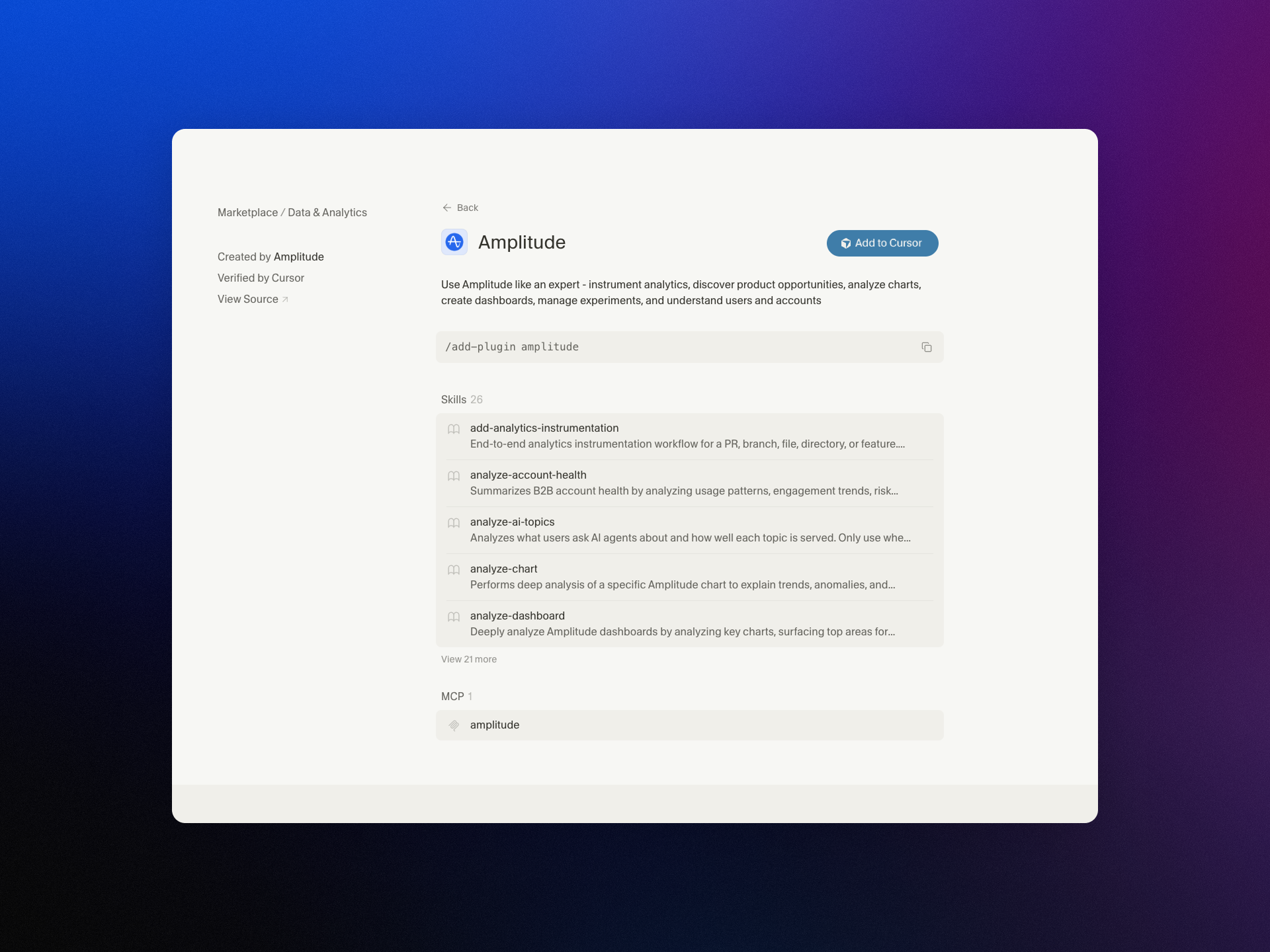
I’m excited to share that we’ve brought Amplitude Plug and Play to the Claude and Cursor marketplaces—a lightweight way to infuse your everyday prompts with serious product analytics context and speed.
"Learn more about our new AI plugin, the easiest way to turn your favorite AI client into an analytics expert with a single-install."
For years, I’ve watched teams lose momentum hopping between dashboards, docs, and spreadsheets just to answer simple questions like “What changed in activation last week?” or “Which cohort is driving retention?” With Amplitude analytics and behavioral analytics at the core, Amplitude Plug and Play collapses that friction by bringing the answers to where you already think and build—inside Claude and Cursor.
In practice, this means I can ask natural-language questions such as “Show me the funnel from signup to activation by region,” “Compare retention week over week for new users from our latest release,” or “Summarize our last A/B testing results on onboarding” and get structured, context-aware responses. The goal is to keep me in flow while still honoring the rigor of a unified analytics platform.
What I love most is how this elevates both discovery and delivery. Product managers can accelerate continuous discovery by querying cohorts, drivers, and anomalies mid-conversation. Engineers working in Cursor or with Claude Code can validate event definitions, sanity-check metrics, and spot regressions without leaving their IDE. The result is tighter feedback loops and better decision quality.
Just as importantly, the experience is designed for clarity and consistency. When I ask about activation, I expect the same canonical definition every time. When I explore a retention analysis, I want clear assumptions and transparent logic. By anchoring responses to well-defined metrics and event taxonomies, the plugin helps reinforce good data governance while keeping the interaction fast and conversational.
Getting started takes only a few minutes. Open the Claude or Cursor marketplace, search for Amplitude Plug and Play, complete the single-install flow, and connect to your Amplitude analytics workspace. From there, start prompting as you normally would—only now your AI client can reason with product context.
This launch is part of how I see gen ai reshaping AI workflows for product teams: less context switching, more signal per prompt, and a shared, accessible understanding of what’s really moving the business. If you’re ready to turn your AI assistant into a trusted partner for product insight, Amplitude Plug and Play is a powerful next step.
Inspired by this post on Amplitude – Best Practices.
Your Amplitude dashboard is populated, but the room still debates whether the numbers are real. Engineering sees successful requests. Product sees unexplained breaks. Each feature adds more events, yet confidence in the data keeps falling.
You do not fix this by collecting more data or polishing the dashboard. You fix it by treating instrumentation as a product interface: designed around a decision, expressed as a clear contract, reviewed with the code, tested against real journeys, and monitored after release.
Design the decision before you name the event
The most common instrumentation failure starts before an engineer writes code. A stakeholder asks to track a page, button, or feature without saying what decision the data must support. The resulting event may be technically valid and still be useless.
Begin with a decision statement: If this behavior differs by this segment or step, I will change this part of the product. That sentence forces you to identify the behavior, comparison, and possible action. If nobody can describe the action, the proposed event is probably speculative inventory rather than decision-grade data.
Suppose you need to decide whether team invitations are blocking activation. A useful behavioral sequence might contain Workspace Created, Invitation Sent, Teammate Joined, and First Shared Action Completed. The important work is not typing those labels. It is defining what each one means.
Does Invitation Sent fire when someone clicks the button, when the request succeeds, or when the message is accepted for delivery?
Does Teammate Joined mean the invite was accepted, the new user signed in, or the user entered the intended workspace?
Can retries emit the same behavior more than once?
Can an existing user join through a path that bypasses the invitation flow?
Which actor owns the event: the inviter, the invitee, the workspace, or some combination?
Those distinctions determine whether the funnel represents the customer journey or merely the user interface. A click is evidence of intent. A confirmed state change is evidence of completion. Track both only when you have a real use for both, and do not give them names that imply the same meaning.
Use events for behaviors that happened and properties for the context needed to interpret them. If email and link invitations represent the same business action, use one Invitation Sent event with an invitation channel property. Split them into separate events only when their meanings, lifecycles, or downstream decisions genuinely differ.
Before approving an event, require answers to five questions: Who will use it? What decision will it change? What exact condition emits it? What else could produce the same signal? What will you do if the result moves? This keeps the tracking plan small enough to govern and precise enough to trust.
Turn the tracking plan into an executable contract
A tracking spreadsheet is not a contract if the implementation can drift from it unnoticed. The definition must be specific enough for an engineer to implement, a reviewer to challenge, and an automated check to validate.
Data quality has several independent layers. Structural validity asks whether the payload follows the expected schema. Semantic validity asks whether the event means what its name claims. Coverage asks whether every intended surface and journey emits it. Identity integrity asks whether behavior is attached to the right user, account, or workspace. Passing one layer does not prove the others.
An event can therefore be perfectly formatted and analytically false. Invitation Sent with a valid channel property still misleads you if it fires before the backend confirms success. This is why human-readable names and strict schema validation are necessary controls, but not the whole quality system.
Contract field
What to specify
Failure it prevents
Decision and metric
The product question, downstream measure, and action the signal can change
Events collected without a defined use
Canonical event
One stable, human-readable name and any forbidden aliases
Several names for the same behavior
Trigger and completion boundary
The exact state transition, success condition, and behavior on failure or retry
Clicks or attempts being counted as completed outcomes
Emitter and source of truth
The client, server, worker, or other component responsible for emission
Double counting when multiple layers report the same action
Actor and entity
The user, account, workspace, or object to which the behavior belongs
Metrics grouped around the wrong unit of analysis
Required properties
Names, types, allowed values, null rules, and derivation logic
Broken segments and silent type drift
Identity behavior
Expected handling before sign-up, after login, after logout, and during account changes
Split histories, merged users, and misplaced account activity
Environment and release context
How production, test data, application versions, and relevant platforms are distinguished
Test traffic contaminating decisions or regressions being hidden in aggregates
Owner and lifecycle
The accountable team, review status, downstream consumers, and deprecation path
Orphaned events that nobody can safely change or remove
QA evidence
The automated assertion, tested journey, sample payload, and production verification
Approval based only on code inspection
Property rules deserve the same precision as event rules. Decide whether an absent value means unavailable, not applicable, or an instrumentation defect. Keep types stable. Define bounded values where the business vocabulary is bounded. Avoid using display copy as an analytical value because a harmless wording change can fragment the data.
Treat a property type change, trigger change, or identity change as a breaking contract change. Adding a new optional property is usually less disruptive than changing what an existing field means. When meaning must change, introduce an explicit migration plan and identify which historical comparisons will no longer be valid.
Identity needs its own test plan. Exercise an anonymous visit followed by registration, a returning-user login, logout on a shared device, switching between workspaces, and any cross-device journey you intend to analyze. Verify the resulting user and account histories instead of assuming the SDK calls produce the business behavior you want.
Apply data minimization at the contract boundary. Every property should have a decision use, an owner, and an acceptable data classification. Do not collect free-form or sensitive values merely because they might become useful later. Preventing unnecessary capture is safer than trying to contain it after it has entered the analytics pipeline.
Make the pull request your instrumentation quality gate
Developer-first instrumentation does not mean product hands analytics to engineering and walks away. It means the analytics contract follows the same change-management path as the behavior it describes. The code, definition, tests, and review evidence move together.
Start in a feature branch. Run the setup workflow there so configuration and instrumentation changes are visible before they reach the main branch.
Update the analytics contract in the same pull request as the feature. A behavior change without its contract delta is incomplete; a contract change without its implementation is unverifiable.
Review the emission boundary. Confirm that the event fires on the intended success condition, has one authoritative emitter, handles retries deliberately, and does not fire on rendering unless rendering is the behavior you mean to measure.
Run structural checks in CI/CD. Validate canonical names, required properties, types, permitted values, environment configuration, and forbidden fields. Fail the build when a known contract is violated.
Run behavioral tests around the analytics client. Exercise success, failure, cancellation, and retry paths, then assert which events should and should not be emitted. A negative assertion is often what catches inflated success metrics.
Verify the journey in a non-production environment. Capture the observed sequence and payload, then compare them with the contract. Keep this traffic distinguishable from production behavior.
Define the production check before merging. Name the owner, expected signal, dimensions to inspect, downstream chart or cohort affected, and response if the data does not match the release.
Automated checks are strongest at detecting known structural failures. They can prove that a required field exists; they cannot decide whether the field represents the right business concept. Keep a lightweight semantic review in the pull request. Engineering should own trigger and runtime correctness. The product or analytics owner should own meaning and downstream use. Bring in privacy or security review when the identity model or captured data changes.
The reviewer should be able to reconstruct the analytical meaning without reading every implementation detail. Include the decision statement, contract change, sample payload, tested journey, and affected measures in the pull request. That context preserves intent when the original team has moved on and makes later taxonomy changes auditable.
Do not turn the gate into an analytics committee. Most changes need a clear owner and one qualified reviewer, not a meeting. Escalate when a change redefines a shared event, alters identity, introduces sensitive data, or breaks historical comparability. Routine additions that conform to the contract should remain routine.
Prove production data is decision-grade, then keep proving it
A successful deployment proves that code reached production. It does not prove that actual customers, application versions, queues, retries, and identity transitions produce trustworthy analysis. The final quality gate operates on observed production behavior.
Inspect new or changed instrumentation by release, platform, environment, emitter, and relevant customer segment before relying on an aggregate. Aggregates can hide a missing platform, a version-specific regression, or duplicate client and server events.
Presence: Did the intended event appear after the release, and is an unexpected absence explained by traffic or by a defect?
Completeness: What share of observed events contains each required property, and where are missing values concentrated?
Conformance: Did new property values or types appear outside the agreed contract?
Uniqueness: Do retries, page transitions, or multiple emitters create suspicious duplicate patterns?
Sequence sanity: Can a completion event occur without the prerequisite behavior, and is that a legitimate alternate path?
Identity continuity: Do anonymous, authenticated, user, and account histories connect in the journeys that matter?
Comparability: Did the release change the meaning or population of an existing metric even though its name stayed the same?
Set alert and acceptance thresholds from expected traffic, historical behavior, and the cost of a wrong decision. A universal percentage would create false precision. An event used for an executive activation metric deserves a tighter response than a diagnostic event used occasionally by one feature team.
Give every important event a visible trust state. Proposed means the contract exists but the code does not. Instrumented means the code is deployed. Observed means production data has arrived and basic checks passed. Trusted means the owner has verified the real journey and approved downstream use. Deprecated means new analysis should stop depending on it. This vocabulary prevents a dashboard builder from treating mere event presence as approval.
When production data is wrong, treat it like a data incident. Record the affected event, properties, segments, and time window. Identify the dashboards, experiments, and decisions that consume it. Stop or correct the bad emission. Backfill only when the intended values can be reconstructed deterministically from reliable records; otherwise, preserve the gap and mark the period as non-comparable. A plausible-looking repair is more dangerous than an explicit hole because it hides uncertainty.
Add the failure mode to the contract test after the repair. If a retry caused duplicates, add a retry case. If one platform omitted a property, cover that platform. If identity changed during a workspace switch, turn that journey into a regression test. The incident should leave the instrumentation system harder to break in the same way.
Govern by change triggers rather than recurring ceremony. Review instrumentation when a team launches a new journey, moves an event between client and server, changes identity behavior, modifies a shared taxonomy, adds a platform, or sees unexplained production drift. This focuses attention where meaning can change.
Start every event with a decision, observable behavior, and named owner. If the possible action is unknown, do not collect the event by default.
Define trigger, emitter, actor, properties, identity behavior, environment handling, and QA evidence as one versioned contract.
Ship the contract, implementation, automated checks, and journey evidence in the same pull request.
Separate structural validation from semantic review. A valid payload can still represent the wrong behavior.
Promote events from instrumented to trusted only after production verification, and mark damaged periods instead of silently presenting them as comparable.
Use the next feature as the boundary for change. Pick one consequential customer journey, write its contract, put the instrumentation through the pull request, and verify it after release. Do not wait for a company-wide taxonomy rewrite. One fully governed journey will expose the missing standards and give you a working pattern for the next one.
If your team cannot show the contract, test evidence, production check, and current trust state behind a metric, do not use that metric for a roadmap or growth decision yet. Label the uncertainty, repair the signal, and make trust part of the definition of done.
Your AI feature is ready to move beyond the prototype, but one question can still stop the release: exactly which customer data leaves your boundary, where is it copied, and who can retrieve it later? If the answer is scattered across architecture diagrams, vendor settings, and assumptions, you do not yet have a security decision.
You can resolve that uncertainty without turning every experiment into a committee exercise. Map the data path, assign the capability a risk lane, minimize what the model receives, and automate the controls that follow from the classification. The result is a release process that is both faster and easier to defend.
Start with the data path, not the model
The first security question is not what the model knows. It is what your product sends, retrieves, transforms, stores, logs, and displays. A provider can have a strong security posture while your implementation still exposes data through an overbroad retrieval query, a debug log, or an incorrectly scoped support tool.
Draw the complete path for one user request. Do not use a generic platform diagram. Follow the actual capability from the moment a user or system creates an input until every resulting copy has expired or been deleted.
Identify the original input, including form fields, uploaded files, messages, system-generated events, and API payloads.
List the context added by your application, such as account attributes, conversation history, analytics, retrieved documents, feature configuration, or tool results.
Mark every transformation before the model call: filtering, redaction, tokenization, summarization, chunking, or schema conversion.
Name the service that receives each payload, including gateways, model providers, observability tools, evaluation systems, queues, and caches.
Trace the response through validation, tool execution, display, analytics, support access, and downstream storage.
Record when each copy expires, how deletion propagates, and who can access it while it exists.
For every step, capture six fields: data class, system owner, access scope, external recipient, retention rule, and failure consequence. If any field is unknown, label it unknown. An explicit unknown is useful discovery work; an undocumented assumption is hidden risk.
Use a completion test that exposes weak assumptions
Your map is ready for a decision when someone outside the feature team can answer these questions from it:
What is the most sensitive field the capability can receive?
Which fields cross the company boundary, and which named service receives them?
Can one customer ever retrieve another customer’s data?
Are raw prompts, completions, retrieved passages, or tool results logged?
Which identities can inspect those logs or replay a request?
What happens to derived data when the original record is deleted or its permissions change?
Which control contains the incident if the model, retrieval layer, or tool call behaves unexpectedly?
If the team can only answer these questions by asking several vendors or searching production settings, keep the release open. The missing work is not paperwork. It is part of the product’s operating design.
Turn the risk assessment into a release lane
A risk score is useful only when it changes what the team must do. Avoid a long questionnaire that ends with an ambiguous rating. Use a small number of lanes, give each lane an observable entry condition, and attach default release controls.
Risk lane
Typical signals
Default release posture
Low
Internal capability; synthetic or public inputs; no sensitive context; no consequential external action
Approved provider, least-privilege credentials, basic access tests, and confirmation that secrets are not entering prompts or logs
Elevated
Customer-facing capability; authenticated user context; behavioral telemetry; stored prompts or outputs; retrieval from private content
Data minimization, pre-call redaction, permission-aware retrieval, explicit retention, adversarial evaluations, runtime monitoring, and a named incident owner
High
Regulated-data adjacent; payment identifiers; broad confidential retrieval; sensitive identity data; or authority to perform a consequential action
Early Security, Legal, privacy, and Data involvement; documented threat model; human approval where an action warrants it; verified containment; and release evidence reviewed before exposure
These lanes are an operating model, not a compliance determination. Applicable controls depend on the actual data, customer contracts, geography, industry, and use case. Security and legal specialists should make those determinations when the capability creates legal, regulatory, or material customer exposure.
Classify the capability, not the entire product. A writing assistant that uses text supplied for a single request may sit in a different lane from an account assistant that searches every customer conversation and updates CRM records, even when both use the same model.
Score the capability across these dimensions:
Data sensitivity: public, internal, confidential, personal, payment-related, or regulated-data adjacent.
Audience: constrained employee group, all employees, authenticated customers, or public users.
Retrieval reach: one supplied record, an authorized account subset, or a broad internal corpus.
Action authority: produces a suggestion, drafts a change, or executes an external action.
Persistence: ephemeral processing, structured event storage, or retained raw inputs and outputs.
Third-party exposure: stays inside your controlled environment or passes through one or more providers and subprocessors.
Use the highest-risk dimension to set the initial lane. Lower it only after a design change removes the exposure. A promise to be careful is not a mitigating control; scoped retrieval, enforced redaction, disabled raw logging, and restricted tool permissions are.
Reclassify when the feature changes its data, audience, retrieval reach, retention, provider, or ability to act. A seemingly small roadmap addition, such as remembering past conversations or connecting a second data source, can change the security posture more than a model upgrade does.
Design the system to disclose less data
The most reliable way to protect data is to keep unnecessary data out of the AI path. Encryption and contractual terms matter, but they do not make an irrelevant customer field necessary. Start with the user outcome and ask which minimum facts the model needs to produce it.
Minimize before you redact
Redaction is a valuable deterministic safeguard, but it should not carry the whole design. Free-form text can contain names, secrets, identifiers, and confidential business information in formats your rules do not recognize. Reduce the payload first, then redact the smaller payload that remains.
Replace a full customer object with the few fields required for the task.
Use a temporary account token when the model does not need a person’s name, email address, or payment identifier.
Convert long interaction histories into purpose-specific structured fields when the task does not require the original prose.
Exclude internal notes, disabled fields, hidden metadata, and unrelated attachments by default.
Log structured events such as policy result, model identifier, latency, and request status when raw prompt text is not required.
Separate identity from content wherever the workflow allows it. The application can retain the relationship between a temporary token and an account while the model processes only the content needed for the task. Access to the token map should remain narrower than access to routine AI telemetry.
Make retrieval permission-aware
A retrieval-first architecture can keep the raw corpus inside your controlled boundary while selecting only relevant context for a request. It is not automatically private. If an external model receives the selected passages, those passages still cross the boundary and still require minimization, redaction, approved-provider controls, and a clear retention policy.
Apply authorization when the request is made, not only when content is indexed. The retrieval layer should constrain results by tenant, user, role, and current document permissions before any text becomes model context. Do not index content that the eventual searcher could never be allowed to read unless the architecture has another enforceable isolation boundary.
Treat embeddings and vector-store metadata as sensitive derived data. A vector is not a magic anonymizer, and metadata can disclose document names, account relationships, categories, or activity patterns even when full text is elsewhere. Your deletion and permission-change process must reach the index, cached results, evaluation copies, and any stored citations, not just the primary database.
Retrieved content is also untrusted input. A malicious or compromised document can contain instructions intended to change model behavior. Keep system instructions separate, restrict available tools, validate tool arguments, and enforce authorization in application code. The model should never be the component that decides whether a user may access a record or perform an action.
Place deterministic controls on both sides of the call
Before the call: validate the request schema, remove disallowed fields, redact known sensitive patterns, apply allow and deny policies, and constrain retrieval.
After the call: validate output structure, block disallowed sensitive patterns, verify any cited record belongs to the authorized scope, and check tool arguments before execution.
During operation: monitor unusual prompt, output, retrieval, and access patterns without creating a second uncontrolled store of raw content.
An output filter cannot undo data already disclosed to an external provider. Use post-call checks to protect users and downstream systems, but use pre-call minimization and access enforcement to prevent the disclosure itself.
Make vendor approval specific to the intended use
Do not approve an AI vendor in the abstract. Approve a defined service, account configuration, data class, region, retention posture, and use case. A provider suitable for public-content summarization may not be suitable for customer conversations or payment-related identifiers.
Ask questions that produce enforceable answers rather than broad assurances:
Training and service improvement: Can prompts, files, retrieved passages, outputs, feedback, or metadata be used to train models or improve services? Is the restriction a default, a setting, or a contractual term?
Retention: How long does each data type remain in primary systems, safety systems, failure logs, backups, and support tooling? What initiates deletion, and what exceptions apply?
Human access: Under what conditions can provider personnel inspect customer content, and how is that access authorized, logged, and reviewed?
Security controls: Is data encrypted in transit and at rest? What key-management options, private networking, scoped credentials, access logs, and administrative controls are available?
Location and subprocessors: Which regions process and store the data? Where can support access occur? Which subprocessors participate in the path?
Assurance evidence: Which services and controls are covered by SOC 2, ISO 27001, or HIPAA-related commitments where relevant to the use case?
Response: How will the provider communicate a security incident, policy change, model change, or subprocessor change that affects your approved use?
An audit or certification is useful evidence about a defined scope. It is not proof that your architecture, settings, or use case is safe. Confirm that the service named in the evidence is the service your product will actually call, and that your configuration does not bypass the controls you evaluated.
Keep a short decision record with the approved purpose, permitted and prohibited data, named endpoints or services, required account settings, retention terms, region, responsible owner, and review triggers. Reopen the decision when the purpose, data class, provider terms, model path, subprocessor chain, or architecture changes.
A shared catalog of approved providers and patterns also reduces shadow AI. Make the approved route easier to use by supplying scoped credentials, reference architectures, redaction utilities, retrieval patterns, and clear examples of prohibited inputs. Governance works better when the safe path is a usable product for internal teams.
Put the controls into delivery and incident response
A policy that depends on every engineer remembering every rule will drift. Store the capability’s classification, required controls, approved provider configuration, and decision owner alongside the delivery artifacts. Version changes so the team can see when a new data source or retention behavior altered the release posture.
Translate the release lane into automated checks wherever the control can be tested:
Scan prompts, templates, configuration, and code for exposed secrets and unapproved endpoints.
Unit-test redaction and tokenization against representative allowed and disallowed inputs.
Integration-test tenant boundaries, role permissions, retrieval filters, and deletion propagation.
Run evaluations that attempt to elicit restricted data, override instructions, retrieve unauthorized records, or trigger tools outside the allowed scope.
Validate the selected provider, model path, region, logging setting, and retention configuration against the approval record.
Block release when required evidence, monitoring, rollback controls, or an incident owner is missing.
Evaluation data needs the same scrutiny as production data. Remove unnecessary identities, restrict access, define retention, and avoid copying raw customer interactions merely because an evaluation system is internal. A test corpus can become a long-lived data store if nobody owns its lifecycle.
Monitor security-relevant events rather than indiscriminately recording content. Useful signals include blocked sensitive-data patterns, denied cross-scope retrieval, calls to unapproved services, unusual access behavior, unexpected changes in model or endpoint usage, and failed retention or deletion jobs. Structured metadata often provides the operational signal you need without preserving every prompt and completion.
Prepare containment before the first customer request
Your incident runbook should name the people and mechanisms needed to contain the feature. Depending on the incident, that can include disabling the affected path with a feature flag, revoking or rotating credentials, restricting retrieval, stopping unsafe logging, locating downstream copies, and contacting the provider.
Do not improvise evidence deletion or customer notification during an incident. Security, privacy, and legal owners should determine preservation, notification, and regulatory obligations based on the specific exposure. The product runbook should make those owners reachable and give them an accurate data-flow record, timestamps, affected systems, and containment status.
After containment, update the control that failed: the architecture, automated check, provider setting, policy, runbook, or team guidance. A review that ends with a reminder to be more careful leaves the same mechanism in place.
Key takeaways
Map every copy of the data, including retrieved passages, logs, embeddings, evaluations, caches, and tool results.
Classify individual capabilities by their highest-risk dimension, then attach mandatory controls to the lane.
Minimize fields before redaction, enforce permissions outside the model, and treat derived stores as sensitive.
Approve vendors for a named use, configuration, data class, region, and retention posture rather than issuing blanket approval.
Put redaction, access, retrieval, configuration, evaluation, and release checks into CI/CD.
Design containment and ownership before launch so an incident does not begin with a search for the right people and switches.
Pick one AI capability currently approaching release and produce its request-to-deletion data map. Assign its lane, turn every unknown into an owned backlog item, and automate the first control the team is still checking by hand. That is how security becomes part of product delivery instead of a negotiation at the end.
You have an interview transcript waiting to be synthesized, a roadmap debate with more opinions than evidence, and a stakeholder update due before the decisions are settled. A general-purpose chatbot can help with each task. It can also produce a polished version of the wrong answer.
If you begin with a tool, its demo will define your use case. You will end up generating summaries, specifications, and slide copy because those outputs are easy to show, not because they remove the most important constraint in your product process.
Begin with a decision that is slow, inconsistent, or poorly supported. Write the workflow in one sentence:
When [trigger occurs], [owner] uses [approved evidence] to produce [decision artifact], which [reviewer] checks before [downstream action]. Success is measured by [workflow metric] and [product metric].
For customer discovery, that might become: when an interview round closes, the product manager uses transcripts, participant metadata, and the research question to produce a theme map and a list of unresolved questions. A research or design partner checks the evidence before the findings enter an opportunity solution tree. Synthesis time, evidence corrections, and the quality of the next research questions show whether the workflow is helping.
A strong first use case has four properties:
It recurs. A workflow used repeatedly gives you enough opportunities to find failure modes and improve the prompt.
Its evidence is bounded. You can identify the transcripts, event definitions, strategy documents, or decision logs the model is allowed to use.
A qualified person can review it. The reviewer knows what a plausible but unsupported answer looks like.
The improvement is observable. You can compare cycle time, rework, evidence quality, or another meaningful measure before and after introducing AI.
My rule is to start with frequent, evidence-rich work where a mistake is reversible. Interview synthesis, experiment readouts, roadmap option framing, and release communication are usually better learning environments than an autonomous decision that immediately changes customer data or launches an experience.
Capture a baseline before changing the workflow. Record how long the work takes, where review cycles occur, which errors appear repeatedly, and what downstream decision the artifact supports. Without that baseline, faster drafting can look like progress even when reviewers spend the saved time correcting unsupported claims.
Drop-off patterns, affected segments, anomalies, and testable hypotheses
Turning correlation into causation or analyzing an incorrectly defined event
Knowledge and retrieval layer
Grounding answers in current product context
Strategy, decision logs, research, taxonomy, policies, and product documentation
Traceable answers with evidence and visible conflicts
Retrieving stale, unauthorized, or contradictory material without warning
Workflow and experience automation
Moving an approved decision into repeatable execution
Approved copy, segments, triggers, stop conditions, owners, and measurement events
In-app guides, product tours, handoffs, checklists, and status updates
Publishing or acting before human approval, measurement, or rollback is ready
Use the table to expose missing layers. If research synthesis is strong but event definitions are unreliable, another writing assistant will not improve opportunity sizing. If analytics is mature but the model cannot access the current strategy or decision history, its prioritization advice will remain generic. If automation is available but ownership and rollback are unclear, speed will amplify operational risk.
Evaluate each candidate against the workflow, not against a feature checklist. Ask:
Can it work where the approved evidence already lives, or will people create uncontrolled copies?
Can a reviewer trace a conclusion back to a transcript, event definition, document, or decision record?
Can access, retention, sharing, and deletion follow your data governance rules?
Can you test a stable workflow with representative examples instead of judging a polished demo?
Can you observe failures, corrections, latency, and cost after rollout?
Does the total cost include integration, governance, evaluation, review time, and maintenance rather than only the license?
A vendor can be impressive and still be wrong for your operating environment. The decisive question is whether it strengthens a specific product decision without weakening evidence quality, privacy, or accountability.
Turn the tools into repeatable PM workflows
The prompt is not the workflow. A production workflow includes prepared inputs, an output contract, a review step, a decision owner, and a place to record what happened. The following patterns cover the PM work where AI can create leverage without pretending to replace product judgment.
Synthesize interviews without manufacturing certainty
Qualitative synthesis becomes unreliable when the model merges observation, interpretation, and recommendation into one smooth narrative. Preserve those boundaries. Give each participant a stable identifier, retain relevant segment context, and tell the model to cite the evidence behind every theme.
Copy-paste prompt: Act as a product research analyst. Use only the supplied interviews and research brief. For each theme, return the claim, supporting participant identifiers, contradictory evidence, affected segment, confidence with a reason, and the next unanswered question. Separate direct observations from interpretation and recommendation. Do not infer market prevalence from this interview sample. If a conclusion lacks evidence, label it unsupported.
Review the output by opening the cited passages, not by judging whether the summary sounds plausible. Look for participants who do not fit the dominant theme. Check whether two different needs have been combined because they use similar words. Confirm that the model has not converted the loudest quotation into the most important opportunity.
Only then move the findings into your discovery structure. The useful handoff is not a list of themes. It is a set of evidence-backed needs, open questions, affected segments, and assumptions that the product trio can investigate.
Combine behavioral data with customer evidence
Behavioral analytics can tell you where users drop out, which segments behave differently, and whether a pattern is large enough to deserve attention. It does not tell you why the behavior occurred. Interviews can reveal possible motivations, but a qualitative sample does not establish how common each motivation is. Use the two evidence types together without asking either to answer the other’s question.
Before involving an LLM, verify the event name, event meaning, user or account grain, relevant cohort, and analysis window. If instrumentation changed, include that context. Prefer aggregated or appropriately governed data; do not paste raw personal or confidential customer data into an unapproved model.
Copy-paste prompt: Use the supplied event definitions, cohort table, funnel, and interview themes. Identify the largest observed behavior changes by segment. For each change, distinguish the observed fact from possible explanations. List data quality questions, supporting customer evidence, conflicting customer evidence, and the cheapest analysis or experiment that could reduce uncertainty. Do not claim causation from a correlation.
Return to the analytics system to validate every material claim. The model is useful for connecting evidence and generating hypotheses; the governed analytics layer remains the place to confirm event behavior, segment definitions, retention patterns, and experiment results.
Frame roadmap choices as options, not generated certainty
A roadmap debate rarely fails because nobody can generate feature ideas. It fails when alternatives, assumptions, constraints, and expected outcomes are implicit. AI is most useful here as an argument compiler: it can turn scattered evidence into comparable options and expose what each option requires you to believe.
Copy-paste prompt: Use the supplied product objective, customer evidence, behavioral evidence, strategic constraints, technical constraints, and decision history. Create a set of distinct options rather than a ranked feature backlog. For each option, state the target outcome, supporting evidence, contradictory evidence, critical assumptions, excluded alternatives, leading indicator, delivery risk, and cheapest test. Flag any recommendation that lacks a traceable source. Do not make the final priority decision.
This format makes outcome-versus-output confusion visible. An option such as build a new onboarding checklist is an output. Improve successful first-time setup for a defined customer segment is an outcome. The first can support the second, but the relationship is still a hypothesis. Keep that hypothesis visible in the roadmap and in the experiment plan.
The human decision owner should record the selected option, why it won, what evidence mattered, which assumption remains unresolved, and when the decision should be revisited. That decision log becomes grounding material for later planning instead of forcing the next model session to reconstruct context from scattered documents.
Move an approved launch into an observable experience
Once the decision is approved, AI can reduce the mechanical work of adapting positioning into release notes, support context, product tours, and in-app guides. The risky part is not drafting the words. It is allowing generated content to reach the wrong segment, appear at the wrong moment, or launch without a measurement and stop condition.
Copy-paste prompt: Using only the approved positioning, UX terminology, target segment, trigger event, and product constraints, draft an in-app sequence. For each message, state its purpose, trigger, target user, action requested, dismissal behavior, stop condition, and measurement event. Preserve the approved claim boundaries. Flag any copy that introduces a benefit, capability, or promise not present in the supplied material.
Review the experience in context. Confirm that the audience definition matches the analytics definition, the trigger can actually be observed, the requested action exists in the current interface, and users can dismiss or complete the sequence. Keep experiment design and success analysis outside the copy generator. Fluent wording cannot declare the launch successful.
Make every output inspectable before it becomes operational
The difference between a useful personal assistant and a dependable organizational workflow is inspectability. A reviewer must be able to see which evidence was available, which instructions shaped the answer, what the model produced, what a person changed, and which decision followed.
Use a retrieval-first pipeline grounded in product documents and decision logs. Do not rely on model memory for current strategy, naming, policy, or product behavior. Define an authority order for conflicting material. A current approved decision record should not silently lose to an older planning document simply because the older document contains more text.
Your grounding layer should preserve permissions. Retrieval is not an excuse to expose every document to every workflow. Record the owner and freshness of important material, remove obsolete versions from the approved collection, and instruct the model to show conflicts instead of resolving them invisibly.
Treat each repeated prompt as a small product surface with a contract:
Goal: the decision or artifact the workflow must support.
Allowed evidence: the documents, data, and tools the model may use.
Definitions: the product terms, entities, events, segments, and metrics that must remain consistent.
Method constraints: what the model must separate, preserve, cite, or avoid inferring.
Output contract: the required fields, order, labels, and evidence links.
Uncertainty behavior: when to flag missing context, conflicting inputs, or unsupported conclusions.
Review and stop conditions: who approves the output and what prevents it from moving downstream.
Then create an evaluation set from representative work. Include ordinary inputs, ambiguous cases, conflicting documents, incomplete evidence, sensitive-data traps, and previously observed failures. A good evaluation checks groundedness, traceability, coverage, decision usefulness, confidentiality, and consistency. Writing quality matters, but polish is not evidence.
Re-run the evaluation whenever the model, prompt, connector, knowledge collection, event taxonomy, or output schema changes. A workflow that passed yesterday’s cases can regress when one dependency changes. This is why eval-driven development, observability, privacy-by-design, and AI risk management belong in the product manager’s toolbox rather than in a separate governance document.
For each operational run, retain enough information to diagnose failure: workflow name, input sources, prompt or configuration version, output, reviewer corrections, final decision, latency, and cost where available. The record should support improvement without retaining sensitive data longer than your policy permits.
A screenshot checklist can make the workflow easier to teach and audit. Capture the approved input location, relevant access setting, prompt configuration, evidence-linked output, human edits, final decision record, and measurement view. Screenshots do not replace logs or documentation, but they give PMs and stakeholders the same operating picture during onboarding and review.
Scale adoption through gates and measurable outcomes
Do not roll an AI tool out to every product manager and hope good practices emerge. Move one workflow through explicit gates:
Baseline the current workflow. Record cycle time, review effort, recurring errors, and the downstream outcome it supports.
Run in shadow mode. Produce the AI-assisted artifact without allowing it to drive the real decision. Compare it with the normal process and save failure cases.
Introduce assisted use. Let a named human owner use and edit the output. Require evidence checks before it reaches stakeholders or customers.
Standardize the operating pattern. Publish the input rules, prompt contract, evaluation set, owner, storage location, escalation path, and fallback process.
Expand only after the workflow holds up. Add users, data sources, or automation after quality, privacy, and review behavior remain dependable.
Measure the workflow at more than one level. Cycle time tells you whether work moves faster. Correction rate and review effort show whether speed is hiding rework. Evidence coverage shows whether claims can be defended. The linked product metric shows whether the artifact supports a meaningful outcome. Total cost tells you whether licenses, integration, evaluations, governance, and human review are worth the saved effort.
Do not count prompts submitted, words generated, summaries created, or seats assigned as product impact. Those are activity measures. A workflow is valuable when it shortens a real decision cycle, improves the evidence behind a decision, reduces preventable rework, or helps the team learn about an outcome sooner.
Pause or roll back the workflow when material claims cannot be traced, confidential data crosses an unapproved boundary, reviewers begin rubber-stamping output, small configuration changes cause unpredictable recommendations, or the review and governance burden cancels the useful gain. A graceful fallback to the previous process is part of the design, not an admission that AI failed.
Key takeaways
Choose a recurring product decision before choosing an AI product.
Combine LLMs, research synthesis, behavioral analytics, grounded knowledge, and automation only where the workflow needs them.
Require bounded evidence, visible uncertainty, traceable claims, and a named human decision owner.
Turn repeated prompts into governed contracts with evaluations, observability, and clear stop conditions.
Judge the toolbox by cycle time, evidence quality, rework, product learning, and total cost rather than by generated output.
This week, select one recurring PM decision and write its workflow sentence. Baseline the current process, run the AI-assisted version in shadow mode, and save every failure as an evaluation case. Your toolbox becomes valuable when it improves a decision you can defend, not when it produces more material to review.
Your teams have AI pilots that work in a demo. Then the questions start. Security wants to know what data the system can reach. Product wants to know whether the answers are dependable. Support wants a fallback when the model fails. Executives want evidence that the investment is changing a customer or business outcome.
You do not need another impressive model response. You need a product platform that makes AI behavior understandable, controllable, and repeatable across use cases. That requires a trust architecture, a path from prototype to production, and metrics that expose failure instead of averaging it away.
Trust fails where an AI output crosses a decision boundary
Most teams discuss AI trust as if it were a property of the model. It is better understood as a property of the whole product system. A capable model can still create an untrustworthy experience if it uses the wrong context, hides a consequential assumption, calls an unauthorized tool, or leaves the user unable to correct an action.
The important moment is the handoff from generation to decision. Before that handoff, the output is a possibility. After it, someone may use it to answer a customer, change a record, prioritize work, or trigger another system. The controls you need depend on what crosses that boundary.
A practical way to classify AI use cases is by the authority you give the system:
Inform: The system summarizes, explains, retrieves, or drafts. A person still interprets the result.
Recommend: The system ranks options or proposes a next action. Its framing can materially influence a decision.
Act: The system invokes tools, changes state, communicates externally, or starts a workflow.
Use mode
Primary trust failure
Required product control
Evidence needed before release
Inform
An incorrect, incomplete, or untraceable answer
Visible scope, supporting evidence, uncertainty, and an easy correction path
An evaluator can reproduce the evidence path and identify known limitations
Recommend
A hidden assumption, weak comparison, or recommendation that ignores the user’s constraints
Explicit assumptions, alternatives, decision criteria, and user-editable constraints
Representative cases show whether the recommendation applies the intended rubric
Act
An unauthorized, excessive, or difficult-to-reverse change
Least-privilege access, previews, confirmation, audit records, and reversal where the underlying system supports it
Authorized reviewers validate simulated actions, denied actions, failure recovery, and a limited production path
This classification prevents a common planning error: giving every AI feature the same review process. A summarizer and an autonomous account-management agent should not pass through identical gates. The second system needs stronger identity, permission, confirmation, and recovery controls because its mistakes can propagate beyond the conversation.
For each proposed use case, ask five questions before discussing a model:
Your healthcare AI prototype works in a demo. Clinicians see potential. Then privacy, security, compliance, and legal reviewers ask questions the roadmap cannot answer: Which data crosses the model boundary? What happens when the output is wrong? Who can stop it? What evidence justifies exposing it to patients or providers?
The answer is not a longer policy document. You need a delivery system in which the use case, data boundaries, acceptable behavior, evidence, and rollback path are inspectable before anyone depends on the product. That system lets you move faster because each review produces a decision instead of another round of open-ended concerns.
Key takeaways
Start with the decision or action the AI will influence, not the model you want to deploy.
Keep identifiers in clinical systems by default and send only the behavioral or operational signals a downstream system genuinely needs.
Put success metrics, unacceptable behavior, human review, and stop conditions in the same release contract.
Move from synthetic or de-identified sandbox testing to a tightly controlled pilot, then scale only when the agreed evidence supports it.
Monitor model behavior, workflow performance, segment outcomes, data quality, and incidents as one production system.
Define the clinical boundary before choosing the AI approach
A vague use case such as improving patient engagement is almost impossible to evaluate responsibly. It does not identify a user, a decision, an action, or a credible failure. The first useful artifact is a use-case card that makes those boundaries explicit.
Complete these fields before discussing vendors, models, or architecture:
User and job: Name the person using the capability and the task that person is trying to complete.
Input: List the information required to perform the task. Separate essential inputs from data that is merely available.
Output: Define what the system produces: a summary, draft, recommendation, prediction, classification, or action.
Action authority: State whether the AI informs a person, proposes an action for approval, or executes an action itself.
Unacceptable outcome: Describe the failure that must not reach the user, patient, provider, or downstream system.
Human checkpoint: Identify who reviews the output, what that person can see, and how the person can reject or correct it.
Success measure: Name the workflow outcome that should improve, such as task completion, time-to-first-value, or sustained adoption.
Accountable owner: Name the person who can approve the use case, pause it, and accept or reject residual risk.
The action-authority field is especially important. A system that drafts text for a qualified person to review has a different failure surface from one that sends the text automatically. A recommendation that a clinician can inspect is different from an action that changes a care workflow without an intervening decision. If the team cannot describe that distinction, it is too early to approve a production design.
I use a simple product-risk ladder during intake:
The AI summarizes or drafts, and its output has no effect until a qualified person reviews it.
The AI recommends a next step, but a person must make and record the decision.
The AI executes a reversible administrative action within a tightly bounded workflow.
The AI influences a care pathway, patient communication, or another consequential decision.
The AI executes a consequential or difficult-to-reverse action without prior human approval.
This ladder is a product-triage device, not a legal or clinical classification. Your qualified clinical, privacy, security, compliance, and legal owners still need to determine the obligations that apply. Its purpose is to prevent a low-risk drafting assistant and a high-consequence decision system from passing through the same generic review.
Once the boundary is clear, choose the least complex mechanism that can deliver the outcome. Conventional automation may be enough for deterministic rules. Retrieval may be appropriate when the primary job is finding and grounding information. An agentic workflow introduces additional action authority and therefore needs stronger controls. Selecting among conventional automation, a retrieval-first pipeline, and agentic AI should follow the use case, its failure modes, and its lifecycle requirements.
Apply the same discipline to build-versus-buy decisions. Do not reduce the choice to feature coverage or procurement cost. Evaluate who can control data handling, model and prompt versions, evaluation, incident response, observability, and future changes. A vendor can supply technology, but it cannot own your product decision or your duty to operate the resulting workflow responsibly.
Make the data boundary reviewable, not merely promised
Privacy-by-design becomes real when a reviewer can trace each field from its origin to every place it is processed, logged, measured, retained, and deleted. A sentence saying the product is secure is not a data-control mechanism.
Start with a data-flow map that covers the entire operating path:
The clinical or operational system where the data originates.
Any transformation, minimization, masking, or de-identification step.
The application, retrieval layer, model, or external service that processes it.
Prompt, response, diagnostic, and application logs.
Behavioral analytics and product dashboards.
Human-review, support, escalation, and incident queues.
Long-term storage, retention, deletion, and backup paths.
For every step, record the purpose, permitted fields, prohibited fields, access roles, retention rule, downstream recipients, and owner. If a field has no necessary purpose, remove it before debating how to secure it. Data minimization reduces both the risk surface and the number of controls the team has to maintain.
Do not assume data is de-identified merely because a visible name or patient identifier has been removed. Combinations of fields, free text, prompts, model responses, URLs, error messages, and support attachments can still disclose sensitive information. Have the designated privacy and legal owners determine whether the transformation meets the applicable requirements. If they cannot verify it, keep the data inside the approved clinical boundary or use synthetic data for development.
Behavioral instrumentation needs its own contract. For each event, define:
The event name and the exact behavior it represents.
The allowed properties and the business purpose of each property.
Explicitly prohibited identifiers, clinical text, and other sensitive payloads.
The application and workflow versions that generate the event.
The owner who approves schema changes.
Validation rules that reject or quarantine malformed events.
The metric definitions and dashboards that consume the event.
This is governed analytics in operational form. Curated events, certified metric definitions, role-based access, lineage, and change control create a shared, auditable view for product, data, security, and compliance. They also prevent a quieter product failure: two teams using the same metric name for different behaviors and making incompatible release decisions.
Apply comparable scrutiny to an external provider. Ask what data the provider processes, where it is stored, whether inputs or outputs can be used for training, what is logged, how long each artifact is retained, how deletion works, who can access it, which subprocessors receive it, how tenants are separated, and what happens during an outage or security incident. Route the answers to the people responsible for contractual, security, privacy, and regulatory assessment. Product should own the use-case decision, not silently treat vendor approval as proof that every use is approved.
Convert responsible AI into a release contract
Responsible AI fails as a delivery practice when responsibility is expressed only as principles. A team needs observable release criteria: the behavior it expects, the behavior it prohibits, the evidence it will collect, and the condition that stops the launch.
Put those criteria in one release contract shared by product, engineering, data science, clinical leadership, security, privacy, and compliance. The exact metric thresholds will vary by use case, so the accountable owners must set them before the pilot produces results. A threshold chosen after seeing the data is an explanation, not a gate.
Release layer
Define before the pilot
Evidence to collect
Do not proceed when
Product value
The user task and expected workflow improvement
Task completion, time-to-value, adoption, abandonment, and sustained use
The feature creates activity without improving the intended task
Model behavior
Expected responses, prohibited responses, escalation behavior, and task-specific pass criteria
Versioned offline evaluations, human review, guardrail results, and regression comparisons
A critical safety case fails or behavior cannot be reproduced
Data quality
Required inputs, permitted schemas, freshness expectations, and lineage
Schema validation, missing-data checks, source versions, and anomaly monitoring
Inputs are stale, malformed, untraceable, or outside the approved boundary
Human control
Review point, override, correction, escalation, and rollback path
Correction behavior, overrides, escalations, and successful rollback tests
The responsible person cannot inspect, reject, or stop the output
Operational health
Acceptable latency, cost, availability, error behavior, and incident ownership
Production telemetry, alerts, version history, and incident records
Failure is silent, alerts lack an owner, or recovery depends on an untested path
Segment outcomes
The patient, provider, workflow, and operating segments that require separate review
Outcome and error variance across approved segments
Material variance is unexplained or a consequential segment lacks adequate evidence
Model quality is only one layer. A strong offline result can still produce a poor product if the workflow is slow, users cannot correct the output, input data is unreliable, or the intervention fails to improve the intended task. Connect the layers with a driver tree:
Model behavior: What must the system produce or avoid?
Workflow behavior: What will the user do differently if the output is useful and trusted?
User outcome: Which task becomes more complete, efficient, or reliable?
Organizational or care outcome: What meaningful result should eventually change?
Treat each arrow as a hypothesis, not an assumed causal relationship. For example, a more relevant recommendation might reduce corrections, and fewer corrections might improve task completion. Instrument both transitions. If relevance improves but completion does not, the team has learned that the bottleneck is elsewhere.
Your offline evaluation set should include representative routine inputs, ambiguous inputs, edge cases, and the sensitive scenarios most closely connected to the unacceptable outcomes on the use-case card. For each case, store the expected behavior, reviewer rubric, model version, prompt version, retrieval configuration, policy or rule version, and result. This makes regression testing possible when any part of the system changes.
Use A/B testing only where exposure is ethically and operationally appropriate, failure is reversible, and the relevant reviewers have approved the experiment. Do not use an experiment to discover whether an unbounded high-consequence behavior is safe. Establish safety through evaluation and controlled review first. For an approved experiment, predefine the minimum detectable effect that would make the release risk worthwhile, along with guardrail metrics and stop conditions.
Use evidence gates from sandbox to controlled scale
A responsible rollout is not one approval followed by unrestricted production access. It is a sequence of gates. Each gate expands exposure only after the previous stage produces the required evidence.
Gate 1: Sandbox validation
Start with synthetic or appropriately de-identified data. The sandbox should reproduce the workflow closely enough to test prompts, retrieval, interface behavior, event instrumentation, alerts, and rollback without exposing a patient or provider to an unproven capability.
Use the sandbox to answer concrete questions:
Does each approved input produce a traceable output?
Do ambiguous, incomplete, or malformed inputs fail safely?
Are prohibited data fields rejected before they reach logs or analytics?
Do critical evaluation cases pass on the exact release configuration?
Can a reviewer see the context needed to accept, edit, or reject an output?
Do alerts reach a named owner?
Can the feature be disabled without disrupting the underlying workflow?
Are latency and cost compatible with the intended operating model?
A polished demonstration is not the exit criterion. The exit criterion is a reproducible evidence packet containing the use-case card, data-flow map, event contracts, evaluation results, open risks, mitigations, configuration versions, approvals, and tested rollback procedure.
Gate 2: Controlled production pilot
A pilot is an instrumented risk test, not a smaller marketing launch. Define its boundaries before enabling the feature:
Which users and roles are eligible.
Which workflows and data types are permitted.
Which outputs and actions are enabled.
Where human review is mandatory.
Which feature flag or access control contains exposure.
Which metrics and segments will be reviewed.
Which events trigger an alert, pause, rollback, or incident process.
Who makes the decision to continue, modify, or stop.
Write the success and stop criteria before the first participant enters the pilot. Otherwise, adoption pressure can turn a temporary exception into a permanent operating state. A pre-agreed stop condition gives the incident owner authority to act without waiting for a fresh executive debate while a consequential failure continues.
The pilot should test the entire sociotechnical workflow. Measure whether people understand the AI’s role, inspect the output, use the correction path, escalate uncertain cases, and complete the intended task. A model can appear accurate while users over-trust it, ignore it, or spend more time verifying it than the workflow saves.
Gate 3: Controlled expansion
Scale only when the evidence satisfies the release contract and the remaining risks have named owners. Expand one meaningful dimension at a time where practical: the eligible cohort, supported workflow, data scope, or action authority. Opening all four simultaneously makes it difficult to identify which change caused a new failure.
Outcome and safety health: Guardrail failures, prohibited behavior, incidents, rollback events, and outcome variance across relevant segments.
Every alert needs an owner, response path, and severity interpretation. Every material incident needs a record of the affected configuration, inputs, outputs, user impact, containment action, root cause, and prevention work. If the team cannot reconstruct which version produced a harmful or noncompliant output, observability is incomplete.
Treat a material model, prompt, retrieval, policy, or data-schema change as a product release even when the interface does not change. Run the relevant regression suite, compare the new configuration with the approved baseline, update the risk record, and preserve the decision. Change control is what prevents a previously reviewed system from becoming a different system under the same feature name.
Keep customer success, support, solutions engineering, and operational users in the feedback loop. Structured corrections and escalations can reveal workflow failures that aggregate accuracy metrics hide. Route those signals into evaluation cases, product discovery, and prioritization instead of treating them as isolated support tickets.
Your next step does not need to be a company-wide governance rewrite. Pick one healthcare AI use case and complete four artifacts: the use-case card, data-flow map, release contract, and gated rollout plan. If you cannot name the unacceptable outcome, the person who can stop the system, or the evidence required to resume it, the use case is not ready for production. Once those answers exist, responsibility becomes part of delivery rather than a negotiation at the end of it.
What happens when an AI starts giving advice in your voice—advice you’d never actually give? I’ve been thinking a lot about that question, and this conversation hit home for me as a product leader navigating the fast-evolving reality of AI “clones.”
Listen to this episode on: https://open.spotify.com/episode/7DNDIlIimwbbMOytArewRp?ref=producttalk.org | https://podcasts.apple.com/kh/podcast/bad-advice/id1794203808?i=1000756914818&ref=producttalk.org. Prefer video? Watch on YouTube: https://www.youtube.com/embed/RF4BwaeMMlg?feature=oembed
The episode examines AI “clones” built from podcast transcripts and public content—where the experimentation feels exciting, where it crosses ethical lines, and what happens when mediocre AI outputs get attributed to real people. The tension is real: when a bot confidently answers in your style but misses the nuance, “it’s not me” becomes more than a disclaimer—it’s a reputational defense.
We dig into the messy parts: IP ownership of open-sourced transcripts, the role of pirated books in LLM training sets, rising inference costs, and the uncomfortable economic question: if anyone can prompt “act like Teresa,” how do creators make a living? In my own decision-making, I look for clear consent, guardrails that prevent impersonation, and transparent UX that never confuses a synthetic perspective with a human expert.
This isn’t anti-AI. It’s a nuanced conversation about quality, consent, and remembering there are real humans behind the ideas.
Here’s how I translate the key takeaways into practice. Using AI for perspective is fine—equating it to the real person isn’t. Free-feeling AI outputs still rely on someone’s work. Expertise is more than past content—it’s context, judgment, and evolution. If someone’s work influences you, find a way to support them. These principles help teams benefit from gen ai without eroding trust or the creator ecosystem.
“Technically possible” doesn’t mean “ethically okay.” My AI Strategy playbook includes privacy-by-design, clear data governance on training materials, and a bright line between inspiration and impersonation. When we ship AI features, we label synthetic outputs, avoid mimicking living experts without permission, and create paths to compensate or promote the humans whose thinking underpins the experience.
I’ve also tested the “act like X” pattern to stress-test product quality. Even when outputs sound plausible, they rarely capture the expert’s mental models, trade-offs, or the evolution of their thinking—especially in complex product discovery work. That gap is the difference between average AI text and expert product management leadership.
If you listen, consider a few reflection prompts: Have you ever used AI to “act like” someone you admire? Could you tell whether the output matched that person’s actual thinking? How do you decide what’s ethically okay when using public content in LLMs? And how can we support creators while still embracing new tools?
Have thoughts on this episode or practices that have worked in your org? Share them below—I’m keen to learn how other teams are balancing innovation with integrity.
Your AI roadmap is filling up, but every new use case seems to require another custom retrieval pipeline, another evaluation method, and another analytics implementation. The pilots may work. The portfolio does not yet compound.
You do not solve that problem by declaring an AI platform initiative and assembling a long infrastructure backlog. You solve it by identifying the decisions your products must support, defining the contracts every AI workflow must honor, and connecting evaluation to real product behavior. The result is a foundation that makes the next useful experiment easier to ship, safer to operate, and easier to learn from.
Make critical use cases define the platform
A platform team can spend months building abstractions that application teams neither understand nor need. The usual cause is starting with components: a model gateway, vector storage, a feature store, an evaluation tool, or a new analytics stack. Each may be useful, but none tells you what the platform must make easier.
Start with the highest-value AI decisions in your product and internal operations. A use case is specific enough when you can describe the person making the decision, the context the system requires, the action the AI is allowed to take, the unacceptable failure modes, and the outcome you expect to change.
Write a short capability brief for each critical use case:
User and moment: Who is trying to do what, and where does the AI enter the workflow?
Decision or action: Is the system recommending, drafting, classifying, retrieving, or acting autonomously?
Required context: Which behavioral events, account data, documents, permissions, and prior actions affect the answer?
Quality definition: What makes an output acceptable, and which errors matter most?
Release evidence: What must pass before the change reaches users?
Product outcome: Which user behavior or business result should move if the capability works?
Operating constraints: What must be logged, redacted, approved, monitored, or reversible?
Owner: Who owns the outcome after launch, rather than merely delivering the component?
Now compare the briefs. Repeated needs are platform candidates. If several use cases require permission-aware retrieval, consistent experiment assignment, traceable prompt versions, or the same release evaluation, those capabilities deserve shared interfaces. A requirement that appears once may belong inside the application until reuse is proven.
This distinction prevents two expensive mistakes. The first is premature generalization: building a universal service before you understand the variation. The second is copy-and-paste scaling: allowing every team to create incompatible versions of a capability that is already clearly common.
Prioritize the platform backlog by friction removed from critical use cases, not by architectural elegance. A useful backlog item should complete a sentence such as: After this ships, a product team can run the standard evaluation suite on every retrieval change without building its own runner. If the item cannot name the team behavior it changes, it is probably still an implementation idea rather than a platform outcome.
Build the foundation as four enforceable contracts
A foundational AI platform is not one product or one technical layer. It is a set of contracts connecting data, evaluation, delivery, and analytics. The contracts matter more than whether every component comes from the same vendor. They let application teams move independently without giving up consistency where consistency is valuable.
1. The data and context contract
This contract defines what context an AI workflow can request and what comes back. It should cover identity, permissions, event definitions, document metadata, freshness, provenance, and retention. Retrieval should enforce access rules before context reaches the model, not rely on the model to decide what a user may see.
Keep the interface narrow. An application should be able to request approved context for a known user, account, and task without understanding every underlying data system. The response should carry enough metadata to explain where the context came from and which version was used.
A feature store belongs here when several predictive or real-time workflows need the same feature definitions at training and serving time. It should not become a mandatory platform component merely because feature stores appear on AI architecture diagrams. Add one when inconsistency is a demonstrated problem.
2. The evaluation contract
This contract defines the evidence required to change a model, prompt, retrieval configuration, tool, or policy. It should include representative test cases, expected behavior, failure labels, scoring rules, comparison baselines, and release gates.
Do not reduce evaluation to one average score. A harmless wording variation and a permission leak cannot cancel each other out. Track important failure classes separately and make critical failures blocking. Keep examples that exposed production problems so the evaluation set becomes a memory of what the system has learned.
This contract governs how a tested change reaches production and how you recover when it behaves badly. It should preserve the versions of the model, prompt, retriever, tools, policies, and relevant data configuration associated with each release.
Use controlled rollout, feature flags, rollback paths, and CI/CD gates for AI changes just as you would for other consequential product changes. Observability should connect a production trace to the exact configuration that produced it. Otherwise, a team can detect a quality drop without being able to isolate whether the model, context, prompt, tool call, or upstream data changed.
Record enough to diagnose the workflow, but do not treat raw prompts and conversations as ordinary telemetry. Apply privacy-by-design: minimize collection, redact sensitive fields where appropriate, control access, and make retention a deliberate policy. The default path should be the governed path. If secure operation requires every application team to remember a separate checklist, the platform has not removed the risk.
4. The product analytics contract
This contract maps AI interactions to product behavior. Define events for exposure, acceptance, correction, rejection, fallback, task completion, and abandonment where those states apply. Include stable identifiers that connect an interaction to its release and experiment assignment without copying sensitive content into the analytics layer.
The contract should also specify which product metric each AI capability is expected to influence. That keeps teams from declaring success because response quality improved in an offline test while users ignore the feature or fail to complete the task.
Turn analytics into the AI learning and control loop
Traditional product analytics asks what users did. AI evaluation asks how a probabilistic workflow performed. You need both views joined at the interaction level. Without that connection, model teams optimize scores, product teams optimize funnels, and neither can explain why a release helped or hurt the user.
Use four layers of measurement, and do not blend them into one health score:
Fraud teams are drowning in signals—events, alerts, and edge cases that look suspicious but rarely point to what truly matters now. In my role leading product, I focus on turning that noise into clear, ranked actions the team can trust. Behavioral analytics is how we bridge the gap from “something looks off” to “here’s why it matters and what to do next.”
See how behavioral analytics helps fraud management teams surface anomalies, prioritize risk factors, and act faster with greater confidence.
When I build fraud capabilities, I start by defining the outcomes that matter: find anomalies early, prioritize by impact, and respond in minutes—not days. That requires a rigorous approach to data governance, strong observability across the stack, and a mindset tuned to threat detection and response rather than passive reporting.
For me, behavioral analytics means unifying event streams across web, mobile, payments, and support into a single, trustworthy, unified analytics platform. We then apply anomaly detection on top of baselines for user, device, and entity behavior—capturing velocity spikes, geolocation drift, account takeover signals, and unusual journey paths. The win is not more alerts; it’s clearer context per alert.
Prioritization is where the value compounds. I combine deterministic signals (e.g., device fingerprint mismatches, impossible travel, repeated declines) with weighted risk scoring that adapts to emerging patterns. This helps fraud analysts triage by potential loss and customer impact, not just alert volume—so the highest-risk cases land at the top of the queue with the right context attached.
Actionability is the final mile. I map each risk tier to a playbook—step-up authentication, temporary holds, secondary review, or immediate block—so teams can act with confidence. Real-time alerts route to the right channel; feature flags allow fast containment; and AI risk management practices ensure continuous learning while preserving precision and recall. We close the loop by measuring investigation time, false positive rates, and recovery to keep improving.
A few lessons keep paying off: instrument early and consistently; keep your schema stable; document risk definitions; and test changes with A/B testing to quantify impact before scaling. Treat your fraud stack like a mission-critical cybersecurity system with tight SLAs, clear ownership, and auditable decisions—because it is.
If you’re evaluating your next move, start with a narrow but high-ROI use case (account takeover or payment fraud), stand up clear dashboards for analysts, and iterate on the risk scoring model weekly. With disciplined data practices and aligned playbooks, behavioral analytics turns scattered signals into decisive, defensible action.
Inspired by this post on Amplitude – Perspectives.
I’ve stepped into too many product reviews where teams argued over numbers that should have been obvious. Three names for the same “signup” event, properties scattered across tools, and no shared definitions—classic analytics chaos. As VP of Product Management at HighLevel, I’ve learned that scaling an analytics taxonomy isn’t just a data exercise; it’s a leadership mandate that unlocks decision velocity, alignment, and confident product bets.
Learn best practices our professional services team has compiled in helping customers move from scattered events to a scalable, user-friendly data structure.
Why does this matter so much? A robust taxonomy powers a unified analytics platform across Amplitude analytics, Pendo, and our CRM stack, reduces rework, and strengthens data governance. When events are clear and consistent, product-led growth accelerates: onboarding becomes measurable, activation is trackable, and retention analysis turns into a weekly ritual rather than a quarterly scramble.
I always start with outcomes, not events. We define a North Star metric and use driver trees to map how user behaviors ladder up to that outcome. Then we ground the plan in journey mapping: what signals mark activation, aha moments, and long-term engagement? This ensures our taxonomy mirrors real user intent, not just engineering convenience.
Next comes naming conventions and structure. We standardize on a readable, durable pattern (for example, actor_action_object), apply consistent property naming, and document required vs. optional properties. We version events deliberately, so we can evolve without breaking dashboards. Most importantly, we align events to product strategy—tracking less, but better.
Governance makes it scale. We establish a clear DRI for the tracking plan, a lightweight review process for changes, and a schema registry that serves as the single source of truth. Privacy-by-design is non-negotiable: we treat sensitive fields deliberately and audit access. Observability closes the loop—schema validations and alerts catch drift before it confuses teams.
Tooling and process turn good intentions into muscle memory. We keep the tracking plan “as code” in a repository, run CI/CD checks to validate events, and use feature flags to roll out new instrumentation safely. Pendo helps us annotate in-app experiences, while Amplitude provides the exploratory lens for cohorts, funnels, and retention. Together, these systems reduce guesswork and speed up discovery.
Migrations are where many teams stall, so I de-risk them with a clear, time-boxed plan. We audit the current event surface, map scattered events to the new taxonomy, and deprecate duplicates with guardrails. We communicate changes broadly, provide easy-to-scan documentation, and pair enablement sessions with hands-on examples from live dashboards. The goal is confidence, not just compliance.
We measure success like a product. Are we answering critical questions faster? Are duplicate events trending down? Are activation and retention questions easy to answer in under five minutes? When the taxonomy is working, stakeholders stop asking, “Do we trust this?” and start asking, “What should we build next?”
One of the most rewarding shifts I’ve seen: product trios moving from ad-hoc analyses to repeatable, weekly rituals. With crisp definitions, onboarding flows become testable, PLG motions are predictable, and leadership reviews focus on outcomes, not definitions. That’s the moment analytics transforms from a cost center into a growth engine.
If you’re staring at a wall of scattered events, start small: clarify outcomes, align your journey map, set conventions, and ship a minimum viable taxonomy to one critical flow. Iterate quickly. The compounding payoff—clarity, speed, and trust—will be obvious to every team you partner with.
When we do this well, analytics becomes a strategic asset. Our teams spend less time reconciling numbers and more time building what matters. That’s the real meaning of moving from chaos to clarity.
Inspired by this post on Amplitude – Best Practices.
Human-in-the-loop oversight is the fastest and most reliable way I know to elevate AI quality, build user trust, and reduce risk. At HighLevel, my teams treat oversight as a product feature—not an afterthought—because dependable AI experiences come from deliberate design choices across data, models, and people.
When I say “human-in-the-loop,” I mean a system that blends automation with targeted human judgment at key moments: during data curation, prompt engineering, evaluation, deployment, and post-launch learning. This approach turns “AI workflows” into measurable, repeatable processes and keeps me honest about what’s working, what’s drifting, and where a human safety net must step in.
Architecturally, I start with a retrieval-first pipeline to ground outputs in trusted knowledge, then wrap it in guardrails. Deterministic preprocessing, careful prompt engineering, and post-processing validators catch obvious failure modes. Confidence thresholds and policy checks route ambiguous or sensitive cases to a human reviewer, while clear, auditable traces show why the system chose automation versus escalation. This balance supports reliability at scale while preserving agility for “agentic AI” patterns when they add value.
Quality is only real if I can measure it, so I build with eval-driven development from day one. I maintain golden datasets, rubric-based scoring guidelines, and an automated evaluation harness that runs on every change to prompts, models, or data. Pre-production gates protect against regressions, while production telemetry surfaces drift by segment and use case. When it’s time to run experiments, I use A/B tests sized with a minimum detectable effect (MDE) to avoid overfitting to noise.
Operationally, I optimize for outcomes, not output. I track task success rate, time-to-resolution, safety violation rate, hallucination rate, and cost-to-serve, then connect these to outcomes vs output OKRs. The signal I want is simple: are we reliably solving the user’s job-to-be-done with lower effort and higher confidence? If not, I tighten prompts, refine retrieval, or expand human review where it pays off most.
Risk governance is non-negotiable. I design with privacy-by-design and data governance from the start—role-based access, audit trails, PII redaction, and red-team tests for safety. Clear reviewer playbooks and calibration sessions reduce bias and ensure consistent decisions. These practices aren’t bureaucracy; they’re how I operationalize AI risk management while maintaining velocity.
Teams make or break this model. I empower product trios to own the full lifecycle—discovery, build, and learning—so feedback loops close quickly. In-product feedback widgets, reviewer queues, and incident management playbooks help us respond in hours, not weeks. Over time, human review becomes a targeted scalpel rather than a blanket requirement as the system learns and improves.
Economics guide the level of oversight. I treat each workflow like a portfolio: where the value of accuracy is high and ambiguity is common, I route more to humans; where tasks are simple, frequent, and well-bounded, I automate aggressively. The goal isn’t zero humans—it’s optimal humans, deployed precisely where their judgment compounds ROI.
If you’re getting started, begin with one high-impact workflow, establish your golden set and evaluation rubric, and wire in a simple review queue. Prove the lift, then scale. In the short video above, I walk through the patterns I use to design these loops, measure quality with rigor, and ship AI that teams—and customers—can trust.
You are about to approve an AI feature. The demo works, the team has an adoption dashboard, and every response can collect a thumbs-up or thumbs-down. Yet nobody can answer the questions that will matter after launch: Did the feature help customers finish the job? Was the improvement caused by the AI? Did quality hold across important customer segments? Was the gain worth the latency, cost, and risk?
Do not solve that problem by adding more charts. Build an evidence chain from eligibility and exposure through model behavior and human action to a completed customer outcome. An AI-ready measurement system makes model telemetry and product behavior part of the same decision. That is what lets you improve prompts, retrieval, models, and product design without confusing technical progress with customer value.
Key takeaways
Define the product decision, eligible population, primary outcome, guardrails, and minimum detectable effect before choosing events or building dashboards.
Instrument a traceable sequence from eligibility to exposure, request, response, user action, task completion, and repeat value. Shared identifiers matter more than a large event catalog.
Keep model quality, product behavior, reliability, cost, risk, and business outcomes as separate measurement layers, but make them queryable through the same identities and version fields.
Move through offline evaluation, production shadowing, and a controlled rollout. Each stage answers a different question and needs its own exit criteria.
End every experiment with an explicit decision: ship, iterate, restrict, or stop. A result that produces another indefinite request to collect data is not a decision system.
Start with an evidence contract, not an event list
An instrumentation plan often begins too late in the reasoning process. Someone opens a spreadsheet and lists clicks, generations, feedback actions, and errors. The events may all be valid, but they do not guarantee that the resulting data can answer a product question.
Start with a one-page evidence contract. It should force the product, engineering, data, and AI owners to agree on the decision they are trying to make. Complete these fields before implementation:
Decision: State what will change if the evidence is positive, negative, or inconclusive. For example, the decision might be whether to expand a drafting assistant from one workflow to every workflow.
User problem: Name the job the customer is trying to complete. Avoid substituting the proposed AI capability for the problem.
Eligible population: Define who could reasonably benefit, including account type, workflow state, permission, and any relevant exclusions.
Intervention: Specify what is different from the current experience. Include the product surface and the model, prompt, retrieval, and guardrail configuration that define the treatment.
Primary outcome: Choose one customer behavior that represents successful completion of the job. Give it an exact numerator, denominator, and observation window.
Diagnostics: Identify the signals that will explain why the outcome moved, such as output acceptance, editing, retries, fallbacks, and time to completion.
Guardrails: Define the reliability, safety, customer-experience, and cost conditions that the treatment cannot violate.
Decision rule: Predefine the minimum effect worth detecting, how uncertainty will be handled, which segments will be inspected, and what would cause an early rollback.
A useful hypothesis has a visible causal claim: For an eligible cohort, a defined AI experience will improve a named task outcome over a stated observation window, while specific guardrails remain acceptable. Consider a support workflow. “Customers will like AI drafts” is not testable enough. “Giving eligible support agents an AI-generated draft will improve successful ticket completion without degrading customer satisfaction, safety, latency, or cost per successful resolution” tells you what to instrument and what could veto a rollout.
Separate the six measurement layers
One composite AI score is tempting and usually unhelpful. A single number hides trade-offs and makes failures difficult to diagnose. Keep the layers distinct:
Measurement layer
Question it answers
Useful measures
Decision it informs
Eligibility and adoption
Did the intended customer have a real opportunity to use the feature?
Eligible users or accounts, exposures, first use, repeat use
Reach, discoverability, onboarding, and denominator quality
Task outcome
Did the customer complete the job better?
Task success, time to value, completion without rework, durable repeat behavior
Whether the feature creates customer value
Model quality
Was the output usable for this use case?
Rubric score, groundedness where relevant, acceptance, edits, rejection, regeneration
Prompt, retrieval, data, and model improvements
Reliability and efficiency
Can the experience operate consistently?
Latency, error rate, fallback rate, availability, cost per successful outcome
Architecture, model routing, and operational readiness
Risk and trust
Did the system cross a boundary that should block scale?
Safety violations, moderation triggers, unsupported responses, user overrides
Guardrails, restrictions, and rollback
Business outcome
Does the customer value become durable business value?
Activation, retention, support deflection, account expansion, or attributable revenue
Investment level and product strategy
Choose one primary outcome for the experiment. The other layers are not decorative. Product and model diagnostics explain the result, while guardrails can veto it. A faster workflow that creates unacceptable safety failures is not a win. A highly rated output that does not improve task completion is not yet a product outcome.
Instrument one traceable chain, not a bag of events
The core unit of AI analytics is a traceable attempt to complete a job. You need to follow that attempt across the product interface, AI runtime, and downstream outcome. If each system produces isolated records, the dashboard may show healthy model performance and healthy adoption without revealing whether the same customers received both.
A practical event sequence looks like this:
ai_feature_eligible: The user or account entered a state in which the feature could provide value. This creates the denominator for reach and experiment eligibility.
ai_feature_exposed: The experience was actually rendered or otherwise made available. Keep assignment separate from display so delivery failures remain visible.
ai_request_submitted: The customer initiated an AI-assisted action. Capture the intended use case, not the full sensitive input by default.
ai_response_generated: The AI system produced a response. Record the configuration, latency, error state, fallback behavior, and attributable cost.
ai_response_presented: The output reached the customer. A generated response that never rendered should not count as a usable response.
ai_output_action_taken: The customer accepted, copied, edited, regenerated, rejected, or undid the output. Preserve the difference between no action and an explicit rejection.
ai_task_outcome_recorded: The workflow reached its product-level success or failure state. Link this outcome to the request even if it occurs later in another system.
ai_repeat_value_observed: The user or account returned to the workflow and obtained value again. This distinguishes novelty from an emerging habit.
Those names are examples, not a mandatory standard. Your taxonomy should match the language of your product. The important distinction is semantic: eligibility is not exposure, exposure is not use, generation is not delivery, delivery is not acceptance, and acceptance is not task success.
Give every layer the same join keys
The event chain works only when the records can be joined without relying on an email address, timestamp guess, or mutable account field. At minimum, decide how you will represent:
Identity: Stable user and account identifiers, plus an explicit anonymous-to-authenticated identity rule where needed.
Workflow: A workflow or task identifier that survives navigation, retries, and asynchronous processing.
AI execution: Request and response identifiers that distinguish one customer request from multiple internal model or retrieval calls.
Experiment state: Experiment identifier, assigned variant, assignment timestamp, and the reason a user or account was eligible.
Configuration: Model, prompt template, retrieval index, tool, policy, and guardrail versions. A treatment is not stable if these change invisibly during the test.
Product context: Use case, surface, lifecycle stage, account segment, permission state, and other dimensions selected in the evidence contract.
Operational result: Latency, error class, fallback reason, moderation result, and cost fields defined consistently across providers.
Governance: Schema version, data classification, consent or policy state where applicable, and retention treatment.
Capture context at the time of the event. If an account changes plan or segment later, a query should not silently rewrite the conditions under which the experiment ran. Preserve both the stable identity and the relevant historical snapshot.
Apply privacy-by-design to inputs, outputs, and feedback. Raw prompts and generated text can contain customer data that does not belong in a broadly accessible analytics platform. Prefer structured categories, redacted attributes, content-type labels, and references to a separately governed evaluation store. Store the minimum information needed for the decision, not every token merely because it is available.
Catch instrumentation defects before launch
AI workflows create several failure modes that ordinary click tracking can miss. Add these checks to the release path:
Count one logical customer request separately from provider retries, tool calls, retrieval queries, and fallback calls. Otherwise usage and cost denominators will disagree.
Use idempotency or deduplication rules for events emitted by asynchronous jobs. A replayed queue message should not create a second successful task.
Version an event when its meaning changes. Adding an optional property may be compatible; changing what counts as task success is a new semantic contract.
Test identity resolution across the full journey, including anonymous use, authentication, account switching, shared workspaces, and delayed downstream outcomes.
Reconcile generated, presented, and acted-on counts. A large unexplained gap often reveals a delivery, client, or instrumentation failure before it becomes a misleading product conclusion.
Turn model quality into a product scorecard
An offline model score and an online product metric answer different questions. The offline evaluation asks whether a configuration can produce an acceptable result on a defined set of cases. The online measurement asks whether the experience changes behavior and outcomes for real customers. You need both, and you should not let either impersonate the other.
Use denominators that expose failure
Every rate should state what had the opportunity to enter its numerator. These definitions are more useful than labels such as quality score or engagement:
Task success rate = successful target tasks divided by eligible tasks that reached the defined opportunity.
Delivered response rate = responses presented to the customer divided by valid submitted requests.
Helpful output rate = reviewed outputs that satisfy the use-case rubric divided by outputs with a completed review.
Fallback rate = requests that used the defined fallback path divided by eligible AI requests.
Safety intervention rate = requests that triggered a defined safety intervention divided by requests evaluated by that policy.
Cost per successful outcome = attributable AI runtime cost divided by successful target tasks. Use a consistent cost boundary so model, retrieval, and fallback costs are not included selectively.
Repeat value rate = users or accounts that complete the target task again within the chosen window divided by those that first completed it.
Display the numerator, denominator, missing-outcome count, and metric definition beside the rate. A percentage can look healthy because delivery failures disappeared from its denominator or because only enthusiastic users submitted feedback.
Human signals such as thumbs, edits, acceptance, deflection, and customer satisfaction are valuable diagnostics, but each has an interpretation problem. Thumbs reflect the minority who choose to respond. Acceptance can reward a convenient draft that still needs correction later. A large edit may mean the output was poor, or that it provided a useful starting structure. Regeneration can indicate failure, exploration, or a request for variety. Pair these signals with task completion, time to value, downstream correction, and representative human review.
Build the offline evaluation around the product decision
A representative evaluation set is a product artifact, not merely a model-engineering artifact. Construct it deliberately:
Define the unit being judged. It may be an answer, classification, draft, action plan, tool decision, or completed multi-step workflow.
Write a rubric that separates must-pass requirements from preferences. Include factual or grounded behavior, task completion, policy compliance, and format only where they matter to the user job.
Sample the cases the target population actually produces. Preserve important slices such as use case, complexity, language, account type, or risk level when those dimensions affect the decision.
Define how ambiguous cases, missing context, and evaluator disagreement will be handled. Do not force false certainty into a label simply to complete a dataset.
Record the exact model, prompt, retrieval, tool, and guardrail configuration for every run. A score without a reproducible configuration cannot guide a rollout.
Keep a stable benchmark for comparison while adding a governed set of newly discovered failure cases. If every prompt change also changes the test, improvement becomes impossible to interpret.
Offline success is an entry condition for production learning, not evidence of customer impact. It can eliminate weak configurations cheaply and expose slice-level failures before customers encounter them. It cannot tell you whether people discover the feature, trust it, change their behavior, or retain because of it.
Run experiments as a sequence of risk-reducing gates
Do not ask one A/B test to discover whether the model works, whether the infrastructure survives production, whether the interface is understandable, and whether the business case holds. Move through offline evaluation, production shadowing, and controlled rollout. Each gate removes a different uncertainty.
Offline evaluation: Compare the candidate configuration with the current baseline on the representative evaluation set. Review overall quality, must-pass requirements, important slices, safety behavior, and cost. Exit only when the candidate is good enough to justify production exposure.
Shadow mode: Run the candidate against production traffic without showing its output to customers or changing the workflow. Use this stage to verify input distribution, integration behavior, latency, failures, fallbacks, policy coverage, and attributable cost. Shadow mode cannot demonstrate customer lift because the customer never experiences the treatment.
Controlled rollout: Deliver the experience through a feature flag to a randomized treatment group while preserving a valid control. Measure the primary outcome and guardrails using the assignment unit specified in the evidence contract.
Scaled release: Expand only after the decision rule is met. Continue monitoring for distribution shifts, configuration changes, operational regressions, cost drift, and safety failures that a time-bounded experiment may not capture.
Feature flags are more than a release convenience. They preserve a control, enable a rapid rollback, restrict exposure when a feature is safe only for a defined cohort, and separate model deployment from product exposure. Name an owner for the flag, the rollout decision, and the rollback action before traffic begins.
The product decision and the hypothesis being tested.
The eligible population and every exclusion that will be applied.
The baseline experience and the complete treatment configuration.
The randomization unit, assignment method, and exposure definition.
The primary metric, including numerator, denominator, and observation window.
The minimum detectable effect: the smallest improvement that would be material enough to justify the cost or complexity of rollout.
Guardrail definitions, acceptable boundaries, and rollback conditions.
The diagnostic metrics that may explain the result but will not be promoted to primary after the test begins.
The segments that will be examined and why they matter to the product decision.
The analysis method, expected decision point, and owner of the final call.
The minimum detectable effect is a product choice before it is a statistical input. If a smaller gain would not change the roadmap, do not design the experiment around detecting it. Traffic, baseline behavior, outcome variability, assignment unit, observation window, and the selected effect all shape whether the experiment can be conclusive. When traffic is insufficient, the honest choices are to run longer, test a larger change, use a nearer but defensible outcome, combine learning with other evidence, or decline to run an underpowered experiment. Lowering the standard after seeing the result does not create evidence.
Avoid the analysis traps specific to AI products
Do not treat every generation as an independent experimental subject. A single user or account may generate repeatedly, and those observations share the same behavior and assignment.
Randomize at the account level when treatment can spill across a shared workspace, team process, or common customer record. User-level randomization in that setting can contaminate the control.
Do not analyze only people who clicked the AI control. Treatment may change whether they click, so filtering on that action can remove part of the treatment effect. Start from the assigned eligible population and use triggered views as diagnostics.
Do not change the model, prompt, retrieval source, or guardrail silently inside a treatment. If an urgent fix is necessary, record the version boundary and decide whether the test remains interpretable.
Do not optimize an intermediate signal in isolation. More generations can mean adoption or repeated failure; more acceptance can coexist with lower downstream accuracy; faster responses can be worse responses.
Do not repeatedly inspect the result, stop when it looks favorable, and then present that stopping point as planned. Follow the pre-registered analysis or use a statistical design that explicitly supports sequential decisions.
Do not search every segment for a winner after an inconclusive overall result. Treat an unexpected segment pattern as a hypothesis for validation, not automatic authorization to scale.
Create an operating loop that can say stop
A technically correct dashboard does not create accountability. The system becomes useful when the team knows who reviews each signal, what action follows, and which metric has authority when measures disagree.
Leadership view: Primary customer outcome, durable business outcome, cost per successful outcome, major guardrails, rollout status, and decision owner.
Product view: Eligibility-to-outcome funnel, activation, repeat use, retention by cohort, time to value, and the diagnostics behind the current experiment.
AI quality view: Offline rubric results, online review results, feedback behavior, fallbacks, and performance by use case, model version, and important slice.
Operations and trust view: Latency, errors, availability, cost, moderation triggers, safety interventions, and rollback state.
Every view should resolve to the same metric registry. The registry needs a definition, owner, source events, inclusion and exclusion rules, observation window, grain, version, and change history. If task success means one thing in the product review and another in the model review, a common dashboard tool will not create a common truth.
Put measurement into the delivery workflow
During discovery, write the evidence contract alongside the problem statement. The primary outcome should be agreed before the implementation solution hardens.
During implementation, review event semantics, identity, privacy, configuration versioning, and metric formulas. Run automated schema checks with the same seriousness as other release validations.
Before rollout, verify the offline gate, shadow-mode results, experiment assignment, dashboards, alerts, flag owner, and rollback path.
During the experiment, review data quality and guardrails on the agreed cadence. Distinguish operational monitoring from an unplanned search for a favorable outcome.
At the decision point, record the result, uncertainty, segment findings, guardrail status, configuration, and action. Make the record reusable by the next prompt, retrieval, model, or experience iteration.
After the decision, remove abandoned dashboards and events, close obsolete flags, and update the evaluation set with newly validated failure modes. Measurement debt compounds when every experiment leaves permanent debris.
The decision itself should fall into one of four states:
Ship: The primary outcome meets the decision rule, the evidence is interpretable, and guardrails and economics remain acceptable.
Iterate: The result is not ready to scale, but diagnostics identify a plausible and testable failure in quality, retrieval, interaction design, reliability, or targeting.
Restrict: The value is credible only for a defined cohort or use case, and that boundary can be enforced and validated without creating unacceptable risk.
Stop: The effect is below what would justify the investment, a critical guardrail fails, the economics do not work, or the experiment cannot be made interpretable without redesign.
Cost, safety, privacy, and customer trust are not secondary metrics that a conversion lift can overrule. If one is a hard boundary, say so in the evidence contract and give it the power to stop the rollout.
If your current analytics cannot support this full system, start with one high-value AI workflow. Write its evidence contract, implement the traceable event chain, assemble a representative offline evaluation set, and place the experience behind a controlled flag. Your first useful deliverable is not a larger dashboard. It is a product decision that can be made without debating what the data was supposed to mean.