Tag: customer support ai strategy

  • Break the Headcount Ceiling: How AI Agents Create Net-New Pipeline at Scale

    Break the Headcount Ceiling: How AI Agents Create Net-New Pipeline at Scale

    I’ve been through enough planning cycles to know the impossible math sales leaders juggle. Every year, we’re asked to deliver more pipeline, and the expectation is that the team will somehow hit the target—whether headcount follows or not. In a good year you close some of the gap, but the underlying constraint remains: your pipeline ceiling is tied to your headcount. The ask gets bigger, but the resources rarely keep pace. There’s never been a convincing answer to “how do I grow pipeline by 30% without 30% more people?”

    For the first time in my 20-year sales career, there’s a real answer, and it comes from how we’re using our Customer Agent—internally nicknamed “Fin”—for inbound sales. What changed my perspective wasn’t faster execution on the same tasks; it was recognizing that an Agent can generate its own pipeline, consistently and at scale.

    Most conversations about AI in sales focus on efficiency—do the same work, just faster. That’s helpful but incomplete. In practice, the Agent is producing net-new, attributable pipeline. It’s not simply an efficiency layer inside the SDR team; it’s a distinct source that deserves its own targets, its own owner, and clear visibility in our pipeline analytics.

    Here’s how we run it. Fin has dedicated performance metrics but is held to the same outcomes as any rep: meetings booked, pipeline created, and revenue generated. On live chat, we track qualified, disqualified, and dropped conversations, then follow those cohorts through to opportunity and close. When you fold the Agent’s numbers into the team’s aggregate, you lose the crucial signal of what the Agent is actually doing. Reframing this with explicit attribution changes the boardroom conversation from “efficiency gains” to “a new, incremental source of pipeline.” Last month was our highest pipeline month from Fin to date—stronger than when live chat was handled by humans alone.

    The template for this transformation came from customer service. Before we operationalized AI for sales, I partnered closely with our support organization. They built the organizational architecture we’re applying today: clear ownership of the AI motion, Agents and humans running in parallel, and a continuous optimization loop that treats the Agent as a living system, not a set-and-forget tool. The workflows in support and sales are more similar than people expect—qualify the need, guide to the right solution, and move decisively toward an outcome.

    “The right benchmark is matching a high-performing rep on that channel, consistently and at scale”

    When the Agent reliably meets that benchmark, the gains compound. The team wins back time for work where relationships truly matter—multi-threading across stakeholders, tailoring value narratives, and navigating complex buying processes. That is where human judgment shines.

    The most common question I hear is what this means for SDRs. If the Agent owns the frontline, what are SDRs actually doing? The answer is: higher-leverage work. The Agent handles frontline inbound—engaging instantly, qualifying, routing high-intent prospects to the right team, and keeping lower-intent visitors warm by directing them to self-serve resources or remembering their context until they’re ready for a real conversation. It does this 24/7, across languages, without the capacity constraints that come with a human-only model.

    What changes is where SDRs’ time goes. For us, that’s phone-based qualification, where we still see the strongest conversion. It’s also deeper relationship-building across multiple stakeholders in an account—the kind of multi-threaded engagement that takes time and judgment. Trials are a great example: rather than treating a trial as a conversion mechanism, SDRs can help prospects get real value from it through guided setup and outcome-oriented check-ins.

    Minimalist hero graphic with the headline 'Add Fin to your sales team today,' a glossy 3D blue spiral at center, and a black 'Start free trial' button, promoting Fin for Sales as an AI customer agent.
    Introduce Fin for Sales to your team with this clean hero banner: bold headline, signature blue spiral, and a clear 'Start free trial' call to action—inviting readers to explore an AI customer agent built for revenue.

    “That’s work they rarely have capacity for right now, because too much of their time goes to the frontline. Fin changes that”

    I want to be direct about one thing: replacing your SDR function entirely with AI is a mistake. SDRs are the talent pipeline for closing teams. The reps who become your best AEs are, more often than not, people who came up through an SDR role. That’s where they learn to qualify and build relationships at speed. Eliminating that function to reduce cost creates fragility further up the funnel that can take years to surface.

    Across the market, many sales organizations are still early in this journey. Startups and smaller teams are ahead—they’re building AI-first motions from the ground up and deliberately designing to avoid scaling headcount in the traditional way. Larger, more established sales development functions are mostly still running standard workflows. That makes sense—transforming a mature org is harder than building anew—but complexity isn’t a reason to wait. Momentum is building, and the gap is widening between teams leaning in and those holding back.

    What’s emerging now is dedicated AI ownership within sales. It requires someone with program-level responsibility for how the Agent actually performs, rather than bolting AI tools onto an existing job description. We created that role – it’s called “AI SDR program lead.” This role owns the strategy, implementation, and optimization of Fin within the inbound SDR motion, ensuring it drives pipeline growth and integrates well across our systems and workflows. It’s a new career opportunity that came directly from the AI motion, with one of our existing managers moving into it.

    The long-held assumption that pipeline growth requires proportional headcount growth is no longer a fixed law. AI-generated pipeline is real, measurable, and improvable with the same rigor we apply to any other part of the function. Treating it as its own source—with explicit targets, attribution, and dedicated ownership—is the difference between marginal efficiency gains and truly breaking the link between pipeline growth and headcount.

    The constraint hasn’t disappeared; it has moved. It’s no longer just about how many people you can hire. It’s about how well the Agent understands your product, your customers, and your qualification logic—and how quickly your team can iterate the workflows, knowledge, and guardrails around it. For the first time, the pipeline ceiling can be higher than your headcount allows.

    If you’re standing up this motion now, start with three moves: give the Agent its own KPIs and attribution, put a single owner in charge of performance and iteration, and reorient SDR time toward high-conversion conversations and multi-threaded account development. That’s how you scale pipeline with AI Strategy and sales-led growth—without scaling headcount in lockstep.


    Inspired by this post on The Intercom Blog.


    Book a consult png image
  • Scale Support with Heart: How AI Makes Every Customer Interaction Faster and More Human

    Scale Support with Heart: How AI Makes Every Customer Interaction Faster and More Human

    Every day at HighLevel, I talk with support leaders who are balancing two imperatives that can feel at odds: scaling service efficiently while deepening empathy in every interaction. My product lens is simple—use AI to clear the path for humans to do what only humans can do: listen, understand, and solve nuanced problems with care.

    Discover how AI helps support teams deliver faster, more empathetic experiences. Automate the repetitive, so agents can focus on what matters: the customer.

    That principle anchors our customer support AI strategy. We deploy AI workflows that handle the heavy lift—classification, intent detection, summarization, knowledge retrieval, and next-best-action—so agentic AI can triage, resolve routine issues, and hand off the right context when a human touch is needed. The result is a queue that moves faster, with more signal and less noise, and a team freed to bring empathy and judgment to the moments that matter most.

    On the front line, a voice AI agent or chat interface deflects repetitive requests, while conversation design ensures the experience feels respectful, transparent, and helpful. Inside the console, Agent Analytics surface what leaders care about: which topics spike, where customers get stuck, how sentiment and CSAT shift, and which playbooks actually shorten time to resolution. When an agent steps in, AI-assisted replies, real-time summarization, and suggested macros reduce cognitive load—so attention goes to the customer, not the keyboard.

    Shipping these capabilities responsibly requires rigor. My playbook pairs LLMs for product managers with a retrieval-first pipeline that grounds responses in audited knowledge, backed by privacy-by-design and data governance. We use eval-driven development to measure safety and quality, and A/B testing to quantify impact before broad rollout. This isn’t just about automation; it’s about trust, reliability, and continuous discovery with real customers.

    Context is king, so CRM integration is non-negotiable. By unifying tickets, purchase history, prior conversations, and lifecycle stage, agents walk in with empathy already loaded. Whether the channel is Intercom, HubSpot, or native chat, a unified analytics platform connects signals across journeys, enabling proactive outreach, smarter product tours, and in-app guides that prevent avoidable tickets in the first place.

    The outcome is a support organization that scales without sacrificing humanity. AI handles the repetitive; people handle the relational. Teams spend less time searching and more time solving. Leaders coach with data instead of guesswork. And customers feel heard—because they are. That’s how we make human support more human, at scale.


    Inspired by this post on Amplitude – Perspectives.


    Book a consult png image
  • Fin for Sales: Instantly Engage, Qualify, and Close High‑Intent Leads with an AI Customer Agent

    Fin for Sales: Instantly Engage, Qualify, and Close High‑Intent Leads with an AI Customer Agent

    Today, I’m spotlighting Fin for Sales, a new role for Fin Customer Agent that runs your inbound sales motion end-to-end. From my vantage point leading product management and collaborating closely with revenue teams, this is a meaningful evolution in how we capture, qualify, and convert high-intent demand with precision and speed.

    The promise here is simple and powerful: a single Customer Agent with shared context, memory, and business goals that supports the entire journey from first touch to close. Fin for Sales brings Fin to the start of the customer journey so it can engage prospects, guide them through your funnel, and ensure the best opportunities reach your sales team without delay.

    At a high level, here’s what stands out to me in practice. Fin engages every prospect instantly at the moment intent is highest. It runs discovery like your best rep with clear pricing guidance, product education, and objection handling. It qualifies and routes in real time using your playbook and syncs full context to your CRM. And it closes deals while you sleep by booking meetings, starting trials, and steering buyers to the right next step—boosting MQLs, pipeline, and early close/win rates.

    Fin engages every prospect instantly. It starts the right conversation when interest peaks, re-engages before prospects go cold, and works on every channel, in every language, 24/7. In my experience, that immediacy is the difference between a lead that converts and a lead that disappears.

    Screenshot of a Fin for Sales chat widget on a dark abstract background, where an AI assistant compares Free vs Pro CRM plans, recommends Pro for reporting needs, and offers to book a sales call.
    Introducing Fin for Sales, a conversational assistant that qualifies prospects in real time. The chat compares Free vs Pro, spotlights reporting and Salesforce integrations, and invites users to book a call.

    Fin runs discovery like your best rep. It explains pricing, guides product discovery, handles objections, and personalizes each interaction based on who the prospect is and what they care about. This is where thoughtful conversation design and consistent playbook execution really compound.

    Fin qualifies and routes in real time. Using your playbook, it collects and enriches data about your prospects, sends qualified leads to your sales team or down self-serve paths, while syncing full context to your CRM. Your team never works the wrong lead. That’s operational rigor revenue leaders crave.

    Fin closes deals while you sleep. It can book meetings, start trials, and guide buyers to the right next step. Early customers are already seeing impressive results, increasing MQLs, growing pipeline and seeing close/win rates of nearly 50% in the first month. That’s the kind of lift that reshapes go-to-market strategy and forecasting confidence.

    Graphic showing Fin for Sales connecting a prospect insights panel to Salesforce. A dark UI card lists contact details and signals like purchase intent, opportunity, and timeline over blue shapes.
    Fin for Sales links customer agent insights with Salesforce, turning live conversations into rich profiles and lead scores. View key details, intent and opportunity signals, and guided next steps like booking a meeting.

    Why this matters: most online sales experiences still rely on forms, queues, and follow-ups—exactly when prospects want clarity and momentum. Hiring enough reps to cover every time zone, channel, and hour is unrealistic, and even the best teams burn cycles on leads that were never going to convert. I’ve watched high-intent demand slip through the cracks simply because the response wasn’t fast, consistent, or contextual enough.

    Revenue leaders need a system that meets every inbound interaction immediately, without sacrificing quality, and routes only the right opportunities to sales. Incremental automation doesn’t fix the core issue; an agentic approach does. Fin for Sales closes that gap by pairing instant engagement with disciplined qualification and crisp handoffs.

    How it works in the moment: when a prospect is actively exploring your site, any delay—a form, a queue, a “we’ll get back to you”—erodes intent. Fin engages in real time through the Spotlight Messenger, a new interface built specifically for sales conversations. It can proactively start a conversation based on context like the page someone is on or how they’re browsing, and it offers smart suggestions to kick-start engagement.

    Chat widget for Fin for Sales displaying an in-chat calendar and time-slot picker for March 2026, with Friday, March 9 highlighted and a Confirm booking button on a blue gradient background.
    Fin for Sales schedules meetings directly in chat. A sleek widget shows a March 2026 calendar with selectable time slots and a clear Confirm booking CTA, streamlining lead capture and speeding up sales follow-ups.

    Prospects who might have waited—or never reached out—now get answers immediately. Fin also works across channels including messenger and email, so buyers can engage however they prefer. Whether someone is browsing your pricing page at 2am or comparing features during a lunch break, Fin responds instantly and relevantly so no lead is left behind.

    To move prospects toward a decision, Fin guides personalized discovery conversations that clarify needs and accelerate choices. Four pillars make this consistent and trustworthy. Playbook: you brief Fin in natural language on desired outcomes and scenarios; it follows your rules, handles objections with approved guidance, and stays on track. Knowledge: it draws from your product knowledge base to answer pricing, features, and plan fit, and can reuse what you’ve already trained for customer service—no duplicate setup. Enrichment: once Fin learns a user’s email or name, it enriches that data with outside sources to improve qualification, personalization, and routing. Memory: if Fin recognizes a returning visitor, it remembers context so the buyer never starts over.

    As conversations progress, Fin surfaces the opportunities most likely to close. It qualifies like your best SDR—asking about use case, budget, fit, and timing—and applies your existing playbook to identify the strongest opportunities. Details captured in conversation, plus enrichment, produce a complete picture that’s structured and synced into your CRM for immediate sales action. And when a lead isn’t a fit, Fin gracefully disqualifies or redirects to self-serve resources, ensuring your pipeline stays focused.

    Minimalist hero graphic with the headline 'Add Fin to your sales team today,' a glossy 3D blue spiral at center, and a black 'Start free trial' button, promoting Fin for Sales as an AI customer agent.
    Introduce Fin for Sales to your team with this clean hero banner: bold headline, signature blue spiral, and a clear 'Start free trial' call to action—inviting readers to explore an AI customer agent built for revenue.

    When a lead is ready to act, Fin closes. It books meetings via tools like Chili Piper or Calendly, guides qualified buyers into trials or subscriptions, and routes opportunities to your sales team with full context. Crucially, it passes the full conversation history and an AI-generated summary so reps pick up exactly where the buyer left off—no repeated questions, no lost nuance. For self-serve motions, Fin can guide prospects from discovery to trial signup or even paid conversion, automatically assigning the right path.

    Real results underscore the model’s value. Fin is already delivering measurable results for early customers across different company sizes, sales motions, and go-to-market models. Attio, an AI CRM built for scaling go-to-market intelligently, deployed Fin to replace their traditional form-and-wait inbound flow with real-time conversational engagement. In three months, Fin handled over 1,600 conversations with website visitors, qualified more than 50 leads for sales, and routed over 30 applicants into their startup program. One returning prospect engaged with Fin, had their questions answered in real time, and converted to a paying customer at six times Attio’s average contract value.

    Fellow, an AI-powered meeting assistant and management platform, started by deploying Fin overnight, a window where no human was online and prospects waited up to 18 hours for a reply. In January alone, Fin booked 18 meetings the team would never have reached, converting at around 48%. Importantly, the human team maintained its booking rate while Fin added net-new meetings—proof that automation layered on top of strong human coverage can be additive, not cannibalistic.

    Fin for Sales is built on the same AI platform that powers the highest-performing Agent in customer service, which keeps the end-user experience consistent. If a prospect asks a support question mid-sales conversation, Fin can handle it—no handoffs to other vendors, no lost context. It shares knowledge and memory across its platform, always knows whether it’s talking to a prospect or a customer, and moves between roles as needed. Setup follows the same Fin Flywheel: Train, Test, Deploy, Analyze. Describe your sales playbook, qualification criteria, and routing rules in natural language; test in preview; deploy live; and use Analyze to understand performance and iterate quickly.

    Fin for Sales is available today, and there’s more coming. I share the conviction that the future is a single Customer Agent, vertically integrated down to the model layer, orchestrating customer experience across the entire lifecycle. If you want to see it in action, go to fin.ai/sales and talk to Fin—then imagine that instant, high-quality engagement running across your inbound sales engine, every hour of every day.


    Inspired by this post on The Intercom Blog.


    Book a consult png image
  • Why Your Product Needs a Smarter Support Agent: Data-Driven, Agentic AI That Truly Helps

    Why Your Product Needs a Smarter Support Agent: Data-Driven, Agentic AI That Truly Helps

    Your product deserves a support experience that does more than point users to a help article. In my work leading product teams, I’ve seen how an intelligent, in-product assistant can reduce friction, accelerate user activation, and create the kind of product-led growth that traditional support channels struggle to deliver. The bar is higher now: customers expect immediate, context-aware help that feels proactive, measurable, and trustworthy.

    When I evaluate support solutions, I look for three capabilities: an assistant that truly knows the user’s context, can act on their behalf to resolve issues end-to-end, and can prove the impact with rigorous measurement. Anything less is just another interface to your knowledge base. The shift to agentic AI makes this possible—if it’s grounded in behavioral analytics and integrated with your unified analytics platform.

    Learn more about Amplitude AI Assistant. Our in-product support agent knows your users, acts on their behalf, and measures whether it actually helped.

    That promise resonates with how I design AI Strategy: start with data fidelity, not dialog. When an assistant is wired into Amplitude analytics and behavioral analytics, it can understand where a user is in the journey, the features they have (or haven’t) adopted, and which nudges or in-app guides historically drive success. This is the foundation for precise, contextual help—surfacing the right product tours at the right moments and removing guesswork.

    Knowing users isn’t enough; the assistant must act. With agentic AI, the assistant can execute safe, auditable steps on a user’s behalf—updating settings, triggering a workflow, or guiding a multi-step configuration—rather than handing off a to-do back to the customer. Done well, this reduces time-to-value and support tickets while aligning with a thoughtful customer support ai strategy that respects permissions, privacy-by-design, and clear guardrails.

    Equally important is measurement. I expect every AI touchpoint to demonstrate lift: faster time-to-resolution, higher feature adoption, improved retention, and lower churn. This is where robust A/B testing, Agent Analytics, and retention analysis come in—so we can quantify the assistant’s contribution against meaningful product outcomes, not vanity metrics. If we can’t measure it, we can’t manage it.

    Operationally, I advise teams to pilot with narrowly scoped, high-impact journeys and iterate with tight feedback loops. Instrument the assistant’s actions and outcomes, set minimum detectable effect thresholds for experiments, and continually refine prompts and playbooks. Tie insights back to your unified analytics platform so learnings inform roadmap choices and reinforce a durable product-led growth motion.

    In short, the next generation of in-product support will be built on data-rich context, agentic execution, and rigorous proof of value. That’s the standard I hold my teams to—and the experience users deserve when they ask for help.


    Inspired by this post on Amplitude – Best Practices.


    Book a consult png image
  • Cracking the Hardest Percentages: Turn Complex Support into Scalable, Trust-Building Automation

    Cracking the Hardest Percentages: Turn Complex Support into Scalable, Trust-Building Automation

    I’ve learned that the smallest slice of your support queue often dictates the majority of your operating cost, customer memory, and automation ceiling. In product reviews and CX ops deep-dives, I see the same pattern: the “easy” tickets pad your resolution counts, but the complex, multi-step queries quietly own your handle time and your brand trust. If you care about compounding impact, your customer support AI strategy has to target that hardest percentage first.

    Complex queries are a small percentage of your queue, but they consume a disproportionate share of your team’s time.

    Take a typical queue: password resets outnumber refund disputes ten to one, but a reset takes five minutes and a dispute takes thirty. The “rare” query accounts for over a third of total handling time. The same pattern holds for account investigations, subscription changes, and billing disputes.

    How you handle complex queries is also what customers actually remember about their support experience. When someone is dealing with a damaged order or a billing dispute, the stakes are higher, and a fast, good resolution is what separates a forgettable interaction from one that builds lasting trust.

    Most AI Agents automate the easy, informational queries well. The question for your automation rate is whether they can handle the hard ones. That’s where agentic AI and robust AI workflows make or break your outcomes.

    We’ve gotten really good at informational queries – the hard part is what comes next. I’ve seen teams invest deeply here, and for good reason: it lifts containment quickly and cheaply. But to break through the plateau, you have to execute actions across systems, not just answer with text.

    We’ve invested deeply in informational Q&A. We built Apex, a specialized customer service model trained on billions of support interactions, as Fin’s core answering engine. Beneath that sits a custom retrieval model, a purpose-built reranker, and a unified RAG pipeline, all trained specifically for customer service. Fin resolves issues at a higher rate than general-purpose frontier models, with fewer hallucinations and at lower cost.

    But informational Q&A only covers queries where text is the answer. Most Agents can handle that. Far fewer let you configure complex, multi-step actions without a forward-deployed engineer setting it up for you, which creates a gap.

    Every query your team handles falls into one of three categories:

    Informational: “Can you ship transatlantic by priority next day?” Answered with text from your knowledge base.

    Personalized: “Where is my order?” Requires data unique to that user.

    Action-led: “My order arrived damaged, I need a refund.” Requires doing something: checking a return window, cross-referencing transaction data, making a judgment call – reading from multiple systems and acting across them.

    Dark-themed line chart of percentages from Jan 2026 to Apr 2026. An orange line with circular markers climbs steadily, pauses briefly mid‑period, then spikes sharply to a new high near the end of the timeline.
    From Jan to Apr 2026, the trend moves steadily upward, pausing briefly before a sharp late surge. A clear snapshot of momentum for customer service KPIs, finance results, and the impact of new procedures.

    These complex queries, the ones that require multi-step processes across systems, aren’t edge cases; they’re the reason your support team exists. This is the gap Fin Procedures was built to close.

    It works in practice, and the trajectory matters for product strategy and ops planning.

    Procedures is live, it’s scaling, and the results are clear. Since launching in managed availability, Procedures has handled over 1.5 million conversations, and volume is doubling month over month across hundreds of apps in fintech, e-commerce, gaming, healthcare, and SaaS.

    When customers hit complex, multi-step queries, the experience is dramatically better when Fin can do the work end-to-end. We tested this with a randomized 5% holdout – conversations where Procedures would normally run, but didn’t. CSAT was 28.93% higher when Procedures ran, a statistically significant result.

    A product, not a services engagement. I’ve sat through too many “automation” projects that were really solutions engineering gigs: workshops, custom scripts, then a queue of change requests when policies shift. It’s fragile and slow.

    The B2B AI industry has a consultingware problem. It’s not databases being forked anymore, it’s prompts. The economics of maintaining bespoke setups per customer don’t work. Either the application falls behind new models, or the vendor changes the model and quality degrades invisibly.

    In my view, an agentic AI platform should be a product your team owns end to end: a natural language editor – literally paste your existing SOPs – branching logic, data connectors, and AI-powered simulations for testing. Your CX ops team configures this, iterates on it, owns it. If you need help, a forward-deployed team can assist, but they’re optional, not a dependency. You always have control.

    And because it’s a unified product, improvement compounds. When the vendor optimizes a prompt, every customer’s Procedures get better. When they upgrade the model, they can A/B test across the entire customer base and know it’s better before rolling out. You can’t do that when every customer has a bespoke prompt. The consulting model isn’t just expensive, it’s structurally unable to compound.

    Today, Fin Procedures is available to every Intercom customer – no waitlist or managed rollout, ready for all 8,000+ customers.

    We’re iterating fast based on real customer feedback. Here’s what’s landed since the last major update, and why it matters for reliability and governance:

    AI-powered Procedure review: Flags broken logic, missing references, and unreachable conditions before you deploy.

    Promotional banner reading "Get started with the #1 Agent today" over a dark, aurora-like gradient background, featuring a white button labeled "Start a free trial"; marketing graphic for an AI support agent.
    Kick off your journey with the #1 Agent—an AI partner designed to turn resolutions into real outcomes. Tap “Start a free trial” to explore faster, smarter customer service and see how Fin delivers value from day one.

    Procedure failure reporting: A new reporting dimension that lets you drill into conversations where Procedures failed, so you can diagnose and fix.

    Version history with rollback: Track every change, compare versions, roll back if needed.

    Data connector health monitoring: See at a glance if your integrations are healthy, degraded, or failing.

    Optional data connector parameters: Fin only asks customers for information when it’s actually needed, instead of prompting for every field.

    Email Simulation support: Test how your Procedures behave across chat and email before going live.

    Agent in the Loop (Beta) unlocks the next tranche of automation. Even with Procedures, two things hold teams back from automating their most complex queries: missing integrations and policies that require a human sign-off on sensitive decisions.

    “Agent in the Loop” is built for both. Need Fin to check your internal admin tools but haven’t built a data connector yet? Put a human checkpoint at that step. Fin handles the conversation, gathers context, and pauses, surfacing a structured summary for a human agent to verify or act, then resumes. You get automation on the 80% that doesn’t need the integration.

    For compliance – identity verification, high-value refunds – Fin does the legwork, a human makes the final call and then hands it back to Fin. This works natively in the Intercom Inbox and via Slack. Some competitors don’t have an inbox-native variant at all, meaning humans need to leave their primary workspace to review AI actions.

    Procedures are also built to let you collaborate with all your teammates – both human agents and AI Agents. Fin can work with them directly inside a Procedure, using APIs and webhooks to loop in another teammate mid-flow, hand off context, and pick back up once they’re done.

    Making it easier, faster. Procedures is already self-serve, but the next step is making Procedure creation, testing, and maintenance significantly more streamlined and easy to do, with less manual editing and more AI-assisted building and debugging. There’s a lot coming in this space over the next few months – and it aligns perfectly with a retrieval-first pipeline and stronger governance at scale.

    The hardest percentages matter the most. The biggest unlock for your automation rate won’t be answering more FAQs, it will be handling the complex, multi-step queries that consume your team’s time and define what customers remember about their experience with you.

    That means working with an Agent that goes beyond answering questions and executes processes. A product your team owns and configures, not a service you buy and hope gets maintained. And a platform where every improvement compounds across every customer. That’s Procedures. Available now, for everyone.


    Inspired by this post on The Intercom Blog.


    Book a consult png image
  • From High-Touch Swarms to Scalable Product: Turning Customer Signals into High-Impact Features

    From High-Touch Swarms to Scalable Product: Turning Customer Signals into High-Impact Features

    The best signal often comes from the least scalable work.

    I’ve learned this the hard way—and the rewarding way. When I’m closest to customers, rolling up my sleeves with the team, I uncover nuanced, high-signal insights that no dashboard or aggregate report can reveal. Those insights, when treated with rigor and discipline, become the backbone of a durable product strategy and true product management leadership.

    At Intercom, that is at the heart of how we operate on “swarms.” Swarms are cross-functional teams of Fin experts focused on ensuring customers succeed when trialing Fin. Each team consists of engineers, data scientists, and a product manager, all focused on optimizing Fin for our customers.

    Working in these teams gives us deep insights into the needs of individual customers, but they can also form the foundation of new Fin features. Let me explain.

    I frame the journey from insight to impact in three levels: “Level 1: Swarms – where the signal comes from,” “Level 2: Cockpit – where the signal starts to scale,” and “Level 3: Product – where the signal reaches maximum leverage.” This model blends continuous discovery with pragmatic solutions engineering and creates a clear path from hands-on learning to product-led growth.

    Level 1: Swarms – where the signal comes from. The goal is simple: help Fin resolve more conversations and help customers understand and use the product. Swarms partner with customers to define their goals and how Fin fits into their workflows. We map out an automation roadmap by analyzing their conversations, determining the APIs and Procedures they need, and the level of automation they can achieve. We then support them in implementing it and reaching that outcome. This involves ongoing analysis to identify optimizations to their configuration and the next best actions for increasing automation levels, such as improving knowledge base content or deploying new APIs.

    During a swarm, the feedback loop is fast. We test something, ship something, and quickly see whether the metric moves. That speed and depth is what makes swarms so valuable. It’s also what makes them hard to scale. I’ve felt the thrill of watching a key metric bend within hours—and the constraint of knowing that kind of attention doesn’t scale to every account.

    For example, we developed an automation taxonomy to predict the level of automation a customer can achieve. Initially, this analysis was manual and took more than half a day to run, with time required to prep and visualize the data. But the effort was worthwhile. For one customer, we predicted an automation rate of 70% and they achieved exactly that.

    By working closely with customers, we learn what drives success, but this work is inherently hands-on and doesn’t scale on its own. So the real challenge is figuring out how to turn what we learn in those high-touch engagements into systems, tools, and product changes that benefit far more customers. That’s the inflection point where AI workflows and product strategy meet.

    Level 2: Cockpit – where the signal starts to scale. Not every customer should need swarm-level attention. The way we bridge that gap is by making the swarm analyses repeatable and shareable. Once we can run the same analysis across customers, we can start turning bespoke swarm learnings into reusable signals. This is where Cockpit comes in.

    Analytics dashboard showing taxonomy breakdown of customer support conversations: raw volume trend, 100% stacked percentage split, and topic-level bars for account settings, billing, integration, and more.
    Transform customer signals into action: this dashboard tracks support conversation volume, taxonomy percentages by type, and topic demand across account settings, billing, integration, and more to guide scalable feature bets.

    We take patterns learned in swarms and encode them into internal tooling inside our insights web app, Cockpit. Instead of analysis being a bespoke project, it becomes a workflow. For example, we scaled the automation taxonomy and this has enabled us to quickly understand automation potential for all customers.

    Now, a customer success manager (CSM) can pick a customer, see their automation potential and current performance, understand the biggest issues, and propose next actions. This is how we scale the impact of swarm learnings through CSMs and Sales. It allows far more customers to benefit from the same patterns we see in high-touch work, without requiring direct data science involvement every time.

    Cockpit also functions as a valuable proving ground. It gives us a way to test ideas across a much broader set of customers and see what generalizes before we consider taking anything further. In other words, we transform sharp, local signal into broadly useful guidance—an essential step in any AI Strategy that aims to balance precision with scale.

    Level 3: Product – where the signal reaches maximum leverage. The real payoff comes when the patterns we have validated internally become part of the product itself. Instead of helping one customer directly, or helping many customers through internal teams, we deliver a feature directly to customers so they can improve Fin’s performance on their own. Today, the automation taxonomy is a part of Insights and accessible to customers who have this feature.

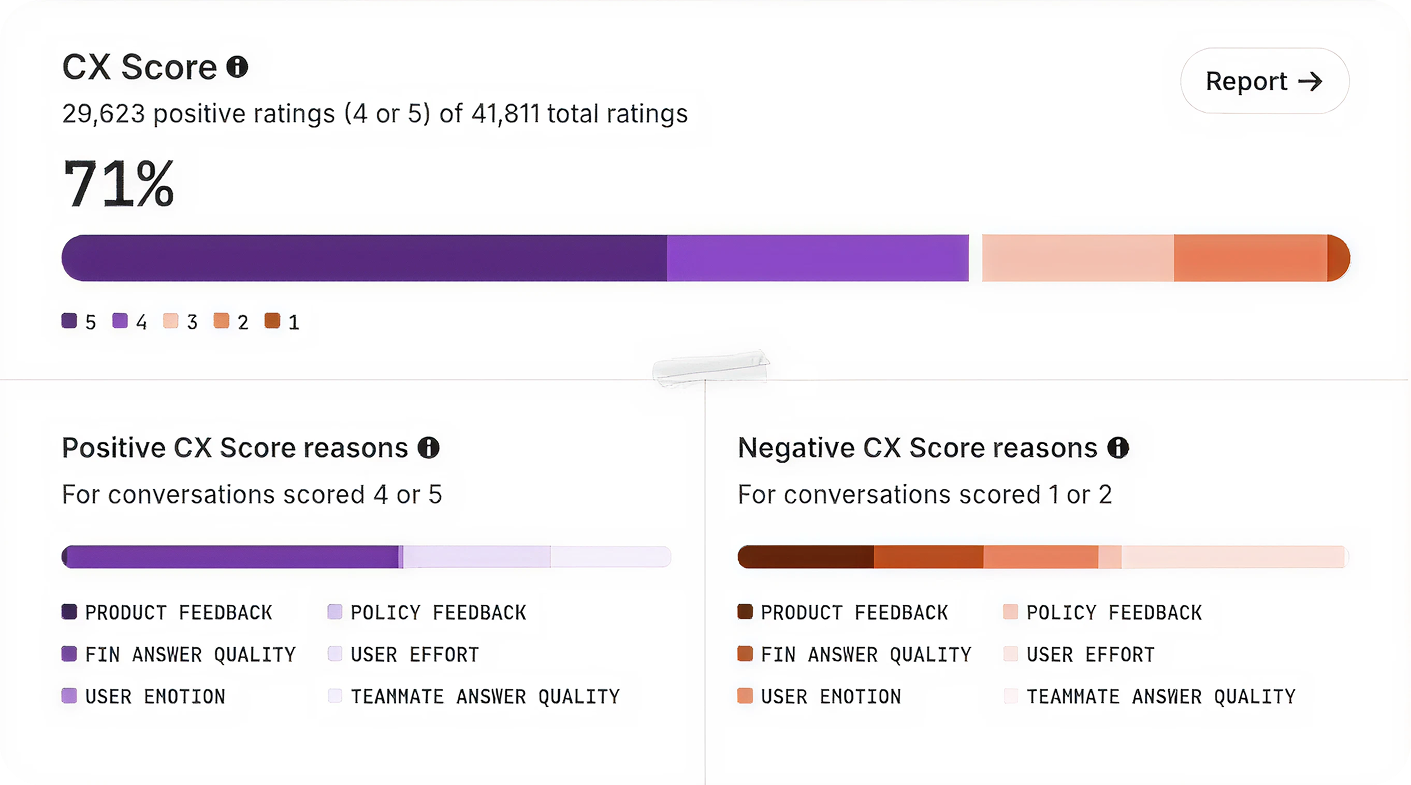
    Another example is CX Score. It started with close work alongside Intercom’s Customer Support team to understand performance with Fin, initially through predicted CSAT and resolution. Over time, this work evolved into CX Score: a scalable way to measure conversation quality across all customers.

    The product stage is fundamentally different from Cockpit because of the constraints. Cockpit provides a platform for our customer analyses/tools but it doesn’t need to scale as far as product. What moves into product has to work for every customer, without configuration, at scale, so it has to generalize. That bar is what protects long-term quality while unlocking product-led growth.

    That’s why the move from Cockpit to product isn’t automatic. We’re not just asking whether something is useful, but whether it’s broadly useful, robust, and scalable enough to run across the entire customer base. As a product leader, I push for this discipline because it’s where customer success, engineering excellence, and business outcomes converge.

    The loop. The model is simple. Swarms generate the best signal, grounded in real customer problems. Cockpit operationalizes that signal so CSMs and Sales can use it across many customers. Product takes the patterns that truly generalize and turn them into scalable features that enhance every customer’s experience.

    This loop allows a small swarm data science function to have impact beyond a small set of high-touch accounts, resulting in a stream of continuous improvements across all three levels and an ever-increasing level of automation for our customers. Practically, it’s a repeatable playbook for product management leadership: start with high-signal discovery, prove repeatability, and only then scale through product. Done well, it compounds learning, accelerates time-to-value, and aligns the entire organization around measurable outcomes.


    Inspired by this post on The Intercom Blog.


    Book a consult png image
  • Never Stop Disrupting: Why the Fin API Platform Signals a New Era for Agentic AI

    Never Stop Disrupting: Why the Fin API Platform Signals a New Era for Agentic AI

    Disruption is the only sustainable strategy in product. When a platform meaningfully changes how we build and operate, I pay attention—not just as a product leader, but as someone accountable for turning AI Strategy into durable competitive differentiation. That’s why the launch of the Fin API platform stands out: it’s a concrete step toward agentic AI at enterprise scale.

    Today, I’m diving into what this launch includes, why it matters for product strategy, and how I’d navigate the build vs buy decision in this new landscape. My goal is to translate the announcement into actionable guidance for product teams, CX leaders, and forward-deployed engineers who are building the next generation of customer support and product-led experiences.

    Fin is a customer agent platform that at present resolves over 2M customer issues a week, growing at a rapid exponential pace. It’s relied on by the best brands, large and small, in every vertical you can imagine. From Atlassian and Riot Games, to smaller hot upstarts like Mercury and Polymarket. It runs on a family of models trained by its AI group. Last week, they announced Apex, which is the world’s first specialized customer service LLM. In production tests over the last 6 months, it beat every single frontier model, including those from Anthropic and OpenAI, on resolution rate, latency, hallucination rate, and cost.

    With this launch, teams can access the platform’s core capabilities and underlying models directly via API, with contracts starting at $250k per year, and usage rates that are by far the cheapest in the industry for each of the model’s subcategories. For leaders evaluating total cost of ownership, this is a meaningful data point: it shifts the economics of scaled automation from experimental to operational.

    Why now? Because builders want options. I hear from teams daily that want to design their own agents, tune prompts and policies, and integrate with bespoke CRMs, data lakes, and product surfaces. The Fin announcement meets that demand with three clear build-paths, each mapping to a different operating model and maturity stage.

    First, for the vast majority of companies, the Fin Agent Platform is the pragmatic starting point. Fin reports ~8k companies on it today. It addresses 99% of customer needs out of the box—without exhausting consulting engagements—while delivering top-tier resolution rates. If your priority is time-to-value, governance, and platform scalability, this route de-risks implementation and accelerates outcomes.

    Second, for teams that need custom surfaces or channels, the Fin Agent API lets you present Fin in unique contexts. You get the Fin platform’s orchestration and controls, but you’re free to bypass the default messenger, email, voice, or any prebuilt channel and embed the agent natively in your product. I see this as the sweet spot for product-led growth motions where conversation design and UX writing are strategic levers.

    Third, for companies building hyper-specific agents—think service plus in-product actions—the new API access to Apex and the broader collection of models is the obvious move. Unlike generalized models, these are purpose-trained for customer service scenarios and operational policies. If you have strong in-house solutions engineering, a retrieval-first pipeline, and eval-driven development in place, this path maximizes control without reinventing the model layer.

    This also opens the door for vertical specialists. Fin-like businesses focused on deep domains can emerge quickly—Fin for dentists? Why not? Fin for car dealerships? Sure. I expect startups and modern CX providers (including players like Decagon and Sierra) to carve out niches where domain data, workflows, and compliance are the real moats. That’s where differentiated AI beats generic capability.

    There’s a defensive reason to pay attention here. The software landscape is shifting fast: the moat is no longer feature parity—it’s the quality of your agents and the data flywheels powering them. Building software is simply less hard now, and I’ve watched engineering teams more than double measurable productivity as they adopt AI-assisted development. The implication is clear: the interface-and-features era is giving way to an agents-and-outcomes era.

    Serious software companies must evolve from being a features company to an agents company—and build those agents on differentiated AI. More value will accrue at the model and orchestration layers, where safety, latency, cost, and resolution quality are won. That puts a premium on prompt engineering discipline, policy routing, continuous discovery of edge cases, and rigorous offline/online evals to keep hallucination rates low while maintaining speed.

    How would I choose among the three build-paths? If you’re early or resource-constrained, start with the Fin Agent Platform to validate outcomes and align stakeholders. If you need branded experiences and tighter product integration, use the Fin Agent API to control surfaces without owning the heavy lifting. If you have strong ML ops and a mature customer support ai strategy, go model-level with Apex and companions, layering in your own guardrails, context window management, and test harnesses. In each case, balance velocity, control, and risk—your build vs buy decision should be grounded in clear metrics and an explicit product strategy.

    Where does this lead? We’ll see more companies expose specialized model families with clearer economics and stronger governance. For now, I’m excited to see what teams build with the Fin API platform—and how they turn agentic AI into measurable improvements in resolution rate, CSAT, cost-to-serve, and ultimately, customer loyalty.


    Inspired by this post on The Intercom Blog.


    Book a consult png image
  • Apex Arrives: Vertical AI That Beats GPT-5.4 on Customer Service Speed, Accuracy, and Cost

    Apex Arrives: Vertical AI That Beats GPT-5.4 on Customer Service Speed, Accuracy, and Cost

    I just watched one of the most significant leaps in customer service AI in years. Last week, a quiet but seismic release landed in CX: Fin introduced Apex, a vertical model purpose-built for support that raises the bar on speed, accuracy, and cost. As a product leader, this is exactly the kind of breakthrough that changes roadmaps, vendor strategies, and what customers can expect from modern service operations.

    It’s a brand new model for Fin called Apex, and it’s objectively the highest performing, fastest, and cheapest model for customer service. It beats the very best models in the industry including GPT-5.4 and Opus 4.5.

    In this analysis, I’ll unpack why the launch matters for the customer service agent category, what it signals for frontier labs and open‑weight ecosystems, and how leaders should rethink their AI Strategy, build vs buy decisions, and eval-driven development roadmaps.

    Fin was already the highest performing and most sophisticated agent in the customer service space, consistently beating impressive competitors like Decagon and Sierra at an average win rate in the 70s. It operates at tremendous scale, now resolving almost 2M customer issues per week, a number that’s growing at an exponential clip. In its short life it’s grown to nearly $100M in recurring revenue.

    As of last week, ~100% of all (English language, chat and email) customer conversations are now running on Apex. Since day 1, the Fin engine has comprised a system of models, and last year the team began replacing off‑the‑shelf models with custom ones trained on proprietary data. The core answering model had been a frontier labs offering—initially versions of GPT and more recently Sonnet 4.0. Now, that core answering model is Apex 1.0.

    This model resolves customer issues at a materially higher rate than any other model available. One of their largest customers in the gaming space saw the resolution rate improve overnight from 68% to 75% (i.e. a reduction in unresolved conversations of 22%). The team notes they had never seen a jump this large from a single improvement since they started Fin.

    Just as important, it’s dramatically faster, has fewer hallucinations, and is far cheaper than other available models—exactly the attributes operations leaders weigh most when deploying agents at scale. In practice, these are the levers that unlock higher CSAT, tighter SLAs, and better unit economics.

    Achieving all three simultaneously is extraordinarily hard. Credit goes to foundational research from a 60‑person AI group run by Fergal Reid, and, crucially, to domain‑specific proprietary evals drawn from billions of human and agent interactions produced by the Fin resolution engine—already hand‑tuned to be the most effective in the category. That creates a flywheel: an eval‑driven development loop that trains models to keep improving at the edge of the system’s abilities. In other words, Apex 1.0 looks like the tip of the iceberg.

    Zooming out, service is one of the few categories where generative AI has already delivered commercial impact at scale (alongside coding, and arguably the legal industry). With TAMs measured in the hundreds of billions, competition is intense and well capitalized. The pattern I’ve seen repeatedly is clear: winners in these spaces must become full‑stack AI companies. As features become ~free to build, durable competitive differentiation shifts under the hood—to proprietary data, post‑training, inference efficiency, and the quality of the eval loop.

    Dual bar charts showcasing Fin Apex 1.0 with -65% hallucination reduction and a 3.7s time to first token, benchmarked against Sonnet 4.6, Opus 4.5, and GPT-5.4 on a clean, light background.
    Fin Apex raises the bar for finance-ready AI, highlighting a -65% cut in hallucinations and a quicker first token at 3.7s (0.6s faster), compared with Sonnet 4.6, Opus 4.5, and GPT-5.4 in side-by-side charts.

    That’s why competitors will need to release their own models. Many appear to be just starting to hire the talent to do so, which likely gives Fin at least a year of head start. For product leaders, this is a strong signal to revisit build vs buy assumptions, and to quantify when owning your post‑training pipeline and evals becomes the rational move.

    Honestly, 2–3 years ago I expected AI application differentiation to live mostly in what we built around third‑party models. The AI game humbles all of us; today it’s obvious that vertical models paired with proprietary evals create compounding moats.

    In a podcast interview last week, Andrej Karpathy said:

    "I do think we should expect more speciation in the intelligences. The animal kingdom is extremely [diverse] in the brains that exist. And there’s lots of different niches of nature… And I think we should be able to see more speciation. And you don’t need this oracle that knows everything. You kind of speciate it. And then you put it on a specific task. And we should be seeing some of that because you should be able to have much smaller models that still have the cognitive core."

    The frontier labs still have the very best models, but open‑weight models aren’t far behind—making pre‑training look increasingly like a commodity. The frontier is moving to post‑training, which is precisely what we see with Apex (and Cursor’s Composer 2), and what we should expect to dominate going forward.

    Labs now face a dual reality. On one hand, horizontal general‑purpose models can over‑serve specific verticals (e.g., customer service doesn’t need an oracle that knows everything). On the other, open‑weight models are good enough that high‑quality, domain‑specific post‑training can produce superior models for special‑purpose jobs—and in the ways that matter for those jobs. In service, soft factors like judgement, pleasantness, and attentiveness matter alongside hard factors like resolution effectiveness, speed, and cost.

    I’m still bullish on the labs. Many organizations remain heavy customers of Anthropic—whether as part of multi‑model systems or through deep usage of Claude Code in engineering teams (see this example of Claude Code adoption). Yet classic disruption (à la the late, great Clay Christensen) is now at their door. The way out is to disrupt themselves by building cheaper specialized models too, which likely requires acquiring the evals—or the companies with the evals—needed for each task. Expect creative data partnerships, M&A consolidation, and a wave of hyper‑specific model providers that compete head‑to‑head with the labs.

    In the meantime, Fin appears to be the only vendor in its space with a custom model that’s also objectively superior to everything else out there. I’m excited to see it deployed broadly for end customers, and I’m watching closely for the next announcement that will accelerate that rollout. For product leaders, the message is clear: the age of vertical models and agentic AI is here—bring your evals, or bring your checkbook.


    Inspired by this post on The Intercom Blog.


    Book a consult png image
  • Designing AI-Powered CX at Scale: Lessons Inspired by Amanda Sime at Amplitude

    Designing AI-Powered CX at Scale: Lessons Inspired by Amanda Sime at Amplitude

    Customer experience is where strategy, data, and execution converge—and where AI can deliver compounding value when thoughtfully designed. In my work, I’ve seen how the right CX vision becomes a growth engine when it’s operationalized through clear measures, robust analytics, and disciplined product practices.

    "Amanda Sime is the Customer Experience Strategy Lead at Amplitude. She shapes CX strategy and partners across orgs to design and scale AI-powered solutions." That concise description captures a model I deeply respect: start with a strong CX strategy, then partner across the organization to make AI real in the day-to-day. It’s not just about new technology; it’s about aligning teams, systems, and incentives to deliver consistent customer value.

    Translating that approach into practice requires a rigorous AI Strategy, anchored in measurable outcomes and informed by behavioral analytics. I prioritize journey mapping to expose friction, then connect those insights to AI workflows that enhance customer success and in-product guidance. When cross-functional partners—from solutions engineering to support—operate from a shared driver tree, the roadmap balances speed with sustainability.

    Data is the backbone. A unified analytics platform—often centered on Amplitude analytics—helps teams move beyond vanity metrics to track user activation, feature adoption, and retention analysis with precision. With that foundation, we can test responsibly, iterate quickly, and validate impact with product-led growth motions that scale across segments without sacrificing quality.

    Operational excellence matters just as much as vision. I’ve learned to treat CX programs like enduring products: build reliable feedback loops, connect customer support AI strategy to clear service-level outcomes, and empower product management leadership to make evidence-based tradeoffs. When teams have clarity on the problem space and access to trustworthy insights, they deliver solutions that feel both intelligent and human.

    The real win is cultural: empowering product trios and partner teams to co-own outcomes, not just outputs. That’s how AI moves from a promising experiment to a durable capability—by aligning strategy, analytics, and execution so customers experience value at every touchpoint.


    Inspired by this post on Amplitude – Perspectives.


    Book a consult png image
  • Unlocking AI’s Black Box: How Monitors and Scorecards Elevate CX with Confidence

    Unlocking AI’s Black Box: How Monitors and Scorecards Elevate CX with Confidence

    I followed the energy at Fin Labs Paris and immediately zeroed in on the announcement of Monitors. In my view, it’s the missing piece that turns Fin’s powerful automation into an observable, trustworthy system—sitting alongside Insights and Recommendations to form a complete observability suite that gives teams confidence in what Fin is doing.

    With Monitors, you define what conversations get reviewed, both Fin and human, and set evaluation criteria using Custom Scorecards. That level of control ensures you’re measuring the metrics that matter most to your business and holding support quality to your bar, not a generic one.

    Used in concert with Insights and Recommendations, you can finally see what’s happening across your support operation, evaluate every conversation against your standards, and take targeted action to continuously move toward perfect customer experiences.

    As Agents become more powerful, transparency and control become critical. I’ve seen this shift firsthand: AI is advancing fast, and the stakes are no longer theoretical—Agents are resolving real customer issues with real consequences at scale.

    Diagram of the AI model lifecycle loop with four stages—Train, Test, Deploy, Analyze—with Analyze highlighted in orange to show monitoring that closes the feedback loop and opens the AI black box.
    Visualizing the AI development flywheel—Train, Test, Deploy, Analyze—this graphic spotlights Analyze in orange to introduce Monitors, turning opaque model behavior into measurable signals and continuous customer service insights.

    Fin has almost 8,000 customers, averages a 67% resolution rate, and resolves close to 2 million customer queries every single week, including highly complex queries in regulated industries.

    At that scale, observability isn’t a nice-to-have; it’s a necessity. Traditional CSAT and small QA samples weren’t built for Agent-led operations—they miss edge cases, don’t scale, and can’t explain drift. The result is a black box. What teams need most right now is confidence, built on data you can trust and act on.

    At Intercom, this is called the Fin Flywheel: Train, Test, Deploy, Analyze.

    Intercom Monitors dashboard with review queues and analytics cards, plus an Edit monitor panel configuring a 'Vulnerable customers' rule set with sample testing and continuous monitoring for Fin conversations.
    See inside Intercom's Monitors: a streamlined dashboard with pass‑rate charts and review queues, alongside a panel to define a 'Vulnerable customers' monitor, test it on sample chats, and run continuous checks.

    Analyze is the step where you find out what’s actually happening and it’s where improvement begins.

    In my experience, achieving confidence in an AI support operation requires three things: (1) a complete understanding of what Fin, your human team, and your customers are talking about; (2) a way to monitor and score conversations based on the criteria that matter most to your business; and (3) AI-powered recommendations that make it easy to act on what you find. Intercom launched Insights and Recommendations to address the first and third. Now, Monitors completes the system for full observability and opens the black box.

    Monitors: know whether every conversation met your standards. Customer sentiment is important, but it’s different from determining whether a conversation was handled correctly. With Monitors, you can do both—and do it at scale.

    Quote graphic for Announcing Monitors: Opening the AI black box, featuring a testimonial on tracking AI quality continuously vs. spot checks, attributed to Ineke Oates, Head of Support at Agorapulse.
    Customer support leaders praise Monitors for turning AI performance from a black box into measurable signals. This quote from Ineke Oates of Agorapulse highlights the shift from manual spot checks to continuous quality tracking.

    Monitors is a new QA capability that delivers a structured, repeatable way to define which conversations get reviewed and evaluate them against quality criteria you set. It replaces ad-hoc sampling and spreadsheet-driven QA with a system that scales as your volume grows.

    Two components work together: Monitors define what gets reviewed and Custom Scorecards define how each conversation is evaluated. That pairing brings the rigor of Agent Analytics and the discipline of eval-driven development to everyday CX operations.

    Random sampling has always been a blunt tool. When AI is handling thousands of conversations a week, a small, arbitrary slice won’t reliably capture your highest-risk edge cases, your most complex escalations, or where quality is starting to drift. I’ve felt that pain in operations reviews—too many unknowns, not enough signal.

    Product screenshot of a Monitors dashboard with review queues and bar-chart analytics, plus a New scorecard panel to assess human teammates or an AI agent using configurable criteria and pass rates.
    Open the AI black box with Monitors: track conversations, triage unreviewed items, and build transparent scorecards with criteria like accuracy, process adherence, and efficiency to lift customer support quality.

    With Monitors, you select and evaluate conversations with intent. You can target specific signals of risk or failure, like “the customer showed signs of financial vulnerability” or “Fin looped around with the same answer without resolving the issue.” Or you can create consistent, repeatable samples to benchmark quality over time. Use the existing library of filters (customer data, channel, Fin-specific metrics) or describe nuanced scenarios in natural language. Most teams will do both: hone in on the conversations that matter most and maintain a steady, structured QA sample each week.

    "When I saw Monitors, my first reaction was — this is exactly what we need. The ability to track quality continuously, instead of relying on spot checks, is a big shift for us." Ineke Oates, Head of Support, Agorapulse

    Custom Scorecards make your standards explicit and enforceable. One-size-fits-all rubrics never reflect your brand voice, industry constraints, or customer expectations. With Custom Scorecards, you define what “good” looks like for your business and turn that into a measurable, comparable quality score for every conversation.

    Minimalist testimonial graphic on an off‑white background quoting a customer about Monitors enabling QA where conversations happen, running across Fin and human support in one place; attributed to a Culture Amp leader.
    A customer testimonial underscores the promise of Monitors: bring quality assurance into the flow of work, unifying AI assistant Fin and human agents in a single place for faster, clearer customer support.

    You define the criteria that matters, how each should be measured, and how important each one is. Some criteria can be scored automatically by AI, others reviewed by a human, or both — all within the same scorecard. This means you’re not choosing between scale and judgment; you get both in one system.

    Each conversation is then evaluated against these criteria, and the system calculates an overall quality score based on your configuration. You can weigh what matters most, or mark certain criteria as critical, so a single failure can fail the entire evaluation when needed.

    The result is a single, consistent quality score that reflects your standards—not a generic metric, and not a collection of disconnected checks. That’s what makes quality measurable over time and comparable across AI and human support.

    Dashboard screenshot of Monitors review queues showing users, monitor types, colored review scores, reviewers, review status, notes, and follow-up actions with AI auto-review labels.
    Monitors helps open the AI black box by turning model outputs into trackable reviews. This clean queue groups customers, monitor types, scores, and actions—with AI auto-review—so teams improve quality faster.

    There’s an important distinction here: CX Score tells you how customers felt about a conversation. Custom Scorecards tell you whether it met your standards. You need both.

    "We looked at dedicated QA tools, but what's compelling about Monitors is that it lives where our conversations already happen. We don't need another system — we can run QA across Fin and our human team in one place." Jared Ellis, Senior Director, Global Product Support, Culture Amp

    When a conversation meets your criteria for review, Monitors routes it into a Review Queue. Each conversation is assigned to the right reviewer with its scorecard attached and status tracked end to end: Not reviewed, Reviewed, Needs a fix, Fix complete. Reviewers work directly in Intercom, capture what went wrong, and propose concrete fixes—like updating documentation or refining a workflow—so quality loops end in action, not just scores.

    Fin quality dashboard showing AI support monitor metrics and a line chart of criteria trends over time; cards list 75.2% average review score, 92.8% reviews passed, 856 reviews, and 62 failed, with date and filter controls.
    Monitors turn AI performance from opaque to measurable. The Fin quality view summarizes review score, pass rate, and review counts while a time‑series chart tracks escalation ease, clarification, and efficiency—delivering fast, actionable CX insights.

    Reporting turns QA into a continuous signal rather than a one-off audit. You can track review scores over time across Monitors and Scorecards, and compare them directly to CX Score, resolution rate, and other performance metrics. Patterns that were previously invisible become clear: a topic consistently underperforming, a quality dip correlated with a recent knowledge base change, or a team whose scores are improving week over week. This is observability applied to CX—evidence you can act on.

    Monitors for Fin conversations is live today, and the roadmap goes further. Human agent QA will bring the same structured evaluation to your human team’s conversations, creating one consistent quality system across your entire support operation.

    Real-time alerts will notify you the moment a conversation crosses a threshold you’ve defined—before the issue reaches more customers and risks compounding negative sentiment.

    Promotional banner reading "Get started with the #1 Agent today" over a dark, aurora-like gradient background, featuring a white button labeled "Start a free trial"; marketing graphic for an AI support agent.
    Kick off your journey with the #1 Agent—an AI partner designed to turn resolutions into real outcomes. Tap “Start a free trial” to explore faster, smarter customer service and see how Fin delivers value from day one.

    Knowledge base evaluation will connect AI scoring directly to your content so conversations are assessed against your latest policies and documentation, catching inaccurate or outdated responses and providing clear rationale linked to the relevant source.

    Creating perfect customer experience with AI requires transparency. You need to understand how the system is performing if you want to maintain and improve quality over time. With Insights, Monitors, and Recommendations, this is now possible—a complete analysis suite that lets you see what’s happening across every conversation, ensure it meets your standards, and pinpoint improvement opportunities when they matter most.

    I’ve long advocated for a retrieval-first, eval-driven approach to AI Strategy because it makes risk visible and manageable. Monitors operationalizes that philosophy for CX leaders: you get continuous signal, shared definitions of quality, and a direct path from flags to fixes. If you’re scaling AI support, this is how you replace uncertainty with control—and turn the black box into a competitive advantage.


    Inspired by this post on The Intercom Blog.


    Book a consult png image
  • Kaizen for the AI Era: Tiny Daily Wins That Build Smarter, Scalable Customer Support

    Kaizen for the AI Era: Tiny Daily Wins That Build Smarter, Scalable Customer Support

    Every day, I challenge my teams to make one small, meaningful improvement—something so lightweight it’s impossible to ignore and easy to repeat. That tiny daily motion compounds, and over time it reshapes customer experience, operational quality, and team culture.

    That’s the essence of Kaizen, the Japanese philosophy of continuous improvement. Developed in post-war Japan and popularized by companies like Toyota, Kaizen proves that small, steady changes lead to significant long-term results. In product management and customer support, this approach transforms big ambitions into daily behaviors that actually stick.

    Crucially, Kaizen isn’t passive or unstructured. It thrives on three principles I reinforce across my org. First, small changes reduce resistance—when you lower the activation energy, teams move faster. Second, improvement is continuous, not occasional; instead of waiting for quarterly reviews or major releases, you ask: “What can we improve right now?” Third, everyone participates—the people closest to the work are best positioned to improve it. That’s how momentum spreads.

    In practice, the cycle is simple: identify a small problem, test the change, measure the result, refine, and repeat. The point isn’t radical transformation in a single swing; it’s steady progress guided by data and observation—a rhythm that aligns beautifully with eval-driven development and continuous discovery.

    At Intercom, we apply this same philosophy to how we manage our Agent Fin through a process we call the “Fin Flywheel”. Here’s how this works.

    Train: Teach Fin how to handle and resolve the most complex customer queries.

    Test: Run fully simulated customer conversations from start to finish to see exactly how Fin will behave before going live.

    Deploy: Launch Fin across all channels so customers get consistent support wherever they reach out.

    Analyze: Use AI-powered insights to review and improve Fin’s performance so it can deliver better customer experiences.

    This isn’t a one-time setup; it’s a continuous loop where every interaction feeds ongoing improvement. Rather than deploying AI and assuming it will perform as expected, improvement is built into the system itself. The more Fin is used, the better it gets. That’s the hallmark of agentic AI done right—tight feedback loops, purposeful conversation design, and clear Agent Analytics that illuminate what to tune next.

    But continuous improvement doesn’t stop with AI. Within our Human Support operations, I emphasize the same mindset that drives great LLMs for product managers: you instrument the experience, learn from real usage, and close gaps fast. We operate with a simple mindset: the first time that you solve a customer issue should be the last time it happens.

    When a conversation reaches a human, we pause to diagnose and prevent recurrence. Why did this reach me? Why couldn’t Fin resolve it? How can we prevent this from happening again? Those questions anchor a culture of root-cause thinking and accelerate product-led growth by removing friction at the source.

    To make this effortless, we’ve built a lightweight, AI-powered way to log suggestions in the moment—no long explanations or heavy admin required. Ideas are reviewed quickly and implemented by subject matter experts or by the team themselves. This keeps the flywheel spinning: insights flow in, fixes go out, and measurable outcomes improve.

    The result is a frontline that evolves from reactive problem-solvers into a proactive improvement engine. The people closest to customers spot friction, suggest fixes, and see their insights shaped into meaningful change. It’s continuous discovery embedded in everyday work, not a side project.

    Kaizen demonstrates that lasting progress doesn’t come from occasional transformation; it comes from intentional, everyday refinement. The “Fin Flywheel” applies that philosophy to AI. Our Human Support continuous improvement process applies it to human insights. Together, they create a shared system where both people and AI learn continuously from customer interactions.

    When improvement is built into the mechanics of how you work, it stops being a one-off project and becomes an ingrained capability. Over time, those small daily improvements don’t just add up—they compound into a sustainable, data-driven advantage that elevates customer experience and differentiates your customer support ai strategy.


    Inspired by this post on The Intercom Blog.


    Book a consult png image
  • How We Automated 81% of Customer Support with AI—While Uplifting CX, Speed, and ROI

    How We Automated 81% of Customer Support with AI—While Uplifting CX, Speed, and ROI

    Leading the Support function for a company that builds a leading Agent and AI-forward customer service platform has been, for me, unique, exciting, and yes—daunting. It’s where product ambition meets operational reality, and where every decision I make is immediately tested by customers who expect excellence.

    It’s unique because we use the same technology as our customers. We live in the product every day, which puts us in a privileged position to be the voice of the customer across the organization. That tight feedback loop has shaped how I prioritize, what I build next, and how I measure success.

    It’s exciting because we get to try all of the new features and capabilities of Fin and the Intercom helpdesk. With a relentless focus on AI innovation, I’ve had access to remarkable tools that help us deliver an incredible customer experience—and I’ve seen firsthand how the right workflows and guardrails turn those tools into outcomes.

    And it’s daunting because expectations for our own Customer Support (CS) team are sky high. If we can’t deliver incredible support using our own technology, we undermine its value proposition. That imperative has kept me honest, focused, and fast.

    In our new research, “The 2026 Customer Service Transformation Report,” we’ve been sharing how forward-looking teams use AI to transform their support models. If you’d like to get straight to the report, download it here.

    When Intercom changed its focus in late 2022 to prioritize the customer service use case, we undertook a critical review of the support experience we were delivering and committed to driving meaningful change under an AI-first framework. That was a turning point: I aligned product strategy and operations around a single north star—automate with quality, and elevate humans to higher-value work.

    Three years on, Fin now resolves over 81% of all our customer support volume, delivering immediate and high-quality resolutions. We have absorbed a 300%+ increase in customer demand since 2022 without proportional headcount growth. Without Fin, we would have needed at least 100 additional CS team members to meet that demand and our improved service levels – a net saving to Intercom of between $7.5M–$9M annually.

    Throughout this work, we drew on research from the 2026 Customer Service Transformation Report and applied the lessons directly to our own org design, knowledge management, and AI workflows. What follows is our story of transformation and how we achieved a mature deployment of Fin.

    The problems we set out to solve

    Back in 2022, our challenges looked familiar to any modern support organization, and I knew we needed a step-change—not incremental tweaks.

    We faced increased support demand from new and existing customers: Intercom was launching major features and changes at speed, driving up overall customer conversation volume and requiring additional headcount for the CS team. I could see we were scaling people faster than processes—unsustainable without automation.

    Our support policy (as defined by our service level objectives) was not based on a high bar: In most cases, we were only committed to “business hours” coverage for the majority of our customers, impacting first response times. Even with SLOs that were not considered best in class, we were struggling to meet our commitments. I wanted 24/7 coverage and faster first responses without sacrificing quality.

    We wanted to do more: As we pivoted our strategy, we wanted to open new routes to our support team, such as providing support to website visitors with technical questions and to trial customers. That meant meeting customers earlier in their journey with accurate, on-brand responses—at scale.

    What we did

    We made a very conscious decision to become our own best reference customer. As Intercom embraced the opportunity that generative AI presented to transform customer service, we intentionally moved to an AI-first strategy for our Customer Support team. I set a simple operating principle: ship value quickly, measure relentlessly, and let evidence guide the next bet.

    We started with the highest-volume, informational queries and saw our resolution rates climb quickly. With that foundation in place, we pushed Fin further, training it on deeper documentation and internal procedures, and eventually giving it the ability to take actions on behalf of customers. As Fin took on more complex work, our results started to compound—and trust in the system grew across the organization.

    Early adoption and building trust. When “AI Assist” features came to the Intercom Inbox, the CS team got early exposure to AI and were empowered to provide feedback directly to our product teams. This built awareness and trust across the team about what we were trying to achieve with AI, and helped shape the product roadmap. We were also the first beta customer for Fin, rolling it out to a subset of customers to watch sentiment and outcomes closely. With no adverse reaction and an initial resolution rate of over 25%, we deployed Fin to most customer segments within weeks. I’ll never forget the first week we put Fin in front of real customers—the silence of issues that never reached humans was the loudest signal of success.

    Knowledge management as a product. We recognized quickly that time spent tuning our help center and knowledge assets for Fin would pay dividends. We transitioned our Help Center Manager into a “Knowledge Manager,” with a dedicated remit to optimize content for Fin. We embedded knowledge creation into our “New Product Introduction” (NPI) process, targeting that Fin would resolve at least 50% of customer issues at every new product and feature launch. Over time, we added new sources, including “Developer Documents,” enabling Fin to handle increasingly complex issues. We built a culture of continuous improvement—allocating “out of the inbox” time so every teammate could close content gaps and raise the bar.

    Conversation design end-to-end. To ensure a consistent, high-quality customer experience, we created a new “Conversation Designer” role that owns the journey across automation and human handoffs. Using Intercom’s Workflows, we introduced “skills-based routing” so that when a customer asks for a human, the conversation reaches someone with the right expertise quickly. This is now handled by Fin directly using a feature called “Attributes.” The result: a seamless, on-brand experience regardless of channel or escalation path.

    Neon green hero graphic reading 'The 2026 Customer Service Transformation Report', with subhead 'The AI deployment gap is widening' and a black 'Get the report' button over a bar-chart pattern.
    Leaders are racing ahead with real AI in support. Explore the 2026 Customer Service Transformation Report to see where deployment is stalling, benchmark your team, and get practical steps to scale automation that delights.

    Organization changes that unlocked leverage. As we scaled Fin, we stood up a dedicated AI Support team under a senior CS leader to continuously optimize automation and define our AI adoption strategy across the journey. We restructured human roles into “Technical Support Specialist” and “Technical Support Engineer” to better align with the complexity of incoming work. We also expanded Support Operations to focus on optimization—using AI to uplevel Enablement, Workforce Management, QA, Process Management, and Data Insights. Just as important, we reset expectations about the balance between time spent supporting customers directly versus improving AI. That mindset shift created compounding returns.

    Pushing Fin further with new capabilities. As capabilities matured, we were early adopters and saw measurable wins:

    Fin Guidance: Multiple Guidance rules provide additional controls and a more personalized, targeted experience for customers.

    Fin Tasks and Procedures: Enables Fin to carry out activities such as updating customers on incident status and deep troubleshooting for technical issues.

    Insights: AI-driven dashboards provide deep insight into Fin’s performance and surface recommendations for further optimization. Insights also provides a Customer Experience (CX) Score for every customer interaction, enabling more targeted improvement efforts and opening up new ways to close the loop with customers who have had a poor experience.

    What we achieved

    What started as a focused effort to improve our customer support experience became the strongest proof point for what’s possible when you fully embrace AI. Fin now resolves over 81% of all our customer support volume and has allowed us to absorb a 300%+ increase in demand without proportional headcount growth. Over 90% of our customers now benefit from improved first response performance, 24/7 coverage, and outbound phone support.

    What the numbers don’t fully capture is the shift in how our team operates. With volume absorbed by Fin, our CS teammates now deliver consultative support—guiding next best actions, deepening product adoption, and contributing directly to retention and expansion. Customers that receive these engagements adopt Fin at a much deeper level and achieve greater support success. What was once a reactive, volume-driven team is now a function that generates significant revenue.

    What’s next

    Customer expectations are always rising, so we’re building on our progress by embracing the Fin Flywheel—an actionable framework for ongoing improvement and optimization. This keeps us honest about the discipline required to sustain AI performance at scale.

    Train: Teach Fin to resolve even the most complex queries with Procedures, knowledge, and policies.

    Test: Run fully simulated customer conversations from start to finish to see exactly how Fin will behave before going live.

    Deploy: Set Fin live across every channel – voice, email, chat, and social – for consistent support wherever customers reach out.

    Analyze: Use AI-powered Insights to analyze and improve Fin’s performance and deliver better customer experiences.

    We are also investing in our support teammates so they can adjust to the new world of AI—taking on more complex work and being valued for the subject matter expertise, consultative engagement, and empathy they bring to the role. That human layer is where differentiation shines.

    We will continue to develop and share best practices for deploying an Agent, based on our own experience with Fin and the lessons learned from our most forward-looking customers. These are captured and continually evolving in The Agent Blueprint.

    Transformation takes commitment

    The most successful teams aren’t bolting AI onto old processes; they’re rebuilding support around it—investing in knowledge and people alongside technology, and treating AI as a continuous discipline rather than a one-time deployment. That’s the real change required. For support teams willing to make it, there’s a rare opportunity to redefine what customer service can deliver—higher CSAT, faster resolution, and durable ROI.


    Inspired by this post on The Intercom Blog.


    Book a consult png image