Tag: AI Strategy

  • Plan Your 2026 Product Conference Calendar: Top Events, Locations, and Insider Tips

    Plan Your 2026 Product Conference Calendar: Top Events, Locations, and Insider Tips

    I’m curating a living list of 2026 product conferences to help product managers, product leaders, and empowered product teams plan ahead with confidence. I use this calendar to align my team’s discovery work, roadmapping, and go-to-market strategy—and to prioritize conference networking and learning that moves the needle on product-led growth.

    This list is not exhaustive. If there’s a product conference missing that should be here, please send it to conferences@producttalk.org. I’ll keep updating this as new events are announced so you have a reliable guide throughout the year.

    I’ll be teaching a workshop and speaking at the Product at Heart conference in June in Hamburg, Germany. If you plan to attend, be sure to say hi.

    Are you looking for the 2025 Product Conferences list? Find it here.

    How I use this guide: I map events to our quarterly OKRs (outcomes vs output OKRs), focus on sessions that sharpen product discovery, stakeholder management, and product roadmapping and sprint planning, and bring a clear plan for takeaways I can apply the day I’m back. If you’re exploring AI Strategy and LLMs for product managers, you’ll find several strong options below.

    January

    Jan 28 — Product-Led Summit — Washington, DC, USA

    Jan 30–31 — Prdkt+ — Cairo, Egypt

    February

    Feb 1–4 — WebSummit — Doha, Qatar

    Feb 2–20 — DeveloperWeek Hackathon — San Jose, CA, USA & Virtual

    Feb 4 — DDX Innovation & UX Conference — Tokyo, Japan

    Feb 4–5 — UX360 Virtual Summit — Virtual

    Feb 7–8 — DDX Innovation & UX Conference — Dubai, UAE

    Feb 18–20 — DeveloperWeek — San Jose, CA, USA

    Feb 18–20 — ProductWorld — San Jose, CA, USA

    Feb 24 — ProductCon — London, UK

    Feb 24–25 — axe-con — Virtual

    Feb 24–25 — Product-Led Summit — Austin, TX, USA

    March

    Mar 9–10 — Gartner Product Leadership Conference — Grapevine, TX, USA

    Mar 12–18 — SXSW — Austin, TX, USA

    Mar 23–26 — The Annual ACM Conference on Intelligent User Interface — Paphos, Cyprus

    Mar 26 — Chief Product Officer Summit — New York, NY, USA

    Mar 26–27 — Product Operations Summit — New York, NY, USA

    Mar 26–27 — Product-Led Summit — New York, NY, USA

    April

    Apr 1–2 — Product-Led Summit — Denver, CO, USA

    Apr 11 — ProductCamp — Phoenix, AZ, USA

    Apr 13–14 — Business of Software — Cambridge, UK

    Apr 13–17 — ACM CHI — Barcelona, Spain

    Apr 14 — Chief Product Officer Summit — Palo Alto, CA, USA

    Apr 15–16 — UX Nordic — Aarhus, Denmark

    Apr 15 — AI Product Summit — San Jose, CA, USA

    Apr 20–21 — Product at Heart Leadership — Hamburg, Germany

    April 22–23 — UX360 NA — Atlanta, GA, USA

    May

    May 7–8 — ProductWorld 2026 — Opatija, Croatia

    May 9 — DDX Innovation & UX Conference — Munich, Germany

    May 11–13 — UXDX — New York, NY, USA & Virtual

    May 11–14 — Web Summit — Vancouver, Canada

    May 12–13 — Product Operations Summit — Amsterdam, The Netherlands

    May 12–15 — UXLx User Experience — Lisbon, Portugal

    May 13 — Leading the Product Leaders Forum — Melbourne, Australia

    May 13–15 — SaaStr Annual — San Mateo, CA, USA

    May 14 — Leading the Product Conference — Melbourne, Australia

    May 19 — La Product Conf — Paris, France

    May 20 — Leading the Product Leaders Forum — Sydney, Australia

    May 20 — ProductCon — New York, NY, USA

    May 21 — Leading the Product Conference — Sydney, Australia

    May 27–29 — UXDX EMEA — Berlin, Germany & Virtual

    May 22 — La Product Conf — Madrid, Spain

    May 27–28 — Dublin Tech Summit — Dublin, Ireland

    May 28–29 — Chief Product Officer Summit — Amsterdam, The Netherlands

    May 28–29 — Product-Led Summit — Amsterdam, The Netherlands

    June

    Jun 8–11 — Web Summit — Rio de Janeiro, Brazil

    Jun 15–16 — #mtpcon: A Mind the Product conference — London, UK

    Jun 16 — Growth Minded Superheroes — Frankfurt, Germany

    Jun 17–18 — Product-Led Summit — Seattle, WA, USA

    Jun 22–26 — UXPA International — Las Vegas, NV, USA

    Jun 23–24 — UX360 EU — Berlin, Germany

    Jun 24–25 — Product-Led Summit — London, UK

    Jun 26 — Product at Heart Conference — Hamburg, Germany

    July

    Jul 2–3 — Agile on the Beach — Falmouth, UK

    Jul 26–28 — Agile2026 — Washington, DC, USA

    Jul 26–31 — HCI International — Montreal, Canada

    August

    Aug 5 — ProductCon AI: Online Edition — Virtual

    September

    Sep 16–17 — uxcon — Vienna, Austria

    Sep 16–18 — Hatch Conference — Berlin, Germany & Virtual

    Sep 17 — DDX Innovation & UX Conference — San Diego, CA, USA

    Sep 17 — Chief Product Officer Summit — San Francisco, CA, USA

    Sep 22–23 — Product-Led Summit — San Francisco, CA, USA

    Sep 22–23 — Product Operations Summit — San Francisco, CA, USA

    Sep 28–30 — B2B Summit EMEA — London, UK

    Sep 30–Oct 2 — GOTO Copenhagen — Copenhagen, Denmark

    October

    Oct 14–15 — Product-Led Summit — Berlin, Germany

    Oct 16 — Just Product 2026 — Munich, Germany

    Oct 26–27 — Y Oslo — Oslo, Norway

    Oct 28 — Product-Led Summit — Sydney, Australia

    Oct 28–29 — Product-Led Summit — Boston, MA, USA

    November

    Nov 9–12 — Web Summit — Lisbon, Portugal

    Nov 11–12 — Product-Led Summit — Toronto, Canada

    Nov 11–12 — Leading Design — London, UK

    If you’re attending any of these, let me know—conference networking is always better with a plan and a friendly face. And if you’ve got a must-attend event on your radar, send it to conferences@producttalk.org so I can keep this guide comprehensive for the community.


    Inspired by this post on Product Talk.


    Book a consult png image
  • Master AI as a Product Manager in 12 Months: My 2026 Roadmap to Ship Smarter, Faster

    Master AI as a Product Manager in 12 Months: My 2026 Roadmap to Ship Smarter, Faster

    AI isn’t a side quest for product managers anymore—it’s the skill stack that will define how we discover problems, prototype solutions, and ship value in 2026. Over the last few cycles, I’ve watched teams that embrace AI Strategy outperform on speed, signal, and stakeholder confidence. This roadmap is the approach I use to build capability in a structured, outcome-driven way—so we ship smarter, faster, and more impact-driven products.

    "AI for PMs in 2026: why it matters, what to learn, and a 12-month AI roadmap to master product skills and ship smarter, faster, impact-driven products."

    Here’s how I frame what to learn and why: focus on enduring capabilities first (problem discovery, experimentation, ethics), then layer the AI product toolbox (LLMs for product managers, retrieval-first pipeline patterns, AI workflows), and finally operationalize with outcomes vs output OKRs. The goal isn’t to sprinkle gen ai on everything—it’s to make better decisions, reduce cycle time, and unlock product-led growth in measurable ways.

    Months 1–3: Foundations. I build literacy around model behavior and constraints, context window management, and prompting patterns. I pair this with data governance and privacy-by-design basics so we avoid rework later. Practically, I assemble an AI product toolbox (evaluation checklists, prompt libraries, retrieval-first pipeline templates) and apply them to product discovery—summarizing research, clustering feedback, and sharpening value propositions without losing critical nuance.

    Months 4–6: Prototyping and evaluation. This is where ideas become testable artifacts. I use gen ai for product prototyping to create UX mocks, PRDs, and in-app guides rapidly, then validate with eval-driven development. I run lean experiments (A/B testing with a clear minimum detectable effect), wire up analytics to Amplitude, and track activation and retention signals. The mantra: instrument early, measure causally, and iterate based on evidence.

    Months 7–9: Shipping AI-enabled workflows. I partner with product trios to integrate AI into real user journeys—customer support ai strategy, CRM integration, and guided onboarding are common wins. We explore agentic AI for complex multi-step tasks, add safeguards for AI risk management, and pressure-test systems with threat detection and response playbooks. As features reach production, we monitor deployment frequency and tighten feedback loops to protect quality while accelerating learning.

    Months 10–12: Scale and governance. I operationalize what works with product roadmapping and sprint planning aligned to outcomes vs output OKRs. We codify playbooks for continuous discovery, define eval gates for new AI features, and unify analytics so teams can compare lift apples-to-apples. Stakeholder management matures into clear narratives: what shipped, what moved, what’s next—so leadership sees compounding value, not just activity.

    Throughout the year, I keep the focus on real users and real metrics: fewer hops from insight to iteration, tighter loops between problem and prototype, and crisper communication around trade-offs. The result is a team that can translate AI capabilities into differentiated product experiences—reliably and responsibly. If you follow this path, you’ll enter 2026 with the confidence to lead, the systems to scale, and the evidence to prove it.


    Inspired by this post on Product School.


    Book a consult png image
  • Stop Tuning Prompts: How Context Engineering 10x’d Accuracy and Adoption in Our AI Platform

    Stop Tuning Prompts: How Context Engineering 10x’d Accuracy and Adoption in Our AI Platform

    "The best AI products improve more through context engineering than prompt tinkering." I’ve seen this play out repeatedly in high-stakes, enterprise use cases: substantive gains come from how we curate, structure, and deliver context to models—not from wordsmithing. When we started treating context as a product surface, performance climbed, hallucinations dropped, and teams shipped with more confidence.

    Here are four key decisions we made to improve our AI context.

    First, we moved to a retrieval-first pipeline. We unified trusted sources—CRM records, support knowledge bases, product telemetry, and governance-approved docs—behind hybrid retrieval (semantic + keyword) with strong metadata ranking. This let us constrain generations to verifiable facts, apply privacy-by-design rules at the edge, and practice disciplined context window management so every token carried its weight. Freshness policies, source-level confidence scores, and lightweight schemas kept the system precise and auditable.

    Second, we made eval-driven development non-negotiable. Every change to context assembly goes through offline evals and online A/B testing with clear acceptance thresholds (e.g., task success, groundedness, time-to-first-answer, and deflection rate). We sized tests with minimum detectable effect (MDE) and tied them to outcomes vs output OKRs so we weren’t just shipping more prompts—we were shipping measurable improvements that mattered to customers.

    Third, we personalized context based on intent and role. We built AI workflows that detect user intent, segment by persona, and dynamically assemble context: recent account activity for customer success, policy-safe excerpts for finance, and fine-grained reasoning chains for product teams. For conversational and voice AI agent experiences, we combined short-term conversation memory with scoped, long-term account memory to preserve relevance without bloating the prompt. This agentic AI pattern ensured faster, safer, and more helpful responses.

    Fourth, we operationalized context as a first-class platform capability. We invested in data governance (ownership, lineage, and redaction), instrumentation (Amplitude analytics for usage, retrieval hit rates, and failure modes), and CI/CD guardrails for context updates. Product trios partnered with SRE to monitor drift, while side-by-side comparisons and human-in-the-loop reviews turned frontline feedback into structured improvements. The result: a durable system that improves continuously instead of relying on one-off prompt tweaks.

    Context engineering isn’t glamorous, but it compounds. By prioritizing retrieval-first design, rigorous evaluation, intent-aware assembly, and operational excellence, we transformed our AI features into dependable, enterprise-ready capabilities. If you’re serious about LLMs for product managers and sustainable AI Strategy, shift your energy from clever prompts to robust context—and watch adoption and trust follow.


    Inspired by this post on Amplitude – Perspectives.


    Book a consult png image
  • Inside a Staff AI Engineer’s Impact: How Cross-Functional AI Initiatives Drive Product Wins

    Inside a Staff AI Engineer’s Impact: How Cross-Functional AI Initiatives Drive Product Wins

    When I think about the roles that truly move the needle on AI Strategy and product outcomes, the Staff AI Engineer stands out. This is the person who can translate research into repeatable AI workflows, partner with product to solve real user problems, and operationalize models in a way that scales. It’s where innovation meets accountability—and where product management leadership meets hands-on engineering craft.

    Ram Soma is a Staff AI Engineer at Amplitude, leading various AI initiatives across the company. He has a background in data science and machine learning engineering.

    What does that look like in practice from my seat? It starts with precise problem framing and measurable success criteria. I align with a Staff AI Engineer on eval-driven development and instrumentation so we can track impact from prototype to production. With Amplitude analytics operating as a unified analytics platform, we can quantify user activation, retention analysis, and feature adoption, then iterate through continuous discovery with tight feedback loops.

    Execution quality hinges on robust experimentation. Together, we design A/B testing plans with minimum detectable effect (MDE) targets, isolate confounding variables, and build evaluation harnesses that reflect real-world UX constraints. We also agree on rollout strategies—staged deployments, guardrails, and observability—so we can learn safely while preserving customer trust and performance SLAs.

    On the technical approach, I look for pragmatic architectures that balance speed and reliability: a retrieval-first pipeline for grounding, judicious use of LLMs for product managers to instrument prompts and policies, and agentic AI patterns only when task decomposition truly reduces complexity. Just as important are privacy-by-design and data governance practices from day one, because responsible innovation beats retrofitting controls after the fact.

    Finally, the magic happens in empowered product teams and product trios. When product, design, and Staff AI Engineering operate with shared context and clear constraints, we compress decision cycles and ship value faster. That’s how AI initiatives evolve from demos to durable capabilities—and how we enable product-led growth with measurable results that customers feel, not just features they see.


    Inspired by this post on Amplitude – Perspectives.


    Book a consult png image
  • Teach AI to Think Like an Analyst: My Amplitude-Inspired Playbook for Faster Decisions

    Teach AI to Think Like an Analyst: My Amplitude-Inspired Playbook for Faster Decisions

    I’ve spent years trying to bottle the judgment of a great product analyst and pour it into our AI workflows. The hardest part isn’t access to data; it’s encoding the nuance of analytical reasoning. That’s why Amplitude’s approach resonated with me—turning expert analysis into a repeatable, stepwise process AI can run with discipline and speed.

    Learn how Amplitude turned its data analysis expertise into a structured, iterative process that AI can execute in moments.

    In practical terms, I translate that one line into an operating model: define the decision, formalize the metrics, map the data, decompose the questions, iterate on evidence, and converge on a recommendation with clear trade-offs. This is the backbone of agentic AI for product managers—giving an LLM not just data, but a procedure that mirrors how our best analysts think.

    Here’s the analyst-to-AI loop I use. First, frame the business question in decision language (what will we do differently?). Second, anchor on success metrics and guardrails, including statistical sensitivity and minimum detectable effect (MDE). Third, locate trusted sources—your unified analytics platform, experiment logs, and product instrumentation—so the AI never guesses. Fourth, generate hypotheses and segment the data (cohorts, channels, plans, geos), prioritizing signal over noise. Finally, synthesize findings into options with expected impact, risks, and next steps.

    To operationalize this, I build a retrieval-first pipeline that binds Amplitude analytics to structured prompts and function calls. The AI receives exact metric definitions, event taxonomies, and governance rules, then returns a predictable schema—headlines, evidence, segments, caveats, and recommended actions. That combination of clear constraints and consistent output makes eval-driven development possible: I can test prompts and tooling against a gold set of analyses and steadily improve quality.

    Consider retention analysis on a new onboarding flow. I’ll ask the system to pull activation rate, time-to-value, and day-7 retention from Amplitude, then compare cohorts by channel and plan. The AI proposes hypotheses (e.g., tooltip engagement correlates with activation), runs segmentation to validate them, and lays out product-led growth levers—like simplifying the first-run checklist or moving guidance in-app. What used to take hours of manual slicing now becomes an iterative loop that lets me spend more time on prioritization and less on tab wrangling.

    Of course, speed without rigor is a trap. I guard against metric drift and hallucinations with strong definitions, lineage checks, and human-in-the-loop approvals for consequential decisions. I also log analysis steps and outcomes so we can audit reasoning, catch regressions, and keep AI grounded in our true north metrics—not just what’s easy to compute.

    The big unlock isn’t a clever prompt; it’s codifying the analyst’s craft. When we treat analysis as a structured, iterative process, AI can execute it with consistency, and product teams can move faster with more confidence. If you’re building AI workflows for product insight, start by formalizing your analyst loop, connect it to your Amplitude analytics, and evaluate continuously. The result is smarter, faster decisions—and a repeatable path from raw data to action.


    Inspired by this post on Amplitude – Best Practices.


    Book a consult png image
  • 2026 Support Capacity Playbook: Bold AI Automation, Smarter Staffing, Zero‑Surprise SLAs

    Capacity planning has always been a high-stakes exercise in customer service, and when you miss, the signal shows up fast in backlogs and SLAs. I’ve lived that pressure across multiple cycles, and 2026 will reward teams that plan differently. AI fundamentally changes capacity planning because it changes the work. It resolves the bulk of your volume, speeds up execution, and elevates the complexity and value of what humans handle. The consequence is simple: planning models must evolve. This is the final installment in my 2026 customer service planning series, and I’m focusing on the tension every leader feels right now—be ambitious about automation, but avoid the trap of understaffing if your assumptions don’t hold. My goal is to share how AI changes the logic of capacity planning, what I’ve learned implementing these practices with my team and with customers, and the common traps to avoid. Traditional planning rests on relatively stable assumptions: volume grows predictably, work types stay consistent, handle times don’t swing dramatically, and productivity improves slowly with better tools and training. In an AI-first model, none of that is guaranteed, and the fundamentals flip. The mix of work changes as AI absorbs a growing share of simpler conversations, leaving humans with deeper, more time-consuming issues that demand human-to-human connection. Demand can actually increase when you remove friction, so AI can both resolve more and attract more volume. Human time splits differently as teammates solve customer problems and also review AI behavior, give feedback, improve content, and support system-level work. Performance becomes dynamic, not fixed—automation rate isn’t a one-time number; it can rise with care and fall with neglect. If you plan for 2026 using a pre-AI model—assuming similar productivity, similar work mix, and a linear relationship between volume and headcount—you will underestimate what it now takes to run a high-performing support organization. There are many metrics you can track, but the one to put at the center is automation rate (AI Agent involvement rate × AI Agent resolution rate). This single construct tells me what share of total volume AI actually resolves, how much work remains for humans, how much additional demand humans can absorb, and how ambitious I can be with headcount. Early in the journey, I prioritize raising involvement—getting the AI involved in more conversations. Once involvement is high, I shift to resolution on the hardest remaining work, where each additional 1% of automation can represent several people’s worth of capacity. In my 2026 plans, automation rate sits alongside projected inbound volume, average “output” per person for the more complex work that remains, and occupancy—how much time is allocated to customer-facing interactions versus operational and strategic work. Together, those inputs give a realistic picture of how many people you need and where they should spend their time. First, plan boldly on automation, but match it with investment. I do not cap automation assumptions at 40–50% “because AI is new.” Many teams are already modeling 60%, 70%, even 80%+ for 2026—when they invest in AI ownership and content. The investment is non-negotiable: named ownership for AI performance (AI ops, knowledge management, conversation design), clear automation targets by work type (e.g., informational vs. personalized vs. actions vs. deep troubleshooting), realistic expectations for what’s easy to automate and what’s not, and a concrete plan to raise automation over time in monthly or quarterly steps rather than a single jump. To decide where to invest first, I dig into the data. I start with the biggest volume drivers, separate content-led issues from those dependent on data or complex procedures, assume higher resolution potential for content-led topics once the knowledge base is in shape, and set more modest initial resolution expectations for system-dependent flows. Then I stair-step improvements as the systems, data contracts, and workflows mature. In short, bold automation goals only work when paired with the team structure, content, and systems required to reach them—and the discipline to iterate. Second, expect human “output” per person to go down. That’s a mindset shift. Historically, we assumed individual productivity would stay flat or tick up as tools improved. In an AI-first model, humans handle fewer conversations but more complex, cross-functional issues—and create more value despite lower case counts. I model a lower “cases closed per person” than prior-year baselines, explicitly assume the remaining work is more complex and time-consuming, and redefine productivity to include system-level work like AI Agent improvements, content updates, and policy or workflow change management. I also report “capacity created” from automation alongside human outputs, so leadership sees the full picture. Third, rethink occupancy: more time off the queues, on higher-value work. Traditional occupancy splits time between inbox and training, meetings, and breaks. Now there’s an expanding “out-of-inbox” portfolio that directly affects AI performance and overall capacity: reviewing AI-handled conversations, improving AI Agent triaging and handovers, contributing to content and procedures, feeding insights to product and engineering, and supporting system changes that reduce future volume. I set lower inbox occupancy targets than before and make the rationale explicit. People aren’t working less—they’re working differently. In planning, I assume more time spent on improvement and system work, make it visible (for example, X% in inbox and Y% on AI and system improvement), and treat this as critical, not a “nice to have.” If you don’t proactively allocate it, it won’t happen—and your automation and performance targets will suffer. Fourth, work with the finance team early, and treat your plan as a set of assumptions. Capacity planning with AI is a set of bets across automation rate, human output, demand growth, occupancy, and where surplus capacity (if any) goes. I bring finance in early, show that the plan is dynamic and directly tied to AI performance, and label every lever as an assumption with ranges. I commit to a quarterly review cadence with finance to compare assumptions versus reality and adjust headcount, targets, and investment as needed. The risks are real: if automation grows slower than expected and you stop backfilling too early, you’ll be understaffed for months. Hiring and onboarding take time, so course-correcting late creates strain. If you do produce surplus capacity, have a clear strategy to reallocate those teammates to higher-value work—improving systems, feeding insights back to product, supporting new channels, and driving proactive CX—rather than defaulting to reductions. I also set explicit guardrails—if automation rate misses by five points for two consecutive months, we pause planned reductions and revisit hiring gates. If it over-performs, we shift people into backlog eradication, content upgrades, or proactive outreach, so we bank compounding value. To set your team up for success in 2026, anchor your plan on automation rate, be honest that humans will handle fewer but harder conversations, and protect time for system improvements. Partner early and often with finance, avoid shrinking too fast, and design a plan for surplus capacity so you’re never caught flat-footed. If AI is going to handle the majority of your customer conversations, your plan has to be designed to help it do that well and to keep your team set up for meaningful, sustainable work. A 2026 plan built on adaptable assumptions—not fixed predictions—will hold up as your work, your systems, and your customers’ expectations continue to change. If you’d like future editions like this, subscribe and stay close—I’ll keep sharing what’s working, what isn’t, and how to tune your customer support AI strategy in real time.

    Inspired by this post on The Intercom Blog.


    Book a consult png image
  • AI in Product Design: My Proven Playbook, Real Use Cases, and the Tools That Win Faster

    AI in Product Design: My Proven Playbook, Real Use Cases, and the Tools That Win Faster

    In product design, AI has shifted from novelty to non-negotiable. I’ve watched teams accelerate discovery, compress prototyping cycles, and turn ambiguous ideas into validated experiences faster than ever—without sacrificing quality or customer trust.

    AI in product design has quickly moved from new to necessary. Here are the AI product design tools and approaches you need to stay relevant in this decade.

    From my vantage point leading product teams, “necessary” means AI is woven throughout the product lifecycle—discovery, prioritization, prototyping, validation, and iteration—not bolted on. The goal isn’t to chase hype; it’s to build durable advantage with clear AI Strategy, disciplined execution, and measurable outcomes.

    First, anchor the work in strategy. Tie every AI initiative to a specific customer problem and value proposition, then express that linkage with outcomes vs output OKRs. This keeps teams focused on real impact and avoids feature-chasing. It also sharpens product positioning and clarifies where AI can deliver competitive differentiation versus simple points of parity.

    Second, upgrade discovery. I rely on AI workflows to synthesize interviews, cluster themes, and surface insights at scale. A retrieval-first pipeline—grounding models in our own data—improves factuality and reduces hallucinations. Combine this with strong data governance and privacy-by-design so insights are trustworthy and compliant from day one.

    Third, make quality measurable. Adopt eval-driven development: define evaluation sets and acceptance thresholds that reflect real user tasks before you ship. Pair that with A/B testing and minimum detectable effect (MDE) discipline, so you learn quickly and confidently. Add safety guardrails (red-teaming prompts, content filters, and bias checks) to manage AI risk without slowing the pace.

    Fourth, enable empowered product teams. Product trios (PM, design, engineering) should co-create prompts, prototypes, and evaluation criteria. Give designers and PMs practical tools—LLMs for product managers, structured prompt templates, and reusable components—so AI-augmented work becomes the default, not a special project.

    Where does AI shine in product design today? Concept exploration and market scans, turning fuzzy opportunity spaces into crisp problem statements. Rapid wireframes and interaction ideas, using gen ai for product prototyping to explore multiple design directions in minutes. UX writing that adapts tone and reduces friction across onboarding, tooltip design, and microcopy.

    It also excels at guided experiences. I’ve seen strong lifts in user activation when we pair in-app guides and product tours with context-aware suggestions. For support and education use cases, a retrieval-grounded assistant can deflect tickets, shorten time-to-value, and reinforce the product’s value proposition at the exact moment a user needs help.

    Voice is another frontier. A well-scoped voice AI agent can accelerate complex workflows (think data entry or multi-step configurations) when hands-free is faster or more intuitive. Just be intentional about when agentic AI adds net value versus when a simple UI tweak would do.

    On the tooling side, my AI product toolbox is pragmatic and modular. For analytics and learning loops, Amplitude analytics and Pendo help quantify behavior changes and retention analysis. For in-product engagement and feedback routing, Intercom and HubSpot integrate cleanly with LLM-driven tagging and summarization. For ideation and automation, I use a ChatGPT connector and Claude Code for quick scripts, data wrangling, and prompt experiments. The constant: a retrieval-first pipeline that grounds models in approved knowledge and maintains context window management at scale.

    Risk management is built in, not bolted on. Set clear AI risk management policies, catalog model and data dependencies, and document decisions. Align with regulatory compliance requirements early, and keep an audit trail of prompts, datasets, and eval results. That’s how you move fast without breaking trust.

    If you’re getting started, begin small: pick one high-friction workflow, add a retrieval-grounded copilot, and measure the lift. Use the results to inform product roadmapping and sprint planning, then scale to adjacent use cases. With disciplined discovery, sharp evaluation, and the right tooling, AI becomes a force multiplier for product teams and a clear win for customers.


    Inspired by this post on Product School.


    Book a consult png image
  • From Concierge to AI Marketing Engine: Inside Mowie’s Document Hierarchy Playbook

    From Concierge to AI Marketing Engine: Inside Mowie’s Document Hierarchy Playbook

    I’m constantly asked by SMB owners: What if your small business could have a full marketing team—automated content calendars, customer segmentation, and channel-specific posts—without the headcount? That question is no longer hypothetical; it’s precisely the promise behind Mowie, and the way they got there is a masterclass in practical AI product development.

    I recently listened to Chris O'Connor (CEO) and Jessica Valenzuela (Co-Founder) of Mowie, an AI marketing platform built for small and medium-sized businesses in restaurants, retail, and e-commerce. Their story starts with a concierge marketing service—doing the work by hand for overwhelmed owners—and evolves into a fully automated AI product.

    They walk through their "document hierarchy" approach: how Mowie crawls the web to build a "dossier" about each business, infers customer segments and marketing pillars, and generates quarterly content calendars with channel-specific posts. As a product leader, this is the kind of retrieval-first pipeline that consistently outperforms naive prompt chaining because it builds durable context before generation.

    They also unpack the technical challenges of structuring unstructured data and the evolution from rigid schemas to loosely structured markdown. In my experience with LLMs for product managers, markdown becomes a flexible intermediate representation that’s easy to diff, trace, and feed back into models without brittle parsing.

    Equally important, they use customer feedback—from calendar approvals to regeneration requests—as their primary evaluation signal. That’s eval-driven development in practice: close the loop with lightweight evals that reflect genuine user intent, not proxy metrics.

    The planning model is elegant: the three mini-calendars—public events, business-specific events, and recommended campaigns—roll up into a coherent plan that eliminates the blank-page problem and enables steady, predictable execution.

    Crucially, they’re building traceability so customers can see which context documents influenced their content. This kind of transparency increases trust, accelerates edits, and supports governance in regulated categories where auditability matters.

    Onboarding and data collection stay pragmatic: let the system crawl first, ask humans only for deltas, and progressively profile over time. It’s a pattern I advocate in continuous discovery and AI workflows—keep humans in the loop without overwhelming them, and make the right action the easy action.

    Early on, they used Simon Sinek's Golden Circle framework to validate demand and sharpen messaging. Framing the "why" before the "what" helps teams maintain a crisp value proposition and tighten their go-to-market strategy.

    Performance measurement goes beyond vanity metrics by connecting marketing performance back to point-of-sale data for attribution. The ability to tie campaigns to revenue events is the bridge from clever content to accountable outcomes.

    What’s next is equally compelling: deeper attribution, omnichannel expansion, and digital out-of-home displays. For SMBs, that points to a unified analytics platform spanning email, social, and in-store touchpoints—exactly where modern marketing is headed.

    My takeaways for builders: invest in a retrieval-first pipeline with a resilient document hierarchy; prefer loosely structured markdown over rigid JSON when dealing with messy inputs; design human-in-the-loop controls that double as evals; and always connect activity to business outcomes. That’s how you turn an idea into a repeatable system that scales.

    If you want to explore further, start here: Mowie AI — AI marketing platform for SMBs. For early validation and storytelling, revisit Simon Sinek's Golden Circle.


    Inspired by this post on Product Talk.

    Book a consult png image
  • Automated Insights for Product Teams: Uncover Causal ‘Aha’ Moments in Minutes, Not Weeks

    Automated Insights for Product Teams: Uncover Causal ‘Aha’ Moments in Minutes, Not Weeks

    I’ve spent countless cycles guiding teams through the maze of dashboards, SQL pulls, and ad‑hoc analyses—only to watch truly meaningful patterns emerge far too late. Automated insights are the next frontier in product analytics: a shift from manual exploration to AI that proactively surfaces what matters most. When we let the system do the heavy lifting, we accelerate discovery, reduce bias, and give product trios the clarity to act.

    Finding causal connections in product data involves exhaustive searches and tests. We trained our AI to find “aha” moments in minutes instead of weeks.

    Here’s what that means in practice for product management: the platform continuously scans events, cohorts, and segments; prioritizes signals linked to activation, conversion, and retention; and highlights likely causes behind meaningful movements in your core KPIs. Instead of sifting through endless funnels and cohorts, I get ranked hypotheses I can validate with targeted A/B testing and minimum detectable effect (MDE) guardrails.

    This approach turns analytics into action. Automated insights reduce time-to-learning, tighten our discovery loops, and make continuous discovery tangible—especially when we’re aligning roadmaps, designing experiments, and refining onboarding. Whether you’re using tools like Amplitude analytics or instrumenting a unified analytics platform, the value is the same: faster, clearer paths to customer impact.

    I’ve seen teams unlock retention analysis breakthroughs by spotting counterintuitive patterns—like a specific feature combination or an overlooked step in onboarding—well before they would have surfaced through manual analysis. With AI workflows scanning the noise and elevating the signal, we can focus on decisions: ship or iterate, scale or sunset, double down or pivot. That’s empowered product teams in action.

    If you’re building for product-led growth, this is the leverage you’ve been waiting for. Automated insights transform how we prioritize, test, and communicate strategy—bringing us from gut feel and lagging indicators to explainable, causal narratives we can stand behind. The outcome is simple: more confident bets, less waste, and a faster path to durable product-market fit.


    Inspired by this post on Amplitude – Best Practices.


    Book a consult png image
  • Unlock Real-Time Product Insights: Amplitude + OpenAI MCP in ChatGPT, Without BI Bottlenecks

    Unlock Real-Time Product Insights: Amplitude + OpenAI MCP in ChatGPT, Without BI Bottlenecks

    I’ve been working to remove the friction between product questions and product answers. The most impactful step so far: connecting Amplitude analytics directly into ChatGPT via OpenAI’s MCP. This turns everyday conversations into decision-grade insights—no dashboards to hunt, no SQL to write, and no analytics queue to wait on.

    Connect Amplitude data directly to the tools your team uses every day. OpenAI’s MCP connector eliminates traditional barriers to product data.

    In practice, this means I can ask ChatGPT natural-language questions like, “Where are users dropping in our activation funnel this week?” or “Which cohorts are driving retention lift post-onboarding?” and get grounded answers from Amplitude—fast. It’s a step-change for product-led growth because the insights live where we already think and plan.

    Here’s how I apply it day to day: I’ll prompt ChatGPT to compare week-over-week activation for new SMB signups across regions, diagnose drop-offs by step, and summarize A/B testing outcomes with guardrails like minimum detectable effect considerations. When we’re shaping strategy, I’ll pull a retention analysis and cohort breakdown to inform bet sizing and roadmap tradeoffs—all without pulling the team into a BI bottleneck.

    Governance remains non-negotiable. I scope the MCP tools to a least-privilege data slice, apply privacy-by-design rules to exclude PII, and log every query for auditability. Clear data governance and AI risk management policies ensure we maintain trust while accelerating discovery. Tight context window management keeps prompts focused and reduces noise.

    Operationally, the setup is straightforward: define the MCP tool spec for Amplitude, map canonical events and metrics (activation, retention, conversion, and product-qualified lead stages), and test with a retrieval-first pipeline so responses reliably cite the right source of truth. We standardize metric definitions across product, growth, and customer success to avoid semantic drift.

    The impact on empowered product teams is immediate. Continuous discovery becomes a daily habit rather than a quarterly ritual; questions move from “I’ll get back to you” to “Let’s check right now.” For product managers working with LLMs, this is the connective tissue that makes ChatGPT a true ChatGPT connector for analytics—an on-demand, unified analytics platform that supports faster iteration and sharper decision-making.

    If you’ve been waiting to make analytics truly ambient, this is the moment. Start small with a single funnel or cohort, validate governance, and expand to your core lifecycle metrics. The payoff is a shared understanding of what’s working, what’s not, and where to focus next—delivered in the flow of work.


    Inspired by this post on Amplitude – Best Practices.


    Book a consult png image
  • Build Powerful AI Writing Workflows with Claude Code: A No‑Code, Step‑by‑Step Playbook

    Build Powerful AI Writing Workflows with Claude Code: A No‑Code, Step‑by‑Step Playbook

    My writing process used to be messy. Even in my role leading product strategy, I’d start strong and then stall because I hadn’t clarified what I truly wanted to say.

    I’d begin with a brain dump—everything swirling in my head. I’d try to shape it into an outline, lose patience, and just start writing. A few paragraphs later, I’d realize I didn’t know where I was going, stop, and return to the outline. It was a tortured loop between writing and structuring.

    Now I do it differently. When I get stuck, I don’t start writing. I ask Claude for help.

    Claude reviews my outline and helps me fill in gaps. It often suggests things that I don’t like. This is good. It helps me figure out the core of what I want to say. Instead of writing my way to what I think, I discuss my way to what I think.

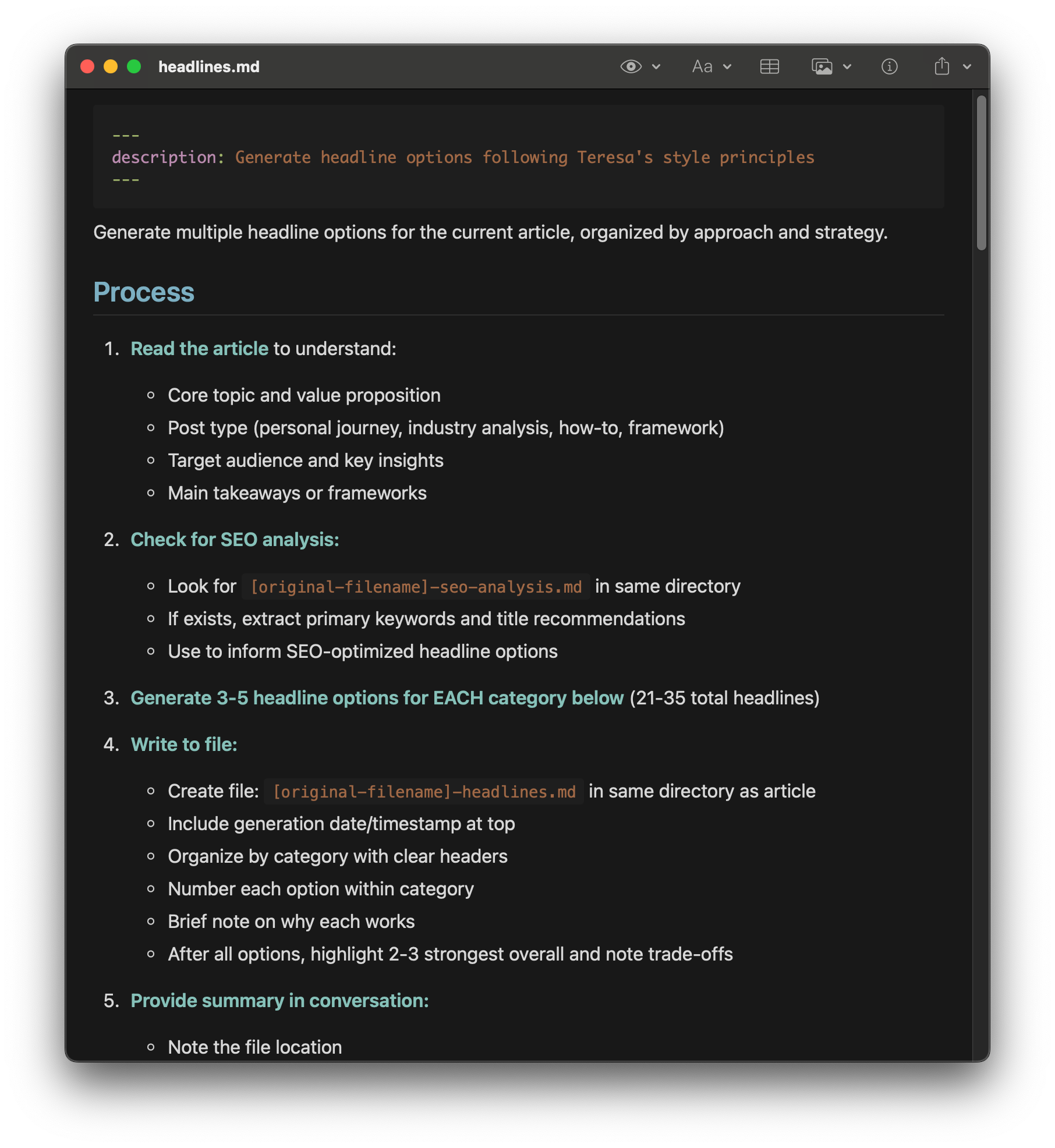
    Claude isn’t just a sounding board. I also use it to help me brainstorm headlines, explore outline alternatives, critique each section as I write, conduct supporting research, act as my thesaurus and dictionary, make SEO recommendations, and so much more. As a result, I am writing way more.

    I didn’t design this workflow in one sitting. I built it iteratively, the same way I build products: by asking, "How can Claude help with this?" and evolving from there.

    If you haven’t been following along, I’m deep in a series about Claude Code and how it helps me work better. Here’s what we’ve covered so far: Claude Code: What It Is, How It’s Different, and Why Non-Technical People Should Use It, Stop Repeating Yourself: Give Claude Code a Memory, How to Use Claude Code Safely: A Non-Technical Guide to Managing Risk, and How to Choose Which Tasks to Automate with AI (+50 Real Examples).

    This week, I’m diving into how to design personal AI workflows. I’ll use my writing workflow to illustrate each step, and I encourage you to follow along with your own process so you end with something tangible.

    macOS dark-mode editor screenshot where Claude outlines an article on building AI workflows, showing a section breakdown, three paywall placement options, trade-offs, and a guidance prompt.
    Claude breaks down an AI workflow article and suggests three paywall points, weighing trade-offs to guide conversion strategy. A clear, structured example of planning content and automation steps with Claude Code.

    Designing AI workflows looks a lot like designing product solutions. I lean on "discovery" habits—clarifying outcomes, mapping the journey, and testing assumptions—to make the work both reliable and repeatable.

    This series is inspired by my personal usage of Claude Code. I have not received any compensation from Anthropic for writing this series. And you can trust that if that ever changes, I will disclose it. This is not only required by the FTC here in the US, but I strongly believe it is the right thing to do. You can count on me to do so.

    First, I map out what I do to complete the task. Once you’ve identified the AI workflow you want to create, start by mapping exactly what you do when you do it yourself. If this feels hard, do the task a few more times and jot down each step as you go.

    Here’s what I do when I write a blog post: I choose a topic; I write down everything I can think of related to that topic; I structure it into an outline; I do some research to fill in gaps; I write each section; I edit each section; I think about SEO tactics; I brainstorm headlines; I decide what images to add; and I send it to my editor.

    If this looks a lot like story mapping, that’s because it is. Instead of mapping what a customer has to do to get value from a solution, I’m mapping what I do to complete a task. The benefit is the same: I can see what must happen and ask, "Where can AI help?"

    From here, I focus on four moves: choose one step to automate or augment with AI; decide on the right automation (or augmentation) strategy—code vs. LLMs; prototype the first workflow with detailed instructions; and test and iterate until it meets my bar for quality and speed.

    My goal is to give you enough guidance that you can follow along and end with a draft of your first AI workflow. If you apply continuous discovery to your own process, you’ll not only accelerate output—you’ll improve the clarity and quality of your thinking along the way.


    Inspired by this post on Product Talk.


    Book a consult png image
  • 6 AI Strategies to Accelerate Business Growth: Unlock Revenue, Cut Costs, Scale Faster

    6 AI Strategies to Accelerate Business Growth: Unlock Revenue, Cut Costs, Scale Faster

    I’ve spent the last few years weaving AI into core product workflows, and the pattern is clear: when we pair disciplined product thinking with pragmatic AI Strategy, growth compounds. The question I hear most isn’t if AI can help, but where to begin and how to de-risk the journey while moving fast.

    AI for business growth starts with one of these six strategies. See how companies use AI to unlock revenue, cut costs, and scale smarter and faster.

    1) Revenue acceleration with unified customer intelligence. I start by connecting behavioral analytics and CRM integration to a unified analytics platform, then layer a retrieval-first pipeline so large language models can surface high-intent accounts, churn signals, and next-best actions. With Amplitude analytics and A/B testing, we validate AI-driven playbooks for upsell, cross-sell, and win-back—turning insights into measurable lift rather than novelty.

    2) Cost reduction through targeted automation. Not all automation yields the same outcome. I look for repetitive, high-volume processes where quality is easy to verify—customer support ai strategy with AI-assisted deflection, accounts payable automation, and security workflows like threat detection and response. Combining agentic AI with clear guardrails reduces handle time, frees teams for higher-value work, and keeps error rates within acceptable thresholds.

    3) Faster time-to-market via eval-driven development. Speed without signal is noise. I lean on eval-driven development to instrument models, measure drift, and tighten CI/CD loops. We track DORA metrics like deployment frequency while using gen ai for product prototyping to compress discovery and delivery. Frameworks and tools such as Claude Code help engineers iterate safely behind feature flags so we can ship learning, not just code.

    4) Personalization that drives activation and retention. Growth sticks when onboarding is contextual. I use in-app guides, product tours, and thoughtful tooltip design powered by LLMs for product managers to tailor the first-run experience. With retention analysis and outcomes vs output OKRs, we align personalization with the moments that matter—activation, habit formation, and expansion.

    5) Trust-by-design to scale responsibly. AI risk management, privacy-by-design, and data governance are not afterthoughts; they are growth enablers. By defining policy, red-teaming prompts, and practicing context window management, we reduce rework, limit incident management, and maintain compliance across markets. Clear review gates make it easier to say yes to more AI use cases without compromising customer trust.

    6) Voice and agent experiences that feel like product, not add-ons. When prompt engineering for voice and voice AI agent patterns are integrated into the core journey—guided onboarding, smart handoffs, proactive notifications—engagement rises. Agent Analytics turns conversations into product signals we can act on in roadmapping and sprint planning, closing the loop between user intent and product improvement.

    My playbook for getting started is simple: pick one revenue and one efficiency use case, define success upfront, and ship a narrowly scoped MVP with robust analytics. Use continuous discovery with product trios to refine prompts, data sources, and experience design. Then scale what works, retire what doesn’t, and let evidence—not hype—set the roadmap.

    If you’re evaluating where to apply gen ai next, these six lanes offer fast paths to impact without sacrificing governance or customer trust. The companies I’ve seen win treat AI as a capability within the product, not a separate project—and they measure it with the same rigor they use for any critical feature.


    Inspired by this post on Product School.


    Book a consult png image